

Next Article in Journal
Modified In-Office Superior Laryngeal Nerve Steroid Injection Technique for the Treatment of Chronic Cough
Previous Article in Journal
Protocol for the NEURO-BREAC-02 Trial: Evaluation of a Self-Assessment Tool for Mild Chemotherapy-Induced Peripheral Neuropathy in Breast Cancer Survivors
 
 
jcm-logo
Article Menu

Article Menu

Article

Real-World Outcomes and Prognostic Factors in Patients with Radioiodine-Refractory Differentiated Thyroid Cancer Treated with Sorafenib: A Multicenter Study

by
Suheda Atas Ipek
1,*,
Sendag Yaslikaya
2,
Ismail Oguz Kara
1,
Tolga Koseci
1,
Ertugrul Bayram
1,
Esra Asarkaya
1,
Hatice Asoglu
1,
Mehmet Turker
3,
Abdurrahman Aykut
1,
Seda Jeral Evinc
4,
Ozkan Alan
4,
Mehmet Emin Yilmaz
5,
Ozturk Ates
5,
Hatime Arzu Yasar
6,
Mehmet Kayaalp
6,
Esra Asik
7,
Atila Yildirim
8,
Burcu Bacak
9,
Meltem Baykara
9,
Dicle Yurdatap Koc
10,
Muhammed Bekir Hacioglu
10,
Suleyman Alkan
11,
Ferhat Ekinci
12,
Ahmet Burak Agaoglu
12,
Mesut Yilmaz
13,
Ilhan Hacibekiroglu
13,
Mustafa Karaca
11,
Taliha Guclu Kantar
14,
Gamze Gokoz Dogu
15,
Tuba Karacelik
16,
Melek Karakurt Eryilmaz
16,
Teoman Sakalar
17,
Sedat Biter
1,
Mehmet Mutlu Kıdı
1,
Yasemin Aydınalp Camadan
1 and
Mahmut Buyuksimsek
18
add Show full author list remove Hide full author list
1
Department of Medical Oncology, Faculty of Medicine, Cukurova University, Adana 01330, Turkey
2
Department of Medical Oncology, Giresun Training and Research Hospital, Giresun 28200, Turkey
3
Department of Medical Oncology, Adana Training and Research Hospital, Adana 01370, Turkey
4
Department of Medical Oncology, Cerrahpasa Faculty of Medicine, Istanbul 34098, Turkey
5
Department of Medical Oncology, Dr. Abdurrahman Yurtaslan Oncology Training and Research Hospital, Ankara 06200, Turkey
6
Department of Medical Oncology, Faculty of Medicine, Ankara University, Ankara 06590, Turkey
7
Department of Medical Oncology, Kanuni Training and Research Hospital, Trabzon 61040, Turkey
8
Department of Medical Oncology, Faculty of Medicine, Karadeniz Technical University, Trabzon 61080, Turkey
9
Department of Medical Oncology, Afyon Health Sciences University, Afyonkarahisar 03200, Turkey
10
Department of Medical Oncology, Faculty of Medicine, Trakya University, Edirne 22030, Turkey
11
Department of Medical Oncology, Faculty of Medicine, Akdeniz University, Antalya 07070, Turkey
12
Department of Medical Oncology, Manisa Celal Bayar University, Manisa 45030, Turkey
13
Department of Medical Oncology, Faculty of Medicine, Sakarya University, Sakarya 54050, Turkey
14
Department of Medical Oncology, Denizli State Hospital, Denizli 20040, Turkey
15
Department of Medical Oncology, Pamukkale University, Denizli 20070, Turkey
16
Department of Medical Oncology, Necmettin Erbakan University, Konya 42090, Turkey
17
Department of Medical Oncology, Kahramanmaras Sutcu Imam University, Kahramanmaras 46050, Turkey
18
Department of Medical Oncology, Adana City Hospital, Adana 01370, Turkey
*
Author to whom correspondence should be addressed.
J. Clin. Med. 2026, 15(13), 4880; https://doi.org/10.3390/jcm15134880
Submission received: 28 May 2026 / Revised: 20 June 2026 / Accepted: 22 June 2026 / Published: 23 June 2026
(This article belongs to the Section Oncology)

Abstract

Background: Sorafenib remains an important treatment option for patients with radioiodine-refractory differentiated thyroid cancer (RAI-R DTC). This study evaluated real-world outcomes and prognostic factors in patients treated with sorafenib. Materials and Methods: This retrospective multicenter study included 176 patients with RAI-R DTC treated with sorafenib between 2000 and 2024 across sixteen centers. Clinical, pathological and treatment-related variables, including metastatic sites, radiotherapy, dose reduction, inflammatory markers (neutrophil-to-lymphocyte ratio [NLR] and platelet-to-lymphocyte ratio [PLR]) and pretreatment thyroglobulin (Tg), were analyzed. Progression-free survival (PFS) was evaluated using Kaplan–Meier analysis. Prognostic factors were assessed using univariate and multivariate Cox regression analyses. Results: The median follow-up duration was 24 months and the median PFS was 21 months (95% CI: 15.5–26.5). Partial response was observed in 82 patients (46.6%), stable disease in 55 (31.3%) and progressive disease in 35 (19.9%). Patients who underwent dose reduction had longer PFS than those without dose reduction (42 vs. 19 months, p = 0.030), and absence of dose reduction remained independently associated with progression risk. Patients who received radiotherapy had shorter PFS than those who did not receive radiotherapy (16 vs. 37 months, p = 0.002), and radiotherapy-related variables remained independent predictors of progression. Patients with PLR values >138.2 had shorter PFS than those with PLR values ≤ 138.2 (19 vs. 34 months, p = 0.047), although this association was not maintained in Cox regression analysis. Similarly, associations between NLR and Tg values and PFS did not reach statistical significance (p = 0.112 and p = 0.072, respectively). Hand–foot syndrome was the most common toxicity, occurring in 59 patients (33.5%), while Grade 3 hand–foot syndrome was observed in 7 patients (4.0%). Conclusions: Sorafenib provided meaningful disease control with a median PFS of 21 months in this real-world cohort. Dose reduction was associated with longer PFS, whereas radiotherapy requirement appeared to reflect a higher-risk subgroup. Toxicities were generally manageable.

1. Introduction

Differentiated thyroid carcinoma (DTC), one of the most common endocrine malignancies, accounts for approximately 1–2% of all cancers and represents more than 90% of thyroid malignancies, including papillary, follicular, Hurthle cell and poorly differentiated subtypes [1]. Although most patients with DTC have an excellent prognosis, a subset develops advanced disease with limited treatment options. In this context, radioiodine (RAI) refractoriness—defined as the absence of RAI-avid metastatic lesions or structural disease progression within 6–12 months after the last RAI treatment—represents a critical clinical challenge [2].
Despite these developments, multikinase inhibitors remain the standard first-line treatment for patients with RAI-R DTC [3]. Sorafenib, a multikinase inhibitor targeting tumor proliferation and angiogenesis, has been shown to significantly improve progression-free survival (PFS) compared to placebo [3]. In the DECISION trial, sorafenib achieved a median PFS of 10.8 months compared to 5.8 months in the placebo group [3].
In addition to therapeutic advances, there is increasing interest in identifying prognostic biomarkers that may guide treatment decisions in this heterogeneous patient population [4,5]. Systemic inflammation has been recognized as a key component of cancer progression and several inflammation-based indices have been proposed as prognostic markers [4,5,6]. Among these, the neutrophil-to-lymphocyte ratio (NLR) and platelet-to-lymphocyte ratio (PLR) are among the most widely studied inflammation-based biomarkers in various malignancies [4,5,6]. However, the prognostic value of these markers in patients with RAI-R DTC remains to be clearly defined. In addition to NLR and PLR, other inflammation-related biomarkers such as white blood cell count (WBC), erythrocyte sedimentation rate (ESR) and fibrinogen have also been investigated in thyroid diseases and malignancies [7]. Previous studies have demonstrated significant differences in several inflammatory parameters between benign and malignant thyroid lesions, suggesting a potential relationship between systemic inflammatory response and disease behavior [7]. However, inflammation-based biomarkers are not specific to thyroid cancer and may be influenced by concurrent inflammatory or autoimmune conditions, which should be considered when interpreting their clinical significance [8]. Therefore, the integration of inflammatory markers with clinical and pathological characteristics may provide a more comprehensive assessment of prognosis in patients with thyroid cancer [7,8].
Taken together, these findings highlight the need for better identification of prognostic factors in patients with RAI-R DTC, and this study aimed to evaluate the factors affecting progression-free survival in patients treated with sorafenib, with a particular focus on clinical characteristics and systemic inflammatory markers.

2. Materials and Methods

This study was conducted in accordance with the Declaration of Helsinki and was approved by the institutional ethics committee (approval number: 146, date: 26 July 2024).
This retrospective, multicenter study included patients from sixteen centers who were aged ≥ 18 years and diagnosed with progressive, locally advanced, or metastatic RAI-R DTC between 2000 and 2024 and who subsequently received sorafenib treatment. A total of 176 patients with RAI-R DTC who received sorafenib at any stage of their disease course were included. To reflect real-world clinical practice, all eligible patients who received sorafenib were included regardless of treatment line. Eligible patients were required to have measurable or evaluable disease according to RECIST version 1.1, available baseline clinical data and sufficient follow-up information, with disease progression assessed using radiological imaging (CT, MRI and/or PET/CT) [9]. Patients with missing key clinical data, absence of evaluable radiological response, follow-up durations shorter than three months or those receiving concurrent systemic anticancer therapies were excluded from the analysis. RAI-refractory disease was defined as the absence of radioiodine uptake in metastatic lesions, disease progression despite radioiodine uptake or progression within 6–12 months following the last radioactive iodine (RAI) treatment.
Demographic and clinical data were obtained from patient records and institutional databases. Collected variables included age, sex, date of diagnosis, histopathological subtype, tumor localization, metastatic sites, treatment history, radiotherapy (RT) requirement and molecular profiling data when available. Risk stratification was performed according to the American Thyroid Association (ATA) risk stratification system, and patients were classified into low-, intermediate- and high-risk groups [10]. Metastatic sites, including lung, liver, bone and lymph nodes, were recorded at baseline. The number of RAI treatments and cumulative RAI dose were recorded for each patient.
Sorafenib was initiated at a standard dose of 400 mg twice daily. Dose reduction was defined as any decrease in the standard sorafenib dose during treatment due to toxicity or clinical decision. Treatment-related adverse events were evaluated according to the Common Terminology Criteria for Adverse Events (CTCAE), version 5.0 [11].
Tumor response was assessed using RECIST version 1.1 criteria [9]. Progression-free survival (PFS) was defined as the time from initiation of sorafenib treatment to disease progression or death from any cause. Patients without progression were censored at the date of last follow-up. Follow-up duration was calculated from the initiation of sorafenib treatment to the last clinical visit or death.
Neutrophil (103/mL), lymphocyte (103/mL), monocyte (103/mL) and platelet (103/mL) counts were recorded prior to treatment initiation. The neutrophil-to-lymphocyte ratio (NLR) and platelet-to-lymphocyte ratio (PLR) were calculated by dividing neutrophil and platelet counts by lymphocyte count, respectively. The association between inflammatory markers (NLR and PLR) and progression-free survival (PFS) was evaluated. Pretreatment thyroglobulin (Tg) levels were also recorded and evaluated as potential prognostic markers. Cut-off values for Tg, NLR, PLR and PNI were determined using receiver operating characteristic (ROC) curve analysis.
Subgroup analyses were performed based on histopathological subtype, metastatic sites, dose reduction status and inflammatory markers.
Statistical analysis was performed using SPSS 15.0 for Windows (SPSS Inc., Chicago, IL, USA). Descriptive statistics were expressed as numbers and percentages for categorical variables and as means, standard deviations, minimums, maximums and medians for continuous variables. Categorical variables were compared using the Chi-square test. Comparisons of continuous variables between two independent groups were performed using the Mann–Whitney U test because the assumption of a normal distribution was not met. Survival rates were calculated using Kaplan–Meier analysis. Receiver operating characteristic (ROC) curve analysis was performed to determine optimal cutoff values for prognostic markers. Univariate and multivariate Cox regression analyses were performed to identify factors associated with disease progression. Variables with a p-value < 0.25 in univariate analysis were included in the multivariate model and backward stepwise selection method was applied. A p-value < 0.05 was considered statistically significant.

3. Results

A total of 176 patients with RAI-R DTC who received sorafenib were included in the study. The median age was 63 years (range: 52–70), and 52.8% of the patients were female. Papillary carcinoma was the most common histological subtype (71%), followed by follicular carcinoma (22.7%). According to the ATA risk stratification, 96 patients (54.5%) were classified as high risk, while 44 (25.0%) and 36 (20.5%) were categorized as intermediate and low risk, respectively (Table 1).
Sorafenib was administered as first-line therapy in 154 patients (87.5%). The remaining 22 patients (12.5%) had received systemic therapy before sorafenib. Four patients received targeted therapy prior to sorafenib, including Lenvatinib in 1 patient and Vandetanib in 3 patients. Metastasectomy was performed in 44 patients (25%) and 92 patients (52.3%) received RT (Table 2).
Partial response was observed in 82 patients (46.6%), while 55 (31.3%) had stable disease and 35 (19.9%) showed progressive disease. Complete response was observed in 4 patients (2.3%). Dose reduction during treatment was performed in 39 patients (22.2%) (Table 3).
Treatment-related adverse events were observed across multiple categories. Hand–foot syndrome was the most frequently observed toxicity. Grade 3 toxicities were infrequent across all adverse event groups. Treatment discontinuation occurred most commonly due to disease progression, while other causes were rare (Table 4).
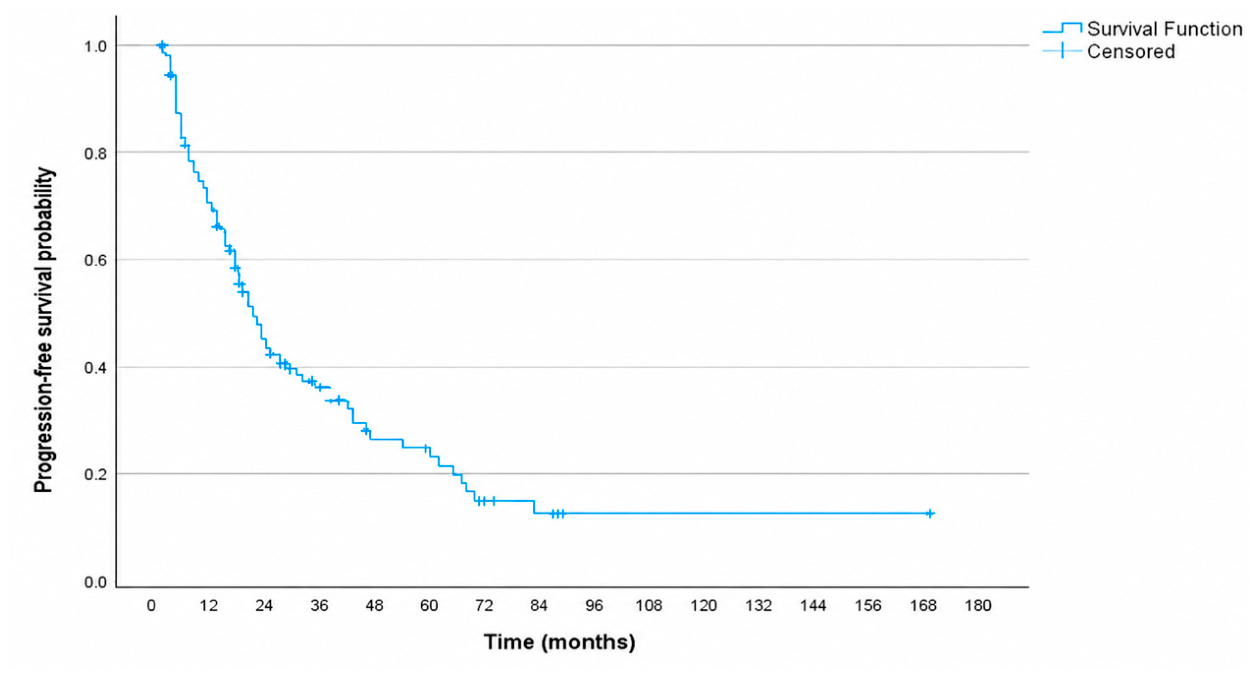
The median follow-up duration was 24 months (IQR: 10–45). The median progression-free survival (PFS) was 21 months (95% CI: 15.5–26.5). The estimated PFS rates were 79.4% at 6 months, 67.0% at 1 year, 45.2% at 2 years, 35.8% at 3 years, 22.0% at 5 years and 11.0% at 7 years (Figure 1).
ROC curve analysis identified cut-off values of ≤691 for Tg, >1.5 for NLR, >138.2 for PLR and ≤51.4 for PNI. The corresponding AUC values were 0.523, 0.516, 0.547 and 0.501, respectively. Sensitivity and specificity were 92.4% and 26.2% for Tg, 89.5% and 23.5% for NLR, 68.6% and 47.1% for PLR and 63.1% and 46.7% for PNI. Patients with Tg values ≤ 691 ng/mL had longer PFS compared to those with Tg values > 691 ng/mL (42 months vs. 21 months, p = 0.072). In addition, patients with PLR values > 138.2 had shorter PFS compared to those with PLR values ≤ 138.2 (19 months vs. 34 months, p = 0.047), while patients with NLR values > 1.5 showed shorter PFS but this difference was not statistically significant (20 months vs. 37 months, p = 0.112).
Molecular profiling data were available for a subset of patients. BRAF status was available in 76 patients, which included 42 positive and 34 negative cases. Median PFS was 41 months in patients with positive BRAF status and 22 months in those with negative BRAF status (log-rank p = 0.307). NTRK status was available in 57 patients, which included 35 positive and 22 negative cases. Median PFS was 37 months in patients with positive NTRK status and 18 months in those with negative NTRK status (log-rank p = 0.505).
Median PFS was 23 months in patients with follicular carcinoma, 22 months in patients with papillary carcinoma and 12 months in patients with undefined histology. Although patients with undefined histology showed numerically shorter PFS, the difference did not reach statistical significance (p = 0.692).
No statistically significant association between metastatic sites and PFS was observed (lymph node, p = 0.282; lung, p = 0.969; liver, p = 0.065; bone, p = 0.381; other metastatic sites, p = 0.189).
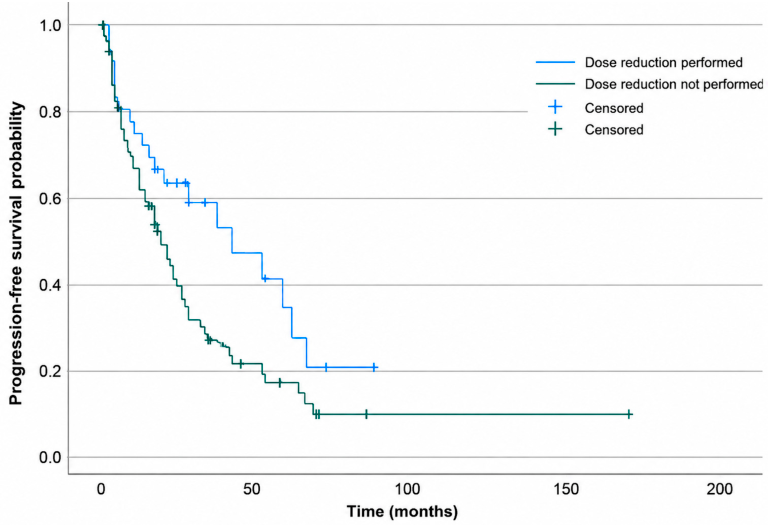
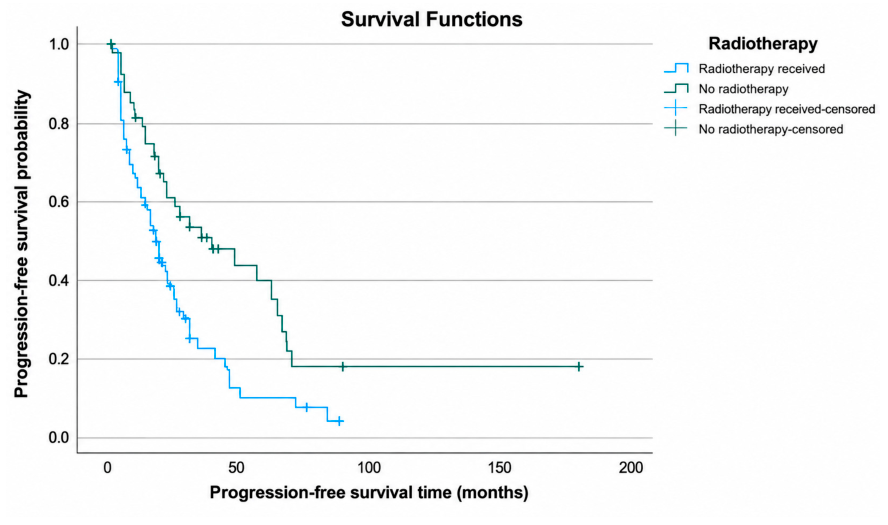
In Kaplan–Meier analysis, patients who underwent sorafenib dose reduction had longer PFS than those without dose reduction (42 months vs. 19 months, p = 0.030) (Figure 2). Similarly, patients who did not receive RT had longer PFS compared to those who received RT (37 months vs. 16 months, p = 0.002) (Figure 3).
In univariate Cox regression analysis, RT (HR: 1.957, p = 0.003), lymph node RT (HR: 2.334, p = 0.002), liver RT (HR: 20.537, p < 0.001), RT to other metastatic sites (HR: 2.690, p = 0.002) and absence of sorafenib dose reduction (HR: 1.730, p = 0.034) were associated with increased risk of progression. In multivariate Cox regression analysis using the backward stepwise method, lymph node RT (HR: 3.080, p = 0.012), liver RT (HR: 100.77, p < 0.001), RT to other metastatic sites (HR: 4.300, p = 0.008) and absence of sorafenib dose reduction (HR: 2.563, p = 0.022) remained independent predictors of progression (Table 5).

4. Discussion

In this multicenter real-world study evaluating patients with RAI-R DTC treated with sorafenib, we demonstrated that sorafenib provided meaningful clinical benefit with a median PFS of 21 months and a high disease control rate. Another notable finding of our study was the significantly longer PFS observed in patients who required dose reduction during treatment, which also remained independently associated with progression risk in multivariate analysis. In addition, patients requiring RT demonstrated less favorable survival outcomes, suggesting that RT requirement may reflect a more advanced disease burden. Furthermore, sorafenib demonstrated a manageable safety profile, with hand–foot syndrome being the most common adverse event and treatment discontinuation occurring predominantly due to disease progression rather than toxicity. On the other hand, the relatively high use of RAI among ATA low-risk patients may reflect the multicenter design of the study, the long study period and variations in RAI administration practices across participating centers.
Lenvatinib is currently considered a preferred first-line treatment option for many patients with RAI-R DTC because of its high response rates and the prolonged progression-free survival demonstrated in clinical trials [12]. Nevertheless, sorafenib remains a relevant therapeutic option in selected patients, particularly when lenvatinib is not available, contraindicated or not well tolerated [13]. Therefore, real-world data regarding sorafenib continue to provide clinically meaningful information for contemporary practice. Our study demonstrated a median PFS of 21 months in patients with RAI-R DTC treated with sorafenib, which appears numerically longer than the 10.8-month median PFS reported in the phase III DECISION trial that led to the approval of sorafenib in this patient population [3]. Similarly, real-world studies such as the RIFTOS MKI study reported a median PFS of 16.7 months in patients receiving sorafenib treatment [14]. In our cohort, the estimated PFS rates remained relatively favorable over time, with 67.0% at 1 year and 45.2% at 2 years, suggesting sustained disease control in a substantial proportion of patients. Although direct cross-study comparisons should be interpreted cautiously due to differences in study design and patient characteristics, our findings support the clinical activity of sorafenib under real-world conditions. The relatively prolonged PFS observed in our cohort may be associated with factors such as multidisciplinary management strategies, close treatment monitoring and the predominantly first-line use of sorafenib in a largely systemic treatment-naive population.
NLR and PLR are widely recognized as biomarkers reflecting the degree of systemic inflammatory response in cancer patients [15,16,17,18]. Increasing evidence has demonstrated that systemic inflammation plays a critical role in tumor progression, angiogenesis and metastatic spread [15,18]. Neutrophils and platelets may contribute to tumor growth through the secretion of proangiogenic and protumoral mediators such as VEGF and TGF-β, whereas lymphocytes represent a key component of the antitumor immune response [19,20,21]. Therefore, elevated NLR and PLR values may reflect a tumor-promoting inflammatory microenvironment accompanied by impaired antitumor immunity. Previous studies in several malignancies, including gastric, ovarian, colorectal and lung cancers, have shown that elevated NLR and PLR are associated with poorer oncological outcomes [15,16,17,18]. In ovarian cancer, pooled analyses demonstrated hazard ratios of 1.63 for overall survival and 1.69 for progression-free survival in patients with elevated NLR. In the present study, elevated PLR values were associated with shorter PFS in patients with RAI-R DTC treated with sorafenib in Kaplan–Meier analysis, although this association did not remain statistically significant in Cox regression analysis. Similarly, elevated NLR values showed a trend toward shorter PFS without reaching statistical significance. These findings suggest that inflammation-based markers may reflect disease biology and tumor-related inflammatory burden, although their independent prognostic value appears limited in this cohort.
Pretreatment Tg levels may also reflect tumor burden and aggressive disease biology in patients with advanced DTC [22]. Previous studies have suggested that elevated Tg levels are associated with advanced-stage disease and poorer oncological outcomes, although their independent prognostic value may become limited in RAI-refractory disease because of tumor dedifferentiation [22,23]. Similarly, in our cohort, patients with higher Tg values demonstrated shorter PFS, although statistical significance was not reached.
Patients who undergo dose reduction tend to remain on treatment for longer periods and consequently have a higher likelihood of developing cumulative toxicities requiring dose modification over time [24]. Real-world studies have similarly demonstrated that dose modification is common during tyrosine kinase inhibitor treatment [23]. In the RIFTOS MKI study, approximately 70% of patients receiving sorafenib required dose modification and maintained a median PFS of 16.7 months [14]. Consistent with these observations, patients who underwent dose reduction in our cohort demonstrated significantly longer PFS compared to those without dose modification in Kaplan–Meier analysis (42 months vs. 19 months, p = 0.030). Moreover, absence of dose reduction remained independently associated with progression risk in multivariate Cox regression analysis.
Sorafenib is generally considered to have a manageable safety profile in the treatment of RAI-R DTC [25]. Previous clinical studies have identified hand–foot syndrome (palmar–plantar erythrodysesthesia) as the most common adverse event, which occurred in approximately 76% of patients [24]. However, the rates of severe Grade 3–4 hand–foot syndrome (20%) and other Grade 3 toxicities such as diarrhea (6%) and fatigue (6%) have been reported to be relatively low, supporting the tolerability of the treatment [25]. Real-world studies and phase III trials have further demonstrated that approximately 64–70% of patients require dose modification because of adverse events; nevertheless, disease progression rather than toxicity remains the leading cause of permanent treatment discontinuation [14,25,26]. Consistent with the literature, hand–foot syndrome was also the most frequently observed toxicity in our cohort, while Grade 3 toxicities were relatively uncommon across adverse event groups. In addition, treatment discontinuation occurred predominantly because of disease progression. Overall, our findings support the view that sorafenib has a predictable and manageable toxicity profile that may allow for prolonged treatment continuation with appropriate supportive care and dose management strategies.
The prognostic impact of histopathological subtypes and metastatic sites in patients with RAI-refractory DTC treated with sorafenib remains controversial. In our cohort, no statistically significant differences in PFS were observed between histopathological subtypes (p = 0.692). Similarly, metastatic sites were not significantly associated with PFS, although patients with liver metastasis demonstrated numerically shorter PFS compared to those without liver involvement (16 months vs. 23 months, p = 0.065). Previous studies evaluating sorafenib in patients with RAI-refractory DTC have likewise reported no clinically significant differences in progression-free survival between histopathological subtypes such as papillary, follicular, Hurthle cell or poorly differentiated tumors [27]. These findings suggest that sorafenib may retain therapeutic activity across different histological subtypes of RAI-refractory disease [27].
Regarding metastatic sites, the presence of distant metastases, particularly those detected by [18F] FDG PET/CT, has been reported as an adverse prognostic factor for PFS [22]. Although some studies have suggested a borderline negative impact of liver metastasis on survival outcomes, these findings do not appear to outweigh the overall systemic activity of sorafenib [14]. In addition, RT, particularly external beam radiotherapy (EBRT), is generally used in patients with symptomatic lesions, unresectable disease or high-risk metastatic involvement requiring local control [28]. Similarly, in our cohort, patients requiring radiotherapy demonstrated significantly shorter PFS and radiotherapy-related variables remained independently associated with progression risk in multivariate analysis. These findings likely reflect a subgroup with greater disease burden and more aggressive tumor biology rather than a direct adverse effect of radiotherapy itself. Furthermore, the very high hazard ratio observed for liver irradiation should be interpreted cautiously, as the limited number of patients in this subgroup may have influenced the stability of the model. Overall, our findings support the concept that sorafenib may provide disease control across different metastatic subgroups of RAI-refractory DTC.

5. Limitations

This study has several limitations. First, its retrospective multicenter design may have introduced selection bias and interinstitutional heterogeneity in patient management and follow-up strategies. Due to the multicenter design, the complete patient flow from radioiodine treatment to radioiodine-refractory disease and subsequent sorafenib treatment was not available and the interval between surgery and first RAI administration could not be consistently evaluated across participating centers. Another limitation of this study is the lack of comprehensive overall survival data across participating centers, which precluded a reliable analysis of overall survival outcomes.
A further limitation is that the association between dose reduction and prolonged PFS should be interpreted with caution, as dose modifications are more likely to occur in patients who remain progression-free and continue treatment for longer periods. In addition, radiotherapy indications and supportive treatment approaches were not fully standardized across centers because treatment decisions were based on real-world multidisciplinary clinical practice. The wide confidence intervals observed for some variables in the multivariate analysis, particularly liver irradiation, also suggest that these findings should be interpreted with caution. Finally, radiological response assessments were performed within routine clinical practice, which may have introduced variability in response evaluation.

6. Conclusions

In conclusion, sorafenib demonstrated meaningful clinical activity and a manageable safety profile in patients with RAI-refractory differentiated thyroid cancer in this multicenter real-world cohort. Patients who underwent dose reduction showed longer progression-free survival, suggesting that appropriately managed treatment modification may support prolonged treatment benefit. In addition, radiotherapy requirement was associated with poorer survival outcomes and remained independently associated with progression risk, likely reflecting greater disease burden and more aggressive tumor biology. Overall, our findings support the continued role of sorafenib as an effective treatment option in patients with RAI-refractory DTC.

Author Contributions

Conceptualization, S.A.I., S.Y. and I.O.K.; methodology, S.A.I., S.Y., I.O.K. and Y.A.C.; formal analysis, M.M.K.; investigation, T.K. (Tolga Koseci)., E.B., E.A. (Esra Asik), H.A., M.T., A.A., S.J.E., O.A. (Ozkan Alan), M.E.Y., O.A. (Ozturk Ates), H.A.Y., M.K. (Mehmet Kayaalp), E.A. (Esra Asarkaya), A.Y., B.B., M.B. (Meltem Baykara), D.Y.K., M.B.H., S.A., F.E., A.B.A., M.Y., I.H., M.K. (Mustafa Karaca), T.G.K., G.G.D., T.K. (Tuba Karacelik), M.K.E., T.S., S.B. and M.B. (Mahmut Buyuksimsek); data curation, S.A.I., S.Y., T.K. (Tuba Karacelik), E.B., E.A. (Esra Asarkaya), H.A., M.T., A.A., S.B., M.M.K. and Y.A.C.; writing—original draft preparation, S.A.I. and S.Y.; writing—review and editing, all authors; supervision, I.O.K. and O.A. (Ozturk Ates). All authors have read and agreed to the published version of the manuscript.

Funding

This research received no external funding.

Institutional Review Board Statement

The study was conducted in accordance with the Declaration of Helsinki and approved by the Ethics Committee of Cukurova University Faculty of Medicine (approval number: 146, date: 26 July 2024).

Informed Consent Statement

Informed consent was obtained from all subjects involved in the study.

Data Availability Statement

The data presented in this study are available on reasonable request from the corresponding author.

Conflicts of Interest

The authors declare no conflicts of interest.

References

  1. Schlumberger, M.; Leboulleux, S. Current practice in patients with differentiated thyroid cancer. Nat. Rev. Endocrinol. 2021, 17, 176–188. [Google Scholar] [CrossRef] [PubMed]
  2. Durante, C.; Haddy, N.; Baudin, E.; Leboulleux, S.; Hartl, D.; Travagli, J.; CaillAou, B.; Ricard, M.; Lumbroso, J.D.; De Vathaire, F.; et al. Long-term outcome of 444 patients with distant metastases from papillary and follicular thyroid carcinoma: Benefits and limits of radioiodine therapy. J. Clin. Endocrinol. Metab. 2006, 91, 2892–2899. [Google Scholar] [CrossRef] [PubMed]
  3. Brose, M.S.; Nutting, C.M.; Jarzab, B.; Elisei, R.; Siena, S.; Bastholt, L.; Fouchardiere, C.d.l.; Pacini, F.; Paschke, R.; KeeShong, Y.; et al. Sorafenib in locally advanced or metastatic, radioactive iodine-refractory, differentiated thyroid cancer: A randomized, double-blind, phase 3 trial. Lancet 2014, 384, 319–328. [Google Scholar] [CrossRef] [PubMed]
  4. Li, Z.; An, W.; Wang, B.; Yan, Z.; Gao, L.; Wang, J.; Yu, H.; Wen, S. Prognostic significance of peripheral blood inflammatory biomarkers (SII, PLR, NLR, LMR, SIRI, PIV, PNI) in lip cancer: NLR as an independent biomarker for survival outcomes. Front. Oncol. 2025, 15, 1676824. [Google Scholar] [CrossRef] [PubMed]
  5. Topkan, E.; Selek, U.; Kucuk, A.; Pehlivan, B. Low pre-ChemoradiotherapyPan-immune-inflammation value (PIV) measures predict better survival outcomes in locally advanced pancreatic adenocarcinomas. J. Inflamm. Res. 2022, 15, 5413–5423. [Google Scholar] [CrossRef] [PubMed]
  6. Bizzarri, F.P.; Campetella, M.; Russo, P.; Palermo, G.; Moosavi, S.K.; Rossi, F.; D’Amico, L.; Creti, A.; Gavi, F.; Panio, E.; et al. Prognostic Value of PLR, SIRI, PIV, SII, and NLR in Non-Muscle Invasive Bladder Cancer: Can Inflammatory Factors Influence Pathogenesis and Outcomes? Cancers 2025, 17, 2189. [Google Scholar] [CrossRef] [PubMed]
  7. Matei, M.; Vlad, M.M.; Golu, I.; Dumitru, C.Ș.; De Scisciolo, G.; Matei, S.C. Can routine laboratory tests be suggestive in determining suspicions of malignancy in the case of thyroid nodules? Medicina 2023, 59, 1488. [Google Scholar] [CrossRef] [PubMed]
  8. Sharma, G.; Kumar, A.; Mittal, A.; Singh, R.; Chaudhary, N. Diagnostic Utility of the Neutrophil-Lymphocyte Ratio and Absolute Lymphocyte Count in Distinguishing Thyroiditis vs Other Benign Causes of Thyroid Enlargement. Cureus 2025, 17, e81379. [Google Scholar] [CrossRef] [PubMed]
  9. Eisenhauer, E.A.; Therasse, P.; Bogaerts, J.; Schwartz, L.H.; Sargent, D.; Ford, R.; Dancey, J.; Arbuck, S.; Gwyther, S.; Mooney, M.; et al. New response evaluation criteria in solid tumours: Revised RECIST guideline (version 1.1). Eur. J. Cancer 2009, 45, 228–247. [Google Scholar] [CrossRef] [PubMed]
  10. Haugen, B.R.; Alexander, E.K.; Bible, K.C.; Doherty, G.M.; Mandel, S.J.; Nikiforov, Y.E.; Pacini, F.; Randolph, G.W.; Sawka, A.M.; Schlumberger, M.; et al. 2015 American Thyroid Association management guidelines for adult patients with thyroid nodules and differentiated thyroid cancer: The American Thyroid Association guidelines task force on thyroid nodules and differentiated thyroid cancer. Thyroid 2016, 26, 1–133. [Google Scholar] [CrossRef] [PubMed]
  11. Freites-Martínez, A.; Santana, N.; Arias-Santiago, S.; Viera, A. Using the common terminology criteria for adverse events (CTCAE–version 5.0) to evaluate the severity of adverse events of anticancer therapies. Actas Dermo-Sifiliográficas 2021, 112, 90–92. [Google Scholar] [CrossRef] [PubMed]
  12. Haddad, R.I.; Bischoff, L.; Ball, D.; Bernet, V.; Blomain, E.; Busaidy, N.L.; Campbell, M.; Dickson, P.; Duh, Q.-Y.; Ehya, H.; et al. Thyroid carcinoma, version 2.2022, NCCN clinical practice guidelines in oncology. J. Natl Compr. Cancer Netw. 2022, 20, 925–951. [Google Scholar] [CrossRef]
  13. McFarland Daniel, C.; Misiukiewicz Krzysztof, J. Sorafenib in radioactive iodine-refractory well-differentiated metastatic thyroid cancer. OncoTargets Ther. 2014, 7, 1291–1299. [Google Scholar] [CrossRef]
  14. Brose, M.S.; Smit, J.W.; Lin, C.-C.; Tori, M.; Bowles, D.W.; Worden, F.; Shen, D.H.-Y.; Huang, S.-M.; Tsai, H.-J.; Alevizaki, M.; et al. Multikinase inhibitors for the treatment of asymptomatic radioactive iodine-refractory differentiated thyroid cancer: Global noninterventional study (RIFTOS MKI). Thyroid 2022, 32, 1059–1068. [Google Scholar] [CrossRef] [PubMed]
  15. Tan, S.; Zheng, Q.; Zhang, W.; Zhou, M.; Xia, C.; Feng, W. Prognostic value of inflammatory markers NLR, PLR, and LMR in gastric cancer patients treated with immune checkpoint inhibitors: A meta-analysis and systematic review. Front. Immunol. 2024, 15, 1408700. [Google Scholar] [CrossRef] [PubMed]
  16. Zhang, C.; Jiang, X.; Li, Y.; Pan, X.; Gao, M.; Chen, Y.; Pang, B. Independent predictive value of blood inflammatory composite markers in ovarian cancer: Recent clinical evidence and perspective focusing on NLR and PLR. J. Ovarian Res. 2023, 16, 36. [Google Scholar] [CrossRef] [PubMed]
  17. Wang, J.; Li, H.; Xu, R.; Lu, T.; Zhao, J.; Zhang, P.; Guo, J.; Zhang, L. The MLR, NLR, PLR and D-dimer are associated with clinical outcome in lung cancer patients treated with surgery. BMC Pulm. Med. 2022, 22, 104. [Google Scholar] [CrossRef] [PubMed]
  18. Misiewicz, A.; Dymicka-Piekarska, V. Fashionable, but what is their real clinical usefulness? NLR, LMR, and PLR as a promising indicator in colorectal cancer prognosis: A systematic review. J. Inflamm. Res. 2023, 16, 69–81. [Google Scholar] [CrossRef] [PubMed]
  19. Ozel, I.; Duerig, I.; Domnich, M.; Lang, S.; Pylaeva, E.; Jablonska, J. The good, the bad, and the ugly: Neutrophils, angiogenesis, and cancer. Cancers 2022, 14, 536. [Google Scholar] [CrossRef] [PubMed]
  20. Liao, K.; Zhang, X.; Liu, J.; Teng, F.; He, Y.; Cheng, J.; Yang, Q.; Zhang, W.; Xie, Y.; Guo, D.; et al. The role of platelets in the regulation of tumor growth and metastasis: The mechanisms and targeted therapy. MedComm 2023, 4, e350. [Google Scholar] [CrossRef] [PubMed]
  21. Segal, B.H.; Giridharan, T.; Suzuki, S.; Khan, A.N.H.; Zsiros, E.; Emmons, T.R.; Yaffe, M.B.; Gankema, A.A.F.; Hoogeboom, M.; Goetschalckx, I.; et al. Neutrophil interactions with T cells, platelets, endothelial cells, and of course tumor cells. Immunol. Rev. 2023, 314, 13–35. [Google Scholar] [PubMed]
  22. Phuong, N.T.; Son, M.H.; Thong, M.H.; Ha, L.N. Clinico-pathological factors and [18F] FDG PET/CT metabolic parameters for prediction of progression-free survival in radioiodine refractory differentiated thyroid carcinoma. BMC Med. Imaging 2024, 24, 344. [Google Scholar] [CrossRef] [PubMed]
  23. Verburg, F.A.; Amthauer, H.; Binse, I.; Brink, I.; Buck, A.; Darr, A.; Dierks, C.; Koch, C.; König, U.; Kreissl, M.C.; et al. Questions and controversies in the clinical application of tyrosine kinase inhibitors to treat patients with radioiodine-refractory differentiated thyroid carcinoma: Expert perspectives. Horm. Metab. Res. 2021, 53, 149–160. [Google Scholar] [CrossRef] [PubMed]
  24. Tahara, M.; Brose, M.S.; Wirth, L.J.; Suzuki, T.; Miyagishi, H.; Fujino, K.; Ductus, C.E.; Gianoukakis, A. Impact of dose interruption on the efficacy of lenvatinib in a phase 3 study in patients with radioiodine-refractory differentiated thyroid cancer. Eur. J. Cancer 2019, 106, 61–68. [Google Scholar] [CrossRef] [PubMed]
  25. Kiyota, N.; Tahara, M.; Robinson, B.; Schlumberger, M.; Sherman, S.I.; Leboulleux, S.; Lee, E.K.; Suzuki, T.; Ren, M.; Fushimi, K.; et al. Impact of baseline tumor burden on overall survival in patients with radioiodine-refractory differentiated thyroid cancer treated with lenvatinib in the SELECT global phase 3 trial. Cancer 2022, 128, 2281–2287. [Google Scholar] [CrossRef] [PubMed]
  26. Worden, F.; Rajkovic-Hooley, O.; Reynolds, N.; Milligan, G.; Zhang, J. Real-world treatment patterns and clinical outcomes in patients with radioiodine-refractory differentiated thyroid cancer (RAI-R DTC) treated with first line lenvatinib monotherapy in the United States. Head Neck Tumors 2025, 15, 26–33. [Google Scholar] [CrossRef]
  27. Gianoukakis, A.G.; Choe, J.H.; Bowles, D.W.; Brose, M.S.; Wirth, L.J.; Owonikoko, T.; Babajanyan, S.; Worden, F.P. Real-world practice patterns and outcomes for RAI-refractory differentiated thyroid cancer. Eur. Thyroid J. 2024, 13, e230039. [Google Scholar] [PubMed]
  28. Díaz Vico, T.; Martínez-Amores Martínez, B.; Mihic Góngora, L.; Jiménez-Fonseca, P.; Peinado Martín, P.; Grao Torrente, I.; Muñoz-Nájar, A.G.; Durán-Poveda, M. Systemic therapeutic options in radioiodine-refractory differentiated thyroid cancer: Current indications and optimal timing. Cancers 2025, 17, 1800. [Google Scholar] [CrossRef] [PubMed]
Figure 1. Kaplan–Meier curve for progression-free survival.
Jcm 15 04880 g001
Figure 2. Relationship between dose reduction and progression-free survival.
Jcm 15 04880 g002
Figure 3. Relationship between radiotherapy status and progression-free survival.
Jcm 15 04880 g003
Table 1. Baseline and Disease Characteristics of Patients (n = 176).
VariableValue *
Demographics
Age, years (median, IQR)63 (52–70)
Female93 (52.8)
Male83 (47.2)
Histopathology
Papillary carcinoma125 (71.0)
Follicular carcinoma40 (22.7)
Undefined11 (6.3)
ATA Risk Stratification
Low risk36 (20.5)
Intermediate risk44 (25.0)
High risk96 (54.5)
Surgical Treatment
Lobectomy17 (9.7)
Total thyroidectomy88 (50.0)
Total thyroidectomy + BD61 (34.7)
Other10 (5.7)
Metastatic Sites (at baseline) **
Lymph node87 (49.4)
Lung113 (64.2)
Liver17 (9.7)
Bone72 (40.9)
Other14 (8.0)
RAI Treatment
Number of RAI courses (median, IQR)5 (4–5.3)
Cumulative RAI dose, mCi (median, IQR)600 (375–900)
Abbreviations: ATA, American Thyroid Association; RAI, radioactive iodine; BD, bilateral dissection; mCi, millicurie. * Categorical variables are presented as n (%) and continuous variables are presented as median (IQR: Interquartile Range). ** Some patients have more than one metastatic site.
Table 2. Treatment Characteristics of Patients.
VariableValue, n (%)
Line of Sorafenib Therapy
First-line154 (87.5)
Second-line19 (10.8)
Third-line2 (1.1)
Fourth-line1 (0.6)
Pre-sorafenib Systemic Therapy
None154 (87.5)
Carboplatin–taxane7 (4.0)
Anthracycline8 (4.5)
Other chemotherapy3 (1.7)
Targeted therapy before sorafenib4 (2.3)
Local Treatments
Metastasectomy performed44 (25)
Metastasectomy not performed132 (75)
Radiotherapy
Radiotherapy received92 (52.3)
Radiotherapy not received84 (47.7)
Sites of Metastasectomy
Lymph node18 (10.2)
Lung6 (3.4)
Liver3 (1.7)
Bone13 (7.4)
Other4 (2.3)
Not applicable132 (75.0)
Sites of Radiotherapy
Lymph node22 (12.5)
Lung9 (5.1)
Liver2 (1.1)
Bone59 (33.5)
Other13 (7.4)
Not applicable71 (40.3)
Table 3. Response to Sorafenib and Dose Modification.
VariableValue, n (%)
Best Response to Sorafenib
Complete response4 (2.3)
Partial response82 (46.6)
Stable disease55 (31.3)
Progressive disease35 (19.9)
Dose Reduction
Performed39 (22.2)
Not performed137 (77.8)
Table 4. Sorafenib-Related Toxicity Profile.
VariableValue, n (%)
Diarrhea
No toxicity139 (79.0)
Grade 125 (14.2)
Grade 26 (3.4)
Grade 36 (3.4)
Hepatitis
No toxicity164 (93.2)
Grade 18 (4.5)
Grade 23 (1.7)
Grade 31 (0.6)
Pneumonitis
No toxicity173 (98.3)
Grade 11 (0.6)
Grade 21 (0.6)
Grade 31 (0.6)
Stomatitis
No toxicity150 (85.2)
Grade 117 (9.7)
Grade 29 (5.1)
Skin Toxicity
No toxicity118 (67.0)
Grade 131 (17.6)
Grade 222 (12.5)
Grade 35 (2.8)
Hand–Foot Syndrome
No toxicity117 (66.5)
Grade 126 (14.8)
Grade 226 (14.8)
Grade 37 (4.0)
Renal Function Impairment
No toxicity153 (86.9)
Grade 119 (10.8)
Grade 22 (1.1)
Grade 32 (1.1)
Treatment Status and Reasons for Discontinuation
Ongoing16 (9.1)
Due to progression156 (88.6)
Congestive cardiac failure1 (0.6)
Treatment refusal1 (0.6)
Osteonecrosis of jaw1 (0.6)
Acute myeloid leukemia1 (0.6)
Table 5. Univariate and multivariate Cox regression analyses for progression risk.
VariableUnivariate pUnivariate HR95% CIMultivariate pMultivariate HR95% CIIncluded in Multivariate
Age0.1251.0130.996–1.0300.0511.0351.000–1.071Yes
Papillary histology0.6921.1010.685–1.767---No
Undefined histology0.3991.4180.630–3.193---No
Low ATA risk0.8480.9330.460–1.891---No
Intermediate ATA risk0.8350.9510.590–1.532---No
Liver metastasis0.0721.6610.956–2.886---Yes
Radiotherapy0.0031.9571.249–3.064---Yes
Lymph node radiotherapy0.0022.3341.376–3.9570.0123.0801.277–7.431Yes
Liver radiotherapy<0.00120.5374.145–101.756<0.001100.778.181–1241.1Yes
Other site radiotherapy0.0022.6901.435–5.0400.0084.3001.463–12.639Yes
No dose reduction0.0341.7301.043–2.8720.0222.5631.146–5.730Yes
Tg ≤ 691 ng/mL0.0832.0930.909–4.8190.0653.2200.928–11.165Yes
NLR > 2.70.1201.6470.879–3.086---Yes
PLR > 138.20.0511.5230.998–2.323---Yes
Abbreviations: HR, hazard ratio; CI, confidence interval; ATA, American Thyroid Association; Tg, thyroglobulin; NLR, neutrophil-to-lymphocyte ratio; PLR, platelet-to-lymphocyte ratio.
Disclaimer/Publisher’s Note: The statements, opinions and data contained in all publications are solely those of the individual author(s) and contributor(s) and not of MDPI and/or the editor(s). MDPI and/or the editor(s) disclaim responsibility for any injury to people or property resulting from any ideas, methods, instructions or products referred to in the content.