Occupational Reproductive Health Risks Among Women Healthcare Workers: A Narrative Review for Clinical Surveillance, Preconception Counseling, and Prevention

Abstract
1. Introduction
- This review integrates evidence on antineoplastic agents, high-level disinfectants, sterilants, and work-organization factors rather than focusing on a single exposure category.
- It translates heterogeneous occupational and reproductive health evidence into a clinically usable framework for preconception counseling, pregnancy-sensitive risk stratification, and workplace accommodation.
- It provides practical clinical questions for occupational history taking and exposure-control verification among women healthcare workers.
- It highlights evidence gaps for non-nursing healthcare workers, including sterilization technicians, pathology staff, laboratory personnel, and environmental services workers.
2. Narrative Review Methodology
2.1. Search Strategy
2.2. Search Terms
2.3. PECO Framework
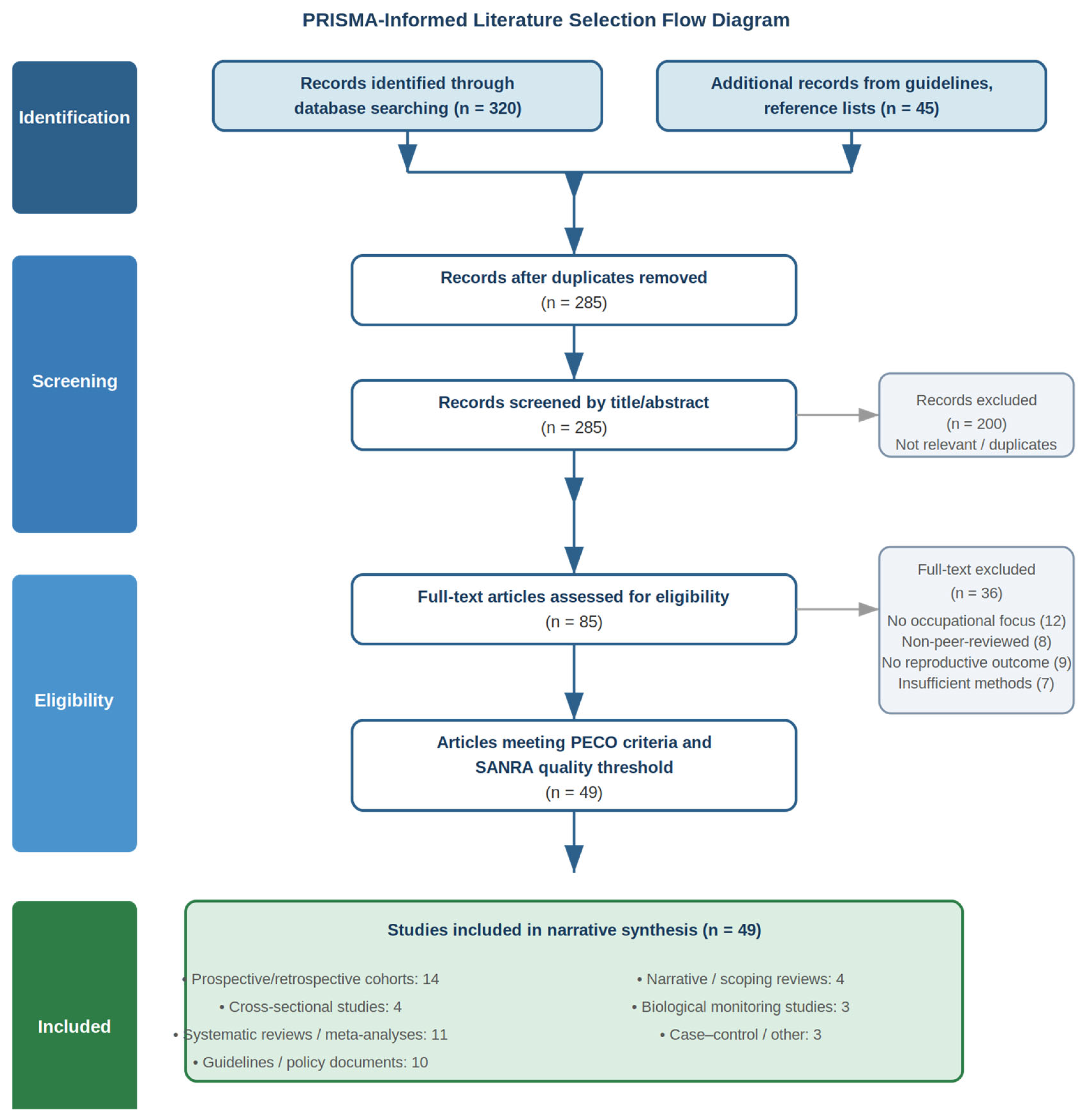
2.4. Eligibility Criteria and Literature Selection
2.5. Evidence Synthesis Framework
2.6. Evidence Quality Assessment
3. Review of Occupational Exposures and Clinical Outcomes
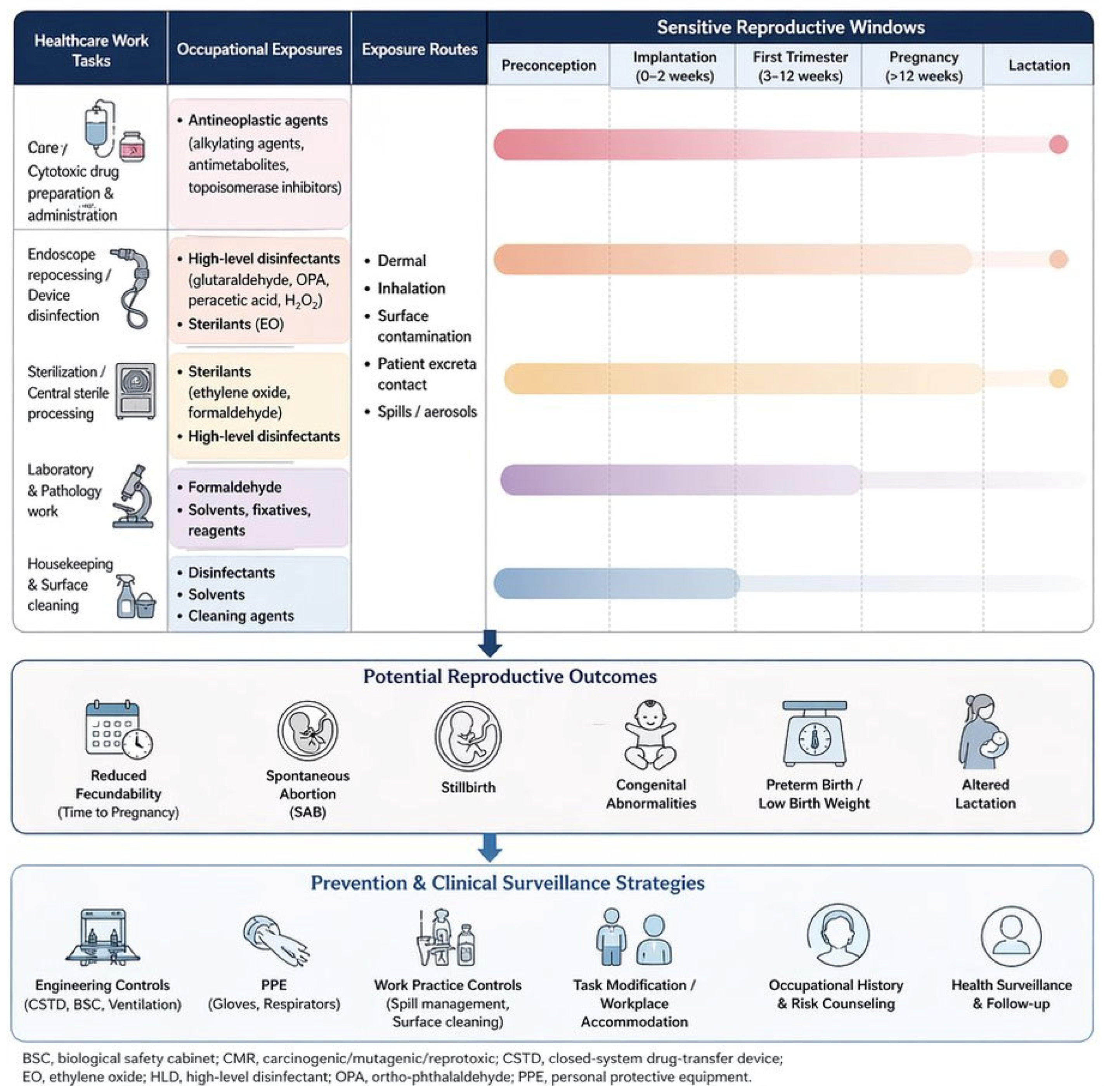
3.1. The Clinical Relevance of Reproductive Risk in Healthcare Settings
3.2. Antineoplastic Agents: Reproductive and Cancer-Related Clinical Concerns
3.2.1. Mechanisms and Biological Plausibility
3.2.2. Epidemiological Evidence
3.3. High-Level Disinfectants and Sterilants
3.3.1. Related but Distinct Exposure Categories
3.3.2. Formaldehyde and Ethylene Oxide
3.4. Mixed and Work-Organization-Related Reproductive Risks
4. Clinical Implications for Occupational and Reproductive Medicine
4.1. International Guidelines as a Clinical Tool
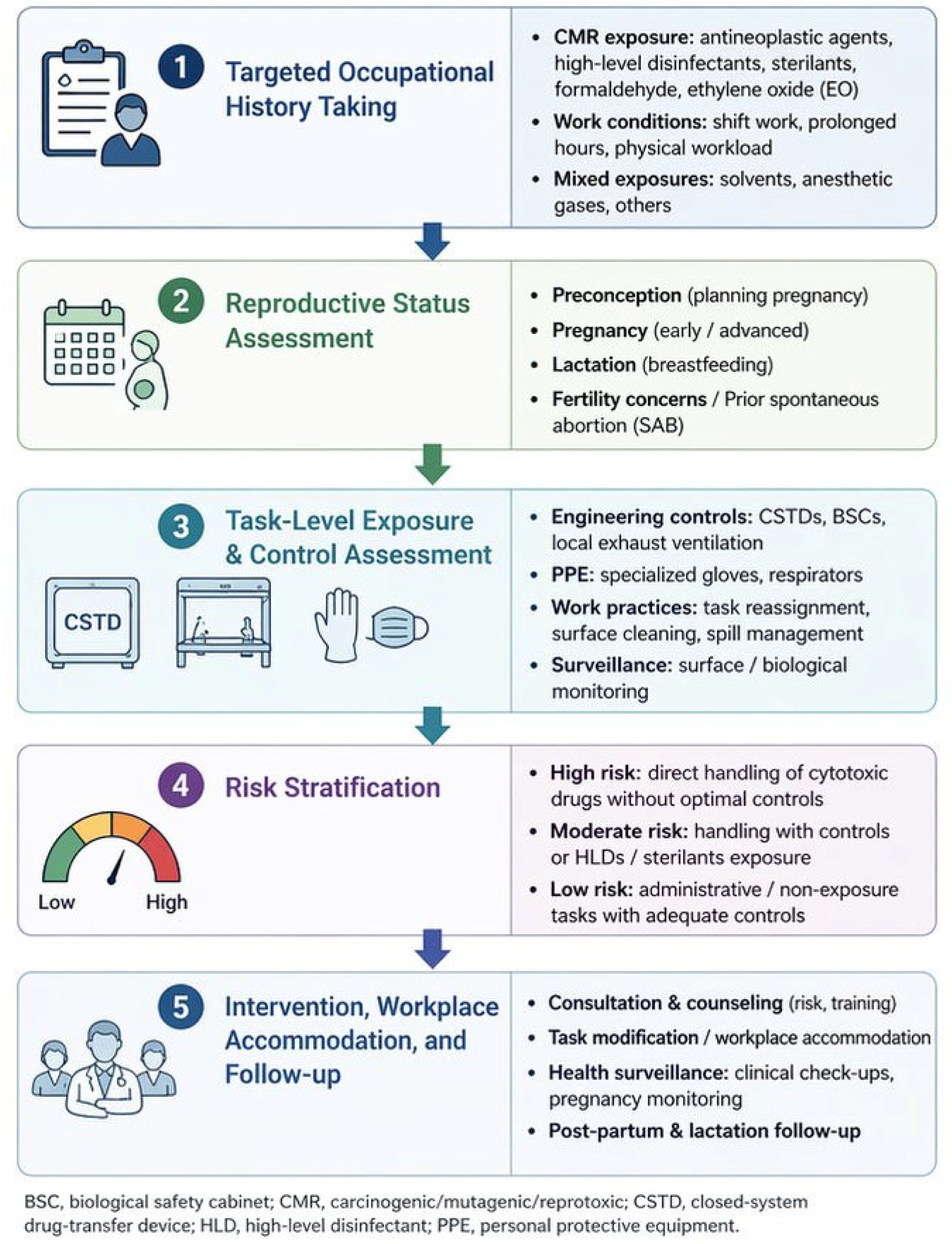
4.2. Occupational History Taking and Clinical Risk Stratification
Exposure Assessment Considerations for Clinical Practice
4.3. Preconception Counseling and Pregnancy-Sensitive Management
Lactation Period and Postpartum Return-to-Work Considerations
4.4. Clinical Surveillance and Preventive Framework
5. Limitations of the Current Evidence
6. Future Directions
7. Conclusions
Supplementary Materials
Author Contributions
Funding
Institutional Review Board Statement
Informed Consent Statement
Data Availability Statement
Conflicts of Interest
Abbreviations
| BSC | Biological safety cabinet |
| CMR | Carcinogenic/mutagenic/reprotoxic |
| CSTD | Closed-system drug-transfer device |
| EO | Ethylene oxide |
| FR | Fecundability ratio |
| HLD | High-level disinfectant |
| H2O2 | Hydrogen peroxide |
| LBW | Low birth weight |
| NHS | Nurses′ Health Study |
| NS | Not statistically significant |
| OCEBM | Oxford Centre for Evidence-Based Medicine |
| OPA | Ortho-phthalaldehyde |
| PECO | Population–Exposure–Comparison–Outcome |
| PPE | Personal protective equipment |
| SAB | Spontaneous abortion |
| SALSA | Search–Appraisal–Synthesis–Analysis |
| SANRA | Scale for the Assessment of Narrative Review Articles |
| SIR | Standardized incidence ratio |
| SR | Systematic review |
| TTP | Time to pregnancy |
| USP | United States Pharmacopeial Convention |
References
- Izadi, N.; Aminian, O.; Ghafourian, K.; Aghdaee, A.H.; Samadanian, S. Reproductive outcomes among female health care workers. BMC Women′s Health 2024, 24, 44. [Google Scholar] [CrossRef]
- Marsters, C.M.; Stafl, L.; Bugden, S.; Gustainis, R.; Nkunu, V.; Reimer, R.; Fletcher, S.; Smith, S.; Joe, M.B.; Hyde, C.; et al. Pregnancy, obstetrical and neonatal outcomes in women exposed to physician-related occupational hazards: A scoping review. BMJ Open 2023, 13, e064483. [Google Scholar] [CrossRef] [PubMed]
- United States Pharmacopeial Convention. USP General Chapter <800>: Hazardous Drugs—Handling in Healthcare Settings; USP: Rockville, MD, USA, 2020; Available online: https://www.usp.org/compounding/general-chapter-hazardous-drugs-handling-healthcare (accessed on 10 March 2026).
- Quansah, R.; Gissler, M.; Jaakkola, J.J.K. Work as a nurse and a midwife and adverse pregnancy outcomes: A Finnish nationwide population-based study. J. Women′s Health 2009, 18, 2071–2076. [Google Scholar] [CrossRef]
- Gaskins, A.J.; Chavarro, J.E.; Rich-Edwards, J.W.; Missmer, S.A.; Laden, F.; Henn, S.A.; Lawson, C.C. Occupational use of high-level disinfectants and fecundity among nurses. Scand. J. Work Environ. Health 2017, 43, 171–180. [Google Scholar] [CrossRef]
- Foroughi, P.; Golbabaei, F.; Sadeghi-Yarandi, M.; Yaseri, M.; Fooladi, M.; Kalantary, S. Occupational exposure, carcinogenic and non-carcinogenic risk assessment of formaldehyde in the pathology labs of hospitals in Iran. Sci. Rep. 2024, 14, 12006. [Google Scholar] [CrossRef]
- Ding, M.; Lawson, C.C.; Johnson, C.Y.; Rich-Edwards, J.W.; Gaskins, A.J.; Boiano, J.; Henn, S.A.; Rocheleau, C.M.; Chavarro, J.E. Occupational exposure to high-level disinfectants and risk of miscarriage among nurses. Occup. Environ. Med. 2021, 78, 731–737. [Google Scholar] [CrossRef]
- Protano, C.; Cammalleri, V.; Romano Spica, V.; Pocino, R.N.; Marotta, D.; Simonazzi, S.; Cardoni, F.; Petyx, M.; Iavicoli, S.; Vitali, M. The carcinogenic effects of formaldehyde occupational exposure: A systematic review. Cancers 2022, 14, 165. [Google Scholar] [CrossRef]
- Beigzadeh, Z.; Golbabaei, F.; Omidi, F.; Shahtaheri, S.J. Comparative analysis of dermal and inhalation exposures to antineoplastic drugs among workers in the workplaces: A systematic review. BMC Public Health 2025, 25, 1800. [Google Scholar] [CrossRef] [PubMed]
- National Institute for Occupational Safety and Health (NIOSH). NIOSH List of Hazardous Drugs in Healthcare Settings, 2024; DHHS (NIOSH) Publication No. 2025-103; Centers for Disease Control and Prevention: Atlanta, GA, USA, 2024. [Google Scholar] [CrossRef]
- Leso, V.; Sottani, C.; Santocono, C.; Russo, F.; Grignani, E.; Iavicoli, I. Exposure to antineoplastic drugs in occupational settings: A systematic review of biological monitoring data. Int. J. Environ. Res. Public Health 2022, 19, 3737. [Google Scholar] [CrossRef]
- Rutala, W.A.; Weber, D.J.; Healthcare Infection Control Practices Advisory Committee. Guideline for Disinfection and Sterilization in Healthcare Facilities, 2008; Centers for Disease Control and Prevention: Atlanta, GA, USA, 2008. Available online: https://www.cdc.gov/infection-control/media/pdfs/guideline-disinfection-h.pdf (accessed on 10 March 2026).
- NIOSH. Managing Hazardous Drug Exposures: Information for Healthcare Settings; DHHS (NIOSH) Publication No. 2023-130; Department of Health and Human Services, Centers for Disease Control and Prevention, National Institute for Occupational Safety and Health: Cincinnati, OH, USA, 2023. [Google Scholar] [CrossRef]
- Liu, S.; Huang, Y.; Huang, H.; Hu, S.; Zhong, X.; Peng, J.; Zhang, X.; Huang, X. Influence of occupational exposure to antineoplastic agents on adverse pregnancy outcomes among nurses: A meta-analysis. Nurs. Open 2023, 10, 5827–5837. [Google Scholar] [CrossRef] [PubMed]
- Jiang, Z.; Chen, J.; Feng, L.; Jin, M.; Liu, S.; Wang, L.; Wang, J.; Yu, C.; Zhou, J.; Ye, Y.; et al. Associations between maternal occupational exposures and pregnancy outcomes among Chinese nurses: A nationwide study. Reprod. Health 2023, 20, 161. [Google Scholar] [CrossRef]
- Lawson, C.C.; Rocheleau, C.M.; Whelan, E.A.; Lividoti Hibert, E.N.; Grajewski, B.; Spiegelman, D.; Rich-Edwards, J.W. Occupational exposures among nurses and risk of spontaneous abortion. Am. J. Obstet. Gynecol. 2012, 206, 327.e1–327.e8. [Google Scholar] [CrossRef]
- Connor, T.H.; Lawson, C.C.; Polovich, M.; McDiarmid, M.A. Reproductive health risks associated with occupational exposures to antineoplastic drugs in health care settings: A review of the evidence. J. Occup. Environ. Med. 2014, 56, 901–910. [Google Scholar] [CrossRef]
- Quansah, R.; Jaakkola, J.J.K. Occupational exposures and adverse pregnancy outcomes among nurses: A systematic review and meta-analysis. J. Women′s Health 2010, 19, 1851–1862. [Google Scholar] [CrossRef]
- Bonzini, M.; Palmer, K.T.; Coggon, D.; Carugno, M.; Cromi, A.; Ferrario, M.M. Shift work and pregnancy outcomes: A systematic review with meta-analysis of currently available epidemiological studies. BJOG 2011, 118, 1429–1437. [Google Scholar] [CrossRef] [PubMed]
- Palmer, K.T.; Bonzini, M.; Harris, E.C.; Linaker, C.; Bonde, J.P. Work activities and risk of prematurity, low birth weight and pre-eclampsia: An updated review with meta-analysis. Occup. Environ. Med. 2013, 70, 213–222. [Google Scholar] [CrossRef]
- Croteau, A. Occupational lifting and adverse pregnancy outcome: A systematic review and meta-analysis. Occup. Environ. Med. 2020, 77, 496–505. [Google Scholar] [CrossRef] [PubMed]
- Cai, C.; Vandermeer, B.; Khurana, R.; Nerenberg, K.; Featherstone, R.; Sebastianski, M.; Davenport, M.H. The impact of occupational shift work and working hours during pregnancy on health outcomes: A systematic review and meta-analysis. Am. J. Obstet. Gynecol. 2019, 221, 563–576. [Google Scholar] [CrossRef]
- Valanis, B.; Vollmer, W.M.; Steele, P. Occupational exposure to antineoplastic agents: Self-reported miscarriages and stillbirths among nurses and pharmacists. J. Occup. Environ. Med. 1999, 41, 632–638. [Google Scholar] [CrossRef] [PubMed]
- Power, L.A.; Coyne, J.W. ASHP guidelines on handling hazardous drugs. Am. J. Health Syst. Pharm. 2018, 75, 1996–2031. [Google Scholar] [CrossRef] [PubMed]
- CDC/NIOSH. Closed System Drug-Transfer Device (CSTD) Research; Centers for Disease Control and Prevention, National Institute for Occupational Safety and Health. 2024. Available online: https://www.cdc.gov/niosh/healthcare/hazardous-drugs/hazardous-drugs-resources.html (accessed on 10 March 2026).
- Xu, W.; Zhang, W.; Zhang, X.; Dong, T.; Zeng, H.; Fan, Q. Association between formaldehyde exposure and miscarriage in Chinese women. Medicine 2017, 96, e7146. [Google Scholar] [CrossRef]
- Duong, A.; Steinmaus, C.; McHale, C.M.; Vaughan, C.P.; Zhang, L. Reproductive and developmental toxicity of formaldehyde: A systematic review. Mutat. Res. 2011, 728, 118–138. [Google Scholar] [CrossRef]
- Gresie-Brusin, D.F.; Kielkowski, D.; Baker, A.; Channa, K.; Rees, D. Occupational exposure to ethylene oxide during pregnancy and association with adverse reproductive outcomes. Int. Arch. Occup. Environ. Health 2007, 80, 559–565. [Google Scholar] [CrossRef]
- NIOSH. About Formaldehyde and Reproductive Health. Reproductive Health and the Workplace; Centers for Disease Control and Prevention, National Institute for Occupational Safety and Health. 2024. Available online: https://www.cdc.gov/niosh/reproductive-health/prevention/formaldehyde.html (accessed on 10 March 2026).
- Munn, Z.; Peters, M.D.J.; Stern, C.; Tufanaru, C.; McArthur, A.; Aromataris, E. Systematic review or scoping review? Guidance for authors when choosing between a systematic or scoping review approach. BMC Med. Res. Methodol. 2018, 18, 143. [Google Scholar] [CrossRef]
- Gurusamy, K.S.; Best, L.M.J.; Tanguay, C.; Lennan, E.; Korva, M.; Bussieres, J.F. Closed-system drug-transfer devices plus safe handling of hazardous drugs versus safe handling alone for reducing exposure to infusional hazardous drugs in healthcare staff. Cochrane Database Syst. Rev. 2018, 2019, CD012860. [Google Scholar] [CrossRef]
- Mengist, W.; Soromessa, T.; Legese, G. Method for conducting systematic literature review and meta-analysis for environmental science research. MethodsX 2020, 7, 100777. [Google Scholar] [CrossRef] [PubMed]
- Ratner, P.A.; Spinelli, J.J.; Beking, K.; Lorenzi, M.; Chow, Y.; Teschke, K.; Le, N.D.; Gallagher, R.P.; Dimich-Ward, H. Cancer incidence and adverse pregnancy outcome in registered nurses potentially exposed to antineoplastic drugs. BMC Nurs. 2010, 9, 15. [Google Scholar] [CrossRef]
- Stucker, I.; Caillard, J.F.; Collin, R.; Gout, M.; Poyen, D.; Hemon, D. Risk of spontaneous abortion among nurses handling antineoplastic drugs. Scand. J. Work Environ. Health 1990, 16, 102–107. [Google Scholar] [CrossRef] [PubMed]
- Fransman, W.; Roeleveld, N.; Peelen, S.; de Kort, W.; Kromhout, H.; Heederik, D. Nurses with dermal exposure to antineoplastic drugs: Reproductive outcomes. Epidemiology 2007, 18, 112–119. [Google Scholar] [CrossRef]
- Fransman, W.; Peelen, S.; Hilhorst, S.; Roeleveld, N.; Heederik, D.; Kromhout, H. A pooled analysis to study trends in exposure to antineoplastic drugs among nurses. Ann. Occup. Hyg. 2007, 51, 231–239. [Google Scholar] [CrossRef] [PubMed]
- Valanis, B.; Vollmer, W.; Labuhn, K.; Glass, A. Occupational exposure to antineoplastic agents and self-reported infertility among nurses and pharmacists. J. Occup. Environ. Med. 1997, 39, 574–580. [Google Scholar] [CrossRef]
- Page, M.J.; McKenzie, J.E.; Bossuyt, P.M.; Boutron, I.; Hoffmann, T.C.; Mulrow, C.D.; Shamseer, L.; Tetzlaff, J.M.; Akl, E.A.; Brennan, S.E.; et al. The PRISMA 2020 statement: An updated guideline for reporting systematic reviews. BMJ 2021, 372, n71. [Google Scholar] [CrossRef]
- Baethge, C.; Goldbeck-Wood, S.; Mertens, S. SANRA—A scale for the quality assessment of narrative review articles. Res. Integr. Peer Rev. 2019, 4, 5. [Google Scholar] [CrossRef]
- OCEBM Levels of Evidence Working Group. The Oxford Levels of Evidence 2. Oxford Centre for Evidence-Based Medicine. Available online: https://www.cebm.ox.ac.uk/resources/levels-of-evidence/ocebm-levels-of-evidence (accessed on 10 March 2026).
- Nassan, F.L.; Chavarro, J.E.; Johnson, C.Y.; Boiano, J.M.; Rocheleau, C.M.; Rich-Edwards, J.W.; Lawson, C.C. Administration of antineoplastic drugs and fecundity in female nurses. Am. J. Ind. Med. 2019, 62, 672–679. [Google Scholar] [CrossRef] [PubMed]
- Nassan, F.L.; Chavarro, J.E.; Johnson, C.Y.; Boiano, J.M.; Rocheleau, C.M.; Rich-Edwards, J.W.; Lawson, C.C. Prepregnancy handling of antineoplastic drugs and risk of miscarriage in female nurses. Ann. Epidemiol. 2021, 53, 95–102.e2. [Google Scholar] [CrossRef]
- Roussel, C.; Witt, K.L.; Shaw, P.B.; Connor, T.H. Occupational exposure to antineoplastic drugs and chromosomal aberrations in healthcare workers: A meta-analysis. Mutat. Res. Rev. Mutat. Res. 2019, 781, 207–217. [Google Scholar] [CrossRef] [PubMed]
- Hu, J.; Zhao, F.; Liu, L.; Huang, H.; Huang, X. The meta-analysis of sister chromatid exchange as a biomarker in healthcare workers with occupational exposure to antineoplastic drugs. Medicine 2023, 102, e34781. [Google Scholar] [CrossRef] [PubMed]
- Simon, N.; Vasseur, M.; Pinturaud, M.; Soichot, M.; Richeval, C.; Humbert, L.; Lebecque, M.; Sidikou, O.; Barthelemy, C.; Bonnabry, P.; et al. Effectiveness of a closed-system transfer device in reducing surface contamination in a new antineoplastic drug-compounding unit: A prospective, controlled, parallel study. PLoS ONE 2016, 11, e0159052. [Google Scholar] [CrossRef]
- Saurel-Cubizolles, M.J.; Hays, M.; Estryn-Behar, M. Work in operating rooms and pregnancy outcome among nurses. Int. Arch. Occup. Environ. Health 1994, 66, 235–241. [Google Scholar] [CrossRef]
- Baniasadi, S.; Alehashem, M.; Yunesian, M.; Rastkari, N. Biological monitoring of healthcare workers exposed to antineoplastic drugs: Urinary assessment of cyclophosphamide and ifosfamide. Iran. J. Pharm. Res. 2018, 17, 1458–1464. [Google Scholar] [PubMed]
- Chauchat, L.; Tanguay, C.; Therrien, R.; Dufour, A.; Gagné, S.; Caron, N.J.; Bussières, J.-F. Biological monitoring of 4 antineoplastic drugs in health care workers from 2 adult hospitals: A pilot study. Can. J. Hosp. Pharm. 2019, 72, 56–59. [Google Scholar] [CrossRef] [PubMed]
- Piccardo, M.T.; Forlani, A.; Izzotti, A. Effectiveness of closed system drug transfer devices in reducing leakage during antineoplastic drugs compounding. Int. J. Environ. Res. Public Health 2021, 18, 7957. [Google Scholar] [CrossRef]
- Teglia, F.; Collatuzzo, G.; Boffetta, P. Occupational cancers among employed women: A narrative review. Cancers 2023, 15, 1334. [Google Scholar] [CrossRef]



| PECO Element | Inclusion Criteria | Exclusion Criteria |
|---|---|---|
| Population (P) | Women healthcare workers (nurses, pharmacists, laboratory personnel, sterile processing technicians, pathology staff, hospital housekeeping, operating room personnel) | General population without occupational healthcare exposure; male-only study populations; animal-only studies |
| Exposure (E) | Occupational exposure to antineoplastic agents, hazardous drugs, high-level disinfectants (glutaraldehyde, OPA, peracetic acid, H2O2), sterilants (ethylene oxide, formaldehyde), solvents, anesthetic gases, or work-organization factors (shift work, prolonged hours, physical workload) | Non-occupational environmental exposure; dietary or lifestyle-only exposures; therapeutic patient exposure |
| Comparison (C) | Unexposed healthcare workers, general female population, or within-cohort comparisons by exposure level/duration (where available) | No comparator required for descriptive studies or guidelines; absence of comparator did not lead to exclusion |
| Outcome (O) | Reproductive and pregnancy outcomes: spontaneous abortion, stillbirth, congenital abnormalities, reduced fecundability/time to pregnancy, preterm birth, low birth weight, breastfeeding disruption; occupational cancer risk where reproductively relevant | Non-reproductive occupational outcomes (e.g., musculoskeletal injury, respiratory symptoms without reproductive relevance); patient treatment outcomes |
| Year | First Author | Design/Evidence Level | Exposure Assessment | Main Outcome | Principal Finding Effect Estimate | Key Limitation |
|---|---|---|---|---|---|---|
| 1990 | Stucker [34] | Exposed–unexposed/III | Job records; perfusion task logs | Spontaneous abortion | Spontaneous abortion (SAB): 15.7% exposed vs. 10.5% unexposed (p < 0.05) | Small sample; limited exposure quantification |
| 1999 | Valanis [23] | Retrospective survey/III | Self-reported drug handling | Miscarriage, stillbirth | SAB OR range 1.5–2.3 among handling mixing nurses | Recall bias; self-report |
| 2007 | Fransman [35] | Cohort + task-based model/II | Dermal exposure estimation from task questionnaire | TTP, preterm birth, LBW | Highest dermal exposure: FR 0.8 (95% CI: 0.6–1.0) for TTP; preterm OR 1.7 | Modeled exposure; retrospective fertility data |
| 2010 | Ratner [33] | Historical cohort + registry/II | Department-level exposure classification | Cancer incidence, pregnancy outcomes | Breast cancer SIR 1.83 (95% CI: 1.03–3.23); pregnancy outcomes NS | Ecological exposure; healthy worker effect |
| 2012 | Lawson [16] | NHS II analysis/II | Self-reported occupational exposure | Spontaneous abortion | Antineoplastic → SAB aOR ≈ 2.0; nulliparous aOR 3.5; sterilizing agents → late SAB aOR ≈ 2.0 | Self-report; residual confounding |
| 2017 | Gaskins [5] | Prospective cohort (NHS3)/II | Self-reported HLD use frequency | Fecundability (TTP) | HLD use: FR 0.87 (95% CI: 0.77–0.98); attenuated with PPE | Exposure intensity not fully quantified |
| 2019 | Nassan [41] | Prospective cohort (NHS3)/II | Self-reported antineoplastic administration | Fecundability | FR ≈ 1.0 (NS) when exposure controls consistently used | Self-report; limited dose estimation |
| 2021 | Nassan [42] | Prospective cohort (NHS3)/II | Self-reported prepregnancy handling | Miscarriage | AD handling: HR 1.26 (95% CI: 0.97–1.64); inconsistent controls: HR 1.46 (95% CI: 1.02–2.10) | Self-report; unmeasured confounders |
| 2021 | Ding [7] | Prospective cohort (NHS3)/II | Self-reported HLD use | Miscarriage | Overall HR ≈ 1.0 (NS); within 12 months: HR elevated (borderline significant) | Exposure window definition; self-report |
| 2023 | Liu [14] | SR + meta-analysis/I | Pooled from 11 heterogeneous studies | SAB, stillbirth, congenital abnormalities | Pooled OR: SAB, stillbirth, congenital abnormalities all statistically significant | Heterogeneous exposure assessment across studies |
| 2023 | Marsters [2] | Scoping review/I | Mapped 98 studies by hazard type | Mixed pregnancy outcomes | No pooled estimate; elevated SAB signals across studies | Heterogeneous designs; limited to physician-related hazards |
| 2024 | Izadi [1] | Cross-sectional/IV | Questionnaire-based | Multiple reproductive outcomes | Chemical exposure, shift work, psychiatric factors: p < 0.05 for selected outcomes | Cross-sectional design; temporal ambiguity; self-report |
| Domain | Clinical Question | Clinical Interpretation |
|---|---|---|
| Antineoplastic agents | Do you actively prepare, administer, dispose of, or clean spills involving chemotherapy or hazardous drugs? | Identifies direct hazardous-drug exposure and need for task review. |
| Surface contamination | Do you handle contaminated tubing, linens, patient excreta, or drug-contaminated surfaces? | Captures indirect dermal/oral transfer risks that may be missed by job title. |
| HLDs and sterilants | Do you use glutaraldehyde, OPA, formaldehyde, ethylene oxide, peracetic acid, or automated reprocessors? | Identifies device-reprocessing, sterilization, and pathology-related exposure. |
| Exposure controls | Are CSTDs, biological safety cabinets, local exhaust ventilation, double gloves, gowns, and spill protocols used consistently? | Evaluates risk mitigation and whether workplace accommodation is needed. |
| Reproductive status | Are you planning pregnancy, pregnant, undergoing fertility treatment, postpartum, or breastfeeding? | Determines the urgency and type of counseling or task modification. |
| Work organization | Do you work night shifts, extended hours, heavy lifting, or high-stress duties? | Integrates chemical and non-chemical reproductive risk factors. |
| Exposure Source | Primary Clinical Concern | Workplace Control Mechanism | Required Clinical Action | Evidence Tier |
|---|---|---|---|---|
| Antineoplastic agents | Miscarriage, stillbirth, congenital abnormalities, genotoxicity, cancer concerns | CSTDs, biological safety cabinets, PPE, spill protocols, surface monitoring | Preconception counseling, task review, accommodation if controls are inadequate | Tier 1 (Evidence-supported) |
| HLDs | Reduced fecundability, miscarriage risk signals | Local exhaust ventilation, automated reprocessors, substitution, gloves, eye/respiratory protection | Time-to-pregnancy history, PPE adherence assessment, ventilation review | Tier 2 (Precautionary) |
| Formaldehyde/ethylene oxide | Carcinogenic and reproductive concerns | Enclosure, air monitoring, substitution, fume hood/ventilation | Pregnancy-sensitive restriction where exposure is uncontrolled; symptom/exposure review | Tier 2 (Precautionary) |
| Mixed hazards | Preterm birth, pregnancy loss, lactation disruption, fatigue-related risks | Scheduling modification, ergonomic controls, staffing support | Whole-work assessment, fetal growth and maternal health surveillance | Tier 3 (Expert opinion) |
Disclaimer/Publisher’s Note: The statements, opinions and data contained in all publications are solely those of the individual author(s) and contributor(s) and not of MDPI and/or the editor(s). MDPI and/or the editor(s) disclaim responsibility for any injury to people or property resulting from any ideas, methods, instructions or products referred to in the content. |
© 2026 by the authors. Licensee MDPI, Basel, Switzerland. This article is an open access article distributed under the terms and conditions of the Creative Commons Attribution (CC BY) license.
Share and Cite
Kwon, O.-H.; Sim, G.-J.; Choi, S.-H. Occupational Reproductive Health Risks Among Women Healthcare Workers: A Narrative Review for Clinical Surveillance, Preconception Counseling, and Prevention. J. Clin. Med. 2026, 15, 4651. https://doi.org/10.3390/jcm15124651
Kwon O-H, Sim G-J, Choi S-H. Occupational Reproductive Health Risks Among Women Healthcare Workers: A Narrative Review for Clinical Surveillance, Preconception Counseling, and Prevention. Journal of Clinical Medicine. 2026; 15(12):4651. https://doi.org/10.3390/jcm15124651
Chicago/Turabian StyleKwon, Oh-Hyun, Gyu-Jin Sim, and Sun-Haeng Choi. 2026. "Occupational Reproductive Health Risks Among Women Healthcare Workers: A Narrative Review for Clinical Surveillance, Preconception Counseling, and Prevention" Journal of Clinical Medicine 15, no. 12: 4651. https://doi.org/10.3390/jcm15124651
APA StyleKwon, O.-H., Sim, G.-J., & Choi, S.-H. (2026). Occupational Reproductive Health Risks Among Women Healthcare Workers: A Narrative Review for Clinical Surveillance, Preconception Counseling, and Prevention. Journal of Clinical Medicine, 15(12), 4651. https://doi.org/10.3390/jcm15124651