Comparison of Complete Blood Count Results Between K3-EDTA- and MgSO4-Anticoagulated Samples Using a DxH800 Analyzer


Abstract
1. Introduction
2. Materials and Methods
2.1. Samples
2.2. Analyzer Characteristics
2.3. Statistical Analysis
3. Results
3.1. Comparisons of CBC on EDTA and MgSO4-Anticoagulated Samples
3.2. Comparisons of Differentials on K3-EDTA- and MgSO4-Anticoagulated Tubes
3.3. Long-Term Stability of Samples Collected on MgSO4-Anticoagulated Tubes
4. Discussion
5. Conclusions
Supplementary Materials
Author Contributions
Funding
Institutional Review Board Statement
Informed Consent Statement
Data Availability Statement
Acknowledgments
Conflicts of Interest
Abbreviations
| AL2 | Axial light loss |
| CBC | Complete blood count |
| CPD | Cellular positional data |
| EDTA | Ethylene diamine tetracetic acid |
| GFHC | French-Speaking Cellular Hematology Group |
| LALS | Low-angle light scatter |
| LMAL | Lower-median-angle light scatter |
| M | Mean |
| MALS | Median-angle light scatter |
| MCHC | Mean corpuscular hemoglobin concentration |
| MCV | Mean corpuscular volume |
| MPV | Mean platelet volume |
| MRB | Mean relative bias |
| PLT | Platelet |
| PTCP | Pseudothrombocytopenia |
| RBC | Red blood cell |
| SD | Standard deviation |
| UMALS | Upper-median-angle light scatter |
| WBC | White blood cell |
References
- International Council for Standardization in Haematology. Expert Panel on Cytometry Recommendations of the International Council for Standardization in Haematology for Ethylenediaminetetraacetic Acid Anticoagulation of Blood for Blood Cell Counting and Sizing. Am. J. Clin. Pathol. 1993, 100, 371–372. [Google Scholar] [CrossRef] [PubMed]
- Bizzaro, N. EDTA-dependent pseudothrombocytopenia: A clinical and epidemiological study of 112 cases, with 10-year follow-up. Am. J. Hematol. 1995, 50, 103–109. [Google Scholar] [CrossRef]
- Lippi, G.; Plebani, M. EDTA-dependent pseudothrombocytopenia:further insights and recommendations for prevention of a clinically threatening artefact. Clin. Chem. Lab. Med. 2012, 50, 1281–1285. [Google Scholar] [CrossRef]
- Cantón, R.; Manzanares, J.; Alvarez, E.; Zaragozá, F. In vitro and in vivo antiaggregant effects of magnesium halogenates. Thromb. Haemost. 1987, 58, 957–959. [Google Scholar] [CrossRef]
- Golański, J.; Pietrucha, T.; Baj, Z.; Greger, J.; Watala, C. A novel approach to inhibit the anticoagulant-induced spontaneous activation of blood platelets—Effect of magnesium on platelet release reaction in whole blood. Thromb. Res. 1997, 85, 127–132. [Google Scholar] [CrossRef]
- Wuilleme, S.; Girard, S.; Soulard, M.; Chatelain, B.; Etienne, E.; Guiheneuf, E.; Geneviève, F.; Vedrenne, A.; Lesesve, J.F.; Baccini, V.; et al. Influence of Anticoagulants on Platelet Counts: A Study and Recommendations from the French Speaking Cellular Hematology Group (GFHC). Int. J. Lab. Hematol. 2025, 47, 415–420. [Google Scholar] [CrossRef] [PubMed]
- Vincent, J.L.; Baron, J.F.; Reinhart, K.; Gattinoni, L.; Thijs, L.; Webb, A.; Meier-Hellmann, A.; Nollet, G.; Peres-Bota, D.; ABC (Anemia and Blood Transfusion in Critical Care) Investigators. Anemia and blood transfusion in critically ill patients. JAMA 2002, 288, 1499–1507. [Google Scholar] [CrossRef]
- Soulard, M.; Ketatni, H.; Croix, P.; Wuilleme, S.; Cohen, P. Comparison of blood cell count results between MgSO4 and K2EDTA. Stability and accuracy of platelet counting with MgSO4. Int. J. Lab. Hematol. 2026, 48, 336–344. [Google Scholar] [CrossRef] [PubMed]
- Jean, A.; Boutet, C.; Lenormand, B.; Callat, M.P.; Buchonnet, G.; Barbay, V.; Basuyau, J.P.; Vasse, M. The new haematology analyzer DxH 800: An evaluation of the analytical performances and leucocyte flags, comparison with the LH 755. Int. J. Lab. Hematol. 2011, 33, 138–145. [Google Scholar] [CrossRef]
- Mehmood, R.; Muhammed, R.K.; Hussain, S.; Sana, A. Evaluation of di-potassium and tri-potassium EDTA evacuated tubes for routine haematological testing. J. Clin. Lab. Anal. 2018, 32, e22188. [Google Scholar] [CrossRef]
- Ricós, C.; Alvarez, V.; Cava, F.; García-Lario, J.V.; Hernández, A.; Jiménez, C.V.; Minchinela, J.; Perich, C.; Simón, M. Current databases on biological variation: Pros, cons and progress. Scand. J. Clin. Lab. Investig. 1999, 59, 491–500. Available online: https://www.westgard.com (accessed on 25 April 2026). [PubMed]
- Schuff-Werner, P.; Steiner, M.; Fenger, S.; Gross, H.J.; Bierlich, A.; Dreissiger, K.; Mannuß, S.; Siegert, G.; Bachem, M.; Kohlschein, P. Effective estimation of correct platelet counts in pseudothrombocytopenia using an alternative anticoagulant based on magnesium salt. Br. J. Haematol. 2013, 162, 684–692. [Google Scholar] [CrossRef]
- Mannuß, S.; Kohlschein, P.; Dreißiger, K.; Schuff-Werner, P. Measurement of Platelet Counts and Volume Using Magnesium Sulfate as an Anticoagulant: Comparison of Impedance and Light-Scatter Technology. Am. J. Clin. Pathol. 2016, 146, 538–545. [Google Scholar] [CrossRef]
- Soulard, M.; Croix, P.; Cohen, P. Comparison of platelet count results on the Sysmex XN between citrate or MgSO4 and K2 EDTA anticoagulants. Int. J. Lab. Hematol. 2023, 45, 20–28. [Google Scholar] [CrossRef]
- Bath, P.M. The routine measurement of platelet size using sodium citrate alone as the anticoagulant. Thromb. Haemost. 1993, 70, 687–690. [Google Scholar] [CrossRef] [PubMed]
- Dastjerdi, M.S.; Emami, T.; Najafian, A.; Amini, M. Mean platelet volume measurement, EDTA or citrate? Hematology 2006, 11, 317–319. [Google Scholar] [CrossRef]
- Sheu, J.R.; Hsiao, G.; Shen, M.Y.; Fong, T.H.; Chen, Y.W.; Lin, C.H.; Chou, D.S. Mechanisms involved in the antiplatelet activity of magnesium in human platelets. Br. J. Haematol. 2002, 119, 1033–1041. [Google Scholar] [CrossRef]
- Chen, B.H.; Fong, J.F.; Chiang, C.H. Effect of different anticoagulant, underfilling of blood sample and storage stability on selected hemogram. Kaohsiung J. Med. Sci. 1999, 15, 87–93. [Google Scholar]
- Freise, K.J.; Schmidt, R.L.; Gingerich, E.L.; Veng-Pedersen, P.; Widness, J.A. The effect of anticoagulant, storage temperature and dilution on cord blood hematology parameters over time. Int. J. Lab. Hematol. 2009, 31, 496–504. [Google Scholar] [CrossRef] [PubMed]
- Beaven, G.H.; Parmar, J.; Nash, G.B.; Bennett, B.M.; Gratzer, W.B. Effect of magnesium ions on red cell membrane properties. J. Membr. Biol. 1990, 118, 251–257. [Google Scholar] [CrossRef]
- Choccalingam, C.; Radha, R.K.N.; Snigdha, N. Estimation of Platelet Counts and Other Hematological Parameters in Pseudothrombocytopenia Using Alternative Anticoagulant: Magnesium Sulfate. Clin. Med. Insights Blood Disord. 2017, 10, 1179545X17705380. [Google Scholar] [CrossRef]
- Goossens, W.; Van Duppen, V.; Verwilghen, R.L. K2- or K3-EDTA: The anticoagulant of choice in routine haematology? Clin. Lab. Haematol. 1991, 13, 291–295. [Google Scholar] [CrossRef] [PubMed]
- Ciepiela, O.; Kotuła, I.; Kierat, S.; Sieczkowska, S.; Podsiadłowska, A.; Jenczelewska, A.; Księżarczyk, K.; Demkow, U. A Comparison of Mindray BC-6800, Sysmex XN-2000, and Beckman Coulter LH750 Automated Hematology Analyzers: A Pediatric Study. J. Clin. Lab. Anal. 2016, 30, 1128–1134. [Google Scholar] [CrossRef] [PubMed]
- Vassault, A.; Grafmeyer, D.; de Graeve, J.; Cohen, R.; Beaudonnet, A.; Bienvenu, J. Analyses de biologie médicale: Spécifications et normes d’acceptabilité à l’usage de la validation de techniques [Quality specifications and allowable standards for validation of methods used in clinical biochemistry]. Ann. Biol. Clin. 1999, 57, 685–695. [Google Scholar]
- Mannuß, S.; Schuff-Werner, P.; Dreißiger, K.; Kohlschein, P. Magnesium Sulfate as an Alternative In Vitro Anticoagulant for the Measurement of Platelet Parameters? Am. J. Clin. Pathol. 2016, 145, 806–814. [Google Scholar] [CrossRef]
- Sirichotiyakul, S.; Maneerat, J.; Sanguansermsri, T.; Dhananjayanonda, P.; Tongsong, T. Sensitivity and specificity of mean corpuscular volume testing for screening for alpha-thalassemia-1 and beta-thalassemia traits. J. Obstet. Gynaecol. Res. 2005, 31, 198–201. [Google Scholar] [CrossRef]



| K3-EDTA | MgSO4 | p | |
|---|---|---|---|
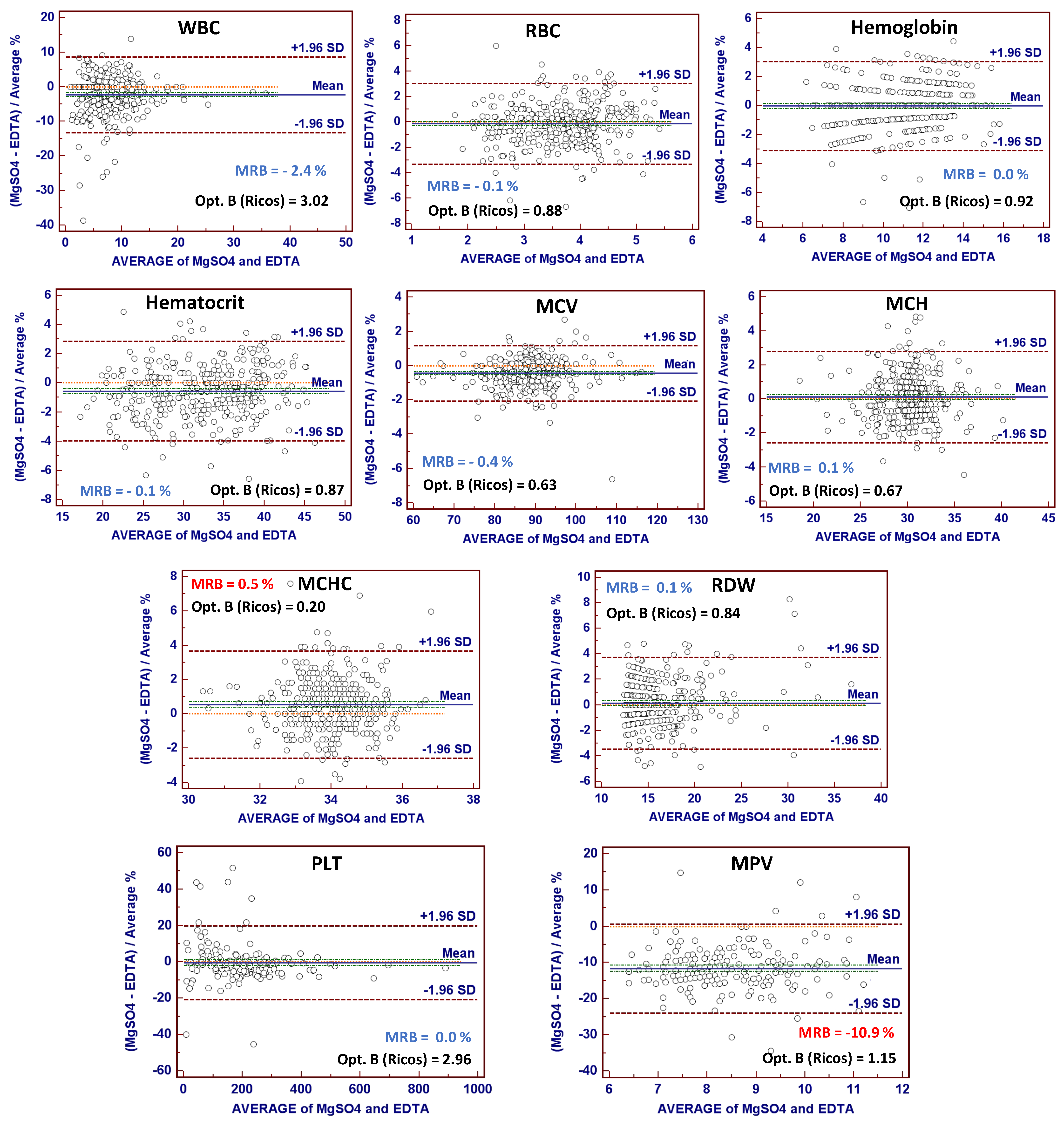
| White Blood Cells (×109/L) * | 7.4 [5.2–10.0] | 7.1 [5.1–9.7] | <0.0001 |
| Red Blood Cells (×1012/L) | 3.75 [3.2–4.2] | 3.75 [3.15–4.17] | 0.2806 |
| Hemoglobin (g/dL) | 11.3 [9.4–12.8] | 11.3 [9.4–12.8] | 0.8897 |
| Hematocrit (%) | 33.3 [27.7–37.5] | 33.0 [27.4–37.4] | <0.0001 |
| Mean Corpuscular Volume (fL) | 89.8 [85.0–92.8] | 89.3 [84.5–92.5] | <0.0001 |
| Mean Corpuscular Hemoglobin (pg) | 30.4 [28.7–31.7] | 30.4 [28.8–31.8] | 0.3165 |
| Mean Corpuscular Hemoglobin Concentration (g/dL) | 33.9 [33.2–34.6] | 34.1 [33.5–34.8] | <0.0001 |
| Red Cell Distribution Width | 14.9 [13.7–17.5] | 14.8 [13.7–17.4] | 0.1669 |
| Platelets (×109/L) ** | 150 [80–259] | 151 [83–248] | 0.0001 |
| Mean Platelet Volume (fL) ** | 8.9 [8.2–10] | 8.0 [7.3–8.9] | <0.0001 |
| Spearman’s Coefficients of Rank Correlations [95% CI] | Slope [95% CI] | Intercept [95% CI] | |
|---|---|---|---|
| White Blood Cells (×109/L) * | 0.993 [0.991–0.994] | 0.9872 [0.9767–1.0000] | −0.0282 [−0.1000–0.0395] |
| Red Blood Cells (×1012/L) | 0.996 [0.996–0.997] | 1.0109 [1.0000–1.0192] | −0.0420 [−0.0714–0.0000] |
| Hemoglobin (g/dL) | 0.996 [0.949–0.969] | 1.0000 [1.0000–1.0161] | 0.0000 [−0.1758–0.0000] |
| Hematocrit (%) | 0.995 [0.994–0.996] | 1.0000 [1.0000–1.0153] | −0.2000 [−0.6557–−0.2000] |
| Mean Corpuscular Volume (fL) | 0.992 [0.990–0.993] | 1.0081 [1.0000–1.0192] | −1.1008 [−2.0611–0.4000] |
| Mean Corpuscular Hemoglobin (pg) | 0.980 [0.976–0.984] | 1.0000 [0.9429–1.0133] | 0.0000 [−0.4040–0.0000] |
| Mean Corpuscular Hemoglobin Concentration (g/L) | 0.841 [0.808–0.869] | 1.0000 [0.9429–1.0357] | 0.2000 [−1.0375–2.1229] |
| Red Cell Distribution Width | 0.991 [0.988–0.992] | 1.0000 [1.0000–1.0156] | 0.0000 [−0.2273–0.0000] |
| Platelets (×109/L) ** | 0.996 [0.995–0.997] | 0.9697 [0.9605–0.9791] | 2.2422 [1.2487–3.5066] |
| Mean Platelet Volume (fL) ** | 0.913 [0.891–0.930] | 0.9375 [0.8889–1.0000] | −0.3937 [−1.0000–0.0167] |
| Cells (×109/L) | K3-EDTA | MgSO4 | p | Spearman’s Coefficients of Rank Correlations [95% CI] | Mean Relative Bias (Bland–Altman) (%) | Slope [95% CI] | Intercept [95% CI] |
|---|---|---|---|---|---|---|---|
| WBC | 8.3 [5.1–9.8] | 8.1 [5.4–9.2] | 0.0151 | 0.977 [0.954–0.989] | −2.9 | 0.9813 [0.9310–1.0128] | −0.0346 [−0.1449–0.2483] |
| Neutrophils | 5.4 [3.2–7.4] | 5.4 [3.3–7.3] | 0.0038 | 0.991 [0.982–0.996] | −2.6 | 0.9706 [0.9250–1.0000] | 0.0147 [−0.1000–0.1525] |
| Eosinophils | 0.1 [0.0–0.1] | 0.1 [0.0–0.1] | 0.7285 | 0.854 [0.726–0.926] | −9.8 * | 1.0000 [1.0000–1.0000] | 0.0000 [0.0000–0.0000] |
| Basophils | 0.0 [0.0–0.1] | 0.0 [0.0–0.1] | 0.8695 | 0.899 [0.827–0.942] | −33.3 ** | 1.0000 [1.0000–1.0000] | 0.0000 [0.0000–0.0000] |
| Lymphocytes | 1.2 [0.8–1.6] | 1.2 [0.8–1.6] | 0.8596 | 0.886 [0.971–0.993] | −0.3 | 1.0000 [0.9091–1.0000] | 0.0000 [0.0000–0.0818] |
| Monocytes | 0.6 [0.4–0.8] | 0.6 [0.4–0.8] | 0.4405 | 0.945 [0.971–0.993] | −2.6 | 1.0000 [0.8333–1.0000] | 0.0000 [0.0000–0.8333] |
| Cells (×109/L) | MN-V | MN-MALS | MN-UMALS | MN-LMALS | MN-LALS | MN-AL2 |
|---|---|---|---|---|---|---|
| Neutrophils | −5.2 [−7.1–−4.1] | 3.8 [0.7–4.9] | 1.4 [−0.3–3.1] | 5.9 [1.5–8.3] | 9.1 [5.1–12.6] | −3.8 [−9.0–−2.4] |
| Eosinophils | −5.1 [−7.6–−2.2] | 2.3 [1.9–3.5] | 1.8 [1.0–3.3] | 3.2 [2.1–4.2] | n.s | −4.0 [−9.7–−0.8] |
| Lymphocytes | −2.4 [−3.7–−1.2] | −2.9 [−6.0–0.0] | −6.3 [−10.5–−3.5] | n.s | 5.7 [2.1–7.9] | n.s |
| Monocytes | −6.7 [−8.2–−3.0] | n.s | −5.1 [−7.3–−2.2] | 8.8 [5.2–9.9] | 21.0 [13.2–28.5] | n.s |
Disclaimer/Publisher’s Note: The statements, opinions and data contained in all publications are solely those of the individual author(s) and contributor(s) and not of MDPI and/or the editor(s). MDPI and/or the editor(s) disclaim responsibility for any injury to people or property resulting from any ideas, methods, instructions or products referred to in the content. |
© 2026 by the authors. Licensee MDPI, Basel, Switzerland. This article is an open access article distributed under the terms and conditions of the Creative Commons Attribution (CC BY) license.
Share and Cite
Védrenne, A.; Habarou, F.; Pascreau, T.; Vasse, M. Comparison of Complete Blood Count Results Between K3-EDTA- and MgSO4-Anticoagulated Samples Using a DxH800 Analyzer. J. Clin. Med. 2026, 15, 4607. https://doi.org/10.3390/jcm15124607
Védrenne A, Habarou F, Pascreau T, Vasse M. Comparison of Complete Blood Count Results Between K3-EDTA- and MgSO4-Anticoagulated Samples Using a DxH800 Analyzer. Journal of Clinical Medicine. 2026; 15(12):4607. https://doi.org/10.3390/jcm15124607
Chicago/Turabian StyleVédrenne, Aurélie, Florence Habarou, Tiffany Pascreau, and Marc Vasse. 2026. "Comparison of Complete Blood Count Results Between K3-EDTA- and MgSO4-Anticoagulated Samples Using a DxH800 Analyzer" Journal of Clinical Medicine 15, no. 12: 4607. https://doi.org/10.3390/jcm15124607
APA StyleVédrenne, A., Habarou, F., Pascreau, T., & Vasse, M. (2026). Comparison of Complete Blood Count Results Between K3-EDTA- and MgSO4-Anticoagulated Samples Using a DxH800 Analyzer. Journal of Clinical Medicine, 15(12), 4607. https://doi.org/10.3390/jcm15124607