Article

Comparison of Complete Blood Count Results Between K3-EDTA- and MgSO4-Anticoagulated Samples Using a DxH800 Analyzer


1
Biology Department, Foch Hospital, 92150 Suresnes, France
2
Hémostase Inflammation Thrombose U1176, INSERM, Université Paris-Saclay, 94270 Le Kremlin-Bicêtre, France
*
Author to whom correspondence should be addressed.
J. Clin. Med. 2026, 15(12), 4607; https://doi.org/10.3390/jcm15124607 (registering DOI)
Submission received: 14 May 2026 / Revised: 5 June 2026 / Accepted: 10 June 2026 / Published: 13 June 2026
(This article belongs to the Section Hematology)

Abstract

Background/Objectives: In case of EDTA-induced pseudothrombocytopenia (PTCP), MgSO4-anticoagulated tubes are recommended for platelet counting, requiring the collection of an additional tube. The aim of this study was to analyze whether complete blood count (CBC) and differential performed on MgSO4-anticoagulated tubes were comparable to the results obtained on K3-EDTA samples, and to characterize the stability of the CBC over a 24 h period. Methods: In 355 patients (70 with a confirmed PTCP and 285 without PTCP), we compared CBC results obtained on K3-EDTA- and MgSO4-anticoagulated tubes, using DxH800 analyzers. In 33 cases, a differential was available for both anticoagulants, and for 10 patients, samples were re-analyzed 6, 12, and 24 h after the first determination. Results: In the presence or absence of clumps, white blood cell (WBC) count, hematocrit, and mean corpuscular volume (MCV) were slightly lower in MgSO4 than in K3-EDTA tubes, whereas mean corpuscular hemoglobin concentration (MCHC) was slightly higher. Mean platelet volume (MPV) was significantly lower on MgSO4- than on K3-EDTA-anticoagulated tubes. Values were highly correlated between both anticoagulants, and mean relative biases (MRBs) were below Ricos’s recommendations, except for MCHC and MPV. For differential, neutrophils were significantly lower on MgSO4- in comparison to K3-EDTA-anticoagulated tubes (MRB = −2.9%, below Ricos’s optimal bias). The morphology of white blood cells (WBCs) was similar on both anticoagulants. During storage at room temperature, MCV and red cell distribution width increased slightly, but the increase was more pronounced in K3-EDTA than in MgSO4 tubes. Conclusions: CBC and differentials obtained with the DxH 800 analyzer on MgSO4-anticoagulated samples are similar to those obtained with K3-EDTA, except for MPV.

1. Introduction

According to the recommendations of the International Council for Standardization in Hematology (ICSH), ethylenediaminetetraacetic acid (EDTA) is widely used as the preferred anticoagulant for complete blood count (CBC) [1]. EDTA-dependent pseudothrombocytopenia (PTCP) is an in vitro phenomenon of platelet (PLT) clumping that leads to low PLT counts on hematology analyzers. The mechanism is an immunologically mediated phenomenon due to the presence of EDTA-dependent antiplatelet auto-antibodies [2]. Once PCTP has been documented, the main problem is to provide an accurate PLT count, particularly in thrombocytopenic patients, in whom prophylactic PLT transfusions may be necessary. Different strategies have been developed in order to avoid EDTA–PCTP [3]. The anti-aggregating effect of magnesium salts has been described for many years [4,5], and ready-to-use tubes containing magnesium sulfate, Thromboexact™ (Sarstedt, Nürmbrecht, Germany), are commercially available. Recently, a multicenter study by the French-Speaking Cellular Hematology Group (GFHC) indicated that tubes containing citrate, theophylline, adenosine, dipyridamole, or MgSO4 are preferred when reevaluating PLT counts in cases of EDTA–PTCP [6]. Use of MgSO4-anticoagulated samples, validated only for PLT count, requires collecting an additional volume of blood for the white and red blood cell count, which can be harmful to pregnant women, neonates, or intensive care patients who are often already sampled, leading to increased blood depletion [7]. Recently, it was reported that CBC and differential results obtained on MgSO4-anticoagulated samples on Sysmex XN analyzers were comparable to those on K2-EDTA samples, except for mean corpuscular volume (MCV), hematocrit, and mean corpuscular hemoglobin concentration (MCHC) [8]. The CBC measurement principles of the Sysmex and Beckman Coulter analyzers are slightly different. Briefly, on Sysmex analyzers, red blood cells (RBCs) are quantified by impedance measurement with hydrodynamic focusing, and erythrocyte indices, including mean corpuscular volume (MCV), are calculated, whereas on Beckman Coulter analyzers, RBCs are quantified by impedance, according to a principle that allows the direct determination of MCV, and other erythrocyte indices are calculated. With the Sysmex technology, leukocytes will be permeabilized in order to allow the labeling of their nucleic acids with polymethine, followed by fluorescence analysis, whereas on Beckman Coulter analyzers, white blood cells (WBCs) are identified by their volume measured by direct impedance, their conductivity, analyzed by radio frequency opacity, and the scatter of a laser beam, as described below [9]. In addition, the use of K2- or K3-EDTA as an anticoagulant can modify the CBC results [10]. Therefore, the main goal of this study was to assess whether CBC and differential performed on MgSO4-anticoagulated tubes were comparable to the results obtained on K3-EDTA samples, using the DxH800 analyzer from Beckman Coulter, and to compare the stability of the CBC over a period of 24 h on these anticoagulants.

2. Materials and Methods

2.1. Samples

From 2 January 2024 to 30 June 2025, EDTA (S-Monovette, K3-EDTA, 2.7 mL, Sarstedt), Marnay, France) and Thrombexact™ tubes (Sarstedt) were simultaneously collected from 355 adult patients. All consecutive samples were included, without exclusion criteria. EDTA–PTCP was present in 70 cases, characterized by the presence of an “R” flag on the PLT count and the confirmation of clump presence on a blood smear analyzed at low magnifications (10× and 50×) using a light microscope. For the remaining 285 samples, blood was collected on Thrombexact™ because clinicians suspected EDTA–PTCP based on a previous positive result, but there was no flag on the PLT count, and PLT graphs were normal. CBCs were performed on DxH800 analyzers (Beckman Coulter, Villepinte, France) within 3 h after blood collection. The time elapsed between blood collection and blood analysis was less than 60 min. The time elapsed between the analysis of K3-EDTA and MgSO4 samples on DxH800 was less than 10 min.
In 33 cases, a differential was also available on both K3-EDTA and MgSO4 tubes. Lastly, for 10 patients collected from 10 June to 30 June 2025, samples were re-analyzed at 6, 12, and 24 h after the first determination in order to study the stability of the results over time. For this prospective part of the study, all consecutive samples received between Monday and Friday (working days) were included. The tubes were shaken by inversion 5 times and by manual agitation before being placed in the analyzers.
The analyzers were calibrated and maintained according to the manufacturer’s instructions. Internal quality controls (QC) were performed every day, and samples were assayed only if all QC criteria were fulfilled.
Blood smears were performed on a DxH Slidemaker Stainer II (Beckman Coulter), stained with MCDh (Micro Chromatic Detection for Hematology) kit (RAL Diagnostics, Martillac, France), and analyzed on a CellaVision DM 1200 (Lund, Sweden).

2.2. Analyzer Characteristics

On DxH 800, RBC are quantified by impedance, and hematocrit is a calculated value derived from the RBC count and from the mean corpuscular volume. Differential is based on “VCS technology”. Briefly, WBC are characterized and identified by their volume “V” (measured by direct impedance), their conductivity “C” (analyzed by conductivity in radio frequency current), and their scatter “S” at different angles of a laser beam [median-angle light scatter (MALS), lower-median-angle light scatter (LMALS), low-angle light scatter (LALS), and upper-median-angle light scatter (UMALS)]. Axial light loss (AL2) measurement analyses cellular transparency. For each leukocyte subpopulation, the mean (MN) and standard deviation (SD) of the mean are calculated, and these 14 parameters (called “cellular positional data” = CPD) allow the identification of WBCs [10].

2.3. Statistical Analysis

Data are presented as medians and interquartiles [25th–75th percentiles]. The Shapiro–Wilk test was used to analyze normality and the distribution of the results. Comparisons between counts obtained with K3-EDTA and MgSO4 anticoagulants were performed with Student’s or Wilcoxon’s paired tests, according to the Gaussian distribution of the parameter tested. To assess stability over time, samples were analyzed at 6, 12, and 24 h after the first measurement (T0). For each value obtained during the kinetic run, the value obtained at T0 was subtracted. The evolution of the variations over time has been evaluated using ANOVA or the Kruskal–Wallis test, depending on the distribution of the values. Multiple comparisons were followed by a Bonferroni post hoc test. The significance level was p < 0.05. For method comparison, the Spearman rank-order correlation was used, and the Bland–Altman method was used for the determination of the MRB between K3-EDTA- and MgSO4-anticoagulated samples. Passing Bablock regressions were also reported. Statistical analyses were performed with Medcalc software, version 19.2 (Ostend, Belgium).

3. Results

3.1. Comparisons of CBC on EDTA and MgSO4-Anticoagulated Samples

The comparison of CBC levels in 355 adult patients (217 females and 138 males; median age 61 years; 25th percentile = 36 years; 75th percentile = 72 years) is reported in Table 1. For WBCs, only 347 values were considered because, in eight cases, a flag was present on the WBC count for K3-EDTA samples but absent on MgSO4 tubes. This may reflect PLT clumps that can affect the WBC count by impedance, suggesting WBCs of unusually low volumes. The WBC count, hematocrit, and MCV were significantly lower in MgSO4 than in K3-EDTA tubes, whereas MCHC was higher. For PLTs, we considered only samples without PTCP. The median PLT count was slightly but significantly higher on MgSO4 tubes, whereas mean platelet volume (MPV) was lower (Table 1).
Spearman’s coefficients of rank correlations and Passing Bablock regressions (intercepts and slopes) were reported in Table 2 for the entire population (355 samples). Except for MCHC and MPV, the different coefficients of correlation were >0.980. When we analyzed the results based on the presence or absence of PLT clumps, similar results were observed (Table S1). Rank correlations were similar regardless of the presence of clumps.
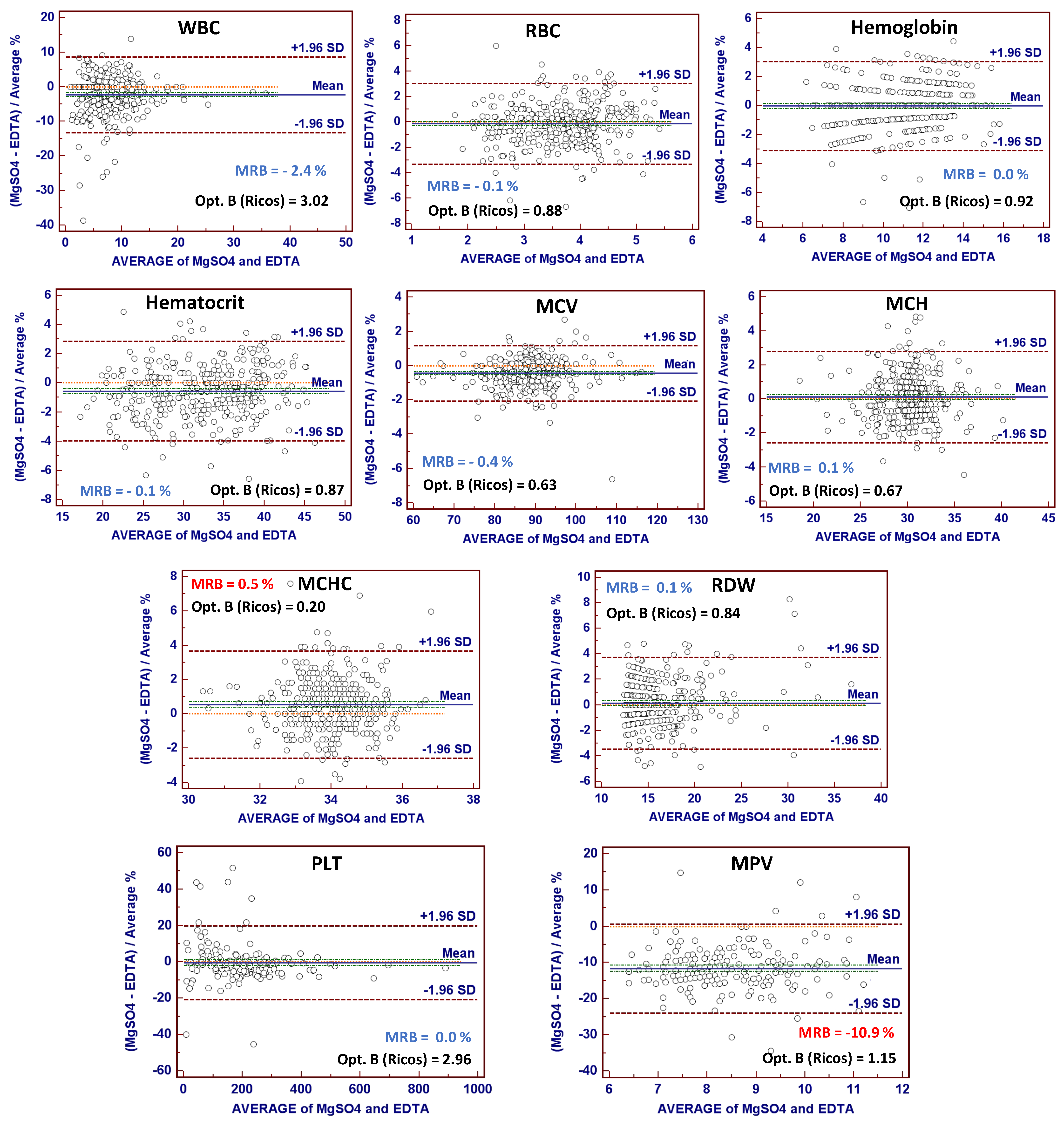
The mean relative bias (MRB) calculated from Bland–Altman regressions for the different parameters for the whole population is shown in Figure 1. All of them, except for WBCs, MCHC, and MPV, were below Ricos’s optimal bias. For WBCs, however, the MRB was below the desirable bias (6.04%). In contrast, for MCHC and MPV, the MRB values were −0.5% and −10.9%, which were below the minimum bias (0.6% and 1.15%, respectively). When we compare the bias in the presence or absence of PLT clumps, MRB was usually lower in the absence of PLT clumps (Table S1). All of them were below the optimal bias, except for WBCs, in the presence of PLT clumps (MRB = 5.8%) and for MCHC, in the presence or absence of clumps (MRB = −0.8%, and −0.5%, respectively). However, for WBCs, the MRB was below the desirable bias (6.04%). The MRB of MCHC in the presence of clumps was above the minimum bias. Clinical consequences are very weak because if we calculate a new threshold for MCHC on MgSO4-anticoagulated samples in the presence of PLT clumps, it is 36.1 g/dL, compared to 36 g/dL on K3-EDTA-anticoagulated samples. For MPV, the normal range is between 7.5 and 11.2 fL. Using the Passing Bablok regression, the usual values in tubes anticoagulated with MgSO4 would be 6.6 to 10.1 fL

3.2. Comparisons of Differentials on K3-EDTA- and MgSO4-Anticoagulated Tubes

For 33 patients, a differential was performed. Results are presented in Table 3. Only neutrophils were significantly lower on MgSO4 tubes in comparison to K3-EDTA, but the MRB (−2.9%) observed was below the optimal bias indicated by Ricos’s recommendations (4.62%). For the other lineages, MRB values were also below the optimal bias, except for basophils (MRB = −33.3%; optimal bias = 7.7%; minimal bias 23.1%). However, the MRB of basophils was below the desirable total error (38.5%). Coefficients of correlation showed a good correlation between K3-EDTA and MgSO4 results but were below 0.9 for eosinophils and basophils.
We also analyzed the consequences of MgSO4 use on CPD. The raw values of CPD were first analyzed (Table S2), and when the variations were statistically significant, they were transformed into percentages of variation. For the four lineages, a significant decrease in mean volume of approximately 5% was observed in MgSO4 tubes (Table 4), whereas conductivity was not significantly affected. The scatter was differently affected according to the different lineages. For the standard deviations (SD), only four were significantly different between K3-EDTA and MgSO4 tubes: the SD-V and SD-UMALS of neutrophils [5.5% (2.2 to 9.2) of decrease and 2.4% (−1.0 to 6.7) of increase, respectively], the SD-V of monocytes [13.2% (1.4–21.0)] of decrease, and the SD-MALS-EO –4.2% [(−25.9–3.8)] of decrease.
Results are expressed as a percentage of variation relative to K3-EDTA samples, with median and 25th–75th percentiles. AL2: Axial light loss; LALS: low-angle light scatter; LMALS: lower-median-angle light scatter; MALS: median-angle light scatter; MN: mean; n.s: not significant; UMALS: upper-median-angle light scatter; V: volume.
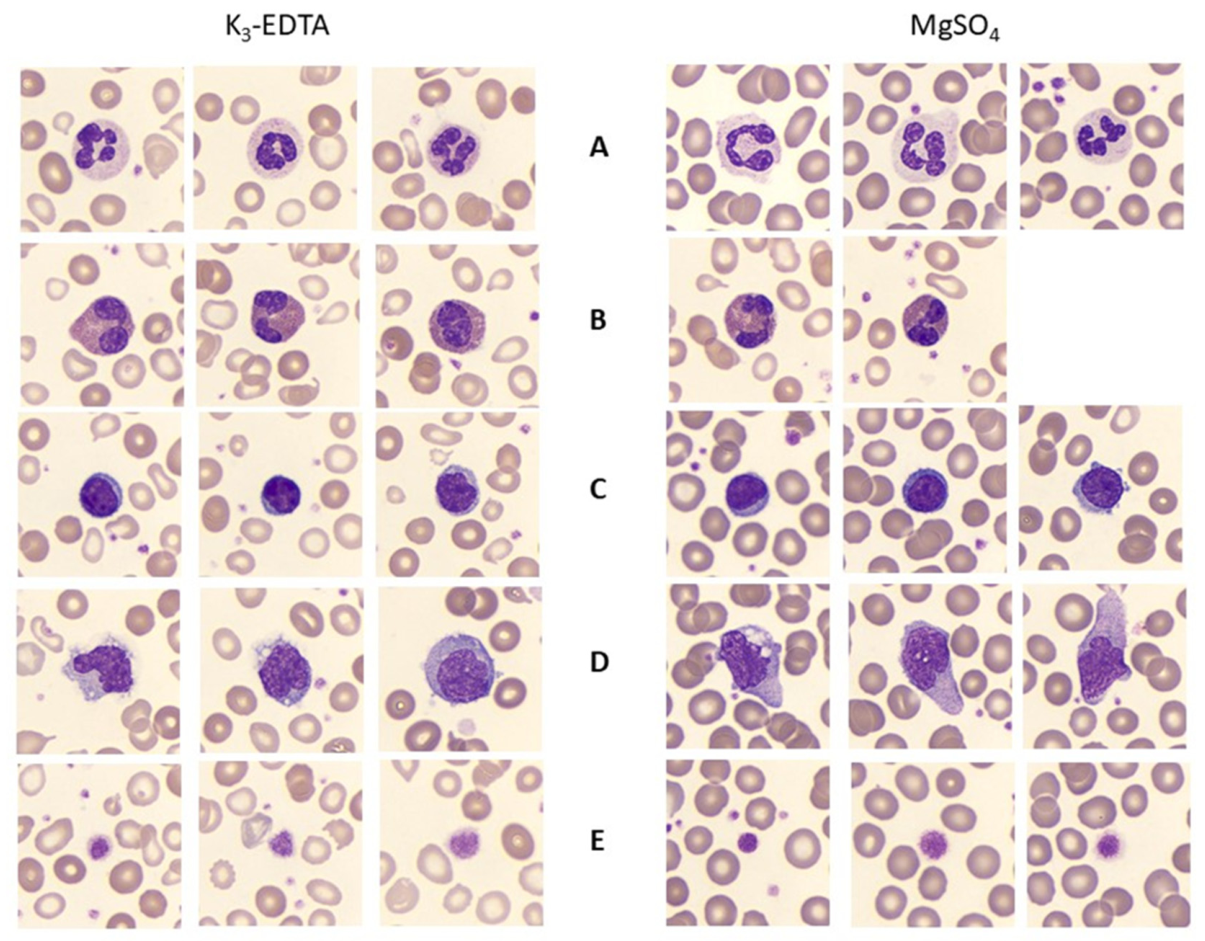
Despite subtle variations detected by the analyzers, the morphology and staining of the different cell types were similar between K3-EDTA- and MgSO4-anticoagulated tubes when smears were stained with MCDh (Figure 2).

3.3. Long-Term Stability of Samples Collected on MgSO4-Anticoagulated Tubes

Long-term stability of CBC was evaluated over a 24 h period. Ten samples were analyzed at times 6, 12, and 24 h after the first analysis (T0). All samples were maintained at room temperature (21 to 25 degrees Celsius) throughout the evaluation period. All parameter results for MgSO4 tubes were compared to the K3-EDTA results obtained at the same time intervals. For PLT count and MPV, only eight values were considered due to EDTA–PTCP in two patients. At T0, as previously detailed, on this small series, WBCs were significantly higher in K3-EDTA samples than in MgSO4 [10.1 (7.5–13.7) versus 9.9 × 10⁹/L (7.4–12.9), respectively, p = 0.0448], MCV [86 (84.4–90.4) versus 85.5 fL (84.1–90.2), respectively, p = 0.0448] as well as MPV [9.0 (8.5–9.5) versus 8.2 fL (7.2–8.6), p < 0.0001] whereas other parameters of CBCs were not significantly different.
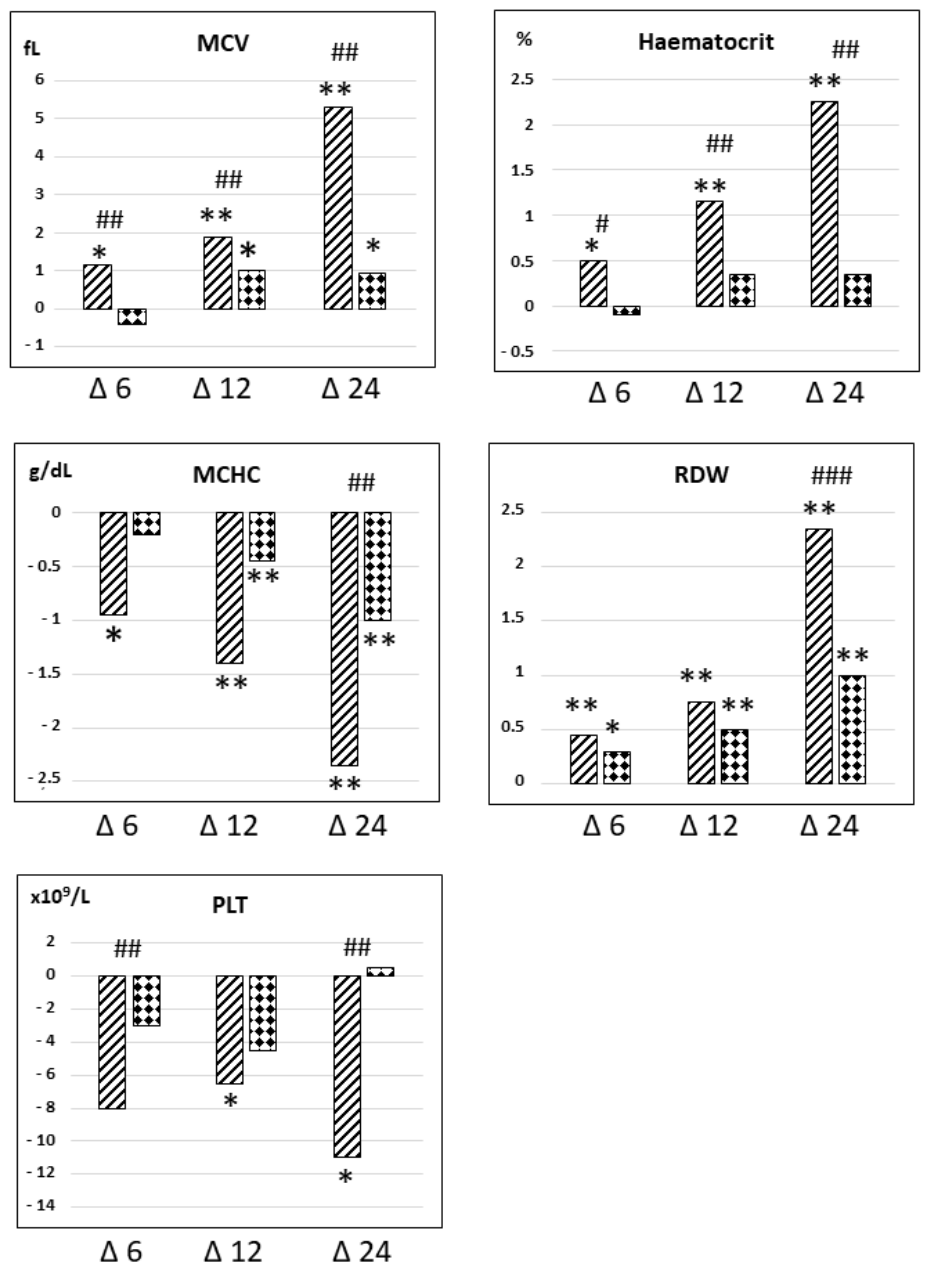
WBCs, RBCs, hemoglobin, and MCH levels were not significantly affected by storage at room temperature during a 24 h period, either on K3-EDTA- or MgSO4-anticoagulated tubes. In contrast, MCV, hematocrit, RDW, and MCMH began to increase significantly from the 6th hour of storage on K3-EDTA-anticoagulated samples and continued to increase over time, whereas MCHC decreased (Figure 3). On MgSO4-anticoagulated samples, RDW also increased slightly from the 6th hour, but after 24 h, the increase was significantly higher (p = 0.004) on K3-EDTA tubes compared to MgSO4-anticoagulated samples. MCV slightly increased from the 12th hour on MgSO4-anticoagulated tubes, but the increase was less marked than on K3-EDTA, and this small increase in MCV did not significantly affect hematocrit as observed for K3-EDTA. MCHC also decreased significantly from the 12th hour of storage on MgSO4-anticoagulated tubes, but the decrease was significantly smaller than that observed in K3-EDTA samples. Concerning PLTs, their levels remained stable when blood was collected in MgSO4 tubes, whereas they decreased over time in K3-EDTA-anticoagulated tubes. MPV was not significantly affected regardless of the anticoagulant used.

4. Discussion

PTCP induced by EDTA is a well-known artifact that can lead to an erroneous result of the PLT count, and the falsely low PLT count may trigger unnecessary, expensive, and even invasive diagnostic or therapeutic procedures. MgSO4, previously used for PLT counting in capillary blood, has been shown to be an efficient anticoagulant to avoid PLT clump formation in case of EDTA-induced PTCP [12,13,14] and has been proposed as the best alternative for PLT quantification in patients with EDTA-induced PTCP [6]. Unfortunately, the use of this specific anticoagulant requires the collection of another EDTA-anticoagulated sample for CBC parameters (WBC, RBC, hemoglobin, and erythrocyte indices). Therefore, the aim of the study was to determine whether CBC obtained on commercially available MgSO4-anticoagulated tubes could be relevant.
On a retrospective series of 355 samples, for which K3-EDTA and MgSO4 tubes were collected simultaneously, and analyzed at similar times on analyzers based on impedance technology (DxH 800), RBC counts, hemoglobin levels, MCH, and RDW were not significantly different, and of course, significantly correlated. In contrast, MCV and hematocrit were significantly lower on MgSO4-anticoagulated samples, as well as MPV. These variations in MCV and hematocrit are very modest and do not affect the interpretation of a possible anemia. In contrast, the variations in MPV are highly significant for clinical interpretation and clearly warrant the establishment of new reference values. A swelling of PLTs when tubes are collected on EDTA has been previously described [15,16] and is less pronounced in MgSO4-anticoagulated blood [17,18], because magnesium has been shown to inhibit platelet activation by different mechanisms [19]. As in our study, swelling of RBC was also observed in EDTA samples kept at room temperature over time [18,19]. In contrast, the swelling of RBCs when MgSO4 was used as an anticoagulant was weak and significant only from the 12th hour after the first analysis and remained stable (1 fL after a 24 h storage at room temperature for MgSO4- versus 5.3 fL for K3-EDTA-anticoagulated samples). The difference between MgSO4 and K3-EDTA is possibly due to the fact that magnesium ions were shown to regulate the stability of the RBC membrane [20]. The slight but significant difference in MCV at T0 (89.8 fL for K3-EDTA versus 89.3 fL for MgSO4 samples, p < 0.0001) could be due to rapid swelling in the K3-EDTA tubes between phlebotomy and blood analysis. If it was not recorded in this study, the median time between blood collection and analysis is approximately 60 min in our hospital. In addition to the variations in MCV, hematocrit, and RDW were slightly lower on MgSO4 tubes than in K3-EDTA, of course, in relation to the swelling of RBCs in K3-EDTA-anticoagulated tubes, and the differences between samples collected on K3-EDTA and MgSO4 become more marked over time, with the lowest variations being observed for the MgSO4-anticoagulated tubes. Similar variations in MCV, hematocrit, and MCHC were also reported in a recent study that examined 250 samples and compared K2-EDTA and MgSO4 samples analyzed on Sysmex XN analyzers [8].
Regarding WBCs, our study showed lower levels in MgSO4 samples than in K3-EDTA samples. A similar result was previously observed by Schuff-Werner et al. [12] in 21 patients: the mean WBC count was 8.25 × 10⁹/L on EDTA versus 7.99 × 10⁹/L on MgSO4 samples. As in our study, neutrophils were also significantly lower (mean level of WBC was 5.61 × 10⁹/L on EDTA versus 5.45 × 10⁹/L on MgSO4 samples, p = 0.0012) on MgSO4 samples than in the EDTA-anticoagulated tube, whereas lymphocyte and monocyte counts were not significantly different. The EDTA salt used was not reported (K2 or K3), and most of the analyzers were from Beckman Coulter. At least three hypotheses can be proposed. Since neutrophils have a significantly smaller volume in MgSO4 samples compared to EDTA tubes, it can be inferred that some neutrophils in MgSO4 samples have a small volume and are excluded from the differential algorithm. However, this does not explain that the total WBC count is also lower in MgSO4 samples, since lymphocytes are smaller than neutrophils; therefore, small neutrophils should be counted in the total WBC count. A second hypothesis would be that neutrophils aggregate in the presence of MgSO4, but no flag was observed, suggesting an erroneous leukocyte count. Lastly, it can be observed that some neutrophils are lysed in the presence of MgSO4. In contrast, Soulard et al. [8] did not observe significant bias when WBC count and differential were performed on K2-EDTA tubes analyzed on the Sysmex XN analyzer. At this time, it is not clear whether these different results are due to the use of different potassium salts or to differences in measurement methods between the two analyzers.
Interestingly, on blood smears, the morphology of the blood cells collected in MgSO4 tubes was comparable to that of samples collected in K3-EDTA, consistent with the results of Schuff-Werner et al. [12]. In contrast, in 15 patients, Choccalingam et al. concluded that the quality of the Leishman-stained smears collected in MgSO4-anticoagulated tubes was below average when compared with EDTA smears for WBCs and RBCs, while PLT morphology was comparable to that of EDTA smears [21]. This discrepancy can be due to the use of a “home-made” anticoagulant, derived from a commercially available MgSO4 solution used for patient injection (Magneon; Neon Laboratories Ltd., Mumbai, India), while Schuff-Werner et al. and we used a commercially available MgSO4-anticoagulated tube, Thrombexact™. Interestingly, Choccalingam et al. also described similar ranges of WBCs and RBCs between EDTA and MgSO4 tubes, but a higher MCV on MgSO4-anticoagulated tubes. Unfortunately, the final concentration of MgSO4 was not reported in their study, making comparisons between their results and ours difficult. They also concluded that further studies on different concentrations of MgSO4 are required in order to use MgSO4 as an anticoagulant for CBCs. Indeed, it was previously observed that MCV variations were dependent on the concentrations of K2-EDTA used, with higher concentrations of K2-EDTA (16 g/L) associated with higher MCV than those observed with low concentrations (2 g/L) of K2-EDTA [22].
Importantly, there was a high correlation between the different CBC parameters obtained with MgSO4- or EDTA-anticoagulated tubes, and CBC values remained stable during a 24 h period, with better stability on MgSO4-anticoagulated tubes, since cell swelling was reduced.
The strength of our study, in real life, is that it included a large number of samples, with wide extreme values of WBCs and RBCs (from 0.8 × 10⁹/L to 99.8 × 10⁹/L for WBC, from 1.76 × 10⁹/L to 5.42 × 10⁹/L for RBC, from 61.0 fL to 116.2 fL for MCV). This work also has several limitations: It is a monocentric, retrospective study, at least concerning the comparison of CBC parameters. In addition, for this study, we compared samples from patients with suspicion of PTCP, mainly because patients had prior PTCP. The PTCP was not confirmed in 285 cases and was considered “normal”. This could introduce a selection bias and reduce the generalizability of the findings to the wider patient population. This study was performed on a DxH 800 analyzer, based on the impedance method. Unfortunately, comparisons of hematology analyzers from different manufacturers have shown an overall moderate agreement between the analyzers [23]. Therefore, we cannot exclude that the good agreement observed for RBC count or hemoglobin levels on a DxH 800 analyzer is also observed for other analyzers that enumerate RBCs optically, for example. Lastly, for differential, we observed good global agreement between the two anticoagulants for “normal” cells, but we did not test patients with activated lymphocytes or immature granular leukocytes. In addition, the number of samples tested for differential, although sufficient for a method validation [24], is low, particularly for eosinophils and basophils, since they were undetectable in some samples. Therefore, this preliminary study requires additional studies to confirm these data, but they are nevertheless in agreement with the recent study using samples collected on K2-EDTA and analyzed on XN analyzers [8]. Such a limitation applies, of course, regarding the stability study.

5. Conclusions

In conclusion, we suggest that CBC and differentials obtained from the DxH 800 analyzer on MgSO4-anticoagulated samples are similar to those obtained using K3-EDTA anticoagulated tubes, both for samples with or without PLT clumps. As previously observed for PLTs [8,13,25], the use of MgSO4 as an anticoagulant does not significantly increase RBC volume during storage when using impedance technology, and it could be employed in situations where an accurate measurement of the MCV is necessary, for example, for the detection of α-thalassemia-1 and β-thalassemia traits in pregnant women [26]. Lastly, the MRB values observed for some parameters were only marginal, within the range of test variability and below the desirable or optimal Ricos’s specifications [11]. The use of MgSO4 on DxH800 produces results comparable to those obtained with K3-EDTA, except for MPV, for which it is necessary to establish new reference values.

Supplementary Materials

The following supporting information can be downloaded at: https://www.mdpi.com/article/10.3390/jcm15124607/s1, Table S1: Comparison of complete blood count of samples anticoagulated either with K3-EDTA or MgSO4 according to the presence (n = 70) or the absence of platelet clumps (n = 285). Spearman’s coefficients of rank correlations and Passing–Bablock regressions between both anticoagulants; Table S2: Comparison of the cellular population data of 33 patients whose blood was collected in K3-EDTA- or MgSO4-anticoagulated tubes.

Author Contributions

Conceptualization, M.V.; methodology, T.P. and M.V.; investigation, A.V. and F.H.; resources, A.V. and F.H.; data curation, M.V.; writing—original draft preparation, M.V.; writing—review and editing, A.V., F.H., T.P. and M.V. All authors have read and agreed to the published version of the manuscript.

Funding

This research received no external funding.

Institutional Review Board Statement

The study was approved by the local Ethics Committee of the Foch Hospital (IRB 00012437) on 13 May 2025. The biological data used were gathered from analyzer systems in an aggregated and/or completely anonymized manner.

Informed Consent Statement

The study was conducted in accordance with French ethical laws. Hospitalized patients and their families were informed that their biological samples and data used for routine care could be used in an anonymous manner unless they expressed their opposition. No patients enrolled in this study, or their families, expressed opposition to the use of their biological samples and data, which, according to French ethical laws and the Foch Hospital Ethics Committee, constitutes informed consent.

Data Availability Statement

The data that support the findings of this study are available from the corresponding author (M.V.) upon reasonable request.

Acknowledgments

The authors warmly thank the laboratory technicians for their daily work and the rigorous backups that made it possible to analyze the data.

Conflicts of Interest

The authors declare no conflicts of interest.

Abbreviations

The following abbreviations are used in this manuscript:
AL2Axial light loss
CBCComplete blood count
CPDCellular positional data
EDTAEthylene diamine tetracetic acid
GFHCFrench-Speaking Cellular Hematology Group
LALSLow-angle light scatter
LMALLower-median-angle light scatter
MMean
MALSMedian-angle light scatter
MCHCMean corpuscular hemoglobin concentration
MCVMean corpuscular volume
MPVMean platelet volume
MRBMean relative bias
PLTPlatelet
PTCPPseudothrombocytopenia
RBCRed blood cell
SDStandard deviation
UMALSUpper-median-angle light scatter
WBCWhite blood cell

References

  1. International Council for Standardization in Haematology. Expert Panel on Cytometry Recommendations of the International Council for Standardization in Haematology for Ethylenediaminetetraacetic Acid Anticoagulation of Blood for Blood Cell Counting and Sizing. Am. J. Clin. Pathol. 1993, 100, 371–372. [Google Scholar] [CrossRef] [PubMed]
  2. Bizzaro, N. EDTA-dependent pseudothrombocytopenia: A clinical and epidemiological study of 112 cases, with 10-year follow-up. Am. J. Hematol. 1995, 50, 103–109. [Google Scholar] [CrossRef]
  3. Lippi, G.; Plebani, M. EDTA-dependent pseudothrombocytopenia:further insights and recommendations for prevention of a clinically threatening artefact. Clin. Chem. Lab. Med. 2012, 50, 1281–1285. [Google Scholar] [CrossRef]
  4. Cantón, R.; Manzanares, J.; Alvarez, E.; Zaragozá, F. In vitro and in vivo antiaggregant effects of magnesium halogenates. Thromb. Haemost. 1987, 58, 957–959. [Google Scholar] [CrossRef]
  5. Golański, J.; Pietrucha, T.; Baj, Z.; Greger, J.; Watala, C. A novel approach to inhibit the anticoagulant-induced spontaneous activation of blood platelets—Effect of magnesium on platelet release reaction in whole blood. Thromb. Res. 1997, 85, 127–132. [Google Scholar] [CrossRef]
  6. Wuilleme, S.; Girard, S.; Soulard, M.; Chatelain, B.; Etienne, E.; Guiheneuf, E.; Geneviève, F.; Vedrenne, A.; Lesesve, J.F.; Baccini, V.; et al. Influence of Anticoagulants on Platelet Counts: A Study and Recommendations from the French Speaking Cellular Hematology Group (GFHC). Int. J. Lab. Hematol. 2025, 47, 415–420. [Google Scholar] [CrossRef] [PubMed]
  7. Vincent, J.L.; Baron, J.F.; Reinhart, K.; Gattinoni, L.; Thijs, L.; Webb, A.; Meier-Hellmann, A.; Nollet, G.; Peres-Bota, D.; ABC (Anemia and Blood Transfusion in Critical Care) Investigators. Anemia and blood transfusion in critically ill patients. JAMA 2002, 288, 1499–1507. [Google Scholar] [CrossRef]
  8. Soulard, M.; Ketatni, H.; Croix, P.; Wuilleme, S.; Cohen, P. Comparison of blood cell count results between MgSO4 and K2EDTA. Stability and accuracy of platelet counting with MgSO4. Int. J. Lab. Hematol. 2026, 48, 336–344. [Google Scholar] [CrossRef] [PubMed]
  9. Jean, A.; Boutet, C.; Lenormand, B.; Callat, M.P.; Buchonnet, G.; Barbay, V.; Basuyau, J.P.; Vasse, M. The new haematology analyzer DxH 800: An evaluation of the analytical performances and leucocyte flags, comparison with the LH 755. Int. J. Lab. Hematol. 2011, 33, 138–145. [Google Scholar] [CrossRef]
  10. Mehmood, R.; Muhammed, R.K.; Hussain, S.; Sana, A. Evaluation of di-potassium and tri-potassium EDTA evacuated tubes for routine haematological testing. J. Clin. Lab. Anal. 2018, 32, e22188. [Google Scholar] [CrossRef]
  11. Ricós, C.; Alvarez, V.; Cava, F.; García-Lario, J.V.; Hernández, A.; Jiménez, C.V.; Minchinela, J.; Perich, C.; Simón, M. Current databases on biological variation: Pros, cons and progress. Scand. J. Clin. Lab. Investig. 1999, 59, 491–500. Available online: https://www.westgard.com (accessed on 25 April 2026). [PubMed]
  12. Schuff-Werner, P.; Steiner, M.; Fenger, S.; Gross, H.J.; Bierlich, A.; Dreissiger, K.; Mannuß, S.; Siegert, G.; Bachem, M.; Kohlschein, P. Effective estimation of correct platelet counts in pseudothrombocytopenia using an alternative anticoagulant based on magnesium salt. Br. J. Haematol. 2013, 162, 684–692. [Google Scholar] [CrossRef]
  13. Mannuß, S.; Kohlschein, P.; Dreißiger, K.; Schuff-Werner, P. Measurement of Platelet Counts and Volume Using Magnesium Sulfate as an Anticoagulant:  Comparison of Impedance and Light-Scatter Technology. Am. J. Clin. Pathol. 2016, 146, 538–545. [Google Scholar] [CrossRef]
  14. Soulard, M.; Croix, P.; Cohen, P. Comparison of platelet count results on the Sysmex XN between citrate or MgSO4 and K2 EDTA anticoagulants. Int. J. Lab. Hematol. 2023, 45, 20–28. [Google Scholar] [CrossRef]
  15. Bath, P.M. The routine measurement of platelet size using sodium citrate alone as the anticoagulant. Thromb. Haemost. 1993, 70, 687–690. [Google Scholar] [CrossRef] [PubMed]
  16. Dastjerdi, M.S.; Emami, T.; Najafian, A.; Amini, M. Mean platelet volume measurement, EDTA or citrate? Hematology 2006, 11, 317–319. [Google Scholar] [CrossRef]
  17. Sheu, J.R.; Hsiao, G.; Shen, M.Y.; Fong, T.H.; Chen, Y.W.; Lin, C.H.; Chou, D.S. Mechanisms involved in the antiplatelet activity of magnesium in human platelets. Br. J. Haematol. 2002, 119, 1033–1041. [Google Scholar] [CrossRef]
  18. Chen, B.H.; Fong, J.F.; Chiang, C.H. Effect of different anticoagulant, underfilling of blood sample and storage stability on selected hemogram. Kaohsiung J. Med. Sci. 1999, 15, 87–93. [Google Scholar]
  19. Freise, K.J.; Schmidt, R.L.; Gingerich, E.L.; Veng-Pedersen, P.; Widness, J.A. The effect of anticoagulant, storage temperature and dilution on cord blood hematology parameters over time. Int. J. Lab. Hematol. 2009, 31, 496–504. [Google Scholar] [CrossRef] [PubMed]
  20. Beaven, G.H.; Parmar, J.; Nash, G.B.; Bennett, B.M.; Gratzer, W.B. Effect of magnesium ions on red cell membrane properties. J. Membr. Biol. 1990, 118, 251–257. [Google Scholar] [CrossRef]
  21. Choccalingam, C.; Radha, R.K.N.; Snigdha, N. Estimation of Platelet Counts and Other Hematological Parameters in Pseudothrombocytopenia Using Alternative Anticoagulant: Magnesium Sulfate. Clin. Med. Insights Blood Disord. 2017, 10, 1179545X17705380. [Google Scholar] [CrossRef]
  22. Goossens, W.; Van Duppen, V.; Verwilghen, R.L. K2- or K3-EDTA: The anticoagulant of choice in routine haematology? Clin. Lab. Haematol. 1991, 13, 291–295. [Google Scholar] [CrossRef] [PubMed]
  23. Ciepiela, O.; Kotuła, I.; Kierat, S.; Sieczkowska, S.; Podsiadłowska, A.; Jenczelewska, A.; Księżarczyk, K.; Demkow, U. A Comparison of Mindray BC-6800, Sysmex XN-2000, and Beckman Coulter LH750 Automated Hematology Analyzers: A Pediatric Study. J. Clin. Lab. Anal. 2016, 30, 1128–1134. [Google Scholar] [CrossRef] [PubMed]
  24. Vassault, A.; Grafmeyer, D.; de Graeve, J.; Cohen, R.; Beaudonnet, A.; Bienvenu, J. Analyses de biologie médicale: Spécifications et normes d’acceptabilité à l’usage de la validation de techniques [Quality specifications and allowable standards for validation of methods used in clinical biochemistry]. Ann. Biol. Clin. 1999, 57, 685–695. [Google Scholar]
  25. Mannuß, S.; Schuff-Werner, P.; Dreißiger, K.; Kohlschein, P. Magnesium Sulfate as an Alternative In Vitro Anticoagulant for the Measurement of Platelet Parameters? Am. J. Clin. Pathol. 2016, 145, 806–814. [Google Scholar] [CrossRef]
  26. Sirichotiyakul, S.; Maneerat, J.; Sanguansermsri, T.; Dhananjayanonda, P.; Tongsong, T. Sensitivity and specificity of mean corpuscular volume testing for screening for alpha-thalassemia-1 and beta-thalassemia traits. J. Obstet. Gynaecol. Res. 2005, 31, 198–201. [Google Scholar] [CrossRef]
Figure 1. Bland–Altman representation of the different parameters of complete blood count from 355 samples collected either on K3-EDTA- (reference) or MgSO4-anticoagulated tubes. The mean relative bias (MRB), in %, is indicated for each parameter, as well as the optimal MRB according to Rico’s [11]. They are red when above the optimal MRB. Hatched lines represent the limits of agreement. MCH: mean corpuscular hemoglobin; MCHC: mean corpuscular concentration of hemoglobin; MCV: mean corpuscular volume; MPV: mean platelet volume; Opt. B: optimal bias; PLT: platelet; RBC: red blood cell; RDW: red blood cell distribution width; TBXT: MgSO4-anticoagulated tube; WBC: white blood cell.
Jcm 15 04607 g001
Figure 2. Comparison of the morphology of leukocytes when the smear was performed from K3-EDTA- or MgSO4-anticoagulated tubes. Blood smears were performed on a DxH Slidemaker Stainer II, stained with an MCDh (Micro Chromatic Detection for Hematology) kit and analyzed on a CellaVision DM 1200. (A) Neutrophils; (B) eosinophils; (C) lymphocytes; (D) monocytes; (E) platelets.
Jcm 15 04607 g002
Figure 3. Variations in complete blood count parameters when samples are collected either in K3-EDTA tubes (oblique lines) or in MgSO4 tubes (diamonds) and re-analyzed 6 (Δ 6), 12 (Δ 12), or 24 (Δ 24) hours after the first analysis (T0). *: comparison to T0; # comparison between K3-EDTA and MgSO4 samples. *: p< 0.05; ** p <0.01; ##: p < 0.01; ###: p < 0.001.
Jcm 15 04607 g003
Table 1. Comparison of complete blood count parameters of 355 patients when blood was collected both on K3-EDTA- and on MgSO4-anticoagulated tubes.
K3-EDTAMgSO4p
White Blood Cells (×109/L) *7.4 [5.2–10.0]7.1 [5.1–9.7]<0.0001
Red Blood Cells (×1012/L)3.75 [3.2–4.2]3.75 [3.15–4.17]0.2806
Hemoglobin (g/dL)11.3 [9.4–12.8]11.3 [9.4–12.8]0.8897
Hematocrit (%)33.3 [27.7–37.5]33.0 [27.4–37.4]<0.0001
Mean Corpuscular Volume (fL)89.8 [85.0–92.8]89.3 [84.5–92.5]<0.0001
Mean Corpuscular Hemoglobin (pg)30.4 [28.7–31.7]30.4 [28.8–31.8]0.3165
Mean Corpuscular Hemoglobin
Concentration (g/dL)
33.9 [33.2–34.6]34.1 [33.5–34.8]<0.0001
Red Cell Distribution Width14.9 [13.7–17.5]14.8 [13.7–17.4]0.1669
Platelets (×109/L) **150 [80–259]151 [83–248]0.0001
Mean Platelet Volume (fL) **8.9 [8.2–10]8.0 [7.3–8.9]<0.0001
* only for the 347 samples without flag on WBC when counted on K3-EDTA tubes; ** only for the 285 samples without platelet clumps. Results are expressed as median (in bold) and [25th–75th percentiles].
Table 2. Spearman’s coefficients of rank correlations and Passing Bablok regressions of 355 samples anticoagulated with K3-EDTA or MgSO4.
Spearman’s
Coefficients of Rank Correlations [95% CI]
Slope
[95% CI]
Intercept
[95% CI]
White Blood Cells (×109/L) *0.993 [0.991–0.994]0.9872 [0.9767–1.0000]−0.0282 [−0.1000–0.0395]
Red Blood Cells (×1012/L)0.996 [0.996–0.997]1.0109 [1.0000–1.0192]−0.0420 [−0.0714–0.0000]
Hemoglobin (g/dL)0.996 [0.949–0.969]1.0000 [1.0000–1.0161]0.0000 [−0.1758–0.0000]
Hematocrit (%)0.995 [0.994–0.996]1.0000 [1.0000–1.0153]−0.2000 [−0.6557–−0.2000]
Mean Corpuscular Volume (fL)0.992 [0.990–0.993]1.0081 [1.0000–1.0192]−1.1008 [−2.0611–0.4000]
Mean Corpuscular Hemoglobin (pg)0.980 [0.976–0.984]1.0000 [0.9429–1.0133]0.0000 [−0.4040–0.0000]
Mean Corpuscular Hemoglobin
Concentration (g/L)
0.841 [0.808–0.869]1.0000 [0.9429–1.0357]0.2000 [−1.0375–2.1229]
Red Cell Distribution Width0.991 [0.988–0.992]1.0000 [1.0000–1.0156]0.0000 [−0.2273–0.0000]
Platelets (×109/L) **0.996 [0.995–0.997]0.9697 [0.9605–0.9791]2.2422 [1.2487–3.5066]
Mean Platelet Volume (fL) **0.913 [0.891–0.930]0.9375 [0.8889–1.0000]−0.3937 [−1.0000–0.0167]
* only for the 347 samples without flag on WBC when counted on K3-EDTA tubes; ** only for the 285 samples without platelet clumps.
Table 3. Comparison of differentials of 33 patients when blood was collected both on K3-EDTA- and on MgSO4-anticoagulated tubes.
Cells (×109/L)K3-EDTAMgSO4pSpearman’s
Coefficients of Rank Correlations [95% CI]
Mean Relative Bias (Bland–Altman)
(%)
Slope
[95% CI]
Intercept
[95% CI]
WBC8.3
[5.1–9.8]
8.1
[5.4–9.2]
0.01510.977
[0.954–0.989]
−2.90.9813
[0.9310–1.0128]
−0.0346
[−0.1449–0.2483]
Neutrophils5.4
[3.2–7.4]
5.4
[3.3–7.3]
0.00380.991
[0.982–0.996]
−2.60.9706
[0.9250–1.0000]
0.0147
[−0.1000–0.1525]
Eosinophils0.1
[0.0–0.1]
0.1
[0.0–0.1]
0.72850.854
[0.726–0.926]
−9.8 *1.0000
[1.0000–1.0000]
0.0000
[0.0000–0.0000]
Basophils0.0
[0.0–0.1]
0.0
[0.0–0.1]
0.86950.899
[0.827–0.942]
−33.3 **1.0000
[1.0000–1.0000]
0.0000
[0.0000–0.0000]
Lymphocytes1.2
[0.8–1.6]
1.2
[0.8–1.6]
0.85960.886
[0.971–0.993]
−0.31.0000
[0.9091–1.0000]
0.0000
[0.0000–0.0818]
Monocytes0.6
[0.4–0.8]
0.6
[0.4–0.8]
0.44050.945
[0.971–0.993]
−2.61.0000
[0.8333–1.0000]
0.0000
[0.0000–0.8333]
* Calculated for 22 samples since in 11 cases, no eosinophils were detected in both K3-EDTA- and MgSO4-anticoagulated tubes. ** Calculated for 12 samples since in 21 cases, no basophils were detected in both K3-EDTA- and MgSO4-anticoagulated tubes.
Table 4. Percentages of variation in the different cellular population data of leukocytes between K3-EDTA- and MgSO4-anticoagulated tubes.
Cells (×109/L)MN-VMN-MALSMN-UMALSMN-LMALSMN-LALSMN-AL2
Neutrophils−5.2
[−7.1–−4.1]
3.8
[0.7–4.9]
1.4
[−0.3–3.1]
5.9
[1.5–8.3]
9.1
[5.1–12.6]
−3.8
[−9.0–−2.4]
Eosinophils−5.1
[−7.6–−2.2]
2.3
[1.9–3.5]
1.8
[1.0–3.3]
3.2
[2.1–4.2]
n.s−4.0
[−9.7–−0.8]
Lymphocytes−2.4
[−3.7–−1.2]
−2.9
[−6.0–0.0]
−6.3
[−10.5–−3.5]
n.s5.7
[2.1–7.9]
n.s
Monocytes−6.7
[−8.2–−3.0]
n.s−5.1
[−7.3–−2.2]
8.8
[5.2–9.9]
21.0
[13.2–28.5]
n.s
Disclaimer/Publisher’s Note: The statements, opinions and data contained in all publications are solely those of the individual author(s) and contributor(s) and not of MDPI and/or the editor(s). MDPI and/or the editor(s) disclaim responsibility for any injury to people or property resulting from any ideas, methods, instructions or products referred to in the content.