Role of Opioid-Free Anesthesia Versus Opioid-Based Anesthesia in Postoperative Pain and Opioid Consumption: A Systematic Review and Meta-Analysis

 , ,
, , 
Abstract
1. Introduction
2. Materials and Methods
2.1. Eligibility Criteria
2.2. Information Sources and Search Strategy
2.3. Selection Process
2.4. Data Collection Process
2.5. Study Risk of Bias Assessment
2.6. Statistical Analysis
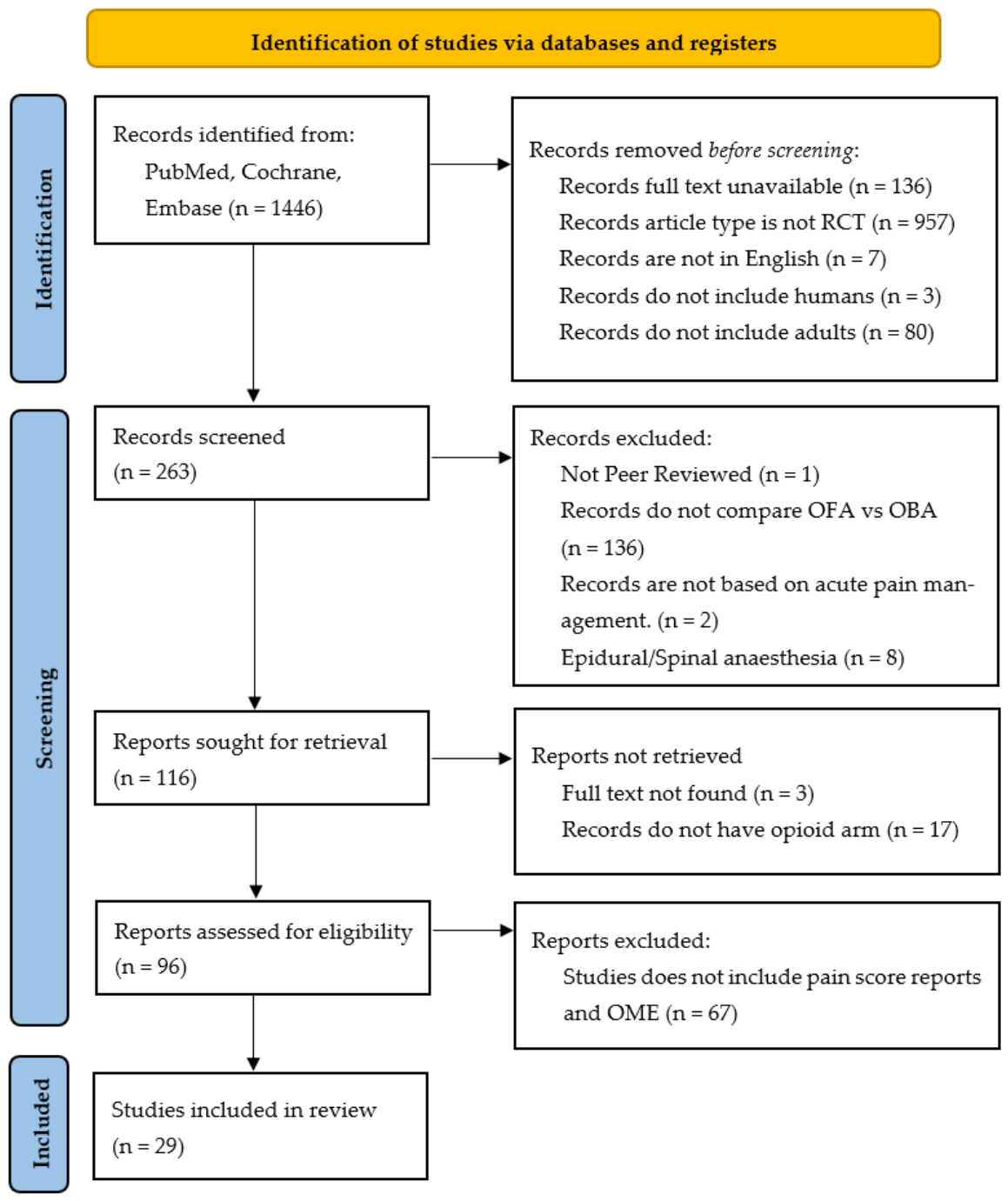
3. Results

| Study | Study Period | Sample (n) | Intraoperative Medications (IV Unless Noted) | Postoperative Medications (IV Unless Noted) | Results | |
|---|---|---|---|---|---|---|
| OBA (Control) | OFA (Treatment) | |||||
| Accurso et al., 2025 [38] | October 2020–December 2022 | 368 | Remifentanil 0.05 μg/kg/min induction → 3 to 5 ng/mL | Bilateral TAP block 20–25 mL of ropivacaine 0.3% for each side (overall 40–50 mL) Bilateral RSB 10 mL of ropivacaine 0.3% for each side (overall 20 mL) Magnesium sulphate 30 mg/kg → 8 mg/kg/h Ketorolac 90 mg (2 mL/h) | OBA: ketorolac 90 mg (2 mL/h) Morphine 0.1 mg/kg/h OFA: acetaminophen 1 g if NRS > 3 | Statistically significant lower NRS score at each time point in the OFA group (p < 0.001). Also, HLOS, PONV, and itching events were significantly lower in OFA group. |
| An et al., 2022 [23] | February 2019–November 2019 | 101 | Sufentanil 0.5 μg/kg → remifentanil 200–500 μg/h | Dexmedetomidine 0.5 µg/kg → 0.5 µg/kg/h Ketorolac 30 mg | Rescue flurbiprofen axetil | There was no statistical difference in VAS scores between the groups (p > 0.05); however, OFA did reduce rescue analgesic consumption after surgery (p < 0.05). Incidences of PONV, intestinal paralysis, pruritus, and HLOS were not significantly different between groups (p > 0.05). |
| Bae et al., 2024 [24] | Not specified | 119 | Remifentanil 3–5 ng/mL → 2–8 ng/mL | Dexmedetomidine 1 µg/kg over 10 min → 0.2–0.7 µg/kg/h Lidocaine 1 mg/kg → 1 mg/kg/h | Fentanyl 15 µg/kg Rescue fentanyl 50 µg or tramadol 50 mg for vNRS > 4 | Opioid requirement and pain scores for 24 h after surgery was lower in the OFA group than in the OBA group (p = 0.036; p = 0.039; p = 0.003, respectively). PONV, LOS, and flatus events were not statistically significant. |
| Bakan et al., 2015 [8] | June 2012–April 2013 | 80 | Fentanyl 2 µg/kg → remifentanil 0.25 µg/kg/min | Dexmedetomidine 0.6 µg/kg → 0.3 µg/kg/h Lidocaine 1.5 mg/kg → 2 mg/kg/h | Fentanyl 20 µg Rescue tramadol 100 mg | OFA reduced pain scores and antiemetic and analgesic use significantly (p = 0.028, p = 0.026, p = 0.034). However, opioid consumption, nausea, vomiting, intraoperative bradycardia, and tachycardia did not significantly change between groups. |
| Beloeil et al., 2021 [5] | March 2017–January 2019 | 314 | Remifentanil 3–5 ng/mL Morphine 0.05 mg/kg | Dexmedetomidine 0.4–1.4 µg/kg/h | Morphine PCA | OFA decreased postoperative opioid consumption (p = 0.002), PONV (p = 0.01), and antiemetic use (p = 0.005) significantly. Intraoperative bradycardia events were significantly higher in OFA (p = 0.004). Other intraoperative hypotension, hypertension events, and HLOS did not differ. |
| Campos-Pérez et al., 2022 [12] | November 2020–March 2021 | 40 | Fentanyl 3 µg/kg bolus → 0.003–0.006 µg/kg/min | Dexmedetomidine 1–1.5 µg/kg over 40 min → 0.3–0.7 µg/kg/min | OFA: metamizole 30 mg/kg Ketamine 0.5 mg/kg MgSO4 5 mg/kg Lidocaine 1 mg/kg Paracetamol 1 g/kg every 12 h OBA: all mentioned above + buprenorphine 1 µg/kg | No significant difference in pain scores, nausea, and vomiting between groups. |
| Chen et al., 2023 [21] | November 2021–May 2022 | 77 | Sufentanil 0.2–0.4 µg/kg → Remifentanil 8–10 µg/kg/h | Dexmedetomidine 0.5 µg/kg → 0.1–0.3 µg/kg/min Esketamine 0.3–0.5 mg/kg → 0.3 mg/kg/h | Flurbiprofen 2.5 mg/kg Rescue flurbiprofen 50 mg OBA: PCIA: sufentanil 2 μg/kg OFA: PCIA: Esketamine 2.5 mg/kg | OFA significantly decreased PONV events (p = 0.02). No difference in pain scores and analgesic use between groups. |
| Chen et al., 2025 [25] | March 2021–January 2022 | 133 | Sufentanil 0.5 μg/kg → 0.025 µg/kg | Dexmedetomidine 1 μg/kg/10 min → 0.5–1.5 µg/kg/h | Flurbiprofen 2.5 mg/kg PCA bolus sufentanil 2 µg | OFA decreased pain scores significantly (p = 0.02). No difference in OME, PONV, and intraoperative bradycardia between groups. |
| Choi et al., 2022 [26] | June 2020–September 2021 | 75 | Remifentanil 3.5 ng/mL → 0.5 ng/mL | Dexmedetomidine 0.7 µg/kg/10 min → 0.5 µg/kg/h Lidocaine 1.5 mg/kg → 1.5 mg/kg/h | PCA: fentanyl 15 µg/kg/100 mL Rescue fentanyl 0.5–1 µg/kg | Postoperative pain score, nausea, vomiting, antiemetic and analgesic use, pruritus, flatus events, and intraoperative bradycardia events were not significantly different between groups. Intraoperative hypotension events were lower (p = 0.039) and QoR-40 was high (p = 0.018) in OFA group. |
| Copik et al., 2024 [39] | December 2015–March 2018 | 50 | Fentanyl 1.5 µg/kg → 1–3 µg/kg | T3–4 PVB with bupivacaine 0.3 mL/kg Lidocaine 1.5 mg/kg → 2 mg /kg/h for 2 h → 1.2 mg /kg/h to 24 h Ketamine 0.35 mg/kg → 0.2 mg /kg/h for 2 h → 0.12 mg /kg/h | Oxycodone PCA 1 mg | OFA had lower opioid consumption (p < 0.0001). No difference in pain, PONV, and analgesic use. |
| Dai et al., 2023 [40] | March 2021–April 2022 | 122 | Sufentanil 0.5–1 µg/kg | Bilateral TAPB + QLB with 20 mL 0.20% ropivacaine per site × 4 | PCIA: esketamine 50 mg + flurbiprofen 250 mg | OFA significantly reduced pain at all checkpoints (p < 0.001). |
| Feng et al., 2024 [22] | May 2022–November 2022 | 120 | Sufentanil 0.3 µg/kg over 5 min → 0.1 µg/kg/h | Dexmedetomidine 0.6 µg/kg/10 min → 0.2–1 µg/kg/h Esketamine 0.3 mg/kg → 0.1 mg/kg | PCA sufentanil 1 µg/mL (1 µg/h basal, 2 µg bolus, 10 min lock) | Pain scores, sufentanil consumption, antiemetic use, LOS, and intraoperative HR and BP changes were similar between groups. PONV events were significantly lower in OFA (p = 0.031). |
| Hakim & Wahba, 2019 [27] | December 2017–January 2019 | 80 | Fentanyl 1 µg/kg → 0.5 µg/kg/h | Dexmedetomidine 0.6 µg/kg / 5 min → 0.2 µg/kg/h | Rescue tramadol 0.5 mg/kg if NRS > 3 | There were significantly lower pain scores (p = 0.02), nausea and vomiting events (p = 0.03), and QoR-40 (p = 0.03) in OFA. No significant change in intraoperative bradycardia. |
| Hu et al., 2024 [28] | February 2023–April 2023 | 72 | Sufentanil 0.3 µg/kg over 5 min → 0.1 µg/kg/h | Lidocaine 1.5 mg/kg → 2 mg/kg/h Esketamine 0.15 mg/kg over 5 min → 0.10 mg/kg/h | Sufentanil 100 µg | There was no difference between groups in pain scores, postoperative opioid need, PONV, and flatus events. |
| Liu et al., 2023 [29] | February 2022–September 2022 | 66 | Remifentanil 1–2 µg/kg → 0.05–0.2 µg/kg/min | Dexmedetomidine 1 µg/kg over 10 min → 0.5 µg/kg/h Esketamine 0.5 mg/kg → 0.25 mg/kg/h Lidocaine 1.5 mg/kg ICPB 7.5 mL 0.25% bupivacaine + dexmedetomidine 5 µg/kg per side | Rescue dezocine 2.5 mg (VAS 4–6) or 5 mg (>6) | There was no difference in pain scores, nausea and vomiting, pruritus, and flatus events. QoR-40 scores were statistically significantly high in OFA (p = 0.001). |
| Luo et al., 2025 [30] | September 2023–September 2024 | 68 | Sufentanil 0.3–0.5 µg/kg → Remifentanil 6–10 µg/kg/h | Esketamine 0.3–0.5 mg/kg → 0.3–0.5 mg/kg/h | PCA: sufentanil 100 µg | OFA group had lower pain AUC (p = 0.001), less PONV (p = 0.033), and higher BP changes between groups. No difference in LOS, pruritus, and HR. |
| Perez et al., 2024 [31] | December 2019–June 2023 | 181 | Fentanyl 50 µg | Dexmedetomidine 1 µg/kg → 0.4 µg/kg/h Ketamine 0.5 mg/kg Lidocaine 2 mg/kg/h | Rescue fentanyl 25–50 µg or hydromorphone 0.5 mg ward: oxycodone 5 mg every 4 h as needed (+rescue 5 mg) | No significant reduction in pain scores, OME, vomiting, antiemetic use, LOS, pruritus and bradycardia events, but OFA significantly decreased analgesic use in 24 h (p = 0.02). |
| Shirakami et al., 2006 [32] | June 2000–October 2002 | 51 | Fentanyl 100 µg | Saline 100 µg | Flurbiprofen 50 mg Loxoprofen, po 60 mg | No significant reduction in pain scores, bradycardia, tachycardia, or hypotension events, but OFA significantly decreased analgesic use (p < 0.01), vomiting (p < 0.05), and antiemetic use (p < 0.05). |
| Swamy et al., 2025 [33] | October 2020–May 2022 | 70 | Fentanyl 2 µg/kg | Dexmedetomidine 1 µg/kg Ketamine 25 mg | Rescue diclofenac 75 mg IV for VAS > 4 | Pain score was statistically significantly reduced in OFA group (p < 0.0001). |
| Toleska & Dimitrovski, 2019 [11] | Not specified | 60 | Fentanyl 0.002 mg/kg | Dexamethasone 0.1 mg/kg Paracetamol 1 g Lidocaine 1 mg/kg → 2 mg/kg/h Ketamine 0.5 mg/kg Magnesium sulphate 1.5 g/h | Ketoprofen 100 mg if VAS 4–6 Tramadol 100 mg if VAS ≥ 7 | Pain score was statistically significantly reduced in OFA group (p < 0.002). |
| Toleska et al., 2023 [10] | Not specified | 60 | Fentanyl 100 µg → 50–100 µg | Dexamethasone 0.1 mg/kg Paracetamol 1 g Lidocaine 2 mg/kg/h Ketamine 0.5 mg/kg → 0.2 mg/kg/h Magnesium sulphate 15 mg/kg/h | Thoracic epidural morphine | OFA significantly reduced pain (p < 0.001), opioid use (p = 0.0015), and PONV (p < 0.001). No difference in non-opioid analgesic use. |
| Walldén et al., 2006 [34] | April 2002–January 2003 | 45 | Remifentanil 0.2 µg/kg/min TCI-propofol 2–4 µg/mL | Mask induction 8% sevoflurane | Rescue ketobemidone 1–2 mg for VAS > 3 | Total 24 h pain, opioid consumption, and PONV events did not differ between groups. |
| Wang et al., 2024 [7] | May 2022–December 2022 | 394 | Sufentanil 0.3 µg/kg → 0.1 µg/kg | Esketamine 0.3 mg/kg → 0.1 mg/kg Lidocaine 1 mg/kg Dexmedetomidine 0.5 µg/kg → 0.2 µg/kg/h | Rescue tramadol 50 mg for NRS ≥ 4 | OFA decreased pain significantly (p = 0.017), as well as PONV (p < 0.001), and antiemetic use (p < 0.001). No difference in analgesic use and LOS. |
| Wang et al., 2025 [35] | July 2023–June 2024 | 173 | Sufentanil 0.6 µg/kg | Ultrasound-guided TAP block 20 mL 0.375% ropivacaine/side dexmedetomidine 0.4 µg/kg over 10 min Esketamine 0.5 mg/kg Lidocaine 1 mg/kg | Rescue sufentanil 5 µg if VAS > 3 | OFA decreased pain significantly (p < 0.001). No difference in PONV and analgesic use. |
| Xue et al., 2024 [14] | September 2021–September 2022 | 60 | Propofol 2 mg/kg → 5–8 mg/kg/h Fentanyl 3–4 µg/kg → remifentanil 5–10 µg/kg/h | Dexmedetomidine 0.8–1 µg/kg over 10 min → 0.3–0.5 µg/kg/h Esketamine 0.3 mg/kg → 0.15 mg/kg/h | Rescue dezocine 5 mg if VAS > 3 | Pain scores and antiemetic frequency were similar between groups; when counting nausea and vomiting together, OFA had fewer events (p = 0.039). |
| Yan et al., 2025 [13] | Not specified | 165 | Sufentanil 0.3–0.4 µg/kg → remifentanil 0.1–0.2 µg/kg/min | Dexmedetomidine 0.5 µg/kg × 15 min → 0.5 µg/kg/h Lidocaine 1.5 mg/kg → 1.5 mg/kg/h | PCA sufentanil 1 µg/h + 2 µg bolus | Pain scores, OME, and LOS were similar between groups, but OFA had fewer PONV events (p = 0.017). |
| Yu et al., 2023 [36] | Not specified | 150 | Remifentanil 1 µg/kg → 0.1–0.3 µg/kg/min | Dexmedetomidine 0.6 µg/kg over 10 min Lidocaine 1.5 mg/kg → 2 mg/kg/h Esketamine 0.3 mg/kg | PCIA: butorphanol 10 mg in 100 mL Rescue 2.5 mL (2.5 mg) bolus every 15 min | OFA cut rescue butorphanol requirements (p < 0.001), and less time to flatus in hours (p < 0.029) significantly. PONV events were similar between groups. |
| Zhou et al., 2023 [37] | May 2021–December 2021 | 773 | Sufentanil 0.3 µg/kg → remifentanil 0.1–0.5 µg/kg/min | Dexmedetomidine 0.5 mg/kg over 10 min → 0.5 mg/kg/h Lidocaine 1.5 mg/kg → 1.5 mg/kg/h | Rescue tramadol 50–100 mg PO if NRS > 4 | OFA has significantly low pain scores (p = 0.03), low PONV events (p = 0.002), and high QoC-40 scores (p = 0.001). There was no difference in analgesic or antiemetic use. |
| Ziemann-Gimmel et al., 2014 [41] | November 2011–October 2012 | 119 | Fentanyl 0.5–1 µg/kg → intermittent fentanyl/morphine/hydromorphone boluses inhalant anesthetics | Dexmedetomidine 0.5 µg/kg → 0.1–0.3 µg/kg/h, propofol 75–150 µg/kg/min, ketamine 0.5 mg/kg bolus | Rescue hydromorphone or oxycodone PO | Post-op opioid means statistically equivalent. There was a significant decrease in PONV in OFA (p = 0.04). |
3.1. Primary Outcome
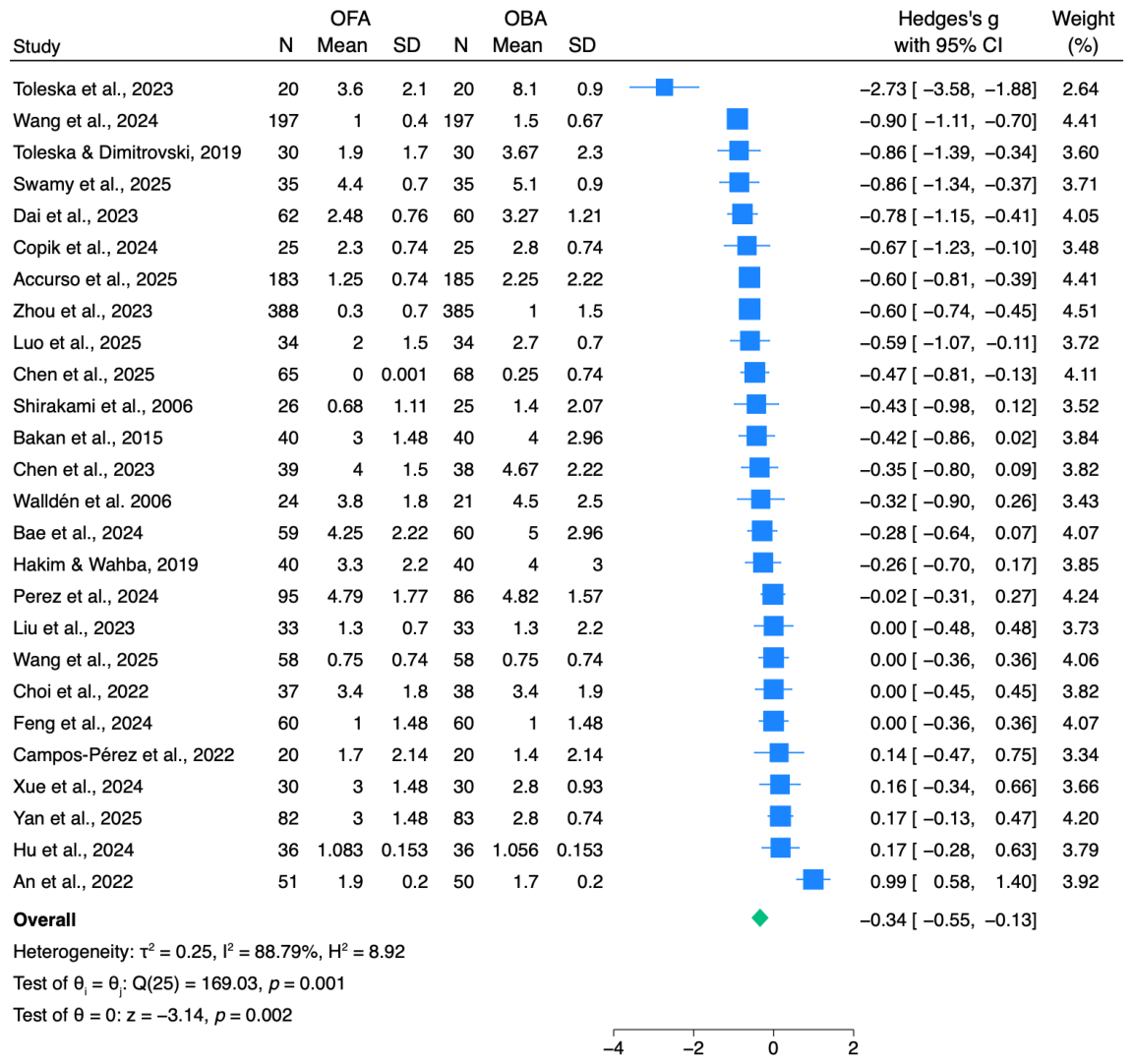
3.1.1. Postoperative Pain
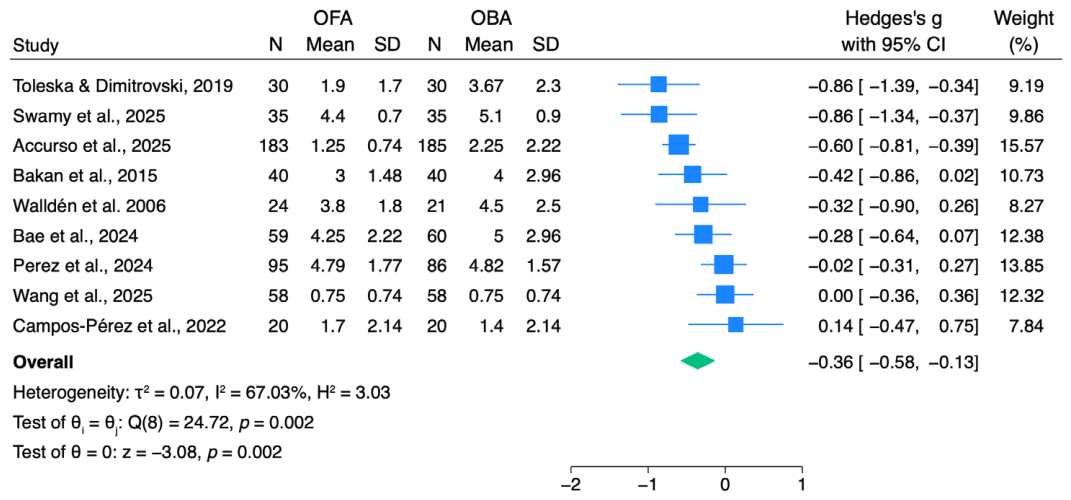
Postoperative Pain Subgroup: Endoscopic Abdominal and Pelvic Procedure
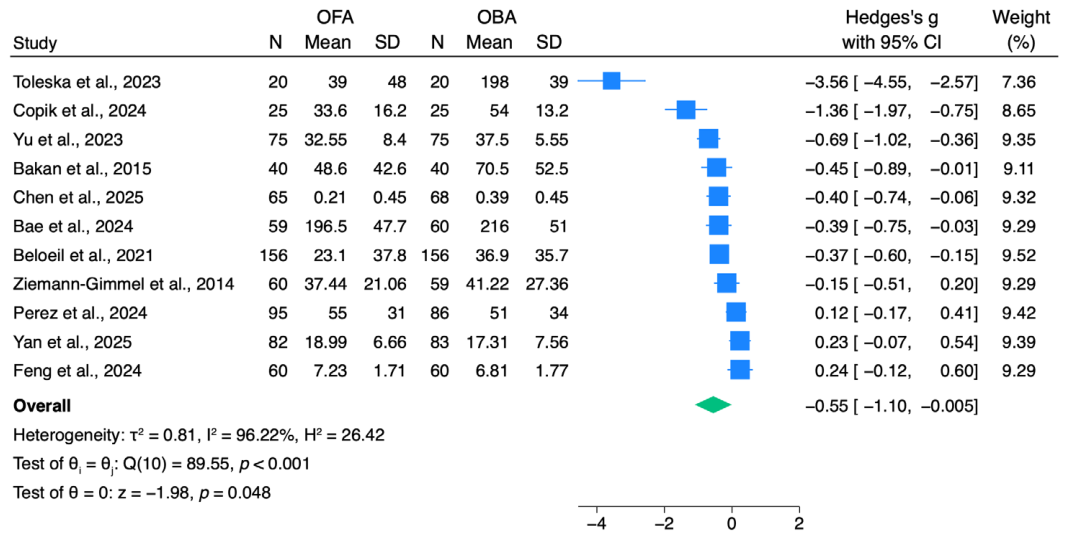
3.1.2. OME
3.2. Secondary Outcome
3.2.1. Postoperative Nausea and Vomiting
3.2.2. Postoperative Antiemetic Use
3.2.3. Rescue Non-Opioid Analgesic Use
3.2.4. Other Secondary Outcomes in the Postoperative Period
3.2.5. Intraoperative Vital Changes
4. Discussion
4.1. Postoperative Opioid Consumption
4.2. Secondary Outcomes: PONV and Hemodynamics
4.3. Quality of Recovery
4.4. Recent Meta-Analyses
4.5. Limitations and Research Priorities
5. Conclusions
Supplementary Materials
Author Contributions
Funding
Data Availability Statement
Acknowledgments
Conflicts of Interest
Abbreviations
| AUC | Area under the curve |
| CI | Confidence interval |
| CPSP | Chronic postsurgical pain |
| ERAS | Enhanced recovery after surgery |
| GRADE | Grades of recommendation, assessment, development, and evaluation |
| IQR | Interquartile range |
| IV | Intravenous |
| QoR-15 | Quality of recovery-15 questionnaire |
| QoR-40 | Quality of recovery-40 questionnaire |
| NMDA | N-methyl-D-aspartate |
| NSAID | Nonsteroidal anti-inflammatory drug |
| OBA | Opioid-based anesthesia |
| OFA | Opioid-free anesthesia |
| OME | Oral morphine equivalent |
| PONV | Postoperative nausea and vomiting |
| PRISMA | Preferred reporting items for systematic review and meta-analysis |
| PROSPERO | Prospective register of systematic reviews |
| REML | Restricted maximum likelihood |
| RoB 2 | Cochrane risk-of-bias tool for randomized trials |
| RR | Relative risk |
| SD | Standard deviation |
| RCT | Randomized controlled trial |
References
- Koepke, E.J.; Manning, E.L.; Miller, T.E.; Ganesh, A.; Williams, D.G.A.; Manning, M.W. The rising tide of opioid use and abuse: The role of the anesthesiologist. Perioper. Med. 2018, 7, 16. [Google Scholar] [CrossRef]
- Glare, P.; Aubrey, K.R.; Myles, P.S. Transition from acute to chronic pain after surgery. Lancet 2019, 393, 1537–1546. [Google Scholar] [CrossRef]
- Gan, T. Poorly controlled postoperative pain: Prevalence, consequences, and prevention. J. Pain Res. 2017, 10, 2287–2298. [Google Scholar] [CrossRef] [PubMed]
- Luo, X.; Rao, P.G.; Lei, X.H.; Yang, W.W.; Liao, B.Z.; Guo, R. Opioid-free strategies for patient-controlled intravenous postoperative analgesia: A review of recent studies. Front. Pharmacol. 2024, 15, 1454112. [Google Scholar] [CrossRef] [PubMed]
- Beloeil, H.; Garot, M.; Lebuffe, G.; Gerbaud, A.; Bila, J.; Cuvillon, P.; Dubout, E.; Oger, S.; Nadaud, J.; Becret, A.; et al. Balanced Opioid-free Anesthesia with Dexmedetomidine versus Balanced Anesthesia with Remifentanil for Major or Intermediate Noncardiac Surgery. Anesthesiology 2021, 134, 541–551. [Google Scholar] [CrossRef]
- Pirie, K.; Traer, E.; Finniss, D.; Myles, P.S.; Riedel, B. Current approaches to acute postoperative pain management after major abdominal surgery: A narrative review and future directions. Br. J. Anaesth. 2022, 129, 378–393. [Google Scholar] [CrossRef] [PubMed]
- Wang, D.; Sun, Y.; Zhu, Y.J.; Shan, X.S.; Liu, H.; Ji, F.H.; Peng, K. Comparison of opioid-free and opioid-inclusive propofol anaesthesia for thyroid and parathyroid surgery: A randomised controlled trial. Anaesthesia 2024, 79, 1072–1080. [Google Scholar] [CrossRef]
- Bakan, M.; Umutoglu, T.; Topuz, U.; Uysal, H.; Bayram, M.; Kadioglu, H.; Salihoglu, Z. Opioid-free total intravenous anesthesia with propofol, dexmedetomidine and lidocaine infusions for laparoscopic cholecystectomy: A prospective, randomized, double-blinded study. Braz. J. Anesthesiol. 2015, 65, 191–199. [Google Scholar] [CrossRef]
- Barakat, H.; Al Nawwar, R.; Abou Nader, J.; Aouad, M.; Yazbeck Karam, V.; Gholmieh, L. Opioid-free versus opioid-based anesthesia in major spine surgery: A prospective, randomized, controlled clinical trial. Minerva Anestesiol. 2024, 90, 482–490. [Google Scholar] [CrossRef]
- Toleska, M.; Dimitrovski, A.; Dimitrovska, N.T. Comparation Among Opioid-Based, Low Opioid and Opioid Free Anesthesia in Colorectal Oncologic Surgery. Prilozi 2023, 44, 117–126. [Google Scholar] [CrossRef]
- Toleska, M.; Dimitrovski, A. Is Opioid-Free General Anesthesia More Superior for Postoperative Pain Versus Opioid General Anesthesia in Laparoscopic Cholecystectomy? Prilozi 2019, 40, 81–87. [Google Scholar] [CrossRef]
- Campos-Pérez, W.; Ramírez-Plascencia, L.; Pérez-Robles, M.; Rivera-Valdés, J.J.; Sánchez-Muñoz, P.; Pérez-Vargas, L.; González-Landeros, D.; Cuevas, J.H.M.; Martínez-López, E. A comparison of opioid-containing anesthesia versus opioid-free anesthesia using the Cortínez-Sepúlveda model on differential cytokine responses in obese patients undergoing gastric bypass surgery: A randomized controlled trial. BMC Anesthesiol. 2022, 22, 294. [Google Scholar] [CrossRef]
- Yan, X.; Liang, C.; Jiang, J.; Ji, Y.; Wu, A.S.; Wei, C.W. Effects of balanced opioid-free anesthesia on post-operative nausea and vomiting in patients undergoing video-assisted thoracic surgery: A randomized trial. BMC Anesthesiol. 2025, 25, 62. [Google Scholar] [CrossRef]
- Xue, Z.; Yan, C.; Liu, Y.; Yang, N.; Zhang, G.; Qian, W.; Qian, B.; Liu, X. Opioid-free anesthesia with esketamine-dexmedetomidine versus opioid-based anesthesia with propofol-remifentanil in shoulder arthroscopy: A randomized controlled trial. BMC Surg. 2024, 24, 228. [Google Scholar] [CrossRef]
- Olausson, A.; Svensson, C.J.; Andréll, P.; Jildenstål, P.; Thörn, S.E.; Wolf, A. Total opioid-free general anaesthesia can improve postoperative outcomes after surgery, without evidence of adverse effects on patient safety and pain management: A systematic review and meta-analysis. Acta Anaesthesiol. Scand. 2022, 66, 170–185. [Google Scholar] [CrossRef] [PubMed]
- Feenstra, M.L.; Jansen, S.; Eshuis, W.J.; van Berge Henegouwen, M.I.; Hollmann, M.W.; Hermanides, J. Opioid-free anesthesia: A systematic review and meta-analysis. J. Clin. Anesth. 2023, 90, 111215. [Google Scholar] [CrossRef]
- Wan, X.; Wang, W.; Liu, J.; Tong, T. Estimating the sample mean and standard deviation from the sample size, median, range and/or interquartile range. BMC Med. Res. Methodol. 2014, 14, 135. [Google Scholar] [CrossRef] [PubMed]
- University of California San Francisco. Available online: https://pain.ucsf.edu/opioid-analgesics/calculation-oral-morphine-equivalents-ome (accessed on 24 May 2026).
- McGuinness, L.A.; Higgins, J.P.T. Risk-of-bias VISualization (robvis): An R package and Shiny web app for visualizing risk-of-bias assessments. Res. Synth. Methods 2021, 12, 55–61. [Google Scholar] [CrossRef]
- Guyatt, G.; Oxman, A.D.; Akl, E.A.; Kunz, R.; Vist, G.; Brozek, J.; Norris, S.; Falck-Ytter, Y.; Glasziou, P.; DeBeer, H.; et al. GRADE guidelines: 1. Introduction-GRADE evidence profiles and summary of findings tables. J. Clin. Epidemiol. 2011, 64, 383–394. [Google Scholar] [CrossRef] [PubMed]
- Chen, L.; He, W.; Liu, X.; Lv, F.; Li, Y. Application of opioid-free general anesthesia for gynecological laparoscopic surgery under ERAS protocol: A non-inferiority randomized controlled trial. BMC Anesthesiol. 2023, 23, 34. [Google Scholar] [CrossRef]
- Feng, C.D.; Xu, Y.; Chen, S.; Song, N.; Meng, X.W.; Liu, H.; Ji, F.H.; Peng, K. Opioid-free anaesthesia reduces postoperative nausea and vomiting after thoracoscopic lung resection: A randomised controlled trial. Br. J. Anaesth. 2024, 132, 267–276. [Google Scholar] [CrossRef] [PubMed]
- An, G.; Wang, G.; Zhao, B.; Zhang, X.; Li, Z.; Fu, J.; Zhao, X. Opioid-free anesthesia compared to opioid anesthesia for laparoscopic radical colectomy with pain threshold index monitoring: A randomized controlled study. BMC Anesthesiol. 2022, 22, 241. [Google Scholar] [CrossRef]
- Bae, M.I.; Oh, J.; Lee, H.S.; Park, S.; Kwon, I.G.; Song, Y. Influence of psychological factors and pain sensitivity on the efficacy of opioid-free anesthesia: A randomized clinical trial. Gen. Hosp. Psychiatry 2024, 89, 84–92. [Google Scholar] [CrossRef] [PubMed]
- Chen, J.; He, L.; Shi, Y.; Jiao, J.; Huang, S.; Zhou, J.; Luo, Q. Effect of opioid-free anesthesia combined with pectoral nerve block on the quality of recovery in patients after mastectomy: A randomized, controlled trial. PLoS ONE 2025, 20, e0320592. [Google Scholar] [CrossRef]
- Choi, H.; Song, J.Y.; Oh, E.J.; Chae, M.S.; Yu, S.; Moon, Y.E. The Effect of Opioid-Free Anesthesia on the Quality of Recovery After Gynecological Laparoscopy: A Prospective Randomized Controlled Trial. J. Pain Res. 2022, 15, 2197–2209. [Google Scholar] [CrossRef]
- Hakim, K.Y.K.; Wahba, W.Z.B. Opioid-Free Total Intravenous Anesthesia Improves Postoperative Quality of Recovery after Ambulatory Gynecologic Laparoscopy. Anesth. Essays Res. 2019, 13, 199–203. [Google Scholar] [CrossRef]
- Hu, Y.; Zhang, Q.Y.; Qin, G.C.; Zhu, G.H.; Long, X.; Xu, J.F.; Gong, Y. Balanced opioid-free anesthesia with lidocaine and esketamine versus balanced anesthesia with sufentanil for gynecological endoscopic surgery: A randomized controlled trial. Sci. Rep. 2024, 14, 11759. [Google Scholar] [CrossRef]
- Liu, Z.; Bi, C.; Li, X.; Song, R. The efficacy and safety of opioid-free anesthesia combined with ultrasound-guided intermediate cervical plexus block vs. opioid-based anesthesia in thyroid surgery-a randomized controlled trial. J. Anesth. 2023, 37, 914–922. [Google Scholar] [CrossRef]
- Luo, L.L.; Xiao, R.; Zhang, J.P.; Xi, W.F.; Xu, G.H.; Yuan, H. Opioid-Free Anesthesia with Esketamine Combined with Iliac Fascia Block in Elderly Patients Undergoing Hip Surgery. Drug Des. Dev. Ther. 2025, 19, 3337–3349. [Google Scholar] [CrossRef]
- Perez, J.J.; Strunk, J.D.; Preciado, O.M.; DeFaccio, R.J.; Chang, L.C.; Mallipeddi, M.K.; Deal, S.B.; Oryhan, C.L. Effect of an opioid-free anesthetic on postoperative opioid consumption after laparoscopic bariatric surgery: A prospective, single-blinded, randomized controlled trial. Reg. Anesth. Pain Med. 2024, 50, 699–705. [Google Scholar] [CrossRef] [PubMed]
- Shirakami, G.; Teratani, Y.; Segawa, H.; Matsuura, S.; Shichino, T.; Fukuda, K. Omission of fentanyl during sevoflurane anesthesia decreases the incidences of postoperative nausea and vomiting and accelerates postanesthesia recovery in major breast cancer surgery. J. Anesth. 2006, 20, 188–195. [Google Scholar] [CrossRef]
- Swamy, A.H.M.; Sneka, G.; Kumararadhya, G.B.; Chennabasappa, A.; Shivakumar, K.G.; Umesh, S. Effects of Opioid-based and Opioid-free Anesthesia in Patients Undergoing Elective Laparoscopic Surgeries. Ann. Afr. Med. 2025, 24, 317–323. [Google Scholar] [CrossRef]
- Walldén, J.; Thörn, S.E.; Lövqvist, A.; Wattwil, L.; Wattwil, M. The effect of anesthetic technique on early postoperative gastric emptying: Comparison of propofol-remifentanil and opioid-free sevoflurane anesthesia. J. Anesth. 2006, 20, 261–267. [Google Scholar] [CrossRef] [PubMed]
- Wang, L.; Hong, X.; Xue, Y.; Su, Z. Effect of opioid sparing strategies on postoperative pain and perioperative hemodynamics in patients undergoing laparoscopic cholecystectomy: A randomized controlled study. BMC Anesthesiol. 2025, 25, 100. [Google Scholar] [CrossRef]
- Yu, J.M.; Tao, Q.Y.; He, Y.; Liu, D.; Niu, J.Y.; Zhang, Y. Opioid-Free Anesthesia for Pain Relief After Laparoscopic Cholecystectomy: A Prospective Randomized Controlled Trial. J. Pain Res. 2023, 16, 3625–3632. [Google Scholar] [CrossRef]
- Zhou, F.; Cui, Y.; Cao, L.; Opioid-Free Anesthesia Working Group. The effect of opioid-free anaesthesia on the quality of recovery after endoscopic sinus surgery: A multicentre randomised controlled trial. Eur. J. Anaesthesiol. 2023, 40, 542–551. [Google Scholar] [CrossRef] [PubMed]
- Accurso, G.; Rampulla, D.; Cusenza, M.; Candela, G.; Savatteri, P.; Vetrugno, L.; Giarratano, A.; Raineri, S.M. A blended opioid-free anesthesia protocol and regional parietal blocks in laparoscopic abdominal surgery- a randomized controlled trial. Sci. Rep. 2025, 15, 14097. [Google Scholar] [CrossRef]
- Copik, M.M.; Sadowska, D.; Smereka, J.; Czyzewski, D.; Misiołek, H.D.; Białka, S. Assessment of feasibility of opioid-free anesthesia combined with preoperative thoracic paravertebral block and postoperative intravenous patient-controlled analgesia oxycodone with non-opioid analgesics in the perioperative anesthetic management for vide. Anaesthesiol. Intensive Ther. 2024, 56, 98–107. [Google Scholar] [CrossRef]
- Dai, J.; Lin, S.; Cui, X.; Xu, Z.; Zheng, R.; Wu, D. The effects of ultrasound-guided QLB and TAPB combined with opioid-free anesthesia (OFA) on clinical efficacy of the patients undergoing abdominal surgery. Heliyon 2023, 9, e20878. [Google Scholar] [CrossRef] [PubMed]
- Ziemann-Gimmel, P.; Goldfarb, A.A.; Koppman, J.; Marema, R.T. Opioid-free total intravenous anaesthesia reduces postoperative nausea and vomiting in bariatric surgery beyond triple prophylaxis. Br. J. Anaesth. 2014, 112, 906–911. [Google Scholar] [CrossRef]
- Shanthanna, H.; Joshi, G.P. Opioid-free Anesthesia and Analgesia in Clinical Practice: Considerations, Techniques, and Limitations. Anesthesiology 2025, 143, 1574–1583. [Google Scholar] [CrossRef] [PubMed]
- Giovannitti, J.A., Jr.; Thoms, S.M.; Crawford, J.J. Alpha-2 adrenergic receptor agonists: A review of current clinical applications. Anesth. Prog. 2015, 62, 31–39. [Google Scholar] [CrossRef]
- Venn, R.M.; Grounds, R.M. Comparison between dexmedetomidine and propofol for sedation in the intensive care unit: Patient and clinician perceptions. Br. J. Anaesth. 2001, 87, 684–690. [Google Scholar] [CrossRef] [PubMed]
- Mercado Santa Cruz, L.A.; Liu, R.; Bharadwaj, K.M.; Johnson, J.J.; Gutierrez, R.; Das, P.; Balanza, G.; Deng, H.; Pandit, A.; Stone, T.A.D.; et al. Association of Intraoperative Opioid Administration with Postoperative Pain and Opioid Use. JAMA Surg. 2023, 158, 854–864. [Google Scholar] [CrossRef]
- Ibrahim, M.; Elnabtity, A.M.; Hegab, A.; Alnujaidi, O.A.; El Sanea, O. Combined opioid free and loco-regional anaesthesia enhances the quality of recovery in sleeve gastrectomy done under ERAS protocol: A randomized controlled trial. BMC Anesthesiol. 2022, 22, 29. [Google Scholar] [CrossRef]
- Choi, H.; Huh, J.; Kim, M.; Moon, S.W.; Kim, K.S.; Hwang, W. Opioid-Free Using Ketamine versus Opioid-Sparing Anesthesia during the Intraoperative Period in Video-Assisted Thoracoscopic Surgery: A Randomized Controlled Trial. J. Pers. Med. 2024, 14, 881. [Google Scholar] [CrossRef] [PubMed]
- Qin, J.; Zhang, J.; Bo, J.; Ma, X.; He, X. Impact of the absence of opioid anesthesia on postoperative outcome indicators: A systematic review and meta-analysis. Front. Med. 2025, 12, 1639968. [Google Scholar] [CrossRef]


| Outcome | n of Studies | Overall | p | I2, % | z | p | GRADE Strength of Evidence |
|---|---|---|---|---|---|---|---|
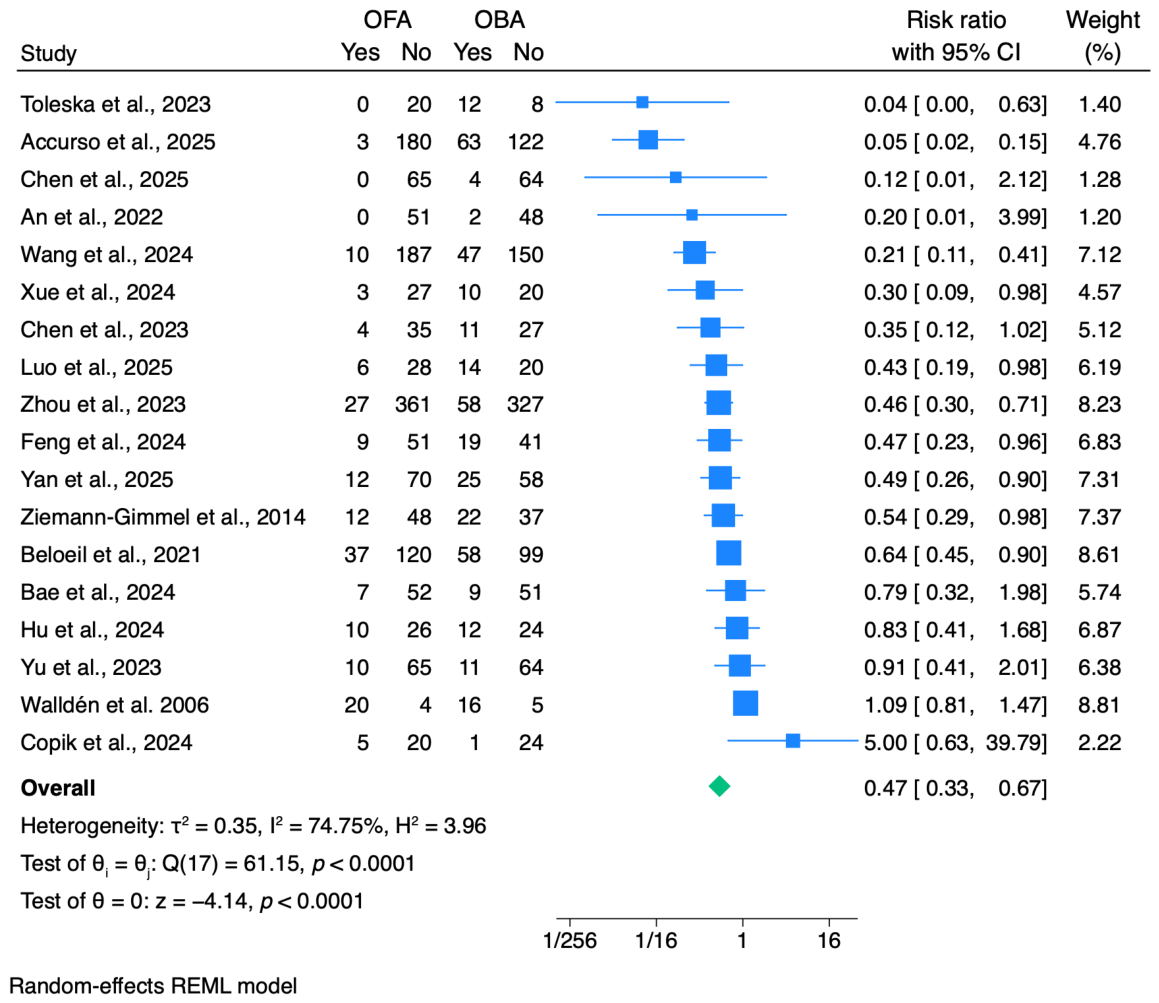
| PONV | 18 | RR: 0.47 [0.33–0.67] | <0.001 | 74.75 | −4.14 | <0.001 | ⨁◯◯◯ Very low |
| Nausea events | 11 | RR: 0.50 [0.36–0.71] | <0.001 | 57.19 | −3.98 | <0.001 | ⨁⨁◯◯ Low |
| Vomiting events | 12 | RR: 0.47 [0.33–0.67] | <0.001 | 18.81 | −4.16 | 0.38 | ⨁⨁⨁◯ Moderate |
| Antiemetic consumption | 9 | RR: 0.36 [0.20–0.66] | <0.001 | 75.65 | −3.33 | <0.001 | ⨁⨁◯◯ Low |
| Analgesic consumption | 10 | RR: 0.71 [0.55–0.91] | 0.01 | 46.50 | −2.65 | 0.03 | ⨁⨁◯◯ Low |
| Time to flatus, hours | 7 | Hedges’ g: −0.33 [−1.03–0.36] | 0.35 | 95.07 | −0.94 | <0.001 | ⨁◯◯◯ Very low |
| Pruritus events | 6 | RR: 0.35 [0.11–1.15] | 0.08 | 44.48 | −1.73 | 0.12 | ⨁◯◯◯ Very low |
| QoR-40 | 4 | Hedges’ g: 0.50 [0.22–0.79] | <0.001 | 59.52 | 3.46 | 0.05 | ⨁⨁◯◯ Low |
| Hospital length of stay, days | 9 | Hedges’ g: −0.21 [−0.67–0.24] | 0.36 | 95.47 | −0.91 | <0.001 | ⨁◯◯◯ Very low |
| Intraoperative hypotension | 7 | RR: 0.73 [0.49–1.10] | 0.13 | 76.63 | −1.19 | <0.001 | ⨁◯◯◯ Very low |
| Intraoperative hypertension | 6 | RR: 1.25 [0.97–1.60] | 0.09 | 24.43 | 1.72 | 0.13 | ⨁⨁◯◯ Low |
| Intraoperative bradycardia | 13 | RR: 1.01 [0.98–1.05] | 0.43 | 62.14 | −0.71 | <0.001 | ⨁◯◯◯ Very low |
| Intraoperative tachycardia | 7 | RR: 1.35 [0.83–2.18] | 0.23 | 13.23 | 1.20 | 0.64 | ⨁⨁◯◯ Low |
Disclaimer/Publisher’s Note: The statements, opinions and data contained in all publications are solely those of the individual author(s) and contributor(s) and not of MDPI and/or the editor(s). MDPI and/or the editor(s) disclaim responsibility for any injury to people or property resulting from any ideas, methods, instructions or products referred to in the content. |
© 2026 by the authors. Licensee MDPI, Basel, Switzerland. This article is an open access article distributed under the terms and conditions of the Creative Commons Attribution (CC BY) license.
Share and Cite
Ayazbekova, A.; Khan, A.; Yerzhan, A.; Monroe, A.; Chelly, J.E. Role of Opioid-Free Anesthesia Versus Opioid-Based Anesthesia in Postoperative Pain and Opioid Consumption: A Systematic Review and Meta-Analysis. J. Clin. Med. 2026, 15, 4560. https://doi.org/10.3390/jcm15124560
Ayazbekova A, Khan A, Yerzhan A, Monroe A, Chelly JE. Role of Opioid-Free Anesthesia Versus Opioid-Based Anesthesia in Postoperative Pain and Opioid Consumption: A Systematic Review and Meta-Analysis. Journal of Clinical Medicine. 2026; 15(12):4560. https://doi.org/10.3390/jcm15124560
Chicago/Turabian StyleAyazbekova, Akbota, Abdurrehman Khan, Adina Yerzhan, Amy Monroe, and Jacques E. Chelly. 2026. "Role of Opioid-Free Anesthesia Versus Opioid-Based Anesthesia in Postoperative Pain and Opioid Consumption: A Systematic Review and Meta-Analysis" Journal of Clinical Medicine 15, no. 12: 4560. https://doi.org/10.3390/jcm15124560
APA StyleAyazbekova, A., Khan, A., Yerzhan, A., Monroe, A., & Chelly, J. E. (2026). Role of Opioid-Free Anesthesia Versus Opioid-Based Anesthesia in Postoperative Pain and Opioid Consumption: A Systematic Review and Meta-Analysis. Journal of Clinical Medicine, 15(12), 4560. https://doi.org/10.3390/jcm15124560