Aspirin for Venous Thromboembolism Prevention in Orthopaedic Surgery with Focus on Trauma and Arthroplasty: A Structured Evidence-Based Review of Randomised Trials, Guidelines, and Contemporary Practice Considerations



Abstract
1. Introduction
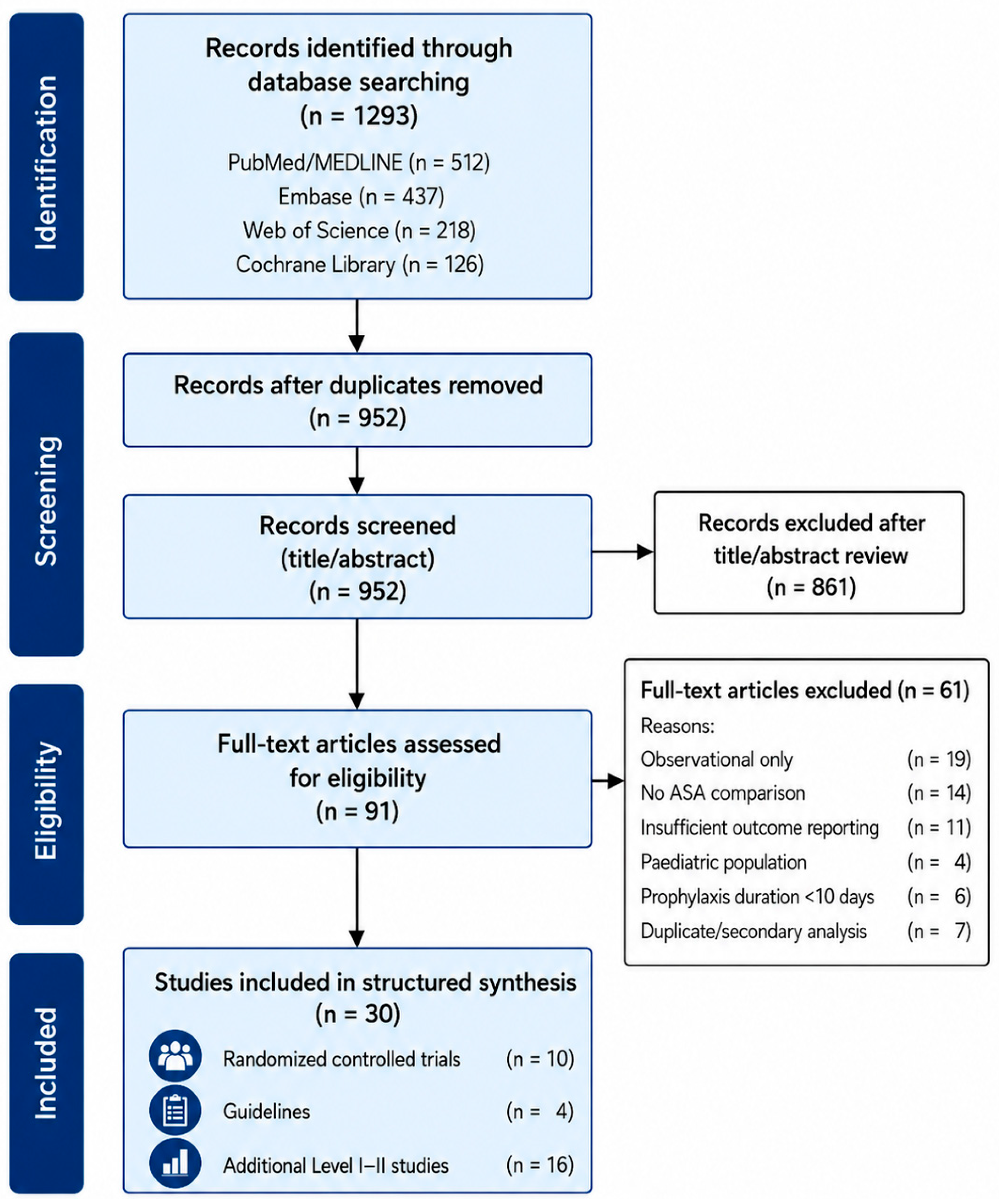
2. Methods
2.1. Eligibility Criteria
- Randomised controlled trials (RCTs) comparing aspirin with LMWH, DOACs, vitamin K antagonists, or placebo;
- Adult patients (≥18 years) undergoing THA, TKA, fracture fixation, or other major orthopaedic procedures;
- Studies reporting symptomatic VTE, major bleeding, or mortality;
- Major international clinical practice guidelines addressing aspirin in orthopaedic VTE prophylaxis;
- High-level meta-analyses (Bayesian or network meta-analyses) published 2021–2025.
- Purely observational studies (except when addressing perioperative risk modifiers relevant to interpretation);
- Case reports or case series;
- Paediatric populations;
- Studies with prophylaxis duration <10 days;
- Studies lacking clear outcome definitions.
2.2. Study Selection
2.3. Data Extraction
- Study design and setting
- Sample size
- Surgical population (THA, TKA, trauma, spine)
- Aspirin dosage and timing of initiation
- Comparator agent and dosing
- Duration of prophylaxis
- Diagnostic modality for VTE detection (venography, ultrasonography, symptomatic assessment)
- Definition of major bleeding
- Length of follow-up
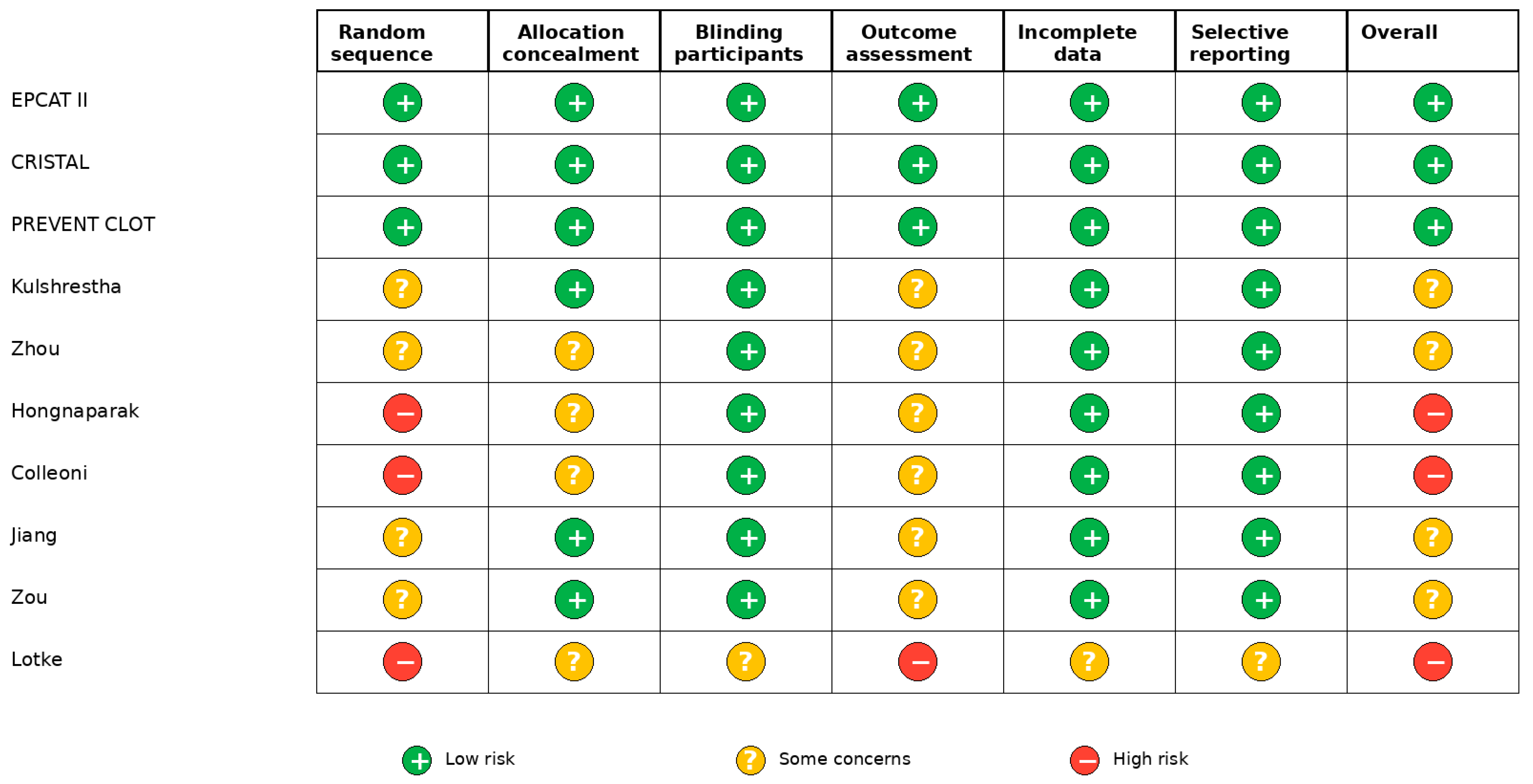
2.4. Risk of Bias and Methodological Considerations
- Timing of prophylaxis initiation (day 0 vs. sequential strategy)
- Variability in aspirin dosing regimens (81–325 mg once or twice daily)
- Differences in DVT detection methods
- Exclusion of high-risk populations (e.g., prior VTE, active malignancy)
- Variability in definitions of “major bleeding”
3. Results
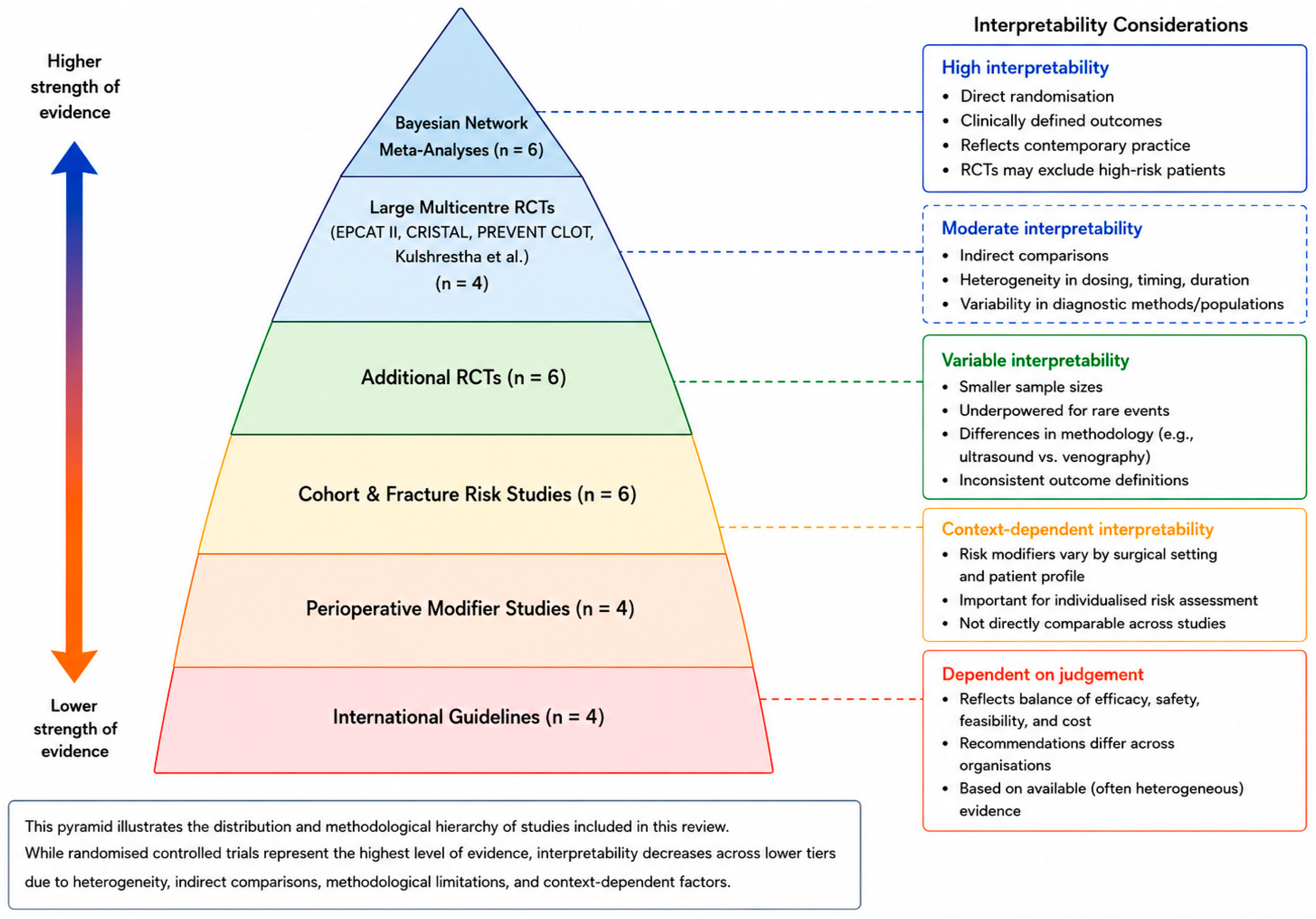
3.1. Overview of Included Evidence
3.2. Arthroplasty: Large Randomised Trials
3.2.1. EPCAT II (Sequential Prophylaxis)
3.2.2. CRISTAL (Aspirin as Primary Prophylaxis)
3.3. Trauma Population
3.4. Risk-Stratified Strategy
3.5. Smaller RCTs
3.6. Bayesian Network Meta-Analyses (2021–2025)
- Timing of prophylaxis initiation
- Aspirin dose (81–325 mg)
- Duration of therapy (2–6 weeks)
- DVT detection methodology
- Definitions of major bleeding
3.7. Perioperative Risk Modifiers
- Tourniquet use during TKA was associated with increased thromboembolic events in a Bayesian network meta-analysis [21].
- Sequential administration of tranexamic acid and haemocoagulase reduced blood loss without increasing VTE [22].
- In non-major orthopaedic surgery, rivaroxaban and LMWH demonstrated similar safety profiles [23].
- Thromboelastography studies revealed persistent postoperative hypercoagulability despite LMWH prophylaxis [24].
3.8. Guideline Recommendations
- The American Society of Hematology suggests aspirin or anticoagulants for THA/TKA with low-certainty evidence [25].
- NICE permits aspirin after TKA or sequentially following LMWH in THA [26].
- The American Academy of Orthopaedic Surgeons endorses aspirin (81–325 mg twice daily for 4–6 weeks) in typical-risk patients [28].
- The European Society of Cardiology emphasises individualised, risk-stratified prophylaxis [29].
4. Discussion
4.1. Principal Findings
4.2. Arthroplasty: Sequential Versus Primary Prophylaxis
4.3. THA Versus TKA: Distinct Clinical Risk Profiles
4.4. Trauma and Fracture Surgery
4.5. Smaller RCTs and Real-World Heterogeneity
4.6. Meta-Analytic Evidence and Its Limitations
4.7. Risk Stratification and Procedure-Specific Considerations
4.8. Safety Considerations
4.9. Guideline Interpretation
4.10. Strengths and Limitations
- Heterogeneity in comparator regimens
- Variable initiation timing
- Differences in prophylaxis duration
- Differences in diagnostic methodology
- Variable bleeding definitions
- Exclusion of high-risk populations (prior VTE, malignancy, severe obesity)
- Limited blinding in some RCTs
4.11. Clinical Implications
- Sequential prophylaxis (initial anticoagulation followed by aspirin) in standard-risk arthroplasty patients
- Aspirin as a pragmatic alternative to LMWH in selected trauma populations
- Avoidance of aspirin monotherapy initiated immediately postoperatively in high-risk arthroplasty patients
4.12. Future Directions
- Define optimal aspirin dosing (81 vs. 325 mg; once vs. twice daily)
- Determine ideal prophylaxis duration across surgical subgroups
- Directly compare ultra-short anticoagulant regimens versus prolonged aspirin strategies in modern fast-track arthroplasty
- Include high-risk and elderly fracture populations in adequately powered RCTs
- Standardise diagnostic and bleeding definitions to improve comparability
- Develop validated risk-stratification models integrating perioperative and patient-specific thrombotic modifiers
5. Conclusions
- As extended prophylaxis following short-term anticoagulation in standard-risk arthroplasty;
- As a pragmatic alternative to LMWH in selected trauma patients;
- Avoided as sole primary prophylaxis immediately postoperatively in high-risk surgical contexts.
- Prospective trials separately evaluating contemporary THA and TKA populations, particularly elderly and high-risk patients;
- Direct comparison of ultra-short anticoagulant regimens versus prolonged aspirin strategies in modern ERAS arthroplasty Standardisation of bleeding and diagnostic definitions;
- Direct comparisons of dosing strategies (81 vs. 325 mg; once vs. twice daily);
- Development of validated risk-stratification algorithms integrating perioperative modifiers and patient-specific thrombotic risk.
Supplementary Materials
Author Contributions
Funding
Institutional Review Board Statement
Informed Consent Statement
Data Availability Statement
Conflicts of Interest
Abbreviations
| AAOS | American Academy of Orthopaedic Surgeons |
| ASA | Acetylsalicylic acid (aspirin) |
| ASH | American Society of Hematology |
| CRISTAL | Comparison of Risk of Symptomatic Thromboembolism After Knee or Hip Arthroplasty Using Aspirin or Low-Molecular-Weight Heparin Trial |
| DVT | Deep vein thrombosis |
| DOAC | Direct oral anticoagulant |
| ERAS | Enhanced recovery after surgery |
| EPCAT II | Extended Prophylaxis Comparing Aspirin and Rivaroxaban II Trial |
| LMWH | Low-molecular-weight heparin |
| NICE | National Institute for Health and Care Excellence |
| PE | Pulmonary embolism |
| PRISMA | Preferred Reporting Items for Systematic Reviews and Meta-Analyses |
| RCT | Randomised controlled trial |
| THA | Total hip arthroplasty |
| TKA | Total knee arthroplasty |
| VTE | Venous thromboembolism |
References
- Falck-Ytter, Y.; Francis, C.W.; Johanson, N.A.; Curley, C.; Dahl, O.E.; Schulman, S.; Ortel, T.L.; Pauker, S.G.; Colwell, C.W., Jr. Prevention of VTEin orthopedic surgery patients: Antithrombotic Therapy Prevention of Thrombosis 9th ed: American College of Chest Physicians Evidence-Based Clinical Practice Guidelines. Chest 2012, 141, e278S–e325S. [Google Scholar] [CrossRef]
- Flevas, D.A.; Megaloikonomos, P.D.; Dimopoulos, L.; Mitsiokapa, E.; Koulouvaris, P.; Mavrogenis, A.F. Thromboembolism prophylaxis in orthopaedics: An update. EFORT Open Rev. 2018, 3, 136–148. [Google Scholar] [CrossRef] [PubMed]
- Simon, S.J.; Patell, R.; Zwicker, J.I.; Kazi, D.S.; Hollenbeck, B.L. Venous Thromboembolism in Total Hip and Total Knee Arthroplasty. JAMA Netw. Open. 2023, 6, e2345883. [Google Scholar] [CrossRef]
- Ingason, A.B.; Hreinsson, J.P.; Ágústsson, A.S.; Lund, S.H.; Rumba, E.; Pálsson, D.A.; Reynisson, I.E.; Guðmundsdóttir, B.R.; Önundarson, P.T.; Björnsson, E.S. Rivaroxaban Is Associated with Higher Rates of Gastrointestinal Bleeding Than Other Direct Oral Anticoagulants: A Nationwide Propensity Score-Weighted Study. Ann. Intern. Med. 2021, 174, 1493–1502. [Google Scholar] [CrossRef]
- O’Brien, J.; Duncan, H.; Kirsh, G.; Allen, V.; King, P.; Hargraves, R.; Mendes, L.; Perera, T.; Catto, P.; Schofield, S.; et al. Prevention of pulmonary embolism and deep vein thrombosis with low dose aspirin: Pulmonary Embolism Prevention (PEP) trial. Lancet 2000, 355, 1295–1302. [Google Scholar] [CrossRef]
- Pennestrì, F.; Maffulli, N.; Sirtori, P.; Perazzo, P.; Negrini, F.; Banfi, G.; Peretti, G.M. Blood management in fast-track orthopedic surgery: An evidence-based narrative review. J. Orthop. Surg. Res. 2019, 14, 263. [Google Scholar] [CrossRef] [PubMed]
- Jørgensen, C.C.; Llau, J.; Jenny, J.Y.; Albaladejo, P. European guidelines on peri-operative venous thromboembolism prophylaxis: First update.: Chapter 3: Day surgery and fast-track surgery. Eur. J. Anaesthesiol. 2024, 41, 577–581. [Google Scholar] [CrossRef]
- Johanson, N.A.; Lachiewicz, P.F.; Lieberman, J.R.; Lotke, P.A.; Parvizi, J.; Pellegrini, V.; Stringer, T.A.; Tornetta, P., 3rd; Haralson, R.H., 3rd; Watters, W.C., 3rd. American academy of orthopaedic surgeons clinical practice guideline on. Prevention of symptomatic pulmonary embolism in patients undergoing total hip or knee arthroplasty. J. Bone Jt. Surg. 2009, 91, 1756–1757. [Google Scholar] [CrossRef]
- Anderson, D.R.; Dunbar, M.; Murnaghan, J.; Kahn, S.R.; Gross, P.; Forsythe, M.; Pelet, S.; Fisher, W.; Belzile, E.; Dolan, S.; et al. Aspirin or Rivaroxaban for VTE Prophylaxis after Hip or Knee Arthroplasty. New Engl. J. Med. 2018, 378, 699–707. [Google Scholar] [CrossRef] [PubMed]
- CRISTAL Study Group; Sidhu, V.S.; Kelly, T.L.; Pratt, N.; Graves, S.E.; Buchbinder, R.; Adie, S.; Cashman, K.; Ackerman, I.; Bastiras, D.; et al. Effect of Aspirin vs. Enoxaparin on Symptomatic Venous Thromboembolism in Patients Undergoing Hip or Knee Arthroplasty: The CRISTAL Randomized Trial. JAMA 2022, 328, 719–727. [Google Scholar] [CrossRef]
- Major Extremity Trauma Research Consortium (METRC); O’Toole, R.V.; Stein, D.M.; O’Hara, N.N.; Frey, K.P.; Taylor, T.J.; Scharfstein, D.O.; Carlini, A.R.; Sudini, K.; Degani, Y.; et al. Aspirin or Low-Molecular-Weight Heparin for Thromboprophylaxis after a Fracture. New Engl. J. Med. 2023, 388, 203–213. [Google Scholar] [CrossRef]
- Kulshrestha, V.; Kumar, S. DVT prophylaxis after TKA: Routine anticoagulation vs. risk screening approach—A randomized study. J. Arthroplast. 2013, 28, 1868–1873. [Google Scholar] [CrossRef] [PubMed]
- Zhang, D.; Yang, Y.; Yi, Y.; Wang, D.; Jiang, L.; Huang, H.; Jin, L.; Meng, H.; Xia, F.; Guo, G. Incidence and influence factors of venous thromboembolism in traumatic rib fracture patient: A multicenter study. J. Orthop. Surg. Res. 2024, 19, 152. [Google Scholar] [CrossRef] [PubMed]
- Song, K.; Zhu, B.; Yao, Y.; Jiang, Q.; Xiong, J.; Shi, H. Incidence and risk factors of preoperative deep vein thrombosis in patients with intertrochanteric fractures: A retrospective study. J. Orthop. Surg. Res. 2022, 17, 375. [Google Scholar] [CrossRef]
- Ren, Z.; Yuan, Y.; Qi, W.; Li, Y.; Wang, P. The incidence and risk factors of deep venous thrombosis in lower extremities following surgically treated femoral shaft fracture: A retrospective case-control study. J. Orthop. Surg. Res. 2021, 16, 446. [Google Scholar] [CrossRef]
- Zheng, X.; Nong, L.; Song, Y.; Han, L.; Zhang, Y.; Yin, Q.; Bian, Y. Comparison of efficacy and safety between aspirin and oral anticoagulants for venous thromboembolism prophylaxis after major orthopaedic surgery: A meta-analysis of randomized clinical trials. Front. Pharmacol. 2024, 14, 1326224. [Google Scholar] [CrossRef]
- Kapoor, A.; Ellis, A.; Shaffer, N.; Gurwitz, J.; Chandramohan, A.; Saulino, J.; Ishak, A.; Okubanjo, T.; Michota, F.; Hylek, E.; et al. Comparative effectiveness of venous thromboembolism prophylaxis options for the patient undergoing total hip and knee replacement: A network meta-analysis. J. Thromb. Haemost. JTH 2017, 15, 284–294. [Google Scholar] [CrossRef]
- Wei, Q.; Sun, J.; Bai, Y.; Meng, C.; Miao, G.; Liu, P.; Wang, H. Aspirin versus LMWH for VTE prophylaxis after orthopedic surgery. Open Med. 2023, 18, 20230760. [Google Scholar] [CrossRef]
- Migliorini, F.; Maffulli, N.; Velaj, E.; Bell, A.; Kämmer, D.; Hildebrand, F.; Hofmann, U.K.; Eschweiler, J. Antithrombotic prophylaxis following total hip arthroplasty: A level I Bayesian network meta-analysis. J. Orthop. Traumatol. 2024, 25, 1. [Google Scholar] [CrossRef]
- Hur, M.; Park, S.K.; Koo, C.H.; Jung, E.D.; Kang, P.; Kim, W.H.; Kim, J.T.; Jung, C.W.; Bahk, J.H. Comparative efficacy and safety of anticoagulants for prevention of venous thromboembolism after hip and knee arthroplasty. Acta Orthop. 2017, 88, 634–641. [Google Scholar] [CrossRef] [PubMed]
- Migliorini, F.; Maffulli, N.; Eschweiler, J.; Knobe, M.; Tingart, M.; Betsch, M. Tourniquet use during knee arthroplasty: A Bayesian network meta-analysis on pain, function, and thromboembolism. Surgeon 2022, 20, 241–251. [Google Scholar] [CrossRef] [PubMed]
- Ju, Y.; Liu, H.; Jiang, W.; Huang, Q.; Zhou, Z.; Pei, F. Perioperative blood loss of sequential administration of hemocoagulase Agkistrodon and Tranexamic acid for primary total knee arthroplasty: A randomized controlled trial. J. Orthop. Surg. Res. 2025, 20, 457. [Google Scholar] [CrossRef] [PubMed]
- Zhu, L.; Zhu, B.; Bing, P.; Qi, M.; He, B. Effectiveness and safety of rivaroxaban or low-molecular-weight heparin in non-major orthopedic surgery: A meta-analysis of randomized controlled trials. J. Orthop. Surg. Res. 2024, 19, 609. [Google Scholar] [CrossRef]
- Xu, H.; Zhang, S.; Xie, J.; Lei, Y.; Cao, G.; Chen, G.; Pei, F. A nested case-control study on the risk factors of deep vein thrombosis for Chinese after total joint arthroplasty. J. Orthop. Surg. Res. 2019, 14, 188. [Google Scholar] [CrossRef]
- Wu, C.T.; Chen, B.; Wang, J.W.; Yen, S.H.; Huang, C.C. Plasma D-dimer is not useful in the prediction of deep vein thrombosis after total knee arthroplasty in patients using rivaroxaban for thromboprophylaxis. J. Orthop. Surg. Res. 2018, 13, 173. [Google Scholar] [CrossRef]
- National Guideline Centre (UK). Venous Thromboembolism in Over 16s: Reducing the Risk of Hospital-Acquired Deep Vein Thrombosis or Pulmonary Embolism; National Institute for Health and Care Excellence (NICE): Manchester, UK, 2018. [Google Scholar]
- Lloyd-Donald, P.; Lee, W.S.; Liu, G.M.; Bellomo, R.; McNicol, L.; Weinberg, L. Thromboelastography in elective total hip arthroplasty. World J. Orthop. 2021, 12, 555–564. [Google Scholar] [CrossRef]
- Bryson, D.J.; Uzoigwe, C.E.; Braybrooke, J. Thromboprophylaxis in spinal surgery: A survey. J. Orthop. Surg. Res. 2012, 7, 14. [Google Scholar] [CrossRef]
- Anderson, D.R.; Morgano, G.P.; Bennett, C.; Dentali, F.; Francis, C.W.; Garcia, D.A.; Kahn, S.R.; Rahman, M.; Rajasekhar, A.; Rogers, F.B.; et al. American Society of Hematology 2019 guidelines for management of venous thromboembolism: Prevention of venous thromboembolism in surgical hospitalized patients. Blood Adv. 2019, 3, 3898–3944. [Google Scholar] [CrossRef]
- Zhou, L.B.; Wang, C.C.; Zhang, L.T.; Wu, T.; Zhang, G.-Q. Effectiveness of different antithrombotic agents in combination with tranexamic acid for venous thromboembolism prophylaxis and blood management after total knee replacement: A prospective randomized study. BMC Musculoskelet. Disord. 2023, 24, 5. [Google Scholar] [CrossRef] [PubMed]
- Hongnaparak, T.; Janejaturanon, J.; Iamthanaporn, K.; Tanutit, P.; Yuenyongviwat, V. Aspirin versus Rivaroxaban to Prevent Venous Thromboembolism after Total Knee Arthroplasty: A Double-blinded, Randomized Controlled Trial. Rev. Bras. Ortop. 2021, 57, 741–746. [Google Scholar] [CrossRef]
- Colleoni, J.L.; Ribeiro, F.N.; Mos, P.A.C.; Reis, J.P.; Oliveira, H.R.; Miura, B.K. Venous thromboembolism prophylaxis after total knee arthroplasty (TKA): Aspirin vs. rivaroxaban. Rev. Bras. De Ortop. 2017, 53, 22–27. [Google Scholar] [CrossRef]
- Jiang, Y.; Du, H.; Liu, J.; Zhou, Y. Aspirin combined with mechanical measures to prevent venous thromboembolism after total knee arthroplasty: A randomized controlled trial. Chin. Med. J. 2014, 127, 2201–2205. [Google Scholar] [CrossRef] [PubMed]
- Zou, Y.; Tian, S.; Wang, Y.; Sun, K. Administering aspirin, rivaroxaban and low-molecular-weight heparin to prevent deep venous thrombosis after total knee arthroplasty. Blood Coagul. Fibrinolysis 2014, 25, 660–664. [Google Scholar] [CrossRef]
- Lotke, P.A.; Palevsky, H.; Keenan, A.M.; Meranze, S.; Steinberg, M.E.; Ecker, M.L.; Kelley, M.A. Aspirin and warfarin for thromboembolic disease after total joint arthroplasty. Clin. Orthop. Relat. Res. 1996, 324, 251–258. [Google Scholar] [CrossRef]
- Ceolin, C.; Bano, G.; Biz, C.; Dianin, M.; Bedogni, M.; Guarnaccia, A.; Berizzi, A.; Ruggieri, P.; Coin, A.; Sergi, G. Functional autonomy and 12-month mortality in older adults with proximal femoral fractures in an orthogeriatric setting: Risk factors and gender differences. Aging Clin. Exp. Res. 2023, 35, 1063–1071. [Google Scholar] [CrossRef]
- Siviero, P.; Marseglia, A.; Biz, C.; Rovini, A.; Ruggieri, P.; Nardacchione, R.; Maggi, S. Quality of life outcomes in patients undergoing knee replacement surgery: Longitudinal findings from the QPro-Gin study. BMC Musculoskelet. Disord. 2020, 21, 436. [Google Scholar] [CrossRef] [PubMed]



| Study | Population | ASA Regimen | Comparator | Duration | Primary Outcome |
|---|---|---|---|---|---|
| EPCAT II [9] | 3424 THA/TKA | Rivaroxaban 5d → ASA 81 mg OD | Rivaroxaban | 90 d | Symptomatic VTE |
| CRISTAL [10] | 9711 THA/TKA | ASA 100 mg OD (day 0) | Enoxaparin 40 mg OD | 90 d | Symptomatic VTE |
| PREVENT CLOT [11] | 12,211 fractures | ASA 81 mg BID | Enoxaparin 30 mg BID | 90 d | Mortality |
| Kulshrestha [12] | ~1000 TKA | Risk-stratified ASA | Routine anticoagulation | 14 d | VTE |
| Zhou [30] | 120 TKA | ASA 100 mg OD | Rivaroxaban | 90 d | VTE |
| Hongnaparak [31] | 40 TKA | ASA 300 mg OD | Rivaroxaban | 14 d | DVT |
| Colleoni [32] | 27 TKA | ASA 150 mg BID | Rivaroxaban | 4 w | VTE |
| Jiang [33] | 120 TKA | ASA + mechanical | LMWH → DOAC | 6 w | VTE |
| Zou [34] | 212 TKA | ASA 100 mg OD | Rivaroxaban | 4 w | VTE |
| Lotke [35] | 192 THA/TKA | ASA 325 mg BID | Warfarin | 6 m | VTE |
Disclaimer/Publisher’s Note: The statements, opinions and data contained in all publications are solely those of the individual author(s) and contributor(s) and not of MDPI and/or the editor(s). MDPI and/or the editor(s) disclaim responsibility for any injury to people or property resulting from any ideas, methods, instructions or products referred to in the content. |
© 2026 by the authors. Licensee MDPI, Basel, Switzerland. This article is an open access article distributed under the terms and conditions of the Creative Commons Attribution (CC BY) license.
Share and Cite
Riediger, C.; Ferl, M.; Schönrogge, M. Aspirin for Venous Thromboembolism Prevention in Orthopaedic Surgery with Focus on Trauma and Arthroplasty: A Structured Evidence-Based Review of Randomised Trials, Guidelines, and Contemporary Practice Considerations. J. Clin. Med. 2026, 15, 4550. https://doi.org/10.3390/jcm15124550
Riediger C, Ferl M, Schönrogge M. Aspirin for Venous Thromboembolism Prevention in Orthopaedic Surgery with Focus on Trauma and Arthroplasty: A Structured Evidence-Based Review of Randomised Trials, Guidelines, and Contemporary Practice Considerations. Journal of Clinical Medicine. 2026; 15(12):4550. https://doi.org/10.3390/jcm15124550
Chicago/Turabian StyleRiediger, Christian, Mark Ferl, and Maria Schönrogge. 2026. "Aspirin for Venous Thromboembolism Prevention in Orthopaedic Surgery with Focus on Trauma and Arthroplasty: A Structured Evidence-Based Review of Randomised Trials, Guidelines, and Contemporary Practice Considerations" Journal of Clinical Medicine 15, no. 12: 4550. https://doi.org/10.3390/jcm15124550
APA StyleRiediger, C., Ferl, M., & Schönrogge, M. (2026). Aspirin for Venous Thromboembolism Prevention in Orthopaedic Surgery with Focus on Trauma and Arthroplasty: A Structured Evidence-Based Review of Randomised Trials, Guidelines, and Contemporary Practice Considerations. Journal of Clinical Medicine, 15(12), 4550. https://doi.org/10.3390/jcm15124550