Targeted Therapies Combined with Intensive Chemotherapy in Fit Acute Myeloid Leukemia: Past Developments, Current Evidence, and Future Therapeutic Paradigms
 , , and
Abstract
1. Introduction
2. From Empiricism to Biologic Targeting
3. FLT3 Inhibitors: Proof of Principle and Beyond
4. Gemtuzumab Ozogamicin and Antibody-Based Targeting
5. IDH Inhibition, Venetoclax, and the Expansion of the Intensive Platform
6. Menin Inhibitors and the Next Molecular Frontier
7. Randomized Evidence, Endpoints, and What Really Changed Practice
8. Resistance, Transplantation, and Maintenance Across the Treatment Continuum
9. Future Directions
10. Practical Implications for Current Frontline Care
11. Closing Perspective
12. Key Issues
Author Contributions
Funding
Data Availability Statement
Acknowledgments
Conflicts of Interest
References
- Yates, J.W.; Wallace, H.J., Jr.; Ellison, R.R.; Holland, J.F. Cytosine arabinoside (NSC-63878) and daunorubicin (NSC-83142) therapy in acute nonlymphocytic leukemia. Cancer Chemother. Rep. 1973, 57, 485–488. [Google Scholar]
- Cancer Genome Atlas Research Network. Genomic and epigenomic landscapes of adult de novo acute myeloid leukemia. N. Engl. J. Med. 2013, 368, 2059–2074. [Google Scholar] [CrossRef] [PubMed]
- Papaemmanuil, E.; Gerstung, M.; Bullinger, L.; Gaidzik, V.I.; Paschka, P.; Roberts, N.D.; Potter, N.E.; Heuser, M.; Thol, F.; Bolli, N.; et al. Genomic Classification and Prognosis in Acute Myeloid Leukemia. N. Engl. J. Med. 2016, 374, 2209–2221. [Google Scholar] [CrossRef] [PubMed]
- Döhner, H.; Estey, E.; Grimwade, D.; Amadori, S.; Appelbaum, F.R.; Büchner, T.; Dombret, H.; Ebert, B.L.; Fenaux, P.; Larson, R.A.; et al. Diagnosis and management of AML in adults: 2017 ELN recommendations from an international expert panel. Blood 2017, 129, 424–447. [Google Scholar] [CrossRef] [PubMed]
- DiNardo, C.D.; Stein, E.M.; de Botton, S.; Roboz, G.J.; Altman, J.K.; Mims, A.S.; Swords, R.; Collins, R.H.; Mannis, G.N.; Pollyea, D.A.; et al. Durable Remissions with Ivosidenib in IDH1-Mutated Relapsed or Refractory AML. N. Engl. J. Med. 2018, 378, 2386–2398. [Google Scholar] [CrossRef]
- Chatzikalil, E.; Roka, K.; Diamantopoulos, P.T.; Rigatou, E.; Avgerinou, G.; Kattamis, A.; Solomou, E.E. Venetoclax Combination Treatment of Acute Myeloid Leukemia in Adolescents and Young Adult Patients. J. Clin. Med. 2024, 13, 2046. [Google Scholar] [CrossRef]
- Short, N.J.; Zhou, S.; Fu, C.; Berry, D.A.; Walter, R.B.; Freeman, S.D.; Hourigan, C.S.; Huang, X.; Nogueras Gonzalez, G.; Hwang, H.; et al. Association of Measurable Residual Disease with Survival Outcomes in Patients with Acute Myeloid Leukemia: A Systematic Review and Meta-analysis. JAMA Oncol. 2020, 6, 1890–1899. [Google Scholar] [CrossRef]
- Dillon, L.W.; Gui, G.; Page, K.M.; Ravindra, N.; Wong, Z.C.; Andrew, G.; Mukherjee, D.; Zeger, S.L.; El Chaer, F.; Spellman, S.; et al. DNA Sequencing to Detect Residual Disease in Adults with Acute Myeloid Leukemia Prior to Hematopoietic Cell Transplant. JAMA 2023, 329, 745–755. [Google Scholar] [CrossRef]
- Daver, N.; Wei, A.H.; Pollyea, D.A.; Fathi, A.T.; Vyas, P.; DiNardo, C.D. New directions for emerging therapies in acute myeloid leukemia: The next chapter. Blood Cancer J. 2020, 10, 107. [Google Scholar] [CrossRef]
- Perl, A.E. The role of targeted therapy in the management of patients with AML. Blood Adv. 2017, 1, 2281–2294. [Google Scholar] [CrossRef]
- Pollyea, D.A.; Stevens, B.M.; Jones, C.L.; Winters, A.; Pei, S.; Minhajuddin, M.; D’alessandro, A.; Culp-Hill, R.; Riemondy, K.A.; Gillen, A.E.; et al. Venetoclax with azacitidine disrupts energy metabolism and targets leukemia stem cells in patients with acute myeloid leukemia. Nat. Med. 2018, 24, 1859–1866. [Google Scholar] [CrossRef]
- Tamamyan, G.; Kadia, T.; Ravandi, F.; Borthakur, G.; Cortes, J.; Jabbour, E.; Daver, N.; Ohanian, M.; Kantarjian, H.; Konopleva, M. Frontline treatment of acute myeloid leukemia in adults. Crit. Rev. Oncol. 2017, 110, 20–34. [Google Scholar] [CrossRef] [PubMed]
- Sievers, E.L.; Larson, R.A.; Stadtmauer, E.A.; Estey, E.; Löwenberg, B.; Dombret, H.; Karanes, C.; Theobald, M.; Bennett, J.M.; Sherman, M.L.; et al. Efficacy and safety of gemtuzumab ozogamicin in patients with CD33-positive acute myeloid leukemia in first relapse. J. Clin. Oncol. Off. J. Am. Soc. Clin. Oncol. 2001, 19, 3244–3254. [Google Scholar] [CrossRef]
- Hills, R.K.; Castaigne, S.; Appelbaum, F.R.; Delaunay, J.; Petersdorf, S.; Othus, M.; Estey, E.H.; Dombret, H.; Chevret, S.; Ifrah, N.; et al. Addition of gemtuzumab ozogamicin to induction chemotherapy in adult patients with acute myeloid leukaemia: A meta-analysis of individual patient data from randomised controlled trials. Lancet Oncol. 2014, 15, 986–996. [Google Scholar] [CrossRef]
- Castaigne, S.; Pautas, C.; Terré, C.; Raffoux, E.; Bordessoule, D.; Bastie, J.N.; Legrand, O.; Thomas, X.; Turlure, P.; Reman, O.; et al. Effect of gemtuzumab ozogamicin on survival of adult patients with de-novo acute myeloid leukaemia (ALFA-0701): A randomised, open-label, phase 3 study. Lancet 2012, 379, 1508–1516. [Google Scholar] [CrossRef] [PubMed]
- Kottaridis, P.D.; Gale, R.E.; Frew, M.E.; Harrison, G.; Langabeer, S.E.; Belton, A.A.; Walker, H.; Wheatley, K.; Bowen, D.T.; Burnett, A.K.; et al. The presence of a FLT3 internal tandem duplication in patients with acute myeloid leukemia (AML) adds important prognostic information to cytogenetic risk group and response to the first cycle of chemotherapy: Analysis of 854 patients from the United Kingdom Medical Research Council AML 10 and 12 trials. Blood 2001, 98, 1752–1759. [Google Scholar] [CrossRef]
- Levis, M. FLT3 mutations in acute myeloid leukemia: What is the best approach in 2013? Hematol. Am. Soc. Hematol. Educ. Program 2013, 2013, 220–226. [Google Scholar] [CrossRef]
- Röllig, C.; Serve, H.; Hüttmann, A.; Noppeney, R.; Müller-Tidow, C.; Krug, U.; Baldus, C.D.; Brandts, C.H.; Kunzmann, V.; Einsele, H.; et al. Addition of sorafenib versus placebo to standard therapy in patients aged 60 years or younger with newly diagnosed acute myeloid leukaemia (SORAML): A multicentre, phase 2, randomised controlled trial. Lancet Oncol. 2015, 16, 1691–1699. [Google Scholar] [CrossRef]
- Stone, R.M.; Mandrekar, S.J.; Sanford, B.L.; Laumann, K.; Geyer, S.; Bloomfield, C.D.; Thiede, C.; Prior, T.W.; Döhner, K.; Marcucci, G.; et al. Midostaurin plus Chemotherapy for Acute Myeloid Leukemia with a FLT3 Mutation. N. Engl. J. Med. 2017, 377, 454–464. [Google Scholar] [CrossRef]
- Dinardo, C.D.; Jonas, B.A.; Pullarkat, V.; Thirman, M.J.; Garcia, J.S.; Wei, A.H.; Konopleva, M.; Döhner, H.; Letai, A.; Fenaux, P.; et al. Azacitidine and Venetoclax in Previously Untreated Acute Myeloid Leukemia. N. Engl. J. Med. 2020, 383, 617–629. [Google Scholar] [CrossRef] [PubMed]
- El Chaer, F.; Hourigan, C.S.; Zeidan, A.M. How I treat AML incorporating the updated classifications and guidelines. Blood 2023, 141, 2813–2823. [Google Scholar] [CrossRef]
- Erba, H.; Montesinos, P.; Kim, H.; Patkowska, E.; Vrhovac, R.; Žák, P.; Wang, P.; Mitov, T.; Hanyok, J.; Kamel, Y.; et al. Quizartinib plus chemotherapy in newly diagnosed patients with FLT3-internal-tandem-duplication-positive acute myeloid leukaemia (QuANTUM-First): A randomised, double-blind, placebo-controlled, phase 3 trial. Lancet 2023, 401, 1571–1583. [Google Scholar] [CrossRef]
- Pollyea, D.; Bixby, D.; Perl, A.; Bhatt, V.; Altman, J.; Appelbaum, F.; de Lima, M.; Fathi, A.; Foran, J.; Gojo, I.; et al. Acute myeloid leukemia, version updates. J. Natl. Compr. Cancer Netw. 2021. [Google Scholar]
- Ferrara, F.; Schiffer, C.A. Acute myeloid leukaemia in adults. Lancet 2013, 381, 484–495. [Google Scholar] [CrossRef] [PubMed]
- Daver, N.; Schlenk, R.F.; Russell, N.H.; Levis, M.J. Targeting FLT3 mutations in AML: Review of current knowledge and evidence. Leukemia 2019, 33, 299–312. [Google Scholar] [CrossRef]
- Levis, M.J.; Hamadani, M.; Logan, B.; Jones, R.J.; Singh, A.K.; Litzow, M.; Wingard, J.R.; Papadopoulos, E.B.; Perl, A.E.; Soiffer, R.J.; et al. Gilteritinib as Post-Transplant Maintenance for AML With Internal Tandem Duplication Mutation of FLT3. J. Clin. Oncol. Off. J. Am. Soc. Clin. Oncol. 2024, 42, 1766–1775. [Google Scholar] [CrossRef]
- Perl, A.E.; Martinelli, G.; Cortes, J.E.; Neubauer, A.; Berman, E.; Paolini, S.; Montesinos, P.; Baer, M.R.; Larson, R.A.; Ustun, C.; et al. Gilteritinib or Chemotherapy for Relapsed or Refractory FLT3-Mutated AML. N. Engl. J. Med. 2019, 381, 1728–1740. [Google Scholar] [CrossRef]
- DiNardo, C.D.; Tiong, I.S.; Quaglieri, A.; MacRaild, S.; Loghavi, S.; Brown, F.C.; Thijssen, R.; Pomilio, G.; Ivey, A.; Salmon, J.M.; et al. Molecular patterns of response and treatment failure after frontline venetoclax combinations in older patients with AML. Blood 2020, 135, 791–803. [Google Scholar] [CrossRef]
- Larrosa-Garcia, M.; Baer, M.R. FLT3 Inhibitors in Acute Myeloid Leukemia: Current Status and Future Directions. Mol. Cancer Ther. 2017, 16, 991–1001. [Google Scholar] [CrossRef] [PubMed]
- Morcos-Sandino, M.; Quezada-Ramírez, S.I.; Gómez-De León, A. Advances in the Treatment of Acute Myeloid Leukemia: Implications for Low- and Middle-Income Countries. Biomedicines 2025, 13, 1221. [Google Scholar] [CrossRef]
- Montesinos, P.; Rodríguez-Veiga, R.; Bergua, J.M.; Algarra Algarra, J.L.; Botella, C.; Rodríguez-Arbolí, E.; Bernal, T.; Tormo, M.; Calbacho, M.; Salamero, O.; et al. Quizartinib for Newly Diagnosed FLT3-Internal Tandem Duplication-Negative AML: The Randomized, Double-Blind, Placebo-Controlled, Phase II QUIWI Study. J. Clin. Oncol. Off. J. Am. Soc. Clin. Oncol. 2026, 44, 42–53. [Google Scholar] [CrossRef]
- Estey, E.H. Acute myeloid leukemia: 2021 update on risk-stratification and management. Am. J. Hematol. 2020, 95, 1368–1398. [Google Scholar] [CrossRef]
- Tettero, J.M.; Ngai, L.L.; Bachas, C.; Breems, D.A.; Fischer, T.; Gjertsen, B.T.; Gradowska, P.; Griskevicius, L.; Janssen, J.J.W.M.; Juliusson, G.; et al. Measurable residual disease-guided therapy in intermediate-risk acute myeloid leukemia patients is a valuable strategy in reducing allogeneic transplantation without negatively affecting survival. Haematologica 2023, 108, 2794–2798. [Google Scholar] [CrossRef]
- Oyogoa, E.; Traer, E.; Tyner, J.; Lachowiez, C. Building on Foundations: Venetoclax-Based Combinations in the Treatment of Acute Myeloid Leukemia. Cancers 2023, 15, 3589. [Google Scholar] [CrossRef]
- DiNardo, C.D.; Lachowiez, C.A.; Takahashi, K.; Loghavi, S.; Xiao, L.; Kadia, T.; Daver, N.; Adeoti, M.; Short, N.J.; Sasaki, K.; et al. Venetoclax Combined With FLAG-IDA Induction and Consolidation in Newly Diagnosed and Relapsed or Refractory Acute Myeloid Leukemia. J. Clin. Oncol. 2021, 39, 2768–2778. [Google Scholar] [CrossRef] [PubMed]
- Lachowiez, C.A.; DiNardo, C.D.; Loghavi, S. Molecularly Targeted Therapy in Acute Myeloid Leukemia: Current Treatment Landscape and Mechanisms of Response and Resistance. Cancers 2023, 15, 1617. [Google Scholar] [CrossRef] [PubMed]
- Stein, E.M.; Dinardo, C.D.; Pollyea, D.A.; Fathi, A.T.; Roboz, G.J.; Altman, J.K.; Stone, R.M.; DeAngelo, D.J.; Levine, R.L.; Flinn, I.W.; et al. Enasidenib in mutant IDH2 relapsed or refractory acute myeloid leukemia. Blood 2017, 130, 722–731. [Google Scholar] [CrossRef] [PubMed]
- Samra, B.; Konopleva, M.; Isidori, A.; Daver, N.; DiNardo, C. Venetoclax-Based Combinations in Acute Myeloid Leukemia: Current Evidence and Future Directions. Front. Oncol. 2020, 10, 562558. [Google Scholar] [CrossRef]
- Issa, G.C.; Aldoss, I.; DiPersio, J.; Cuglievan, B.; Stone, R.; Arellano, M.; Thirman, M.J.; Patel, M.R.; Dickens, D.S.; Shenoy, S.; et al. The menin inhibitor revumenib in KMT2A-rearranged or NPM1-mutant leukaemia. Nature 2023, 615, 920–924. [Google Scholar] [CrossRef]
- Wang, E.S.; Issa, G.C.; Erba, H.P.; Altman, J.K.; Montesinos, P.; DeBotton, S.; Walter, R.B.; Pettit, K.; Savona, M.R.; Shah, M.V.; et al. Ziftomenib in relapsed or refractory acute myeloid leukaemia (KOMET-001): A multicentre, open-label, multi-cohort, phase 1 trial. Lancet Oncol. 2024, 25, 1310–1324. [Google Scholar] [CrossRef]
- U.S. Food and Drug Administration. FDA Approves Revumenib for Relapsed or Refractory Acute Leukemia with a KMT2A Translocation; U.S. Food and Drug Administration: Silver Spring, MD, USA, 2024.
- U.S. Food and Drug Administration. FDA Approves Revumenib for Relapsed or Refractory Acute Myeloid Leukemia with a Susceptible NPM1 Mutation; U.S. Food and Drug Administration: Silver Spring, MD, USA, 2025.
- Döhner, H.; Wei, A.H.; Appelbaum, F.R.; Craddock, C.; DiNardo, C.D.; Dombret, H.; Ebert, B.L.; Fenaux, P.; Godley, L.A.; Hasserjian, R.P.; et al. Diagnosis and management of AML in adults: 2022 recommendations from an international expert panel on behalf of the ELN. Blood 2022, 140, 1345–1377. [Google Scholar] [CrossRef] [PubMed]


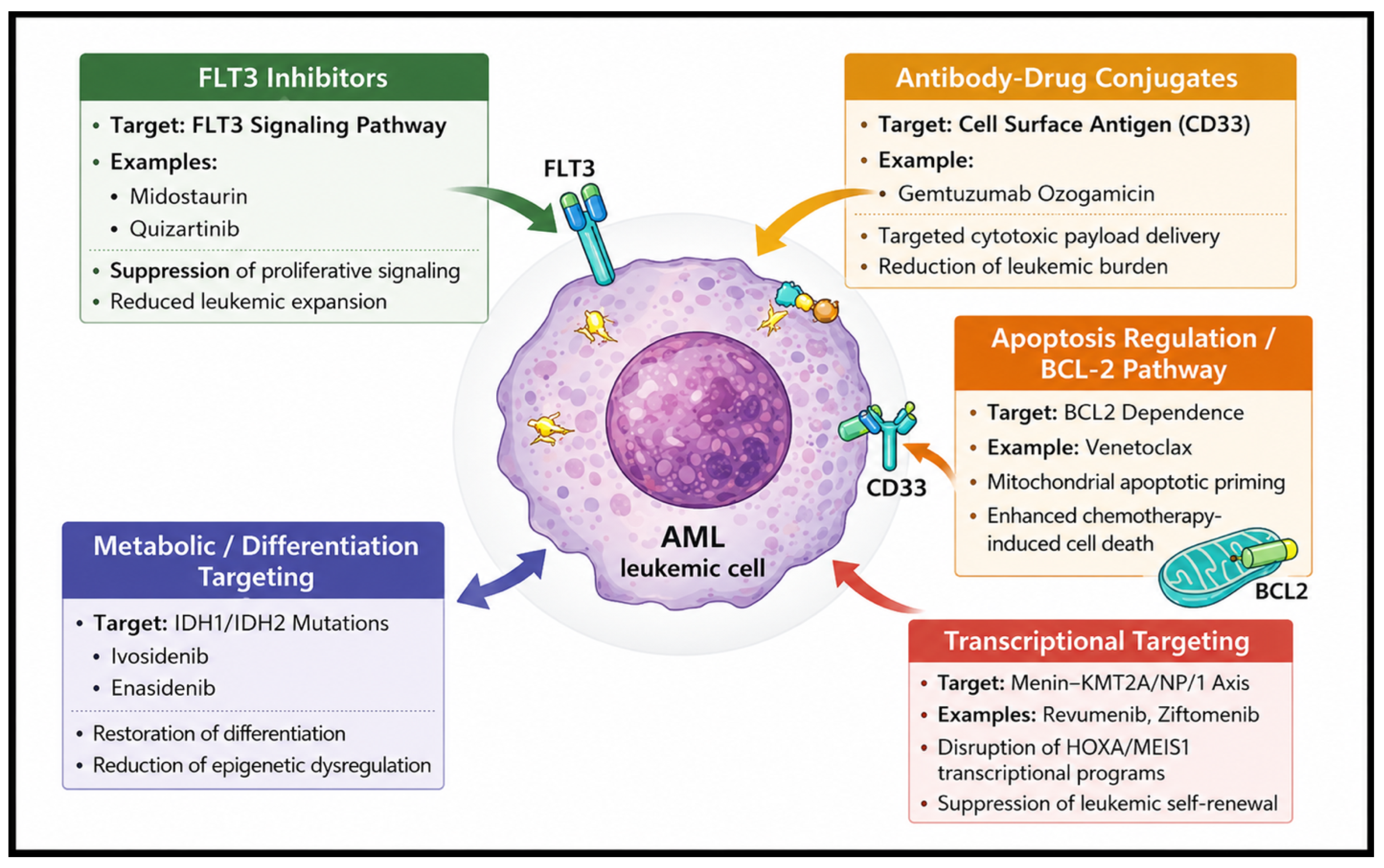
| Strategy/Agent Class | Biologic Target | Supporting Evidence | Clinical Setting in Fit AML | Clinical Relevance | Current Role in Clinical Practice | Limitations |
|---|---|---|---|---|---|---|
| Gemtuzumab ozogamicin (GO) | CD33-directed antibody-drug conjugate; phenotype-directed targeting of AML blasts | Sievers et al. [13]; ALFA-0701 [15]; Hills et al. meta-analysis [14] | Added to induction/consolidation chemotherapy in selected newly diagnosed fit adults | Reduced relapse risk and benefit in selected subgroups, especially favorable-risk and some intermediate-risk AML | Established in selected subgroups | Benefit is context-dependent; toxicity, especially hepatic toxicity/VOD risk, requires careful dose/schedule optimization |
| FLT3 inhibitors—midostaurin | Inhibition of constitutive FLT3 signaling in FLT3-mutated AML | RATIFY/Stone et al. [19] | Integrated across induction, consolidation, and continuation phases with intensive chemotherapy | Clear survival benefit in FLT3-mutated AML; proof of principle for genotype-directed frontline therapy | Practice-changing/standard of care in FLT3-mutated fit AML | Optimal integration with transplant, maintenance duration, and MRD-guided use still evolving |
| FLT3 inhibitors—quizartinib | Potent/selective FLT3 inhibition, particularly FLT3-ITD | Erba et al. [22] | Frontline combination with intensive chemotherapy in newly diagnosed FLT3-ITD AML | Reinforced frontline value of sustained FLT3 inhibition | Highly mature/practice-informing | Resistance mechanisms, clonal escape, sequencing with other FLT3 inhibitors, and post-transplant strategy remain unresolved |
| FLT3 inhibitors—gilteritinib | Potent FLT3 inhibitor with established activity in relapsed disease | Perl et al. [27] | Primarily relapsed/refractory AML; relevant as a candidate for earlier integration in fit AML platforms | Strong salvage efficacy; supports interest in earlier use | Promising, but frontline role not yet definitive in this review | Frontline benefit cannot be assumed from relapse efficacy; requires full-platform evaluation with chemotherapy |
| IDH inhibitors (ivosidenib, enasidenib) | Mutant IDH1/2 inhibition; reversal of 2-HG-driven differentiation block | DiNardo et al. [5]; Stein et al. [37] | Investigational addition to intensive chemotherapy in IDH1/2-mutated fit AML | Strong biologic rationale; promising activity extrapolated from non-intensive and relapsed settings | Promising but not practice-defining in fit AML | Uncertain incremental benefit over chemotherapy alone; effect likely depends on co-mutations, sequencing, and post-remission strategy |
| Venetoclax + intensive chemotherapy | BCL2 inhibition; apoptosis priming to deepen cytotoxic effect | Short et al. [7]; DiNardo et al. [35]; | Investigational intensive combinations in newly diagnosed fit AML | High CR/MRD-negative rates in early studies | Promising but still investigational in fit AML | Cytopenias, infections, azole interactions, schedule optimization, transplant timing, and lack of mature long-term comparative survival data |
| Triplet strategies (e.g., chemotherapy + FLT3 inhibitor + venetoclax) | Simultaneous targeting of proliferation and apoptotic dependency | Discussed from [6,9,38] | Early-phase/frontier approach in biologically aggressive AML, especially FLT3-mutated disease | Potential for deeper remission and improved molecular clearance | Emerging/experimental | High regimen complexity, overlapping myelosuppression, feasibility, and whether deeper responses translate into better survival without impairing pathway completion |
| Menin inhibitors (revumenib, ziftomenib) | Menin inhibition in KMT2A-rearranged and NPM1-mutated AML; suppression of HOXA/MEIS1-driven leukemic programs | Issa et al. [39]; Wang et al. [40]; FDA approvals in R/R settings [42] | Currently investigational for frontline integration with intensive chemotherapy | Strong biologic and early clinical proof of concept in molecularly defined AML | Very promising, but early for frontline fit AML | Frontline role undefined; best use may be induction combination, post-remission deepening, or MRD-directed intervention |
| MRD-guided targeted strategy (cross-cutting concept) | Use of MRD/genomic monitoring to assess biologic depth of response and guide transplant/maintenance decisions | Short et al. [7]; Dillon et al. [8] | Across induction, consolidation, transplant, and maintenance in fit AML | Improves interpretation of response quality beyond morphology alone | Increasingly central, but not a drug class | Standardization, assay choice, timing, and how MRD should modify treatment remain active areas of development |
| Post-transplant/maintenance targeted therapy | Suppression of residual molecular disease after remission or allo-HSCT | Perl et al. [27]; Perl et al. [10] | Especially relevant in FLT3-mutated AML; concept potentially extendable to other molecular subsets | May prolong disease control after transplant and reduce relapse risk | Most mature in FLT3-mutated AML | Optimal duration, patient selection, MRD-guided discontinuation, and extension to non-FLT3 targets remain uncertain |
| Study/Reference | Year | Study Design/Phase | Population/Setting | Investigational Strategy | Comparator/Backbone | Findings |
|---|---|---|---|---|---|---|
| Yates et al. [1] | 1973 | Pivotal chemotherapy study | Adult AML patients | Cytarabine + daunorubicin | None/historical backbone | Established the anthracycline-cytarabine backbone still used in intensive AML therapy |
| Sievers et al. [13] | 2001 | Clinical trial | Adult AML patients | Gemtuzumab ozogamicin | GO-based therapy | Early demonstration of CD33-targeted therapy activity in AML |
| Castaigne et al. (ALFA-0701) [15] | 2012 | Randomized clinical trial | Newly diagnosed Adult AML patients | GO + intensive chemotherapy | Standard chemotherapy | Fractionated GO improved outcomes in selected patients |
| Hills et al. [14] | 2014 | Meta-analysis | AML patients from randomized trials | GO + induction chemotherapy | Chemotherapy alone | GO reduced relapse risk in selected biologic subgroups |
| Röllig et al. [18] | 2015 | Randomized placebo-controlled clinical trial | Young newly diagnosed AML | Sorafenib + chemotherapy | Placebo + chemotherapy | Early attempt to integrate FLT3 inhibition in frontline therapy |
| Stone et al. [19] (RATIFY) | 2017 | Randomized phase III clinical trial | Newly diagnosed FLT3-mutated AML | Midostaurin + intensive chemotherapy | Placebo + chemotherapy | Landmark trial establishing FLT3 inhibition in frontline AML |
| Erba et al. [22] | 2023 | Randomized clinical trial | Newly diagnosed FLT3-ITD AML | Quizartinib + chemotherapy | Chemotherapy alone | Confirmed the benefit of potent FLT3 inhibition in frontline AML |
| Perl et al. [27] | 2019 | Randomized phase III clinical trial | Relapsed/refractory FLT3-mutated AML | Gilteritinib | Salvage chemotherapy | Demonstrated superiority of gilteritinib in relapse, supporting earlier use |
| DiNardo et al. [5] | 2018 | Clinical trial | Relapsed/refractory IDH1-mutated AML | Ivosidenib | Single-arm | Demonstrated clinical activity of IDH1 inhibition |
| Stein et al. [37] | 2017 | Clinical trial | Relapsed/refractory IDH2-mutated AML | Enasidenib | Single-arm | Established differentiation-based therapy targeting IDH2 |
| DiNardo et al. [20] | 2020 | Randomized clinical trial | Previously untreated AML (mostly older/unfit) | Azacitidine + venetoclax | Azacitidine alone | Practice-changing regimen influencing venetoclax development in AML |
| Short et al. [7] | 2020 | Early-phase clinical study | Newly diagnosed AML | Venetoclax + intensive chemotherapy | Intensive chemotherapy | Reported high remission and MRD negativity rates |
| Short et al. [7] | 2020 | Clinical outcome study | AML patients with MRD assessment | MRD monitoring | Not a therapeutic comparison | Demonstrated strong prognostic value of MRD |
| Dillon et al. [8] | 2023 | Translational clinical study | Adult AML patients | DNA sequencing MRD detection | Conventional monitoring | Supported genomic MRD detection for residual disease |
| Issa et al. [39] | 2023 | Clinical trial | R/R leukemia with KMT2A-r or NPM1 mutation | Revumenib | Single-arm | Proof of concept for menin inhibition |
| Wang et al. [40] (KOMET-001) | 2024 | Phase I clinical trial | R/R Adult AML patients | Ziftomenib | Single-arm | Confirmed activity of menin inhibition in AML |
| Levis et al. [26] | 2024 | Clinical trial | Post-transplant FLT3-mutated AML | FLT3 inhibitor maintenance | Standard follow-up | Supports post-transplant targeted maintenance strategies |
| DiNardo et al. [35] | 2024 | Clinical trial | Newly diagnosed AML | Venetoclax + intensive chemotherapy | Intensive chemotherapy | Strengthens the rationale for venetoclax-based intensive combinations |
Disclaimer/Publisher’s Note: The statements, opinions and data contained in all publications are solely those of the individual author(s) and contributor(s) and not of MDPI and/or the editor(s). MDPI and/or the editor(s) disclaim responsibility for any injury to people or property resulting from any ideas, methods, instructions or products referred to in the content. |
© 2026 by the authors. Licensee MDPI, Basel, Switzerland. This article is an open access article distributed under the terms and conditions of the Creative Commons Attribution (CC BY) license.
Share and Cite
Molica, M.; De Fazio, L.; Simio, C.; Alati, C.; Martino, M.; Rossi, M. Targeted Therapies Combined with Intensive Chemotherapy in Fit Acute Myeloid Leukemia: Past Developments, Current Evidence, and Future Therapeutic Paradigms. J. Clin. Med. 2026, 15, 4529. https://doi.org/10.3390/jcm15124529
Molica M, De Fazio L, Simio C, Alati C, Martino M, Rossi M. Targeted Therapies Combined with Intensive Chemotherapy in Fit Acute Myeloid Leukemia: Past Developments, Current Evidence, and Future Therapeutic Paradigms. Journal of Clinical Medicine. 2026; 15(12):4529. https://doi.org/10.3390/jcm15124529
Chicago/Turabian StyleMolica, Matteo, Laura De Fazio, Claudia Simio, Caterina Alati, Massimo Martino, and Marco Rossi. 2026. "Targeted Therapies Combined with Intensive Chemotherapy in Fit Acute Myeloid Leukemia: Past Developments, Current Evidence, and Future Therapeutic Paradigms" Journal of Clinical Medicine 15, no. 12: 4529. https://doi.org/10.3390/jcm15124529
APA StyleMolica, M., De Fazio, L., Simio, C., Alati, C., Martino, M., & Rossi, M. (2026). Targeted Therapies Combined with Intensive Chemotherapy in Fit Acute Myeloid Leukemia: Past Developments, Current Evidence, and Future Therapeutic Paradigms. Journal of Clinical Medicine, 15(12), 4529. https://doi.org/10.3390/jcm15124529