The Prognostic Value of Frailty Assessment Tools in Predicting Postoperative Outcomes After Revision Total Hip and Knee Arthroplasty: A Systematic Review
Abstract
1. Introduction
2. Materials and Methods
2.1. Study Design and Protocol Registration
2.2. Search Strategy and Information Sources
2.3. Eligibility Criteria and Study Selection
2.4. Data Extraction and Risk-of-Bias Assessment
2.5. Data Synthesis and Certainty of Evidence
3. Results
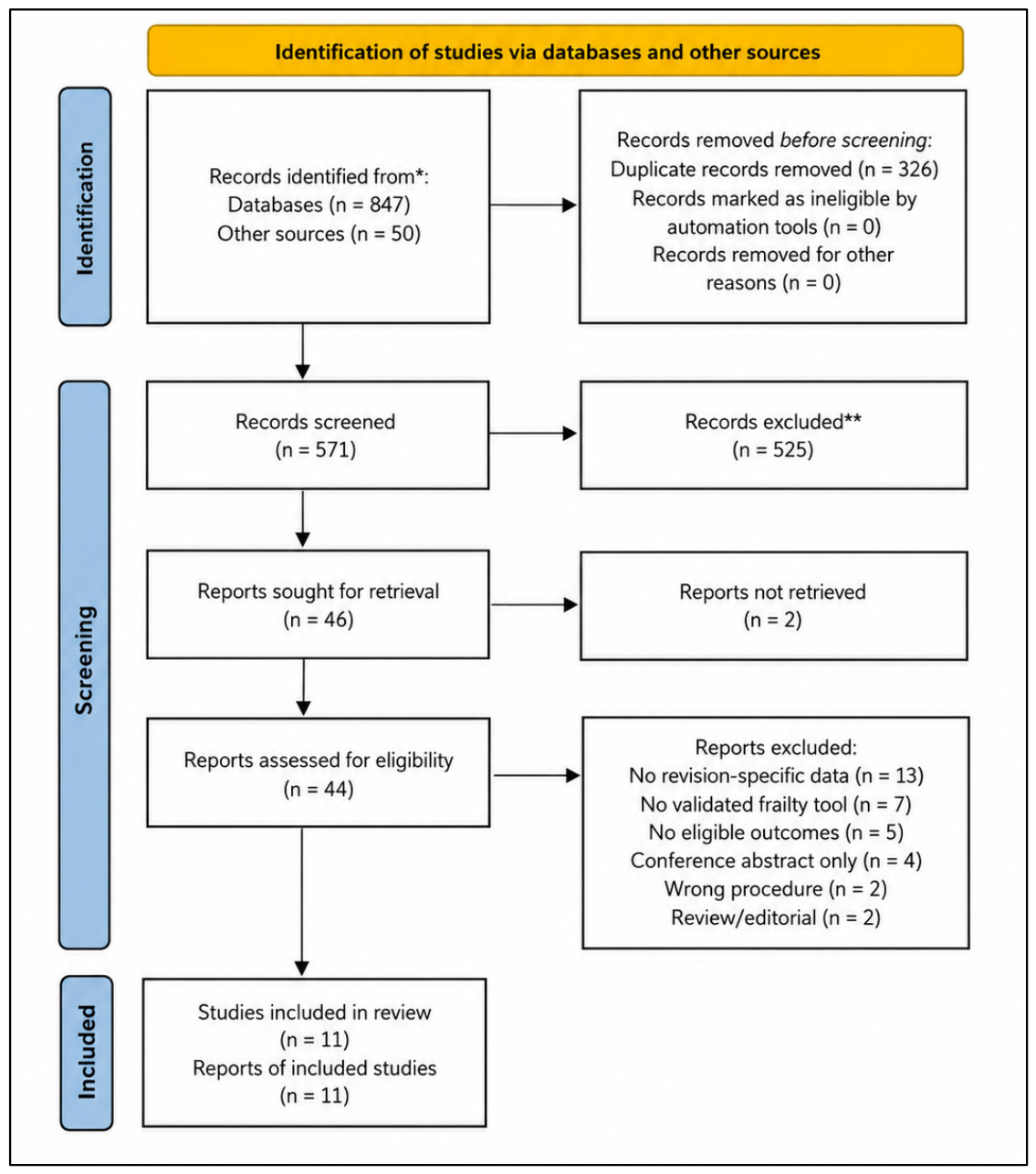
3.1. Study Selection
3.2. Characteristics of the Included Studies
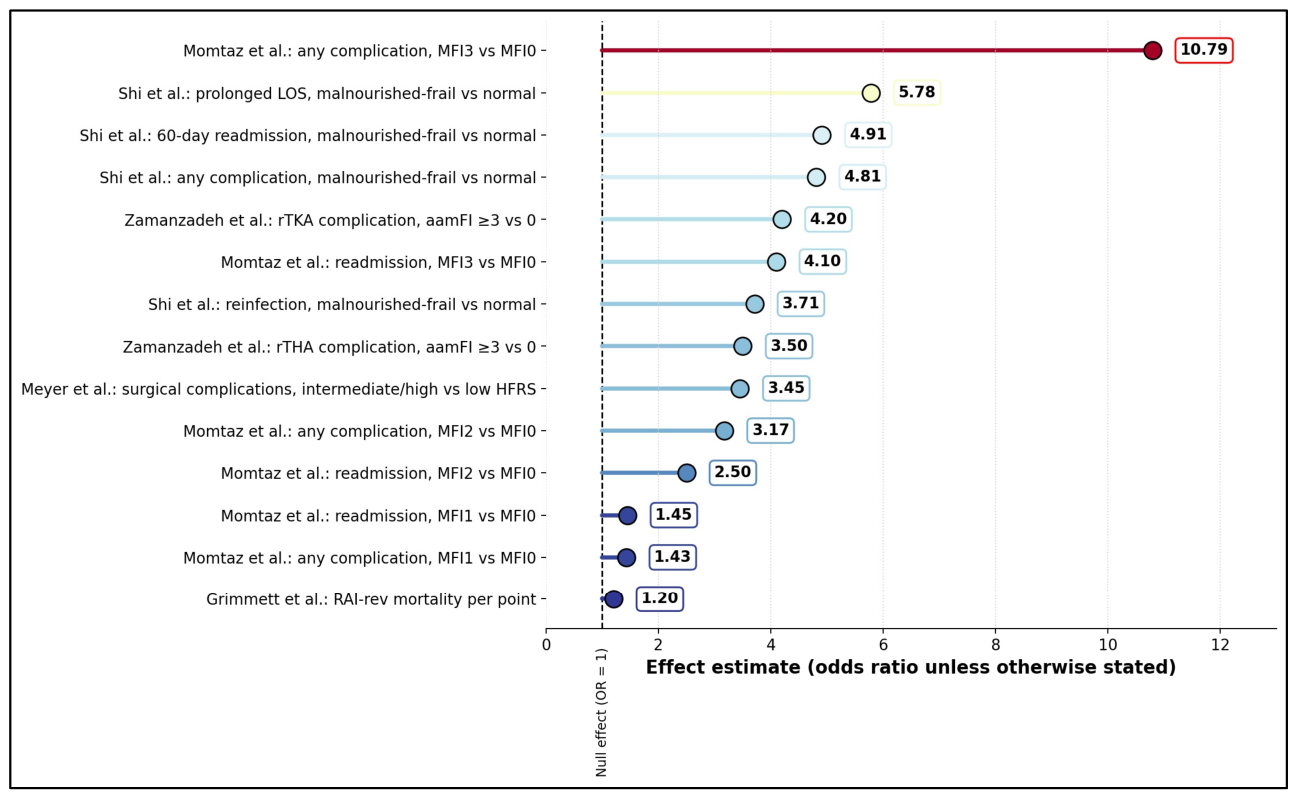
3.3. Quantitative Findings Across Studies
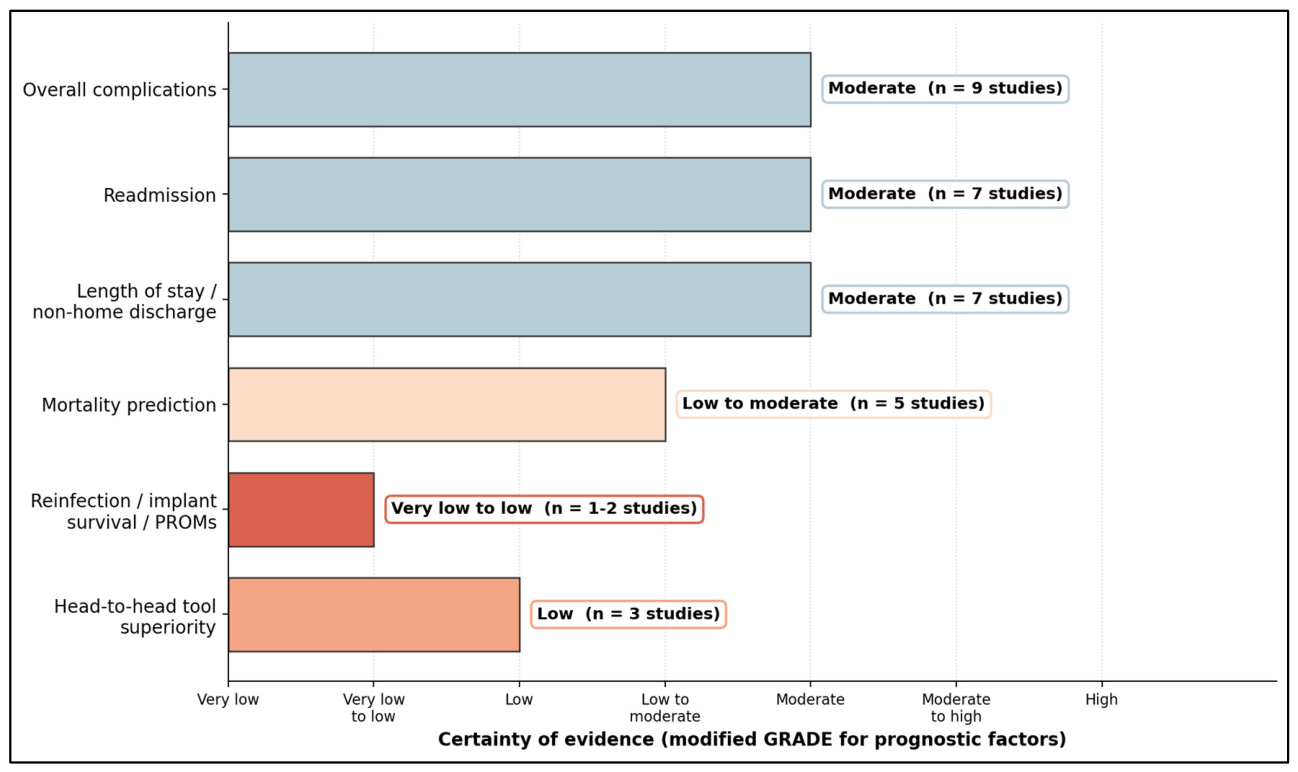
3.4. Outcome Domains and Evidence Quality
4. Discussion
4.1. Analysis of Findings
4.2. Study Limitations
5. Conclusions
Author Contributions
Funding
Institutional Review Board Statement
Informed Consent Statement
Data Availability Statement
Acknowledgments
Conflicts of Interest
Appendix A. Complete Search Strings and Gray-Literature Procedures
- PubMed/MEDLINE: ((“Arthroplasty, Replacement, Hip”[Mesh] OR “Arthroplasty, Replacement, Knee”[Mesh] OR “revision total hip arthroplasty” OR “revision total knee arthroplasty” OR rTHA OR rTKA OR “revision joint replacement” OR “second-stage revision”) AND (“Frailty”[Mesh] OR frail* OR “frailty index” OR “modified frailty index” OR mFI-5 OR mFI-11 OR “hospital frailty risk score” OR HFRS OR “clinical frailty scale” OR CFS OR “CARDE-B” OR “Risk Analysis Index” OR RAI-rev) AND (complication* OR mortality OR readmission OR morbidity OR outcome* OR “length of stay” OR discharge OR reoperation OR reinfection)).
- Embase: (‘revision hip arthroplasty’/exp OR ‘revision knee arthroplasty’/exp OR ‘revision total hip arthroplasty’ OR ‘revision total knee arthroplasty’ OR rtha OR rtka OR ‘second-stage revision’) AND (‘frailty’/exp OR frail* OR ‘modified frailty index’ OR ‘hospital frailty risk score’ OR ‘clinical frailty scale’ OR ‘carde-b’ OR ‘risk analysis index’) AND (‘postoperative complication’/exp OR complication* OR mortality OR readmission OR ‘length of stay’ OR discharge OR reoperation OR reinfection).
- Cochrane Library: ([revision total hip arthroplasty] OR [revision total knee arthroplasty] OR [revision joint replacement] OR rTHA OR rTKA) AND (frailty OR frail OR modified frailty index OR hospital frailty risk score OR clinical frailty scale OR CARDE-B) AND (complications OR mortality OR readmission OR length of stay OR discharge).
- Web of Science Core Collection: TS = ((revision NEAR/2 (hip OR knee OR arthroplasty OR replacement)) OR rTHA OR rTKA OR “second-stage revision”) AND TS = (frailty OR frail* OR “modified frailty index” OR “hospital frailty risk score” OR “clinical frailty scale” OR “CARDE-B” OR “Risk Analysis Index”) AND TS = (complication* OR mortality OR readmission OR “length of stay” OR discharge OR reinfection OR reoperation).
- Scopus: TITLE-ABS-KEY((revision W/2 (hip OR knee OR arthroplasty OR replacement)) OR rTHA OR rTKA OR “second-stage revision”) AND TITLE-ABS-KEY(frailty OR frail* OR “modified frailty index” OR “hospital frailty risk score” OR “clinical frailty scale” OR “CARDE-B” OR “Risk Analysis Index”) AND TITLE-ABS-KEY(complication* OR mortality OR readmission OR “length of stay” OR discharge OR reinfection OR reoperation).
- Gray literature and conference sources: AAOS, EFORT, and ISAR proceedings were searched for 2019 through January 2026 using the terms revision arthroplasty, revision hip, revision knee, frailty, modified frailty index, hospital frailty risk score, CARDE-B, and risk analysis index. Conference-only abstracts were used for citation tracking only and were not included unless a full-length peer-reviewed article was available.
References
- Learmonth, I.D.; Young, C.; Rorabeck, C. The operation of the century: Total hip replacement. Lancet 2007, 370, 1508–1519. [Google Scholar] [CrossRef] [PubMed]
- Sloan, M.; Premkumar, A.; Sheth, N.P. Projected volume of primary total joint arthroplasty in the U.S., 2014 to 2030. J. Bone Jt. Surg. Am. 2018, 100, 1455–1460. [Google Scholar] [CrossRef]
- Schwartz, A.M.; Farley, K.X.; Guild, G.N.; Bradbury, T.L. Projections and epidemiology of revision hip and knee arthroplasty in the United States to 2030. J. Arthroplast. 2020, 35, S79–S85. [Google Scholar] [CrossRef]
- Bozic, K.J.; Kurtz, S.M.; Lau, E.; Ong, K.; Vail, T.P.; Berry, D.J. The epidemiology of revision total hip arthroplasty in the United States. J. Bone Jt. Surg. Am. 2009, 91, 128–133. [Google Scholar] [CrossRef]
- Bozic, K.J.; Kurtz, S.M.; Lau, E.; Ong, K.; Chiu, V.; Vail, T.P.; Rubash, H.E.; Berry, D.J. The epidemiology of revision total knee arthroplasty in the United States. Clin. Orthop. Relat. Res. 2010, 468, 45–51. [Google Scholar] [CrossRef]
- Postler, A.; Lützner, C.; Beyer, F.; Tille, E.; Lützner, J. Analysis of total knee arthroplasty revision causes. BMC Musculoskelet. Disord. 2018, 19, 55. [Google Scholar] [CrossRef]
- Pulido, L.; Parvizi, J.; Macgibeny, M.; Sharkey, P.F.; Purtill, J.J.; Rothman, R.H.; Hozack, W.J. In hospital complications after total joint arthroplasty. J. Arthroplast. 2008, 23, 139–145. [Google Scholar] [CrossRef] [PubMed]
- Mahomed, N.N.; Barrett, J.; Katz, J.N.; Baron, J.A.; Wright, J.; Losina, E. Epidemiology of total knee replacement in the United States Medicare population. J. Bone Jt. Surg. Am. 2005, 87, 1222–1228. [Google Scholar]
- Kurtz, S.M.; Ong, K.L.; Lau, E.; Bozic, K.J. Impact of the economic downturn on total joint replacement demand in the United States. J. Bone Jt. Surg. Am. 2014, 96, 624–630. [Google Scholar] [CrossRef] [PubMed]
- Daigle, M.E.; Weinstein, A.M.; Katz, J.N.; Losina, E. The cost-effectiveness of total joint arthroplasty: A systematic review of published literature. Best. Pract. Res. Clin. Rheumatol. 2012, 26, 649–658. [Google Scholar] [CrossRef]
- Fried, L.P.; Tangen, C.M.; Walston, J.; Newman, A.B.; Hirsch, C.; Gottdiener, J.; Seeman, T.; Tracy, R.; Kop, W.J.; Burke, G.; et al. Frailty in older adults: Evidence for a phenotype. J. Gerontol. A Biol. Sci. Med. Sci. 2001, 56, M146–M156. [Google Scholar] [CrossRef]
- Rockwood, K.; Mitnitski, A. Frailty in relation to the accumulation of deficits. J. Gerontol. A Biol. Sci. Med. Sci. 2007, 62, 722–727. [Google Scholar] [CrossRef]
- Hoogendijk, E.O.; Afilalo, J.; Ensrud, K.E.; Kowal, P.; Onder, G.; Fried, L.P. Frailty: Implications for clinical practice and public health. Lancet 2019, 394, 1365–1375. [Google Scholar] [CrossRef]
- Lin, H.S.; Watts, J.N.; Peel, N.M.; Hubbard, R.E. Frailty and post-operative outcomes in older surgical patients: A systematic review. BMC Geriatr. 2016, 16, 157. [Google Scholar] [CrossRef]
- Pearl, A.; Ismail, A.; Alsadi, T.; Crespi, Z.; Daher, M.; Saleh, K. Frailty and pre-frailty in the setting of total joint arthroplasty: A narrative review. Geriatr. Orthop. Surg. Rehabil. 2023, 14, 21514593231188864. [Google Scholar] [CrossRef]
- Traven, S.A.; Reeves, R.A.; Slone, H.S.; Walton, Z.J. Frailty predicts medical complications, length of stay, readmission, and mortality in revision hip and knee arthroplasty. J. Arthroplast. 2019, 34, 1412–1416. [Google Scholar] [CrossRef]
- Meyer, M.; Schwarz, T.; Renkawitz, T.; Maderbacher, G.; Grifka, J.; Weber, M. Hospital frailty risk score predicts adverse events in revision total hip and knee arthroplasty. Int. Orthop. 2021, 45, 2765–2772. [Google Scholar] [CrossRef]
- Raad, M.; Amin, R.; Puvanesarajah, V.; Musharbash, F.; Rao, S.; Best, M.J.; Amanatullah, D.F. The CARDE-B scoring system predicts 30-day mortality after revision total joint arthroplasty. J. Bone Jt. Surg. Am. 2021, 103, 424–431. [Google Scholar] [CrossRef]
- Zamanzadeh, R.S.; Seilern Und Aspang, J.R.M.; Schwartz, A.M.; Martin, J.R.; Premkumar, A.; Wilson, J.M. Age-Adjusted Modified Frailty Index Predicts 30-Day Complications and Mortality in Aseptic Revision Total Hip and Knee Arthroplasty. J. Arthroplast. 2024, 39, 198–205. [Google Scholar] [CrossRef]
- Shi, T.; Chen, Z.; Hu, D.; Wu, D.; Wang, Z.; Liu, W. Concomitant malnutrition and frailty are significant risk factors for poor outcome following two-stage revision for chronic periprosthetic joint infection. J. Orthop. Surg. Res. 2023, 18, 804. [Google Scholar] [CrossRef]
- Momtaz, D.; Okpara, S.; Martinez, A.; Cushing, T.; Ghali, A.; Gonuguntla, R.; Kotzur, T.; Duruewuru, A.; Harris, M.; Seifi, A.; et al. A modified frailty index predicts complication, readmission, and 30-day mortality following the revision total hip arthroplasty. Arthroplasty 2024, 6, 7. [Google Scholar] [CrossRef] [PubMed]
- Tram, M.K.; Tabbaa, A.; Lakra, A.; Anoushiravani, A.A.; Bernasek, T.L.; Lyons, S.T.; O’Connor, C.M. Patient frailty is correlated with increased adverse events and costs after revision total hip arthroplasty. J. Arthroplast. 2024, 39, 1151–1156.e4. [Google Scholar] [CrossRef] [PubMed]
- Kyaw, N.R.; Tram, M.K.; Lakra, A.; Bernasek, T.L.; Lyons, S.T.; O’Connor, C.M. Patient frailty is correlated with increased adverse events and costs after revision knee arthroplasty. J. Arthroplast. 2024, 39, 1165–1170.e3. [Google Scholar] [CrossRef]
- Arapovic, A.E.; Zalikha, A.K.; Zamzam, M.; Keeley, J.; Hussein, I.H.; El-Othmani, M.M. Frailty among revision total knee arthroplasty recipients: Epidemiology and propensity score-weighted analysis of effect on in-hospital postoperative outcomes. J. Am. Acad. Orthop. Surg. 2024, 32, e387–e395. [Google Scholar] [CrossRef]
- Pean, C.A.; Buddhiraju, A.; Shimizu, M.R.; Chen, T.L.W.; Esposito, J.G.; Kwon, Y.M. Prediction of 30-day mortality following revision total hip and knee arthroplasty: Machine learning algorithms outperform CARDE-B, 5-item, and 6-item modified frailty index risk scores. J. Arthroplast. 2024, 39, 2824–2830. [Google Scholar] [CrossRef]
- Grimmett, H.; Sayyed, A.; Koltenyuk, V.; Areti, A.; Chmait, H.R.; Gupta, N.; Gray, M.; Young, W.; Williamson, T.K.; Moore, C.; et al. Comparative analysis of frailty indices on complication risk following septic revision total hip and knee arthroplasty. Geriatr. Orthop. Surg. Rehabil. 2025, 16, 21514593251392692. [Google Scholar] [CrossRef]
- Johnson, R.L.; Abdel, M.P.; Frank, R.D.; Chamberlain, A.M.; Habermann, E.B.; Mantilla, C.B. Impact of frailty on outcomes after primary and revision total hip arthroplasty. J. Arthroplast. 2019, 34, 56–64.e5. [Google Scholar] [CrossRef]
- Chamberlain, A.M.; Wilsher, L.C.; Frank, R.D.; Abdel, M.P.; Habermann, E.B.; Mantilla, C.B. Frailty index is associated with periprosthetic fracture and mortality after total knee arthroplasty. Orthopedics 2019, 42, 335–343. [Google Scholar] [CrossRef]
- Zalikha, A.K.; Pham, L.; Keeley, J.; Hussein, I.H.; El-Othmani, M.M. Frailty among total hip and knee arthroplasty recipients: Epidemiology and propensity score-weighted analysis of effect on in-hospital postoperative outcomes. J. Am. Acad. Orthop. Surg. 2023, 31, 292–299. [Google Scholar] [CrossRef]
- Liu, E.X.; Kuhataparuks, P.; Liow, M.H.L.; Tay, K.J.D.; Lo, N.N.; Yeo, S.J. Clinical Frailty Scale is a better predictor for adverse post-operative complications and functional outcomes than Modified Frailty Index and Charlson Comorbidity Index after total knee arthroplasty. Knee Surg. Sports Traumatol. Arthrosc. 2023, 31, 3186–3195. [Google Scholar] [CrossRef] [PubMed]
- Wall, B.J.; Wittauer, M.; Dillon, K.; Seymour, H.; Yates, P.J.; Jones, C.W. Clinical frailty scale predicts outcomes following total joint arthroplasty. Arthroplasty 2025, 7, 13. [Google Scholar] [CrossRef]
- Velanovich, V.; Antoine, H.; Swartz, A.; Peters, D.; Rubinfeld, I. Accumulating deficits model of frailty and postoperative mortality and morbidity: Its application to a national database. J. Surg. Res. 2013, 183, 104–110. [Google Scholar] [CrossRef]
- Gilbert, T.; Neuburger, J.; Kraindler, J.; Keeble, E.; Smith, P.; Ariti, C.; Arora, S.; Street, A.; Parker, S.; Roberts, H.C.; et al. Development and validation of a Hospital Frailty Risk Score focusing on older people in acute care settings using electronic hospital records: An observational study. Lancet 2018, 391, 1775–1782. [Google Scholar] [CrossRef]
- Rockwood, K.; Song, X.; MacKnight, C.; Bergman, H.; Hogan, D.B.; McDowell, I.; Mitnitski, A. A global clinical measure of fitness and frailty in elderly people. CMAJ 2005, 173, 489–495. [Google Scholar] [CrossRef] [PubMed]
- Văduva, D.M.B.; Velimirovici, D.E.; Văduva, M.M.B.; Stanga, L.; Petrescu, H.; Rada, M.; Cipu, D.; Văduva, B.M.B.; Rădulescu, M. Phenotypic Study and Sensitivity to Anti-Infective Chemotherapy of Bacterial Strains Isolated from Cutaneous-Mucosal Infections. Mater. Plast. 2018, 55, 372–375. [Google Scholar] [CrossRef]
- Tapalaga, G.; Stanga, L.; Sîrbu, I. Systematic Review of Lead Exposure and Its Effects on Caries and Aesthetics in Children and Adolescents. Healthcare 2025, 13, 1460. [Google Scholar] [CrossRef]
- Stanciu, I.-V.; Fildan, A.-P.; Thakur, B.R.; Ilie, A.C.; Stanga, L.; Oancea, C.; Tudorache, E.; Bratosin, F.; Roșca, O.; Bogdan, I.; et al. Full-Blood Inflammatory Ratios Predict Length of Stay but Not Early Death in Romanian Pulmonary Tuberculosis. Medicina 2025, 61, 1238. [Google Scholar] [CrossRef]
- Nistor, P.; Stanga, L.; Chirila, A.; Iorgoni, V.; Gligor, A.; Ciresan, A.; Popa, I.; Florea, B.; Imre, M.; Cocioba, V.; et al. Seroprevalence and Passive Clinical Surveillance of West Nile Virus in Horses from Ecological High-Risk Areas in Western Romania: Exploratory Findings from a Cross-Sectional Study. Microorganisms 2025, 13, 1910. [Google Scholar] [CrossRef]
- Betea, R.; Budișan, C.; Stanga, L.; Mureșan, M.C.; Popa, Z.L.; Cîțu, C.; Rațiu, A.; Chiriac, V.D. Quality-of-Life Trajectories and Perceived Stress in Women Treated for Uterine Cancer: A Six-Month Prospective Study. Healthcare 2025, 13, 1787. [Google Scholar] [CrossRef]
- Stanciu, I.V.; Fildan, A.P.; Chenna, V.S.H.; Ilie, A.C.; Tudorache, E.; Rosca, O.; Stanga, L.; Cozma, G.V.; Preotesoiu, I.; Dantes, E. Physiologic–Inflammatory–Nutrition (TRIAD-TB) Score at 72 Hours Predicts 30-Day Mortality and Length of Stay in Pulmonary Tuberculosis: A Prospective Cohort Study. Biomedicines 2025, 13, 2901. [Google Scholar] [CrossRef] [PubMed]
- Iorgoni, V.; Stanga, L.; Iancu, I.; Degi, J.; Popa, I.; Gligor, A.; Orghici, G.; Sicoe, B.; Dreghiciu, I.C.; Purec, D.; et al. Multidrug-Resistant Escherichia coli Associated with Respiratory and Systemic Infection in a Domestic Rabbit in Romania: First Confirmed Case. Antibiotics 2025, 14, 929. [Google Scholar] [CrossRef] [PubMed]
- Iacob, M.S.; Kundnani, N.R.; Sharma, A.; Meche, V.; Ciobotaru, P.; Bedreag, O.; Sandeș, D.; Drăgan, S.R.; Papurica, M.; Stanga, L.C. Multifactorial Risk Stratification in Patients with Heart Failure, Chronic Kidney Disease, and Atrial Fibrillation: A Comprehensive Analysis. Life 2025, 15, 786. [Google Scholar] [CrossRef] [PubMed]
- Daliu, P.; Bogdan, I.; Roșca, O.; Licker, M.; Stanga, L.C.; Hogea, E.; Văduva, D.B.; Muntean, D. Fungal Pulmonary Coinfections in COVID-19: Microbiological Assessment, Inflammatory Profiles, and Clinical Outcomes. Biomedicines 2025, 13, 864. [Google Scholar] [CrossRef]



| Study | Country; Data Source | Design; Study Period | Revision Cohort | N | Frailty Tool/Threshold | Follow-Up | Adjustment Variables/Model | Main Outcomes | Key Revision-Specific Findings |
|---|---|---|---|---|---|---|---|---|---|
| Traven et al. [16] | USA; ACS-NSQIP | Retrospective database; 2006–2015 | rTHA + rTKA | 30,252 | mFI-5; increasing score categories | 30 days | Multivariable models using demographic, comorbidity, and procedural variables available in NSQIP | Serious medical complications, LOS, facility discharge, readmission, mortality | mFI-5 independently predicted serious medical complications, prolonged stay, non-home discharge, readmission, and mortality. |
| Meyer et al. [17] | Germany; single center | Retrospective cohort; 2013–2019 | rTHA + rTKA | 565 | HFRS; low vs. intermediate/high risk | 30 days | Regression models adjusted for baseline clinical and surgical variables reported by the authors | Readmission, complications, transfusion | Readmission was 23.8% vs. 9.9% and surgical complications 28.6% vs. 7.8%; OR 3.45 for surgical complications. |
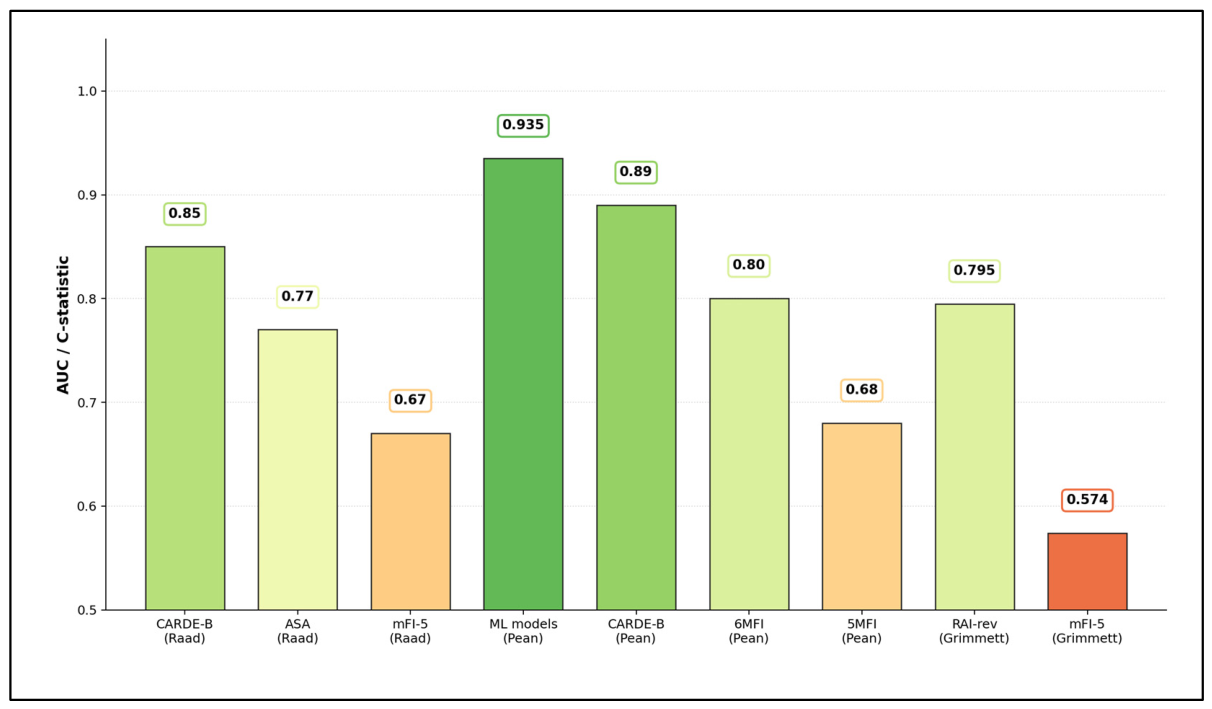
| Raad et al. [18] | USA; ACS-NSQIP with NIS validation | Retrospective derivation/validation; 2005–2016 | Revision TJA | 13,118 derivation; 19,153 validation | CARDE-B score; compared with ASA and mFI-5 | 30 days | Revision-specific mortality prediction model with external validation | 30-day mortality discrimination | CARDE-B AUC 0.85 in derivation and 0.75 in validation, outperforming ASA and mFI-5. |
| Zamanzadeh et al. [19] | USA; national database | Retrospective database; 2015–2020 | Aseptic rTHA + rTKA | 32,069 | Age-adjusted mFI (aamFI); categories 0 to >=5; age >= 73 years as one component | 30 days | Multivariable models adjusted for demographics, comorbidities, and operative characteristics | Any 30-day complication, mortality | Complication incidence increased from 15% to 45% in rTHA and 5% to 55% in rTKA across frailty strata. |
| Shi et al. [20] | China; single center | Retrospective cohort; 2010–2020 | Two-stage revision for chronic PJI | 117 | mFI-11 plus albumin-defined malnutrition; combined frailty/malnutrition groups | 60 days and infection follow-up reported by authors | Multivariable models including nutrition and clinical variables | Reinfection, complications, readmission, prolonged LOS | Malnourished–frail patients had OR 3.71 for reinfection, 4.81 for complications, 4.91 for 60-day readmission, and 5.78 for prolonged stay. |
| Momtaz et al. [21] | USA; ACS-NSQIP | Retrospective database; 2015–2020 | Revision THA | 17,868 | Custom 8-item MFI; MFI0-MFI3 | 30 days | Multivariable models adjusted for demographic and comorbidity factors | Complications, readmission, mortality, discharge | Dose–response: any-complication ORs 1.43, 3.17, and 10.79 across MFI1-MFI3; readmission ORs 1.45, 2.50, and 4.10. |
| Tram et al. [22] | USA; NRD | Retrospective national readmission database; 2016–2019 | Revision THA | 36,243 | HFRS; frail vs. non-frail | 30 days/index admission | Models adjusted for demographic, payer, hospital, and comorbidity variables | Readmission, LOS, cost, complications, reoperation | Frailty was associated with higher readmission, longer stay, greater costs, more complications, and more reoperation. |
| Kyaw et al. [23] | USA; NRD | Retrospective national readmission database; 2016–2019 | Revision TKA | 47,347 | HFRS; frail vs. non-frail | 30 days/index admission | Models adjusted for demographic, hospital, and comorbidity variables | Readmission, LOS, cost, complications, reoperation | Frailty remained prognostic across loosening, infection, and instability indications; infection readmission 13.5% vs. 8.1%. |
| Arapovic et al. [24] | USA; NIS | Retrospective inpatient database; 2005–2014 | Revision TKA | 576,920 | ICD-9 frailty coding; frail vs. non-frail | Index hospitalization | Propensity score-weighted analysis | In-hospital complications, discharge, LOS | Frailty was associated with postoperative complications, non-home discharge, and longer hospitalization. |
| Pean et al. [25] | USA; ACS-NSQIP | Retrospective database; 2005–2020 | Revision TJA | Not separately stated in accessible full-text record | CARDE-B, 5MFI, 6MFI and machine-learning models | 30 days | Machine-learning and comparative prediction models | Mortality prediction | ML models achieved AUC 0.93–0.94, exceeding CARDE-B, 6MFI, and 5MFI. |
| Grimmett et al. [26] | USA; ACS-NSQIP | Retrospective database; 2008–2021 | Septic revision THA + TKA | 4395 | RAI-rev vs. mFI-5 | 30 days | Comparative C-statistic models | Mortality and non-home discharge prediction | RAI-rev outperformed mFI-5 for mortality C-statistic (0.795 vs. 0.574) and non-home discharge (0.670 vs. 0.602). |
| Clinical Interpretation | Outcome Domain | Comparison/Frailty Definition | Key Quantitative Findings | Study |
|---|---|---|---|---|
| This large ACS-NSQIP study supports routine frailty stratification even when only a short administrative index is available. | Complications/LOS/readmission/discharge/mortality | mFI-5 modeled as a preoperative frailty score | Frailty independently predicted serious medical complications, discharge to a facility, longer stay, readmission, and mortality after revision THA/TKA. | Traven et al. [16] |
| Higher HFRS identified a small but distinctly high-risk subgroup with substantially worse early outcomes. | Readmission/complications/transfusion | Intermediate-high vs. low HFRS | 30-day readmission 23.8% vs. 9.9%; surgical complications 28.6% vs. 7.8%; OR 3.45 (95% CI 1.45–8.18) for surgical complications. | Meyer et al. [17] |
| Revision-specific risk modeling can improve discrimination beyond general perioperative or generic frailty tools. | Mortality prediction | CARDE-B vs. ASA vs. mFI-5 | 30-day mortality 0.7%; AUC 0.85 for CARDE-B versus 0.77 for ASA and 0.67 for mFI-5 in derivation, with AUC 0.75 in external validation. | Raad et al. [18] |
| The age-adjusted index showed a clear dose–response pattern across both major revision arthroplasty settings. | Any 30-day complication | aamFI 0 to >=5; reference aamFI 0 | Any-complication incidence rose from 15% to 45% in rTHA and from 5% to 55% in rTKA across aamFI categories; aamFI >= 3 gave OR 3.5 in rTHA and OR 4.2 in rTKA. | Zamanzadeh et al. [19] |
| Frailty appears especially consequential when combined with poor nutritional reserve in chronic PJI revision pathways. | Reinfection/complications/LOS/readmission | Combined malnutrition + frailty vs. normal nutrition and non-frailty | Compared with the normal group, the malnourished–frail group had OR 3.71 for reinfection, OR 4.81 for complications, OR 4.91 for 60-day readmission, and OR 5.78 for prolonged stay. | Shi et al. [20] |
| The steep gradient across frailty strata suggests a clinically meaningful accumulation-of-deficits effect in revision THA. | Complications/readmission/mortality/discharge | Increasing custom MFI burden (MFI1 to MFI3) vs. MFI0 | Relative to MFI0, odds of any complication were 1.43, 3.17, and 10.79 for MFI1, MFI2, and MFI3; corresponding readmission ORs were 1.45, 2.50, and 4.10. | Momtaz et al. [21] |
| Administrative frailty scoring remained informative across large national revision THA cohorts and multiple indications. | Readmission/LOS/cost/complications/reoperation | Frail vs. non-frail by HFRS | Across revision THA indications, frailty was associated with higher 30-day readmission, longer stay, greater cost, more complications, and more reoperation; in dislocation revisions, ORs reached 1.96 for readmission and 1.85 for longer stay. | Tram et al. [22] |
| Frailty carried prognostic value regardless of whether revision TKA was performed for aseptic or septic reasons. | Readmission/LOS/cost/complications/reoperation | Frail vs. non-frail by HFRS | In revision TKA for loosening, readmission was 7.8% vs. 3.7% and complications 6.8% vs. 2.9%; in infection, readmission was 13.5% vs. 8.1% and complications 14.0% vs. 8.3%; in instability, readmission was 8.7% vs. 3.9% and complications 8.0% vs. 3.5%. | Kyaw et al. [23] |
| A population-level inpatient analysis confirmed that frailty is already clinically visible during the index hospitalization. | In-hospital complications/discharge/LOS | Frail vs. non-frail by ICD-9 frailty coding | Frail revision TKA recipients had higher in-hospital postoperative complications, including DVT, postoperative anemia, respiratory complications, and wound dehiscence, with lower home discharge rates and longer stay. | Arapovic et al. [24] |
| Prediction performance may improve when frailty-related variables are embedded in broader nonlinear risk models. | Mortality prediction | ML models vs. CARDE-B vs. 6MFI vs. 5MFI | Machine-learning models reached AUC 0.93–0.94 and Brier score 0.005 for 30-day mortality, outperforming CARDE-B (0.89), 6MFI (0.80), and 5MFI (0.68). | Pean et al. [25] |
| Tool selection matters, particularly in septic revision cohorts with substantial physiological stress and complex discharge needs. | Mortality/discharge prediction | RAI-rev vs. mFI-5 | RAI-rev outperformed mFI-5 for mortality discrimination (C-statistic 0.795 vs. 0.574) and non-home discharge (0.670 vs. 0.602) in septic revision arthroplasty. | Grimmett et al. [26] |
| Outcome Domain | No. Studies | Evidence Base | Consistency | Key Limitations | Certainty | Conclusion Supported |
|---|---|---|---|---|---|---|
| Overall complications | 9 | Retrospective observational cohorts and databases | Consistently worse outcomes with higher frailty | Heterogeneous definitions, mixed hip/knee and septic/aseptic revisions | Moderate | Frailty is a reliable marker of elevated short-term complication risk. |
| Readmission | 7 | Mostly 30-day administrative outcomes | Generally consistent increased risk | Variable readmission windows and adjustment variables | Moderate | Frailty is associated with higher early readmission. |
| Length of stay/non-home discharge | 7 | Database and institutional cohorts | Consistent direction of effect | Discharge practices differ by health system | Moderate | Frailty informs discharge planning and resource use. |
| Mortality prediction | 5 | Prediction model and comparative-tool studies | Consistent improvement with tailored models | Low event rates and retrospective design | Low to moderate | Frailty-related models improve short-term mortality discrimination, but clinical thresholds remain unresolved. |
| Reinfection/implant survival/patient-reported outcome measures (PROMs) | 1–2 | Sparse revision-specific evidence | Insufficient for firm conclusions | Few studies, limited follow-up | Very low to low | Long-term revision-specific endpoints require prospective study. |
| Head-to-head tool superiority | 3 | Direct comparisons of CARDE-B, mFI, ML models and RAI-rev | Suggests tailored tools may perform better | Few same-cohort comparisons and differing endpoints | Low | No universal best instrument can yet be recommended for all revision pathways. |
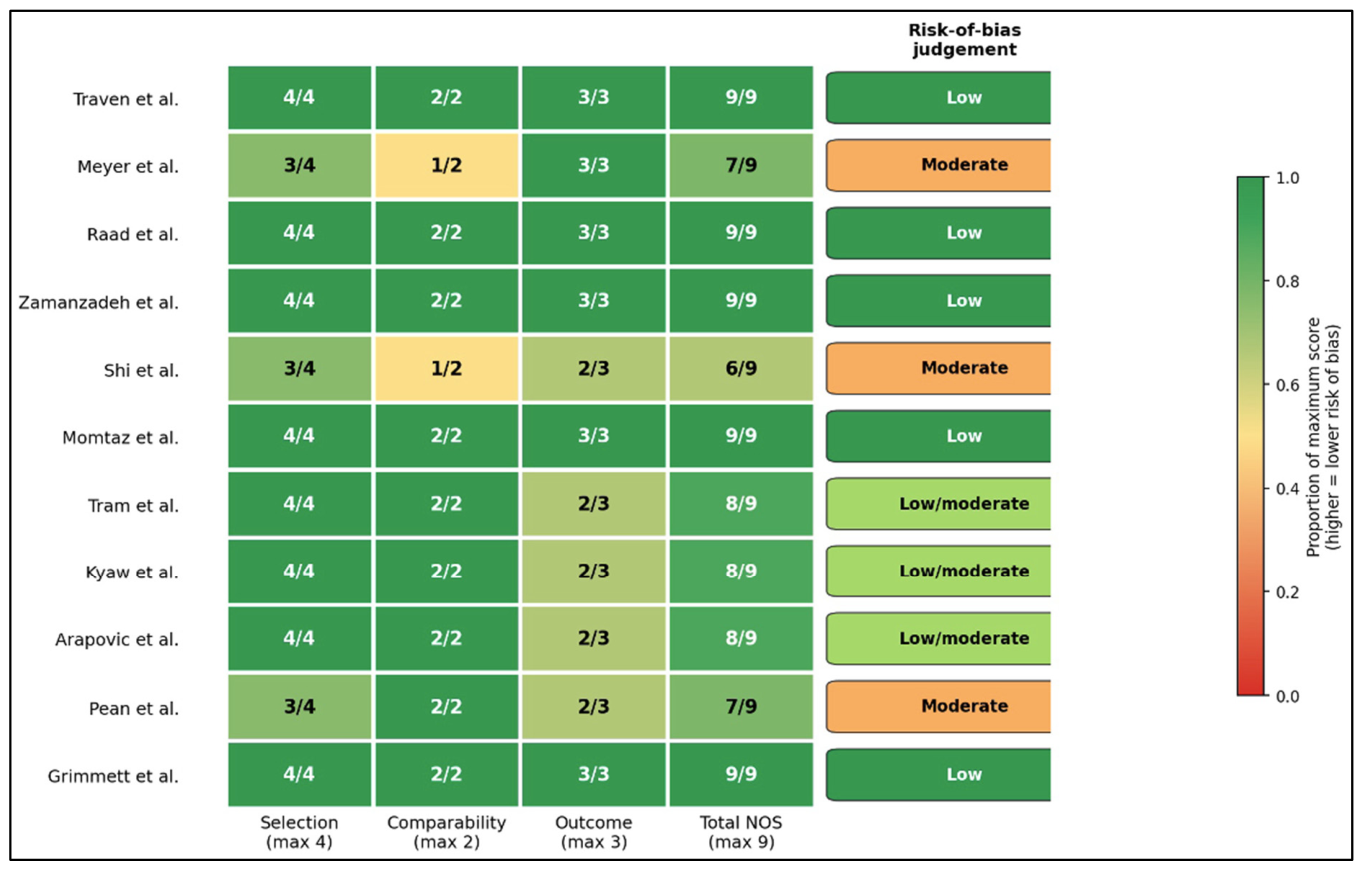
| Study | Selection (0–4) | Comparability (0–2) | Outcome (0–3) | NOS total | Risk-of-bias judgment | Influence on synthesis |
| Traven et al. [16] | 4 | 2 | 3 | 9/9 | Low | Large adjusted NSQIP analysis; high weight in consistency assessment. |
| Meyer et al. [17] | 3 | 1 | 3 | 7/9 | Moderate | Single-center design and modest sample size reduced certainty. |
| Raad et al. [18] | 4 | 2 | 3 | 9/9 | Low | Derivation plus validation strengthened prediction evidence. |
| Zamanzadeh et al. [19] | 4 | 2 | 3 | 9/9 | Low | Large aseptic revision cohort supported dose–response inference. |
| Shi et al. [20] | 3 | 1 | 2 | 6/9 | Moderate | Small single-center PJI cohort; estimates interpreted cautiously. |
| Momtaz et al. [21] | 4 | 2 | 3 | 9/9 | Low | Large adjusted analysis and graded frailty strata strengthened association evidence. |
| Tram et al. [22] | 4 | 2 | 2 | 8/9 | Low/moderate | Administrative coding and indication heterogeneity considered. |
| Kyaw et al. [23] | 4 | 2 | 2 | 8/9 | Low/moderate | Large NRD cohort but outcome definitions varied by indication. |
| Arapovic et al. [24] | 4 | 2 | 2 | 8/9 | Low/moderate | Propensity weighting strengthened inference, but frailty depended on ICD coding. |
| Pean et al. [25] | 3 | 2 | 2 | 7/9 | Moderate | Predictive modeling report; incomplete descriptive data limited external interpretation. |
| Grimmett et al. [26] | 4 | 2 | 3 | 9/9 | Low | Direct head-to-head comparison in septic revision cohort supported tool-comparison conclusions. |
Disclaimer/Publisher’s Note: The statements, opinions and data contained in all publications are solely those of the individual author(s) and contributor(s) and not of MDPI and/or the editor(s). MDPI and/or the editor(s) disclaim responsibility for any injury to people or property resulting from any ideas, methods, instructions or products referred to in the content. |
© 2026 by the authors. Licensee MDPI, Basel, Switzerland. This article is an open access article distributed under the terms and conditions of the Creative Commons Attribution (CC BY) license.
Share and Cite
Braescu, R.D.; Pătrașcu, J.M., Jr.; Pătrașcu, J.M.; Cojocaru, D.G. The Prognostic Value of Frailty Assessment Tools in Predicting Postoperative Outcomes After Revision Total Hip and Knee Arthroplasty: A Systematic Review. J. Clin. Med. 2026, 15, 4489. https://doi.org/10.3390/jcm15124489
Braescu RD, Pătrașcu JM Jr., Pătrașcu JM, Cojocaru DG. The Prognostic Value of Frailty Assessment Tools in Predicting Postoperative Outcomes After Revision Total Hip and Knee Arthroplasty: A Systematic Review. Journal of Clinical Medicine. 2026; 15(12):4489. https://doi.org/10.3390/jcm15124489
Chicago/Turabian StyleBraescu, Ruben David, Jenel Marian Pătrașcu, Jr., Jenel Marian Pătrașcu, and Dan Grigore Cojocaru. 2026. "The Prognostic Value of Frailty Assessment Tools in Predicting Postoperative Outcomes After Revision Total Hip and Knee Arthroplasty: A Systematic Review" Journal of Clinical Medicine 15, no. 12: 4489. https://doi.org/10.3390/jcm15124489
APA StyleBraescu, R. D., Pătrașcu, J. M., Jr., Pătrașcu, J. M., & Cojocaru, D. G. (2026). The Prognostic Value of Frailty Assessment Tools in Predicting Postoperative Outcomes After Revision Total Hip and Knee Arthroplasty: A Systematic Review. Journal of Clinical Medicine, 15(12), 4489. https://doi.org/10.3390/jcm15124489