This is an early access version, the complete PDF, HTML, and XML versions will be available soon.
Review

The Revolution in Surgery That Saves Millions of Lives


1
Camran Nezhat Institute Center for Minimally Invasive and Robotic Surgery, Woodside, CA 94061, USA
2
Stanford University, Medical Center, Palo Alto, CA 94305, USA
3
University of California, San Francisco, CA 94143, USA
*
Author to whom correspondence should be addressed.
J. Clin. Med. 2026, 15(12), 4476; https://doi.org/10.3390/jcm15124476 (registering DOI)
Submission received: 10 February 2026 / Revised: 21 March 2026 / Accepted: 26 March 2026 / Published: 9 June 2026
(This article belongs to the Section General Surgery)

Abstract

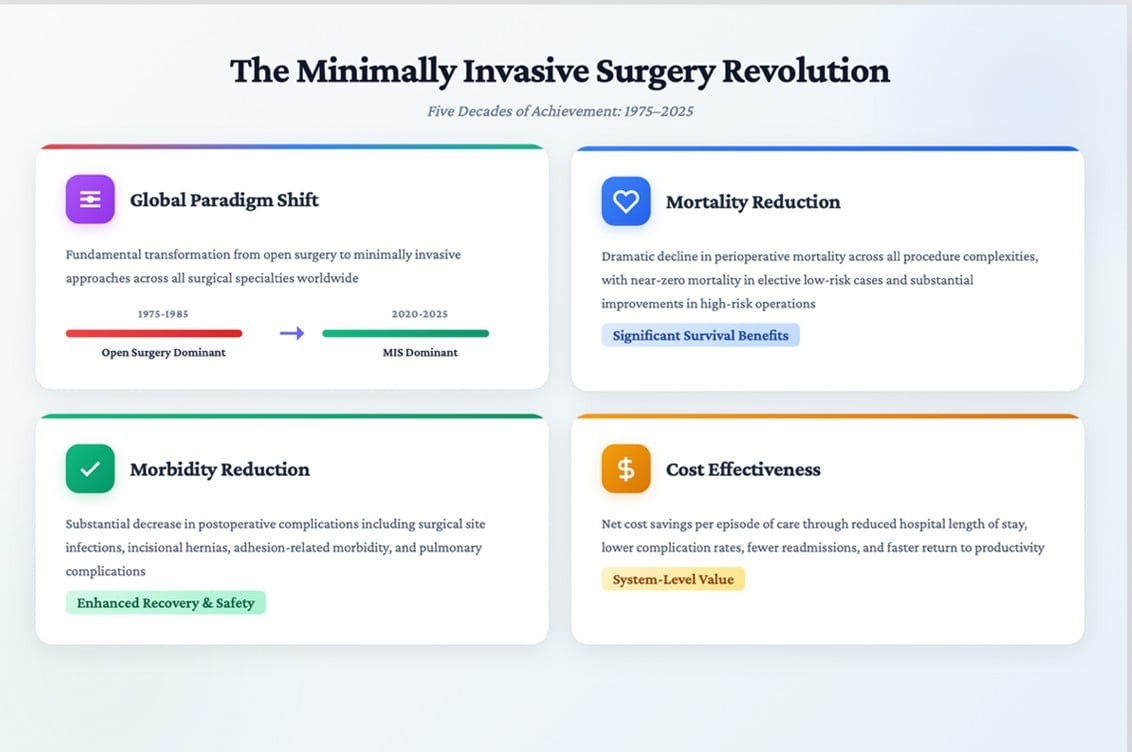
The introduction of minimally invasive surgery (MIS) marked a turning point in the history of medicine, driving one of the sharpest declines in surgical mortality and morbidity ever recorded—saving millions of lives and sparing an estimated one billion patients the suffering once inherent to large-incision surgery. Within a single generation, this once highly contested surgical innovation became the global standard of care, transforming surgical practice across disciplines and on a global scale. By every measure of public health, these outcomes place modern minimally invasive and robotic-assisted surgery as among the most consequential life-saving advances in modern medical history. This review examines the clinical impact and global dissemination of MIS, tracing its evolution from Camran Nezhat’s pioneering expansion of laparoscopy beyond diagnostics to complex therapeutic procedures across surgical disciplines. Drawing on decades of evidence across gynecology, general surgery, and urology, we show that MIS is associated with substantial reductions in perioperative mortality, major complications, blood loss, infections, thromboembolic events, postoperative pain, and length of hospital stay, while maintaining oncologic equivalence and improving functional and quality-of-life outcomes. Beyond these technical advances, MIS catalyzed a broader reimagining of surgery itself, challenging long-standing norms rooted in large-incision approaches and shifting the field toward precision, organ preservation, and pathology-directed intervention. These changes were accompanied by parallel advances in multiple domains, including in imaging, intraoperative visualization technologies, surgical anatomy, instrumentation, and nerve- and organ-sparing techniques—developments that collectively established the foundation for contemporary minimally invasive and robotic-assisted surgery. Collectively, these advances have contributed to the prevention of an estimated 10–20 million surgery-related deaths that would likely have occurred under the large-incision approaches of the past.
Keywords: minimally invasive surgery; MIS; video-assisted endoscopic surgery; video-assisted laparoscopy; laparoscopic surgery; robotic-assisted endoscopic surgery; surgical innovation; surgical outcomes; perioperative mortality; postoperative morbidity; enhanced recovery; oncologic equivalence; patient safety; surgical education; technology adoption; operative visualization; health economics; quality of life; evidence-based surgery; surgical training; historical perspective; Camran Nezhat minimally invasive surgery; MIS; video-assisted endoscopic surgery; video-assisted laparoscopy; laparoscopic surgery; robotic-assisted endoscopic surgery; surgical innovation; surgical outcomes; perioperative mortality; postoperative morbidity; enhanced recovery; oncologic equivalence; patient safety; surgical education; technology adoption; operative visualization; health economics; quality of life; evidence-based surgery; surgical training; historical perspective; Camran Nezhat
Graphical Abstract