This is an early access version, the complete PDF, HTML, and XML versions will be available soon.
Systematic Review

Prediction Models and Risk Factors for Steroid Resistance in Children with Nephrotic Syndrome: A Systematic Review and Meta-Analysis

1
Department of Pharmacy/Evidence-Based Pharmacy Center, West China Second University Hospital, Sichuan University, No.20, Section 3, Renmin South Road, Wuhou District, Chengdu 610041, China
2
Children’s Medicine Key Laboratory of Sichuan Province, No.20, Section 3, Renmin South Road, Wuhou District, Chengdu 610041, China
3
NMPA Key Laboratory for Technical Research on Drug Products In Vitro and In Vivo Correlation, No.20, Section 3, Renmin South Road, Wuhou District, Chengdu 610041, China
4
Key Laboratory of Birth Defects and Related Diseases of Women and Children, Sichuan University, Ministry of Education, No.20, Section 3, Renmin South Road, Wuhou District, Chengdu 610041, China
5
West China School of Pharmacy, Sichuan University, No.17, Section 3, Renmin South Road, Wuhou District, Chengdu 610041, China
6
Department of Pediatrics, West China Second University Hospital, Sichuan University, No.20, Section 3, Renmin South Road, Wuhou District, Chengdu 610041, China
7
West China School of Medicine, Sichuan University, No.17, Section 3, Renmin South Road, Wuhou District, Chengdu 610041, China
8
West China Biomedical Big Data Center, West China Hospital, Sichuan University, No. 37, Guoxue Lane, Wuhou District, Chengdu 610041, China
9
School of Pharmacy, Macau University of Science and Technology, No.100-460, Avenida Wai Long, Taipa, Macao 999078, China
10
Chinese Evidence-Based Medicine Center, West China Hospital, Sichuan University, No. 37, Guoxue Lane, Wuhou District, Chengdu 610041, China
*
Authors to whom correspondence should be addressed.
J. Clin. Med. 2026, 15(12), 4438; https://doi.org/10.3390/jcm15124438 (registering DOI)
Submission received: 14 April 2026 / Revised: 28 May 2026 / Accepted: 3 June 2026 / Published: 8 June 2026
(This article belongs to the Section Clinical Pediatrics)

Abstract

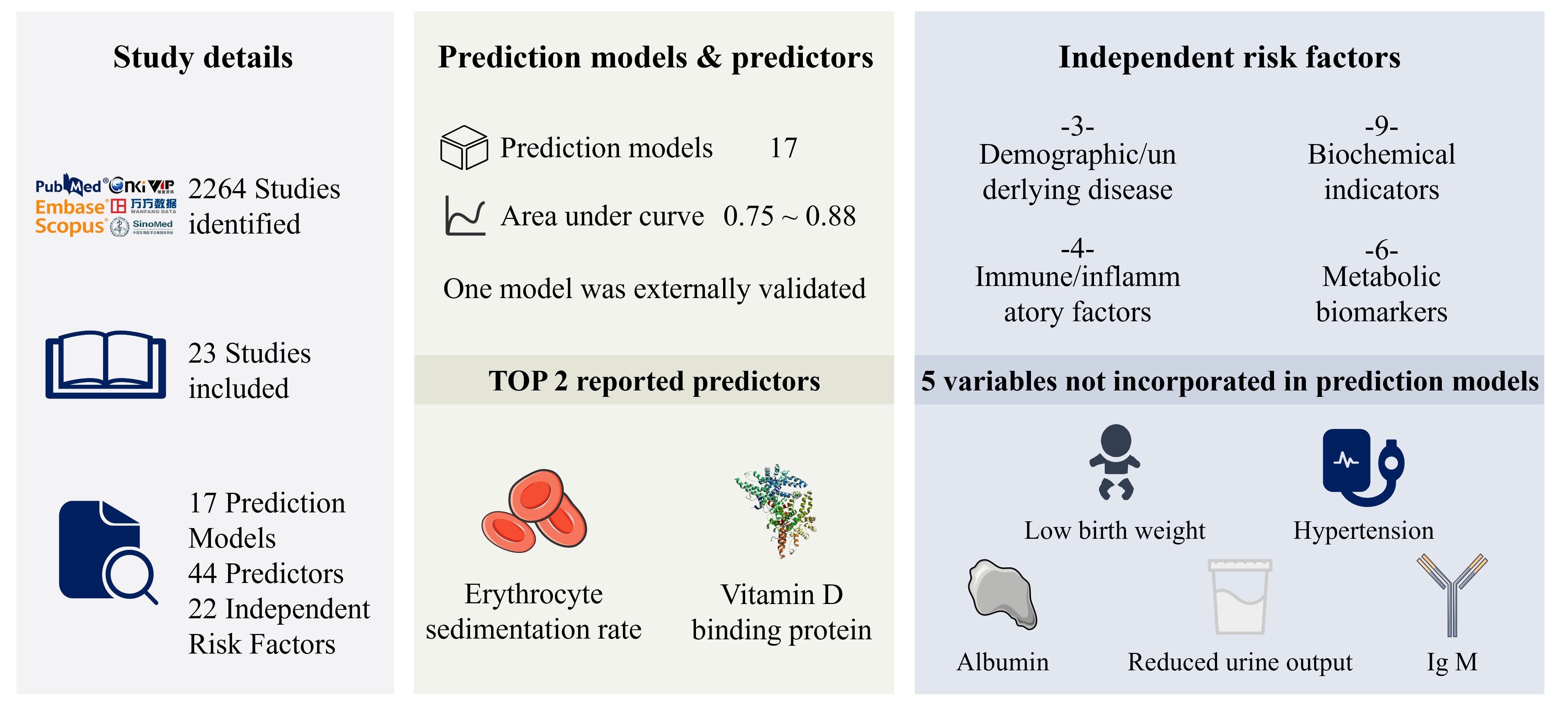
Background: Steroid resistance indicates poor prognosis in pediatric nephrotic syndrome, but predictive models and risk factors for steroid-resistant nephrotic syndrome (SRNS) remain poorly understood. Methods: We searched PubMed, Embase, Scopus, CNKI, SinoMed, Wanfang, and VIP (inception to 1 March 2025) for studies developing SRNS prediction models or identifying risk factors. Odds ratios and AUC were pooled using random-effects meta-analysis. Risk of bias was assessed with PROBAST and Newcastle-Ottawa Scale. Results: Out of 2264 studies, 23 were included. Prediction models were mainly developed using logistic regression (16/17, 94.1%). The most frequently reported predictors included erythrocyte sedimentation rate and vitamin D binding protein. The reported AUC ranged from 0.75 to 0.88. Only one model had undergone external validation with an accuracy of 0.94. A total of 22 independent risk factors were identified, five of which—low birth weight, decreased urine output, hypertension, serum albumin, and serum IgM—were not in existing models. In total, 76% of model studies and 26% of risk factor analyses were at high or moderate risk of bias. Conclusions: Existing SRNS prediction models reported apparent discrimination but had a high risk of bias and very limited external validation, which substantially restricts their current clinical applicability. Several relevant risk factors remain unincorporated. Future research should prioritize rigorous model development and multi-center external validation.
Keywords: nephrotic syndrome; prediction model; risk factor; steroid resistance nephrotic syndrome; prediction model; risk factor; steroid resistance
Graphical Abstract