Diagnostic Challenges and Management of Blunt Traumatic Duodenal Diverticulum Perforation: A Systematic Review
 , , , , and
Abstract
1. Introduction
1.1. Characteristics of Duodenal Diverticula
- -
- Ampulla (D1);
- -
- Descending part (D2);
- -
- Horizontal part (D3);
- -
- Ascending part (D4).
1.2. Research Gap and Rationale for Systematic Review
1.3. Objectives and Methodology
2. Methods
2.1. Eligibility Criteria
2.2. Information Sources
2.3. Search Strategy
- “duodenal diverticulum” OR “duodenal diverticula,”
- AND (trauma OR injury OR traumatic OR blunt trauma OR perforation OR perforated OR crush OR compression OR rupture OR laceration).
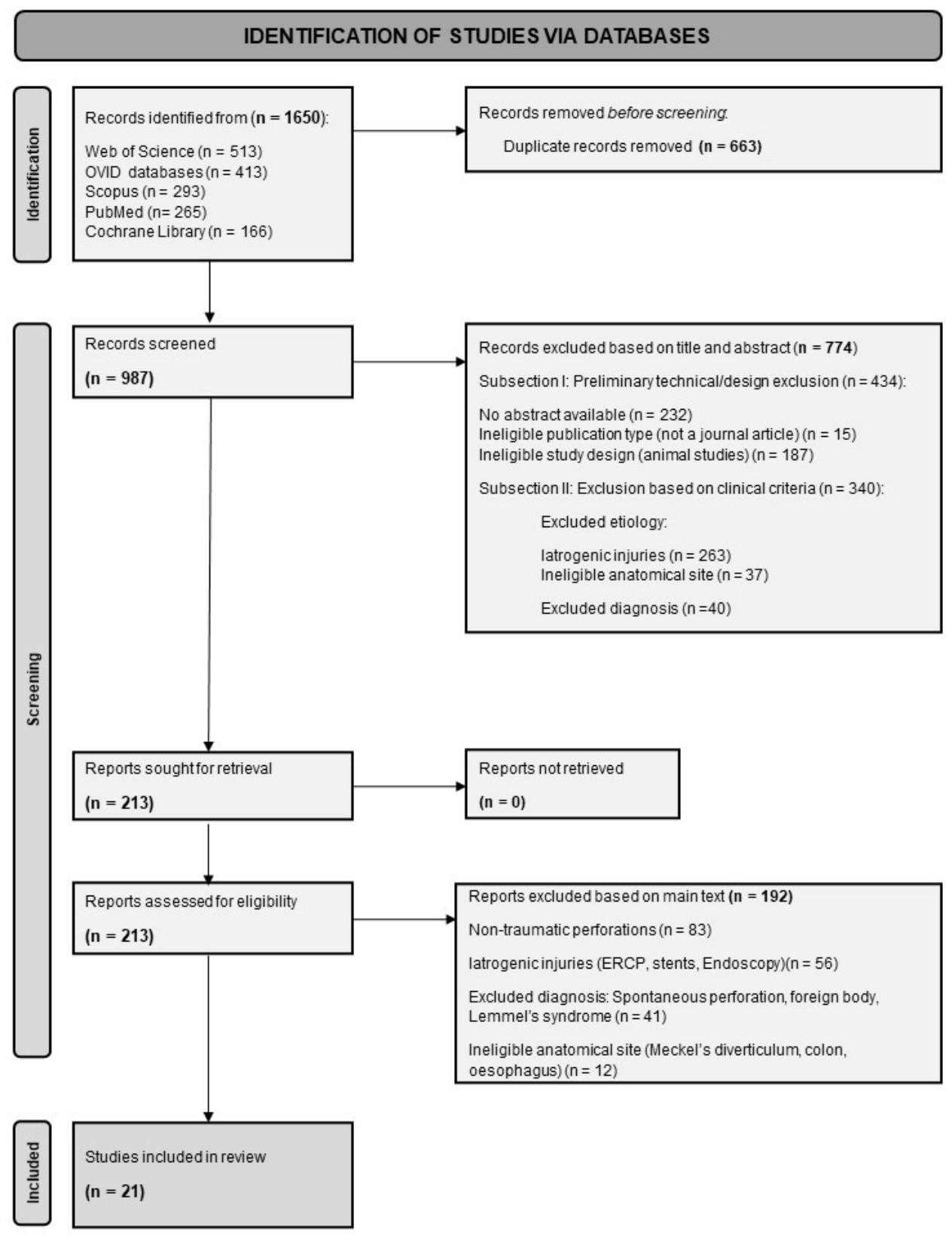
2.4. Selection Process
2.5. Data Collection Process
- Demographic: age, gender;
- Traumatic: cause of injury, mechanism (e.g., compression, deceleration, shearing injuries);
- Clinical and diagnostic: location of the diverticulum, size, nature (congenital/acquired), clinical symptoms (abdominal pain, vomiting, epigastric tenderness, peritoneal symptoms, elevated temperature, others), diagnostic method, histopathological examination result (if performed);
- Therapeutic: surgical treatment method, presence of drainage, complications, complications (retrospectively graded by the authors using the Clavien–Dindo classification system);
- Course: length of hospitalization, patient outcome (survived/died).
2.6. Bias Risk Assessment
2.7. Measures of Effect
2.8. Data Synthesis Methods
- A summary of symptoms, characteristics of diverticula, treatment methods, and treatment outcomes (survival/complications);
- Analysis of the frequency and specificity of clinical symptoms;
- Evaluation of complication severity based on the assigned Clavien–Dindo grades in relation to time-to-intervention;
- Narrative synthesis of data to identify the most common and rare symptoms.
2.9. Assessment of Publication Bias and Certainty of Evidence
3. Results
3.1. Risk of Bias Results
- -
- Complete description of patient demographics;
- -
- Detailed description of the intervention used;
- -
- Presentation of adverse events described and a clear formulation of clinical conclusions (take-away lessons).
3.2. Study and Population Characteristics
3.3. Clinical Symptoms and Course
3.4. Treatment
3.5. Treatment Outcomes and Complications
3.6. Study Limitations
4. Discussion
4.1. Presentation of Results in the Context of Literature
4.2. Limits of the Evidence Contained in the Review
4.3. Limitations of the Review Process
4.4. Practical Implications and Implications for Future Research
4.4.1. Indications and Limitations of Conservative Treatment
4.4.2. Justification for the Surgical Treatment
4.4.3. Education of Clinicians
4.4.4. Research Directions
4.4.5. Need for a Case Registry
5. Conclusions
Supplementary Materials
Author Contributions
Funding
Institutional Review Board Statement
Informed Consent Statement
Data Availability Statement
Conflicts of Interest
Abbreviations
| CARE | Case Report Guidelines |
| CT | Computed Tomography |
| D1, D2, D3, D4 | parts of the duodenum: |
| D1 | (ampulla) |
| D2 | (Descending part) |
| D3 | (Horizontal part) |
| D4 | (Ascending part) |
| DD | Duodenal Diverticulum |
| eFAST/FAST | (Extended) Focused Assessment with Sonography in Trauma |
| ERCP | Endoscopic Retrograde Cholangiopancreatography |
| JBI | Joanna Briggs Institute |
| MRI | magnetic resonance imaging |
| PRISMA | Preferred Reporting Items for Systematic Reviews and Meta-Analyses |
| PROSPERO | International prospective register of systematic reviews |
| RoB | Risk of Bias |
| SD | standard deviation |
| USG | Ultrasonography (ultrasound) |
| X-ray | Radiography |
References
- Yadollahi, M.; Fazeli, H.; Ghasemian, M.; Yousefi, M.R.; Karajizadeh, M.; Farajpour, H. Incidence, pattern and mortality of traumatic abdominal injury: A three-year study at the largest trauma center in southern Iran. Health Sci. Rep. 2025, 8, e70941. [Google Scholar] [CrossRef]
- Wang, J.; Cheng, L.; Liu, J.; Zhang, B.; Wang, W.; Zhu, W.; Guo, Y.; Bao, C.; Hu, Y.; Qi, S.; et al. Laparoscopy vs laparotomy for the management of abdominal trauma: A systematic review and meta-analysis. Front. Surg. 2022, 9, 817134. [Google Scholar] [CrossRef]
- Kumar, A.; Sridhar, R.; Kumar, H.; Hakeem, S.A.; Khan, A.V.; Anwer, M. Blunt abdominal trauma: A retrospective study on clinical insights and treatment outcomes. J. Trauma Inj. 2025, 38, 221–231. [Google Scholar] [CrossRef]
- Hansen, C.C.; Søreide, K. Systematic review of epidemiology, presentation, and management of Meckel’s diverticulum in the 21st century. Medicine 2018, 97, e12154. [Google Scholar] [CrossRef] [PubMed]
- Tursi, A.; Scarpignato, C.; Strate, L.L.; Lanas, A.; Kruis, W.; Lahat, A.; Danese, S. Colonic diverticular disease. Nat. Rev. Dis. Primers 2020, 6, 20. [Google Scholar] [CrossRef] [PubMed]
- Longo, W.E.; Vernava, A.M. Clinical implications of jejunoileal diverticular disease. Dis. Colon Rectum 1992, 35, 381–388. [Google Scholar] [CrossRef]
- Donald, J.W. Major complications of small bowel diverticula. Ann. Surg. 1979, 190, 183–188. [Google Scholar] [CrossRef] [PubMed]
- Costa Simões, V.; Santos, B.; Magalhães, S.; Faria, G.; Sousa Silva, D.; Davide, J. Perforated duodenal diverticulum: Surgical treatment and literature review. Int. J. Surg. Case Rep. 2014, 5, 547–550. [Google Scholar] [CrossRef]
- Gore, R.M.; Ghahremani, G.G.; Kirsch, M.D.; Nemcek, A.A.; Karoll, M.P. Diverticulitis of the duodenum: Clinical and radiological manifestations of seven cases. Am. J. Gastroenterol. 1991, 86, 981–985. [Google Scholar] [PubMed]
- Akhrass, R.; Yaffe, M.B.; Fischer, C.; Ponsky, J.; Shuck, J.M. Small-bowel diverticulosis: Perceptions and reality. J. Am. Coll. Surg. 1997, 184, 383–388. [Google Scholar]
- Leivonen, M.K.; Halttunen, J.A.; Kivilaakso, E.O. Duodenal diverticulum at endoscopic retrograde cholangiopancreatography: Analysis of 123 patients. Hepatogastroenterology 1996, 43, 961–966. [Google Scholar]
- Tseng, Y.; Bolatihan, J.; Li, X.; Yu, J.; Wang, D.; Jin, Y.; Ma, L.; Luo, Z. Small bowel diverticular disease: Are we clinically aware? BMC Gastroenterol. 2025, 25, 701. [Google Scholar] [CrossRef]
- Yin, W.; Chen, H.; Huang, S.; Lin, H.; Chang, T. Clinical analysis and literature review of massive duodenal diverticular bleeding. World J. Surg. 2001, 25, 848–855. [Google Scholar] [CrossRef]
- Chomel, J.B. Report of a case of duodenal diverticulum containing gallstones. Hist. Acad. Roy. Sci. Paris 1710, 1710, 48–50. [Google Scholar]
- Terra, C.; Ramos-Andrade, D.; Sá-Marques, I.; Brito, J.; Caseiro-Alves, F.; Curvo-Semedo, L. Duodenal imaging on the spotlight: From A to Z. Insights Imaging 2021, 12, 94. [Google Scholar] [CrossRef] [PubMed]
- Rao, P.M. Case 11: Perforated duodenal diverticulitis. Radiology 1999, 211, 711–713. [Google Scholar] [CrossRef]
- Oukachbi, N.; Brouzes, S. Management of complicated duodenal diverticula. J. Visc. Surg. 2013, 150, 173–179. [Google Scholar] [CrossRef]
- Degheili, J.A.; Abdallah, M.H.; Haydar, A.A.; Moukalled, A.; Hallal, A.H. Perforated duodenal diverticulum treated conservatively: Another two successful cases. Case Rep. Surg. 2017, 2017, 4045970. [Google Scholar] [CrossRef]
- Thorson, C.M. The perforated duodenal diverticulum. Arch. Surg. 2012, 147, 81. [Google Scholar] [CrossRef]
- Duarte, B.; Nagy, K.K.; Cintron, J. Perforated duodenal diverticulum. Br. J. Surg. 1992, 79, 877–881. [Google Scholar] [CrossRef] [PubMed]
- Asensio, J.A.; Martín, W.; Petrone, P.; Roldán, G.; Pardo, M.; García, J.C.; O’shanahan, G.; Karsidag, T.; Pak-Art, R.; Kuncir, E. Traumatismos duodenales: Lesiones complejas. Cir. Esp. 2003, 74, 308–315. [Google Scholar] [CrossRef]
- Van Beers, B.; Trigaux, J.P.; De Ronde, T.; Melange, M. CT findings of perforated duodenal diverticulitis. J. Comput. Assist. Tomogr. 1989, 13, 528–530. [Google Scholar] [CrossRef] [PubMed]
- Ziman, P.; Marčišin, J.; Benko, A.; Benko, A.; Lukeš, R.; Stramba, S. Traumatic extraperitoneal perforation of a duodenal diverticulum. Rozhl. Chir. 1986, 65, 416–419. [Google Scholar]
- Guglielmi, A.; Veraldi, G.F.; Leopardi, F.; Frameglia, M.; Boni, M. Sulla perforazione del diverticolo duodenale paravateriano (presentazione di due casi clinici). Ann. Ital. Chir. 1993, 64, 309–313. [Google Scholar] [PubMed]
- Souza, A.d.L., Jr.; Pogetti, R.S.; Fontes, B.; Bernini, C.D.O.; Figueiredo, A.D.M.; Branco, P.D.; Birolini, D. Ruptura traumática de divertículo duodenal: Relato de um caso e revisão da literatura. Rev. Hosp. Clin. Fac. Med. Sao Paulo 1996, 41, 247–249. [Google Scholar]
- Poostizadeh, A.; Gow, K.W.; Al-Mahmeed, T.; Allardyce, D.B. Traumatic rupture of a duodenal diverticulum. J. Trauma 1997, 43, 370–372. [Google Scholar] [CrossRef] [PubMed]
- Graudins, J. Stumpfes Bauchtrauma mit Perforation eines Duodenaldivertikels. Zentralbl Chir. 1970, 97, 129–131. [Google Scholar]
- Wedemeyer, C.; Brüstle, N. Traumatische retroperitoneale Ruptur eines juxtapapillären Divertikels. Zentralblatt Fur Chir.—Z. Fur Allg. Visz.-Und Gefasschir. 2012, 137, 554–555. [Google Scholar] [CrossRef]
- Majerus, B.; Mathonet, P.; Haxhe, J.P. Traumatic rupture of a duodenal diverticulum: Case report and review of the literature. Acta Chir. Belg. 2015, 115, 310–313. [Google Scholar] [CrossRef]
- Valenzuela Martínez, M.J.; Bonasa, E.; Sánchez, J.M.; Arribas, M.D.; Córdoba, E.; Santero, M.P.; Albiach, M.; Martínez, F. Perforación traumática de un divertículo duodenal. Cir. Esp. 2006, 80, 224–226. [Google Scholar] [CrossRef]
- Fowler, J.S.; Cheatham, M.L.; Sandler, B.; Padron, A. Traumatic perforation of a duodenal diverticulum. Am. Surg. 2006, 72, 781–782. [Google Scholar] [CrossRef]
- Kim, H.H.; Park, Y.C.; Lee, D.K.; Park, C.Y.; Kim, J.H.; Kim, Y.D.; Kim, J.C. Traumatic perforation of the duodenal diverticulum: A case report. J. Trauma Inj. 2013, 26, 53–57. (In Korean) [Google Scholar]
- Caires, A.G.; Carvalhinha, C.G.; Caires, F.G.; Flores, P.R.; Subotin, I.; Caldeira, C. Traumatic rupture of duodenal diverticulum: Clinical case in catastrophe setting. Int. Surg. J. 2024, 11, 2131–2134. [Google Scholar] [CrossRef]
- Albin, J.S.; Dunn, E.L. Ruptured duodenal diverticulum after blunt abdominal trauma. Am. Surg. 2014, 80, E111–E112. [Google Scholar] [CrossRef]
- Brabrand, G. Retroperitoneal rupture of the duodenum following nonpenetrating trauma: Report of two cases. Acta Chir. Scand. 1960, 119, 20–23. [Google Scholar] [PubMed]
- Angus, L.; Larson, B.; Egodage, T.; Govinda Raju, S. Traumatic blowout of a duodenal diverticulum: A rare clinical finding. Inj. Extra 2013, 44, 95–98. [Google Scholar] [CrossRef]
- Atmani, A.; Lachachi, F. Les diverticules duodénaux juxta-papillaires perforés: À propos de 2 cas. Chirurgie 2002, 26, 285–288. (In French) [Google Scholar]
- Essofi, R.; Azzahiri, I.; Benzalim, M.; Alj, S. Post-traumatic perforated duodenal diverticulum: A case report. SAS J. Med. 2023, 9, 1234–1236. [Google Scholar] [CrossRef]
- Shiraishi, T.; Wada, H.; Hashimoto, S.; Katayama, H.; Taba, M.; To, K. A case of two traumatic penetrations of a duodenal diverticulum caused by a kick to the upper abdomen. Int. J. Surg. Case Rep. 2021, 87, 106388. [Google Scholar] [CrossRef]
- Metcalfe, M.J.; Rashid, T.G.; Bird, R.l.R. Isolated perforation of a duodenal diverticulum following blunt abdominal trauma. J. Emerg. Trauma Shock. 2010, 3, 79–81. [Google Scholar] [CrossRef]
- Palumbo, V.; Sofia, M.; Mattone, E.; Bonaccorso, R.; Guastella, T.; La Greca, G.; Russello, D.; Latteri, S. Traumatic perforated diverticulum of the fourth duodenal portion: First case report and literature review. Ann. Med. Surg. 2020, 57, 114–117. [Google Scholar] [CrossRef]
- Staccini, G.; Senatore, A.M.; Sitta, V.; Podetta, M. Traumatic perforated duodenal diverticulum after a fight: A case report. Int. J. Surg. Case Rep. 2024, 120, 109882. [Google Scholar] [CrossRef] [PubMed]
- Nazim, M.H.; Hashmi, S.; Wilson, A.; Gupta, S.; Zuberi, J. Duodenal diverticulum perforation from blunt trauma. West Va. Med. J. 2009, 105, 20–21. [Google Scholar]
- Page, M.J.; McKenzie, J.E.; Bossuyt, P.M.; Boutron, I.; Hoffmann, T.C.; Mulrow, C.D.; Shamseer, L.; Tetzlaff, J.M.; Akl, E.A.; Brennan, S.E.; et al. The PRISMA 2020 statement: An updated guideline for reporting systematic reviews. BMJ 2021, 372, n71. [Google Scholar] [CrossRef]
- Mattacchione, S.; Mezzetti, G. Duodenal diverticulitis: A crossroad between conservative therapy and surgery—A case report. J. Med. Case Rep. 2025, 19, 154. [Google Scholar] [CrossRef]
- Łącka, M.; Hać, S. Duodenal diverticulum perforation mimicking acute cholecystitis: Case reports and literature review. Eur. J. Transl. Clin. Med. 2022, 5, 64–70. [Google Scholar] [CrossRef]
- Ansari, D.; Torén, W.; Lindberg, S.; Pyrhönen, H.S.; Andersson, R. Diagnosis and management of duodenal perforations: A narrative review. Scand. J. Gastroenterol. 2019, 54, 939–944. [Google Scholar] [CrossRef]
- Pandey, S.; Niranjan, A.; Mishra, S.; Agrawal, T.; Singhal, B.M.; Prakash, A.; Attri, P.C. Retrospective analysis of duodenal injuries: A comprehensive overview. Saudi. J. Gastroenterol. 2011, 17, 142–144. [Google Scholar] [CrossRef]
- Turner, C.; McClure, R.; Pirozzo, S. Injury and risk-taking behavior—A systematic review. Accid. Anal. Prev. 2004, 36, 93–101. [Google Scholar] [CrossRef]
- DiCecco, S.; Weishaar, M.G.; Conner, B.T. Intercorrelations between personality traits, behavioral impulsivity, and extreme sport participation and injury in a US college sample. J. Am. Coll. Health 2025, 74, 458–467. [Google Scholar] [CrossRef]
- Rommel, A.; Varnaccia, G.; Lahmann, N.; Kottner, J.; Kroll, L.E. Occupational injuries in Germany: Population-wide national survey data emphasize the importance of work-related factors. PLoS ONE 2016, 11, e0148798. [Google Scholar] [CrossRef]
- Park, H.; Lucas, C.E. Perforated Meckel’s diverticulum following blunt abdominal trauma. J. Trauma Inj. Infect. Crit. Care 1970, 10, 706–707. [Google Scholar] [CrossRef]
- Conte, C.; Garcia, S.; Arnoux, P.J.; Masson, C. Experimental multiscale analysis of liver damage and failure process under compression. J. Trauma Acute Care Surg. 2012, 72, 727–732. [Google Scholar] [CrossRef]
- Dogjani, A.S.; Hasanaj, B.E.; Matevossian, E.; Doll, D. Meckel’s diverticulum injury after penetrating abdominal trauma. J. Case Rep. 2015, 5, 479–481. [Google Scholar] [CrossRef]
- Bhattarai, S.; Shaikh, O.; Tajudeen, M.; Kumbhar, U.; Balasubramanian, G. Perforation of the Meckel’s diverticulum following blunt trauma to the abdomen. Cureus 2021, 13, e12868. [Google Scholar] [CrossRef]
- Mishra, G.; Gadhire, M.; Joshi, M.; Saini, J.; Gupta, V. A rare case of perforated Meckel’s diverticulum following blunt abdominal trauma in a child. Case Rep. Med. 2014, 2014, 354802. [Google Scholar]
- Almatrafi, A.; Nassan, S.; Yousef, Y. Traumatic rupture of Meckel’s diverticulum secondary to handlebar injury. J. Pediatr. Surg. Case Rep. 2020, 54, 101387. [Google Scholar] [CrossRef]
- Makwana, N.; Hammond, T. Acute intra-abdominal haemorrhage: Beware of red herrings. Int. J. Surg. 2015, 23, S37. [Google Scholar] [CrossRef][Green Version]
- Tummers, W.S.; van der Vorst, J.R.; Swank, D.J. Traumatic rupture of a Meckel’s diverticulum due to blunt abdominal trauma in a soccer game: A case report. Int. J. Surg. Case Rep. 2016, 19, 8–10. [Google Scholar] [CrossRef]
- Benjelloun, E.B.; Ousadden, A.; Ibnmajdoub, K.; Mazaz, K.; Taleb, K. Small bowel intussusception with the Meckel’s diverticulum after blunt abdominal trauma: A case report. World J. Emerg. Surg. 2009, 4, 18. [Google Scholar] [CrossRef]
- Luke, L.C.; Day, P.; Mulhearn, T.R. Delayed small intestinal obstruction following blunt trauma to a Meckel’s diverticulum. Injury 1990, 21, 251–252. [Google Scholar] [CrossRef]
- Kazemi, K.; Jalaeian, H.; Fattahi, M.R.; Hosseini, S.V.; Shafiee, M.; Roshan, N. Ruptured Meckel’s mesodiverticulum and Meckel’s diverticulum following blunt abdominal trauma. Med. Princ. Pract. 2008, 17, 161–163. [Google Scholar] [CrossRef]
- Cullen, J.R.; Catanzaro, F.P. Traumatic perforation of a Meckel’s diverticulum. Conn. State Med. J. 1954, 18, 347–353. [Google Scholar]
- Pape, Y.; Fremont, B.; Menguy, P.; Manbrini, A. Une lésion rare des contusions de l’abdomen: La perforation du diverticule de Meckel. Ouest Med. 1985, 39, 19–20. [Google Scholar]
- Gamble, H.A. Subcutaneous rupture of Meckel’s diverticulum. Am. J. Surg. 1941, 54, 727–728. [Google Scholar] [CrossRef]
- Loftus, T.J.; Morrow, M.L.; Lottenberg, L.; Rosenthal, M.D.; Croft, C.A.; Smith, R.S.; Moore, F.A.; Brakenridge, S.C.; Borrego, R.; Efron, P.A.; et al. The Impact of Prior Laparotomy and Intra-abdominal Adhesions on Bowel and Mesenteric Injury Following Blunt Abdominal Trauma. World J. Surg. 2019, 43, 457–465. [Google Scholar] [CrossRef]
- Baker, A.; Walcott-Bremmer, M.; Harriott, J.; Mitchell, D. Adhesive duodenal obstruction: A report of a previously undescribed pathology. J. Surg. Case Rep. 2024, 2024, rjae551. [Google Scholar] [CrossRef] [PubMed]
- Houssni, J.E.L.; Cherraqi, A.; Chehrastane, R.; Jellal, S.; Hsain, I.H.; Oukacem, S.; Adjou, N.; Saouab, R.; Nouali, H.E.; EL Fenni, J. Lemmel syndrome: An unusual cause of biliary obstruction secondary to a duodenal juxta-ampullary diverticulum: A report of two cases. Radiol. Case Rep. 2023, 18, 1147–1151. [Google Scholar] [CrossRef] [PubMed]
- Kapp, J.R.; Müller, P.C.; Gertsch, P.; Gubler, C.; Clavien, P.A.; Lehmann, K. A systematic review of the perforated duodenal diverticula: Lessons learned from the last decade. Langenbecks Arch. Surg. 2022, 407, 25–35. [Google Scholar] [CrossRef]
- Shea, B.J.; Reeves, B.C.; Wells, G.; Thuku, M.; Hamel, C.; Moran, J.; Moher, D.; Tugwell, P.; Welch, V.; Kristjansson, E.; et al. AMSTAR 2: A criticalappraisal tool for systematic reviews that include randomised or non-randomised studies of healthcare interventions, or both. BMJ 2017, 358, j4008. [Google Scholar] [CrossRef]



| No. | Author (Year) | Reviewer 1 | Reviewer 2 | Results Risk of Bias | ||||||||||||||||||||
|---|---|---|---|---|---|---|---|---|---|---|---|---|---|---|---|---|---|---|---|---|---|---|---|---|
| Demographics Clearly Described | History Timeline Presented | Clinical Condition on Presentation | Diagnostic Tests Results Described | Intervention Described | Post-Intervention Condition | Adverse Events Described | Takeaway Lessons | R1 RoB Score | R1 RoB Category | Demographics Clearly Described | History Timeline Presented | Clinical Condition on Presentation | Diagnostic Tests Results Described | Intervention Described | Post-Intervention Condition | Adverse Events Described | Takeaway Lessons | R2 RoB Score | R2 RoB Category | Consensus RoB Score | Consensus RoB Category | Agreement Rate (%) | ||
| 1 | Brabrand (1960) [35] | Y | Y | Y | Y | Y | U | Y | Y | 7 | L | Y | Y | Y | Y | Y | U | Y | Y | 7 | L | 14 | L | 100 |
| 2 | Graudins (1970) [27] | Y | Y | Y | U | Y | U | Y | Y | 6 | L | Y | Y | Y | Y | Y | U | Y | Y | 7 | L | 13 | L | 87.5 |
| 3 | Ziman (1986) [23] | Y | Y | Y | U | Y | Y | Y | Y | 7 | L | Y | Y | Y | U | Y | Y | Y | Y | 7 | L | 14 | L | 100 |
| 4 | Guglielmi (1993) [24] | Y | Y | Y | Y | Y | Y | Y | Y | 8 | L | Y | Y | Y | Y | Y | Y | Y | Y | 8 | L | 16 | L | 100 |
| 5 | Souza (1996) [25] | Y | Y | Y | U | Y | U | Y | Y | 6 | L | Y | Y | Y | U | Y | U | Y | Y | 6 | L | 12 | L | 100 |
| 6 | Poostizadeh (1997) [26] | Y | Y | Y | Y | Y | Y | Y | Y | 8 | L | Y | Y | Y | Y | Y | Y | Y | Y | 8 | L | 16 | L | 100 |
| 7 | Atmani (2002) [37] | Y | Y | Y | Y | Y | Y | Y | Y | 8 | L | Y | Y | Y | Y | Y | Y | Y | Y | 8 | L | 16 | L | 100 |
| 8 | Martinez (2006) [30] | Y | U | Y | Y | Y | U | Y | Y | 6 | L | Y | U | Y | Y | Y | U | Y | Y | 6 | L | 12 | L | 100 |
| 9 | Fowler (2008) [31] | Y | Y | Y | Y | Y | Y | Y | Y | 8 | L | Y | Y | Y | Y | Y | Y | Y | Y | 8 | L | 16 | L | 100 |
| 10 | Nazim (2009) [43] | Y | Y | Y | Y | Y | Y | Y | Y | 8 | L | Y | Y | Y | Y | Y | Y | Y | Y | 8 | L | 16 | L | 100 |
| 11 | Metcalfe (2010) [40] | Y | Y | Y | Y | Y | Y | Y | Y | 8 | L | Y | Y | Y | Y | Y | Y | Y | Y | 8 | L | 16 | L | 100 |
| 12 | Wedemeyer (2012) [28] | Y | Y | Y | Y | Y | Y | Y | Y | 8 | L | Y | Y | Y | Y | Y | Y | Y | Y | 8 | L | 16 | L | 100 |
| 13 | Angus (2013) [36] | Y | Y | U | Y | Y | Y | Y | Y | 7 | L | Y | Y | U | Y | Y | Y | Y | Y | 7 | L | 14 | L | 100 |
| 14 | Kim (2013) [32] | Y | Y | Y | Y | Y | Y | Y | Y | 8 | L | Y | Y | Y | Y | Y | Y | Y | Y | 8 | L | 16 | L | 100 |
| 15 | Albin (2015) [34] | Y | Y | U | Y | Y | Y | Y | Y | 7 | L | Y | Y | U | Y | Y | Y | Y | Y | 7 | L | 14 | L | 100 |
| 16 | Majerus (2015) [29] | Y | Y | Y | Y | Y | Y | Y | Y | 8 | L | Y | Y | Y | Y | Y | Y | Y | Y | 8 | L | 16 | L | 100 |
| 17 | Palumbo (2020) [41] | Y | Y | Y | Y | Y | Y | Y | Y | 8 | L | Y | Y | Y | Y | Y | Y | Y | Y | 8 | L | 16 | L | 100 |
| 18 | Shiraishi (2021) [39] | Y | Y | Y | Y | Y | Y | Y | Y | 8 | L | Y | Y | Y | Y | Y | Y | Y | Y | 8 | L | 16 | L | 100 |
| 19 | Essofi (2023) [38] | Y | Y | Y | Y | Y | Y | Y | Y | 8 | L | Y | Y | Y | Y | Y | Y | Y | Y | 8 | L | 16 | L | 100 |
| 20 | Staccini (2024) [42] | Y | Y | Y | Y | Y | Y | Y | Y | 8 | L | Y | Y | Y | Y | Y | Y | Y | Y | 8 | L | 16 | L | 100 |
| 21 | Caires (2024) [33] | Y | Y | Y | Y | Y | Y | Y | Y | 8 | L | Y | Y | Y | Y | Y | Y | Y | Y | 8 | L | 16 | L | 100 |
| Variable | Value (n = 21) | |
|---|---|---|
| Demographics | Age (years) * | 62.9 (14.3) |
| Sex (M:F) | 8:13 | |
| Mechanism of injury | Traffic accident | 10/21 |
| Fall from height | 8/21 | |
| Direct blow/kick | 2/21 | |
| Abdominal compression | 1/21 | |
| Location of diverticulum | D2 segment | 17/21 |
| D2 and D3 junction | 2/21 | |
| D4 segment | 1/21 | |
| Unknown/Not reported | 1/21 | |
| Type of diverticulum | Congenital (true) | 3/21 |
| Acquired (false) | 7/21 | |
| Unknown/Not reported | 11/21 | |
| Clinical presentation | Abdominal pain | 19/21 |
| Epigastric tenderness | 16/21 | |
| Peritoneal signs | 10/21 | |
| Nausea/vomiting | 5/21 | |
| No. | Study (Year) | Age/Sex | Mechanism of Injury | Diverticulum (Loc./Type) | Clinical Symptoms | Delayed Peritoneal Signs | Dx Method |
|---|---|---|---|---|---|---|---|
| 1 | Brabrand (1960) [35] | 54/F | Fall against bed | D2/Ac | AP, NV, ET, PS, F | No | Lap. |
| 2 | Graudins (1970) [27] | 70/F | Slip and fall | D2/Co | AP, NV, ET, PS | No | Lap. |
| 3 | Ziman (1986) [23] | 53/M | Fall from scaffolding (6 m) | D2/NR | AP, ET, PS | Yes (4 h) | Lap. |
| 4 | Guglielmi (1993) [24] | 33/F | Fall from height (3 m) | D2/NR | AP, ET, PS | No | CT |
| 5 | Souza (1996) [25] | 49/M | Traffic accident | D2/Co | AP, ET | No | Lap. |
| 6 | Poostizadeh (1997) [26] | 72/F | Traffic accident | D2/Ac | AP, ET | No | CT |
| 7 | Atmani (2002) [37] | 83/F | Traffic accident | D2/NR | AP, ET | No | CT |
| 8 | Martinez (2006) [30] | 73/M | Fall downstairs | D2/NR | AP, ET, PS | No | CT |
| 9 | Fowler (2008) [31] | 45/F | Fall from bucket | D2/NR | AP, NV, ET, PS, F | Yes (1 d) | CT |
| 10 | Nazim (2009) [43] | 84/F | Traffic accident | D2/NR | AP | No | CT |
| 11 | Metcalfe (2010) [40] | 58/M | Fall from ladder | D2/D3/NR | AP, ET, PS | No | CT |
| 12 | Wedemeyer (2012) [28] | 79/F | Fall (crush against railing) | D2/NR | AP, ET, PS | No | CT |
| 13 | Angus (2013) [36] | 64/F | Traffic accident | D2/NR | NR | No | CT |
| 14 | Kim (2013) [32] | 61/M | Fall downstairs | D2/D3/NR | AP | No | CT |
| 15 | Albin (2015) [34] | 65/F | Traffic accident | D2/Ac | NR | No | CT |
| 16 | Majerus (2015) [29] | 65/F | Traffic accident | D2/Ac | AP, NV, ET | No | CT |
| 17 | Palumbo (2020) [41] | 82/M | Traffic accident | D4/Ac | AP, NV, ET, PS | No | CT |
| 18 | Shiraishi (2021) [39] | 67/F | Kick to abdomen | D2/Ac | AP, ET | No | CT |
| 19 | Essofi (2023) [38] | 63/M | Traffic accident | NR/NR | AP | Yes (2 d) | CT |
| 20 | Staccini (2024) [42] | 36/M | Kick to abdomen | D2/Co | AP, ET, PS | No | CT |
| 21 | Caires (2024) [33] | 64/F | Traffic accident | D2/NR | AP, ET | No | CT |
| No. | Study (Year) | Associated Injuries | Tx Method (Drainage) | Time to Dx/Time to Tx | Complications (Clavien–Dindo) | LOS (Days) |
|---|---|---|---|---|---|---|
| 1 | Brabrand (1960) [35] | None | Surg. (L)/Yes | 4 d/4 d | IIIa | 49 |
| 2 | Graudins (1970) [27] | None | Surg. (L)/Yes | 5 h/5 h | V | 4 |
| 3 | Ziman (1986) [23] | None | Surg. (L)/Yes | 7 h/7 h | II | 25 |
| 4 | Guglielmi (1993) [24] | None | Surg. (L)/Yes | FH/FH | II | 21 |
| 5 | Souza (1996) [25] | Yes (Orthopedic) | Surg. (L)/Yes | FH/ES | V | 68 |
| 6 | Poostizadeh (1997) [26] | None | Surg. (L)/Yes | FH/FH | V | 3 |
| 7 | Atmani (2002) [37] | None | Surg. (L)/Yes | FH/FH | None | 21 |
| 8 | Martinez (2006) [30] | None | Surg. (L)/Yes | FH/FH | None | NR |
| 9 | Fowler (2008) [31] | None | Surg. (SL)/Yes | 1 d/1 d | None | 4 |
| 10 | Nazim (2009) [43] | None | Surg. (SL)/Yes | 4 h/ES | IVa | 21 |
| 11 | Metcalfe (2010) [40] | None | Surg. (L)/Yes | ES/ES | II | 11 |
| 12 | Wedemeyer (2012) [28] | None | Surg. (SL)/Yes | FH/ES | None | 12 |
| 13 | Angus (2013) [36] | Severe (Thoracic, Abdominal, Orthopedic) | Surg. (SL)/Yes | FH/ES | IIIa | 7 |
| 14 | Kim (2013) [32] | Yes (Abdominal) | Surg. (L)/Yes | 3 h/ES | V | 10 |
| 15 | Albin (2015) [34] | Severe (Thoracic, Abdominal, Orthopedic) | Surg. (L)/Yes | FH/ES | None | 5 |
| 16 | Majerus (2015) [29] | None | Surg. (SL)/Yes | FH/FH | II | 12 |
| 17 | Palumbo (2020) [41] | Yes (Neurological, Cervical) | Surg. (SL)/Yes | FH/FH | None | NR |
| 18 | Shiraishi (2021) [39] | None | Surg. (SL)/No | 6 h/ES | None | 21 |
| 19 | Essofi (2023) [38] | Yes (Orthopedic) | Conservative | NR/Cons. | None | NR |
| 20 | Staccini (2024) [42] | None | Surg. (SL)/Yes | 2 h/4 h | None | 10 |
| 21 | Caires (2024) [33] | Severe (Thoracic, Cervical, Orthopedic) | Surg. (SL)/No | FH/ES | IVa | 7 |
| Category | Sub-Category | Modality/Parameter | Value (n = 21) |
|---|---|---|---|
| Imaging performed | Computed tomography (CT) | 17/21 | |
| Ultrasonography | 5/21 | ||
| Radiography (X-ray) | 5/21 | ||
| Management strategy | Surgical intervention | Total underwent surgery | 20/21 |
| Manual diverticulectomy | 11/21 | ||
| Stapled diverticulectomy | 9/21 | ||
| Abdominal drainage applied | 18/21 | ||
| Conservative care | Total treated conservatively | 1/21 | |
| Clinical outcomes | Hospitalization | Length of stay (days) * | 17.3 (16.8) |
| Morbidity | Total complications | 13/21 | |
| Minor complications † | 5/21 | ||
| Severe complications ‡ | 8/21 | ||
| Mortality | Total deaths | 4/21 | |
| Follow-up | Time (months) | 1–12 (average 5.4) | |
Disclaimer/Publisher’s Note: The statements, opinions and data contained in all publications are solely those of the individual author(s) and contributor(s) and not of MDPI and/or the editor(s). MDPI and/or the editor(s) disclaim responsibility for any injury to people or property resulting from any ideas, methods, instructions or products referred to in the content. |
© 2026 by the authors. Licensee MDPI, Basel, Switzerland. This article is an open access article distributed under the terms and conditions of the Creative Commons Attribution (CC BY) license.
Share and Cite
Rybicki, M.; Białas, B.; Kłosiński, K.K.; Pasieka, Z.W.; Czyżewski, B.M.; Arkuszewski, P.T. Diagnostic Challenges and Management of Blunt Traumatic Duodenal Diverticulum Perforation: A Systematic Review. J. Clin. Med. 2026, 15, 4390. https://doi.org/10.3390/jcm15114390
Rybicki M, Białas B, Kłosiński KK, Pasieka ZW, Czyżewski BM, Arkuszewski PT. Diagnostic Challenges and Management of Blunt Traumatic Duodenal Diverticulum Perforation: A Systematic Review. Journal of Clinical Medicine. 2026; 15(11):4390. https://doi.org/10.3390/jcm15114390
Chicago/Turabian StyleRybicki, Maciej, Bartłomiej Białas, Karol Kamil Kłosiński, Zbigniew Włodzimierz Pasieka, Bartosz Marek Czyżewski, and Piotr Tomasz Arkuszewski. 2026. "Diagnostic Challenges and Management of Blunt Traumatic Duodenal Diverticulum Perforation: A Systematic Review" Journal of Clinical Medicine 15, no. 11: 4390. https://doi.org/10.3390/jcm15114390
APA StyleRybicki, M., Białas, B., Kłosiński, K. K., Pasieka, Z. W., Czyżewski, B. M., & Arkuszewski, P. T. (2026). Diagnostic Challenges and Management of Blunt Traumatic Duodenal Diverticulum Perforation: A Systematic Review. Journal of Clinical Medicine, 15(11), 4390. https://doi.org/10.3390/jcm15114390