Maternal Oral Microbiome Dysbiosis and Adverse Pregnancy Outcomes: Microbial Signatures, Inflammatory Pathways, and Clinical Evidence

 , , , ,
Abstract
1. Introduction
2. Materials and Methods
2.1. Study Design
2.2. Search Strategy
- PubMed/MEDLINE;
- Scopus;
- Web of Science;
- Cochrane Library.
2.3. Eligibility Criteria
- Investigated pregnant women as the study population.
- Evaluated oral microbiome composition, periodontal pathogens, or periodontal disease indicators.
- Reported pregnancy outcomes, including preterm birth, low birth weight, preeclampsia, or other obstetric complications.
- Observational studies (cohort, case–control, cross-sectional) or clinical trials.
- Published in English.
- Animal studies;
- Case reports or case series;
- Editorials or commentaries;
- Narrative or systematic reviews;
- Studies lacking relevant pregnancy outcome data.
2.4. Study Selection
2.5. Data Extraction
- Author and year of publication;
- Country of study;
- Study design;
- Sample size;
- Methods used for microbiome analysis;
- Oral microbial species identified;
- Pregnancy outcomes evaluated;
- Main findings.
2.6. Risk of Bias Assessment
- Selection of study groups;
- Comparability between study groups;
- Assessment of outcomes or exposures.
2.7. Certainty of Evidence Assessment
2.8. Data Synthesis
3. Results
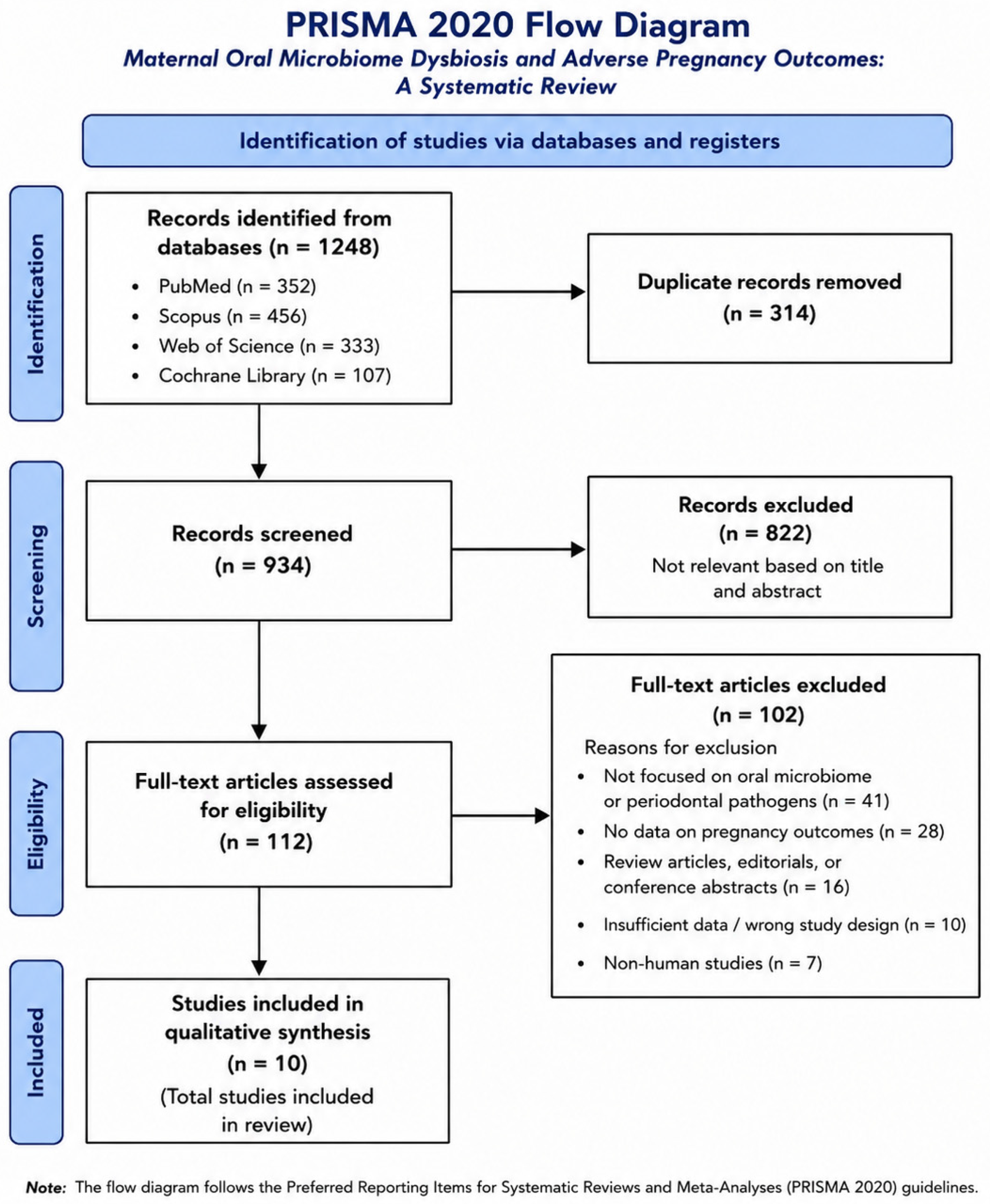
3.1. Study Selection
3.2. Characteristics of Included Studies
3.3. Maternal Oral Dysbiosis During Pregnancy
3.4. Association Between Oral Microbiome and Preterm Birth
3.5. Association with Low Birth Weight
3.6. Risk of Bias Assessment
3.7. Certainty of Evidence Assessment
4. Discussion
5. Conclusions
6. Limitations
Supplementary Materials
Author Contributions
Funding
Institutional Review Board Statement
Informed Consent Statement
Data Availability Statement
Conflicts of Interest
References
- Raju, K.; Berens, L. Periodontology and pregnancy: An overview of biomedical and epidemiological evidence. Periodontology 2000 2021, 87, 132–142. [Google Scholar] [CrossRef] [PubMed]
- Ye, C.; Kapila, Y. Oral microbiome shifts during pregnancy and adverse pregnancy outcomes: Hormonal and immunologic changes at play. Periodontol 2000 2021, 87, 276–281. [Google Scholar] [CrossRef] [PubMed]
- Ye, C.; You, M.; Huang, P.; Xia, Z.; Radaic, A.; Tang, J.; Wu, W.; Wu, Y.; Kapila, Y. Clinical study showing a lower abundance of Neisseria in the oral microbiome aligns with low birth weight pregnancy outcomes. Clin. Oral Investig. 2021, 26, 2465–2478. [Google Scholar] [CrossRef]
- Bobetsis, Y.A.; Graziani, F.; Gürsoy, M.; Madianos, P.N. Periodontal disease and adverse pregnancy outcomes. Periodontology 2000 2020, 83, 154–174. [Google Scholar] [CrossRef]
- Wells, G.A.; Shea, B.; O’Connell, D.; Peterson, J.; Welch, V.; Losos, M.; Tugwell, P. The Newcastle–Ottawa Scale (NOS) for Assessing the Quality of Nonrandomised Studies in Meta-Analyses; Ottawa Hospital Research Institute: Ottawa, ON, Canada, 2014; Available online: https://www.ohri.ca/programs/clinical_epidemiology/oxford.asp (accessed on 24 January 2026).
- Han, Y.W. Fusobacterium nucleatum: A commensal-turned pathogen. Curr. Opin. Microbiol. 2015, 23, 141–147. [Google Scholar] [CrossRef] [PubMed] [PubMed Central]
- Figuero, E.; Han, Y.W.; Furuichi, Y. Periodontal diseases and adverse pregnancy outcomes: Mechanisms. Periodontology 2000 2020, 83, 175–188. [Google Scholar] [CrossRef]
- La, X.; Wang, Y.; Xiong, X.; Shen, L.; Chen, W.; Zhang, L.; Yang, F.; Cai, X.; Zheng, H.; Jiang, H. The composition of placental microbiota and its association with adverse pregnancy outcomes. Front. Microbiol. 2022, 13, 911852. [Google Scholar] [CrossRef]
- Collado, M.C.; Rautava, S.; Aakko, J.; Isolauri, E.; Salminen, S. Human gut colonisation may be initiated in utero by distinct microbial communities in the placenta and amniotic fluid. Sci. Rep. 2016, 6, 23129. [Google Scholar] [CrossRef]
- Ye, C.; Xia, Z.; Tang, J.; Khemwong, T.; Kapila, Y.; Kuraji, R.; Huang, P.; Wu, Y.; Kobayashi, H. Unculturable and culturable periodontal-related bacteria are associated with periodontal inflammation during pregnancy and with preterm low birth weight delivery. Sci. Rep. 2020, 10, 15807. [Google Scholar] [CrossRef] [PubMed]
- Page, M.J.; McKenzie, J.E.; Bossuyt, P.M.; Boutron, I.; Hoffmann, T.C.; Mulrow, C.D.; Shamseer, L.; Tetzlaff, J.M.; Akl, E.A.; Brennan, S.E.; et al. The PRISMA 2020 statement: An updated guideline for reporting systematic reviews. BMJ 2021, 372, n71. [Google Scholar] [CrossRef] [PubMed]
- Liu, P.; Wen, W.; Yu, K.F.; Tong, R.W.M.; Gao, X.; Lo, E.C.M.; Wong, M.C.M. Can oral microbiome predict low birth weight infant delivery? J. Dent. 2024, 146, 105018. [Google Scholar] [CrossRef]
- La, X.; Jiang, H.; Chen, A.; Zheng, H.; Shen, L.; Chen, W.; Yang, F.; Zhang, L.; Cai, X.; Mao, H.; et al. Profile of the oral microbiota from preconception to the third trimester of pregnancy and its association with oral hygiene practices. J. Oral Microbiol. 2022, 14, 2053389. [Google Scholar] [CrossRef]
- Li, X.; Xiao, Q.; Xiong, X.; Du, B.C.; Zheng, H.; Su, Y.; Zhang, W.; Cai, X.; Zhu, T.; Yin, A.; et al. The impact of maternal oral microbiota on the risk of small vulnerable newborns: A nested case-control study. BMC Oral Health 2025, 25, 1444. [Google Scholar] [CrossRef]
- Vidmar Šimic, M.; Maver, A.; Zimani, A.N.; Hočevar, K.; Peterlin, B.; Kovanda, A.; Premru-Sršen, T. Oral microbiome and preterm birth. Front. Med. 2023, 10, 1177990. [Google Scholar] [CrossRef] [PubMed] [PubMed Central]
- Gonzales-Marin, C.; Spratt, D.A.; Allaker, R.P. Maternal oral origin of Fusobacterium nucleatum in adverse pregnancy outcomes as determined using the 16S-23S rRNA gene intergenic transcribed spacer region. J. Med. Microbiol. 2013, 62, 133–144. [Google Scholar] [CrossRef] [PubMed]
- Pozo, E.; Mesa, F.; Ikram, M.H.; Puertas, A.; Torrecillas-Martínez, L.; Ortega-Oller, I.; Magán-Fernández, A.; Rodríguez-Martínez, M.D.; Padial-Molina, M.; Sánchez-Fernández, E.; et al. Preterm birth and/or low birth weight are associated with periodontal disease and the increased placental immunohistochemical expression of inflammatory markers. Histol. Histopathol. 2016, 31, 231–237, Erratum in Histol. Histopathol. 2020, 35, 1211. https://doi.org/10.14670/HH-18-282. [Google Scholar] [CrossRef] [PubMed]
- Douglas, G.M.; Maffei, V.J.; Zaneveld, J.R.; Yurgel, S.N.; Brown, J.R.; Taylor, C.M.; Huttenhower, C.; Langille, M.G.I. PICRUSt2 for prediction of metagenome functions. Nat. Biotechnol. 2020, 38, 685–688. [Google Scholar] [CrossRef] [PubMed]
- Caspi, R.; Billington, R.; Keseler, I.M.; Kothari, A.; Krummenacker, M.; Midford, P.E.; Ong, W.K.; Paley, S.; Subhraveti, P.; Karp, P.D. The MetaCyc database of metabolic pathways and enzymes: A 2019 update. Nucleic Acids Res. 2020, 48, D445–D453. [Google Scholar] [CrossRef]
- Cobb, C.M.; Kelly, P.J.; Williams, K.B.; Babbar, S.; Angolkar, M.; Derman, R.J. The oral microbiome and adverse pregnancy outcomes. Int. J. Women’s Health 2017, 9, 551–559. [Google Scholar] [CrossRef]
- de Goffau, M.C.; Lager, S.; Sovio, U.; Gaccioli, F.; Cook, E.; Peacock, S.J.; Parkhill, J.; Charnock-Jones, D.S.; Smith, G.C.S. Human placenta has no microbiome but can contain potential pathogens. Nature 2019, 572, 329–334. [Google Scholar] [CrossRef]
- Lauder, A.P.; Roche, A.M.; Sherrill-Mix, S.; Bailey, A.; Laughlin, A.L.; Bittinger, K.; Leite, R.; Elovitz, M.A.; Parry, S.; Bushman, F.D. Comparison of placenta samples with contamination controls does not provide evidence for a distinct placenta microbiota. Microbiome 2016, 4, 29. [Google Scholar] [CrossRef]
- Lee, Y.H.; Chung, S.W.; Auh, Q.S.; Hong, S.J.; Lee, Y.A.; Jung, J.; Lee, G.J.; Park, H.J.; Shin, S.I.; Hong, J.Y. Progress in Oral Microbiome Related to Oral and Systemic Diseases: An Update. Diagnostics 2021, 11, 1283. [Google Scholar] [CrossRef] [PubMed] [PubMed Central]


| Author (Year) | Country | Study Design | Sample Size | Microbiological Method | Main Outcome Evaluated | Key Findings |
|---|---|---|---|---|---|---|
| Ye et al., 2021 [2] | China | Case–control | 186 pregnant women | 16S rRNA sequencing | Low birth weight | Lower abundance of Neisseria spp. associated with low-birth-weight pregnancies |
| La et al., 2022 [8] | China | Cross-sectional | 156 placental samples | Placental microbiome sequencing | Adverse pregnancy outcomes | Placental microbiota associated with pregnancy complications |
| Collado et al., 2016 [9] | Spain | Observational | 15 mother–infant pairs | Placental/amniotic microbiome sequencing | Placental microbial colonization | Distinct microbial communities identified in placenta and amniotic fluid |
| Ye et al., 2020 [10] | China | Case–control | 90 pregnant women | PCR and microbial culture | Preterm birth and low birth weight | Periodontal-related bacteria associated with periodontal inflammation and preterm birth/low-birth-weight pregnancies |
| Liu et al., 2024 [12] | China | Cohort | 111 pregnant women | Oral microbiome sequencing | Low birth weight | Oral microbiome composition predictive of low-birth-weight delivery |
| La et al., 2022 [13] | China | Longitudinal observational | 101 pregnant women | 16S rRNA sequencing | Changes in oral microbiome during pregnancy | Oral microbiome composition changed across pregnancy trimesters |
| Li X et al., 2025 [14] | China | Nested case–control | 279 pregnant women | Oral microbiota sequencing | Adverse neonatal outcomes | Maternal oral microbiota associated with adverse newborn outcomes |
| Šimic et al., 2023 [15] | Croatia | Cohort | 152 pregnant women | 16S rRNA sequencing | Preterm birth | Increased abundance of Veillonella, Prevotella, and Capnocytophaga in women with preterm birth |
| Gonzales-Marin et al., 2013 [16] | Spain | Observational | 24 mother–infant pairs | ITS sequencing | Preterm birth | Fusobacterium nucleatum strains identified in maternal oral and neonatal samples |
| Pozo et al., 2016 [17] | Spain | Case–control | 53 pregnant women | Placental immunohistochemistry and periodontal assessment | Preterm birth and low birth weight | Periodontal disease associated with increased placental inflammatory marker expression in adverse pregnancy outcomes |
| Microorganism | Reported Alteration | Associated Pregnancy Outcome | Proposed Biological Role | Representative Studies |
|---|---|---|---|---|
| Porphyromonas gingivalis | Increased abundance in periodontal sites during pregnancy | preterm birth, low birth weight | Induction of inflammatory cytokines and periodontal inflammation | Ye et al., 2020 [10]; Liu et al., 2024 [12] |
| Fusobacterium nucleatum | Detection in placental and periodontal samples | preterm birth and placental inflammation | Hematogenous dissemination and placental colonization | La et al., 2022 [8]; Collado et al., 2016 [9] |
| Prevotella intermedia | Increased abundance during pregnancy-associated gingival inflammation | preterm birth, low birth weight | Promotion of inflammatory responses in periodontal tissues | Ye et al., 2020 [10] |
| Neisseria spp. | Reduced abundance in oral microbiota | low birth weight | Loss of commensal microbial balance and oral homeostasis | Ye et al., 2021 [2] |
| Placental inflammatory markers associated with periodontal disease | Increased placental inflammatory response | Preterm birth/low birth weight | Promotion of placental inflammation and adverse fetal outcomes | Pozo et al., 2016 [17] |
| Study | Selection | Comparability | Outcome/Exposure | Total Score | Risk Level |
|---|---|---|---|---|---|
| Ye et al., 2021 [2] | 4 | 2 | 3 | 9 | Low |
| La et al., 2022 (placental microbiota) [8] | 3 | 1 | 2 | 6 | Moderate |
| Collado et al., 2016 [9] | 3 | 1 | 2 | 6 | Moderate |
| Ye et al., 2020 [10] | 4 | 2 | 3 | 9 | Low |
| Liu et al., 2024 [12] | 4 | 2 | 3 | 9 | Low |
| La et al., 2022 (pregnancy longitudinal study) [13] | 4 | 2 | 2 | 8 | Low |
| Li X et al., 2025 [14] | 4 | 2 | 3 | 9 | Low |
| Šimic et al., 2023 [15] | 4 | 2 | 3 | 9 | Low |
| Gonzales-Marin et al., 2013 [16] | 3 | 1 | 2 | 6 | Moderate |
| Pozo et al., 2016 [17] | 4 | 2 | 3 | 9 | Low |
Disclaimer/Publisher’s Note: The statements, opinions and data contained in all publications are solely those of the individual author(s) and contributor(s) and not of MDPI and/or the editor(s). MDPI and/or the editor(s) disclaim responsibility for any injury to people or property resulting from any ideas, methods, instructions or products referred to in the content. |
© 2026 by the authors. Licensee MDPI, Basel, Switzerland. This article is an open access article distributed under the terms and conditions of the Creative Commons Attribution (CC BY) license.
Share and Cite
Radu, E.-A.; Mocanu, E.; Fulina, M.; Rotar, V.; Enache, F.; Popescu, S.; Șerbănescu, L. Maternal Oral Microbiome Dysbiosis and Adverse Pregnancy Outcomes: Microbial Signatures, Inflammatory Pathways, and Clinical Evidence. J. Clin. Med. 2026, 15, 4379. https://doi.org/10.3390/jcm15114379
Radu E-A, Mocanu E, Fulina M, Rotar V, Enache F, Popescu S, Șerbănescu L. Maternal Oral Microbiome Dysbiosis and Adverse Pregnancy Outcomes: Microbial Signatures, Inflammatory Pathways, and Clinical Evidence. Journal of Clinical Medicine. 2026; 15(11):4379. https://doi.org/10.3390/jcm15114379
Chicago/Turabian StyleRadu, Eugenia-Alina, Elena Mocanu, Maria Fulina, Vadym Rotar, Florin Enache, Stere Popescu, and Lucian Șerbănescu. 2026. "Maternal Oral Microbiome Dysbiosis and Adverse Pregnancy Outcomes: Microbial Signatures, Inflammatory Pathways, and Clinical Evidence" Journal of Clinical Medicine 15, no. 11: 4379. https://doi.org/10.3390/jcm15114379
APA StyleRadu, E.-A., Mocanu, E., Fulina, M., Rotar, V., Enache, F., Popescu, S., & Șerbănescu, L. (2026). Maternal Oral Microbiome Dysbiosis and Adverse Pregnancy Outcomes: Microbial Signatures, Inflammatory Pathways, and Clinical Evidence. Journal of Clinical Medicine, 15(11), 4379. https://doi.org/10.3390/jcm15114379