


Abstract
Background/Objectives: Ultrasound (US) is a valuable tool in hand surgery because of its portability, low cost, and ability to provide noninvasive, real-time evaluation of soft tissue structures. However, it has not been widely assessed for measuring the scapholunate (SL) interval using dynamic stress views. This study aimed to determine whether ultrasound provides comparable measurements to radiography when evaluating the SL interval in healthy subjects. Methods: We analyzed 29 wrists from 29 individuals. Each wrist underwent dynamic stress maneuvers while the SL interval was measured with both radiography and US. The following views were obtained: neutral rotation, ulnar deviation, clenched fist, and a modified dynamic clenched fist view. The latter was performed by applying pressure on the head of the third metacarpal from distal to proximal. Results: The SL interval could be visualized in the clenched fist and ulnar deviation radiographic views, as well as in the modified dynamic clenched fist US view. Ultrasound in the neutral position produced measurements similar to those of traditional stress radiographs. The most pronounced changes in the SL interval occurred between neutral and dynamic views, whether assessed by radiography or US. There was no significant difference in the magnitude of interval change between the two imaging modalities. Conclusions: Ultrasound with dynamic stress maneuvers provided similar dynamic SL interval changes to stress radiographs in healthy individuals. A modified stress view using a slightly clenched fist and manual pressure on the third metacarpal head may offer hand surgeons a simple, real-time tool to noninvasively evaluate SL instability.
1. Introduction
Injuries to the scapholunate (SL) joint are the most frequent cause of carpal instability, although their diagnosis remains challenging for the hand surgeon [1]. The sequelae of these injuries account for considerable morbidity and, if left untreated, may lead to advanced scapholunate collapse and progressive deterioration of the carpus [2]. In a patient with pain around the SL complex, dynamic scapholunate instability (SLI) is present when a 3 mm widening of the SL interval is seen on stress radiographs but not on neutral radiographs [3,4].
Although many dynamic stress maneuver techniques have been described in the literature [5,6,7,8], no consensus has been reached on the optimal imaging for diagnosing this spectrum of lesions [9]. In 2021, an expert group suggested that standardized radiographs, radiographic stress views, dynamic fluoroscopy, magnetic resonance (MR) arthrography, and computed tomography (CT) arthrography are the most valuable and accurate imaging techniques for the work-up of SLI. Still, no gold standard has been defined [9].
Ultrasound (US) has been shown to be an effective tool in diagnosing SL ligament tears [10,11] but not in diagnosing dynamic SLI. Additionally, US is a useful tool in hand surgery due to its accessibility, portability, low cost, and noninvasive evaluation of soft tissue structures [12]. Only one study has evaluated US efficacy in assessing dynamic SLI [11]. However, this 2004 study only compared the SL intervals seen on US with arthroscopy, a more invasive imaging technique. In addition, advances in US technology were not considered in this study, which dates back over twenty years [11].
The main objective of the current study was to determine whether US provides comparable SL interval measurements to radiography in healthy subjects. The secondary objective was to determine the best dynamic US incidence for measuring a healthy SL joint space.
2. Materials and Methods
2.1. Study Design and Population
Patients were recruited prospectively from the orthopedic or emergency department for wrist examination in a tertiary academic hospital. These patients were initially admitted for unilateral hand wounds and were selected to participate in the study with their contralateral, healthy hand. Patients with a history of acute or chronic hand pain, hand injury, arthropathy, or radiographic abnormality were excluded. Informed consent was obtained from all patients. Twenty-nine participants were enrolled consecutively over a six-month period in 2023 (23 men, 6 women; mean age 38 years, range 19–60 years). Twenty right wrists were examined, of which 16 were the dominant hand.
2.2. Scapholunate Imaging Strategy
All patients were examined using the GE LOGIQ E9 sonographic unit (GE Healthcare, Milwaukee, WI, USA) and an ML 6 to 15 MHz high-resolution transducer (Supplemental Figure S1). The examinations were carried out by one investigator with specialized hand-surgery US experience (level III on Tang’s rating [13]).
First, the scaphoid and lunate bones were visualized with the US transducer, and then the intervening dorsal portion of the SL interosseous ligament was identified. Dynamic US examinations were then performed by visualizing the SL ligament with the transducer applied dorsally while progressively flexing the wrist with a clenched fist. The forearm was positioned in pronation on a padded support, and the wrist was placed in slight flexion on a wedge to optimize dorsal visualization of the SL interval. The transducer was applied in a strictly transverse plane and adjusted until the dorsal cortices of the proximal pole of both the scaphoid and the lunate were simultaneously visualized in the same plane. For dynamic assessment, at least three loading cycles were performed per maneuver; the frame selected for measurement corresponded to the image showing maximal visible dorsal SL separation while maintaining sharp delineation of both cortical borders in the same plane. The SL interval was measured using the built-in electronic calipers as the distance between the dorsal cortical margins of the scaphoid and lunate. An OEC C-arm 9900 (GE Healthcare, Milwaukee, WI, USA) was used to obtain fluoroscopic images, and a standard radiographic marker, 1 cm in length, was used for calibration. The following specific dynamic stress views were tested on each patient:
- −
- Posteroanterior neutral radiograph (PA-N XR): taken with the forearm in neutral rotation and pronation, the wrist in a neutral position, and the third metacarpal aligned with the longitudinal axis of the radius.
- −
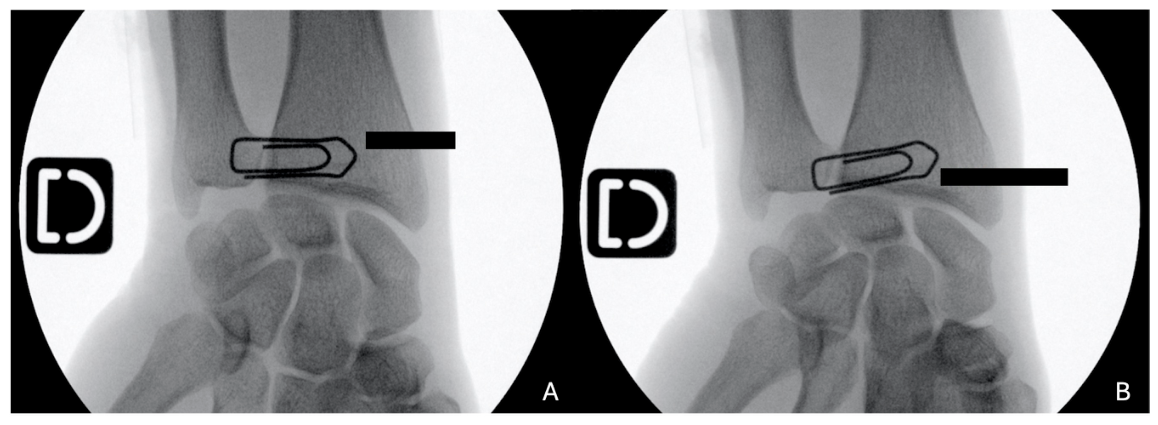
- Posteroanterior ulnar deviation (PA-UD XR): taken with the forearm in neutral rotation and pronation, the wrist in 30° of ulnar deviation and a neutral position, and the third metacarpal aligned with the longitudinal axis of the radius (Figure 1A).
- −
- Posteroanterior clenched fist in ulnar deviation (PA-CF XR): taken with the forearm in neutral rotation and pronation, the wrist is in 30° of ulnar deviation in a neutral position with the fourth and fifth metacarpal heads flat on the cassette. The patient held a pencil, and it was positioned parallel to the cassette (Figure 1B) [5].
Figure 1.
Radiographic images of the wrist after dynamic maneuvers; (A) Ulnar inclination at 30°, (B) Clenched fist pen incidence.
- −
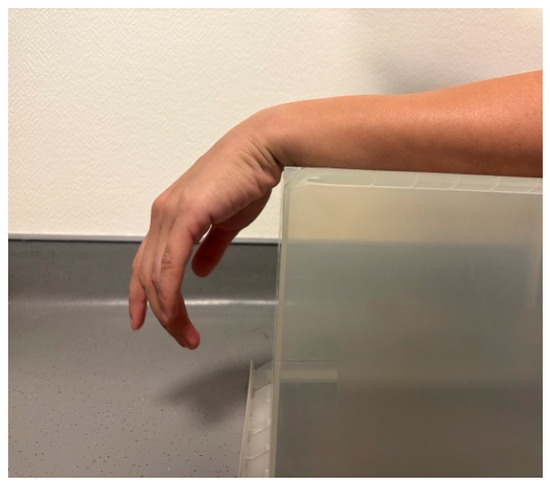
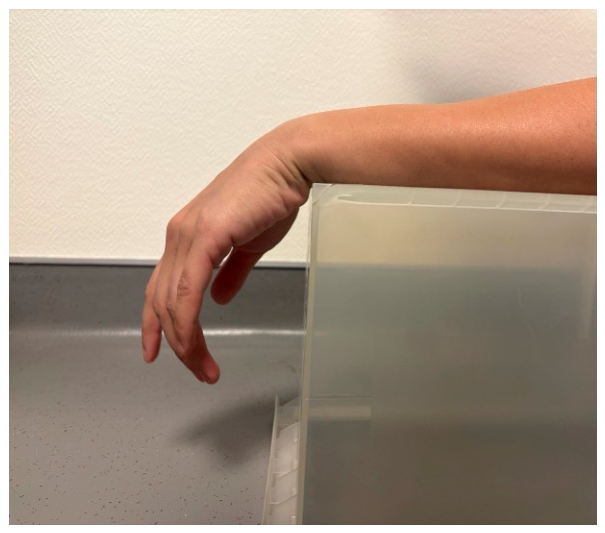
- At-rest flexed wrist ultrasound examinations (N-US): taken with the forearm in neutral rotation and pronation on a wedge with the wrist slightly flexed at rest position (Figure 2).Figure 2. Forearm in neutral rotation and pronation on a wedge with the wrist slightly flexed at rest position.
- −
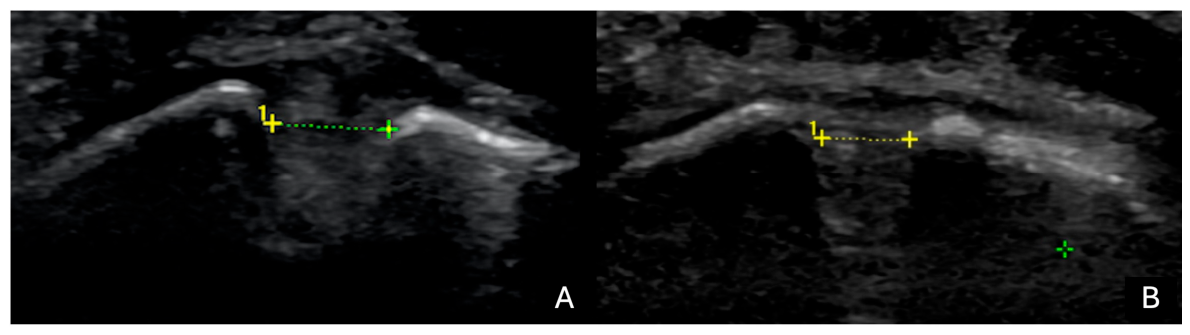
- Third metacarpal head push dynamic ultrasound examinations (M3-US): taken with the forearm in neutral rotation and pronation on a wedge with the wrist flexed and the fist slightly clenched. The examiner dynamically pushed on the head of the third metacarpal distally to proximally in the capitate’s axis, aiming to open the SL interval (Figure 3A).
- −
- Clenched fist and flexed wrist dynamic ultrasound examinations (CF-US): taken with the forearm in neutral rotation and pronation on a wedge with the wrist flexed and the fist clenched at maximum level (Figure 3B).
Figure 3.
(A) Ultrasound images of the wrist after dynamic maneuvers with support on the head of the third metacarpal. (B) Ultrasound images of the wrist after dynamic maneuvers with the patient clenching their fist.
2.3. Measurements and Statistical Analysis
As there is no consensus on the optimal technique for measuring SL intervals, it was calculated using fluoroscopy by measuring the distance between the scaphoid and lunate surfaces of the SL joint on the proximal aspect of the proximal carpal row. Dynamic US examinations demonstrated an echogenic fibrillar structure, and the gap was measured as the distance between the scaphoid and lunate borders of the SL joint on the dorsal part with the transducer transversely inclined. Two independent observers blinded to data from the other technique performed US and radiographic measurements. We also systematically calculated the inclination of the US transducer when the SL space was detected and measured at rest. We made two independent measurements of the SL interval and calculated the mean value. The association between transducer inclination and SL interval was assessed using linear regression (R2 reported). As the same participants underwent all six imaging conditions, pairwise comparisons between views were performed using the Wilcoxon signed-rank test, a non-parametric paired test appropriate for repeated measurements within the same subject. The significance threshold was set at α = 0.05. No correction for multiple comparisons was applied. Statistical analysis was conducted using JASP (version 0.19, Amsterdam, The Netherlands). A post-hoc sensitivity analysis indicated that with n = 29, the study had sufficient power (1 − β ≈ 0.80, α = 0.05, two-tailed) to detect a mean between-view difference of approximately 0.5 mm in the SL interval (SD ≈ 0.6 mm), which is consistent with the smallest difference observed in our data. The absence of a formal a priori power calculation is acknowledged as a limitation.
2.4. Ethical Approval
This study was approved by the local Institutional Review Board (IORG0012275—IULS, University Institute for Locomotion and Sport; IRB00014528—ULS, University Institute for Locomotion and Sport). Approval was granted for Research Project No. IRB00014528_2025_30: “Comparison of Radiographic and Ultrasonic Imaging Techniques for Assessing the Scapholunate Interval in Healthy Individuals.”
3. Results
Twenty-nine healthy wrists were examined in 29 patients (23 men; mean age, 38 years; range, 19–60 years; 20 right wrists).
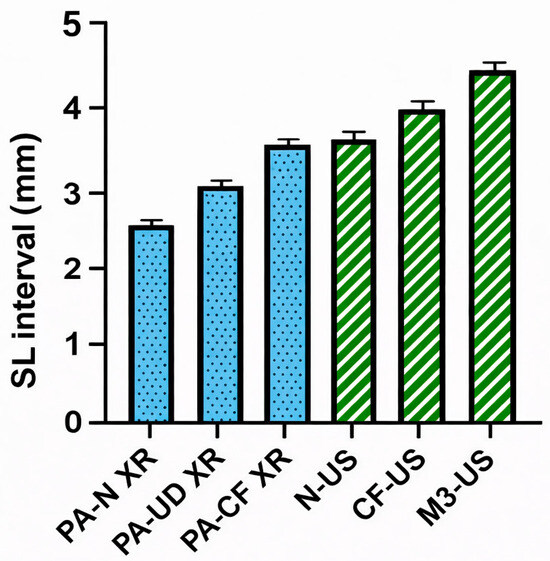
Among the radiographic views, the PA-CF XR view provided higher mean SL interval measurements. Regarding US examination, the highest mean SL interval was achieved with the M3-US view (Table 1 and Table 2). The mean values of the SL interval gap for each dynamic stress view are reported in Figure 4.
Table 1.
Mean scapholunate interval values by view (n = 29 wrists).
Table 2.
Pairwise comparisons of scapholunate interval measurements between views.
Figure 4.
Average SL intervals (in mm) for the different radiographic and ultrasound images taken under stress.
Comparing radiographic views, PA-CF XR produced significantly greater SL interval measurements than PA-UD XR, whereas the PA-N XR view showed the lowest SL interval of all the radiographic views evaluated. Interestingly, the highest difference in SL interval values was observed between the PA-N XR view and the PA-CF XR view.
Comparing US views, the N-US view provided significantly lower SL interval values than the other two US views. Between the US dynamic views, M3-US provided higher SL interval measurements than CF-US, and this was the highest difference observed among the US views.
When comparing US and radiographic views directly, N-US produced measurements similar to those of PA-UD XR (Δ = 0.25 mm; p = 0.105) and PA-CF XR (Δ = 0.30 mm; p = 0.060), indicating that the resting ultrasound is comparable to the most commonly used radiographic stress views. Among all six views assessed, M3-US produced the highest mean SL interval overall, exceeding that of PA-CF XR and all other views regardless of imaging modality. The magnitude of SL interval change from neutral to the best dynamic maneuver was similar between modalities (PA-N XR to PA-CF XR: Δ = +1.16 mm versus N-US to M3-US: Δ = +0.99 mm; Δ = 0.17 mm; p = 0.180), suggesting that ultrasound dynamic assessment provides a comparable degree of SL interval opening to standard radiographic stress views. However, these direct cross-modality comparisons should be interpreted with caution, as the US and radiographic maneuvers are not strictly equivalent.
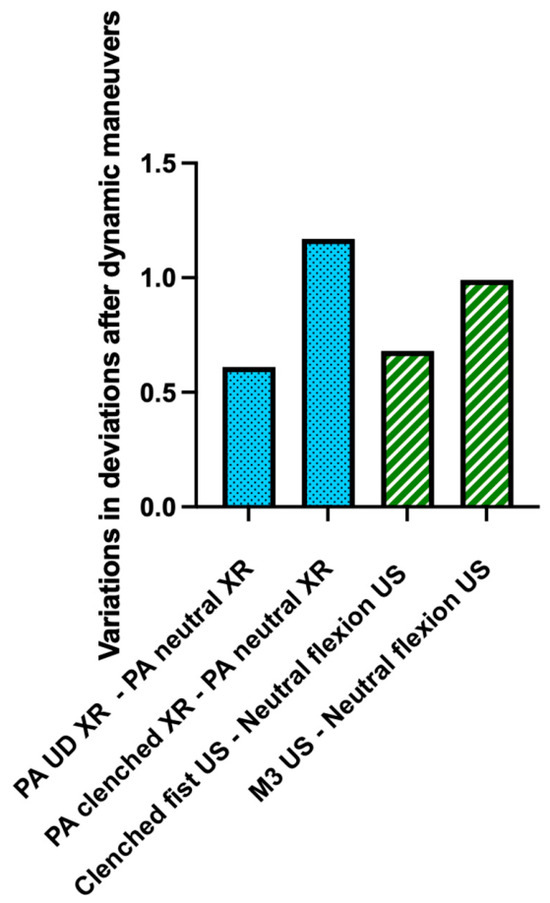
The SL interval changes between neutral and dynamic views are shown in Figure 5.
Figure 5.
Variations in SL intervals (in mm) measured between neutral, radiographic, or ultrasound positions and positions under constraint.
The posteroanterior neutral radiograph was less efficient than all other stress views for SL interval widening visualization (p < 0.05). PA-CF XR was better than PA-UD XR for visualizing the SL gap (Δ = 0.55 mm; p = 0.009). N-US was similar to PA-UD XR (Δ = 0.25 mm; p = 0.105) and PA-CF XR (Δ = 0.30 mm; p = 0.06) but was less successful than both CF-US (Δ = 0.66 mm; p < 0.001) and M3-US (Δ = 0.99 mm; p < 0.001) for visualizing the SL interval. The most significant difference was observed between PA-N XR and PA-CF XR (Δ = +1.16 mm; range: 0.1–2.9 mm), but this difference was similar to that between M3-US and N-US (Δ = + 0.99 mm; range: −0.1–1.9 mm) (Δ = 0.17 mm; p = 0.18). Variations in the SL intervals from PA-N XR to PA-CF XR were greater than those from N-US to CF-US (Δ = +0.66 mm; range: −0.1–1.4 mm) (Δ = 0.50 mm; p = 0.002). The SL interval changes between neutral and dynamic views are shown in Figure 5.
The mean range of ultrasound transducer flexion at rest was 47° (33–70°), and no statistically significant association was found between the range of flexion and the SL interval (R2 = 0.07; p > 0.05).
4. Discussion
The findings from this study demonstrate that dynamic US examination provides similar results compared to dynamic stress radiographs in healthy patients. The M3-US view, achieved by pushing the head of the third metacarpal, provided the best results regarding the SL interval, although absolute values had a low clinical significance. Overall, dynamic maneuvers significantly increased the SL interval compared to rest in both modalities. The magnitude of interval change was greatest for PA-CF XR within radiography and for M3-US within ultrasound, supporting the conclusion that M3-US is the most effective ultrasound maneuver for SL interval assessment. Consequently, ultrasound examination by pushing the head of the third metacarpal appears to be the most effective modality assessed in this study for measuring the SL interval in healthy patients. We did not identify any preferential transducer inclination for better SL space detection at rest.
In the literature, radiographic views with ulnar deviation or clenched pencil views are considered the most effective in visualizing dynamic SLI [6]. A cadaveric study by Lee et al. assessed eight different stress views and showed that the pencil view with a clenched fist was the most effective view to display SL widening [5]. The study by Lee et al. also found that a tilt of 30° for ulnar deviation is most effective in demonstrating SL widening and that the SL interval decreases above this threshold [5]. The clenched pencil view helps provide a bilateral comparative assessment of the SL interval. On standard radiographs in the neutral position, a threshold of 3 mm is commonly considered for the diagnosis of SLI [14]. However, differentials are more variable in the case of dynamic SLI and may differ from 2 to 5 mm according to the various techniques for measuring the SL interval. Dornberger et al. found that Stecher’s projection radiographs with a closed fist and ulnar deviation had the most accurate sensitivity and specificity for diagnosing SL complex tears, with thresholds of 3 or 3.7 mm [15].
Previous research has described several techniques to obtain the largest SL interval when the wrist has a physiologic load [4,7,16], yet there is currently no established gold standard. Real-time, three-dimensional magnetic resonance imaging (MRI) also allows detection of subtle SL interval variations, which may improve the accuracy for the diagnosis of dynamic SLI [17]. However, it is an expensive imaging modality that is often difficult to access. There may also be limitations with standards and dynamic radiographs, since partially healed, acute SL ligament tears may be associated with either a negative result or a delay between clinical assessment and imaging. Artifacts of chronic inflammation may lead to the same errors [18]. Therefore, US may help to quickly identify injuries to the extrinsic and intrinsic carpal ligaments [10,19]. Moreover, this examination can be performed by the trained surgeon, thereby simplifying the diagnostic circuit for the patient [20,21]. Ultrasound can also predict the diagnosis of tears of the dorsal band of the SL ligament with a sensitivity of 46–100% and a specificity of 92–100% [22]. Gondim Teixera et al. found that the dorsal SL ligament was not visible in 15% of cases without indication of an injury, whereas the proximal component of the SL ligament was seen in all cases [23]. Similarly, we did not clearly visualize the dorsal part of the SL ligament in nine cases (31%). This seems to be due to the quality of the ultrasound examination.
If US provides comparable results to radiography in measuring the SL interval, it also carries another advantage. Indeed, US enables the correct analysis of structures invisible on radiographs, such as the dorsal capsulo-scapholunate septum [24] or the dorsal part of the interosseous ligament. The direct observation of the SL ligament by US can help analyze signs of disruption of the dorsal aspect of the SL ligament [11,21], such as an absence of continuous hyperechoic ligament fibers between the scaphoid and lunate bones or a hypoechogenic discontinuity [25]. Dynamic ultrasound examinations of the dorsal portion of the SL ligament have been described with a clenched fist to detect dynamic instability. Dao et al. reported a sensitivity of 46% and a specificity of 100% [11]; the low sensitivity could be due to arthroscopy being the gold standard or to pre-dynamic instability, which is not detected by conventional or dynamic radiographs [3]. Another study showed that a tightly squeezed clenched fist, without radial or ulnar deviation, was a reliable method for assessing the SL ligament in healthy patients; however, there was no significant difference in the SL ligament interval length between the squeeze test and US performed at rest [26].
Besides assessing the SL interval, the quantification of dorsal subluxation of the scaphoid in relation to the lunate using US seems to be an effective method for diagnosing SLI. Indeed, in 2021, a Swiss team showed that the dorsal subluxation of the scaphoid can be accurately measured on US with excellent interobserver reliability between four experienced hand surgeons using a standardized 3D test model [27]. This was confirmed by a clinical trial published in 2024 on 20 patients with SLI in whom US was used during the Watson test preoperatively [28].
The current study has several limitations. First, US examination was performed by one investigator, which did not allow for inter-examiner reliability. However, US and radiographic measurements were performed by two independent observers blinded to data from the other technique.
Second, there was no comparison group of patients with dynamic SLI. Third, the study has a small sample size, which limits the generalizability of the results. Larger comparative studies on patients with SLI are needed to confirm this study’s results and enhance the clinical relevance of dynamic stress US examination. Moreover, wrist arthroscopy, considered the gold standard for evaluating ligamentous instability, should be performed on patients with SLI and assessed by US to determine the efficiency of dynamic stress maneuvers in symptomatic patients. Finally, the maneuvers compared between US and radiography are not strictly equivalent, which limits the validity of direct comparisons between the two modalities. However, pushing on the third metacarpal during radiography would be difficult to translate into clinical practice. Therefore, we consider this view to be a specificity that ultrasound can provide.
5. Conclusions
This study’s findings suggest that US examination with dynamic stress maneuvers appears clinically comparable to stress radiographs for viewing SL intervals in healthy patients. A modified stress view with a fist slightly clenched while pressure is applied to the head of the third metacarpal seems to be the best view for SL interval assessment. For a clinician assessing SL complex injuries, US could offer a valuable method for obtaining a SL stress view.
Supplementary Materials
The following supporting information can be downloaded at: https://www.mdpi.com/article/10.3390/jcm15114250/s1, Figure S1: Illustration of ultrasound examination procedures.
Author Contributions
Conceptualization, G.M. and E.L.; methodology, G.M., N.D. and T.A.; software, G.M.; validation, G.M.; formal analysis, G.M.; investigation, G.M.; resources, G.M. and E.L.; data curation, G.M.; writing—original draft preparation, G.M.; writing—review and editing, E.L., G.M., J.B.D.V.B., N.D., P.N. and T.A.; visualization, G.M.; supervision, E.L. and J.B.D.V.B.; project administration, E.L.; funding acquisition, E.L. All authors have read and agreed to the published version of the manuscript.
Funding
This research received no external funding.
Institutional Review Board Statement
This study was conducted in accordance with the Declaration of Helsinki. Participants were prospectively recruited in 2023 after written informed consent had been obtained from all subjects before inclusion in this study. The research protocol and analysis were subsequently approved by the Institutional Review Board of the University Institute for Locomotion and Sport (IORG0012275—IULS; IRB00014528—ULS) under approval code IRB00014528_2025_30 on 4 June 2025.
Informed Consent Statement
Written informed consent was obtained from all subjects involved in this study prior to participation.
Data Availability Statement
The original contributions presented in this study are included in the article. Further inquiries can be directed to the corresponding author.
Acknowledgments
The authors thank Zachary Rogozinski for his careful review of the English language of the manuscript.
Conflicts of Interest
The authors declare no conflicts of interest.
Abbreviations
The following abbreviations are used in this manuscript:
| STROBE | Strengthening the Reporting of Observational Studies in Epidemiology |
| CF-US | Clenched fist and flexed wrist dynamic ultrasound examinations |
| CT | Computed tomography |
| M3-US | Third metacarpal head push dynamic ultrasound |
| MR | Magnetic resonance |
| MRI | Magnetic resonance imaging |
| N-US | At-rest flexed wrist ultrasound examination |
| PA-CF XR | Posteroanterior clenched fist in ulnar deviation radiograph |
| PA-N XR | Posteroanterior neutral radiograph |
| PA-UD XR | Posteroanterior ulnar deviation radiograph |
| R2 | Coefficient of determination |
| SL | Scapholunate |
| SLI | Scapholunate instability |
| JASP | Statistical software used for all analyses |
| US | Ultrasound |
References
- Wessel, L.E.; Wolfe, S.W. Scapholunate Instability: Diagnosis and Management—Anatomy, Kinematics, and Clinical Assessment—Part I. J. Hand Surg. Am. 2023, 48, 1139–1149. [Google Scholar] [CrossRef] [Scilit]
- Lane, R.; Tafti, D.; Varacallo, M.A. Scapholunate Advanced Collapse. In StatPearls; StatPearls Publishing: Treasure Island, FL, USA, 2025. [Google Scholar]
- Dautel, G.; Goudot, B.; Merle, M. Arthroscopic diagnosis of scapho-lunate instability in the absence of X-ray abnormalities. J. Hand Surg. Am. 1993, 18, 213–218. [Google Scholar] [CrossRef] [Scilit]
- Lawand, A.; Foulkes, G.D. The “clenched pencil” view: A modified clenched fist scapholunate stress view. J. Hand Surg. Am. 2003, 28, 414–418; discussion 419–420. [Google Scholar] [CrossRef] [Scilit] [PubMed]
- Lee, S.K.; Desai, H.; Silver, B.; Dhaliwal, G.; Paksima, N. Comparison of radiographic stress views for scapholunate dynamic instability in a cadaver model. J. Hand Surg. Am. 2011, 36, 1149–1157. [Google Scholar] [CrossRef] [Scilit] [PubMed]
- Patel, R.M.; Kalainov, D.M.; Chilelli, B.J.; Makowiec, R.L. Comparisons of three radiographic views in assessing for scapholunate instability. Hand 2015, 10, 233–238. [Google Scholar] [CrossRef] [Scilit] [PubMed]
- Sikora, S.K.; Tham, S.K.; Harvey, J.N.; Garcia-Elias, M.; Goldring, T.; Rotstein, A.H.; Ek, E.T. The Twist X-Ray: A Novel Test for Dynamic Scapholunate Instability. J. Wrist Surg. 2019, 8, 61–65. [Google Scholar] [CrossRef] [Scilit]
- Kelly, P.M.; Hopkins, J.G.; Furey, A.J.; Squire, D.S. Dynamic CT Scan of the Normal Scapholunate Joint in a Clenched Fist and Radial and Ulnar Deviation. Hand 2018, 13, 666–670. [Google Scholar] [CrossRef] [Scilit]
- Dietrich, T.J.; Toms, A.P.; Cerezal, L.; Omoumi, P.; Boutin, R.D.; Fritz, J.; Schmitt, R.; Shahabpour, M.; Becce, F.; Cotton, A.; et al. Interdisciplinary consensus statements on imaging of scapholunate joint instability. Eur. Radiol. 2021, 31, 9446–9458. [Google Scholar] [CrossRef] [Scilit]
- Boutry, N.; Lapegue, F.; Masi, L.; Claret, A.; Demondion, X.; Cotten, A. Ultrasonographic evaluation of normal extrinsic and intrinsic carpal ligaments: Preliminary experience. Skelet. Radiol. 2005, 34, 513–521. [Google Scholar] [CrossRef] [Scilit]
- Dao, K.D.; Solomon, D.J.; Shin, A.Y.; Puckett, M.L. The efficacy of ultrasound in the evaluation of dynamic scapholunate ligamentous instability. J. Bone Jt. Surg. 2004, 86, 1473–1478. [Google Scholar] [CrossRef] [Scilit]
- Apard, T. Ultrasonography for the orthopaedic surgeon. Orthop. Traumatol. Surg. Res. 2019, 105, S7–S14. [Google Scholar] [CrossRef] [Scilit] [PubMed]
- Tang, J.B. Re: Levels of experience of surgeons in clinical studies. J. Hand Surg. Eur. 2009, 34, 137–138. [Google Scholar] [CrossRef] [Scilit]
- Belsole, R.J. Radiography of the wrist. Clin. Orthop. Relat. Res. 1986, 202, 50–56. [Google Scholar] [CrossRef] [Scilit]
- Dornberger, J.E.; Rademacher, G.; Mutze, S.; Eisenschenk, A.; Stengel, D. Accuracy of simple plain radiographic signs and measures to diagnose acute scapholunate ligament injuries of the wrist. Eur. Radiol. 2015, 25, 3488–3498. [Google Scholar] [CrossRef] [Scilit]
- Moneim, M.S. The tangential posteroanterior radiograph to demonstrate scapholunate dissociation. J. Bone Jt. Surg. 1981, 63, 1324–1326. [Google Scholar] [CrossRef] [Scilit]
- Shaw, C.B.; Foster, B.H.; Borgese, M.; Boutin, R.D.; Bateni, C.; Boonsri, P.; Bayne, C.O.; Szabo, R.M.; Nayak, K.S.; Chaudhari, A.J. Real-time three-dimensional MRI for the assessment of dynamic carpal instability. PLoS ONE 2019, 14, e0222704. [Google Scholar] [CrossRef] [Scilit]
- Ezzati, F.; Pezeshk, P. Radiographic Findings of Inflammatory Arthritis and Mimics in the Hands. Diagnostics 2022, 12, 2134. [Google Scholar] [CrossRef] [Scilit]
- Gitto, S.; Messina, C.; Mauri, G.; Aliprandi, A.; Sardanelli, F.; Sconfienza, L.M. Dynamic high-resolution ultrasound of intrinsic and extrinsic ligaments of the wrist: How to make it simple. Eur. J. Radiol. 2017, 87, 20–35. [Google Scholar] [CrossRef] [Scilit]
- Bollard, S.M.; Kelly, B.; McDermott, C.; Potter, S. The Use of Point of Care Ultrasound in Hand Surgery. J. Hand Surg. Am. 2021, 46, 602–607. [Google Scholar] [CrossRef] [Scilit] [PubMed]
- Vigny, S.; Rubinstenn, E.; Michelin, P.; Sabatier, T.; Dhellemmes, O.; Duparc, F.; Auquit-Aukbur, I.; Lalevee, M. Ultrasound identification of hand and wrist anatomical structures by hand surgeons new to ultrasonographic techniques. Surg. Radiol. Anat. 2024, 46, 795–804. [Google Scholar] [CrossRef] [Scilit] [PubMed]
- Ramamurthy, N.K.; Chojnowski, A.J.; Toms, A.P. Imaging in carpal instability. J. Hand Surg. Eur. 2016, 41, 22–34. [Google Scholar] [CrossRef] [Scilit] [PubMed]
- Gondim Teixeira, P.A.; Badr, S.; Hossu, G.; Lefebvre, G.; Arab, W.A.; Blum, A.; Cotton, A. Quantitative analysis of scapholunate diastasis using stress speckle-tracking sonography: A proof-of-concept and feasibility study. Eur. Radiol. 2017, 27, 5344–5351. [Google Scholar] [CrossRef] [Scilit]
- Debril, H.; Saab, M.; Demondion, X.; Muys, P.; Cotten, A.; Jacques, T. Anatomical study of the dorsal capsulo-scapholunate septum using high frequency ultrasonography. Orthop. Traumatol. Surg. Res. 2023, 109, 103483. [Google Scholar] [CrossRef] [Scilit]
- Jacobson, J.A.; Oh, E.; Propeck, T.; Jebson, P.J.; Jamadar, D.A.; Hayes, C.W. Sonography of the scapholunate ligament in four cadaveric wrists: Correlation with MR arthrography and anatomy. AJR Am. J. Roentgenol. 2002, 179, 523–527. [Google Scholar] [CrossRef] [Scilit]
- Reckelhoff, K.E.; Clark, T.B.; Kettner, N.W. The Sonographic Squeeze Test: Assessing the Reliability of the Dorsal Scapholunate Ligament. J. Med. Ultrasound 2013, 21, 138–142. [Google Scholar] [CrossRef] [Scilit]
- Labèr, R.; Reissner, L.; Nagy, L.; Schweizer, A. Feasibility of ultrasound-based measurement of dorsal scaphoid displacement: A 3D-model study. Hand Surg. Rehabil. 2021, 40, 595–601. [Google Scholar] [CrossRef] [Scilit] [PubMed]
- Huber, N.; Götschi, T.; Schweizer, A.; Reissner, L. Catch the shift: Ultrasound diagnosis of scapholunate lesion during Watson test. Hand Surg. Rehabil. 2024, 43, 101756. [Google Scholar] [CrossRef] [Scilit]

Disclaimer/Publisher’s Note: The statements, opinions and data contained in all publications are solely those of the individual author(s) and contributor(s) and not of MDPI and/or the editor(s). MDPI and/or the editor(s) disclaim responsibility for any injury to people or property resulting from any ideas, methods, instructions or products referred to in the content. |
© 2026 by the authors. Licensee MDPI, Basel, Switzerland. This article is an open access article distributed under the terms and conditions of the Creative Commons Attribution (CC BY) license.