Controlling Myopia: Insights from a Nation-Wide Clinical Practice Survey

 , , ,
, , ,  , , ,
, , ,  ,
,
Abstract
1. Introduction
2. Materials and Methods
- -
- Demographic and professional characteristics (including years of experience, work context, and education level);
- -
- General perception and approach;
- -
- Monitoring and assessment practices;
- -
- Treatment strategies;
- -
- Implementation barriers.
3. Results
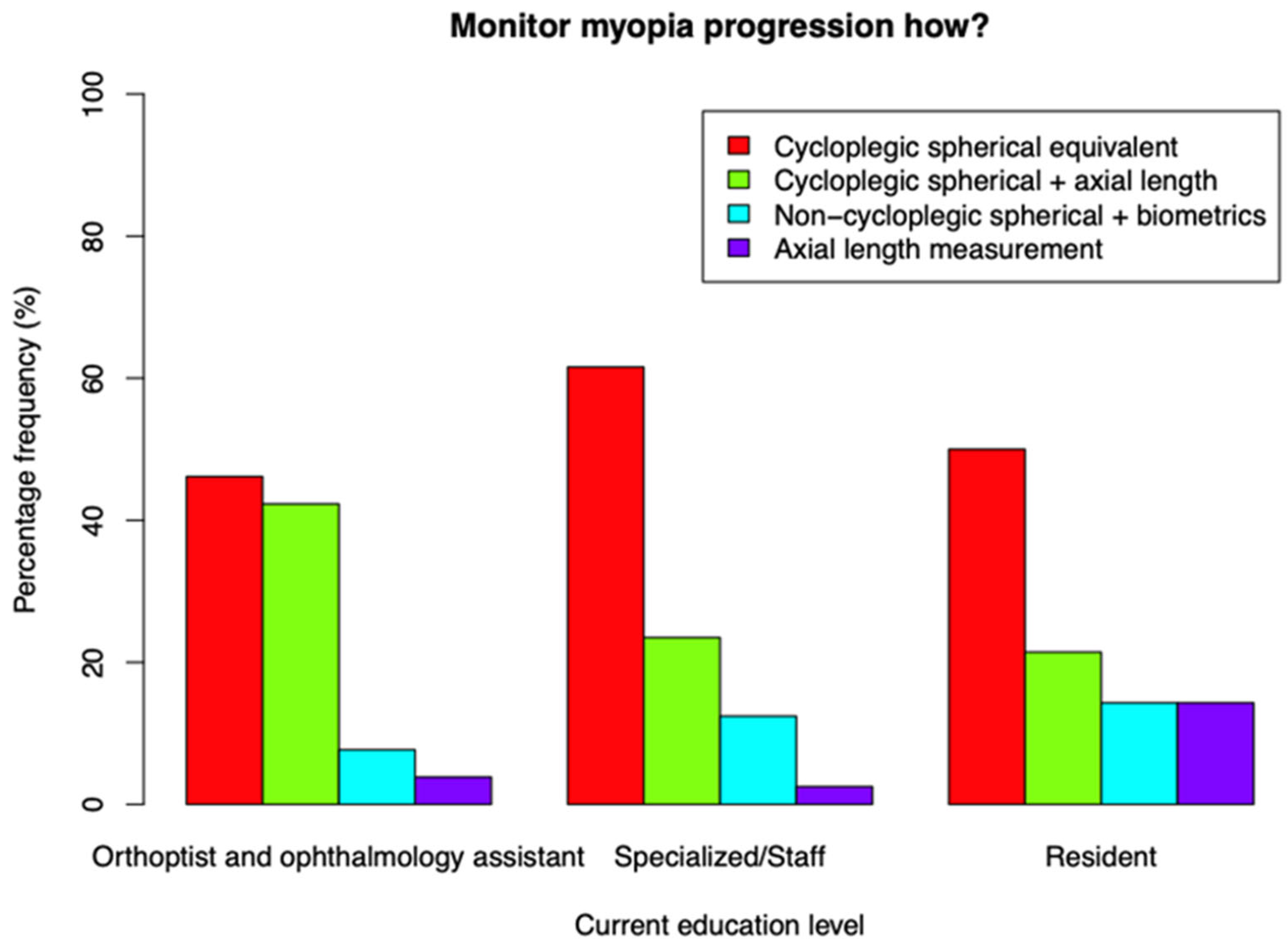
- Cycloplegic Spherical Equivalent Monitoring:
- ○
- Predominant choice among specialized/staff practitioners (61.58%);
- ○
- Higher adoption in private practice settings (60.2%);
- ○
- Preferred by early-career practitioners (74% in 0–5 years group).
- Combined Assessment Approaches (cycloplegic spherical and axial length measured by ocular biometry):
- ○
- Cycloplegic spherical with axial length measurements was favored by 32.48% of those facing myopia control at a high frequency, determined as 50–70% of their clinical practice;
- ○
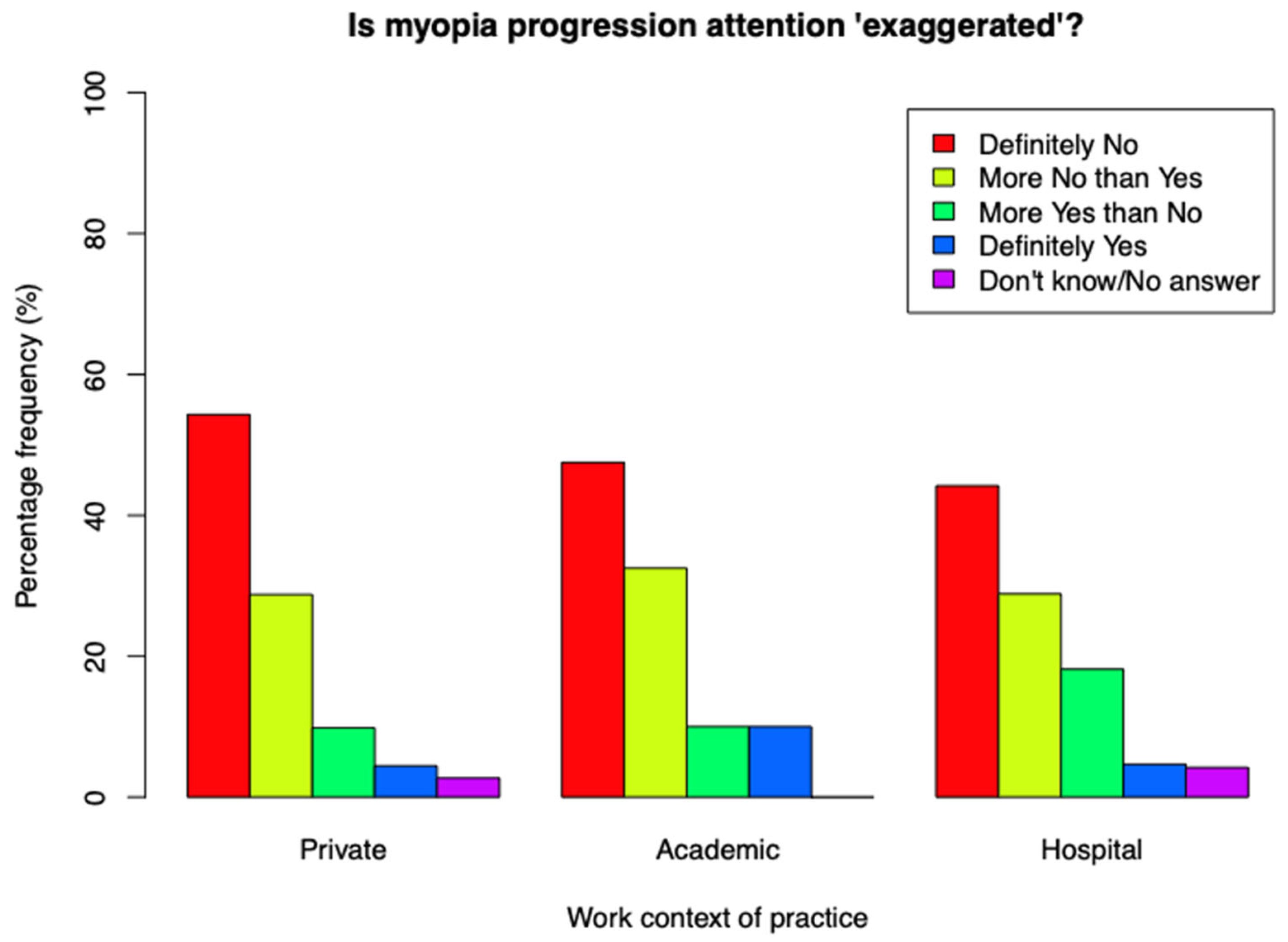
- Academic centers showed the highest rate of combined assessment methods (32.5%);
- ○
- Mid-career practitioners (11–20 years) demonstrated a lower propensity to use combined approaches (25.81%) compared to using the SE alone.
4. Discussion
5. Conclusions
Author Contributions
Funding
Institutional Review Board Statement
Informed Consent Statement
Data Availability Statement
Conflicts of Interest
References
- Holden, B.A.; Fricke, T.R.; Wilson, D.A.; Jong, M.; Naidoo, K.S.; Sankaridurg, P.; Wong, T.Y.; Naduvilath, T.; Resnikoff, S. Global prevalence of myopia and high myopia and temporal trends from 2000 through 2050. Ophthalmology 2016, 123, 1036–1042. [Google Scholar] [CrossRef]
- Morgan, I.G.; French, A.N.; Ashby, R.S.; Guo, X.; Ding, X.; He, M.; Rose, K.A. The epidemics of myopia: Aetiology and prevention. Prog. Retin. Eye Res. 2018, 62, 134–149. [Google Scholar] [CrossRef]
- Pan, C.W.; Ramamurthy, D.; Saw, S.M. Worldwide prevalence and risk factors for myopia. Ophthalmic Physiol. Opt. 2012, 32, 3–16. [Google Scholar] [CrossRef] [PubMed]
- Rudnicka, A.R.; Kapetanakis, V.V.; Wathern, A.K.; Logan, N.S.; Gilmartin, B.; Whincup, P.H.; Cook, D.G.; Owen, C.G. Global variations and time trends in the prevalence of childhood myopia, a systematic review and quantitative meta-analysis: Implications for aetiology and early prevention. Br. J. Ophthalmol. 2016, 100, 882–890. [Google Scholar] [CrossRef] [PubMed] [PubMed Central]
- Williams, K.M.; Bertelsen, G.; Cumberland, P.; Wolfram, C.; Verhoeven, V.J.; Anastasopoulos, E.; Buitendijk, G.H.; Cougnard-Grégoire, A.; Creuzot-Garcher, C.; Erke, M.G.; et al. European Eye Epidemiology (E3) Consortium. Increasing prevalence of myopia in Europe and the impact of education. Ophthalmology 2015, 122, 1489–1497. [Google Scholar] [CrossRef] [PubMed]
- Russo, A.; Semeraro, F.; Romano, M.R.; Mastropasqua, R.; Dell’oMo, R.; Costagliola, C. Myopia onset and progression: Can it be prevented? Int. Ophthalmol. 2020, 40, 3357–3367. [Google Scholar] [CrossRef]
- Flitcroft, D.I. The complex interactions of retinal, optical and environmental factors in myopia aetiology. Prog. Retin. Eye Res. 2012, 31, 622–660. [Google Scholar] [CrossRef]
- Ohno-Matsui, K.; Kawasaki, R.; Jonas, J.B.; Cheung, C.M.G.; Saw, S.-M.; Verhoeven, V.J.; Klaver, C.C.; Moriyama, M.; Shinohara, K.; Kawasaki, Y.; et al. International photographic classification and grading system for myopic maculopathy. Am. J. Ophthalmol. 2015, 159, 877–883. [Google Scholar] [CrossRef]
- Naidoo, K.S.; Leasher, J.; Bourne, R.R.; Flaxman, S.R.; Jonas, J.B.; Keeffe, J.; Limburg, H.; Pesudovs, K.; Price, H.; White, R.A.; et al. Global Vision Impairment and Blindness Due to Uncorrected Refractive Error, 1990–2010. Optom. Vis. Sci. 2016, 93, 227–234. [Google Scholar] [CrossRef] [PubMed]
- Fricke, T.R.; Holden, B.A.; Wilson, D.A.; Schlenther, G.; Naidoo, K.S.; Resnikoff, S.; Frick, K.D. Global cost of correcting vision impairment from uncorrected refractive error. Bull. World Health Organ. 2012, 90, 728–738. [Google Scholar] [CrossRef] [PubMed] [PubMed Central]
- Németh, J.; Tapasztó, B.; Aclimandos, W.A.; Kestelyn, P.; Jonas, J.B.; De Faber, J.-T.H.N.; Januleviciene, I.; Grzybowski, A.; Nagy, Z.Z.; Pärssinen, O.; et al. Update and guidance on management of myopia. European Society of Ophthalmology in cooperation with International Myopia Institute. Eur. J. Ophthalmol. 2021, 31, 853–883. [Google Scholar] [CrossRef]
- Gifford, K.L.; Richdale, K.; Kang, P.; Aller, T.A.; Lam, C.S.; Liu, Y.M.; Michaud, L.; Mulder, J.; Orr, J.B.; Rose, K.A.; et al. IMI—Clinical Management Guidelines Report. Investig. Ophthalmol. Vis. Sci. 2019, 60, M184–M203. [Google Scholar] [CrossRef]
- Walline, J.J.; Lindsley, K.; Vedula, S.S.; Cotter, S.A.; Mutti, D.O.; Twelker, J.D. Interventions to slow progression of myopia in children. Cochrane Database Syst. Rev. 2020, 1, CD004916. [Google Scholar]
- Wildsoet, C.F.; Chia, A.; Cho, P.; Guggenheim, J.A.; Polling, J.R.; Read, S.; Sankaridurg, P.; Saw, S.-M.; Trier, K.; Walline, J.J.; et al. IMI—Interventions for Controlling Myopia Onset and Progression Report. Investig. Ophthalmol. Vis. Sci. 2019, 60, M106–M131. [Google Scholar] [CrossRef] [PubMed]
- Huang, J.; Wen, D.; Wang, Q.; McAlinden, C.; Flitcroft, I.; Chen, H.; Saw, S.M.; Chen, H.; Bao, F.; Zhao, Y.; et al. Efficacy comparison of 16 interventions for myopia control in children. Ophthalmology 2016, 123, 697–708. [Google Scholar] [CrossRef]
- Sun, Y.; Xu, F.; Zhang, T.; Liu, M.; Wang, D.; Chen, Y.; Liu, Q. Orthokeratology to control myopia progression: A meta-analysis. PLoS ONE 2015, 10, e0124535, Erratum in PLoS ONE 2015, 10, e0130646. https://doi.org/10.1371/journal.pone.0130646. [Google Scholar] [CrossRef] [PubMed] [PubMed Central]
- Lam, C.S.Y.; Tang, W.C.; Tse, D.Y.-Y.; Lee, R.P.K.; Chun, R.K.M.; Hasegawa, K.; Qi, H.; Hatanaka, T.; To, C.H. Defocus Incorporated Multiple Segments (DIMS) spectacle lenses slow myopia progression: A 2-year randomised clinical trial. Br. J. Ophthalmol. 2020, 104, 363–368. [Google Scholar] [CrossRef] [PubMed]
- Rappon, J.; Chung, C.; Young, G.; Hunt, C.; Neitz, J.; Neitz, M.; Chalberg, T. Control of myopia using diffusion optics spectacle lenses: 12-month results of a randomised controlled, efficacy and safety study (CYPRESS). Br. J. Ophthalmol. 2023, 107, 1709–1715. [Google Scholar] [CrossRef] [PubMed] [PubMed Central]
- Yam, J.C.; Jiang, Y.; Tang, S.M.; Law, A.K.P.; Chan, J.J.; Wong, E.; Ko, S.T.; Young, A.L.; Tham, C.C.; Chen, L.J.; et al. Low-Concentration Atropine for Myopia Progression (LAMP) Study: A Randomized, Double-Blinded, Placebo-Controlled Trial of 0.05%, 0.025%, and 0.01% Atropine Eye Drops in Myopia Control. Ophthalmology 2019, 126, 113–124. [Google Scholar] [CrossRef]
- Chua, W.-H.; Balakrishnan, V.; Chan, Y.-H.; Tong, L.; Ling, Y.; Quah, B.-L.; Tan, D. Atropine for the treatment of childhood myopia. Ophthalmology 2006, 113, 2285–2291. [Google Scholar] [CrossRef]
- Chia, A.; Chua, W.-H.; Cheung, Y.-B.; Wong, W.-L.; Lingham, A.; Fong, A.; Tan, D. Atropine for the treatment of childhood myopia: Safety and efficacy of 0.5%, 0.1%, and 0.01% doses (Atropine for the Treatment of Myopia 2). Ophthalmology 2012, 119, 347–354. [Google Scholar] [CrossRef]
- Chia, A.; Lu, Q.S.; Tan, D. Five-year clinical trial on atropine for the treatment of myopia 2: Myopia control with atropine 0.01% eyedrops. Ophthalmology 2016, 123, 391–399. [Google Scholar] [CrossRef]
- Yam, J.C.; Li, F.F.; Zhang, X.; Tang, S.M.; Yip, B.H.; Kam, K.W.; Ko, S.T.; Young, A.L.; Tham, C.C.; Chen, L.J.; et al. Two-year clinical trial of the Low-concentration Atropine for Myopia Progression (LAMP) study: Phase 2 report. Ophthalmology 2020, 127, 910–919. [Google Scholar] [CrossRef]
- Wu, P.C.; Yang, Y.H.; Fang, P.C. The long-term results of using low-concentration atropine eye drops for controlling myopia progression in schoolchildren. J. Ocul. Pharmacol. Ther. 2011, 27, 461–466. [Google Scholar] [CrossRef]
- Wu, P.-C.; Tsai, C.-L.; Wu, H.-L.; Yang, Y.-H.; Kuo, H.-K. Outdoor activity during class recess reduces myopia onset and progression in school children. Ophthalmology 2013, 120, 1080–1085. [Google Scholar] [CrossRef]
- Ang, M.; Flanagan, J.L.; Wong, C.W.; Müller, A.; Davis, A.; Keys, D.; Resnikoff, S.; Jong, M.; Wong, T.Y.; Sankaridurg, P. Review: Myopia control strategies recommendations from the 2018 WHO/IAPB/BHVI meeting on myopia. Br. J. Ophthalmol. 2020, 104, 1482–1487. [Google Scholar]
- He, M.; Xiang, F.; Zeng, Y.; Mai, J.; Chen, Q.; Zhang, J.; Smith, W.; Rose, K.; Morgan, I.G. Effect of Time Spent Outdoors at School on the Development of Myopia Among Children in China: A Randomized Clinical Trial. JAMA 2015, 314, 1142–1148. [Google Scholar] [CrossRef] [PubMed]
- Xiong, S.; Sankaridurg, P.; Naduvilath, T.; Zang, J.; Zou, H.; Zhu, J.; Lv, M.; He, X.; Xu, X. Time spent in outdoor activities in relation to myopia prevention and control: A meta-analysis and systematic review. Acta Ophthalmol. 2017, 95, 551–566. [Google Scholar] [CrossRef] [PubMed] [PubMed Central]
- Lanca, C.; Yam, J.C.; Jiang, W.J.; Tham, Y.C.; Hassan Emamian, M.; Tan, C.S.; Guo, Y.; Liu, H.; Zhong, H.; Zhu, D.; et al. Near work, screen time, outdoor time and myopia in schoolchildren in the Sunflower Myopia AEEC Consortium. Acta Ophthalmol. 2022, 100, 302–311. [Google Scholar] [CrossRef] [PubMed]
- Wolffsohn, J.S.; Whayeb, Y.; Logan, N.S.; Weng, R.; the International Myopia Institute Ambassador Group. IMI—Global Trends in Myopia Management Attitudes and Strategies in Clinical Practice—2022 Update. Investig. Ophthalmol. Vis. Sci. 2023, 64, 6. [Google Scholar] [CrossRef] [PubMed]
- Yotsukura, E.; Torii, H.; Inokuchi, M.; Tokumura, M.; Uchino, M.; Nakamura, K.; Hyodo, M.; Mori, K.; Jiang, X.; Ikeda, S.-I.; et al. Current Prevalence of Myopia and Association of Myopia with Environmental Factors Among Schoolchildren in Japan. JAMA Ophthalmol. 2019, 137, 1233–1239. [Google Scholar] [CrossRef]
- Li, X.; Li, L.; Qin, W.; Cao, Q.; Mu, X.; Liu, T.; Li, Z.; Zhang, W. Urban Living Environment and Myopia in Children. JAMA Netw. Open 2023, 6, e2346999. [Google Scholar] [CrossRef] [PubMed]
- Eppenberger, L.S.; Davis, A.; Resnikoff, S.; Wong, T.Y.; Lan, W.; Saw, S.M.; He, M.G.; Ohno-Matsui, K.; Jonas, J.B.; Qu, J.; et al. Key strategies to reduce the global burden of myopia: Consensus from the international myopia summit. Br. J. Ophthalmol. 2025, 109, 535–542. [Google Scholar] [CrossRef] [PubMed] [PubMed Central]
- Liu, Y.; Huang, Z.; Wang, G. Student learning performance prediction based on online behavior: An empirical study during the COVID-19 pandemic. PeerJ Comput. Sci. 2023, 9, e1699. [Google Scholar] [CrossRef] [PubMed] [PubMed Central]
- Brennan, N.A.; Toubouti, Y.M.; Cheng, X.; Bullimore, M.A. Efficacy in myopia control. Prog. Retin Eye Res. 2021, 83, 100923. [Google Scholar] [CrossRef] [PubMed]



| Questions | Frequency |
|---|---|
| Professional categories | |
| Ophtalmology assistants | 52 (7.85%) |
| Residents | 14 (2.11%) |
| Specialized/Staff pratictioners | 539 (89.58%) |
| NA | 3 (0.45%) |
| Years of experience | |
| 0–5 | 50 (7.55%) |
| 6–10 | 61 (9.21%) |
| 10–20 | 124 (18.73%) |
| >20 | 403 (60.88%) |
| NA | 24 (3.63%) |
| Practice settings | |
| Academic | 40 (6.04%) |
| Private | 354 (53.47%) |
| Hospital-based | 215 (32.48%) |
| NA | 53 (8.01%) |
| Questions | Definetly No | More No Than Yes | More Yes Than No | Definetly Yes | Don’t Know/No Answer | p-Value |
|---|---|---|---|---|---|---|
| If first strategy fails, then? | <0.001 | |||||
| Propose second treatment | 5 (25%) | 10 (9.17%) | 30 (9.84%) | 16 (7.44%) | 1 (7.69%) | |
| Combine with first treatment | 9 (45%) | 64 (58.72%) | 222 (72.79%) | 162 (75.35%) | 8 (61.54%) | |
| Refer to secondary care | 1 (5%) | 9 (8.26%) | 19 (6.23%) | 3 (1.4%) | 0 (0%) | |
| Do not initiate further treatment | 5 (25%) | 26 (23.85%) | 28 (9.18%) | 30 (13.95%) | 4 (30.77%) | |
| Increase atropine concentration | 0 (0%) | 0 (0%) | 6 (1.97%) | 4 (1.86%) | 0 (0%) |
Disclaimer/Publisher’s Note: The statements, opinions and data contained in all publications are solely those of the individual author(s) and contributor(s) and not of MDPI and/or the editor(s). MDPI and/or the editor(s) disclaim responsibility for any injury to people or property resulting from any ideas, methods, instructions or products referred to in the content. |
© 2026 by the authors. Licensee MDPI, Basel, Switzerland. This article is an open access article distributed under the terms and conditions of the Creative Commons Attribution (CC BY) license.
Share and Cite
Vagge, A.; Drago, G.; Catti, C.; Resnikoff, S.; Caputo, R.; Nucci, P.; Sabetti, L.; Gabutto, M.G.; Serafino, M.; Stramare, G.; et al. Controlling Myopia: Insights from a Nation-Wide Clinical Practice Survey. J. Clin. Med. 2026, 15, 4237. https://doi.org/10.3390/jcm15114237
Vagge A, Drago G, Catti C, Resnikoff S, Caputo R, Nucci P, Sabetti L, Gabutto MG, Serafino M, Stramare G, et al. Controlling Myopia: Insights from a Nation-Wide Clinical Practice Survey. Journal of Clinical Medicine. 2026; 15(11):4237. https://doi.org/10.3390/jcm15114237
Chicago/Turabian StyleVagge, Aldo, Gabriele Drago, Carlo Catti, Serge Resnikoff, Roberto Caputo, Paolo Nucci, Lelio Sabetti, Matteo Gabriele Gabutto, Massimiliano Serafino, Giuliano Stramare, and et al. 2026. "Controlling Myopia: Insights from a Nation-Wide Clinical Practice Survey" Journal of Clinical Medicine 15, no. 11: 4237. https://doi.org/10.3390/jcm15114237
APA StyleVagge, A., Drago, G., Catti, C., Resnikoff, S., Caputo, R., Nucci, P., Sabetti, L., Gabutto, M. G., Serafino, M., Stramare, G., Schiavetti, I., Fedriga, M., Musolino, M., & Iester, M. (2026). Controlling Myopia: Insights from a Nation-Wide Clinical Practice Survey. Journal of Clinical Medicine, 15(11), 4237. https://doi.org/10.3390/jcm15114237