Brief Report

Use of Disopyramide in Obstructive Hypertrophic Cardiomyopathy: A European Insight

1
Department of Cardiology & Department of Genetics, Hôpital Universitaire Pitié-Salpêtrière, IHU-ICAN, INSERM 1166, AP-HP, Sorbonne Université, 75013 Paris, France
2
Institute of Cardio-Metabolic Medicine, University Hospitals Coventry and Warwickshire NHS Trust, Coventry CV2 2DX, UK
3
Warwick Medical School, University of Warwick, Coventry CV4 7AL, UK
4
L’institut du Thorax, Hôpital Universitaire, Nantes Université, INSERM, Centre National de Recherche Scientifique, 44035 Nantes, France
5
Bristol Myers Squibb, Princeton, NJ 08543, USA
6
Bristol Myers Squibb, Uxbridge UB8 1DH, UK
7
Bristol Myers Squibb, 92506 Rueil-Malmaison, France
8
Department of Cardiology, St George’s NHS Foundation Trust & St George’s University of London, London SW17 0QT, UK
*
Author to whom correspondence should be addressed.
J. Clin. Med. 2026, 15(11), 4234; https://doi.org/10.3390/jcm15114234
Submission received: 29 April 2026 / Revised: 22 May 2026 / Accepted: 27 May 2026 / Published: 30 May 2026
(This article belongs to the Section Cardiology)

Abstract

Background/Objectives: Guidelines for obstructive hypertrophic cardiomyopathy (HCM) recommend treatment with disopyramide as an add-on to beta-blockers or calcium-channel blockers when symptoms persist. Data pertaining to effective disopyramide use in practice beyond single-center experience are very limited. This study aimed to quantify disopyramide use in patients with obstructive HCM in England, France and Germany, before the availability of cardiac myosin inhibitors. Methods: This retrospective study used nationally representative databases from England (Clinical Practice Research Datalink and Hospital Episode Statistics, 2010–2019), France (National Healthcare Data System, 2012–2019) and Germany (German statutory health insurance, 2011–2019). Adults (18+) with obstructive HCM were included, based on diagnostic codes for obstructive HCM or any HCM with septal reduction therapy. Disopyramide usage was defined as ≥1 prescription for a patient in a calendar year. Results: Overall, 3730, 6823 and 1141 patients diagnosed with obstructive HCM were identified in the English, French and German databases, respectively. In England, disopyramide use ranged from 4.7% to 5.6% per year with use generally stable over time. The equivalent usage for France was 1.7% to 2.6% per year. As expected, no recorded reimbursed use was reported in Germany during the study period. Conclusions: Disopyramide use is very low in patients with obstructive HCM, possibly due to treatment-related issues, availability or lack of reimbursement. These barriers may drive the uptake of alternative guideline recommended therapies for obstructive HCM treatment.

1. Introduction

Hypertrophic cardiomyopathy (HCM) can be genetic and is the most common inherited cardiac disorder; it is characterized by left ventricular hypertrophy not explained by abnormal loading conditions [1,2,3,4]. Approximately 70% of patients with HCM have obstructive HCM, which is defined as an obstruction in the left ventricular outflow tract (LVOT) either at rest or with provocation, with patients experiencing varying symptomatic burden including dyspnea, chest pain, fatigue, palpitations and syncope [1,2].
European Society of Cardiology (ESC) and American Heart Association/American College of Cardiology (AHA/ACC) guidelines for the treatment of symptomatic obstructive HCM advise the addition of disopyramide for patients who have persistent symptoms despite use of non-vasodilating beta-blockers (BBs) or non-dihydropyridine calcium-channel blockers (CCBs) [3,4]. The guidelines recommend disopyramide use in these patients at an equivalent or higher recommendation class level than cardiac myosin inhibitor therapy; however, the precise use of disopyramide in practice at a national level has not been previously assessed [3,4]. A study in a large specialty hospital found that 41% of patients with obstructive HCM did not respond to first-line therapy with BBs or CCBs [5]. This study also investigated disopyramide use among patients who required further therapy and provided the primary evidence to support HCM guidance regarding disopyramide therapy for the treatment of advanced obstructive HCM [3,4,5]. Despite the potential for disopyramide to reduce the LVOT gradient owing to its negative inotropic properties and augmentation of systemic vascular resistance, use of disopyramide may be limited owing to the associated rates of non-response (up to one-third), availability, side effect tolerance and discrete QT prolongation [5,6,7].
Variation can be seen in reimbursement policies for disopyramide across different countries. Although disopyramide is fully reimbursed and low cost in many countries, access varies across Europe. Disopyramide has never been reimbursed for use in Germany, is available in France despite an unfavorable reimbursement opinion (with reported supply issues), and is currently subject to a medicine supply notification in England due to intermittent stock availability [8,9,10].
It is important to understand disopyramide use in a large population, as quantifying real-world prescribing patterns may help identify potential gaps between guideline recommendations and clinical practice, as well as regional differences in access and uptake. Therefore, the objective of this analysis was to quantify use of disopyramide through analysis of nationwide databases from three countries.

2. Methods

2.1. Data Sources

This retrospective study used nationwide or nationally representative databases from three countries: Clinical Practice Research Datalink (CPRD) primary care data linked with Hospital Episode Statistics secondary care data in England from 2010 to 2019; French National Healthcare Data System (SNDS) data from 2012 to 2019; and Wissenschaftliches Institut für Gesundheitsökonomie und Gesundheitssystemforschung (WIG2) benchmark database of several German statutory health insurances from 2011 to 2019 (Table 1).

2.2. Study Population

Eligible patients were adults (≥18 years of age) with a diagnosis of obstructive HCM, based on an obstructive HCM diagnosis or diagnosis of any HCM in the presence of a septal reduction therapy procedure. All relevant coding systems applicable to the specific country were used (e.g., International Classification of Diseases, Tenth Revision, Clinical Modification; Read codes; and Systematized Nomenclature of Medicine Clinical Terms codes). The diagnosis, procedure and prescription codes used in the analysis are summarized in the Supplementary Materials (Tables S1 and S2).

2.3. Outcomes

Patient characteristics were assessed either at or up to 2 years before the first obstructive HCM diagnosis during the study period. Disopyramide use was based on the number of patients with obstructive HCM and at least one disopyramide prescription in a calendar year. There were two clinical HCM guidelines in effect during the enrollment period—the 2003 guidelines and the 2014 guidelines. Per the 2003 ACC/ESC guidelines [11], disopyramide was considered a favorable pharmacologic therapy, typically reserved for patients with obstructive HCM who were severely symptomatic. It was often administered in combination with BBs, although co-administration with verapamil was discouraged. Following the publication of the 2014 ESC guidelines [12], patients could receive disopyramide if symptomatic with resting or provocable LVOT obstruction, with treatment titrated to the maximum tolerated dose and used either in combination with BBs or verapamil or as monotherapy. To account for the potential use of unspecified HCM codes rather than obstructive HCM diagnosis codes, the percentage of all patients with HCM with at least one prescription of disopyramide was also calculated.

2.4. Ethics Approval

This study complies with the principles outlined in the Declaration of Helsinki. The research protocol was approved by the respective locally appointed ethics committees (aligned with the respective guidance for utilizing each of the datasets: England, Independent Scientific Advisory Committee application reference 21_000342; France, Comité éthique et scientifique pour les recherches, les études et les évaluations dans le domaine de la santé file 1912776bis), and permission was granted by the database owners to use the data. The use of the anonymized WIG2 database for scientific purposes is in conformity with German law; as such, no ethics committee approval was required. Only aggregated data are presented in this study, and the patient-level data used were pseudo-anonymized to reflect the appropriate requirements for accessing the aggregated datasets. As these data were used retrospectively, written consent was not required.

3. Results

In total, 6440 unique patients with HCM (3730 with obstructive HCM) were identified from 2010 to 2019 in the English CPRD database, 20,111 patients (6823 with obstructive HCM) from 2012 to 2019 in the French SNDS database, and 2601 patients (1141 with obstructive HCM) from 2011 to 2019 in the German WIG2 database.

3.1. Patient Characteristics

Of the patients with obstructive HCM (Table 2), 39%, 45% and 38% were female in England, France and Germany, respectively. Mean (95% confidence interval) age at the first obstructive HCM diagnosis in the study period was 61.2 (60.7, 61.7), 65.5 (65.1, 65.9) and 59.6 (58.6, 60.6) years in each of the respective countries. Common cardiovascular comorbidities were similar across the countries; the majority had primary hypertension during their baseline period. Within each of the three countries, the proportion of the obstructive HCM population independent of follow-up time with a prescription for disopyramide use was very low (England: 7.6%; France: 3.3%) or, in the case of Germany, was zero. In England and France, where disopyramide usage was recorded, patients with obstructive HCM receiving disopyramide were younger on average and had fewer comorbidities (particularly atrial fibrillation/flutter), represented by a mean Charlson comorbidity score of 2.37 (vs. 3.01) in England and 2.15 (vs. 3.90) in France when compared with the patient population who did not receive disopyramide.

3.2. Prevalence of Disopyramide Use

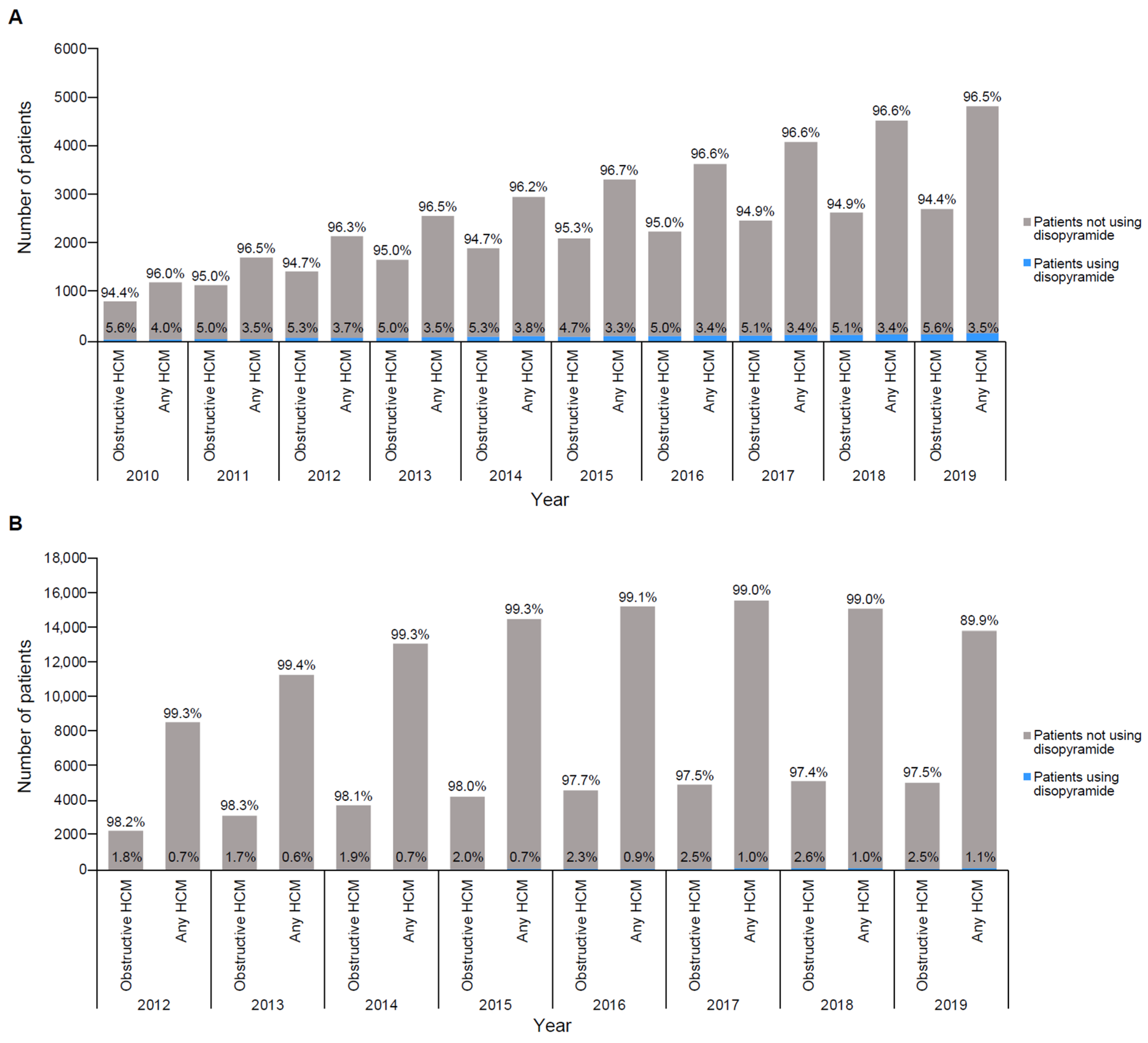
The percentage of patients with obstructive HCM who received disopyramide in a given calendar year was generally stable from 2010 to 2019 in England and ranged from 4.7% to 5.6% per year (Figure 1). Very few additional patients receiving disopyramide were added when analyzing use among all patients with HCM. In France, disopyramide use in patients with obstructive HCM was lower than in England and ranged from 1.7% to 2.6% per year, with prevalence generally increasing from 2012 to 2019. Although additional patients receiving disopyramide were identified when analyzing all patients with HCM, usage remained extremely low. No reimbursed disopyramide use was recorded in Germany from 2011 to 2019 within the obstructive HCM cohort.

4. Discussion

This is the first study to examine disopyramide use among populations of adult patients with obstructive HCM in multiple countries in Europe. The datasets for England and France are largely representative of the respective overall adult populations, and the large dataset for Germany has been shown to reflect the population covered by statutory health insurance [13]. Across these settings, disopyramide use was consistently low, with a maximum yearly prevalence of 5.6% in England, 2.6% in France, and no recorded reimbursed use in Germany despite guideline recommendations. In countries where disopyramide use was observed, treatment was more frequently prescribed in younger patients with fewer comorbidities. These findings highlight a gap between guideline recommendations and real-world clinical practice and demonstrate variation in treatment patterns across healthcare systems, providing important context for understanding management of obstructive HCM in routine care in the time period observed.
To date, no phase 3 randomized controlled trial has been performed to assess the efficacy and safety of disopyramide treatment in patients with obstructive HCM. However, multiple observational studies have demonstrated that disopyramide treatment (often in conjunction with BBs or CCBs) is associated with substantial improvements in resting LVOT gradient and New York Heart Association (NYHA) functional class [5,14,15]. Despite this, and despite disopyramide being guideline-recommended for the treatment of patients with obstructive HCM who have not responded to BB/CCB therapy, extremely low use was observed among patients with obstructive HCM. This result might be related to insufficient awareness in the medical community about the potential benefit of this drug. In addition, disopyramide prescribing may be concentrated in specialist HCM centers and therefore underrepresented in population-based datasets. This result may reflect several factors, including differences in access, reimbursement, and drug availability across healthcare systems. Alternatively, the findings of the present study may reflect treatment-related factors, including variability in response, issues with patient adherence and potential side effects with disopyramide, including corrected QT interval prolongation and anticholinergic effects [5,6,7,15]. With the inclusion of newer drugs within most recent treatment guideline updates, disopyramide may be less frequently used in the treatment of arrhythmias regardless of the presence of HCM. Furthermore, the ESC 2020 Guidelines for the diagnosis and management of atrial fibrillation include messages about the need to exercise caution when using Class Ia antiarrhythmic drugs (i.e., quinidine and disopyramide), which have been associated with increased overall mortality [16,17]. In some countries, limited use of disopyramide is likely to be related to a lack of reimbursement and market approval. Some countries have never had disopyramide available, have an unfavorable clinical assessment of it, or are facing shortages [8,10].
Anecdotal evidence from practicing clinicians suggests that only specialized referral centers that treat patients with advanced HCM use disopyramide. Although these highly specialized centers may use disopyramide more frequently than non-specialized centers, the population estimates illustrate that very few patients with obstructive HCM receive disopyramide each year. This observation is supported by the findings of VALOR-HCM, a US study which was designed to determine whether mavacamten therapy (a selective, cardiac-specific myosin inhibitor for patients with symptomatic obstructive HCM) would enable patients to improve sufficiently to no longer require, or be guideline eligible for, septal reduction therapy. In VALOR-HCM, 25.0% and 14.3% of patients in the mavacamten and placebo groups, respectively, were receiving disopyramide as monotherapy or alongside other therapies at baseline [18]; highlighting that, even in patients with severely symptomatic obstructive HCM, disopyramide use is limited. The updated guidelines for the management of hypertrophic cardiomyopathy from the ESC 2023 and the American Heart Association/American College of Cardiology Joint Committee on Clinical Practice Guidelines 2024, still recommend disopyramide use (Class I/Level B) but now along with the recently approved mavacamten (Class IIa/Level A) [3,4].
A limitation of this analysis is the potential miscoding of obstructive HCM. ‘Unspecified’ HCM is an option in diagnosis coding; however, when disopyramide use was examined across a wider population of patients that included those with ‘unspecified HCM’, very few additional disopyramide users were identified. In addition, the use of diagnostic codes may not fully distinguish sarcomeric HCM from phenocopies (e.g., Fabry disease, cardiac amyloidosis, or glycogen storage disorders), which differ in underlying pathophysiology and management and may influence prescribing patterns [19]. Of course, under-recognition of HCM is also known to be problematic, which leads to patients not receiving the appropriate diagnosis. Since patients are prescribed disopyramide following diagnosis of HCM, misdiagnosis of HCM is only likely to reduce the prevalence of disopyramide treatment. Disopyramide usage was defined as a patient with one or more prescriptions within a calendar year. As such, values could be seen as an overestimate of true prevalence, as it fails to consider the duration of treatment, dosing adherence and dosing persistence. In addition, the denominator used in the analysis included all patients with obstructive HCM, irrespective of symptomatic status or prior treatment exposure. This approach may have underestimated the proportion of patients eligible for disopyramide according to guideline criteria. Finally, the absence of linked clinical outcomes data precludes assessment of whether the observed low use of disopyramide is associated with suboptimal patient outcomes.
Patients receiving disopyramide were younger and had fewer comorbidities, which may reflect selective prescribing based on clinical risk and contraindications rather than random treatment allocation. This potential bias should be considered when interpreting treatment patterns. Further research of the geographical variation in disopyramide use, both within countries and across countries, and use by NYHA functional class may be helpful to improve our understanding of the variations in disopyramide use in Europe.
To conclude, disopyramide use among patients with obstructive HCM was found to be consistently low in England between 2010 and 2019 and in France between 2012 and 2019. As expected, no reimbursed disopyramide use was identified in Germany between 2011 and 2019. Despite previous studies suggesting that a substantial proportion of patients with obstructive HCM who receive BBs or CCBs are eligible for treatment intensification with disopyramide [5], use of the drug remained minimal across countries. These findings reflect treatment patterns prior to the introduction of cardiac myosin adenosine triphosphatase inhibitors [20,21] and should be interpreted within the context of evolving guideline-recommended therapies for obstructive HCM.

Supplementary Materials

The following supporting information can be downloaded at: https://www.mdpi.com/article/10.3390/jcm15114234/s1, Table S1: Diagnostic and procedure codes; Table S2: Disopyramide prescription codes.

Author Contributions

C.Z., M.H., F.-E.C. and M.T.E. contributed to data acquisition. All authors contributed to conception and design of the study, data analysis and data interpretation. All authors have read and agreed to the published version of the manuscript.

Funding

This work was supported by Bristol Myers Squibb. The journal publication fee for this manuscript was funded by Bristol Myers Squibb.

Institutional Review Board Statement

The study was conducted in accordance with the Declaration of Helsinki. For the English cohort, the study was approved by the Independent Scientific Advisory Committee (protocol code 21_000342, approved on 9 April 2021). For the French cohort, approval was obtained from the Comité éthique et scientifique pour les recherches (protocol code 1912776bis, approved on 8 October 2020); additionally, authorization to use the data was granted by the French data protection authority (Commission Nationale de l’Informatique et des Libertés; Decision DR-2020-373 and authorization number 920414, approved on 10 December 2020). For the German cohort, ethical review and approval were waived in conformity with German law, as the study utilized anonymized patient data retrospectively.

Informed Consent Statement

Patient consent was waived due to the retrospective nature of the study and the use of completely anonymized data, in accordance with the ethical approval obtained for this research.

Data Availability Statement

The datasets generated during and/or analyzed during the current study are not publicly available and only available upon license for the respective data custodians within each of the three countries involved in this study. Further information for data access for CPRD can be found at: https://www.cprd.com/data-access (accessed on 19 April 2026); SNDS at https://www.snds.gouv.fr/SNDS/Accueil (accessed on 19 April 2026); WIG2 at https://www.wig2.de/diga-digital-health-applications.html (accessed on 19 April 2026).

Acknowledgments

The authors thank Oksana Kirichek from HEOR Ltd., UK, and Eléonore Herquelot from Heva, France, for the analytical support on the study.

Conflicts of Interest

Philippe Charron has received consulting fees/honoraria from Amicus, Bayer, Bristol Myers Squibb, Cytokinetics, Owkin, Pfizer and Sanofi. Faizel Osman has received research grants from Abbott, Boston Scientific, Bristol Myers Squibb, British Heart Foundation, Creavo Medical Technologies and Medtronic. Jean-Noel Trochu has received personal fees from Abbott, AstraZeneca, Bayer, Boehringer Ingelheim, Bristol Myers Squibb and Vifor Pharma; grants and personal fees from Novartis; and grants from Boston Scientific. Carla Zema was a contractor of Bristol Myers Squibb at the time of the study and is currently the Managing Partner of Zema Consulting. Michael Hurst, François-Emery Cotté and Teresa Lemmer are employees of Bristol Myers Squibb and may own Bristol Myers Squibb stock or stock options. Belinda Sandler was an employee of Bristol Myers Squibb at the time of the study. Maite Tome Esteban has received consultancy fees from Bristol Myers Squibb and Cytokinetics.

Abbreviations

The following abbreviations are used in this manuscript:
ACCAmerican College of Cardiology
AHAAmerican Heart Association
BBBeta-blocker
CCBCalcium-channel blocker
CCICharlson Comorbidity Index
CIConfidence interval
CPRDClinical Practice Research Datalink
ESCEuropean Society of Cardiology
HCMHypertrophic cardiomyopathy
LVOTLeft ventricular outflow tract
NYHANew York Heart Association (functional class)
PEPulmonary embolism
SNDSFrench National Healthcare Data System
TIATransient ischemic attack
WIG2Wissenschaftliches Institut für Gesundheitsökonomie und Gesundheitssystemforschung

References

  1. Maron, B.J. Clinical course and management of hypertrophic cardiomyopathy. N. Engl. J. Med. 2018, 379, 655–668. [Google Scholar] [CrossRef] [PubMed]
  2. Veselka, J.; Anavekar, N.S.; Charron, P. Hypertrophic obstructive cardiomyopathy. Lancet 2017, 389, 1253–1267. [Google Scholar] [CrossRef] [PubMed]
  3. Arbelo, E.; Protonotarios, A.; Gimeno, J.R.; Arbustini, E.; Barriales-Villa, R.; Basso, C.; Bezzina, C.R.; Biagini, E.; Blom, N.A.; de Boer, R.A.; et al. ESC Scientific Document Group. 2023 ESC Guidelines for the management of cardiomyopathies: Developed by the task force on the management of cardiomyopathies of the European Society of Cardiology (ESC). Eur. Heart J. 2023, 44, 3503–3626. [Google Scholar] [CrossRef] [PubMed]
  4. Ommen, S.R.; Ho, C.Y.; Asif, I.M.; Balaji, S.; Burke, M.A.; Day, S.M.; Dearani, J.A.; Epps, K.C.; Evanovich, L.; Ferrari, V.A.; et al. 2024 AHA/ACC/AMSSM/HRS/PACES/SCMR guideline for the management of hypertrophic cardiomyopathy: A report of the American Heart Association/American College of Cardiology joint committee on clinical practice guidelines. Circulation 2024, 149, e1239–e1311. [Google Scholar] [CrossRef] [PubMed]
  5. Sherrid, M.V.; Shetty, A.; Winson, G.; Kim, B.; Musat, D.; Alviar, C.L.; Homel, P.; Balaram, S.K.; Swistel, D.G. Treatment of obstructive hypertrophic cardiomyopathy symptoms and gradient resistant to first-line therapy with β-blockade or verapamil. Circ. Heart Fail. 2013, 6, 694–702. [Google Scholar] [CrossRef] [PubMed]
  6. Habib, M.; Hoss, S.; Bruchal-Garbicz, B.; Chan, R.H.; Rakowski, H.; Williams, L.; Adler, A. Markers of responsiveness to disopyramide in patients with hypertrophic cardiomyopathy. Int. J. Cardiol. 2019, 297, 75–82. [Google Scholar] [CrossRef] [PubMed]
  7. Adler, A.; Fourey, D.; Weissler-Snir, A.; Hindieh, W.; Chan, R.H.; Gollob, M.H.; Rakowski, H. Safety of outpatient initiation of disopyramide for obstructive hypertrophic cardiomyopathy patients. J. Am. Heart Assoc. 2017, 6, e005152. [Google Scholar] [CrossRef] [PubMed]
  8. Haute Autorité de Santé (HAS)—Direction de L’evaluation Médicale, Economique et de Santé Publique Avis Définitif. Available online: https://www.has-sante.fr/upload/docs/evamed/CT-18420_RYTHMODAN_PIC_REEV_AvisDef_CT16311&18420.pdf (accessed on 7 August 2023).
  9. Agence Nationale de Sécurité du Médicament et des Produits de Santé. Disponibilité des Produits de Santé. Rythmodan 250 mg à Libération Prolongée, Comprimé Enrobé—[Disopyramide (Phosphate de)]. Available online: https://ansm.sante.fr/actualites/tensions-dapprovisionnement-en-rythmodan-250-mg-lp-disopyramide-recommandations-pour-les-pharmaciens-et-les-medecins (accessed on 15 October 2024).
  10. NHS England. Medicine Supply Notification: Disopyramide (Rythmodan Retard®) 250mg Modified-Release Tablets and Disopyramide (Rythmodan®) 100mg Capsules. Available online: https://cpsc.org.uk/application/files/4917/1923/7550/MSN__2024_075_disopyramide_250mg_tablets_100mg_capsules.pdf (accessed on 3 April 2025).
  11. Maron, B.J.; McKenna, W.J.; Danielson, G.K.; Kappenberger, L.J.; Kuhn, H.J.; Seidman, C.E.; Shah, P.M.; Spencer, W.H., 3rd; Spirito, P.; Ten Cate, F.J.; et al. American College of Cardiology/European Society of Cardiology clinical expert consensus document on hypertrophic cardiomyopathy. A report of the American College of Cardiology Foundation Task Force on Clinical Expert Consensus Documents and the European Society of Cardiology Committee for Practice Guidelines. J. Am. Coll. Cardiol. 2003, 42, 1687–1713. [Google Scholar] [CrossRef] [PubMed]
  12. Elliott, P.M.; Anastasakis, A.; Borger, M.A.; Borggrefe, M.; Cecchi, F.; Charron, P.; Hagege, A.A.; Lafont, A.; Limongelli, G.; Mahrholdt, H.; et al. 2014 ESC Guidelines on diagnosis and management of hypertrophic cardiomyopathy: The Task Force for the Diagnosis and Management of Hypertrophic Cardiomyopathy of the European Society of Cardiology (ESC). Eur. Heart J. 2014, 35, 2733–2779. [Google Scholar] [CrossRef] [PubMed]
  13. Ständer, S.; Ketz, M.; Kossack, N.; Akumo, D.; Pignot, M.; Gabriel, S.; Chavda, R. Epidemiology of prurigo nodularis compared with psoriasis in Germany: A claims database analysis. Acta Derm. Vener. 2020, 100, 5903. [Google Scholar] [CrossRef] [PubMed]
  14. Sherrid, M.V.; Barac, I.; McKenna, W.J.; Elliott, P.M.; Dickie, S.; Chojnowska, L.; Casey, S.; Maron, B.J. Multicenter study of the efficacy and safety of disopyramide in obstructive hypertrophic cardiomyopathy. J. Am. Coll. Cardiol. 2005, 45, 1251–1258. [Google Scholar] [CrossRef] [PubMed]
  15. Maurizi, N.; Chiriatti, C.; Fumagalli, C.; Targetti, M.; Passantino, S.; Antiochos, P.; Skalidis, I.; Chiti, C.; Biagioni, G.; Tomberli, A.; et al. Real-world use and predictors of response to disopyramide in patients with obstructive hypertrophic cardiomyopathy. J. Clin. Med. 2023, 12, 2725. [Google Scholar] [CrossRef] [PubMed]
  16. Hindricks, G.; Potpara, T.; Dagres, N.; Arbelo, E.; Bax, J.J.; Blomström-Lundqvist, C.; Boriani, G.; Castella, M.; Dan, G.-A.; Dilaveris, P.E.; et al. 2020 ESC Guidelines for the diagnosis and management of atrial fibrillation developed in collaboration with the European Association for Cardio-Thoracic Surgery (EACTS): The task force for the diagnosis and management of atrial fibrillation of the European Society of Cardiology (ESC) developed with the special contribution of the European Heart Rhythm Association (EHRA) of the ESC. Eur. Heart J. 2020, 42, 373–498. [Google Scholar] [CrossRef]
  17. Valembois, L.; Audureau, E.; Takeda, A.; Jarzebowski, W.; Belmin, J.; Lafuente-Lafuente, C. Antiarrhythmics for maintaining sinus rhythm after cardioversion of atrial fibrillation. Cochrane Database Syst. Rev. 2019, 9, CD005049. [Google Scholar] [CrossRef]
  18. Desai, M.Y.; Owens, A.; Geske, J.B.; Wolski, K.; Naidu, S.S.; Smedira, N.G.; Cremer, P.C.; Schaff, H.; McErlean, E.; Sewell, C.; et al. Myosin Inhibition in Patients With Obstructive Hypertrophic Cardiomyopathy Referred for Septal Reduction Therapy. J. Am. Coll. Cardiol. 2022, 80, 95–108. [Google Scholar] [CrossRef] [PubMed]
  19. Teresi, L.; Trimarchi, G.; Licordari, R.; Restelli, D.; Taverna, G.; Liotta, P.; Micari, A.; Smecca, I.; Dendramis, G.; Turturiello, D.; et al. Hypertrophic Cardiomyopathy Phenocopies: Classification, Key Features, and Differential Diagnosis. Biomedicines 2025, 13, 3062. [Google Scholar] [CrossRef] [PubMed]
  20. Olivotto, I.; Oreziak, A.; Barriales-Villa, R.; Abraham, T.P.; Masri, A.; Garcia-Pavia, P.; Saberi, S.; Lakdawala, N.K.; Wheeler, M.T.; Owens, A.; et al. Mavacamten for treatment of symptomatic obstructive hypertrophic cardiomyopathy (EXPLORER-HCM): A randomised, double-blind, placebo-controlled, phase 3 trial. Lancet 2020, 396, 759–769. [Google Scholar] [CrossRef] [PubMed]
  21. Maron, M.S.; Masri, A.; Nassif, M.E.; Barriales-Villa, R.; Arad, M.; Cardim, N.; Choudhury, L.; Claggett, B.; Coats, C.J.; Dungen, H.D.; et al. Aficamten for Symptomatic Obstructive Hypertrophic Cardiomyopathy. N. Engl. J. Med. 2024, 390, 1849–1861. [Google Scholar] [CrossRef] [PubMed]
Figure 1. Disopyramide use each year in England (A) and France (B). No reimbursed disopyramide use was confirmed in Germany from 2011 to 2019. HCM—hypertrophic cardiomyopathy.
Jcm 15 04234 g001
Table 1. Comparison of data sources.
FeatureEngland (CPRD-HES)France (SNDS)Germany (WIG2)
Population coveragePrimary care linked dataNational claims databaseStatutory insurance sample
Study period2010–20192012–20192011–2019
Prescription captureGP prescriptionsReimbursed claimsInsurance claims
CPRD—Clinical Practice Research Datalink; GP—general practice; SNDS—French National Healthcare Data System; WIG2—Wissenschaftliches Institut für Gesundheitsökonomie und Gesundheitssystemforschung.
Table 2. Baseline characteristics of patients with obstructive HCM.
CharacteristicsEngland France Germany
Overall
obstructive HCM
(n = 3730)
Disopyramide use
(n = 284)
No disopyramide use
(n = 3446)
Overall
obstructive HCM
(n = 6823)
Disopyramide use
(n = 227)
No disopyramide use
(n = 6596)
Overall obstructive HCM
(n = 1141)
Female, n (%)1473 (39.5)142 (50.0)1331 (38.6)3093 (45.3)107 (47.1)2986 (45.3)430 (37.7)
Age, years, mean (95% CI)61.2
(60.7, 61.7)
58.1
(56.5, 59.7)
61.4
(60.9, 61.9)
65.5
(65.1, 65.9)
54.1
(52.2, 56.0)
65.9
(65.5, 66.3)
59.6
(58.6, 60.6)
CCI score, mean (95% CI)2.96
(2.88, 3.04)
2.37
(2.13, 2.61)
3.01
(2.93, 3.09)
3.84
(3.78, 3.90)
2.15
(1.94, 2.36)
3.90
(3.84, 3.96)
2.34
(2.21, 2.47)
Comorbidities,
n (%)
Atrial fibrillation/flutter574 (15.4)27 (9.5)547 (15.9)1876 (27.5)37 (16.3)1839 (27.9)172 (15.1)
DVT/PE56 (1.5)NRNR123 (1.8)1 (0.4)122 (1.9)34 (3.0)
Heart failure564 (15.1)32 (11.3)532 (15.4)1674 (24.5)40 (17.6)1634 (24.8)246 (21.6)
Hypertension1806 (48.4)126 (44.4)1680 (48.8)5869 (86.0)194 (85.5)5675 (86.0)727 (63.7)
Myocardial infarction297 (8.0)15 (5.3)282 (8.2)170 (2.5)2 (0.9)168 (2.5)50 (4.4)
Stroke/TIA405 (10.9)20 (7.0)385 (11.2)417 (6.1)8 (3.5)409 (6.2)102 (8.9)
Previous septal reduction therapy,
n (%)
6 (0.2)NRNR18 (0.3)0 (0.0)18 (0.3)10 (0.9)
CCI—Charlson Comorbidity Index; CI—confidence interval; DVT—deep vein thrombosis; HCM—hypertrophic cardiomyopathy; NR—not reported due to small numbers; PE—pulmonary embolism; TIA—transient ischemic attack.
Disclaimer/Publisher’s Note: The statements, opinions and data contained in all publications are solely those of the individual author(s) and contributor(s) and not of MDPI and/or the editor(s). MDPI and/or the editor(s) disclaim responsibility for any injury to people or property resulting from any ideas, methods, instructions or products referred to in the content.