This is an early access version, the complete PDF, HTML, and XML versions will be available soon.
Review

Mechanistic Non-Response After Psychotherapy for Anxiety Disorders: A Maintenance-Mechanism-Based Clinical Taxonomy

1
6th Department of Psychiatry, Mazovian Specialist Health Centre in Pruszkow, 05-802 Pruszkow, Poland
2
Department of Psychiatry, Health Center of Tomaszow Mazowiecki, 97-200 Tomaszow Mazowiecki, Poland
3
Institute of Psychology, The John Paul II Catholic University of Lublin, 20-950 Lublin, Poland
4
Institute of Medical Science, The John Paul II Catholic University of Lublin, 20-708 Lublin, Poland
*
Author to whom correspondence should be addressed.
J. Clin. Med. 2026, 15(11), 4223; https://doi.org/10.3390/jcm15114223
Submission received: 9 May 2026 / Revised: 25 May 2026 / Accepted: 28 May 2026 / Published: 29 May 2026
(This article belongs to the Special Issue Innovations in the Treatment for Depression and Anxiety—2nd Edition)

Abstract

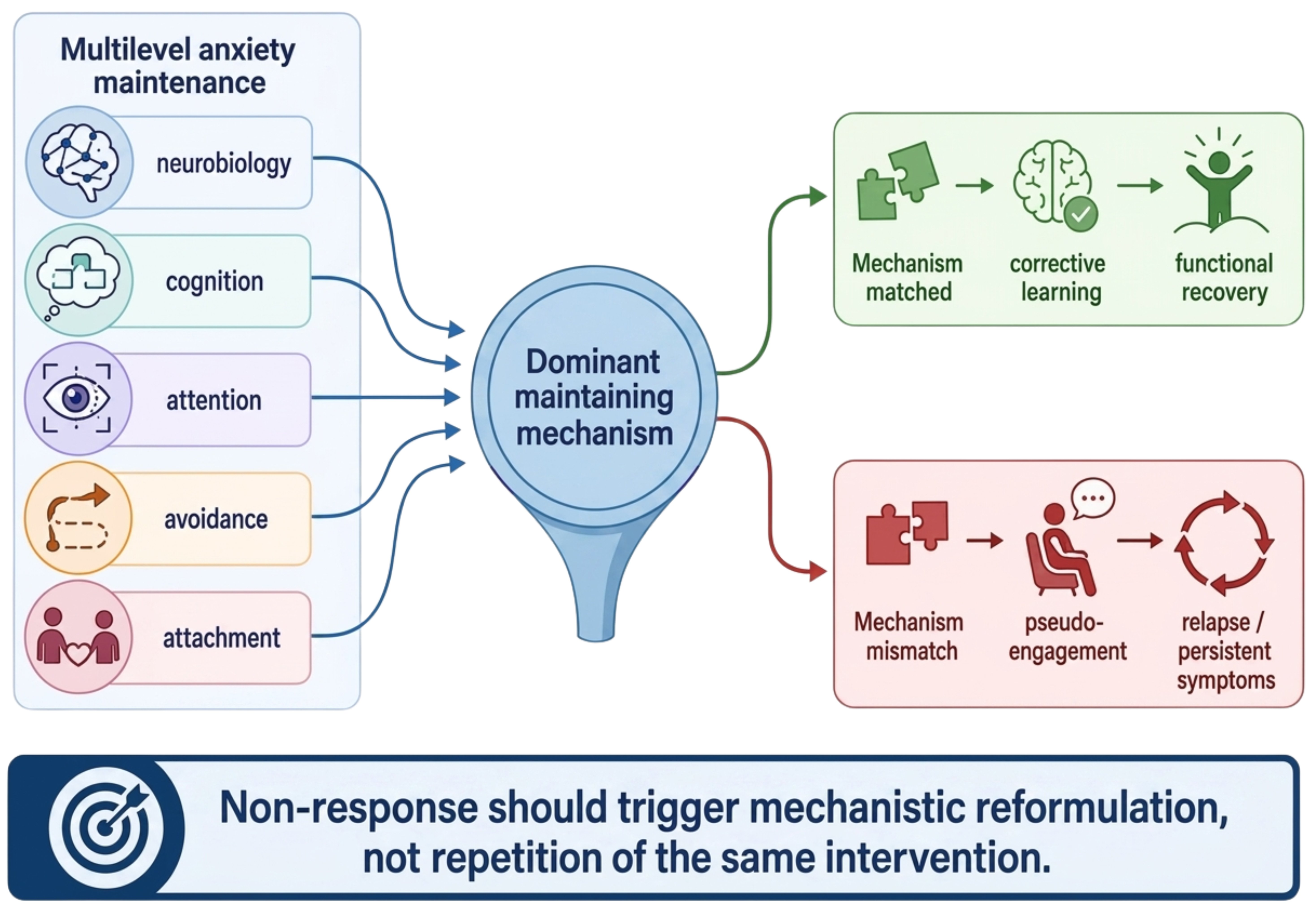
Anxiety disorders are disabling and treated with cognitive-behavioral or exposure-based psychotherapy. However, many patients remain symptomatic, fail to remit, relapse, or discontinue treatment. This narrative review examined whether psychotherapy non-response, defined here as persistent clinically significant anxiety symptoms, avoidance, or functional impairment after an apparently adequate psychotherapy trial, may reflect mismatch between therapeutic mechanisms and the dominant processes maintaining anxiety, and aimed to develop a usable taxonomy of mechanistic non-response. This structured narrative review followed SANRA principles. PubMed/MEDLINE, Scopus, PsycINFO, Web of Science, and the Cochrane Library were searched for peer-reviewed literature published from 1 January 2000 to 30 April 2026, including selected earlier landmark studies. Clinical, experimental, neurobiological, psychophysiological, process, and theoretical evidence were synthesized narratively. Psychotherapy mechanisms were organized around inhibitory learning, cognitive reappraisal, attentional modulation, emotion regulation, avoidance reversal, and interpersonal learning. Anxiety maintenance was multilevel, involving threat neurocircuitry, stress-related learning conditions, intolerance of uncertainty, attentional threat capture, safety behaviors, avoidance reinforcement, developmental adversity, and attachment insecurity. Non-response was framed as mismatch between the dominant maintaining process and the therapeutic mechanism expected to modify it. Six failure modes were identified: impaired inhibitory learning, cognitive rigidity/intolerance of uncertainty, stress-related learning impairment, attentional dysregulation, attachment-related barriers, and chronic avoidance dominance. Psychotherapy non-response in adult anxiety disorders should prompt mechanistic reformulation rather than repetition of the same intervention or labeling as treatment resistance. The taxonomy links recognizable failure signatures to mechanism-matched adaptations: redesigned exposure, uncertainty-focused work, attentional interventions, sequencing when arousal or sleep impairs learning, relational repair, and reduction in avoidance contingencies. The narrative review provides a concise clinical taxonomy and practical mechanism-matched adaptations to guide reformulation and treatment redesign after psychotherapy non-response in routine care. The taxonomy supports mechanism-matched reformulation after psychotherapy non-response and requires prospective validation.
Keywords: anxiety disorders; attachment; avoidance; cognitive-behavioral therapy; exposure therapy; inhibitory learning; neurobiology; precision psychiatry; psychotherapy; treatment matching; treatment resistance anxiety disorders; attachment; avoidance; cognitive-behavioral therapy; exposure therapy; inhibitory learning; neurobiology; precision psychiatry; psychotherapy; treatment matching; treatment resistance
Graphical Abstract