




Risk Factors for Postoperative Complications in Different Fusion Surgical Approaches for Lumbar Degenerative Diseases

Abstract
1. Introduction
2. Materials and Methods
2.1. Study Population
2.2. Data Collection
2.3. Surgical Technique
2.4. Statistical Analysis
3. Results
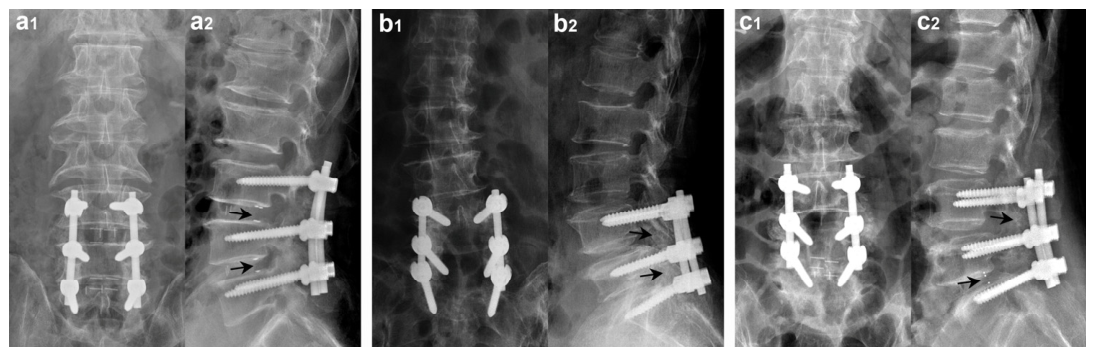
3.1. Distribution of Postoperative Complications
3.2. Comparison of Baseline Characteristics
3.3. Comparison of Clinical and Radiological Indicators
3.4. Comparison of Intraoperative Indicators
3.5. Comparison of Biological Markers and Clinical Outcome Scores
3.6. Multivariate Logistic Regression Analysis
4. Discussion
4.1. BMI as a Core Risk Factor for Postoperative Complications
4.2. Osteoporosis: A Critical Determinant of Fusion Stability
4.3. Pre-Existing Adjacent Disc Degeneration: A Predictor of ASD
4.4. Strengthening Radiological Assessment: Toward Dynamic Evaluation of Spinal Curvature
4.5. Surgical Parameters: Operative Time and Intraoperative Blood Loss
4.6. Fusion Versus Nonfusion Surgery: Indications and Rationality
4.7. Controversial Risk Factors: Age, Gender, and Inflammatory Biomarkers
4.8. Clinical Implications and Study Limitations
5. Conclusions
Supplementary Materials
Author Contributions
Funding
Institutional Review Board Statement
Informed Consent Statement
Data Availability Statement
Conflicts of Interest
References
- He, Z.; Zhou, K.; Tang, K.; Quan, Z.; Liu, S.; Su, B. Perioperative hypoalbuminemia is a risk factor for wound complications following posterior lumbar interbody fusion. J. Orthop. Surg. Res. 2020, 15, 538. [Google Scholar] [CrossRef] [PubMed]
- Ravindra, V.M.; Senglaub, S.S.; Rattani, A.; Dewan, M.C.; Härtl, R.; Bisson, E.; Park, K.B.; Shrime, M.G. Degenerative lumbar spine disease: Estimating global incidence and worldwide volume. Glob. Spine J. 2018, 8, 784–794. [Google Scholar] [CrossRef]
- Endler, P.; Ekman, P.; Möller, H.; Gerdhem, P. Outcomes of posterolateral fusion with and without instrumentation and of interbody fusion for isthmic spondylolisthesis: A prospective study. J. Bone Jt. Surg. Am. 2017, 99, 743–752. [Google Scholar] [CrossRef]
- Morse, K.W.; Sun, J.; Hu, L.; Bok, S.; Debnath, S.; Cung, M.; Yallowitz, A.R.; Meyers, K.N.; Iyer, S.; Greenblatt, M.B. Development of murine anterior interbody and posterolateral spinal fusion techniques. J. Bone Jt. Surg. Am. 2024, 106, 735–745. [Google Scholar] [CrossRef]
- Fenton-White, H.A. Trailblazing: The historical development of the posterior lumbar interbody fusion (plif). Spine J. 2021, 21, 1528–1541. [Google Scholar] [CrossRef] [PubMed]
- Lytle, E.J.; Lawless, M.H.; Paik, G.; Tong, D.; Soo, T.M. The minimally effective dose of bone morphogenetic protein in posterior lumbar interbody fusion: A systematic review and meta-analysis. Spine J. 2020, 20, 1286–1304. [Google Scholar] [CrossRef]
- Plantz, M.A.; Hsu, W.K. Single-level posterolateral fusion (plf) alone and posterior interbody fusion (plif/tlif) alone lead to a decreased risk of short-term complications compared to combined plf with plif/tlif procedures: A matched analysis. Spine 2020, 45, E1391–E1399. [Google Scholar] [CrossRef]
- Liu, X.; Qiu, G.; Weng, X.; Yu, B.; Wang, Y. What is the optimum fusion technique for adult spondylolisthesis-plif or plf or plif plus plf? A meta-analysis from 17 comparative studies. Spine 2014, 39, 1887–1898. [Google Scholar] [CrossRef]
- Baeesa, S.S.; Medrano, B.G.; Noriega, D.C. Long-term outcomes of posterior lumbar interbody fusion using stand-alone ray threaded cage for degenerative disk disease: A 20-year follow-up. Asian Spine J. 2016, 10, 1100–1105. [Google Scholar] [CrossRef] [PubMed]
- Wang, T.; Ding, W. Risk factors for adjacent segment degeneration after posterior lumbar fusion surgery in treatment for degenerative lumbar disorders: A meta-analysis. J. Orthop. Surg. Res. 2020, 15, 582. [Google Scholar] [CrossRef]
- Blumberg, T.J.; Woelber, E.; Bellabarba, C.; Bransford, R.; Spina, N. Predictors of increased cost and length of stay in the treatment of postoperative spine surgical site infection. Spine J. 2018, 18, 300–306. [Google Scholar] [CrossRef]
- Hoeller, S.; Roch, P.J.; Weiser, L.; Hubert, J.; Lehmann, W.; Saul, D. C-reactive protein in spinal surgery: More predictive than prehistoric. Eur. Spine J. 2021, 30, 1261–1269. [Google Scholar] [CrossRef]
- Wu, X.; Ma, X.; Zhu, J.; Chen, C. C-reactive protein to lymphocyte ratio as a new biomarker in predicting surgical site infection after posterior lumbar interbody fusion and instrumentation. Front. Surg. 2022, 9, 910222. [Google Scholar] [CrossRef]
- Aljabi, Y.; Manca, A.; Ryan, J.; Elshawarby, A. Value of procalcitonin as a marker of surgical site infection following spinal surgery. Surgeon 2019, 17, 97–101. [Google Scholar] [CrossRef]
- Pfirrmann, C.W.; Metzdorf, A.; Zanetti, M.; Hodler, J.; Boos, N. Magnetic resonance classification of lumbar intervertebral disc degeneration. Spine 2001, 26, 1873–1878. [Google Scholar] [CrossRef]
- Flandry, F.; Hunt, J.P.; Terry, G.C.; Hughston, J.C. Analysis of subjective knee complaints using visual analog scales. Am. J. Sports Med. 1991, 19, 112–118. [Google Scholar] [CrossRef]
- Fujiwara, A.; Kobayashi, N.; Saiki, K.; Kitagawa, T.; Tamai, K.; Saotome, K. Association of the japanese orthopaedic association score with the oswestry disability index, roland-morris disability questionnaire, and short-form 36. Spine 2003, 28, 1601–1607. [Google Scholar] [CrossRef]
- Ware, J.E.J.; Sherbourne, C.D. The mos 36-item short-form health survey (sf-36). I. Conceptual framework and item selection. Med. Care 1992, 30, 473–483. [Google Scholar] [CrossRef]
- Fairbank, J.C.; Pynsent, P.B. The oswestry disability index. Spine 2000, 25, 2940–2952. [Google Scholar] [CrossRef]
- Zhu, Z.; Xuan, A.; Xu, C.; Wang, C.; He, Q.; Tang, L.; Ruan, D. Comparison of clinical efficacy in the treatment of lumbar degenerative disease: Posterior lumbar interbody fusion, posterior lumbar fusion, and hybrid surgery. Int. J. Spine Surg. 2024, 18, 756–768. [Google Scholar] [CrossRef]
- Hou, Y.; Shi, H.; Shi, H.; Zhao, T.; Shi, J.; Shi, G. A meta-analysis of risk factors for cage migration after lumbar fusion surgery. World Neurosurg. X 2023, 18, 100152. [Google Scholar] [CrossRef]
- Luo, M.; Wang, D.; Shi, Y.; Yi, Q.; Wang, Z.; Zhou, B.; Yang, G.; Chen, J.; Liang, C.; Wang, H.; et al. Risk factors of postoperative delirium following spine surgery: A meta-analysis of 50 cohort studies with 1.1 million participants. Heliyon 2024, 10, e24967. [Google Scholar] [CrossRef]
- Zhang, X.; Liu, P.; You, J. Risk factors for surgical site infection following spinal surgery: A meta-analysis. Medicine 2022, 101, e28836. [Google Scholar] [CrossRef]
- Kimura, H.; Fujibayashi, S.; Otsuki, B.; Shimizu, T.; Murata, K.; Takemoto, M.; Odate, S.; Shikata, J.; Sakamoto, T.; Tsutsumi, R.; et al. Risk factors for cage migration following lateral lumbar interbody fusion combined with posterior instrumentation: A multicenter retrospective study of 983 cases. Spine 2023, 48, 1741–1748. [Google Scholar] [CrossRef]
- Wang, Q.; Gao, Z.; Guo, K.; Wang, F.; Wu, D. Effect of sagittal screw angle and distance of screw apex to superior endplate on adjacent segment disease after posterolateral lumbar fusion: A retrospective study. J. Orthop. Surg. Res. 2022, 17, 486. [Google Scholar] [CrossRef]
- Guan, J.; Liu, T.; Li, W.; Zhao, H.; Yang, K.; Li, C.; Feng, N.; Jiang, G.; Yang, Y.; Yu, X. Effects of posterior lumbar nonfusion surgery with isobar devices versus posterior lumbar interbody fusion surgery on clinical and radiological features in patients with lumbar degenerative diseases: A meta-analysis. J. Orthop. Surg. Res. 2022, 17, 116. [Google Scholar] [CrossRef]
- Chen, B.; Wei, F.; Ueyama, K.; Xie, D.; Sannohe, A.; Liu, S. Adjacent segment degeneration after single-segment PLIF: The risk factor for degeneration and its impact on clinical outcomes. Eur. Spine J. 2011, 20, 1946–1950. [Google Scholar] [CrossRef]
- Nakashima, H.; Kawakami, N.; Tsuji, T.; Ohara, T.; Suzuki, Y.; Saito, T.; Nohara, A.; Tauchi, R.; Ohta, K.; Hamajima, N.; et al. Adjacent segment disease after posterior lumbar interbody fusion: Based on cases with a minimum of 10 years of follow-up. Spine 2015, 40, E831–E841. [Google Scholar] [CrossRef]
- Miyagi, M.; Ikeda, O.; Ohtori, S.; Tsuneizumi, Y.; Someya, Y.; Shibayama, M.; Ogawa, Y.; Inoue, G.; Orita, S.; Eguchi, Y.; et al. Additional decompression at adjacent segments leads to adjacent segment degeneration after plif. Eur. Spine J. 2013, 22, 1877–1883. [Google Scholar] [CrossRef]
- Tian, H.; Wu, A.; Guo, M.; Zhang, K.; Chen, C.; Li, X.; Cheng, X.; Zhou, T.; Murray, S.S.; Sun, X.; et al. Adequate restoration of disc height and segmental lordosis by lumbar interbody fusion decreases adjacent segment degeneration. World Neurosurg. 2018, 118, e856–e864. [Google Scholar] [CrossRef]
- Osiński, K.; Bryndal, A.; Grochulska, A.; Nawos-Wysocki, W.; Glowinski, S. Assessment of lumbosacral spinal curvatures before and after surgery using 3d posturography. Sci. Rep. 2025, 15, 16126. [Google Scholar] [CrossRef]
- Fayaz, M.; Chibber, S.S.; Singh, K.D.; Tyngkam, L.; Hela, A.; Chaurasia, B. Unprecedented journey to 650 transpedicular screws using freehand technique and intraoperative c-arm imaging with technical nuances. J. Craniovertebr. Junction Spine 2024, 15, 326–330. [Google Scholar] [CrossRef]
- Ahsan, K.; Khan, S.I.; Zaman, N.; Ahmed, N.; Montemurro, N.; Chaurasia, B. Fusion versus nonfusion treatment for recurrent lumbar disc herniation. J. Craniovertebr. Junction Spine 2021, 12, 44–53. [Google Scholar] [CrossRef]
- Jang, H.; Lee, J.C.; Seo, J.; Roh, Y.; Choi, S.; Shin, B. Comparison of minimally invasive lateral lumbar interbody fusion, minimally invasive lateral lumbar interbody fusion, and open posterior lumbar interbody fusion in the treatment of single-level spondylolisthesis of l4-l5. World Neurosurg. 2022, 158, e10–e18. [Google Scholar] [CrossRef]
- Singla, A.; Qureshi, R.; Chen, D.Q.; Nourbakhsh, A.; Hassanzadeh, H.; Shimer, A.L.; Shen, F.H. Risk of surgical site infection and mortality following lumbar fusion surgery in patients with chronic steroid usage and chronic methicillin-resistant staphylococcus aureus infection. Spine 2019, 44, E408–E413. [Google Scholar] [CrossRef] [PubMed]
- Hou, Y.; Yuan, W. Influences of disc degeneration and bone mineral density on the structural properties of lumbar end plates. Spine J. 2012, 12, 249–256. [Google Scholar] [CrossRef] [PubMed]
- Murray, C.J.L.; Vos, T.; Lozano, R.; Naghavi, M.; Flaxman, A.D.; Michaud, C.; Ezzati, M.; Shibuya, K.; Salomon, J.A.; Abdalla, S.; et al. Disability-adjusted life years (dalys) for 291 diseases and injuries in 21 regions, 1990–2010: A systematic analysis for the global burden of disease study 2010. Lancet 2012, 380, 2197–2223. [Google Scholar] [CrossRef] [PubMed]

| Postoperative Complications | PLIF Group | PLF Group | Hybrid Group |
|---|---|---|---|
| Cage Migration | 15 | NA | 6 |
| ASD | 65 | 59 | 58 |
| Total | 80 | 59 | 64 |
| Indicators | PLIF Postoperative Normal Group, N = 80 | PLIF Postoperative Complication Group, N = 80 | Test Statistic | p-Value | PLF Postoperative Normal Group, N = 93 | PLF Postoperative Complication Group, N = 59 | Test Statistic | p-Value | Hybrid Postoperative Normal Group, N = 80 | Hybrid Postoperative Complication Group, N = 64 | Test Statistic | p-Value |
|---|---|---|---|---|---|---|---|---|---|---|---|---|
| Operation Time (min) | 219.0 ± 49.4 | 230.0 ± 45.2 | 3.19 | <0.01 * | 158.1 ± 34.68 | 176.1 ± 36.47 | 3.30 | <0.01 * | 180.3 ± 33.6 | 205.6 ± 40.5 | 4.424 | <0.01 * |
| Average Postoperative Drainage Volume (mL) | 387.4 ± 71.8 | 405.4 ± 85.9 | 0.33 | 0.73 | 319.2 ± 90.5 | 320.7 ± 95.5 | 0.09 | 0.92 | 290.1 ± 86.9 | 300.8 ± 91.6 | 1.921 | 0.057 |
| Intraoperative Blood Loss (mL) | 350.17 ± 85.7 | 399.17 ± 94.7 | 2.29 | 0.02 | 316.8 ± 86.8 | 351.1 ± 90.5 | 3.08 | <0.01 * | 370.75 ± 95.24 | 408.6 ± 89.2 | 4.414 | <0.01 * |
| Indicators | PLIF Postoperative Normal Group, N = 80 | PLIF Postoperative Complication Group, N = 80 | Test Statistic | p-Value | PLF Postoperative Normal Group, N = 93 | PLF Postoperative Complication Group, N = 59 | Test Statistic | p-Value | Hybrid Postoperative Normal Group, N = 80 | Hybrid Postoperative Complication Group, N = 64 | Test Statistic | p-Value |
|---|---|---|---|---|---|---|---|---|---|---|---|---|
| CLR | 1.81 ± 0.63 | 2.15 ± 0.71 | 7.24 | <0.01 * | 1.68 ± 0.78 | 2.09 ± 0.67 | 3.06 | <0.01 * | 1.77 ± 0.32 | 2.13 ± 0.38 | 6.362 | <0.01 * |
| PCT (ug/L) | 1.07 ± 0.23 | 1.17 ± 0.85 | 0.90 | 0.37 | 1.27 ± 0.63 | 1.36 ± 0.91 | 1.18 | 0.24 | 1.24 ± 0.53 | 1.16 ± 0.83 | 1.816 | 0.071 |
| SAA (mg/L) | 8.76 ± 2.23 | 9.15 ± 3.83 | 1.23 | 0.10 | 8.43 ± 2.63 | 9.34 ± 3.59 | 1.56 | 0.09 | 7.13 ± 3.54 | 8.56 ± 3.79 | 1.793 | 0.075 |
| Indicators | PLIF Postoperative Normal Group, N = 80 | PLIF Postoperative Complication Group, N = 80 | Test Statistic | p-Value | PLF Postoperative Normal Group, N = 93 | PLF Postoperative Complication Group, N = 59 | Test Statistic | p-Value | Hybrid Postoperative Normal Group, N = 80 | Hybrid Postoperative Complication Group, N = 64 | Test Statistic | p-Value |
|---|---|---|---|---|---|---|---|---|---|---|---|---|
| ODI | 65.39 ± 6.56 | 72.34 ± 4.64 | 7.68 | <0.01 * | 64.29 ± 4.56 | 71.34 ± 5.54 | 8.71 | <0.01 * | 62.29 ± 6.16 | 70.74 ± 4.84 | 10.864 | <0.05 |
| JOA Score | 13.42 ± 2.71 | 10.92 ± 2.45 | 5.98 | <0.01 * | 12.22 ± 2.71 | 9.32 ± 3.01 | 6.83 | <0.01 * | 13.29 ± 2.51 | 10.82 ± 2.55 | 4.792 | <0.05 |
| VAS Score | 4.72 ± 2.89 | 6.59 ± 2.37 | 6.21 | <0.01 * | 5.05 ± 2.79 | 6.92 ± 2.36 | 4.65 | <0.01 * | 4.87 ± 2.56 | 6.78 ± 2.47 | 6.342 | <0.05 |
| SF-36 Score | 23.03 ± 5.53 | 21.04 ± 5.17 | 4.85 | <0.01 * | 21.53 ± 4.53 | 22.04 ± 4.21 | 0.815 | 0.42 | 23.13 ± 5.43 | 21.54 ± 4.57 | 1.924 | 0.059 |
Disclaimer/Publisher’s Note: The statements, opinions and data contained in all publications are solely those of the individual author(s) and contributor(s) and not of MDPI and/or the editor(s). MDPI and/or the editor(s) disclaim responsibility for any injury to people or property resulting from any ideas, methods, instructions or products referred to in the content. |
© 2026 by the authors. Licensee MDPI, Basel, Switzerland. This article is an open access article distributed under the terms and conditions of the Creative Commons Attribution (CC BY) license.
Share and Cite
Zhu, Z.; Xuan, A.; Xu, C.; Wang, C.; He, Q.; Tang, L.; Ruan, D. Risk Factors for Postoperative Complications in Different Fusion Surgical Approaches for Lumbar Degenerative Diseases. J. Clin. Med. 2026, 15, 4195. https://doi.org/10.3390/jcm15114195
Zhu Z, Xuan A, Xu C, Wang C, He Q, Tang L, Ruan D. Risk Factors for Postoperative Complications in Different Fusion Surgical Approaches for Lumbar Degenerative Diseases. Journal of Clinical Medicine. 2026; 15(11):4195. https://doi.org/10.3390/jcm15114195
Chicago/Turabian StyleZhu, Zhenbiao, Anwu Xuan, Cheng Xu, Chaofeng Wang, Qing He, Liang Tang, and Dike Ruan. 2026. "Risk Factors for Postoperative Complications in Different Fusion Surgical Approaches for Lumbar Degenerative Diseases" Journal of Clinical Medicine 15, no. 11: 4195. https://doi.org/10.3390/jcm15114195
APA StyleZhu, Z., Xuan, A., Xu, C., Wang, C., He, Q., Tang, L., & Ruan, D. (2026). Risk Factors for Postoperative Complications in Different Fusion Surgical Approaches for Lumbar Degenerative Diseases. Journal of Clinical Medicine, 15(11), 4195. https://doi.org/10.3390/jcm15114195

