Disease Mechanisms and Therapeutic Advances in Idiopathic and Progressive Pulmonary Fibrosis: From Approved Drugs to Emerging Strategies

 , , ,
, , ,
Abstract
1. Introduction
2. Materials and Methods
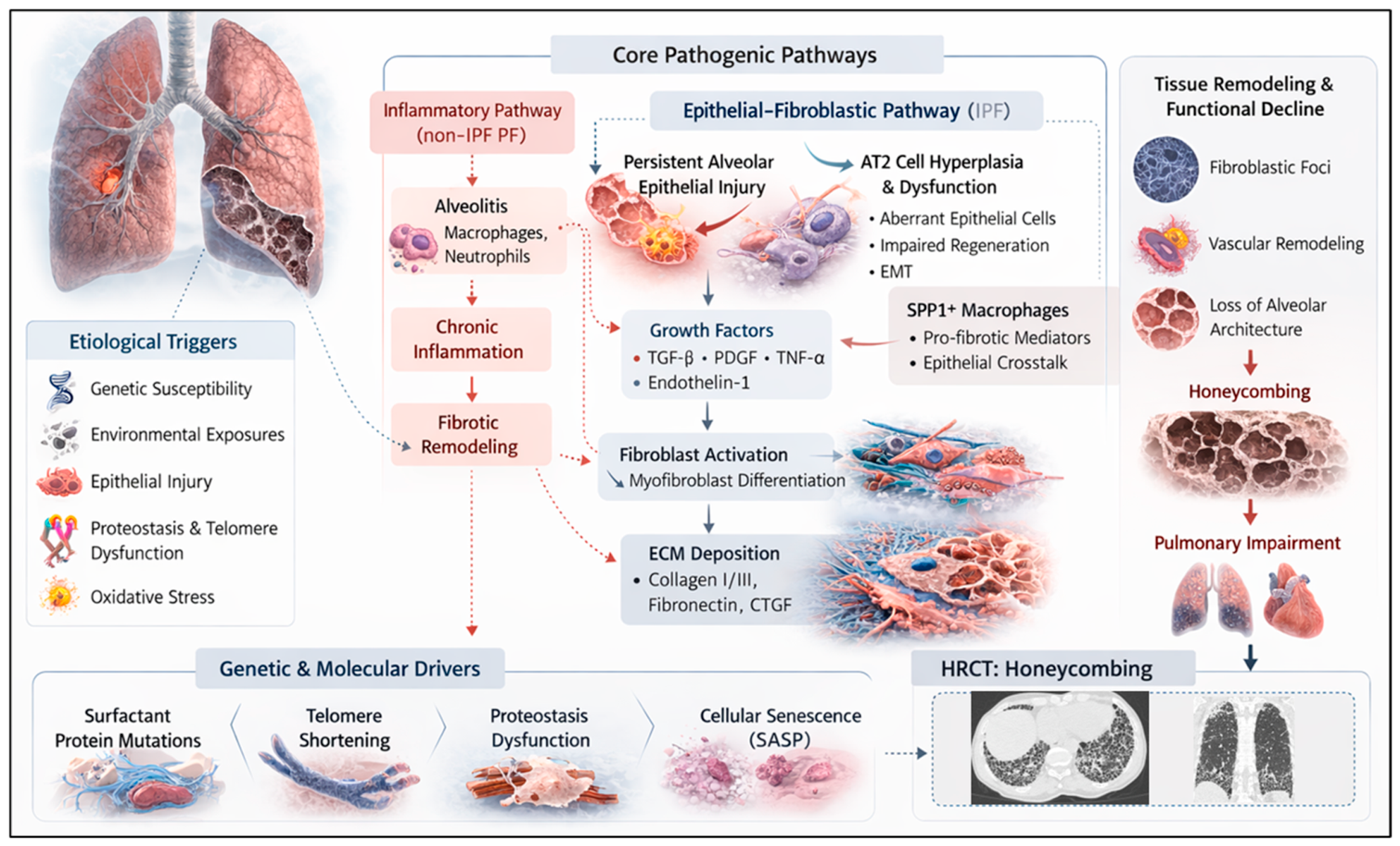
3. Pathophysiology of Pulmonary Fibrosis
3.1. Disease Heterogeneity Within the PPF Framework
3.2. Epithelial Injury, Immune Remodeling, and the Fibrotic Niche
3.3. Fibroblast Activation and Profibrotic Signaling
3.4. Genetic Susceptibility, Epithelial Vulnerability, and Cellular Senescence
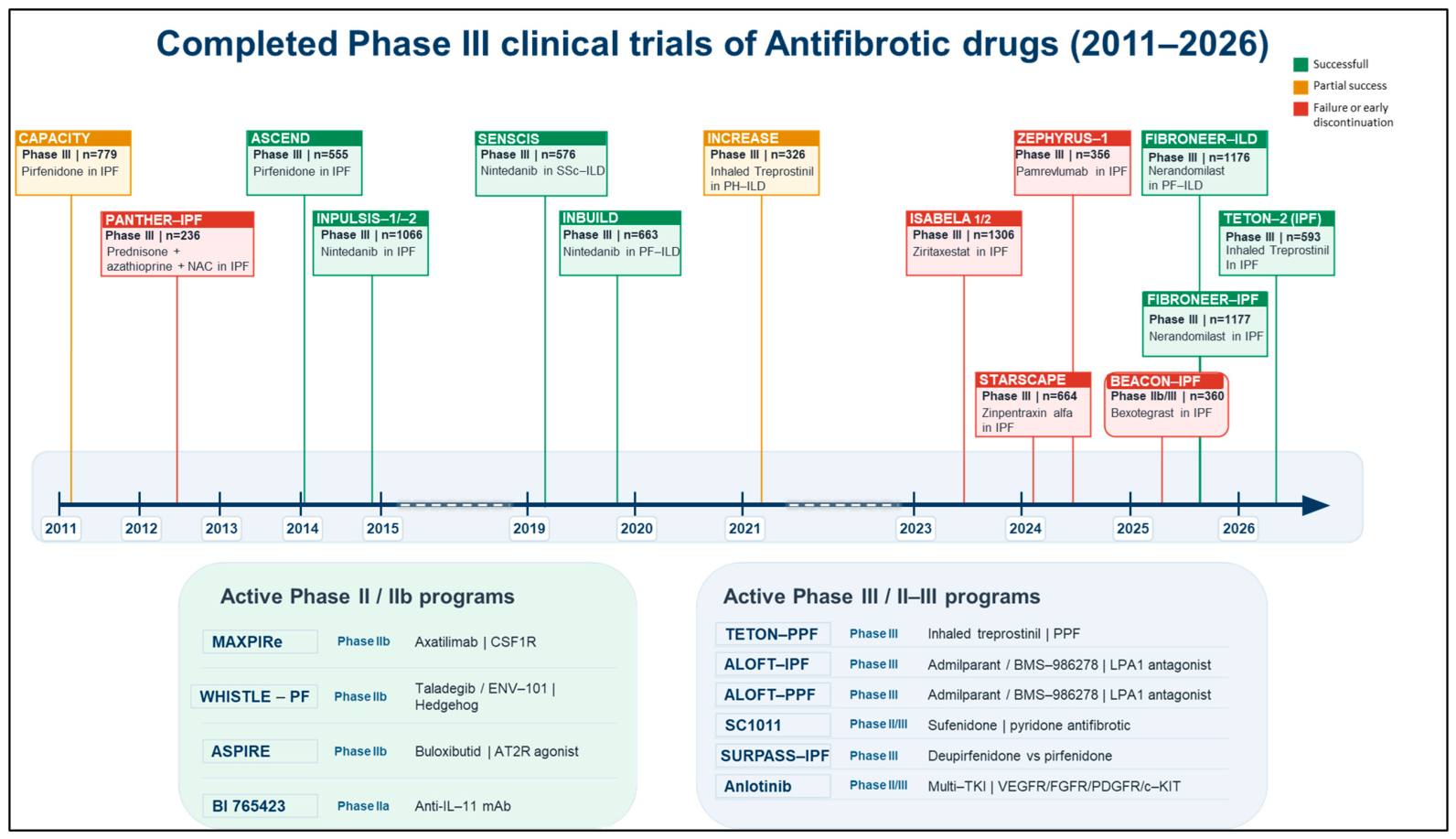
4. Pre-Antifibrotic Era: Historical Perspectives
5. Pharmacological Treatment for Idiopathic Pulmonary Fibrosis
5.1. Pirfenidone
5.2. Nintedanib
6. Antifibrotic Drugs Beyond Idiopathic Pulmonary Fibrosis
7. From Setbacks to Breakthrough: The Emergence of Nerandomilast in Antifibrotic Therapy
8. Pathway-Driven Emerging Therapies
8.1. Admilparant (BMS-986278)
8.2. Inhaled Treprostinil
8.3. Bexotegrast (PLN-74809)
8.4. Sufenidone (SC1011)
8.5. Deupirfenidone (LYT-100)
8.6. Anlotinib
9. Future Perspectives: From Genetic Stratification to Senescent Cell Clearance
10. Conclusions
Author Contributions
Funding
Institutional Review Board Statement
Informed Consent Statement
Data Availability Statement
Conflicts of Interest
References
- Wijsenbeek, M.; Cottin, V. Spectrum of Fibrotic Lung Diseases. N. Engl. J. Med. 2020, 383, 958–968. [Google Scholar] [CrossRef]
- Wijsenbeek, M.; Suzuki, A.; Maher, T.M. Interstitial Lung Diseases. Lancet 2022, 400, 769–786. [Google Scholar] [CrossRef]
- Maher, T.M. Interstitial Lung Disease: A Review. JAMA 2024, 331, 1655–1665. [Google Scholar] [CrossRef]
- Johannson, K.A.; Chaudhuri, N.; Adegunsoye, A.; Wolters, P.J. Treatment of Fibrotic Interstitial Lung Disease: Current Approaches and Future Directions. Lancet 2021, 398, 1450–1460. [Google Scholar] [CrossRef]
- Moss, B.J.; Ryter, S.W.; Rosas, I.O. Pathogenic Mechanisms Underlying Idiopathic Pulinary Fibrosis. Annu. Rev. Pathol. 2022, 17, 515–546. [Google Scholar] [CrossRef]
- Fernandez, I.E.; Eickelberg, O. New Cellular and Molecular Mechanisms of Lung Injury and Fibrosis in Idiopathic Pulmonary Fibrosis. Lancet 2012, 380, 680–688. [Google Scholar] [CrossRef]
- Lederer, D.J.; Martinez, F.J. Idiopathic Pulmonary Fibrosis. N. Engl. J. Med. 2018, 378, 1811–1823. [Google Scholar] [CrossRef]
- Richeldi, L.; Collard, H.R.; Jones, M.G. Idiopathic Pulmonary Fibrosis. Lancet 2017, 389, 1941–1952. [Google Scholar] [CrossRef] [PubMed]
- Raghu, G.; Remy-Jardin, M.; Richeldi, L. Idiopathic Pulmonary Fibrosis (An Update) and Progressive Pulmonary Fibrosis in Adults: An Official ATS/ERS/JRS/ALAT Clinical Practice Guideline. Am. J. Respir. Crit. Care Med. 2022, 205, e18–e47. [Google Scholar] [PubMed]
- Wang, J.; Chao, J. Epithelial Cell Dysfunction in Pulmonary Fibrosis: Mechanisms, Interactions, and Emerging Therapeutic Targets. Pharmaceuticals 2025, 18, 812. [Google Scholar] [CrossRef] [PubMed]
- Mutsaers, S.E.; Miles, T.; Prele, C.M.; Hoyne, G.F. Emerging Role of Immune Cells as Drivers of Pulmonary Fibrosis. Pharmacol. Ther. 2023, 252, 108562. [Google Scholar] [CrossRef] [PubMed]
- Hoffman, E.T.; Shah, A.; Barboza, W.R. Aberrant Intermediate Alveolar Epithelial Cells Promote Pathogenic Activation of Lung Fibroblasts in Preclinical Fibrosis Models. Nat. Commun. 2025, 16, 8710. [Google Scholar] [CrossRef] [PubMed]
- Morse, C.; Tabib, T.; Sembrat, J. Proliferating SPP1/MERTK-Expressing Macrophages in Idiopathic Pulmonary Fibrosis. Eur. Respir. J. 2019, 54, 1802441. [Google Scholar] [CrossRef] [PubMed]
- Kishore, A.; Petrek, M. Roles of Macrophage Polarization and Macrophage-Derived MiRNAs in Pulmonary Fibrosis. Front. Immunol. 2021, 12, 678457. [Google Scholar] [CrossRef]
- Ge, Z.; Chen, Y.; Ma, L.; Hu, F.; Xie, L. Macrophage Polarization and Its Impact on Idiopathic Pulmonary Fibrosis. Front. Immunol. 2024, 15, 1444964. [Google Scholar] [CrossRef]
- Isshiki, T.; Vierhout, M.; Naiel, S. Therapeutic Strategies Targeting Pro-Fibrotic Macrophages in Interstitial Lung Disease. Biochem. Pharmacol. 2023, 211, 115501. [Google Scholar] [CrossRef]
- Yang, X.; Liu, Z.; Zhou, J. SPP1 Promotes the Polarization of M2 Macrophages Through the Jak2/Stat3 Signaling Pathway and Accelerates the Progression of Idiopathic Pulmonary Fibrosis. Int. J. Mol. Med. 2024, 54, 89. [Google Scholar] [CrossRef]
- Hou, J.; Ji, J.; Chen, X. Alveolar Epithelial Cell-Derived Sonic Hedgehog Promotes Pulmonary Fibrosis Through OPN-Dependent Alternative Macrophage Activation. FEBS J. 2021, 288, 3530–3546. [Google Scholar] [CrossRef]
- Ji, J.; Zheng, S.; Liu, Y. Increased Expression of OPN Contributes to Idiopathic Pulmonary Fibrosis and Indicates a Poor Prognosis. J. Transl. Med. 2023, 21, 640. [Google Scholar] [CrossRef]
- Ligresti, G.; Raslan, A.A.; Hong, J. Mesenchymal Cells in the Lung: Evolving Concepts and Their Role in Fibrosis. Gene 2023, 859, 147142. [Google Scholar] [CrossRef]
- Yao, L.; Zhou, Y.; Li, J. Bidirectional Epithelial-Mesenchymal Crosstalk Provides Self-Sustaining Profibrotic Signals in Pulmonary Fibrosis. J. Biol. Chem. 2021, 297, 101096. [Google Scholar] [CrossRef] [PubMed]
- Younesi, F.S.; Miller, A.E.; Barker, T.H.; Rossi, F.M.V.; Hinz, B. Fibroblast and Myofibroblast Activation in Normal Tissue Repair and Fibrosis. Nat. Rev. Mol. Cell Biol. 2024, 25, 617–638. [Google Scholar] [CrossRef]
- Yamaguchi, M.; Hirai, S.; Tanaka, Y. Fibroblastic Foci, Covered with Alveolar Epithelia Exhibiting Epithelial-Mesenchymal Transition, Destroy Alveolar Septa by Disrupting Blood Flow in Idiopathic Pulmonary Fibrosis. Lab. Investig. 2017, 97, 232–242. [Google Scholar] [CrossRef]
- Singh, P.; Edjah, S.; Shi, W.; Madala, S. Emerging Concepts in Fibroblast Biology and Progressive Pulmonary Fibrosis. Semin. Respir. Crit. Care Med. 2025, 46, 322–329. [Google Scholar] [CrossRef]
- Herrera, J.A.; Dingle, L.; Montero, M.A. The UIP/IPF Fibroblastic Focus Is a Collagen Biosynthesis Factory Embedded in a Distinct Extracellular Matrix. JCI Insight 2022, 7, e156115. [Google Scholar] [CrossRef]
- Guillotin, D.; Taylor, A.R.; Plate, M. Transcriptome Analysis of IPF Fibroblastic Foci Identifies Key Pathways Involved in Fibrogenesis. Thorax 2021, 76, 73–82. [Google Scholar] [CrossRef]
- Gupta, D.; Kumar, A.; Mandloi, A.; Shenoy, V. Renin Angiotensin Aldosterone System in Pulmonary Fibrosis: Pathogenesis to Therapeutic Possibilities. Pharmacol. Res. 2021, 174, 105924. [Google Scholar] [CrossRef]
- Yao, C.; Guan, X.; Carraro, G. Senescence of Alveolar Type 2 Cells Drives Progressive Pulmonary Fibrosis. Am. J. Respir. Crit. Care Med. 2021, 203, 707–717. [Google Scholar] [CrossRef] [PubMed]
- Enomoto, Y.; Katsura, H.; Fujimura, T. Autocrine TGF-β-Positive Feedback in Profibrotic AT2-Lineage Cells Plays a Crucial Role in Non-Inflammatory Lung Fibrogenesis. Nat. Commun. 2023, 14, 4956. [Google Scholar] [CrossRef] [PubMed]
- Craig, V.J.; Zhang, L.; Hagood, J.S.; Owen, C.A. Matrix Metalloproteinases as Therapeutic Targets for Idiopathic Pulmonary Fibrosis. Am. J. Respir. Cell Mol. Biol. 2015, 53, 585–600. [Google Scholar] [CrossRef]
- Frangogiannis, N. Transforming Growth Factor-βin Tissue Fibrosis. J. Exp. Med. 2020, 217, e20190103. [Google Scholar] [CrossRef]
- Noskovicova, N.; Petrek, M.; Eickelberg, O.; Heinzelmann, K. Platelet-Derived Growth Factor Signaling in the Lung: From Lung Development and Disease to Clinical Studies. Am. J. Respir. Cell Mol. Biol. 2015, 52, 263–284. [Google Scholar] [CrossRef]
- Wermuth, P.J.; Li, Z.; Mendoza, F.A.; Jimenez, S.A. Stimulation of Transforming Growth Factor-β1-Induced Endothelial-to-Mesenchymal Transition and Tissue Fibrosis by Endothelin-1. PLoS ONE 2016, 11, e0161988. [Google Scholar] [CrossRef]
- Ross, B.; D’Orleans-Juste, P.; Giaid, A. Potential Role of Endothelin-1 in Pulmonary Fibrosis: From the Bench to the Clinic. Am. J. Respir. Cell Mol. Biol. 2010, 42, 16–20. [Google Scholar] [CrossRef]
- Chen, F.; Lyu, L.; Xing, C. The Pivotal Role of TGF-β/Smad Pathway in Fibrosis Pathogenesis and Treatment. Front. Oncol. 2025, 15, 1649179. [Google Scholar] [CrossRef] [PubMed]
- Ong, C.H.; Tham, C.L.; Harith, H.H.; Firdaus, N.; Israf, D.A. TGF-β-Induced Fibrosis: A Review on the Underlying Mechanism and Potential Therapeutic Strategies. Eur. J. Pharmacol. 2021, 911, 174510. [Google Scholar] [CrossRef] [PubMed]
- Antoniades, H.N.; Bravo, M.A.; Avila, R.E. Platelet-Derived Growth Factor in Idiopathic Pulmonary Fibrosis. J. Clin. Investig. 1990, 86, 1055–1064. [Google Scholar] [CrossRef]
- Bozyk, P.D.; Moore, B.B. Prostaglandin E2 and the Pathogenesis of Pulmonary Fibrosis. Am. J. Respir. Cell Mol. Biol. 2011, 45, 445–452. [Google Scholar] [CrossRef] [PubMed]
- Mukherjee, S.; Sheng, W.; Michkov, A. Prostaglandin E Inhibits Profibrotic Function of Human Pulmonary Fibroblasts by Disrupting Ca Signaling. Am. J. Physiol. Lung Cell. Mol. Physiol. 2019, 316, L810–L821. [Google Scholar] [CrossRef]
- Isshiki, T.; Naiel, S.; Vierhout, M. Therapeutic Strategies to Target Connective Tissue Growth Factor in Fibrotic Lung Diseases. Pharmacol. Ther. 2024, 253, 108578. [Google Scholar] [CrossRef]
- Yanagihara, T.; Tsubouchi, K.; Gholiof, M. Connective-Tissue Growth Factor Contributes to TGF-β1-Induced Lung Fibrosis. Am. J. Respir. Cell Mol. Biol. 2022, 66, 260–270. [Google Scholar] [CrossRef] [PubMed]
- Yang, J.; Velikoff, M.; Canalis, E.; Horowitz, J.C.; Kim, K.K. Activated Alveolar Epithelial Cells Initiate Fibrosis Through Autocrine and Paracrine Secretion of Connective Tissue Growth Factor. Am. J. Physiol. Lung Cell. Mol. Physiol. 2014, 306, L786–L796. [Google Scholar] [CrossRef] [PubMed]
- Barratt, S.L.; Blythe, T.; Jarrett, C. Differential Expression of VEGF-Axxx Isoforms Is Critical for Development of Pulmonary Fibrosis. Am. J. Respir. Crit. Care Med. 2017, 196, 479–493. [Google Scholar] [CrossRef]
- Farkas, L.; Farkas, D.; Ask, K. VEGF Ameliorates Pulmonary Hypertension Through Inhibition of Endothelial Apoptosis in Experimental Lung Fibrosis in Rats. J. Clin. Investig. 2009, 119, 1298–1311. [Google Scholar] [CrossRef] [PubMed]
- Andrianifahanana, M.; Wilkes, M.C.; Gupta, S.K. Profibrotic TGF-β Responses Require the Cooperative Action of PDGF and ErbB Receptor Tyrosine Kinases. FASEB J. 2013, 27, 4444–4454. [Google Scholar] [CrossRef]
- Gu, H.; Mickler, E.A.; Cummings, O.W. Crosstalk Between TGF-β1 and Complement Activation Augments Epithelial Injury in Pulmonary Fibrosis. FASEB J. 2014, 28, 4223–4234. [Google Scholar] [CrossRef]
- Oikonomou, N.; Mouratis, M.-A.; Tzouvelekis, A. Pulmonary Autotaxin Expression Contributes to the Pathogenesis of Pulmonary Fibrosis. Am. J. Respir. Cell Mol. Biol. 2012, 47, 566–574. [Google Scholar] [CrossRef]
- Tager, A.M.; LaCamera, P.; Shea, B.S. The Lysophosphatidic Acid Receptor LPA1 Links Pulmonary Fibrosis to Lung Injury by Mediating Fibroblast Recruitment and Vascular Leak. Nat. Med. 2008, 14, 45–54. [Google Scholar] [CrossRef]
- Neighbors, M.; Li, Q.; Zhu, S.J. Bioactive Lipid Lysophosphatidic Acid Species Are Associated with Disease Progression in Idiopathic Pulmonary Fibrosis. J. Lipid Res. 2023, 64, 100375. [Google Scholar] [CrossRef]
- Alder, J.K.; Armanios, M. Telomere-Mediated Lung Disease. Physiol. Rev. 2022, 102, 1703–1720. [Google Scholar] [CrossRef]
- Adegunsoye, A.; Kropski, J.A.; Behr, J. Genetics and Genomics of Pulmonary Fibrosis: Charting the Molecular Landscape and Shaping Precision Medicine. Am. J. Respir. Crit. Care Med. 2024, 210, 401–423. [Google Scholar] [CrossRef]
- Newton, C.A.; Oldham, J.M.; Applegate, C. The Role of Genetic Testing in Pulmonary Fibrosis: A Perspective from the Pulmonary Fibrosis Foundation Genetic Testing Work Group. Chest 2022, 162, 394–405. [Google Scholar] [CrossRef]
- Moore, C.; Blumhagen, R.Z.; Yang, I. V Resequencing Study Confirms That Host Defense and Cell Senescence Gene Variants Contribute to the Risk of Idiopathic Pulmonary Fibrosis. Am. J. Respir. Crit. Care Med. 2019, 200, 199–208. [Google Scholar] [CrossRef]
- Juge, P.A.; Lee, J.S.; Ebstein, E. MUC5B Promoter Variant and Rheumatoid Arthritis with Interstitial Lung Disease. N. Engl. J. Med. 2018, 379, 2209–2219. [Google Scholar] [CrossRef]
- Barnes, P.J.; Baker, J.; Donnelly, L.E. Cellular Senescence as a Mechanism and Target in Chronic Lung Diseases. Am. J. Respir. Crit. Care Med. 2019, 200, 556–564. [Google Scholar] [CrossRef] [PubMed]
- Katzen, J.; Beers, M.F. Contributions of Alveolar Epithelial Cell Quality Control to Pulmonary Fibrosis. J. Clin. Investig. 2020, 130, 5088–5099. [Google Scholar] [CrossRef] [PubMed]
- Lee, J.S.; La, J.; Aziz, S. Molecular Markers of Telomere Dysfunction and Senescence Are Common Findings in the Usual Interstitial Pneumonia Pattern of Lung Fibrosis. Histopathology 2021, 79, 67–76. [Google Scholar] [CrossRef] [PubMed]
- Wang, X.C.; Song, K.; Tu, B. New Aspects of the Epigenetic Regulation of EMT Related to Pulmonary Fibrosis. Eur. J. Pharmacol. 2023, 956, 175959. [Google Scholar] [CrossRef]
- Idiopathic Pulmonary Fibrosis Clinical Research Network; Raghu, G.; Anstrom, K.J.; King, T.E., Jr.; Lasky, J.A.; Martinez, F.J. Prednisone, Azathioprine, and N-Acetylcysteine for Pulmonary Fibrosis. N. Engl. J. Med. 2012, 366, 1968–1977. [Google Scholar]
- Noble, P.W.; Albera, C.; Bradford, W.Z.; Costabel, U.; Glassberg, M.K.; Kardatzke, D.; King, T.E., Jr.; Lancaster, L.; Sahn, S.A.; Szwarcberg, J.; et al. Pirfenidone in Patients with Idiopathic Pulmonary Fibrosis (CAPACITY): Two Randomised Trials. Lancet 2011, 377, 1760–1769. [Google Scholar] [CrossRef]
- King, T.E., Jr.; Bradford, W.Z.; Castro-Bernardini, S.; Fagan, E.A.; Glaspole, I.; Glassberg, M.K.; Gorina, E.; Hopkins, P.M.; Kardatzke, D.; Lancaster, L.; et al. A Phase 3 Trial of Pirfenidone in Patients with Idiopathic Pulmonary Fibrosis. N. Engl. J. Med. 2014, 370, 2083–2092. [Google Scholar] [CrossRef]
- Richeldi, L.; du Bois, R.M.; Raghu, G.; Azuma, A.; Brown, K.K.; Costabel, U.; Cottin, V.; Flaherty, K.R.; Hansell, D.M.; Inoue, Y.; et al. Efficacy and Safety of Nintedanib in Idiopathic Pulmonary Fibrosis. N. Engl. J. Med. 2014, 370, 2071–2082. [Google Scholar] [CrossRef] [PubMed]
- Chianese, M.; Screm, G.; Salton, F. Pirfenidone and Nintedanib in Pulmonary Fibrosis: Lights and Shadows. Pharmaceuticals 2024, 17, 709. [Google Scholar] [CrossRef] [PubMed]
- Distler, O.; Highland, K.B.; Gahlemann, M. Nintedanib for Systemic Sclerosis-Associated Interstitial Lung Disease. N. Engl. J. Med. 2019, 380, 2518–2528. [Google Scholar] [CrossRef] [PubMed]
- Highland, K.B.; Distler, O.; Kuwana, M. Efficacy and Safety of Nintedanib in Patients with Systemic Sclerosis-Associated Interstitial Lung Disease Treated with Mycophenolate: A Subgroup Analysis of the SENSCIS Trial. Lancet Respir. Med. 2021, 9, 96–106. [Google Scholar] [CrossRef]
- Allanore, Y.; Vonk, M.C.; Distler, O. Continued Treatment with Nintedanib in Patients with Systemic Sclerosis-Associated Interstitial Lung Disease: Data from SENSCIS-ON. Ann. Rheum. Dis. 2022, 81, 1722–1729. [Google Scholar] [CrossRef]
- Flaherty, K.R.; Wells, A.U.; Cottin, V.; Devaraj, A.; Walsh, S.L.F.; Inoue, Y.; Richeldi, L.; Kolb, M.; Tetzlaff, K.; Stowasser, S.; et al. Nintedanib in Progressive Fibrosing Interstitial Lung Diseases. N. Engl. J. Med. 2019, 381, 1718–1727. [Google Scholar] [CrossRef]
- Dixon, G.; Hague, S.; Mulholland, S. Real-World Experience of Nintedanib for Progressive Fibrosing Interstitial Lung Disease in the UK. ERJ Open Res. 2024, 10, 529–2023. [Google Scholar] [CrossRef]
- Mondoni, M.; Varone, F.; Luppi, F. Effectiveness of Nintedanib in Progressive Pulmonary Fibrosis Assessed by Progression Criteria: An Italian, Observational, Multicenter Study. Lung 2025, 203, 1–9. [Google Scholar] [CrossRef]
- Muscato, G.; Libra, A.; Reina, C. Nintedanib for Progressive Pulmonary Fibrosis in Real-World Setting: An Observational Study Comparing Outcomes with an IPF Cohort. BMC Pulm. Med. 2026, 26, 73. [Google Scholar] [CrossRef]
- Behr, J.; Prasse, A.; Kreuter, M. Pirfenidone in Patients with Progressive Fibrotic Interstitial Lung Diseases Other Than Idiopathic Pulmonary Fibrosis (RELIEF): A Double-Blind, Randomised, Placebo-Controlled, Phase 2b Trial. Lancet Respir. Med. 2021, 9, 476–486. [Google Scholar] [CrossRef]
- Solomon, J.J.; Danoff, S.K.; Woodhead, F.A. Safety, Tolerability, and Efficacy of Pirfenidone in Patients with Rheumatoid Arthritis-Associated Interstitial Lung Disease: A Randomized, Double-Blind, Placebo-Controlled, Phase 2 Study. Lancet Respir. Med. 2023, 11, 87–96. [Google Scholar] [CrossRef] [PubMed]
- Juge, P.A.; Hayashi, K.; McDermott, G.C. Effectiveness and Tolerability of Antifibrotics in Rheumatoid Arthritis-Associated Interstitial Lung Disease. Semin. Arthritis Rheum. 2024, 64, 152312. [Google Scholar] [CrossRef]
- Liang, M.; Matteson, E.L.; Abril, A.; Distler, J.H.W. The Role of Antifibrotics in the Treatment of Rheumatoid Arthritis-Associated Interstitial Lung Disease. Ther. Adv. Musculoskelet. Dis. 2022, 14, 1759720X221074457. [Google Scholar] [CrossRef]
- Johnson, S.R.; Bernstein, E.J.; Bolster, M.B. 2023 American College of Rheumatology (ACR)/American College of Chest Physicians (CHEST) Guideline for the Treatment of Interstitial Lung Disease in People with Systemic Autoimmune Rheumatic Diseases. Arthritis Care Res. 2024, 76, 1051–1069. [Google Scholar] [CrossRef]
- Raghu, G.; Montesi, S.B.; Silver, R.M. Treatment of Systemic Sclerosis-Associated Interstitial Lung Disease: Evidence-Based Recommendations. An Official American Thoracic Society Clinical Practice Guideline. Am. J. Respir. Crit. Care Med. 2024, 209, 137–152. [Google Scholar] [CrossRef]
- Antoniou, K.M.; Distler, O.; Gheorghiu, A.M. ERS/EULAR Clinical Practice Guidelines for Connective Tissue Disease-Associated Interstitial Lung Disease. Eur. Respir. J. 2026, 67, 2402533. [Google Scholar] [CrossRef]
- Spagnolo, P.; Maher, T.M. The Future of Clinical Trials in Idiopathic Pulmonary Fibrosis. Curr. Opin. Pulm. Med. 2024, 30, 494–499. [Google Scholar] [CrossRef] [PubMed]
- Maher, T.M.; Ford, P.; Brown, K.K. Ziritaxestat, a Novel Autotaxin Inhibitor, and Lung Function in Idiopathic Pulmonary Fibrosis: The ISABELA 1 and 2 Randomized Clinical Trials. JAMA 2023, 329, 1567–1578. [Google Scholar] [CrossRef] [PubMed]
- Richeldi, L.; Schiffman, C.; Behr, J. Zinpentraxin Alfa for Idiopathic Pulmonary Fibrosis: The Randomized Phase III STARSCAPE Trial. Am. J. Respir. Crit. Care Med. 2024, 209, 1132–1140. [Google Scholar] [CrossRef]
- Raghu, G.; Richeldi, L.; Fernandez Perez, E.R. Pamrevlumab for Idiopathic Pulmonary Fibrosis: The ZEPHYRUS-1 Randomized Clinical Trial. JAMA 2024, 332, 380–389. [Google Scholar] [CrossRef]
- Richeldi, L.; Azuma, A.; Cottin, V. Nerandomilast in Patients with Idiopathic Pulmonary Fibrosis. N. Engl. J. Med. 2025, 392, 2193–2202. [Google Scholar] [CrossRef]
- Maher, T.M.; Assassi, S.; Azuma, A. Nerandomilast in Patients with Progressive Pulmonary Fibrosis. N. Engl. J. Med. 2025, 392, 2203–2214. [Google Scholar] [CrossRef]
- Richeldi, L.; Azuma, A.; Cottin, V. Trial of a Preferential Phosphodiesterase 4B Inhibitor for Idiopathic Pulmonary Fibrosis. N. Engl. J. Med. 2022, 386, 2178–2187. [Google Scholar] [CrossRef]
- Kolb, M.; Crestani, B.; Maher, T.M. Phosphodiesterase 4B Inhibition: A Potential Novel Strategy for Treating Pulmonary Fibrosis. Eur. Respir. Rev. 2023, 32, 220206. [Google Scholar] [CrossRef]
- Oldham, J.M.; Azuma, A.; Kreuter, M. Nerandomilast in Idiopathic Pulmonary Fibrosis: Data from the Whole Follow-Up Period of the FIBRONEER-IPF Trial. Am. J. Respir. Crit. Care Med. 2026, 212, 972–980. [Google Scholar] [CrossRef]
- Reininger, D.; Wolf, F.; Mayr, C.H. Insights into the Cellular and Molecular Mechanisms Behind the Antifibrotic Effects of Nerandomilast. Am. J. Respir. Cell Mol. Biol. 2025, 73, 700–712. [Google Scholar] [CrossRef]
- Peters-Golden, M.; Fortier, S.M. Mechanistic Basis for the Antifibrotic Actions of CAMP-Based Therapies. Eur. Respir. Rev. 2026, 35, 250265. [Google Scholar] [CrossRef]
- Mondoni, M.; Rinaldo, R.; Ryerson, C.J. Vascular Involvement in Idiopathic Pulmonary Fibrosis. ERJ Open Res. 2024, 10, 550–2024. [Google Scholar] [CrossRef]
- Tirelli, C.; Pesenti, C.; Miozzo, M.; Mondoni, M.; Fontana, L.; Centanni, S. The Genetic and Epigenetic Footprint in Idiopathic Pulmonary Fibrosis and Familial Pulmonary Fibrosis: A State-of-the-Art Review. Diagnostics 2022, 12, 3107. [Google Scholar] [CrossRef]
- Denis, A.; Tsiri, P.; Guiot, J.; Tzouvelekis, A. A New Era in the Treatment of Progressive Fibrosing Interstitial Lung Diseases. Breathe 2025, 21, 240259. [Google Scholar] [CrossRef]
- Corte, T.J.; Behr, J.; Cottin, V. Efficacy and Safety of Admilparant, an LPA1 Antagonist, in Pulmonary Fibrosis: A Phase 2 Randomized Clinical Trial. Am. J. Respir. Crit. Care Med. 2025, 211, 230–238. [Google Scholar] [CrossRef]
- Kreuter, M.; Maher, T.M.; Wuyts, W.A. Effect of Admilparant, a Lysophosphatidic Acid Receptor 1 Antagonist, on Disease Progression in Pulmonary Fibrosis. Chest 2025, 168, 677–687. [Google Scholar] [CrossRef]
- Lindegaard Pedersen, M.; Kruger, M.; Grimm, D.; Infanger, M.; Wehland, M. The Prostacyclin Analogue Treprostinil in the Treatment of Pulmonary Arterial Hypertension. Basic Clin. Pharmacol. Toxicol. 2020, 126, 32–42. [Google Scholar] [CrossRef]
- Waxman, A.; Restrepo-Jaramillo, R.; Thenappan, T. Inhaled Treprostinil in Pulmonary Hypertension Due to Interstitial Lung Disease. N. Engl. J. Med. 2021, 384, 325–334. [Google Scholar] [CrossRef]
- Nathan, S.D.; Waxman, A.; Rajagopal, S. Inhaled Treprostinil and Forced Vital Capacity in Patients with Interstitial Lung Disease and Associated Pulmonary Hypertension: A Post-Hoc Analysis of the INCREASE Study. Lancet Respir. Med. 2021, 9, 1266–1274. [Google Scholar] [CrossRef]
- Nathan, S.D.; Johri, S.; Joly, J.M. Survival Analysis from the INCREASE Study in PH-ILD: Evaluating the Impact of Treatment Crossover on Overall Mortality. Thorax 2024, 79, 301–306. [Google Scholar] [CrossRef]
- Waxman, A.; Restrepo-Jaramillo, R.; Thenappan, T. Long-Term Inhaled Treprostinil for Pulmonary Hypertension Due to Interstitial Lung Disease: INCREASE Open-Label Extension Study. Eur. Respir. J. 2023, 61, 2202414. [Google Scholar] [CrossRef]
- Nathan, S.D.; Smith, P.; Deng, C.; De Salvo, M.; Wuyts, W.; Pavie-Gallegos, J.; Song, J.W.; Kramer, M.R.; King, C.S.; Mackintosh, J.A.; et al. Inhaled Treprostinil for Idiopathic Pulmonary Fibrosis. N. Engl. J. Med. 2026. Online ahead of print. [Google Scholar] [CrossRef]
- Decaris, M.L.; Schaub, J.R.; Chen, C. Dual Inhibition of αvβ6 and αvβ1 Reduces Fibrogenesis in Lung Tissue Explants from Patients with IPF. Respir. Res. 2021, 22, 265. [Google Scholar] [CrossRef]
- Lancaster, L.; Cottin, V.; Ramaswamy, M. Bexotegrast in Patients with Idiopathic Pulmonary Fibrosis: The INTEGRIS-IPF Clinical Trial. Am. J. Respir. Crit. Care Med. 2024, 210, 424–434. [Google Scholar] [CrossRef]
- Montesi, S.B.; Cosgrove, G.P.; Turner, S.M. Dual αvβ6 and αvβ1 Inhibition over 12 Weeks Reduces Active Type I Collagen Deposition in Individuals with Idiopathic Pulmonary Fibrosis: A Phase 2, Double-Blind, Placebo-Controlled Clinical Trial. Am. J. Respir. Crit. Care Med. 2025, 211, 1229–1240. [Google Scholar] [CrossRef]
- Mooney, J.J.; Jacobs, S.; Lefebvre, E.A. Bexotegrast Shows Dose-Dependent Integrin αvβ6 Receptor Occupancy in Lungs of Participants with Idiopathic Pulmonary Fibrosis: A Phase 2, Open-Label Clinical Trial. Ann. Am. Thorac. Soc. 2025, 22, 350–358. [Google Scholar] [CrossRef]
- Wuyts, W.A.; Lancaster, L.; Maher, T.M. Bexotegrast for Treatment of Idiopathic Pulmonary Fibrosis (BEACON-IPF): Study Protocol for a Multinational, Phase 2b/3, Double-Blind, Randomised, Multicentre, Controlled Trial. BMJ Open Respir. Res. 2026, 13, e002937. [Google Scholar] [CrossRef]
- Liu, Y.; Chen, X.; Tang, H. Safety, Tolerability, and Pharmacokinetics of SC1011 (Sufenidone), a Novel Antifibrotic Small Molecule, in Phase 1 Studies in Healthy Subjects. Clin. Transl. Sci. 2025, 18, e70179. [Google Scholar] [CrossRef]
- Chen, M.C.; Korth, C.C.; Harnett, M.D.; Elenko, E.; Lickliter, J.D. A Randomized Phase 1 Evaluation of Deupirfenidone, a Novel Deuterium-Containing Drug Candidate for Interstitial Lung Disease and Other Inflammatory and Fibrotic Diseases. Clin. Pharmacol. Drug Dev. 2022, 11, 220–234. [Google Scholar] [CrossRef]
- Maher, T.M.; Bergna, M.A.; Hajari Case, A. Deupirfenidone Compared to Placebo and Pirfenidone in Idiopathic Pulmonary Fibrosis: ELEVATE IPF Phase 2b Trial. Am. J. Respir. Crit. Care Med. 2025, 211, A7046. [Google Scholar] [CrossRef]
- Alonso-Gonzalez, A.; Tosco-Herrera, E.; Molina-Molina, M.; Flores, C. Idiopathic Pulmonary Fibrosis and the Role of Genetics in the Era of Precision Medicine. Front. Med. 2023, 10, 1152211. [Google Scholar] [CrossRef]
- Oldham, J.M.; Noth, I.; Martinez, F.J. Pharmacogenetics and Interstitial Lung Disease. Curr. Opin. Pulm. Med. 2016, 22, 456–465. [Google Scholar] [CrossRef]
- Raghu, G. Pharmacotherapy for Idiopathic Pulmonary Fibrosis: Current Landscape and Future Potential. Eur. Respir. Rev. 2017, 26, 170071. [Google Scholar] [CrossRef]
- Moll, M.; Peljto, A.L.; Kim, J.S. A Polygenic Risk Score for Idiopathic Pulmonary Fibrosis and Interstitial Lung Abnormalities. Am. J. Respir. Crit. Care Med. 2023, 208, 791–801. [Google Scholar] [CrossRef]
- Zhang, W.; Xia, T.; Zhang, Q. The Role of Age-Related Genes in Idiopathic Pulmonary Fibrosis and Molecular Docking Analysis of Their Drug Targets. Front. Immunol. 2026, 16, 1697013. [Google Scholar] [CrossRef]


| Idiopathic Pulmonary Fibrosis | ||||
| Clinical Trial | Drug | Study Design | Primary Endpoint | Results |
| CAPACITY (1 and 2) | Pirfenidone | Phase 3, randomized, double-blind, and placebo-controlled (72 weeks) | Change from baseline in percent predicted FVC. | Pirfenidone significantly reduced the decline in FVC. Pooled data showed a reduction in disease progression. |
| ASCEND | Pirfenidone | Phase 3, randomized, double-blind, and placebo-controlled (52 weeks) | Change from baseline in percent predicted FVC. | Confirmed the findings of CAPACITY, showing a significant reduction in FVC decline. Pooled analysis with CAPACITY demonstrated a reduction in all-cause mortality. |
| INPULSIS (1 and 2) | Nintedanib | Phase 3, randomized, double-blind, and placebo-controlled (52 weeks) | Annual rate of decline in FVC (mL/year). | Both trials met the primary endpoint, showing that Nintedanib slowed FVC decline by ~50% compared to placebo. |
| FIBRONEER-IPF | Nerandomilast | Phase 3, randomized, double-blind, and placebo-controlled (52 weeks) | Absolute change from baseline in FVC (mL) at week 52. | Met the primary endpoint, showing a statistically significant reduction in FVC decline vs. placebo. Efficacy was consistent both as monotherapy and as add-on to current antifibrotics. |
| Non-IPF Progressive Fibrosing Interstitial Lung Diseases | ||||
| Clinical Trial | Drug | Study Design | Primary Endpoint | Results |
| INBUILD | Nintedanib | Phase 3, randomized, double-blind, and placebo-controlled (52 weeks) | Annual rate of decline in FVC (mL/year) over 52 weeks. | Met the primary endpoint. Nintedanib reduced the rate of FVC decline by 57% across the entire population, regardless of the fibrotic pattern (UIP-like or others). |
| RELIEF | Pirfenidone | Phase 2b, randomized, double-blind, and placebo-controlled (48 weeks) | Absolute change in percent predicted FVC from baseline to week 48. | Terminated early for futility. Slow recruitment (making the study underpowered to reach the primary endpoint). Failed to meet primary endpoint. |
| FIBRONEER-ILD | Nerandomilast | Phase 3, randomized, double-blind, and placebo-controlled (52 weeks) | Absolute change from baseline in FVC (mL) at week 52. | Met the primary endpoint. Nerandomilast significantly reduced FVC decline vs. placebo (differences of 68.8 mL and 44.9 mL for the tested doses compare to the placebo arm). |
| Molecule | Mechanism of Action | Disease | Trial Name/Clinicaltrials.gov Identifier | Phase/Duration | Status | Number of Patients | Administration | Primary Endpoint | Adverse Events |
|---|---|---|---|---|---|---|---|---|---|
| Admilparant | LPA-r1 antagonist | IPF | NCT04308681 | 2/26 weeks | Completed with results | 276 | Oral | Change From Baseline in Percent Predicted Forced Vital Capacity (ppFVC) in IPF Participants. | Diarrhea |
| PPF | 123 | ||||||||
| IPF | ALOFT-IPF/NCT06003426 | 3/52 weeks | Active, not yet recruiting | 1255 |
| ||||
| PPF | ALOFT-PPF/NCT06025578 | 1092 | |||||||
| Treprostinil | Synthetic analog of Prostacyclin | PH associated with ILD including CPFE | INCREASE/NCT02630316 | 2/3/16 weeks | Completed with results | 326 | Inhaled | Change in 6MWD Measured at Peak Exposure From Baseline to Week 16. | Cough, headache, dyspnea, etc. |
| INCREASE OLE/NCT02633293 | 2/3/124 weeks | Terminated | 243 | Change in Peak 6-min Walk Distance (6MWD) From Baseline through Week 124 in RIN-PH-202. | |||||
| IPF | TETON 2/NCT05255991 | 3/52 weeks | Completed with results | 597 | Change in Absolute FVC from Baseline to Week 52. | Cough | |||
| IPF | TETON 1/NCT04708782 | Completed with results | 598 | ||||||
| PPF | TETON-PPF/NCT05943535 | Recruiting | 698 | ||||||
| IPF or PPF | TETON-OLE/NCT04905693 | 3/up to 6 years | Enrolling by invitation | 1850 | Long-term safety and tolerability of inhaled treprostinil in subjects with IPF or PPF. | ||||
| Bexotegrast | Dual integrin inhibitor (αvβ6 and αvβ1) | IPF | INTEGRIS-IPF/NCT04396756 | 2/up to 12 weeks | Completed with results | 120 | Oral | Number of Participants With Treatment-Emergent Adverse Events or Serious TEAS at 4, 12 and 48 weeks. | Diarrhea |
| NCT05621252 | 2a/12 weeks | Completed with results | 10 | Change from Baseline in top quartile whole lung PET standardized uptake value (SUV) following 12 weeks of treatment with bexotegrast. | |||||
| IPF-201/NCT04072315 | 2a | Completed with results | 9 | Number of Participants With a Predicted Effect on αVβ6 PET in Lungs After Administration of Drug. | |||||
| BEACON-IPF/NCT06097260 | 2/52 weeks | Terminated early (safety concerns) | 320 | Change from baseline in absolute FVC (mL) at Week 52 | |||||
| Sufenidone | Pyridone derivative | IPF | NCT06125327 | 2/3/52 weeks | Recruiting | 210 | Oral | Annual Rate of Decline in FVC Over 52 Weeks. | |
| Deupirfinidone | Deutereated formulation of pirfenidone | IPF | ELEVATE/NCT05321420 | 2/26 weeks | Active, not recruiting | 240 | Oral | Rate of decline in Forced Vital Capacity over 26 weeks | |
| SURPASS-IPF/NCT07284602 | 3/52 weeks | Active, not recruiting | 1100 | Absolute change in FVC measured in mL from baseline to week 52 | |||||
| Anlotinib | Tyrosine kinase inhibitor | IPF/PF-ILDs | NCT05828953 | 2/3/24–52 weeks | Recruiting | 30 | Oral | Change in FVC |
Disclaimer/Publisher’s Note: The statements, opinions and data contained in all publications are solely those of the individual author(s) and contributor(s) and not of MDPI and/or the editor(s). MDPI and/or the editor(s) disclaim responsibility for any injury to people or property resulting from any ideas, methods, instructions or products referred to in the content. |
© 2026 by the authors. Licensee MDPI, Basel, Switzerland. This article is an open access article distributed under the terms and conditions of the Creative Commons Attribution (CC BY) license.
Share and Cite
Tirelli, C.; Muscato, G.; Alaimo, C.; Di Leo, I.; Mirijaj, S.; Pennisi, F.; Vancheri, C.; Mondoni, M. Disease Mechanisms and Therapeutic Advances in Idiopathic and Progressive Pulmonary Fibrosis: From Approved Drugs to Emerging Strategies. J. Clin. Med. 2026, 15, 4172. https://doi.org/10.3390/jcm15114172
Tirelli C, Muscato G, Alaimo C, Di Leo I, Mirijaj S, Pennisi F, Vancheri C, Mondoni M. Disease Mechanisms and Therapeutic Advances in Idiopathic and Progressive Pulmonary Fibrosis: From Approved Drugs to Emerging Strategies. Journal of Clinical Medicine. 2026; 15(11):4172. https://doi.org/10.3390/jcm15114172
Chicago/Turabian StyleTirelli, Claudio, Giuseppe Muscato, Chiara Alaimo, Irene Di Leo, Sara Mirijaj, Francesco Pennisi, Carlo Vancheri, and Michele Mondoni. 2026. "Disease Mechanisms and Therapeutic Advances in Idiopathic and Progressive Pulmonary Fibrosis: From Approved Drugs to Emerging Strategies" Journal of Clinical Medicine 15, no. 11: 4172. https://doi.org/10.3390/jcm15114172
APA StyleTirelli, C., Muscato, G., Alaimo, C., Di Leo, I., Mirijaj, S., Pennisi, F., Vancheri, C., & Mondoni, M. (2026). Disease Mechanisms and Therapeutic Advances in Idiopathic and Progressive Pulmonary Fibrosis: From Approved Drugs to Emerging Strategies. Journal of Clinical Medicine, 15(11), 4172. https://doi.org/10.3390/jcm15114172