Posterior Tibial Slope Is Highly Variable and Asymmetric in Asian Osteoarthritic Knees: A Three-Dimensional CT Analysis

Abstract
1. Introduction
2. Materials and Methods
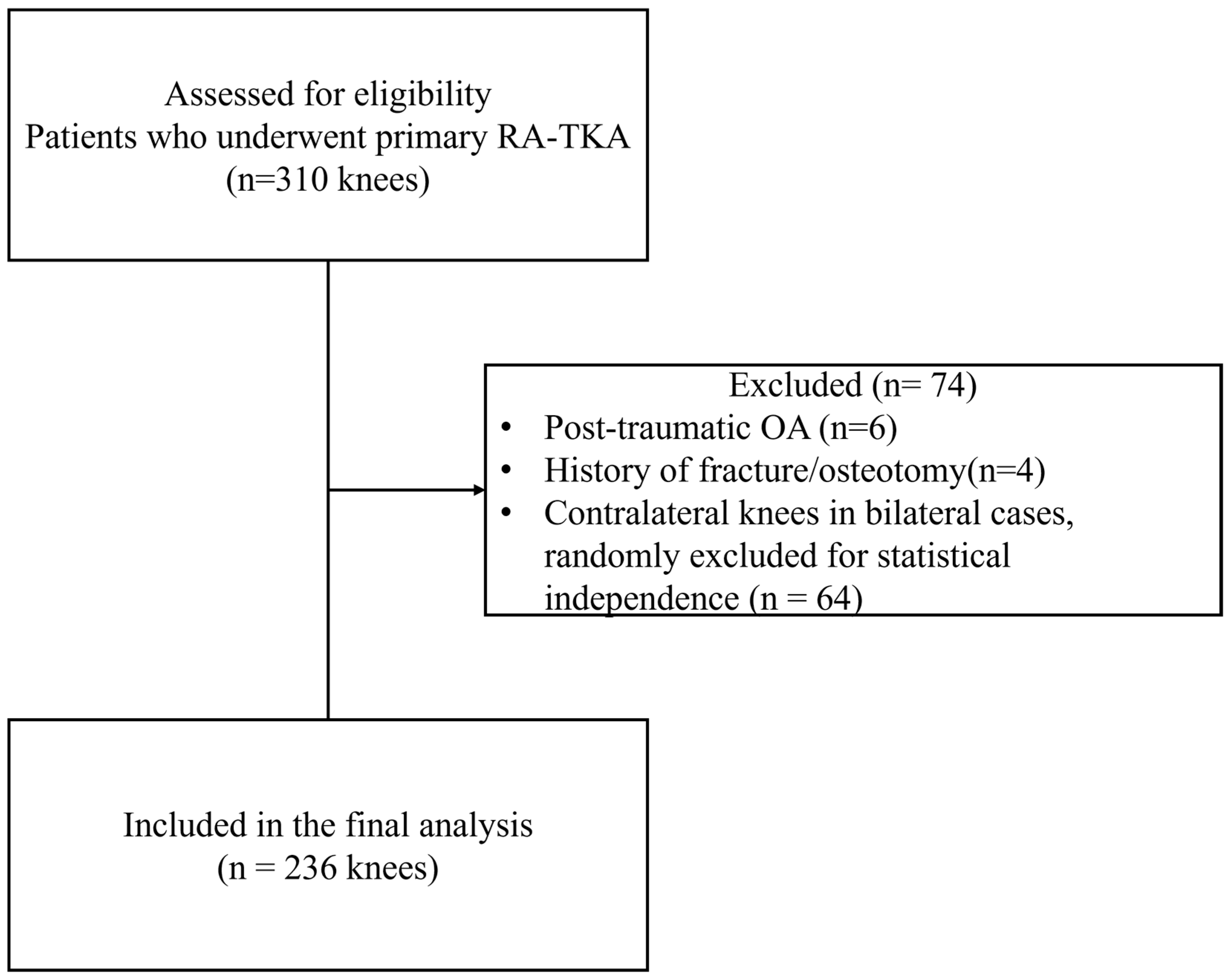
2.1. Patient Selection
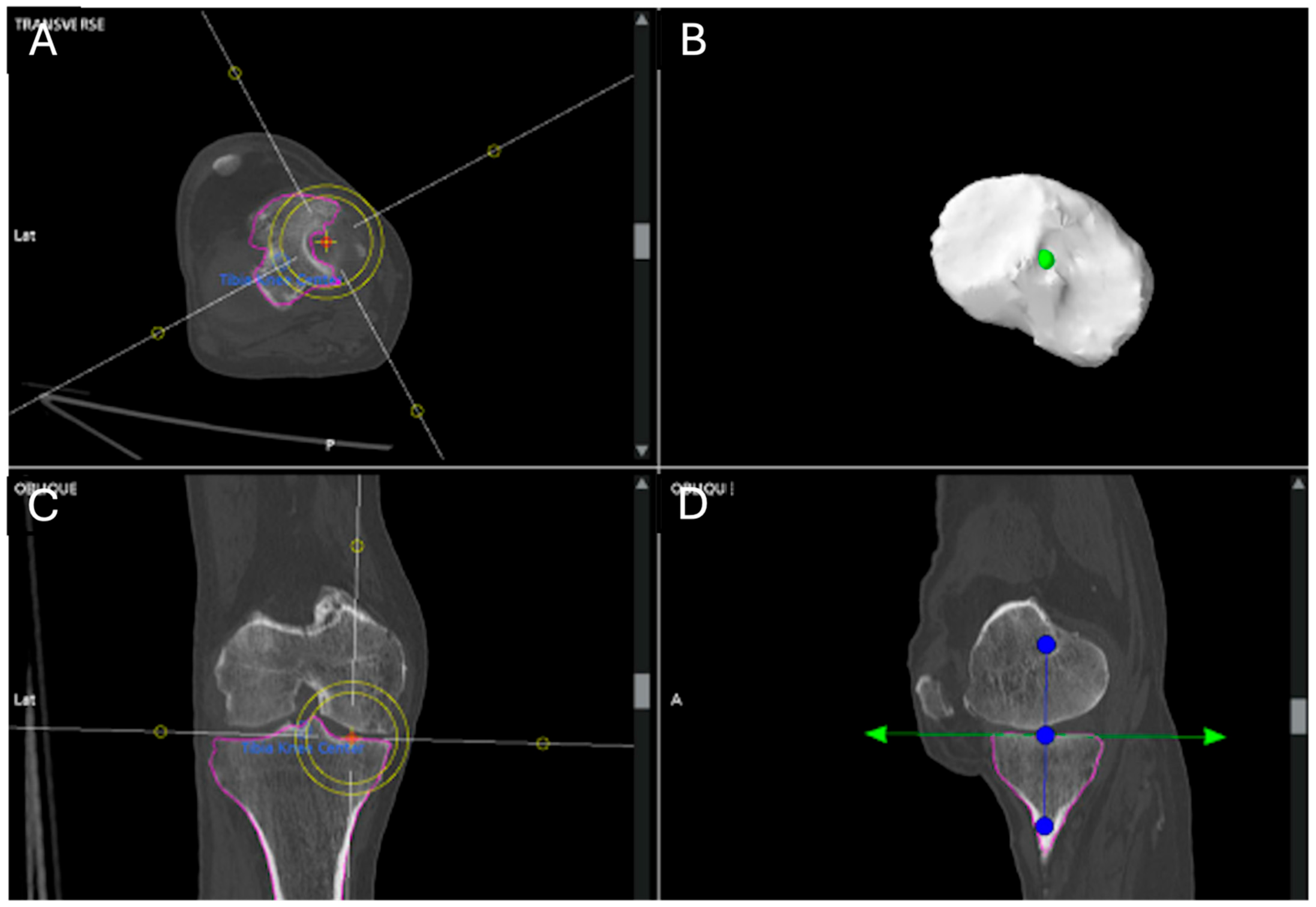
2.2. CT Acquisition and 3D Modeling
2.3. Radiological Measurements
2.4. Statistical Analysis
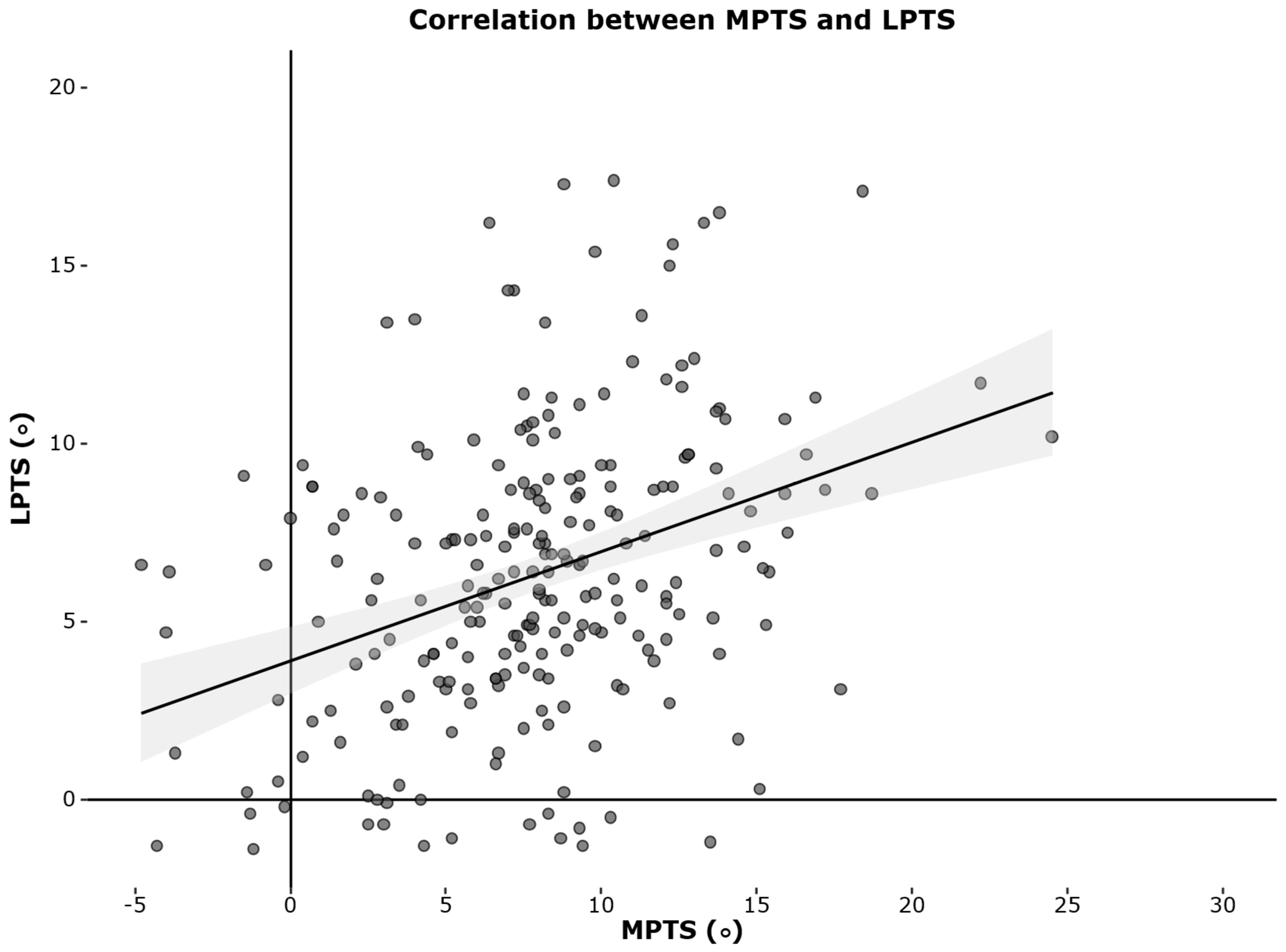
3. Results
4. Discussion
5. Conclusions
Author Contributions
Funding
Institutional Review Board Statement
Informed Consent Statement
Data Availability Statement
Conflicts of Interest
Abbreviations
| PTS | posterior tibial slope |
| TKA | total knee arthroplasty |
| RA-TKA | robotic-assisted total knee arthroplasty |
| MPTS | medial posterior tibial slope |
| LPTS | lateral posterior tibial slope |
| MPTA | medial proximal tibial angle |
| LDFA | lateral distal femoral angle |
| aHKA | arithmetic hip–knee–ankle angle |
| PCA | posterior condylar axis |
| PCL | posterior cruciate ligament |
| OA | osteoarthritis |
| CT | computed tomography |
References
- Lee, H.Y.; Kim, S.J.; Kang, K.T.; Kim, S.H.; Park, K.K. The effect of tibial posterior slope on contact force and ligament stresses in posterior-stabilized total knee arthroplasty: Explicit finite element analysis. Knee Surg. Relat. Res. 2012, 24, 91–98. [Google Scholar] [CrossRef]
- Okazaki, K.; Tashiro, Y.; Mizu-uchi, H.; Hamai, S.; Doi, T.; Iwamoto, Y. Influence of the posterior tibial slope on the flexion gap in total knee arthroplasty. Knee 2014, 21, 806–809. [Google Scholar] [CrossRef]
- Seo, S.S.; Kim, C.W.; Moon, S.W. Clinical results associated with changes of posterior tibial slope in total knee arthroplasty. Knee Surg. Relat. Res. 2013, 25, 25–29. [Google Scholar] [CrossRef] [PubMed]
- Cho, Y.T.; Jung, H.J.; Kim, J.I. Restoring native posterior tibial slope within 4° leads to better clinical outcomes after cruciate-retaining robot-assisted total knee arthroplasty with functional alignment. Knee Surg. Sports Traumatol. Arthrosc. 2025, 33, 2592–2604. [Google Scholar] [CrossRef]
- Hecker, A.; Lerch, T.D.; Egli, R.J.; Liechti, E.F.; Klenke, F.M. The EOS 3D imaging system reliably measures posterior tibial slope. J. Orthop. Surg. Res. 2021, 16, 373. [Google Scholar] [CrossRef]
- Seki, K.; Seki, T.; Siigi, E.; Imagama, T.; Yamabe, T.; Sakai, T. Comparing inter- and intraobserver reliability between two-dimensional radiographic and three-dimensional CT measurements. Acta Orthop. Belg. 2023, 89, 12061. [Google Scholar] [CrossRef] [PubMed]
- Hiyama, S.; Rao, R.P.; Xie, F.; Takahashi, T.; Takeshita, K.; Pandit, H. Comparative analysis of posterior tibial slope measurements: Accuracy and reliability of radiographs and CT. J. Orthop. 2025, 68, 62–67. [Google Scholar] [CrossRef] [PubMed]
- Hashemi, J.; Chandrashekar, N.; Gill, B.; Beynnon, B.D.; Slauterbeck, J.R.; Schutt, R.C., Jr.; Mansouri, H.; Dabezies, E. The geometry of the tibial plateau and its influence on the biomechanics of the tibiofemoral joint. J. Bone Jt. Surg. Am. 2008, 90, 2724–2734. [Google Scholar] [CrossRef]
- Harvey, W.F.; Niu, J.; Zhang, Y.; McCree, P.I.; Felson, D.T.; Nevitt, M.; Xu, L.; Aliabadi, P.; Hunter, D.J. Knee alignment differences between Chinese and Caucasian subjects without osteoarthritis. Osteoarthr. Cartil. 2008, 16, 891–897. [Google Scholar] [CrossRef]
- Ho, J.P.Y.; Merican, A.M.; Ayob, K.A.; Sulaiman, S.H.; Hashim, M.S. Tibia vara in Asians: Myth or fact? Verification with three-dimensional computed tomography. J. Orthop. Surg. 2021, 29, 2309499021992618. [Google Scholar] [CrossRef]
- Moon, Y.W.; Park, J.H.; Lee, S.S.; Kang, J.W.; Lee, D.H. Distal femoral phenotypes in Asian varus osteoarthritic knees. Knee Surg. Sports Traumatol. Arthrosc. 2022, 30, 456–463. [Google Scholar] [CrossRef]
- Wong, W.K.; Zulkhairi, S.Z.; Chua, H.S. CT-Based Software-Generated Measurements Permit More Objective Assessments of Arithmetic Hip-Knee-Ankle Axis and Joint Line Obliquity. Life 2025, 15, 188. [Google Scholar] [CrossRef] [PubMed]
- Faul, F.; Erdfelder, E.; Lang, A.G.; Buchner, A. G*Power 3: A flexible statistical power analysis program for the social, behavioral, and biomedical sciences. Behav. Res. Methods 2007, 39, 175–191. [Google Scholar] [CrossRef]
- Cohen, J. Statistical Power Analysis for the Behavioral Sciences, 2nd ed.; Lawrence Erlbaum Associates: Hillsdale, NJ, USA, 1988. [Google Scholar] [CrossRef]
- Kuwano, T.; Urabe, K.; Miura, H.; Nagamine, R.; Matsuda, S.; Satomura, M.; Sasaki, T.; Sakai, S.; Honda, H.; Iwamoto, Y. Importance of the lateral anatomic tibial slope as a guide to the tibial cut in total knee arthroplasty in Japanese patients. J. Orthop. Sci. 2005, 10, 42–47. [Google Scholar] [CrossRef]
- Calek, A.; Hochreiter, B.; Hess, S.; Amsler, F.; Leclerq, V.; Hirschmann, M.T.; Behrend, H. High inter- and intraindividual differences in medial and lateral posterior tibial slope are not reproduced accurately by conventional TKA alignment techniques. Knee Surg. Sports Traumatol. Arthrosc. 2022, 30, 882–889. [Google Scholar] [CrossRef]
- Meier, M.; Janssen, D.; Koeck, F.X.; Thienpont, E.; Beckmann, J.; Best, R. Variations in medial and lateral slope and medial proximal tibial angle. Knee Surg. Sports Traumatol. Arthrosc. 2021, 29, 939–946. [Google Scholar] [CrossRef] [PubMed]
- Hirschmann, M.T.; Muller, W. Complex function of the knee joint: The current understanding of the knee. Knee Surg. Sports Traumatol. Arthrosc. 2015, 23, 2780–2788. [Google Scholar] [CrossRef] [PubMed]
- Foos, J.; Amakoutou, K.; Cooperman, D.R.; Liu, R.W. A cadaveric anatomical study of the relationship between proximal tibial slope and coronal plane deformity. J. Knee Surg. 2023, 36, 62–67. [Google Scholar] [CrossRef]
- Clinger, B.N.; Plaster, S.; Passarelli, T.; Marshall, J.; Wascher, D.C. Differentiation in Posterior Tibial Slope by Sex, Age, and Race: A Cadaveric Study Utilizing 3-Dimensional Computerized Tomography. Am. J. Sports Med. 2022, 50, 2698–2704. [Google Scholar] [CrossRef]
- Koh, Y.-G.; Nam, J.-H.; Chung, H.-S.; Chun, H.-J.; Kim, H.-J.; Kang, K.-T. Morphometric study of gender difference in osteoarthritis posterior tibial slope using three-dimensional magnetic resonance imaging. Surg. Radiol. Anat. 2020, 42, 667–672. [Google Scholar] [CrossRef]
- Meric, G.; Gracitelli, G.; Aram, L.; Swank, M.L.; Bugbee, W.D. Tibial slope is highly variable in patients undergoing primary total knee arthroplasty: Analysis of 13,546 computed tomography scans. J. Arthroplast. 2015, 30, 1228–1232. [Google Scholar] [CrossRef] [PubMed]
- Moschella, D.; Blasi, A.; Leardini, A.; Ensini, A.; Catani, F. Wear patterns on tibial plateau from varus osteoarthritic knees. Clin. Biomech. 2006, 21, 152–158. [Google Scholar] [CrossRef] [PubMed]
- Hohmann, E.; Tetsworth, K.; Glatt, V.; Ngcelwane, M.; Keough, N. The posterior horn of the medial and lateral meniscus both reduce the effective posterior tibial slope: A radiographic MRI study. Surg. Radiol. Anat. 2021, 43, 1145–1153. [Google Scholar] [CrossRef]
- Wen, D.; Bohlen, H.; Mahanty, S.; Wang, D. Posterior Tibial Slope Measurements of the Medial and Lateral Plateaus Vary Widely Between Magnetic Resonance Imaging and Computed Tomography. Arthroscopy 2025, 46, 1871–1878. [Google Scholar] [CrossRef] [PubMed]



| Variable | N = 236 a |
|---|---|
| Age, years | 71.17 ± 6.93 |
| Sex, male:female | 41:195 |
| Body mass index, kg/m2 | 26.34 ± 3.64 |
| Right:Left | 119:117 |
| Kellgren-Lawrence grade, 3:4 | 72:164 |
| Variable | N = 236 a |
|---|---|
| MPTA, deg | 84.39 ± 2.86 |
| LDFA, deg | 88.12 ± 2.80 |
| mHKA, deg b | −8.3 ± 5.21 |
| aHKA, deg c | −3.73 ± 4.32 |
| AA-MA coronal, deg d | 5.87 ± 0.70 |
| AA-MA sagittal, deg e | 0.35 ± 3.56 |
| MPTS, deg | 7.85 ± 4.72 |
| LPTS, deg | 6.33 ± 4.04 |
| PCA-sTEA, deg f | 3.03 ± 2.05 |
| CPAK classification | |
| Type I | 146 (61.9%) |
| Type II | 54 (22.9%) |
| Type III | 12 (5.1%) |
| Type IV | 17 (7.2%) |
| Type V | 4 (1.7%) |
| Type VI | 1 (0.4%) |
| Type IX | 2 (0.8%) |
| Mean ± SD (°) | Range (°) | Mean Differences ± SD (°) | p Value * | |
|---|---|---|---|---|
| MPTS | 7.85 ± 4.72 | −4.8 to 24.5 | 1.51 ± 4.98 | <0.001 |
| LPTS | 6.33 ± 4.04 | −1.4 to 17.4 |
| Independent Variables | Multivariate Regression a | |||||
|---|---|---|---|---|---|---|
| Non-Standardized Coefficient | Standardized Coefficient | 95% CI | VIF | p Value | ||
| B | SE | ꞵ | ||||
| Height | −0.121 | 0.043 | −0.169 | 1.044 | 0.006 | |
| LDFA | 0.017 | 0.104 | 0.010 | 1.082 | 0.872 | |
| MPTA | −0.054 | 0.100 | −0.033 | 1.049 | 0.589 | |
| Femur flexion angle | −0.259 | 0.079 | −0.195 | 1.020 | <0.001 | |
| LPTS | 0.427 | 0.070 | 0.365 | [0.289, 0.566] | 1.034 | <0.001 |
Disclaimer/Publisher’s Note: The statements, opinions and data contained in all publications are solely those of the individual author(s) and contributor(s) and not of MDPI and/or the editor(s). MDPI and/or the editor(s) disclaim responsibility for any injury to people or property resulting from any ideas, methods, instructions or products referred to in the content. |
© 2026 by the authors. Licensee MDPI, Basel, Switzerland. This article is an open access article distributed under the terms and conditions of the Creative Commons Attribution (CC BY) license.
Share and Cite
Cha, S.H.; Lee, M.J.; Jung, H.J.; Hwang, J.H.; Kim, J.I. Posterior Tibial Slope Is Highly Variable and Asymmetric in Asian Osteoarthritic Knees: A Three-Dimensional CT Analysis. J. Clin. Med. 2026, 15, 4123. https://doi.org/10.3390/jcm15114123
Cha SH, Lee MJ, Jung HJ, Hwang JH, Kim JI. Posterior Tibial Slope Is Highly Variable and Asymmetric in Asian Osteoarthritic Knees: A Three-Dimensional CT Analysis. Journal of Clinical Medicine. 2026; 15(11):4123. https://doi.org/10.3390/jcm15114123
Chicago/Turabian StyleCha, Sun Ho, Min Jae Lee, Ho Jung Jung, Ji Hyo Hwang, and Joong Il Kim. 2026. "Posterior Tibial Slope Is Highly Variable and Asymmetric in Asian Osteoarthritic Knees: A Three-Dimensional CT Analysis" Journal of Clinical Medicine 15, no. 11: 4123. https://doi.org/10.3390/jcm15114123
APA StyleCha, S. H., Lee, M. J., Jung, H. J., Hwang, J. H., & Kim, J. I. (2026). Posterior Tibial Slope Is Highly Variable and Asymmetric in Asian Osteoarthritic Knees: A Three-Dimensional CT Analysis. Journal of Clinical Medicine, 15(11), 4123. https://doi.org/10.3390/jcm15114123