Systematic Review

Vaginal Natural Orifice Transluminal Endoscopic Surgery (vNOTES) in Patients with Gynecological Malignancies: A Systematic Review
by
Aristotelis-Marios Koulakmanidis
1,*,
Evangelia Kontogeorgi
1,
Dimitrios Zacharakis
1,
Anastasia Prodromidou
1,
Ioakeim Sapantzoglou
1,
Giuseppe Mascellino
2,
Konstantinos Kypriotis
1,
Nikolaos Kathopoulis
1,
Dimos Sioutis
3,
Charalampos Voros
1,
Christos Vrysis
1,
Stavros Athanasiou
1 and
Themos Grigoriadis
1
1
1st Department of Obstetrics and Gynaecology, Alexandra Hospital, National and Kapodistrian University of Athens, 115 28 Athens, Greece
2
Unit of Obstetrics and Gynecology, “Paolo Giaccone” Hospital, Department of Health Promotion, Mother and Child Care, Internal Medicine and Medical Specialties (PROMISE), University of Palermo, 901 27 Palermo, Italy
3
3rd Department of Obstretrics and Gyneocology, Attikon Hospital, National and Kapodistrian University of Athens, 124 62 Athens, Greece
*
Author to whom correspondence should be addressed.
J. Clin. Med. 2026, 15(11), 4089; https://doi.org/10.3390/jcm15114089
Submission received: 26 April 2026 / Revised: 17 May 2026 / Accepted: 20 May 2026 / Published: 25 May 2026

Abstract

Aim: The purpose of this study was to investigate the safety, efficacy, and clinical outcomes of the vaginal natural orifice transluminal endoscopic surgery (vNOTES) technique in patients suffering from gynecological cancer. Methods: A systematic review of the literature was conducted from inception to October 2025 following the PRISMA guidelines. PubMed, Google Scholar, and the Cochrane Library were searched for studies investigating vNOTES in gynecological malignancies. Study quality was evaluated using the Newcastle–Ottawa Scale, the National Institute of Health and the Joanna Briggs Institute critical appraisal tools. Results: The search identified 11 observational cohort studies, 28 case series, and 22 case reports. A total of 926 patients with suspected or confirmed gynecologic malignancies underwent surgery via vNOTES approach. The combination of hysterectomy, bilateral salpingo-oophorectomy, and sentinel lymph node biopsy represented the most commonly performed surgical procedure. Endometrial cancer was the most frequent oncological indication. The included studies evaluated the perioperative outcomes, including operative time, estimated blood loss, lymph node assessment, conversion rates and complications. Conclusions: The vNOTES approach appeared to be feasible and at least non-inferior to standard surgical treatments for patients with early-stage gynecologic malignancies. However, the small sample sizes and heterogeneity among studies limit the strength of the evidence and preclude definitive conclusions.

1. Introduction

Gynecological malignancies constitute one of the most prevalent neoplasms worldwide, imposing a substantial burden on patients’ quality of life and healthcare systems. According to the Global Cancer Observatory (GLOBOCAN), these cancers accounted for 1,473,427 new cases and 680,372 deaths globally in 2022 [1]. While laparotomy remains the mainstay of surgical management for gynecological malignancies, their significant clinicopathological heterogeneity, coupled with patient variability, can render such interventions particularly complex [2,3,4]. Specifically, endometrial cancer, as the most prevalent gynecological malignancy, is closely associated with obesity, which poses substantial challenges for perioperative outcomes [5,6]. Furthermore, particularly in cases of ovarian cancer, surgical intervention is often performed in patients pretreated with neoadjuvant chemotherapy, a setting that induces an immunocompromised state and thereby increases susceptibility to surgical site infection [7,8]. In cervical cancer, preoperative assessment of pelvic and para-aortic lymph node status is pivotal in determining whether the management strategy will consist of surgical resection or primary radiotherapy [9]. Moreover, minimizing recovery time is crucial in these oncological patients to ensure the timely initiation of adjuvant therapy [10].
Gynecologic oncologists continually strive to adopt minimally invasive surgical alternatives in order to mitigate morbidity, curtail hospital stays, and expedite recovery. The vaginal natural orifice transluminal endoscopic surgery (vNOTES) represents a novel access route to the peritoneal cavity, utilizing the natural orifice of the vagina [11]. This technique offers a hybrid approach that integrates vaginal surgery with conventional laparoscopy, merging the benefits of a scarless vaginal route with the enhanced intraperitoneal visualization afforded by laparoscopic techniques [12]. In recent years, the vNOTES technique has been increasingly adopted for a broad spectrum of benign gynecological conditions. Specifically, procedures including salpingectomy, oophorectomy, myomectomy, and hysterectomy have demonstrated safety and efficacy profiles comparable to those of conventional laparoscopic approaches [13,14]. Furthermore, several studies have underscored multiple advantages of vNOTES over conventional laparoscopy, including reduced postoperative pain, shorter hospitalization, accelerated recovery, lower complication rates, and superior cosmetic outcomes attributed to the avoidance of abdominal incisions [15].
The demonstrated efficacy of the vNOTES approach in benign gynecological conditions, in conjunction with the specific needs of gynecologic oncology patients, has prompted the exploration of its potential application in this population. The aim of this systematic literature review is to objectively outline the currently available clinical data concerning the safety and efficacy, as well as the limitations, of the vNOTES approach in patients with gynecological malignancies.

2. Materials and Methods

2.1. Protocol Registration

The protocol of this review has been registered in PROSPERO, an international database for prospectively registered systematic reviews. The registration number for this review is CRD420251062011.

2.2. Search Strategy

The literature search covered the period from database inception to October 2025 and was conducted in the following electronic databases: PubMed, Google Scholar, and the Cochrane Library to ensure comprehensive coverage and inclusion of grey literature by two independent reviewers (AMK, EK). The search included Medical Subject Headings (MeSH) terms, along with a combination of the following keywords: vaginal natural orifice transluminal endoscopic surgery, endoscopy, malignancy, cancer, and gynecology. No filters were applied.

2.3. Eligibility Criteria

All studies concerning the application of the vNOTES technique in patients with suspected or confirmed gynecologic malignancies were evaluated based on their title, abstract, and full-text content. Furthermore, the references of all studies were evaluated for further citations.
All retrieved articles were independently assessed for eligibility by two reviewers (AMK, EK). The review considered retrospective and prospective observational studies, while excluding studies on non-gynecological procedures, review articles, publications in Hungarian and Chinese, ongoing studies and in vitro research. Additionally, studies investigating vNOTES for prophylactic purposes, including risk-reducing hysterectomy in asymptomatic patients with genetic predispositions to gynecological malignancies (e.g., Lynch syndrome, BRCA mutations), were not included.
Finally, this study was conducted following the Preferred Reporting Items for Systematic Reviews and Meta-Analysis (PRISMA) guidelines [16]. Supplementary Figure S1a,b present the comprehensive PRISMA 2020 Checklist.

2.4. Quality Assessment of the Included Studies

Quality assessment of the included observational cohort studies was performed using the Newcastle–Ottawa Scale (NOS). The NOS evaluates studies according to three key domains: Selection, Comparability, and Outcome. Each study could be awarded a maximum of nine stars. Studies achieving a score of 7–9 were classified as high quality, those scoring between 4 and 6 as moderate quality, and those with a score of 0–3 as low quality, indicating a high risk of bias [17].
The National Institute of Health (ΝΙΗ) Quality Assessment Tool for Case Series Studies was used to evaluate the methodological quality of the observational case series. This instrument assesses nine methodological criteria, with each component rated as “Yes,” “No,” “Not reported,” or “Not applicable.” The final assessment is qualitative, based on the reviewer’s subjective judgment, and classifies studies into three categories: good, fair, and poor, according to the distribution of “Yes” and “No” responses to critical criteria, representing the corresponding degree of risk of bias [18].
In addition, the methodological rigor of the case report studies was assessed using the Joanna Briggs Institute (JBI) Critical Appraisal Checklist for Case Reports. This checklist consists of eight questions evaluating the methodological quality of each study, with responses recorded as “Yes,” “No,” “Unclear,” or “Not applicable,” providing a qualitative assessment that categorizes studies as high, moderate, or low quality according to the number of criteria fulfilled [19].
Disagreements regarding quality assessments were resolved by involving a third reviewer (DZ).

2.5. Data Extraction

Details were independently collected by two authors (AMK, EK), including variables as the year of publication, hospital setting, study methodology, sample size, type of intervention, patient demographics, type of cancer, and clinical outcomes The results were organized and presented based on study design to improve clarity and consistency in data presentation.
However, no additional statistical synthesis was performed in the present review due to methodological heterogeneity. All variables are presented descriptively, with summary measures reported only in terms of the range of mean and/or median values, as available in the original studies.

3. Results

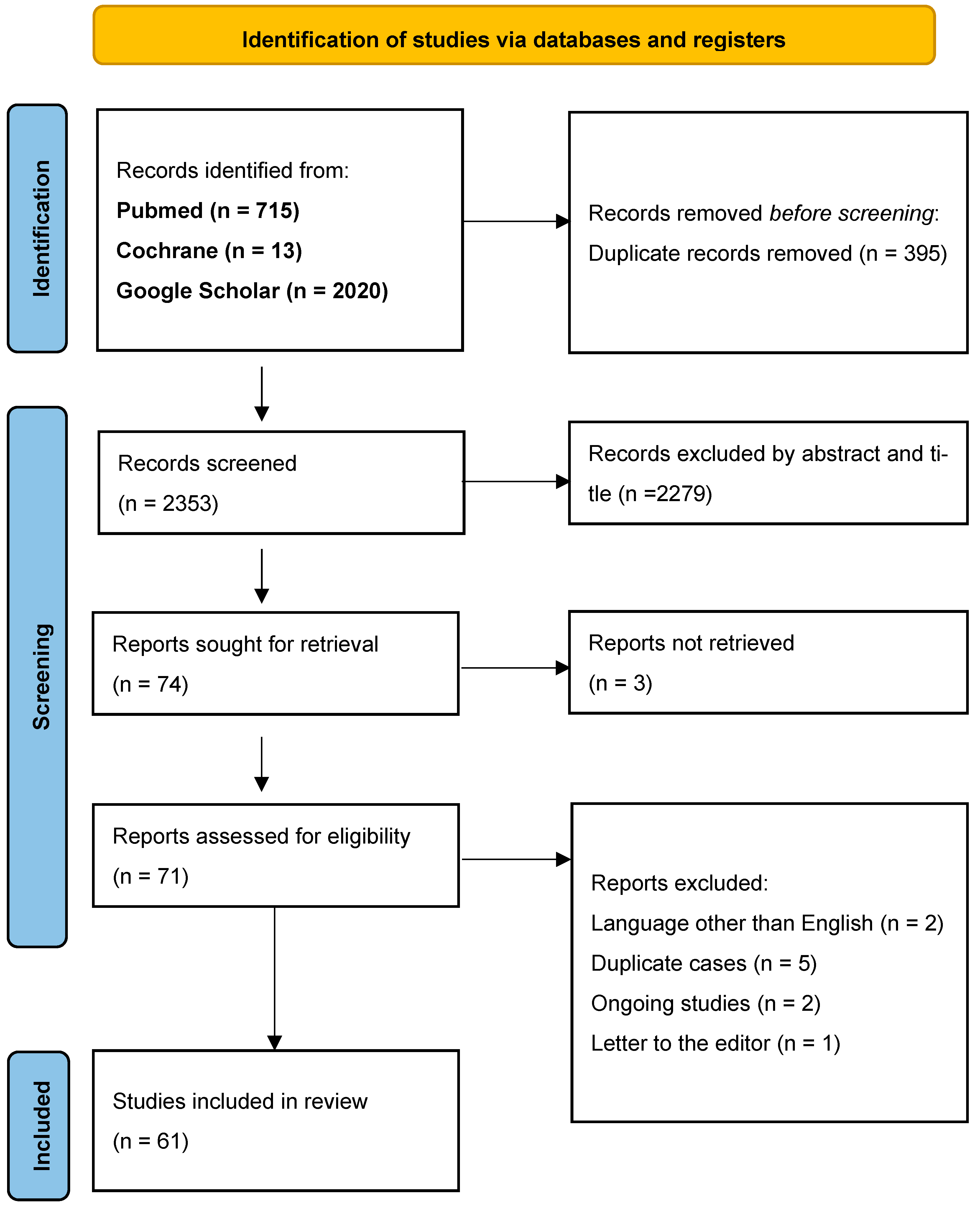
According to the literature, the use of the vNOTES technique in the management of gynecologic cancer has been documented in eleven observational cohort studies [20,21,22,23,24,25,26,27,28,29,30], 28 case series [31,32,33,34,35,36,37,38,39,40,41,42,43,44,45,46,47,48,49,50,51,52,53,54,55,56,57,58], and 22 case reports [59,60,61,62,63,64,65,66,67,68,69,70,71,72,73,74,75,76,77,78,79,80], with the earliest publication dating back to 2008. Figure 1 presents the PRISMA flow diagram, outlining the process of article identification, screening, and selection for inclusion in this analysis.
Table 1 summarizes the demographic characteristics of all included studies.

3.1. Observational Cohort Studies

A total of eleven comparative cohort studies (ten retrospective and one prospective) comprising 906 patients who underwent gynecological procedures were included. The extracted perioperative and surgical outcomes are summarized in Table 2. Among these, 601 (66.33%) patients were treated via vNOTES approach, including 311 (34.32%) cases of gynecological malignancies. Notably, one study involved a cohort of 100 patients, evaluating vNOTES hysterectomy (vNOTES-H) and vaginal hysterectomy (VH) (n = 50 vNOTES-H vs. n = 50 VH); however, the specific number of malignancy cases in this group was not explicitly reported [29].
The included cohort studies were conducted in tertiary care centers across Turkey, Singapore, China, and France between 2021 and 2025. The overall patient demographics varied, with mean ages ranging from 37 years [23] to 62.5 years [21]. Among studies restricted to oncological patients, the vNOTES cohorts reported a median body mass index (BMI) ranging between 21 kg/m2 [23] and 31 kg/m2 [22].
Among the oncological cases treated via vNOTES, 285 (91.63%) patients had endometrial cancer or endometrial intraepithelial neoplasia [20,21,22,24,25,26,27,28,29,30], 19 (6.1%) had histologically confirmed ovarian malignancies [23], and 7 (2.25%) patients were diagnosed with early-stage cervical cancer [28]. The most commonly performed vNOTES oncological procedure was total hysterectomy, frequently combined with bilateral, and less commonly unilateral, salpingo-oophorectomy. Lymph node assessment included sentinel lymph node dissection (SLND) in 211 (67.84%) cases of early-stage endometrial cancer [20,21,25,26,30], while pelvic lymph node dissection (PLND) was performed in three (0.96%) cases of ovarian cancer [23]. Furthermore, one (0.32%) case of endometrial cancer involved both PLND and para-aortic lymph node sampling [28]. Finally, eight (2.57%) patients with ovarian cancer underwent omentectomy, including two (0.64%) who underwent interval debulking surgery via the vNOTES approach [23]. A total of 208 (22.95%) oncological patients across studies had endometrial cancer and underwent alternative minimally invasive surgical (MIS) techniques, including single-port laparoscopy (SPLS), conventional laparoscopy (CL), multiport laparoscopy (ML), robotic surgery or VH. In the study by Merlier et al., patients with grade 1 endometrioid adenocarcinoma were included among the study population; however, the exact number of patients with benign versus malignant pathology was not specified [29].
Among the included studies, estimated blood loss (EBL) was reported in six studies, none of which detected a statistically significant difference between patients undergoing vNOTES and those treated with other MIS approaches [22,24,25,26,29,30]. A statistically significant reduction in operative time was reported in only one study, with an advantage for the vNOTES approach over SPLS [20]. In addition, five studies demonstrated that vNOTES was associated with statistically significant lower postoperative pain scores at 6, 12, and 24 h compared with other MIS approaches [20,22,24,25,26], whereas one study reported no significant difference between vNOTES and CL [30]. With respect to the length of hospital stay, four studies reported comparable outcomes between vNOTES and other MIS techniques [20,22,24,29], while three studies showed a statistically significant reduction favoring the vNOTES approach [25,26,30]. Sentinel lymph node (SLN) detection rates were evaluated in three studies and were not found to differ significantly between vNOTES and other surgical approaches [25,26,30]. Regarding the latter, Arkan et al. evaluated indocyanine green (ICG) versus methylene blue for SLN mapping via vNOTES in endometrial cancer staging, showing that ICG significantly increased both the detection rate and the number of SLNs identified per patient [21]. In terms of safety, no significant differences were observed in intra- and postoperative complications [22,24,25,26,29,30] or conversion rates [22,24,26,29,30]. Only a single case of intraoperative hemorrhage in vNOTES group, with an EBL of approximately 1000 mL, was reported by Fong et al. [23]. Conversion to CL was required in two cases of vNOTES, one due to a large uterus [26] and another due to failed bilateral pelvic sentinel lymph node mapping [30]. Apart from the aforementioned case of significant blood loss and the two conversions to CL, no major intraoperative or postoperative complications were reported in any of the studies.
Table 3 provides an overview of the risk-of-bias assessment for the included studies; all studies were considered moderate quality and risk of bias (NOS 4–6).
Table 1. Demographic Characteristics of the Included Studies Evaluating Vaginal Natural Orifice Transluminal Endoscopic Surgery (vNOTES) for Gynecologic Procedures in Patients with Malignancy.
Author, Year, Reference Study DesignCountry, Duration of StudyInclusion CriteriaExclusion Criteria
Gungorduk K. et al., 2025 [20]Observational cohort study Turkey, January 2020 to June 2024
  • Hysterectomy + BS ± SO/SLND
  • Deep endometriosis
  • Pelvic masses suggestive ovarian cancer
Arkan K. et al., 2025 [21]Observational cohort study Turkey, NR
  • EC: FIGO st I-II
  • Suspected metastatic disease
  • Prior pelvic or para-aortic LND
  • Known allergies to the ICG or MB
  • Cases that required conversion to CL (n = 12)
Şimşek E. et al., 2025 [22]Observational cohort study Turkey, January 2023 to June 2024.
  • Patients > 18 y
  • EC
  • Free of any other malignant pelvic disease
  • Without previous pelvic/abdominal RT
  • Uteruses that were large enough to be removed vaginally in both surgical methods
  • Previous RS for para-aortic LND
  • Deep endometriosis
Fong K.Y. et al., 2025 [23]Observational cohort study Singapore, May 2021 to September 2024
  • Histology-proven OC
N/A
Mat E. et al., 2024 [24]Observational cohort study Turkey, January 2019 to November 2020
  • Low grade EC or EIN a
  • Contraindications for pneumoperitoneum, dorsal lithotomy position, general anesthesia
  • Severe cardio pulmonary renal disease
  • History of colorectal surgery
  • Blood clotting disorders
  • History of pelvic RT
  • Tubo-ovarian abscesses.
  • Douglas pouch obliteration.
Comba C. et al., 2024 [25]Observational cohort study Turkey, February 2021 to June 2023
  • Age: 30–85 y
  • Diagnosis of EC
  • No distant organ metastases
  • No medical contraindications to surgery
  • SLND
  • Systemic lymphadenectomy for EC
  • Presence of distant organ metastases
Deng L. et al., 2023 [26]Observational cohort study China, January 2021 to May 2022
  • ≥18 y
  • EC
  • St I in MRI
  • No tumor mass > 2 cm
  • Patient accepted MIS
  • Biochemical exams normal
  • ECOG ≤ 1
  • No other malignant tumor in the last 5 y
  • Previous pelvic or abdominal RT
  • Uterus > 12 cm
  • Contraindications to surgery
  • Inadequate FU
Bouchez M.C. et al., 2023 [27]Observational cohort study France, February 2020 to January 2022
  • All patients requiring a hysterectomy
  • Endometriosis
  • Cancer b
Mei Y. et al., 2023 [28]Observational cohort study China, February 2020 to January 2022NR
  • Obliteration cul de sac
  • Deep endometriosis
  • Late st CaCx/EC
  • History of multiple prior open abdominal operations
Merlier M. et al., 2022 [29]Observational cohort study France, March 2019 to November 2020
  • All patients requiring hysterectomy
  • Endometriosis
  • Oncological indications c
Wang Y. et al., 2021 [30]Observational cohort study China, August 2017 to May 2020
  • Low-grade (1 or 2) EC
  • Lesion confined to the uterine body
  • Tumor <4 cm in diameter
  • Lesion not involving the cervix
  • No intraperitoneal metastasis
  • Surgical staging with SLND, including vNOTES and LAP
N/A
Nef J. et al., 2025 [31]Case series studySwitzerland, May 2020 to November 2024
  • ≥65 y
N/A
Gungorduk K. et al., 2025 [32]Case series studyTurkey (multi-center), January 2023 to May 2025
  • vNOTES hysterectomy ± SO
  • UP > st I POPQS
  • History of endometriosis or PID
  • Severe renal failure
  • Severe cardiopulmonary disease
  • Previous colorectal surgery
  • Contraindications to general anesthesia or Trendelenburg position
Hanedan C. et al., 2025 [33]Case series studyTurkey, NR
  • vNOTES hysterectomy
  • Uterine weight ≥ 280 g
  • Uterine weight < 280 g
  • No consent
Kellerhals G. et al., 2025 [34]Case series studySwitzerland, October 2021 to August 2024NRN/A
Yang Q. et al., 2025 [35]Case series studyHuston, USA, June 2019 to August 2024
  • RA-vNOTES using the Da Vinci Xi robotic system
N/A
Tan R.C.A. et al., 2025 [36]Case series studySingapore, April 2021 to May 2024
  • vNOTES hysterectomy
N/A
Simsek E. et al., 2024 [37]Case series studyTurkey, January 2022 to June 2024
  • EC confined to the uterus
  • Prior gynecological/abdominal malignancy surgery
  • Deep endometriosis
  • Big uterus for vaginally removal
Baekelandt J. et al., 2024 [38]Case series studySwitzerland, USA, Brazil and Belgium, March 2016 to May 2023
  • EC
N/A
Matak L. et al., 2024 [39]Case series studyNA, August 2023 to October 2023NRN/A
Huber D. et al., 2024 [40]Case series studySwitzerland, October 2021 to November 2023
  • EC/CAH confined to the uterus
  • No metastases
  • Indication to surgical staging with SLND
  • SLND by retroperitoneal vNOTES
N/A
Zarragoitia J. et al., 2024 [41]Case series studySpain, 2022 to 2023NRN/A
Burnett A.F. et al., 2024 [42]Case series studyArkansas, Mississippi, Belgium, 2017 to 2023
  • BMI ≥ 40 kg/m2 for gynecologic surgery and consent for vNOTES
  • Obliteration of the cul de sac due to prior low colorectal surgery
  • Prior PID
  • Deep endometriosis
Hurni Y. et al., 2023 [43]Case series studySwitzerland, May 2020 to April 2023
  • BMI ≥ 30 kg/m2 and VNOTES for gynecological indication
  • Concomitant PSLNB, infracolic omentectomy or appendectomy
Hurni Y. et al., 2023 [44]Case series studySwitzerland, May 2020 to April 2023
  • Early stage of disease
  • Suspicion of advanced stage disease
  • History of perineal/rectal surgery
  • History of pelvic RT
  • Deep endometriosis
  • Active PID
Mat E. et al., 2023 [45]Case series studyTurkey, June 2021 to December 2021NR
  • Any contraindication for pneumoperitoneum or dorsal lithotomy position or general anesthesia
  • Sepsis
  • Severe renal failure
  • Severe cardiopulmonary disease
  • History of colorectal surgery
  • Suspicion of uterine sarcoma
  • Blood coagulation disorders
  • History of pelvic RT
  • Tubo-ovarian abscesses
  • Obliteration of the cul de sac
Burnett A.F. et al., 2023 [46]Case series studyNR, NR SLND in gynecologic malignancies N/A
Kale A. et al., 2022 [47]Case series studyTurkey, January 2019 to April 2021BMI > 30 kg/m2
  • Any contraindication for pneumoperitoneum or dorsal lithotomy position or general anesthesia
  • Virginity or a narrow vagina
  • Suspicion of deep endometriosis
  • Obliteration of the cul-de-sac
  • Previous rectovaginal surgery
  • Large uterus
  • Sepsis
  • Serious renal failure
  • Severe cardiopulmonary disorder
  • Blood coagulation disorders
Huang L. et al., 2022 [48]Case series studyChina, April 2018 to May 2021NR
  • Intolerability of the procedure
  • Acute infection stage
  • Deep venous thrombosis
  • Hypercoagulability
  • Liver or kidney dysfunction
  • Mental illness
  • History of rectal surgery
  • Suspected deep endometriosis or severe adhesions
  • Virginity
  • Pregnancy
Lee C.-L. et al., 2022 [49]Case series studyTaiwan, January 2014 to December 2020
  • Age of 20–80 y
  • EC, st I, grade 1–2, endometroid histopathology type
  • MRI without positive lymph nodes
  • Virginity or narrow vagina
  • History of multiple abdominopelvic surgeries
  • BMI > 42 kg/m2
  • History of any previous incomplete surgery
  • History of deep endometriosis surgery
  • Suspicion of the cul de sac obliteration
  • No FU and had incomplete adjuvant therapy
Huber D. et al., 2022 [50]Case series studySwitzerland, October 2021 to February 2022
  • EC, grade 1 or 2 or CAH
  • No evidence of metastases
  • Indication to surgical staging with SLND
  • SLND by retroperitoneal vNOTES
N/A
Comba C. et al., 2022 [51]Case series studyTurkey, NR NRN/A
Mat E. et al., 2021 [52]Case series studyTurkey, November 2018 to May 2019NR
  • Any contraindication for pneumoperitoneum or dorsal lithotomy position or general anesthesia
  • Sepsis
  • Serious renal failure
  • Severe cardiopulmonary disorder
  • Menstrual period/pregnancy
  • Blood coagulation disorders
  • Obliteration of the cul de sac
Mat E. et al., 2021 [53]Case series studyTurkey, January 2019 to June 2019
  • Extreme obese patients with early-stage EC
  • Any contraindication for pneumoperitoneum or dorsal lithotomy position or general anesthesia
  • Sepsis
  • Serious renal failure
  • Severe cardiopulmonary disorder
  • Blood coagulation disorders
  • Obliteration of the cul de sac
  • Previous rectovaginal surgery
  • Any laparotomy or laparoscopy involving the sigmoid or the rectum
  • Large uterus requiring morcellation
  • Contraindication to Trendelenburg position
Lowenstein L. et al., 2020 [54]Case series studyIsrael, Belgium, November 2018 to August 2019NRN/A
Karkia R. et al., 2019 [55]Case series studyUK, January 2018 to December 2018
  • Benign uterine pathology or EC, st I, grade 1
  • For EC, hysterectomy eligibility was verified by MRI and multidisciplinary team discussion
  • History of surgery to the rectovaginal pouch
  • Deep endometriosis
  • ≥2 cesareans
  • Patients with UP were excluded, as conventional VH was preferred
Tantitamit T., 2019 [56]Case series studyTaiwan, NR
  • EC, st I
N/A
Kaya C. et al., 2018 [57]Case series studyTurkey, January 2017 to May 2017
  • No contraindication for pneumoperitoneum or the Trendelenburg position
  • No fixed uterus or nodularity in the cul de sac on bimanual PE
  • No history of PID, pelvic abscess or endometriosis
N/A
Lee C.-L. et al., 2014 [58]Case series studyTaiwan, NR
  • Eligible for laparoscopic staging
N/A
Zhang C. et al., 2025 [59]Case reportChina, NRNRN/A
Baekelandt J. et al., 2024 [60]Case reportBelgium, NRNRN/A
Can B. et al., 2024 [61]Case reportTurkey, NRNRN/A
Ng W. et al., 2024 [62]Case reportSingapore, NRNRN/A
Erkilinc S. et al., 2024 [63]Case reportTurkey, NRNRN/A
Guevara R. et al., 2024 [64]Case reportSpain, NRNRN/A
Couso A. et al., 2024 [65]Case reportSpain, NRNRN/A
Baekelandt J. et al., 2023 [66]Case reportNRNRN/A
Kita M., et al., 2023 [67]Case reportJapan, NRNRN/A
Li Y. et al., 2022 [68]Case reportChina, NRNRN/A
Hurni Y. et al., 2022 [69]Case reportSwitzerland, NRNRN/A
Mathey M.-P. et al., 2022 [70]Case reportSwitzerland, January 2021NRN/A
Hurni Y. et al., 2022 [71]Case reportSwitzerland, October 2021NRN/A
Lim Y.H. et al., 2022 [72]Case reportSingaporeNRN/A
Comba C. et al., 2021 [73]Case reportTurkey, NRNRN/A
Kita M. et al. 2021 [74]Case reportJapan, NRNRN/A
Ju Y.Y. et al., 2021 [75]Case reportKorea, NRNRN/A
Badiglian-Filho L., 2020 [76]Case reportBrazil, NRNRN/A
Oh S.H., 2019 [77]Case reportRepublic of Korea, NRNRN/A
Htay W.T., 2019 [78]Case reportTaiwan, NRNRN/A
Leblanc E., 2016 [79]Case reportFrance, NRNRN/A
Zorrón R. et al., 2008 [80]Case reportBrazil, NR
  • Low ASA risk
  • Eligible to transvaginal approach instead of LAP
N/A
Abbreviations: BS, bilateral salpingectomy; SO, salpingo-oophorectomy; SLND, sentinel lymph node dissection; NR, not reported; ICG, indocyanine green; MB, methylene blue; EC, endometrial cancer; FIGO, International Federation of Gynecology and Obstetrics; st, stage; LND, lymph node dissection; CL, conventional laparoscopy; y, years; RT, radiotherapy; RS, robotic surgery; OC, ovarian cancer; N/A, not applicable; EIN, endometrial intraepithelial neoplasia; a From preoperative endometrial sampling, with lesion confined to uterus. MRI, magnetic resonance imaging; cm, centimeters; MIS, minimally invasive surgery; ECOG, Eastern Cooperative Oncology Group Performance Status; FU, follow-up; b Except grade 1 endometrioid adenocarcinoma. CaCx, cervical cancer; c Except grade 1 endometrioid adenocarcinoma. vNOTES, vaginal natural orifice transluminal endoscopic surgery; LAP, laparoscopy; UP, uterine prolapse; POPQS, pelvic organ prolapse quantification system; PID, pelvic inflammatory disease; g, grams; RA-vNOTES, Robot-Assisted Vaginal Natural Orifice Transluminal Endoscopic Surgery; CAH, complex atypical hyperplasia; BMI, body mass index; kg, kilogram; m, meter; PSLNB, pelvic sentinel lymph node biopsy; VH, vaginal hysterectomy; PE, pelvic exam.
Table 2. Perioperative and Surgical Outcomes of the Included Studies Evaluating Vaginal Natural Orifice Transluminal Endoscopic Surgery (vNOTES) for Gynecologic Procedures in Patients with Malignancy.
Author, Year, ReferenceSample (Cases/Controls)-DiagnosisvNOTES Intervention (Cases/Controls)Patients Characteristics (Cases/Controls)Outcomes
Gungorduk K. et al., 2025 [20]Total: n = 121
vNOTES (n = 58) vs. SPLS (n = 63)
Oncological indications: n = 30
EC (n = 30)
vNOTES (n = 14) vs. SPLS (n = 16)
Hysterectomy + USO/BSO ± SLND aAge, mean ± SD:
54.9 ± 6.3 vs. 55 ± 8.2 y
BMI, mean ± SD:
30.6 ± 3.4 vs. 30.8 ± 5.5 kg/m2
vNOTES group:
  • Shorter operative time
  • Lower pain scores at 6 h, 12 h and 24 h
No significant difference in:
  • Hospital stay
  • SFI 3 months
  • Dyspareunia
Arkan K. et al., 2025 [21] Total: n = 80
ICG (n = 40) vs. MB (n = 40)
EC, st I-II: n = 80
Hysterectomy + BSO + SLND using ICG/MB Age, mean ± SD:
62.5 ± 8.1 vs. 61.8 ± 7.5 y
BMI, mean ± SD:
28.7 ± 4.5 vs. 29.1 ± 4.2 kg/m2
ICG group:
  • Higher SLN detection rate
  • Higher mean SLNs per patient
No significant difference in:
  • Βilateral SLN detection rate
  • Operative time
  • EBL
  • Transfusion requirements
  • Complication rates
Şimşek E. et al., 2025 [22]Total: n = 76
vNOTES (n = 24) vs. RS (n= 52)
EC: n = 76
vNOTES: hysterectomy + BSO.
Robotic surgery is NR.
Age, mean ± SD:
56.5 ± 3.5 vs. 62 ± 11 y
BMI, mean ± SD:
31 ± 2.25 vs. 31 ± 4.5 kg/m2
vNOTES group:
  • Lower pain scores at 12 h
No significant difference in:
  • Operative time
  • EBL
  • Hospital stay
  • No conversion to CL/Laparotomy
  • Intraoperative complications
  • Postoperative complications
Fong K.Y. et al., 2025 [23]Total: n = 19
OC: n = 19
Procedures b:
primary staging
surgery (n = 12),
fertility-sparing surgery (n = 4),
restaging surgery (n = 1)
and IDS (n = 2)
Age, median (range):
Primary staging surgery group:
62 (54–67.5) y
Fertility-sparing surgery group:
37 (33–38) y
BMI, median (range):
Primary staging surgery group:
25.9 (22.7–30.0) kg/m2
Fertility-sparing surgery group:
21 (20.6–24.2) kg/m2
Primary staging group:
  • EBL: 100 (100–200) mL
  • Operative time: 135 [114, 221] min
  • 1 intraoperative complication [high EBL (1000 mL)]
  • Hospital stay: 2.5 (2–3) days
  • FU time: 27.6 (7.8–31.4) months
Fertility-sparing group:
  • EBL: 75 (50–125) mL
  • Operative time: 105 (91–108) min
  • No intraoperative complications
  • Hospital stay: 2 (2) days
  • FU time: 11.7 (7.1–17.7) months
Mat E. et al., 2024 [24]Total: n = 45
vNOTES (n = 29) vs. CL (n = 16)
Low grade EC/EIN: n = 45
Hysterectomy + BSOAge, mean ± SD:
59 ± 9.2 vs. 58 ± 12.8 y
BMI, median (range):
29.2 (25.3–41.6) vs. 28.2 (23.5–31.1) kg/m2
vNOTES group:
  • Lower pain scores at 6, 12 and 24 h.
  • Lower need for analgesics
No significant difference in:
  • Operative time
  • The decrease in Hb levels
  • Hospital stay
Either vNOTES or CL group:
  • Conversions
  • Damage to adjacent organs
  • Hematoma
  • Re-operations
  • No metastasis or recurrence in 3 y
Comba C. et al., 2024 [25]Total: n = 57
vNOTES (n = 19) vs. CL (n − 38)
EC: n = 57
Hysterectomy + BSO + SLNDAge, mean ± SD:
59.4 ± 11.6 vs. 59.8 ± 9.9 y
BMI, median (range):
29 (24–38) vs. 32 (19–54) kg/m2
vNOTES group:
  • Lower pain scores
  • Shorter hospital stay
No significant difference in:
  • Operative time
  • EBL
  • Number of SLN
  • SLN detection rate: vNOTES 94.8% and CL 100%.
  • Complications
  • The decrease in Hb levels
  • ICU
Either vNOTES or CL group:
  • No recurrence
Deng L. et al., 2023 [26]Total: n = 120
vNOTES (n = 57) vs. ML (n = 63)
EC: n = 120
Hysterectomy + BSO + SLNDAge, median ± SD:
51.46 ± 7.83 vs. 52.52 ± 8.47 y
BMI, median ± SD:
26.25 ± 3.09 vs. 25.76 ± 4.10 kg/m2
vNOTES vs. ML:
  • PSDR: 94.73% vs. 96.82%
  • The bilateral detection rate: 82.46 vs. 84.13%
  • The side specific mapping: 88.6 vs. 90.48%
  • Same number of SLN
vNOTES:
  • Lower pain scores
  • Shorter hospital stay
  • 1 ML convertion (large uterus)
No significant difference in:
  • Operative time
  • EBL
Either vNOTES or ΜL group:
  • No complications
  • Same medical costs
Bouchez M.C. et al., 2023 [27]Total: n = 200
Oncological indications: n = 10
EC, grade 1 (n = 10)
BMI < 30 (n = 6) vs. BMI ≥ 30 (n = 4)
Hysterectomy ± salpingectomy or BSOAge, mean ± SD:
47.30 ± 7.59 y (total)
47.3 ± 7.9 y (BMI < 30) vs. 47.1 ± 6.5 y (BMI ≥ 30)
BMI, median (range):
26.2 (15.90–48.40) (total)
24.3 (21.82–27.77) (BMI < 30) vs. 34.0 (31.68–37.08) (BMI ≥ 30) kg/m2
Total study population:
BMI ≥ 30 group:
  • Longer operative
  • Longer hospital stay
No significant difference in:
  • Complications
  • Intraoperative conversion
  • EBL
Mei Y. et al., 2023 [28]Total: n = 14
GR-vNOTES (n = 5) vs. TR-vNOTES (n = 9)
Oncological indications: n = 8
GR-vNOTES (n = 2) c vs. TR-vNOTES (n = 6) d
Hysterectomy + salpingectomy ± bilateral oophorectomy ± pelvic lymphadenectomy ± para-aortic lymph node sampling f Total study population:
Age, mean ± SD:
GR-vNOTES 44.6 ± 6.5 vs. TR-vNOTES 48.5 ± 6.9 y
BMI, median ± SD:
GR-vNOTES 21.4 ± 3.3 vs. TR-vNOTES 22.4 ± 1.6 kg/m2
Total study population:
No significant difference in:
  • Operative time
  • EBL
  • Hospital stay
  • Pain scores on the operative day, 1 day and 2 day
  • No conversion to CL
  • Complications
Patients for oncology indication:
  • No recurrence or metastasis in 6 months
Merlier M. et al., 2022 [29]Total: n = 100
vNOTES (n = 50) vs. VH (n = 50)
Oncological indications: n = unidentified
EC, grade 1 (n = unidentified)
Hysterectomy ± salpingectomies ± adnexectomies g Total study population:
Age, mean ± SD:
vNOTES 48.6 ± 7.4 vs. VH 49.5 ± 8.5 y
BMI, median ± SD:
vNOTES 27.5 ± 6.4 vs. VH 25.6 ± 5.2 kg/m2
Total study population:
No significant difference in:
  • Hospital stay
  • The rate of outpatient success rate
  • EBL
  • Complications
Wang Y. et al., 2021 [30]Total: n = 74
vNOTES (n = 51) vs. CL (n = 23)
EC, low grade: n = 74
Hysterectomy + SLNDAge, median (range):
53 (48–55) vs. 52 (49–56) y
BMI, median (range):
24.3 (22.7–26.7) vs. 24.4 (22.1–26.7) kg/m2
No significant difference in:
  • Operative time
  • EBL
  • Post operative complications
  • Postoperative pain scores at 12 and 24 h
  • SLND outcomes
  • Intraoperative complications: 0
  • Conversion to CL:1 h
vNOTES group:
  • Lower hospital stay
Nef J. et al., 2025 [31]Total: n = 119
Oncological indications: n = 44
EC (n = 39), CaCx (n = 2), carcinosarcoma (n = 1), LGSOC(n = 1), BOT (n = 1)
Hysterectomy + USO/BSO ± bilateral PSLND ± infracolic omentectomyTotal study population:
Age, mean ± SD:
72.5 ± 5.3 y
BMI median ± SD:
27.4 ± 6.4 kg/m2
Total amount of the study:
  • Operative time: 81.6 (15–221) min
  • EBL: 66.5 (0–500) mL
  • Conversion to laparoscopy: 3.4%
  • No conversion to laparotomy
  • Intraoperative complications: 11.8%
  • Postoperative complications: 16,8%
  • Postoperative opioid: 13.5%
  • Hospital stay: 2.8 (1–8) days
Gungorduk K. et al., 2025 [32] Total: n = 685
Oncological indications: n = 130
EC/endometrial hyperplasia (n = 130)
Hysterectomy + US/BS/USO/BSO + SLNDTotal study population:
Age, mean ± SD:
50.7 ± 9.3 y
BMI, mean ± SD:
29.0 ± 5.5 kg/m2
Total amount of the study:
  • Operative time: 72.4 ± 40.2 min
  • The decrease in Hb levels: 1.4 ± 0.1 g/dL
  • The mean uterine weight: 204 ± 145 g
  • Intraoperative complications: n = 12
  • Postoperative complications: n = 10
  • Conversions to laparoscopy: n = 6
  • Pain scores at 24 h: 2.7 ± 0.8
  • Hospital stay: 2.3 ± 1.4 days
Hanedan C. et al., 2025 [33]Total: n = 46
Oncological indications: n = 3
EC (n = 3)
Hysterectomy + BS ± oophorectomy ± SLNDTotal study population:
Age, median (range):
54 (40–74) y
BMI, median (range):
31 (21–51) kg/m2
Total study population:
  • Operative time: 56 (35–95) min
  • Uterine weight: 410 (280–1036) g
  • Preoperative Hb: 13.1 (8.6–15.9) g/dL
  • Postoperative Hb: 11.7 (8.8–14.4) g/dL
  • Hospital stay: 30 (16–72) h
  • Conversion to laparoscopy: n = 2
  • Intraoperative complication: n = 1
  • Postoperative complication: n = 1
Kellerhals G. et al., 2025 [34]Total: n = 11
OC, early stage: n = 7
BOT: n = 4
USO/BSO + peritoneal washing ± infracolic omentectomy ± pelvic peritonectomy ± rectal mesenteric implant excision ± total hysterectomy Age, median (range):
47 (27–81) y
BMI, median (range):
28.1 (22,4–39.2) kg/m2
  • Operative time: 70 (35–138) min
  • EBL: 50 (10–100) mL
  • No conversions
  • No intraoperative complications i
  • Postoperative complications: 27.3% j
Yang Q. et al., 2025 [35]Total: n = 298
Oncological indications: n = 2
EC (n = 2)
Hysterectomy ± USO/BSO Total study population:
Age, median (range):
41 (36–46) y
BMI, median (range):
29 (24–35) kg/m2
Total study population:
  • Operative time: 138 (116–167) min
  • EBL: 50 (25–50) mL
  • Discharge within 24 h: 69.13%
  • Conversion: 1.01%
  • Complication rate: 16.78%
Tan R.C.A. et al., 2025 [36]Total: n = 176
Oncological indications: n = 3
CIN/low-grade CaCx and adenomyosis (n = 3)
Hysterectomy ± salpingo-oophorectomy/salpingectomyTotal study population:
Age, mean ± SD:
52.3 ± 9.8 y
BMI, mean ± SD:
25.6 ± 5.2 kg/m2
Total study population:
  • Operative time: 109.7 ± 44.3 min
  • Uterine weight: 243.6 ± 198.7 g
  • Hospital stay: 1.6 ±1.0 days
  • EBL: 163.8 ± 185.5 mL
  • Intraoperative complication: n = 1
  • Postoperative complications: n = 5
Simsek E. et al., 2024 [37]Total: n = 24 patients
EC: n = 24
Hysterectomy + BSO + retroperitoneal SLND with ICG.Age, mean (range):
56.5 (51–65) y
BMI, median (range):
31 (29–38) kg/m2
  • Operative time: 125 min
  • EBL: 70 mL
  • Pain scores at 12 h: 2
  • Hospital stay: 1 day
  • Detection of SLN: 23/24
  • No conversions
  • No intraoperative complications
Baekelandt J. et al., 2024 [38]Total: n = 64
EC: n = 64
Hysterectomy + BSO + retroperitoneal SLN Age, mean (range):
69.5 (45–89) y
BMI, median (range):
26 (16–48) kg/m2
  • Operative time: 126 min.
  • EBL: 80 mL
  • Bilateral SLN: 97% and unilaterally: 3% k
  • Hospital stay: 2 days
  • Conversion to laparoscopy: n = 1
  • Reintervention: n = 1
  • Pain scores: 1
Matak L. et al., 2024 [39]Total: 4
EC, grade 1:4
Hysterectomy + adnexectomy + SLN mapping with ICGAge, mean (range):
67 (53–82) y
BMI, mean:
28.45 kg/m2
  • Operative time: 169 (150–200) min
  • Hemoglobin value decrease: 14%
  • No complications
  • Hospital stay: 2 days
  • The mean number of lymph nodes: 12.5
Huber D. et al., 2024 [40]Total: n = 34
Oncological indications: n = 32
EC (n = 32)
vNOTES unilateral/bilateral SLND + vNOTES or conventional VH + BSO.Total study population:
Age, mean (range):
68 (45–87) y
BMI, median (range):
27.3 (16–48.9) kg/m2
Total study population:
  • 97.1% successful procedure SLND
  • Conversion to CL: n = 1
  • The bilateral SNL detection rate 91.2, and the unilateral detection rate SNL: 5.9%.
Zarragoitia J. et al., 2024 [41]Total: n = 54
EC/CaCx, early stage and premalignancy: n = 54
vNOTES procedure ± bilateral SLND (n = 26)NR
  • Operative time: 130 min
  • EBL: 70 mL
  • No intraoperative complications
  • No blood transfusions
  • Hospital stay: 1 day
  • Complication: n = 1
Burnett A.F. et al., 2024 [42]Total: 103
Oncological indications: n = 46
EC/endometrial hyperplasia (n = 46)
Hysterectomy ± adnexae ± BSO ± pelvic nodes Total study population:
Group BMI 40–49.9:
Age, mean (range):
49.6 (26–73) y
BMI, mean (range):
45.7 (40–49.6) kg/m2
Group BMI 40–49.9:
Age, mean (range):
55.7 (35–72) y
BMI, mean (range):
54.3 (50–62) kg/m2
Total study population:
Group of BMI 40–49.9:
  • Conversion to laparoscopy: n = 2
  • Conversion to laparotomy: n = 4
  • Operation time: 82 (30–232) min
  • EBL: 80 (10–400) mL
  • Outpatient: n = 47
  • Observation: n = 32
  • Two days hospital stay: n = 2
  • 3–4 days hospital stay: n = 3 l
Group of BMI 40–49.9:
  • Conversion to laparoscopy: n = 0
  • Conversion to laparotomy: n = 1
  • Operative time: 114 (50–223) min
  • EBL: 104 (65–402) mL
  • Outpatient: n =
  • Observation: n = 11
  • Two days hospital stay: n = 2
  • 3–4 days hospital stay: n = 0 l
Hurni Y. et al., 2023 [43]Total: n = 79
Oncological indications: n = 3
EC (n = 3) m
Hysterectomy ± US/BS ± USO/BSO ± BPSLND ± infracolic omentectomy ± appendectomy Total study population:
Age, median (range):
51 (32–79) y
BMI, median (range):
35.2 (30.1–49.4) kg/m2
Total study population:
  • Operative time: 91 (44–193) min
  • Conversion to CL: n = 4
  • No conversion to laparotomy
  • Intraoperative complications: n = 3
  • Postoperative complications: n = 6
  • Hospital stay: 2 (1–7) days
  • Pain scores at 12 h, 24 h and 48 h were 1, 2 and 1 respectively
Hurni Y. et al., 2023 [44]Total: n = 18
EC, high risk: n = 4
SAM: n = 14
Hysterectomy + USO/BSO + infracolic omentectomy ± peritoneal biopsies ± appendectomy ± BPSLND Age, median (range):
59 (30–81) y
BMI, median (range):
23.8 (16–39.2) kg/m2
  • Operative time: 80 (35–178) min
  • EBL: 50 (10–150) mL
  • No conversion occurred n
  • Hospital stay: 3 cases: one day and 15 cases: 2 (1–5) days
  • Pain scores at 12 h, 24 h and 48 h:
  • 0.5, 3 and 1 respectively
  • No opioids needed
  • No significant intraoperative complications
  • Postoperative complication: n = 1
  • No reintervention
Mat E. et al., 2023 [45]Total: n = 11
Oncological indications: n = 7
EC, grade 1 (n = 7)
Hysterectomy + BSO Total study population:
Age, mean ± SD:
75.91 ± 6.47 y
ΒΜΙ, mean ± SD:
42.49 ± 8.77 kg/m2
Total study population:
  • Operation time: 66.18 ± 25.69 min
  • EBL: 43.64 ± 14.50 mL
  • Hospital stay: 2.55 ± 1.21 days
  • Pain scores at 6 h, 12 h and 24 h: 2.9, 2.0, 0.8 respectively
Burnett A.F. et al., 2023 [46]Total: n = 58
Endometrial hyperplasia or uterine cancer: n = 54
CaCx: n = 4
Hysterectomy + BSO + BSLNDAge, mean (range):
67.3 (35–89) y
BMI, mean (range):
27.2 (16–48) kg/m2
  • Operative time: 126 (64–270) min
  • EBL: 98 (20–400) mL
  • Complications n = 2 o
Kale A. et al., 2022 [47]Total: n = 81
Oncological indications: n = 26
EC, early stage (n = 22), peritoneal carcinomatosis (n = 3), gastric carcinoma (n = 1)
EC (n = 22):
hysterectomy + BSO
Ascites of unknown origin (n = 4):
right salpingo-oophorectomy + peritoneal biopsy + omental biopsy
For the group of malign pathologies:
Age, mean ± (range):
59.4 ± 7.99 (44–77) y
BMI, mean ± (range):
41.5 ± 9.71 (20.6–56) kg/m2
The group of malign pathologies:
  • Operative time: 88.9 (30–245) min
  • Hb change: 0.73 (1–1.8) g/dL
  • No conversion required
  • Pain scores at 6 h,12 h and 24 h: 3.3, 1.76 and 1.03 respectively
  • Blood transfusion: n = 1
  • Bladder injury: n = 1
  • Hospital stay: 1 day
  • No vaginal infections
  • All patients were satisfied with the cosmetic result
Huang L. et al., 2022 [48]Total: n = 1147
Oncological indications: n = 14
EC (n = 9), CaCx (n = 4), OC (n = 1)
EC: hysterectomy + BSO + SLND using ICG
CaCx: extra facial hysterectomy
OC: hysterectomy + BSO + pelvic lymphadenectomy + omentectomy + peritoneal biopsy
Group of oncological indication:
EC:
Age, mean ± SD:
49.22 ± 4.89 y
BMI, mean ± SD:
24.72 ± 2.92 kg/m2
CaCx:
Age, mean ± SD:
49.50 ± 12.37 y
BMI, mean ± SD:
22.80 ± 4.49 kg/m2
OC:
Age, mean ± SD:
46 y
BMI, mean ± SD:
21.10 kg/m2
Group of oncological indication:
  • FU: 14 months: No occurrence
  • Operative time:
EC: 159.13 ± 37.67 min
CaCx: 101.25 ± 26.58 min
OC: 340 min
  • EBL:
EC: 188.89 ± 188.38 mL
CaCx: 50 + /−35.59 mL
OC: 200 mL
  • Hospital stay:
EC: 6 ±1.41 days
CaCx: 5.25 ± 0.96 days
OC: 20 days
  • Pain scores at 12 h, 24 h:
EC: 3.11 ± 0.6/2.89 ± 0.33
CaCx: 2.75 ± 0.5/2.25 ± 0.5
  • OC: 3/3
  • Compication: n = 1 for EC group
Lee C.-L. et al., 2022 [49]Total: n = 15
EC st I, grade 1–2: n = 15
Hysterectomy + BSO + SLND/PLNDAge, mean ± SD:
52.8 ± 6.8 y
BMI, mean ± SD:
27.8 ± 6.4 kg/m2
  • Operative time: 231.4 ± 41.0 min
  • EBL: 122 ± 104.4 mL
  • No blood transfusion
  • Hospital stays: 3.1 ± 1.5 days
  • Only vNOTES: n = 11
  • vNOTES + OUP: n = 3
  • Conversion: n = 1
  • SLN with ICG: n = 12
  • PLND: n = 3
  • FU: no recurrences during 28.6 ± 21.9 months
Huber D. et al., 2022 [50]Total: n = 7
Oncological indications: n = 4
EC (n = 1), CAH (n = 3)
Hysterectomy + BSO + retroperitoneal PSLNBAge, median (range):
68 (45–83) y
BMI, median (range):
26.4 (22.3–44.6) kg/m2
  • Operative time: 113 (81–211) min
  • EBL: 20 (20–400) mL
  • No intraoperative complication
  • No blood transfusion
  • Conversions to CL: n = 2
  • Hospital stay: 2 (2–4) days
  • Postoperative complication: n = 1 p
Comba C. et al., 2022 [51]Total: n = 3
EC: n = 3
Hysterectomy + SLNDNR
  • No complication
  • Hospital stay: 1 day
  • EBL < 50 mL
Mat E. et al., 2021 [52]Total: n = 7
Ascites of unknown cause: n = 7
Peritoneal biopsy + omental biopsy + US/USOAge, mean (range):
53.8 (33–66) y
BMI, mean (range):
31.7 (25–39) kg/m2
  • Operating time: 47.3 (40–60) min
  • EBL: 5.7 (4–8) mL
  • Hospital stay: 1–2 days
  • Pain scores at 6 h and 24 h: 3.4 and 0.5 respectively
  • No conversion to CL or laparotomy
  • No intraoperative or postoperative complication
Mat E. et al., 2021 [53]Total: n = 6
EC, early stage: n = 6
Hysterectomy + BSOAge, mean ± SD:
53.8 ± 7.5 y
BMI, mean (range):
51.4 ± 6.13 (45.6–58.6) kg/m2
  • Operating time: 223.3 ± 25.6 min
  • EBL: minimal
  • No transfusion
  • The Hb level decrease: 1.48 ± 0.17 g/dL on day 1
  • Hospital stay: 2 days
  • Pain scores at 6 h and 24 h: 3.16 and 0.33 respectively
  • No adjuvant therapy was required
Lowenstein L. et al., 2020 [54]Total: n = 5
Suspicious early-stage OC: n = 5
Hysterectomy + BSO + omentectomy ± appendectomyAge, median (range):
61 (50–72) y
BMI, median (range):
27 (23–33) kg/m2
  • Operative time: 103 (92–121) min
  • Omentectomy time: 45 (39–52) min
  • EBL: 150 (20–200) mL
  • Hospital stay: 2 (1–3) days
  • Pain scores at 24 h: 2 (1–2)
  • Demand of paracetamol/patient per 24 h: 3 (2–5)
  • No conversions
  • No complications
Karkia R. et al., 2019 [55]Total: n = 33
Oncological indications: n = 1
EC, st I (n = 1)
Hysterectomy ± adnexectomy Total study population:
Age, mean (range):
50 (35–75) y
BMI, mean (range):
30 (20–53) kg/m2
ASA grade, mean (range):
2 (1–3)
Total population study:
  • Operating time: 68.5 (43.0–110.0) min
  • EBL: 269 (50.0–1200.0) mL
  • Hospital of stay: 1.4 (1.0–2.0) nights
  • No conversion to laparotomy or CL
  • No complications
  • No blood transfusion
  • Pain scores at 6 h and discharge were 0
Tantitamit T., 2019 [56]Total: n = 4
EC, st I: n = 4
Hysterectomy + BSO + SLND with ICG q Age, mean ± SD:
60.3 ± 10.2 y
BMI, mean ± SD:
25.6 ± 3.29 kg/m2
  • Operative time: 182.75 ± 34.5 min
  • EBL: 67.5 ± 39.4 mL
  • The Hb level decrease: 0.57 ± 0.2 g/dL
  • No intraoperative blood transfusion
  • Hospital stay: 3–5 days
  • No complications
  • No conversions to CL or laparotomy
  • The median number of SLNs: 8.5 (5–16)
  • The overall and bilateral detection rate of SNLs: 100%
Kaya C. et al., 2018 [57]Total: n = 12
Oncological indications: n = 1
EC (n = 1)
Hysterectomy + BSOAge: NR
BMI: 32.8 kg/m2
  • Operative time: 42 min
  • EBL: 100 mL
  • No complications
  • No pain in the postoperative PE
Lee C.-L. et al., 2014 [58]Total: n = 3
EC, early stage: n = 3
Hysterectomy + BSO + BPLND Age, mean ± SD:
46.3 ± 2.5 y
BMI:
27.7 ± 2.4 kg/m2
  • Operative time: 249.3 ± 49.3 min
  • EBL: minimal
  • No intraoperative blood transfusion
  • The Hb decrease on 1st postoperative day: 1.5 ± 0.2 g/dL
  • Hospital stay: 5 (4–5) days
  • The average lymph node yield: 9
Zhang C. et al., 2025 [59]Ovarian sex cord-stromal tumor, a granulosa cell tumorRSP-vNOTES hysterectomy + BSO + omentectomy rAge: 45 y
BMI: NR
  • Operative time: 130 min
  • EBL: 50 mL
  • No analgesics were needed
  • Hospital stay: 3 days
Baekelandt J. et al., 2024 [60]CaCx adenocarcinomaRadical hysterectomy + BSO + SLNDAge: 57 y
BMI: NR
∙ NR
Can B. et al., 2024 [61]Endometrioid type Grade 3 ECSPEL + vNOTES approach:
Hysterectomy + BSO + retroperitoneal pelvic + para-aortic lymphadenectomy
Age: 53 y
BMI: NR
  • Operative time: 210 min
  • EBL: 150 mL
  • Pain scores at 6 h and 24 h: 6 and 1 respectively
  • Discharged 30 h after operation
Ng W. et al., 2024 [62]Total: n = 2
Oncological indications: n = 1
EC, endometrioid, grade 1 (n = 1) s
Hysterectomy + BSO + peritoneal washingsAge: 47 y
BMI: 60.4 kg/m2
  • EBL: 150 mL
  • Pain well controlled
  • Discharge postoperative day 1
Erkilinc S. et al., 2024 [63]EC, endometrioid, grade 1: n = 1SNLD + hysterectomy + salpingo-
oophorectomy
Age: 61 y
BMI: NR
  • No complications
  • Discharged postoperative day 2
Guevara R. et al., 2024 [64]EC, endometrioid, grade 1: n = 1 Hysterectomy + double adnexectomyAge: 81 y
BMI: 41.62 kg/m2
  • No postoperative complications
  • Discharged postoperative day 2
Couso A. et al., 2024 [65]BOT: n = 1Hysterectomy + infracolic omentectomy + appendicectomyAge: 59 y
BMI: NR
  • Operative time: 115 min
  • No complications
  • Hospital stay: 1 day
Baekelandt J. et al., 2023 [66]CaCx, superficially invasive squamous cell: n = 1Radical hysterectomy + left side adnexectomy + right side ovario suspension + bilateral parametrium resection + SN resectionAge: 48 y
BMI: NR
  • Discharged at day 3
  • Complicated by a small right-sided uterovaginal fistula
Kita M. et al., 2023 [67]Genital tumor with possible clear cell carcinoma on biopsy: n = 1Cervical tumor resection + laparoscopyAge: 12 y
BMI: NR
  • Operative time: 123 min
  • EBL: minimal
  • R0 resection
  • No postoperative complication
  • FU: no recurrence in 2 y
Li Y. et al., 2022 [68]EC, low grade endometrioid: n = 1 Hysterectomy + BSO + SLND via gasless vNOTESAge: 43 y
BMI: NR
  • Operative time: 147 min
  • EBL: 50 mL
  • Discharged postoperative day 5
  • FU: no recurrence or metastasis in 1 y
Hurni Y. et al., 2022 [69]CaCx, early-stage: n = 1BSLNB through a retroperitoneal vNOTES, after conizationAge: 35 y
BMI: NR
  • Operative time: 96 min
  • No complications
  • 2 pelvic SLNs on the left and 1 on the right side
Mathey M.-P. et al., 2022 [70]EC, endometrioid, grade 1: n = 1Hysterectomy + BSO + retroperitoneal SLNB with ICG.Age: 64 y
Non obese
  • Left side 2 SLN, right side 1 SLN
  • Operative time: 113 min,
  • EBL < 100 mL
  • No complications
  • Discharged postoperative day 2
  • FU: no complications in 3 months
Hurni Y. et al., 2022 [71]Total: n = 2
Oncological indications: n = 2 t
Case 1: LGSOC (n = 1),
Case 2: suspicious ovarian tumor (n = 1)
Case 1: VH + BSO + multiple peritoneal biopsies + respected any suspicious lesions (+ infracolic omentectomy + peritoneal washings.)
Case 2: hybrid vNOTES right salpingo-oophorectomy, infracolic omentectomy, peritoneal washing and multiple biopsies.
Case 1:
Age: 81 y
BMI: 22.7 kg/m2
Case 2:
Age: 62 y,
BMI: 16.9 kg/m2
Case 1:
  • Operative time: 131 min
  • EBL: 100 mL
  • Hospital stay: 4 days
  • Diagnosis: LGSOC
Case 2:
  • Operative time: 97 min,
  • EBL: 30 mL
  • Hospital stay: 1 day
  • Diagnosis: Benign fibrous cystadenoma
Lim Y.H. et al., 2022 [72]Endometrial sarcoma: n = 1Extraperitoneal PLND + hysterectomy + BSO + omentectomyAge: 65 y
BMI: 35 kg/m2
  • Operative time: 206 min
  • EBL: 200 mL
  • No complications
  • Discharged postperative day 3
Comba C. et al., 2021 [73]EC, endometrioid, grade 2: n = 1 Hysterectomy + BSO + total retroperitoneal BSLNDAge: 46 y u
BMI: 27.4 kg/m2
  • Operative time: 180 min
  • EBL: 20 mL
  • Hospital stay: 1 day
  • No major complications
Kita M. et al. 2021 [74]Vaginal recurrence of adult type ovarian granulosa cell tumor: n = 1Tumor resectionAge: 39 y
BMI: NR
  • Operative time: 88 min,
  • EBL: minimal
  • R0 resection
  • No complications
  • FU: no recurrence in 1 y
Ju Y.Y. et al., 2021 [75]EC, endometrioid, grade 1: n = 1Hysterectomy + SLND with ICG vAge: 54 y
BMI: NR
  • Discharged on the postoperative day 2
  • No complications
Badiglian-Filho L., 2020 [76]Serous BOT: n = 1Cystectomy w Age: 22 y
BMI: 42,4 kg/m2
  • Operative time: 120 min
  • EBL: 200 mL
Oh S.H., 2019 [77]EC, endometrioid, grade 2, st IA: n = 1 Hysterectomy + BSO + pelvic lymphadenectomyAge: 59 y
BMI: NR
  • 20 PLNs were retrieved
Htay W.T., 2019 [78]EC, endometrioid, grade 1: n = 1Hysterectomy + BSO + PSLND with ICG x Age: 57 y
BMI: 29 kg/m2
  • Operative time 120 min
  • EBL 50 mL
Leblanc E., 2016 [79]EC, endometrioid, grade 2, st IB: n = 1Hysterectomy + BSO + PSLND with ICGAge: 85 y
BMI: 32 kg/m2
  • Discharged the postoperative day 1
Zorrón R. et al., 2008 [80]OC, adenocarcinoma with ascites and peritoneal carcinomatosis: n = 1vNOTES for diagnostic cancer stagingAge: 50 y
BMI: NR
  • Operative time: 105 min
  • Hospital stay: 2 days
  • No complications
  • No postoperative analgesia needed
Abbreviations: vNOTES, vaginal Natural Orifice Transluminal Endoscopic Surgery; vs, versus; SPLS, Single-port umbilical laparoscopy; EC, endometrial cancer; USO, unilateral salpingo-oophorectomy; BSO, bilateral salpingo-oophorectomy; SLND, sentinel lymph node dissection; a SLND: vNOTES 4 (6.9%) vs. SPLS 6 (9.5%). SD, standard deviation; y, years; BMI, body mass index; kg, kilogram; m, meter; h, hours; SFI, Sexual Function Index; ICG, indocyanine green; MB, methylene blue; st, stage; SLN, sentinel lymph node; EBL, estimated blood loss; RS, robotic surgery; NR, not reported; CL, conventional laparoscopy; OC, ovarian cancer; b Primary staging surgery group: hysterectomy (n = 12) ± omentectomy (n = 4) ± PLND (n = 3), Fertility-sparing surgery group: unilateral salpingo-oophorectomy (n = 2)/unilateral cystectomy (n = 2) ± omentectomy (n = 1), restaging surgery group: total hysterectomy + left salpingo-oophorectomy + omentectomy and IDS group: total hysterectomy + omentectomy ± pelvic peritonectomy. IDS, interval debulking surgery; mL, milliliter; min, minutes; FU, follow-up; EIN, endometrial intraepithelial neoplasia; Hb, hemoglobin; ICU, Intensive care unit; ML, multiport laparoscopy; PSDR, the detection rate of a pelvic LN on at least one side; GR-vNOTES, gasless robot-assisted transvaginal natural orifice transluminal endoscopic surgery; TR-vNOTES, traditional robot-assisted transvaginal natural orifice transluminal endoscopic surgery; c Patients with early cervical cancer. d 5 parients with early cervical cancer and one with early endometrial carcinoma. f 1 patient with early endometrial carcinoma in TR-vNOTES. g Unilateral or bilateral. h Conversion to conventional laparoscopy because of failed mapping on both sides of the pelvis. LGSOC, low-grade ovarian serous carcinoma; CaCx, cervical cancer; BOT, borderline ovarian cancer; PSLND, pelvic sentinel lymph node dissection; US, unilateral salpingectomy; BS, bilateral salpingectomy; i Except one case of ovarian spillage. j Included one surgical infection (9.1%) and two postoperative cystitis (18.2%). CIN, Cervical intraepithelial neoplasia; k On average, three nodes were resected per case. NR, not reported; l Conversions to laparotomy. m Preoperatively, endometrial cancer was the only known indication for surgery. However, postoperative histopathological analysis revealed additional diagnoses, including ovarian adult granulosa cell tumor, ovarian mucinous borderline tumor, and high-grade serous ovarian carcinoma. BPSLND, bilateral pelvic sentinel lymph node dissection; SAM, suspicious adnexal masses; n In one case hybrid approach of vNOTES and transubilical trocar for a 17 cm ovarian lesion performed. BSLND, bilateral sentinel lymph node dissection; o Directly attributable to the SLN dissection, 1 patient had a transient adductor paresis that resolved within three days and 1 patient had transection of an obturator nerve without sequelae. PLND, pelvic lymph node dissection; OUP, one umbilical port; CAH, complex atypical hyperplasia; p 1 patient developed deep venous thrombosis on the 20th postoperative day and later asymptomatic vaginal vault hematoma; q One of the four patients was operated on at another hospital. PE, pelvic exam; BPLND, bilateral pelvic lymph node dissection; RSP-vNOTES, robotic single port- vaginal Natural Orifice Transluminal Endoscopic Surgery; r The initial intervention involved a RSP-vNOTES left oophorectomy, whereas the subsequent procedure, performed following the final pathological diagnosis, consisted of RSP-vNOTES hysterectomy, adnexectomy, and omentectomy. SPEL, single port extraperitoneal laparoscopy; s Case 1 was a suspicious ovarian torsion. SN, sentinel node; t suspicious ovarian tumors u The patient previously underwent a right hemicolectomy via a midline incision for colon adenocarcinoma in 2013, followed by 12 cycles of chemotherapy. v Performed extraperitoneal sentinel lymph node biopsy by vNOTES. w Also, performed resection of the left tube, due to firm adhesion to the cyst. PLN, pelvic lymph node; x The first procedure consisted of vNOTES total hysterectomy with BSO for a myoma indication. The pathological report revealed endometrioid adenocarcinoma Grade 1, and a secondary vNOTES pelvic sentinel lymph node dissection was subsequently performed.
Table 3. Quality assessment of observational cohort studies assessing vaginal natural orifice transluminal endoscopic surgery (vNOTES) for gynecological procedures in patients with a gynecological malignancy, according to the Newcastle-Ottawa Scale (NOS).
First Author,
Publication Year,
Reference
SelectionComparabilityOutcomeNOS Score
Gungorduk K. et al., 2025 [20]*********9
Arkan K. et al., 2025 [21]********8
Şimşek E et al., 2025 [22]*********9
Fong K.Y. et al., 2025 [23]***-***6
Mat E. et al., 2024 [24]****-***7
Comba C. et al., 2024 [25]****-***7
Deng L. et al., 2023 [26]********8
Bouchez MC. et al., 2023 [27]***-***6
Mei Y. et al., 2023 [28]********8
Merlier M. et al., 2022 [29]*******7
Wang Y. et al., 2021 [30]****-**6
* = 1 point; ** = 2 points; *** = 3 points; **** = 4 points in each Newcastle-Ottawa (NOS) domain (Selection, max 4; Comparability, max 2; Outcome, max 3). Total NOS score is the sum of domain points.

3.2. Case-Series

The outcomes of the eligible case series included in this systematic review are summarized in Table 2. In total, 28 case series were identified, comprising 16 retrospective, 4 prospective and 6 combined prospective and retrospective studies, while the study design was unspecified in 2 studies. These studies included 3107 patients who underwent vNOTES surgery for gynecologic indications. Among these, 592 (19.05%) patients underwent procedures for confirmed or suspected gynecologic malignancies or endometrial hyperplasia.
These studies were conducted between 2014 and 2025 across tertiary care centers in Switzerland, Turkey, the United States, Singapore, Brazil, Belgium, Spain, Taiwan, Israel, the United Kingdom and China. Patient demographics varied across studies. The reported mean patient age ranged from 41 years [35] to 72.5 years [31], with the latter study including exclusively patients aged over 65 years. The median BMI in the vNOTES case series ranged from 25.6 kg/m2 [36,56] to 51.4 kg/m2 [53]. Notably, three studies specifically enrolled obese or morbidly obese patients who underwent vNOTES procedures [42,52,53].
More specifically, 534 (90.2%) patients were diagnosed with endometrial carcinoma [31,32,33,37,38,39,40,41,42,43,44,46,49,50,51,56,58], including 54 patients described as having “early-stage endometrial/cervical malignancy or premalignancy,” without further specification [41]. One (0.16%) patient was diagnosed with uterine carcinosarcoma [31], 28 (4.72%) with ovarian or tubal neoplasia [31,34,44,48,54], and 5 (0.84%) with borderline ovarian tumors [31,34]. Cervical intraepithelial neoplasia or low-grade cervical cancer was reported in 13 (2.19%) patients, while 10 (1.68%) patients were explicitly diagnosed with cervical cancer [31,41,46]. Furthermore, 11 (1.85%) patients presented with ascites, including cases of unknown cause (n = 7), peritoneal carcinomatosis (n = 3), and gastric carcinoma (n = 1) [47,52].
The predominant oncologic procedure performed via the vNOTES approach was total hysterectomy, most commonly accompanied by bilateral or unilateral salpingo-oophorectomy. For staging purposes, the procedure was extended to include SLN mapping in 347 (58.61%) cases of endometrial and cervical cancer [31,32,33,37,38,39,40,41,42,43,44,46,48,49,50,51,56,58], while pelvic lymph node dissection was performed in three (0.5%) patients with endometrial cancer [49]. Across these staging procedures, the mean number of lymph nodes excised ranged from 9 to 12.5 per patient [39,58]. Additional oncologic staging procedures, including infracolic omentectomy (n = 51, 8.61%) [31,34,43,44,47,48,54] and peritoneal biopsies (n = 10, 1.68%) for ovarian cancer or ascites of unknown origin [48,52], were also successfully performed via the vNOTES approach. Moreover, concomitant appendectomy was reported in four (0.67%) patients [43,44,54]. Notably, in one (0.16%) case of cervical cancer, the planned total hysterectomy was aborted following the intraoperative identification of SLN metastasis [41].
Of note, Yang et al. reported the application of a robotic-assisted adaptation of the technique, referred to as Robot-Assisted Vaginal Natural Orifice Transluminal Endoscopic Surgery (RA-vNOTES), in a cohort of 292 patients, including two (0.33%) patients diagnosed with endometrial cancer [35].
Regarding the clinical outcomes, the reported mean EBL ranged from 43.6 mL [45] to 269 mL [55], indicating low intraoperative blood loss across most procedures. A single case requiring reintervention due to significant postoperative bleeding was described by Baekeland et al. [38]. Mean operative time varied widely across the included studies, ranging from 68.5 [55] to 340 min [48]. The maximum duration of 340 min, reported by Huang et al. [48], was attributed to the inclusion of patients undergoing vNOTES for ovarian cancer. Conversion to conventional laparoscopy was necessary in eight cases due to bleeding and bladder injury [31,38,40,50,58].
Furthermore, the maximum postoperative visual analog scale (VAS) pain score recorded at 24 h was 3/10 [44]. Across the included case series, the duration of hospital stay following vNOTES ranged from same-day [35,37,41,47,51] discharge to 20 [48] days, with 20 studies reporting mean or median durations of 1 to 3 days regardless of surgical complexity [31,32,33,35,36,37,38,39,41,42,43,44,45,47,50,51,52,53,54,55]. Intraoperative complications included thermal injury to the colon [36] and bladder injury [47], whereas postoperative complications included cystitis, deep vein thrombosis, surgical site infection, pelvic hematoma, and transient adductor muscle paresis.
Table 4 presents the quality assessment of the included studies according to the NIH Quality Assessment Tool. 14 studies were rated as good quality, 13 as fair, and one as poor quality.

3.3. Case Reports

Table 2 also includes the surgical outcomes of the 22 case reports retrieved through the systematic literature review. These studies encompassed a total of 23 patients, with the case report by Hurni et al. contributing two cases of suspicious ovarian tumors [71].
The vNOTES procedures performed for confirmed or suspected malignancies were conducted in tertiary care centers located in Belgium, Turkey, Singapore, China, Spain, Japan, Switzerland, Brazil, the Republic of Korea, Taiwan, and France. While the patient population primarily consisted of adults aged 22 [76] to 85 years [79], one pediatric case involving a 12-year-old patient with a clear cell cervical tumor was also reported [67]. BMI values varied considerably across studies, ranging from 16.9 kg/m2 [71] to 60.4 kg/m2 [62].
The majority of patients, ten (43.47%) in total, underwent vNOTES procedures for endometrial carcinoma [61,62,63,64,68,70,73,75,77,78,79], while four (17.39%) patients were diagnosed with cervical cancer [60,66,67,69]. Additionally, four (17.39%) patients were diagnosed with ovarian malignancy [59,71,80], and two (8.69%) patients were managed for borderline ovarian tumors [65,76]. Furthermore, one (4.34%) patient was operated on for endometrial sarcoma [72], and another (4.34%) for vaginal tumor recurrence of an adult-type ovarian granulosa cell tumor [74].
The surgical intervention that was most commonly performed was total hysterectomy, combined with either unilateral or bilateral salpingo-oophorectomy, with or without pelvic and/or para-aortic lymphadenectomy or SLN mapping. Couso et al. performed a vNOTES total hysterectomy in conjunction with infracolic omentectomy and appendectomy for the management of a borderline ovarian tumor [65]. Additionally, Zhang et al. performed Robotic single port (RSP)–vNOTES hysterectomy and bilateral salpingo-oophorectomy with omentectomy for staging following resection of an ovarian granulosa-cell tumor [59]. Similarly, Hurni et al. supplemented the standard procedure with infracolic omentectomy and peritoneal biopsies in patients with suspected ovarian malignancies [69]. Also, Zorrón et al. performed diagnostic cancer staging surgery for peritoneal carcinomatosis [80], and Kita et al. achieved tumor resection of a vaginal recurrence via vNOTES [74].
Operative time for vNOTES hysterectomy varied across the case reports, ranging from 113 min [70] to 210 min [61]. Hurni et al. reported an operative time of 96 min for bilateral sentinel lymph node biopsy performed via a retroperitoneal vNOTES approach, after positive conization [69]. In another case, Kita et al. described tumor resection via vNOTES in 88 min for a recurrent mass located in the patient’s left vaginal wall, occurring 23 years after initial surgery for an ovarian granulosa cell tumor [74].
EBL was consistently low across all reported cases, ranging from 20 mL [73] to 200 mL [74,76]. No intraoperative or postoperative complications were observed. The length of hospital stay varied among patients, with discharge occurring between postoperative days 1 and 5. Ultimately, no cases of recurrence were reported during the follow-up period, which ranged between 1 and 2 years.
Table 5 summarizes the JBI-based quality assessment of the included case reports.

4. Discussion

This study aimed to assess the feasibility, potential benefits, and limitations of the vNOTES approach for gynecologic malignancies based on a systematic review of the current literature. A total of 61 studies were included, comprising 11 cohort studies, 28 case series, and 22 case reports, encompassing a pooled sample of 926 patients diagnosed with suspected or confirmed gynecologic malignancies who were treated using the vNOTES approach. The most frequently performed procedure was total hysterectomy combined with bilateral salpingo-oophorectomy and sentinel lymph node biopsy, with early-stage endometrial cancer being the predominant oncological indication. The clinical and perioperative outcomes assessed in the included studies encompassed estimated blood loss, operative time, sentinel lymph node detection rate, conversion rates, postoperative pain, hospital length of stay, and complications.
In recent years, the vNOTES approach has gained increasing recognition, particularly regarding its safety and efficacy in the management of benign gynecological conditions [81,82,83,84]. Additionally, current evidence comparing vNOTES with other MIS approaches for benign gynecological surgeries shows significant advantages in operative time, length of hospitalization, and postoperative pain levels [85,86,87,88,89]. Notably, a recent meta-analysis by Michener et al. highlighted that vNOTES offers lower pain scores and comparable complication rates relative to conventional laparoscopy [90]. Moreover, the safety and applicability of vNOTES have been evaluated in specific patient populations. Nef et al. reported its feasibility and safety in elderly patients [31]. Similarly, Burnett et al. established that vNOTES was a viable option for obese patients, noting its association with accelerated recovery; thereby enabling the majority of patients to be managed in an outpatient setting without the need for readmission [42].
Τhe role of vNOTES in the management of gynecologic malignancies has attracted increasing scientific interest, and its use may represent a feasible alternative surgical approach [91]. The majority of published studies to date have primarily focused on its use in the surgical staging of early endometrial cancer, with particular emphasis on the feasibility and outcomes of sentinel lymph node biopsy via this approach [92,93]. Baekelandt et al. described a novel retroperitoneal vNOTES approach, enabling transvaginal access to the pelvic and paraaortic retroperitoneal spaces for the performance of sentinel lymph node biopsy, while Huber et al. demonstrated that the implementation of this technique is feasible and safe [50,94]. Furthermore, Deng et al. compared vNOTES with conventional laparoscopy and showed that it was not inferior in sentinel lymph node detection for endometrial cancer [24]. A key benefit of the transvaginal approach lies in its caudal-to-cranial direction of lymph node dissection, which reflects the physiological lymphatic flow from the uterus. This anatomical alignment reduces the likelihood of misidentifying and excising a secondary lymph node rather than the true sentinel node. Additionally, the shorter anatomical distance to the SLN via the vaginal route contributes to reduced operative time and surgical morbidity by minimizing the extent of surgical dissection. Notably, the retroperitoneal access utilized for SLN mapping avoids the manipulation of the peritoneal cavity, thereby preventing the formation of postoperative peritoneal adhesions [38].
Furthermore, for obese or elderly patient populations, where the prevalence of endometrial cancer is higher, vNOTES provides substantial benefits over conventional laparoscopy. Specifically, it obviates the need for steep Trendelenburg positioning and high-pressure pneumoperitoneum required during conventional laparoscopy, thereby reducing the cardiopulmonary strain typically induced by these factors [29,43,53,95]. Particularly, in obese patients, the placement and manipulation of instruments are facilitated, as the vNOTES technique circumvents the challenges imposed by excessive abdominal wall thickness. Moreover, increased abdominal adiposity can impede laparoscopic colpotomy and vaginal cuff closure, technical challenges that are effectively resolved by the direct access afforded by the transvaginal approach, ultimately resulting in shorter operative times [42,95,96].
The management of early-stage cervical cancer is closely contingent upon the potential lymphatic spread of the disease, which can be assessed through sentinel lymph node biopsy [97,98]. In the absence of lymph node involvement, radical surgery with extended lymphadenectomy is warranted, whereas the presence of metastatic lymph nodes indicates the need for chemoradiotherapy combined with brachytherapy [97]. The retroperitoneal vNOTES approach described by Baekelandt et al. offers full and straightforward access to the retroperitoneal space for sentinel lymph node identification without the need for concurrent hysterectomy. Furthermore, by avoiding entry into the peritoneal cavity, it reduces the risk of adhesion formation and mitigates adverse complications related to subsequent radiotherapy in cases of positive lymph nodes. Moreover, due to its association with reduced postoperative pain and faster recovery compared to other surgical approaches, this technique facilitates earlier initiation of adjuvant therapy, when clinically indicated [28]. Therefore, this approach represents a pivotal modality in the armamentarium of gynecologic oncologists for the two-step strategy in managing early cervical cancer, facilitating definitive pathological assessment of the sentinel lymph node while minimizing morbidity. Hurni et al. advocate its use in patients with negative conization margins and low-risk features for parametrial involvement, aiming to reduce the risk of tumor cell dissemination associated with surgical manipulation [69].
The application of the vNOTES approach in ovarian cancer treatment remains uncertain, primarily because of the scarcity of supporting studies. In their respective studies, Lowenstein et al. (5 cases) and Hurni et al. (18 cases) demonstrated the feasibility of staging early-stage ovarian cancer using this technique [44,54]. The primary benefit of utilizing the vNOTES technique in this patient population lies in the accelerated recovery attributed to the absence of abdominal incisions and associated nerve injury, thereby facilitating the prompt initiation of adjuvant chemo-radiotherapy. However, its use raises concerns regarding potential understaging due to restricted visualization of certain anatomical structures, as well as the risk of tumor cell dissemination and subsequent upstaging in the event of accidental rupture of the mass. Such limitations may be mitigated by employing articulating instruments and variable-view rigid endoscopes, and by ensuring that specimen extraction is conducted entirely within dedicated endobags to prevent tumor cell dissemination [99,100].
Despite its clear benefits, the vNOTES technique may present certain challenges, such as instrument crowding due to insertion through a single narrow port, which restricts the surgeon’s range of motion. Moreover, the surgeon must be highly proficient in vaginal access and maintain spatial orientation despite the distinctive visual perspective, necessitating a dedicated learning curve [39]. A significant limitation of the vNOTES approach is the requirement for a patent pouch of Douglas, which must be free of adhesions or space-occupying masses to ensure safe entry into the peritoneal cavity. Similarly, the absence of pelvic organ prolapse can compromise surgical exposure, rendering vaginal access more technically demanding and posing a significant challenge for the surgeon. Lastly, the introduction of instruments through a non-sterile natural orifice poses a theoretical risk of ascending infection and peritoneal contamination, with potentially severe clinical implications for the inherently immunocompromised oncological population.
Several limitations must be considered. The risk of publication and selection bias is significant, as the current systematic review is largely based on small case series, with a limited number of comparative studies involving control groups. Case reports were included to comprehensively capture the available literature, although they provide a lower tier of evidence for establishing robust conclusions. Furthermore, a formal meta-analysis or subgroup statistical processing was not feasible due to the significant heterogeneity in study design, gynecological cancer types, patient characteristics, and surgical indications; this variability could limit the external validity and generalizability of the accumulated results. Additionally, the utilization of vNOTES in gynecological oncology is currently restricted to a modest number of reported cases worldwide, predominantly involving patients with early-stage disease, with the relatively short follow-up duration precluding drawing definitive oncological conclusions. Consequently, the available data in the literature concerning these patients are derived from specific centers and countries. Moreover, in instances where study periods overlap, the duplication of cases across different reports cannot be entirely ruled out.
Future investigations should focus on well-designed, multicenter randomized controlled trials comparing vNOTES with conventional MIS approaches, with an emphasis on long-term outcomes such as postoperative recovery, recurrence rates, and quality of life. Additionally, comparative studies are required to evaluate vNOTES against robotic or laparoscopic surgery in patients with gynecological malignancies and specific clinical characteristics, such as the obese and elderly. Moreover, comparative studies evaluating the clinical outcomes of vNOTES specifically between obese and non-obese patient cohorts would provide valuable insights into its distinct advantages. It is also imperative to evaluate the efficacy and safety of the vNOTES approach compared with other surgical modalities in patients who have undergone neoadjuvant chemotherapy, a clinical setting where optimized perioperative care is critical. Finally, high-quality evidence is needed to further elucidate patient-reported outcomes, cost-effectiveness, and the learning curve associated with this technique.

5. Conclusions

Based on the accumulated data, the application of the vNOTES approach appeared to be feasible and at least non-inferior to standard surgical modalities for patients with gynecological malignancies, particularly those with early-stage disease. However, it should be acknowledged that the available data are derived from heterogeneous studies with relatively small patient samples, thereby limiting the ability to draw definitive conclusions. Future research should focus on large-scale, multicenter randomized controlled trials to validate these findings and to further define the role of this surgical approach in clinical practice.

Supplementary Materials

The following supporting information can be downloaded at https://www.mdpi.com/article/10.3390/jcm15114089/s1, Figure S1a: Preferred Reporting Items for Systematic Reviews and Meta-Analyses (PRISMA) 2020 Checklist; Figure S1b: Preferred Reporting Items for Systematic Reviews and Meta-Analyses (PRISMA) 2020 Abstract Checklist.

Author Contributions

Conceptualization, S.A., T.G. and A.-M.K.; Methodology, E.K., D.Z. and A.-M.K.; Validation, G.M., A.P. and I.S.; Formal Analysis, S.A., T.G. and K.K.; Investigation, E.K., D.Z. and I.S.; Resources, N.K. and D.S.; Data Curation, C.V. (Christos Vrysis) and C.V. (Charalampos Voros); Writing—Original Draft Preparation, A.-M.K. and E.K.; Writing—Review and Editing, T.G., A.P. and G.M.; Visualization, C.V. (Christos Vrysis), C.V. (Charalampos Voros) and K.K.; Supervision, S.A., T.G. and D.Z. All authors have read and agreed to the published version of the manuscript.

Funding

This research received no external funding.

Data Availability Statement

The data used in this study are available upon request.

Conflicts of Interest

The authors declare no conflicts of interest.

Abbreviations

The following abbreviations are used in this manuscript:
GLOBOCANGlobal Cancer Observatory
vNOTESVaginal Natural Orifice Transluminal Endoscopic Surgery
MeSHMedical Subject Headings
PRISMAPreferred Reporting Items for Systematic Reviews and Meta-Analysis
NOSNewcastle–Ottawa Scale
ΝΙHNational Institute of Health
JBIJoanna Briggs Institute
vNOTES-HVaginal Natural Orifice Transluminal Endoscopic Surgery-Hysterectomy
VHvaginal hysterectomy
BMImedian body mass index
SLNDsentinel lymph node dissection
PLNDpelvic lymph node dissection
MISminimally invasive surgery
SPLSsingle-port laparoscopy
CLconventional laparoscopy
MLmultiport laparoscopy
EBLestimated blood loss
SLNsentinel lymph node
ICGindocyanine green
RA-vNOTESRobot-Assisted Vaginal Natural Orifice Transluminal Endoscopic Surgery
VASvisual analog score
RSPRobotic single port

References

  1. Zhu, B.; Gu, H.; Mao, Z.; Beeraka, N.M.; Zhao, X.; Anand, M.P.; Zheng, Y.; Zhao, R.; Li, S.; Manogaran, P.; et al. Global burden of gynaecological cancers in 2022 and projections to 2050. J. Glob. Health 2024, 14, 04155. [Google Scholar] [CrossRef]
  2. Baker-Rand, H.; Kitson, S.J. Recent Advances in Endometrial Cancer Prevention, Early Diagnosis and Treatment. Cancers 2024, 16, 1028. [Google Scholar] [CrossRef]
  3. Hicks, M.L.; Mutombo, A.; YouYou, T.G.; Anaclet, M.M.; Sylvain, M.K.; Mathieu, K.M.; Henry-Tillman, R.; Lombe, D.; Hicks, M.M.; Pinder, L.; et al. Building workforce capacity for the surgical management of cervical cancer in a fragile, low-income African nation-Democratic Republic of the Congo. Ecancermedicalscience 2021, 15, 1232. [Google Scholar] [CrossRef]
  4. Lheureux, S.; Braunstein, M.; Oza, A.M. Epithelial ovarian cancer: Evolution of management in the era of precision medicine. CA Cancer J. Clin. 2019, 69, 280–304. [Google Scholar] [CrossRef]
  5. Crosbie, E.J.; Kitson, S.J.; McAlpine, J.N.; Mukhopadhyay, A.; Powell, M.E.; Singh, N. Endometrial cancer. Lancet 2022, 399, 1412–1428. [Google Scholar] [CrossRef]
  6. McMahon, M.D.; Scott, D.M.; Saks, E.; Tower, A.; Raker, C.A.; Matteson, K.A. Impact of obesity on outcomes of hysterectomy. J. Minim. Invasive Gynecol. 2014, 21, 259–265. [Google Scholar] [CrossRef] [PubMed]
  7. Gaillard, S.; Lacchetti, C.; Armstrong, D.K.; Cliby, W.A.; Edelson, M.I. Neoadjuvant Chemotherapy for Newly Diagnosed, Advanced Ovarian Cancer: ASCO Guideline Update. J. Clin. Oncol. 2025, 43, 868–891. [Google Scholar] [CrossRef] [PubMed]
  8. Shawky, M.; Choudhary, C.; Coleridge, S.L.; Bryant, A.; Morrison, J. Neoadjuvant chemotherapy before surgery versus surgery followed by chemotherapy for initial treatment in advanced epithelial ovarian cancer. Cochrane Database Syst. Rev. 2025, 2, CD005343. [Google Scholar] [CrossRef] [PubMed]
  9. Bhatla, N.; Aoki, D.; Sharma, D.N.; Sankaranarayanan, R. Cancer of the cervix uteri: 2021 update. Int. J. Gynecol. Obstet. 2021, 155, 28–44. [Google Scholar] [CrossRef]
  10. Kuroki, L.; Guntupalli, S.R. Treatment of epithelial ovarian cancer. BMJ 2020, 371, m3773. [Google Scholar] [CrossRef]
  11. Raquet, J.; Namèche, L.; Nisolle, M.; Closon, F. The revival of vaginal surgery in the era of endoscopy: V-NOTES initial experience with a series of 32 patients. Facts Views Vis. ObGyn 2023, 15, 69–78. [Google Scholar] [CrossRef]
  12. Li, C.B.; Hua, K.Q. Transvaginal natural orifice transluminal endoscopic surgery (vNOTES) in gynecologic surgeries: A systematic review. Asian J. Surg. 2020, 43, 44–51. [Google Scholar] [CrossRef]
  13. Wang, C.J.; Huang, H.Y.; Huang, C.Y.; Su, H. Hysterectomy via transvaginal natural orifice transluminal endoscopic surgery for nonprolapsed uteri. Surg. Endosc. 2015, 29, 100–107. [Google Scholar] [CrossRef]
  14. Baekelandt, J.F.; De Mulder, P.A.; Le Roy, I.; Mathieu, C.; Laenen, A.; Enzlin, P.; Weyers, S.; Mol, B.W.J.; Bosteels, J. Hysterectomy by transvaginal natural orifice trans luminal endoscopic surgery versus laparoscopy as a day-care procedure: A randomised controlled trial. BJOG 2019, 126, 105–113. [Google Scholar] [CrossRef]
  15. Chaccour, C.; Giannini, A.; Golia D’Augè, T.; Ayed, A.; Allahqoli, L.; Alkatout, I.; Laganà, A.S.; Chiantera, V.; D’ORia, O.; Sleiman, Z. Hysterectomy using vaginal natural orifice transluminal endoscopic surgery compared with classic laparoscopic hysterectomy: A new advantageous approach? A systematic review on surgical outcomes. Gynecol. Obstet. Investig. 2023, 88, 187–196. [Google Scholar] [CrossRef]
  16. Page, M.J.; McKenzie, J.E.; Bossuyt, P.M.; Boutron, I.; Hoffmann, T.C.; Mulrow, C.D.; Shamseer, L.; Tetzlaff, J.M.; Akl, E.A.; Brennan, S.E.; et al. The PRISMA 2020 statement: An updated guideline for reporting systematic reviews. BMJ 2021, 372, n71. [Google Scholar] [CrossRef]
  17. Stang, A. Critical evaluation of the Newcastle-Ottawa scale for the assessment of the quality of nonrandomized studies in meta-analyses. Eur. J. Epidemiol. 2010, 25, 603–605. [Google Scholar] [CrossRef]
  18. National Heart, Lung and Blood Institute (NHLBI). Study Quality Assessment Tools: Quality Assessment Tool for Case Series Studies; National Institutes of Health (NIH): Bethesda, MD, USA, 2014. [Google Scholar]
  19. Joanna Briggs Institute. Checklist for Case Reports. In JBI Critical Appraisal Tools; The University of Adelaide: Adelaide, Australia, 2017. [Google Scholar]
  20. Güngördük, K.; Şahin Uyar, B.; Gülseren, V. Comparative outcomes of hysterectomy using single-port umbilical laparoscopy versus vaginal natural orifice transluminal endoscopic surgery. Minim. Invasive Ther. Allied Technol. 2025, 34, 318–323. [Google Scholar] [CrossRef]
  21. Arkan, K.; Erkmen, A.D.; Haliscelik, M.A.; Tunc, S.; Colak, G.C.; Akgol, S.; Can, B. Comparison of identification of sentinel lymph nodes between ICG vs methylene blue in v notes staging surgery for endometrial cancer. BMC Surg. 2025, 25, 491. [Google Scholar] [CrossRef]
  22. Şimşek, E.; Karakaş, S.; Karaaslan, O.; Akdeniz Yildiz, Ö.; Gündüz, S.; Demirayak, G.; Comba, C.; Özdemir, İ.A.; Yaşar, L. Comparison of robotic and natural orifice transluminal endoscopic surgical technique procedures in patients undergoing sentinel lymph node biopsy during endometrial cancer surgery. Surg. Oncol. 2025, 63, 102282. [Google Scholar] [CrossRef]
  23. Fong, K.Y.; Wong, Y.; Tan, A.; Ang, J.; Nadarajah, R. Vaginal natural orifice transluminal endoscopic surgery for malignant ovarian tumors: A single-institution study. Arch. Gynecol. Obstet. 2025, 312, 841–848. [Google Scholar] [CrossRef]
  24. Mat, E.; Keles, E.; Dereli, M.L.; Sucu, S.T.; Kartal, Ö.; Solmaz, U.; Yıldız, P.; Yıldız, G. Comparison of laparoscopy and vNOTES in early-stage endometrial cancer. J. Obstet. Gynaecol. Res. 2024, 50, 1649–1654. [Google Scholar] [CrossRef]
  25. Comba, C.; Karakas, S.; Erdogan, S.V.; Demir, O.; Şimşek, E.; Karasabanoglu, F.; Demirayak, G.; Ozdemir, I.A. Transvaginal natural orifice transluminal endoscopic surgery (VNOTES) retroperitoneal sentinel lymph node BIOPSY compared with conventional laparoscopy in patients with endometrial cancer. Surg. Oncol. 2024, 55, 102099. [Google Scholar] [CrossRef]
  26. Deng, L.; Liu, Y.; Yao, Y.; Deng, Y.; Tang, S.; Sun, L.; Wang, Y. Efficacy of vaginal natural orifice transluminal endoscopic sentinel lymph node biopsy for endometrial cancer: A prospective multicenter cohort study. Int. J. Surg. 2023, 109, 2996–3002. [Google Scholar] [CrossRef]
  27. Bouchez, M.C.; Delporte, V.; Delplanque, S.; Leroy, M.; Vandendriessche, D.; Rubod, C.; Cosson, M.; Giraudet, G. vNOTES Hysterectomy: What about Obese Patients? J. Minim. Invasive Gynecol. 2023, 30, 569–575. [Google Scholar] [CrossRef]
  28. Mei, Y.; He, L.; Zhang, Q.; Chen, Y.; Zheng, J.; Xiao, X.; Lin, Y. The comparison of gasless and traditional robot-assisted transvaginal natural orifice transluminal endoscopic surgery in hysterectomy. Front. Med. 2023, 10, 1117158. [Google Scholar] [CrossRef]
  29. Merlier, M.; Collinet, P.; Pierache, A.; Vandendriessche, D.; Delporte, V.; Rubod, C.; Cosson, M.; Giraudet, G. Is V-NOTES Hysterectomy as Safe and Feasible as Outpatient Surgery Compared with Vaginal Hysterectomy? J. Minim. Invasive Gynecol. 2022, 29, 665–672. [Google Scholar] [CrossRef]
  30. Wang, Y.; Deng, L.; Tang, S.; Dou, Y.; Yao, Y.; Li, Y.; Deng, Y.; Chen, Y.; Liang, Z. vNOTES Hysterectomy with Sentinel Lymph Node Mapping for Endometrial Cancer: Description of Technique and Perioperative Outcomes. J. Minim. Invasive Gynecol. 2021, 28, 1254–1261. [Google Scholar] [CrossRef]
  31. Nef, J.; Hurni, Y.; Simonson, C.; Fournier, I.; Serio, M.D.; Lachat, R.; Bodenmann, P.; Seidler, S.; Huber, D. Safety and efficacy of transvaginal natural orifice endoscopic surgery (vNOTES) for gynecologic procedures in the elderly: A case series of 119 consecutive patients. Eur. J. Obstet. Gynecol. Reprod. Biol. 2025, 308, 23–28. [Google Scholar] [CrossRef]
  32. Gungorduk, K.; Akpak, Y.K.; Erkılınc, S.; Sacinti, K.G.; Korkmaz, V.; Iscan, S.C.; Kanmaz, A.G.; Khatib, G.; Kosan, B.; Hanedan, C.; et al. Outcomes of transvaginal natural orifice transluminal endoscopic hysterectomy: A multi-centre retrospective study from Turkey (TR-MIGS). J. Obstet. Gynaecol. 2025, 45, 2548809. [Google Scholar] [CrossRef]
  33. Hanedan, C.; Öncü, H.N.; Öztürk, N.; Ege, G.; Köksal, O.K.; Korkmaz, V. Feasibility of vNOTES hysterectomy in patients with enlarged uteri: A single-center experience. J. Turk. Ger. Gynecol. Assoc. 2025, 26, 284. [Google Scholar] [CrossRef]
  34. Kellerhals, G.; Nef, J.; Hurni, Y.; Huber, D. Transvaginal natural orifice transluminal endoscopic surgery for early-stage ovarian cancer and borderline ovarian tumors: A case series. Front. Surg. 2025, 12, 1542486. [Google Scholar] [CrossRef]
  35. Yang, Q.; Lovell, D.Y.; Ma, Y.; Zhang, C.; Guan, X. The Feasibility and Safety of Robot-Assisted Vaginal Natural Orifice Transluminal Endoscopic Surgery (RA-vNOTES) for Gynecologic Disease: 298-Case Series. Healthcare 2025, 13, 720. [Google Scholar] [CrossRef]
  36. Tan, R.C.A.; Jie Ying, K.O.; Ng, Q.J.; Qi, M.; Lee, J.M.; Bhutia, K. vNOTES hysterectomy for patients with large uteri: Initial experience in the largest Tertiary Centre in Singapore. Eur. J. Obstet. Gynecol. Reprod. Biol. 2025, 310, 113952. [Google Scholar] [CrossRef]
  37. Şimşek, E.; Yıldız, Ö.A.; Gündüz, S.; Karakaş, S.; Yaşar, L. vNOTES scarless and painless endometrial cancer staging surgery. J. Obstet. Gynaecol. Res. 2024, 50, 1965–1970. [Google Scholar] [CrossRef]
  38. Baekelandt, J.; Jespers, A.; Huber, D.; Badiglian-Filho, L.; Stuart, A.; Chuang, L.; Ali, O.; Burnett, A. vNOTES retroperitoneal sentinel lymph node dissection for endometrial cancer staging: First multicenter, prospective case series. Acta Obstet. Gynecol. Scand. 2024, 103, 1311–1317. [Google Scholar] [CrossRef]
  39. Matak, L.; Šimičević, M.; Dukić, B.; Matak, M.; Baekelandt, J. vNOTES surgical staging for endometrial carcinoma in overweight patients: A case series. Arch. Gynecol. Obstet. 2024, 309, 2829–2832. [Google Scholar] [CrossRef] [PubMed]
  40. Huber, D.; Hurni, Y. Anatomical Distribution of Sentinel Lymph Nodes Harvested by Retroperitoneal vNOTES in 34 Consecutive Patients With Early-Stage Endometrial Cancer: Analysis of 124 Lymph Nodes. J. Minim. Invasive Gynecol. 2024, 31, 438–444. [Google Scholar] [CrossRef]
  41. Zarragoitia, J.; Fargas, F.; Baulies, S.; Tresserra, F.; Fabregas, R. vNOTES approach for oncological surgery: A review of one centre. Int. J. Gynecol. Cancer 2024, 34, A212–A213. [Google Scholar] [CrossRef]
  42. Burnett, A.F.; Pitman, T.C.; Baekelandt, J.F. vNOTES (vaginal natural orifice transluminal surgery) gynecologic procedures in morbidly and super-morbidly obese women: Five year experience. Arch. Gynecol. Obstet. 2024, 309, 565–570. [Google Scholar] [CrossRef] [PubMed]
  43. Hurni, Y.; Simonson, C.; Di Serio, M.; Lachat, R.; Bodenmann, P.; Seidler, S.; Huber, D. Feasibility and safety of vNOTES for gynecological procedures in obese patients. J. Gynecol. Obstet. Hum. Reprod. 2023, 52, 102687. [Google Scholar] [CrossRef]
  44. Hurni, Y.; Huber, D. Omentectomy for oncological surgical staging by transvaginal natural orifice transluminal endoscopic surgery (vNOTES): A preliminary study. Front. Surg. 2023, 10, 1224770. [Google Scholar] [CrossRef] [PubMed]
  45. Mat, E.; Yıldız, P.; Temoçin, R.B.; Kartal, Ö.; Keles, E. Transvaginal natural orifice endoscopic surgery (vNOTES) for elderly patients. Ginekol. Pol. 2023. online ahead of print. [Google Scholar] [CrossRef] [PubMed]
  46. Burnett, A.F.; Huber, D.E.; Filho, L.B.; Chuang, L.; Baekelandt, J.F. vNOTES Sentinel Lymph Node Dissection for Gynecologic Malignancies. J. Minim. Invasive Gynecol. 2023, 30, S100–S101. [Google Scholar] [CrossRef]
  47. Kale, A.; Mat, E.; Başol, G.; Gündoğdu, E.C.; Aboalhasan, Y.; Yildiz, G.; Kuru, B.; Kale, E.; Usta, T.; Altıntaş, M.; et al. A New and Alternative Route: Transvaginal Natural Orifice Transluminal Endoscopic Scarless Surgery (vaginal natural orifice transluminal endoscopic surgery) For Class 2 and Class 3 Obese Patients Suffering From Benign and Malignant Gynecologic Pathologies. Surg. Innov. 2022, 29, 730–741. [Google Scholar] [CrossRef]
  48. Huang, L.; Feng, D.; Gu, D.X.; Lin, Y.H.; Gong, Z.L.; Liu, D.D.; Zhang, Q.; Li, Y.; Huang, L.Q.; He, L. Transvaginal natural orifice transluminal endoscopic surgery in gynecological procedure: Experience of a Women’s and Children’s Medical Center from China. J. Obstet. Gynaecol. Res. 2022, 48, 2926–2934. [Google Scholar] [CrossRef]
  49. Lee, C.L.; Liu, H.M.; Khan, S.; Lee, P.S.; Huang, K.G.; Yen, C.F. Vaginal natural orifice transvaginal endoscopic surgery (vNOTES) surgical staging for endometrial carcinoma: The feasibility of an innovative approach. Taiwan J. Obstet. Gynecol. 2022, 61, 345–352. [Google Scholar] [CrossRef]
  50. Huber, D.; Hurni, Y. Sentinel Node Biopsy for Endometrial Cancer by Retroperitoneal Transvaginal Natural Orifice Transluminal Endoscopic Surgery: A Preliminary Study. Front. Surg. 2022, 9, 907548. [Google Scholar] [CrossRef]
  51. Comba, C.; Demirayak, G.; Karakaş, S.; Ozdemir, I.A. 2022-VA-182-ESGO May transvaginal natural orifice transluminal endoscopic surgery vnotes sentinel lymph node biopsy be the future of endometrial cancer surgery? Int. J. Gynecol. Cancer 2022, 32, A90–A91. [Google Scholar] [CrossRef]
  52. Mat, E.; Kale, A.; Yıldız, G.; Başol, G.; Gündogdu, E.C. Alternative method for the diagnosis of acid cases of unknown cause: Transvaginal natural orifice transluminal endoscopic surgery. J. Obstet. Gynaecol. Res. 2021, 47, 645–652. [Google Scholar] [CrossRef]
  53. Mat, E.; Kale, A.; Gundogdu, E.C.; Basol, G.; Yildiz, G.; Usta, T. Transvaginal natural orifice endoscopic surgery for extremely obese patients with early-stage endometrial cancer. J. Obstet. Gynaecol. Res. 2021, 47, 262–269. [Google Scholar] [CrossRef]
  54. Lowenstein, L.; Matanes, E.; Lauterbach, R.; Boulus, S.; Amit, A.; Baekelandt, J. Transvaginal Natural Orifice Transluminal Endoscopic Surgery (vNOTES) for omentectomy—A case series. Surg. Oncol. 2020, 34, 186–189. [Google Scholar] [CrossRef] [PubMed]
  55. Karkia, R.; Giacchino, T.; Taylor, J.; Ghaffar, A.; Gupta, A.; Kovoor, E. Hysterectomy and Adenextomy via transvaginal natural orifice transluminal endoscopic surgery (vNOTES): A UK perspective with a case series of 33 patients. Eur. J. Obstet. Gynecol. Reprod. Biol. 2019, 242, 29–32. [Google Scholar] [CrossRef]
  56. Tantitamit, T.; Lee, C.L. Application of Sentinel Lymph Node Technique to Transvaginal Natural Orifices Transluminal Endoscopic Surgery in Endometrial Cancer. J. Minim. Invasive Gynecol. 2019, 26, 949–953. [Google Scholar] [CrossRef] [PubMed]
  57. Kaya, C.; Alay, İ.; Ekin, M.; Yaşar, L. Hysterectomy by vaginal-assisted natural orifice transluminal endoscopic surgery: Initial experience with twelve cases. J. Turk. Ger. Gynecol. Assoc. 2018, 19, 34–38. [Google Scholar] [CrossRef]
  58. Lee, C.L.; Wu, K.Y.; Tsao, F.Y.; Huang, C.Y.; Han, C.M.; Yen, C.F.; Huang, K.G. Natural orifice transvaginal endoscopic surgery for endometrial cancer. Gynecol. Minim. Invasive Ther. 2014, 3, 89–92. [Google Scholar] [CrossRef]
  59. Zhang, C.; Li, Q.; Fang, F.; Guan, X. Using robotic single-port vNOTES for gynaecological oncology: Omentectomy in a patient with an ovarian granulosa cell tumor-a case study. J. Obstet. Gynaecol. 2025, 45, 2556279. [Google Scholar] [CrossRef]
  60. Baekelandt, J. vNOTES Radical Hysterectomy: A New Approach to Cervical Cancer. J. Minim. Invasive Gynecol. 2024, 31, 723. [Google Scholar] [CrossRef]
  61. Can, B.; Akgöl, S.; Adıgüzel, Ö.; Kaya, C. A new, less invasive approach for retroperitoneal pelvic and para-aortic lymphadenectomy combining the transvaginal natural orifice transluminal endoscopic surgery (vNOTES) technique and single-port laparoscopy. Int. J. Gynecol. Cancer 2024, 34, 789–790. [Google Scholar] [CrossRef] [PubMed]
  62. Ng, W.; Lim, N.A.; Ang, J.X.; Wong, Y.W.Y.; Nadarajah, R. Transvaginal natural orifice transluminal endoscopic surgery hysterectomy in patients with body mass. J. Obstet. Gynaecol. Res. 2024, 50, 2153–2157. [Google Scholar] [CrossRef]
  63. Erklilinc, S.; Cakir, I.; Ozturk, A.B.; Ozcan, S. V-NOTES sentinel lymph node mapping for endometrial carcinoma. Int. J. Gynecol. Cancer 2024, 34, A58. [Google Scholar] [CrossRef]
  64. Guevara, R.; Fernandez-Gonzalez, S.; Ortega, C.; Perez, S.; Martinez, J.M.; Torrejon-Becerra, J.C.; Sanchez, M.; Ticona, M.; Castilla, M.; Alemany, J.; et al. Turning back to the vaginal route: VNOTES as an alternative for treating endometrial cancer. Int. J. Gynecol. Cancer 2024, 34, A58–A59. [Google Scholar] [CrossRef]
  65. Couso, A.; Zapico, A.; Garcia, R.; Valenzuela, P.; Lopez, P.; Marti, M. Transvaginal endoscopy surgery of borderline ovarian cancer. Int. J. Gynecol. Cancer 2024, 34, A66–A67. [Google Scholar] [CrossRef]
  66. Baekelandt, J.; Chuang, L.; Zepeda Ortega, J.H.; Burnett, A. A new approach to radical hysterectomy: First report of treatment via vNOTES for cervical cancer. Asian J. Surg. 2023, 46, 1852–1853. [Google Scholar] [CrossRef] [PubMed]
  67. Kita, M.; Yasuhara, Y.; Sumi, G.; Yokoe, T.; Butsuhara, Y.; Hisamatsu, Y.; Okada, H. Fertility-sparing radical resection of juvenile clear cell adenocarcinoma of the cervix by pneumovaginal endoscopic surgery. Gynecol. Oncol. Rep. 2023, 45, 101135. [Google Scholar] [CrossRef]
  68. Li, Y.; Hou, Q.; Gong, Z.; Huang, L.; He, L.; Lin, Y. Sentinel Lymph Node Mapping and Staging Surgery Via Gasless Transvaginal Natural Orifice Transluminal Endoscopic Surgery: A Case Report of an Endometrial Cancer Patient and Comorbid Rheumatic Heart Disease. Am. J. Case Rep. 2022, 23, e936694. [Google Scholar] [CrossRef]
  69. Hurni, Y.; Huber, D.E. Sentinel Node Biopsy by Transvaginal Natural Orifice Transluminal Endoscopic Surgery in a Patient with Early-Stage Cervical Cancer: A Case Report. Case Rep. Oncol. 2022, 15, 547–552. [Google Scholar] [CrossRef]
  70. Mathey, M.P.; Romito, F.; Huber, D.E. Retroperitoneal Sentinel Lymph Node Biopsy by Vaginally Assisted Natural Orifices Endoscopic Transluminal Endoscopic Surgery in Early Stage Endometrial Cancer: Description of Technique and Surgeon’s Perspectives after the First Experience. Case Rep. Oncol. 2022, 15, 291–299. [Google Scholar] [CrossRef]
  71. Hurni, Y.; Romito, F.; Huber, D. Transvaginal Natural Orifice Transluminal Endoscopic Surgery for Surgical Staging of Early-Stage Ovarian Cancers: A Report of Two Cases. Front. Surg. 2022, 9, 833126. [Google Scholar] [CrossRef] [PubMed]
  72. Lim, Y.H.; Qi, M. ‘Outside-in’ approach—Extraperitoneal lymph node dissection with vNOTES hysterectomy bilateral salpingo-oophorectomy omentectomy for surgical staging of endometrial sarcoma. Int. J. Gynecol. Cancer 2022, 32, A249–A250. [Google Scholar] [CrossRef]
  73. Comba, C.; Demirayak, G.; Simsek, C.; Atas, B.S.; Özdemir, İ.A. Transvaginal natural orifice transluminal endoscopic surgery (VNOTES) total retroperitoneal sentinel lymph node biopsy for an endometrial cancer patient with prior colon cancer surgery. Int. J. Gynecol. Cancer. 2021, 31, 1386–1387. [Google Scholar] [CrossRef]
  74. Kita, M.; Sumi, G.; Butsuhara, Y.; Hisamatsu, Y.; Okada, H. Resection of vaginal recurrence of granulosa cell tumor by pneumovaginal endoscopic surgery. Gynecol. Oncol. Rep. 2021, 36, 100743. [Google Scholar] [CrossRef]
  75. Ju, Y.Y.; Park, S.J.; Kim, H.S.; Kim, J.-W.; Yim, G.W. Extraperitoneal sentinel lymph node biopsy by vaginal natural orifice transluminal endoscopic surgery (vNOTES) in patients with non-prolapsed uterus and low-risk endometrial cancer. Int. J. Gynecol. Cancer 2021, 31, A24–A25. [Google Scholar] [CrossRef]
  76. Badiglian-Filho, L.; Fukazawa, E.M.; Faloppa, C.; Baiocchi, G. Ovarian sparing cystectomy for borderline serous tumor through vNOTES (vaginal Natural Orifices Transluminal Endoscopic Surgery). Int. J. Gynecol. Cancer 2020, 30, 1253–1254. [Google Scholar] [CrossRef]
  77. Oh, S.H.; Park, S.J.; Lee, E.J.; Yim, G.W.; Kim, H.S. Pelvic lymphadenectomy by vaginal natural orifice transluminal endoscopic surgery (vNOTES) for early-stage endometrial cancer. Gynecol. Oncol. 2019, 153, 211–212. [Google Scholar] [CrossRef]
  78. Htay, W.T.; Huang, C.Y.; Lee, C.L. Sentinel Pelvic Lymph Node Dissection by Natural Orifices Transvaginal Endoscopic Surgery Approach after Indocyanine Green Dye Detection in Early Endometrial Cancer of Posthysterectomy Patient. Gynecol. Minim. Invasive Ther. 2019, 8, 135–137. [Google Scholar] [CrossRef]
  79. Leblanc, E.; Narducci, F.; Bresson, L.; Hudry, D. Fluorescence-assisted sentinel (SND) and pelvic node dissections by single-port transvaginal laparoscopic surgery, for the management of an endometrial carcinoma (EC) in an elderly obese patient. Gynecol. Oncol. 2016, 143, 686–687. [Google Scholar] [CrossRef] [PubMed]
  80. Zorrón, R.; Soldan, M.; Filgueiras, M.; Maggioni, L.C.; Pombo, L.; Oliveira, A.L. NOTES: Transvaginal for cancer diagnostic staging: Preliminary clinical application. Surg. Innov. 2008, 15, 161–165. [Google Scholar] [CrossRef] [PubMed]
  81. Kapurubandara, S.; Lowenstein, L.; Salvay, H.; Herijgers, A.; King, J.; Baekelandt, J. Consensus on safe implementation of vaginal natural orifice transluminal endoscopic surgery (vNOTES). Eur. J. Obstet. Gynecol. Reprod. Biol. 2021, 263, 216–222. [Google Scholar] [CrossRef]
  82. Ahn, K.H.; Song, J.Y.; Kim, S.H.; Lee, K.W.; Kim, T. Transvaginal single-port natural orifice transluminal endoscopic surgery for benign uterine adnexal pathologies. J. Minim. Invasive Gynecol. 2012, 19, 631–635. [Google Scholar] [CrossRef]
  83. Baekelandt, J. Total Vaginal NOTES Hysterectomy: A New Approach to Hysterectomy. J. Minim. Invasive Gynecol. 2015, 22, 1088–1094. [Google Scholar] [CrossRef] [PubMed]
  84. Lee, C.L.; Wu, K.Y.; Su, H.; Wu, P.-J.; Han, C.-M.; Yen, C.-F. Hysterectomy by transvaginal natural orifice transluminal endoscopic surgery (NOTES): A series of 137 patients. J. Minim. Invasive Gynecol. 2014, 21, 818–824. [Google Scholar] [CrossRef]
  85. Yang, Y.S.; Kim, S.Y.; Hur, M.H.; Oh, K.Y. Natural orifice transluminal endoscopic surgery-assisted versus single-port laparoscopic- assisted vaginal hysterectomy: A case-matched study. J. Minim. Invasive Gynecol. 2014, 21, 624–631. [Google Scholar] [CrossRef]
  86. Kaya, C.; Alay, I.; Cengiz, H.; Yıldız, G.O.; Baghaki, H.S.; Yasar, L. Comparison of hysterectomy cases performed via conventional laparoscopy or vaginally assisted natural orifice transluminal endoscopic surgery: A paired sample cross-sectional study. J. Obstet. Gynaecol. 2020, 12, 1185–1190. [Google Scholar] [CrossRef]
  87. Steinemann, D.C.; Müller, P.C.; Probst, P.; Schwarz, A.C.; Büchler, M.W. Meta-analysis of hybrid natural-orifice transluminal endoscopic surgery versus laparoscopic surgery. Br. J. Surg. 2017, 104, 977–989. [Google Scholar] [CrossRef]
  88. Yang, E.; Nie, D.; Li, Z. Comparison of major clinical outcomes between transvaginal NOTES and traditional laparoscopic surgery: A systematic review and meta-analysis. J. Surg. Res. 2019, 244, 278–290. [Google Scholar] [CrossRef]
  89. Housmans, S.; Noori, N.; Kapurubandara, S.; Bosteels, J.J.A.; Cattani, L.; Alkatout, I.; Deprest, J.; Baekelandt, J. Systematic review and meta-analysis on hysterectomy by vaginal natural orifice transluminal endoscopic surgery (vNOTES) compared to laparoscopic hysterectomy for benign indications. J. Clin. Med. 2020, 9, 3959. [Google Scholar] [CrossRef]
  90. Michener, C.M.; Lampert, E.; Yao, M.; Harnegie, M.P.; Chalif, J.; Chambers, L.M. Meta-analysis of Laparoendoscopic Single-site and Vaginal Natural Orifice Transluminal Endoscopic Hysterectomy Compared with Multiport Hysterectomy: Real Benefits or Diminishing Returns? J. Minim. Invasive Gynecol. 2021, 28, 698–709.e1. [Google Scholar] [CrossRef]
  91. Reza Pour, N.; Benton-Bryant, C.; Baekelandt, J.; Elhindi, J.; Ekanyake, K.; Kapurubandara, S. Vaginal Natural Orifice Transluminal Endoscopic Surgery (vNOTES) for Gynaecological Oncology Procedures: A Systematic Review. Gynecol. Obstet. Invest. 2025, 10, 352–361. [Google Scholar] [CrossRef]
  92. Russo, S.A.; Gaillard, T.; Fanfani, F.; Rosati, A.; Ferron, G.; Chollet, C.; Martinez, A. Application of single-port techniques in endometrial cancer. Curr. Opin. Oncol. 2025, 37, 456–463. [Google Scholar] [CrossRef] [PubMed]
  93. Nădăban, M.; Balint, O.; Secoșan, C.; Furău, A.M.; Olaru, F.; Pirtea, L. V-Notes Sentinel Lymph Node Staging for Endometrial Cancer: A Systematic Review. J. Clin. Med. 2025, 14, 6451. [Google Scholar] [CrossRef] [PubMed]
  94. Baekelandt, J.F. New retroperitoneal Transvaginal natural orifice Transluminal endoscopic surgery approach to sentinel node for endometrial cancer: A demonstration video. J. Minim. Invasive Gynecol. 2019, 26, 1231–1232. [Google Scholar] [CrossRef] [PubMed]
  95. Kaya, C.; Yıldız, Ş.; Alay, I.; Aslan, Ö.; Aydıner, I.E.; Yaşar, L. The comparison of surgical outcomes following laparoscopic hysterectomy and vNOTES hysterectomy in obese patients. J. Investig. Surg. 2022, 35, 862–867. [Google Scholar] [CrossRef]
  96. Koulakmanidis, A.M.; Vrysis, C.; Zacharakis, D.; Kontogeorgi, E.; Sapantzoglou, I.; Voros, C.; Gkirgkinoudis, A.; Damaskos, C.; Garmpis, N.; Tsourouflis, G.; et al. Vaginal Natural Orifice Transluminal Endoscopic Surgery (vNOTES) for Gynecological Procedures in Obese Patients: A Systematic Review. J. Clin. Med. 2025, 14, 5713. [Google Scholar] [CrossRef] [PubMed]
  97. Cibula, D.; Pötter, R.; Planchamp, F.; Avall-Lundqvist, E.; Fischerova, D.; Haie Meder, C.; Köhler, C.; Landoni, F.; Lax, S.; Lindegaard, J.C.; et al. The European Society of Gynaecological Oncology/European Society for Radiotherapy and Oncology/European Society of Pathology guidelines for the management of patients with cervical cancer. Radiother. Oncol. 2018, 127, 404–416. [Google Scholar] [CrossRef]
  98. Lécuru, F.; Mathevet, P.; Querleu, D.; Leblanc, E.; Morice, P.; Daraï, E.; Marret, H.; Magaud, L.; Gillaizeau, F.; Chatellier, G.; et al. Bilateral negative sentinel nodes accurately predict absence of lymph node metastasis in early cervical cancer: Results of the SENTICOL study. J. Clin. Oncol. 2011, 29, 1686–1691. [Google Scholar] [CrossRef]
  99. Eskef, K.; Oehmke, F.; Tchartchian, G.; Muenstedt, K.; Tinneberg, H.R.; Hackethal, A. A new variable-view rigid endoscope evaluated in advanced gynecologic laparoscopy: A pilot study. Surg. Endosc. 2011, 25, 3260–3265. [Google Scholar] [CrossRef]
  100. Baekelandt, J.; De Mulder, P.A.; Le Roy, I.; Mathieu, C.; Laenen, A.; Enzlin, P.; Morlion, B.; Weyers, S.; Mol, B.; Bosteels, J. Adnexectomy by vaginal natural orifice transluminal endoscopic surgery versus laparoscopy: Results of a first randomised controlled trial (NOTABLE trial). BJOG Int. J. Obstet. Gynaecol. 2021, 128, 1782–1791. [Google Scholar] [CrossRef]
Figure 1. PRISMA 2020 flow diagram of identification, screening, and inclusion of relevant studies.
Jcm 15 04089 g001
Table 4. Quality assessment of observational case series studies assessing vaginal natural orifice transluminal endoscopic surgery (vNOTES) for gynecological procedures in patients with a gynecological malignancy, according to the National Institute Health (NIH) Quality Assessment Tool for Case Series Studies.
First Author,
Publication Year,
Reference
YesNoOther
(CD, NR, NA) *
Quality Rating
(Good, Fair, or Poor)
Nef J. et al., 2025 [31]612Fair
Gungorduk K. et al., 2025 [32]612Fair
Hanedan C. et al., 2025 [33]711Good
Kellerhals G. et al., 2025 [34]702Good
Yang Q. et al., 2025 [35]522Fair
Tan R.C.A. et al., 2025 [36]900Good
Simsek E et al., 2024 [37]522Fair
Baekelandt J. et al., 2024 [38]702Good
Matak L. et al., 2024 [39]711Good
Huber D. et al., 2024 [40]621Fair
Zarragoitia J. et al., 2024 [41]432Fair
Burnett AF. et al., 2024 [42]621Fair
Hurni Y. et al., 2023 [43]801Good
Hurni Y et al., 2023 [44]801Good
Mat E. et al., 2023 [45]621Fair
Burnett AF. et al., 2023 [46]522Fair
Kale A. et al., 2022 [47]711Good
Huang L. et al., 2022 [48]630Fair
Lee CL. et al., 2022 [49]801Good
Huber D. et al., 2022 [50]801Good
Comba C. et al., 2022 [51]252Poor
Mat E. et al., 2021 [52]711Good
Mat E. et al., 2021 [53]711Good
Lowenstein L. et al., 2020 [54]612Fair
Karkia R. et al., 2019 [55]810Good
Tantitamit T. et al., 2019 [56]612Fair
Kaya C. et al., 2018 [57]711Good
Lee CL. et al., 2014 [58]621Fair
* CD: cannot determine, NA: not applicable, NR: not reported.
Table 5. Quality assessment of case report studies assessing vaginal natural orifice transluminal endoscopic surgery (vNOTES) for gynecological procedures in patients with a gynecological malignancy, according to the Joanna Briggs Institute (JBI) Critical Appraisal Checklist for Case Reports.
First Author, Year of Publication, ReferenceYesNoUnclearNot Applicable
Zhang C. et al., 2025 [59]8---
Baekelandt J. et al., 2024 [60]332-
Can B. et al., 2024 [61]71--
Ng W. et al., 2024 [62]422-
Erkilinc S. et al., 2024 [63]8---
Guevara R. et al., 2024 [64]7-1-
Couso A. et al., 2024 [65]71--
Baekelandt J. et al., 2023 [66]8---
Kita M. et al., 2023 [67]8---
Li Y. et al., 2022 [68]8---
Hurni Y. et al., 2022 [69]8---
Mathey MP et al., 2022 [70]8---
Hurni Y. et al., 2022 [71]8---
Lim Y.H. et al., 2022 [72]71--
Comba C. et al., 2021 [73]71--
Kita M. et al., 2021 [74]8---
Ju Y.Y. et al., 2021 [75]7-1-
Badiglian-Filho L. et al., 2020 [76]71--
Oh SH et al., 2019 [77]71--
Htay WT et al., 2019 [78]71--
Leblanc E. et al., 2016 [79]62--
Zorron R. et al., 2008 [80]8---
Disclaimer/Publisher’s Note: The statements, opinions and data contained in all publications are solely those of the individual author(s) and contributor(s) and not of MDPI and/or the editor(s). MDPI and/or the editor(s) disclaim responsibility for any injury to people or property resulting from any ideas, methods, instructions or products referred to in the content.