Diagnosis and Management of Pediatric Blunt Cerebrovascular Injuries: A Narrative Review

 , , , ,
Abstract
1. Introduction
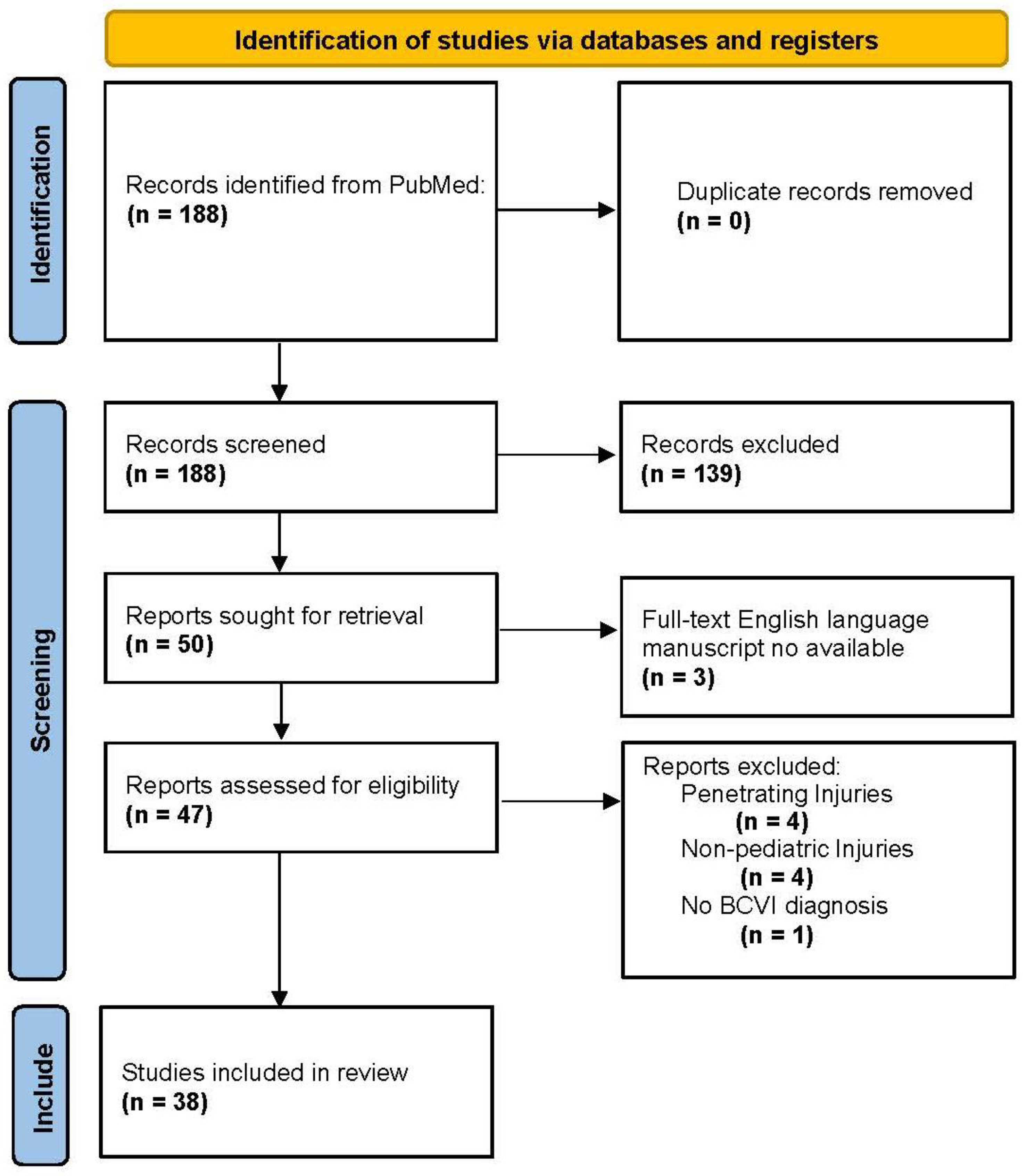
2. Materials and Methods
3. Results/Discussion
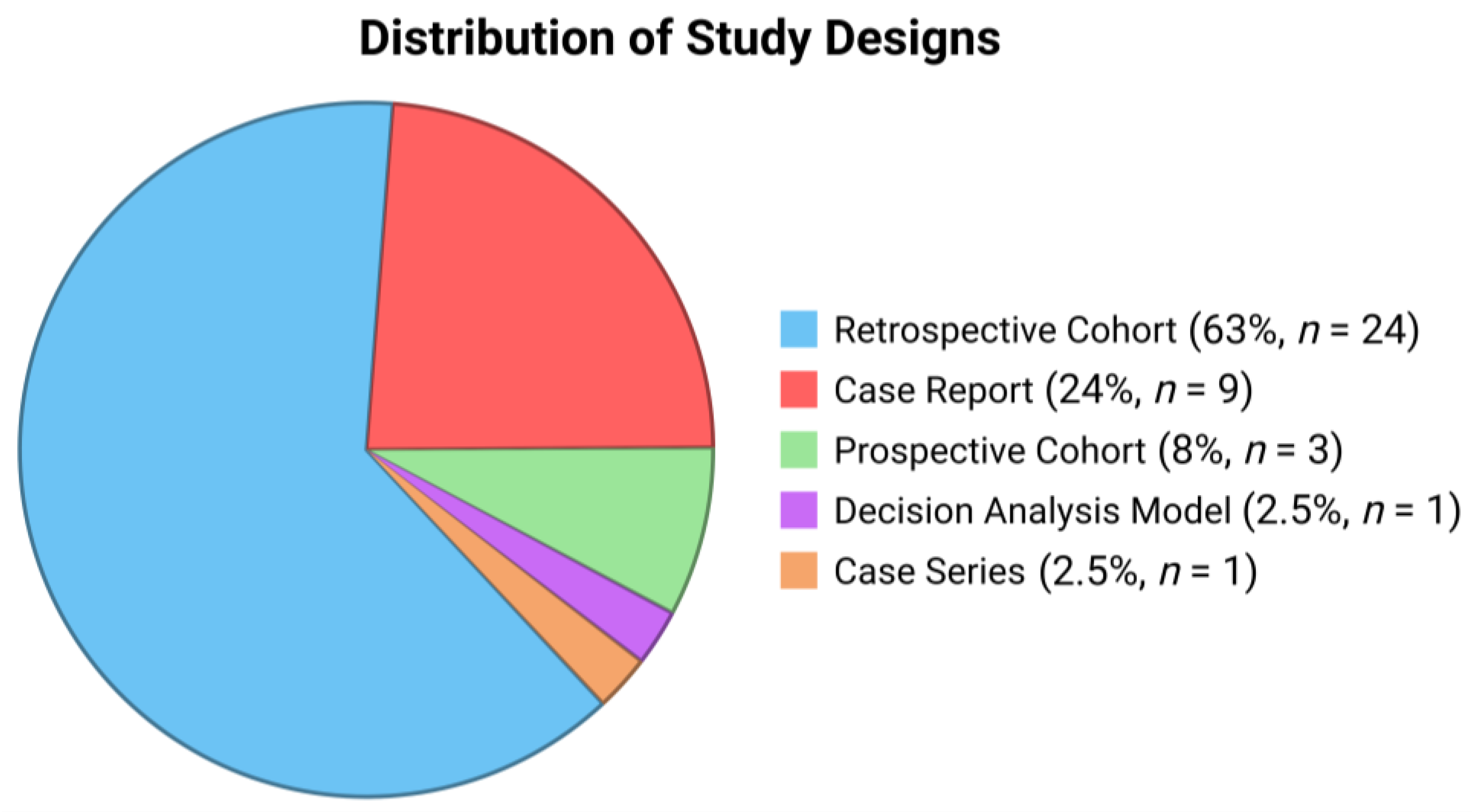
3.1. Manuscripts Reviewed
3.2. Mechanisms of Injury
3.3. Physical Exam, Associated Injuries, Screening Criteria, and Diagnostic Evaluation
3.3.1. Physical Exam
3.3.2. Associated Injuries
3.3.3. Screening Criteria
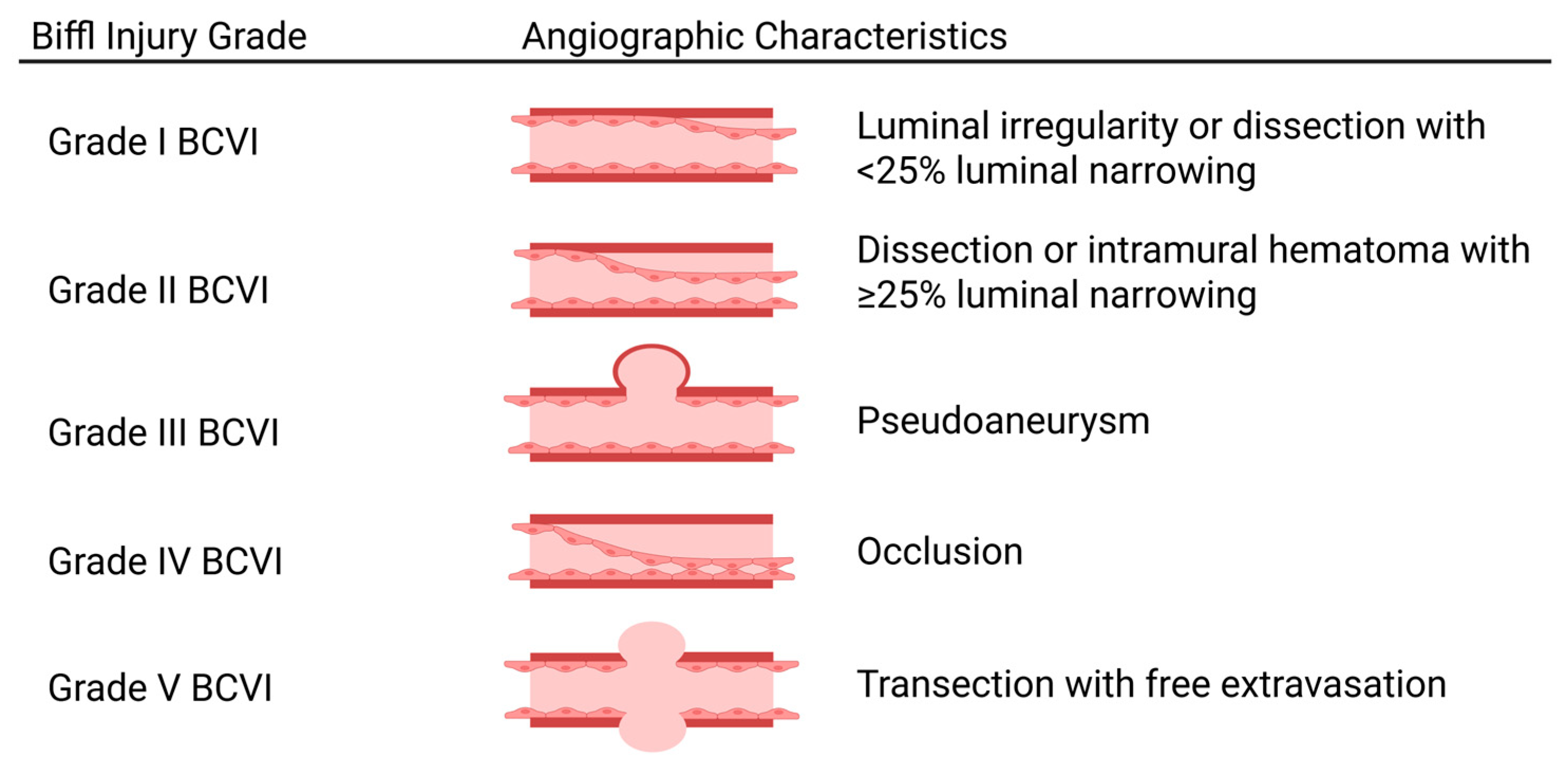
3.3.4. Diagnostics and Angiographic Grading
3.4. Vessels Affected, Treatment, and Outcomes
3.4.1. Vessels Affected
3.4.2. Treatment and Associated Complications
3.4.3. Outcomes
3.4.4. Follow-Up
3.5. Limitations
4. Conclusions
Author Contributions
Funding
Institutional Review Board Statement
Informed Consent Statement
Data Availability Statement
Acknowledgments
Conflicts of Interest
Abbreviations
| BA | Basilar Artery |
| BCVI | Blunt Cerebrovascular Injury |
| CCA | Common Carotid Artery |
| CT | Computed Tomography |
| CTA | Computed Tomography Angiography |
| DSA | Digital Subtraction Angiography |
| GCS | Glasgow Coma Scale |
| ICA | Internal Carotid Artery |
| ICH | Intracranial Hemorrhage |
| ICU | Intensive Care Unit |
| ISS | Injury Severity Scale |
| LMWH | Low-Molecular-Weight Heparin |
| MOI | Mechanism of Injury |
| MRA | Magnetic Resonance Angiography |
| MRI | Magnetic Resonance Imaging |
| MVC | Motor Vehicle Collision |
| PVA | Pedestrian vs. Automobile |
| TBI | Traumatic Brain Injury |
| UFH | Unfractionated Heparin |
| US | Ultrasound |
| VA | Vertebral Artery |
References
- Black, J.A.; Abraham, P.J.; Abraham, M.N.; Cox, D.B.; Griffin, R.L.; Holcomb, J.B.; Hu, P.J.; Kerby, J.D.; Liptrap, E.J.; Tachi, B.; et al. Universal screening for blunt cerebrovascular injury. J. Trauma Acute Care Surg. 2021, 90, 224–231. [Google Scholar] [CrossRef]
- Lewit, R.A.; Nickoles, T.A.; Williams, R.; Notrica, D.M.; Stottlemyre, R.L.; Ryan, M.; Johnson, J.J.; Naiditch, J.A.; Lawson, K.A.; Maxson, R.T.; et al. Blunt cerebrovascular injury in children: A prospective multicenter ATOMAC+ study. J. Trauma Acute Care Surg. 2025, 99, 245–252. [Google Scholar] [CrossRef]
- Bromberg, W.J.; Collier, B.C.; Diebel, L.N.; Dwyer, K.M.; Holevar, M.R.; Jacobs, D.G.; Kurek, S.J.; Schreiber, M.A.; Shapiro, M.L.; Vogel, T.R. Blunt cerebrovascular injury practice management guidelines: The Eastern Association for the Surgery of Trauma. J. Trauma Acute Care Surg. 2010, 68, 471–477. [Google Scholar] [CrossRef] [PubMed]
- Burlew, C.C.; Biffl, W.L.; Moore, E.E.; Barnett, C.C.; Johnson, J.L.; Bensard, D.D. Blunt cerebrovascular injuries: Redefining screening criteria in the era of noninvasive diagnosis. J. Trauma Acute Care Surg. 2012, 72, 330–335; discussion 6–7, quiz 539. [Google Scholar] [CrossRef]
- Nickoles, T.A.; Lewit, R.A.; Notrica, D.M.; Ryan, M.; Johnson, J.; Maxson, R.T.; Naiditch, J.A.; Lawson, K.A.; Temkit, M.; Padilla, B.; et al. Diagnostic accuracy of screening tools for pediatric blunt cerebrovascular injury: An ATOMAC multicenter study. J. Trauma Acute Care Surg. 2023, 95, 327–333. [Google Scholar] [CrossRef]
- Herbert, J.P.; Venkataraman, S.S.; Turkmani, A.H.; Zhu, L.; Kerr, M.L.; Patel, R.P.; Ugalde, I.T.; Fletcher, S.A.; Sandberg, D.I.; Cox, C.S.; et al. Pediatric blunt cerebrovascular injury: The McGovern screening score. J. Neurosurg. Pediatr. 2018, 21, 639–649. [Google Scholar] [CrossRef]
- Ravindra, V.M.; Bollo, R.J.; Sivakumar, W.; Akbari, H.; Naftel, R.P.; Limbrick, D.D.; Jea, A.; Gannon, S.; Shannon, C.; Yekaterina, B.; et al. Predicting Blunt Cerebrovascular Injury in Pediatric Trauma: Validation of the “Utah Score”. J. Neurotrauma 2017, 34, 391–399. [Google Scholar] [CrossRef]
- Dawson-Gore, C.C.; Myers, E.K.; Cooper, E.H.; Evans, L.L.; Schauer, S.G.; Acker, S. The smallest suffer stroke: Understanding stroke and treatment patterns in children with blunt cerebrovascular injury within the Trauma Quality Improvement Program database. Surgery 2025, 183, 109353. [Google Scholar] [CrossRef]
- Dewan, M.C.; Ravindra, V.M.; Gannon, S.; Prather, C.T.; Yang, G.L.; Jordan, L.; Limbrick, D.; Jea, A.; Riva-Cambrin, J.; Naftel, R. Treatment Practices and Outcomes After Blunt Cerebrovascular Injury in Children. Neurosurgery 2016, 79, 872–878. [Google Scholar] [CrossRef]
- Weber, C.D.; Lefering, R.; Weber, M.S.; Bier, G.; Knobe, M.; Pishnamaz, M.; Kobbe, P.; Hildebrand, F. Predictors for Pediatric Blunt Cerebrovascular Injury (BCVI): An International Multicenter Analysis. World J. Surg. 2019, 43, 2337–2347. [Google Scholar] [CrossRef] [PubMed]
- Golubkova, A.A.; Liebe, H.L.; Leiva, T.D.; Stewart, K.E.; Sarwar, Z.; Hunter, C.J.; Johnson, J. Blunt Cerebrovascular Injury in Pediatric Hanging Victims. Am. Surg. 2023, 89, 5897–5903. [Google Scholar] [CrossRef]
- Nickoles, T.A.; Eubanks, J.W.; Lewit, R.A.; Siddique, R.; Notrica, D.M.; Stottlemyre, R.L.; Ryan, M.; Johnson, J.; Maxson, R.T.; Naiditch, J.A.; et al. The A+ criteria for pediatric blunt cerebrovascular injury: An ATOMAC+ multicenter study. J. Trauma Acute Care Surg. 2025, 99, 404–411. [Google Scholar] [CrossRef] [PubMed]
- Grigorian, A.; Dolich, M.; Lekawa, M.; Fujitani, R.M.; Kabutey, N.K.; Kuza, C.M.; Bashir, R.; Nahmias, J. Analysis of blunt cerebrovascular injury in pediatric trauma. J. Trauma Acute Care Surg. 2019, 87, 1354–1359. [Google Scholar] [CrossRef]
- Sainz, D.B.; Howell, E.C.; Grayeb, D.R.; Barlas, Y.; Gonzalez, D.; Miskimins, R. Analyzing computed tomography Modalities for screening pediatric patients for traumatic blunt cerebrovascular injury. Am. J. Surg. 2024, 238, 115859. [Google Scholar] [CrossRef]
- Najar, D.A.; Cardenas-Turanzas, M.; King, J.; Shah, M.N.; Cox, C.S.; Ugalde, I.T. Risk Factors for Blunt Cerebrovascular Injury in a Cohort of Pediatric Patients with Cervical Seat Belt Sign. Pediatr. Emerg. Care 2024, 40, 359–363. [Google Scholar] [CrossRef]
- Ugalde, I.T.; Claiborne, M.K.; Cardenas-Turanzas, M.; Shah, M.N.; Langabeer, J.R.; Patel, R. Risk Factors in Pediatric Blunt Cervical Vascular Injury and Significance of Seatbelt Sign. West. J. Emerg. Med. 2018, 19, 961–969. [Google Scholar] [CrossRef]
- Asaadi, S.; Rosenthal, M.G.; Radulescu, A.; Mukherjee, K.; Luo-Owen, X.; Dubose, J.J.; Tabrizi, M.B. Pediatric Versus Adult Blunt Cerebrovascular Injuries: Patients Characteristics, Management, and Outcomes. Ann. Vasc. Surg. 2025, 116, 1–8. [Google Scholar] [CrossRef]
- Venkataraman, S.S.; Herbert, J.P.; Ravindra, V.M.; Yu, B.N.; Bollo, R.J.; Cox, C.S.; Gannon, S.R.; Limbrick, D.D., Jr.; Naftel, R.P.; Ugalde, I.T.; et al. Multi-Center Validation of the McGovern Pediatric Blunt Cerebrovascular Injury Screening Score. J. Neurotrauma 2023, 40, 1451–1458. [Google Scholar] [CrossRef]
- Long, M.K.; Arevalo, O.; Ugalde, I.T. Case Series of Adolescents with Stroke-Like Symptoms Following Head Trauma. J. Emerg. Med. 2019, 56, 554–559. [Google Scholar] [CrossRef] [PubMed]
- Campbell, A.L.; Xuan, D.; Balaraman, P.; Tatum, D.; Yorkgitis, B.; Yu, D.; McGrew, P.; Zhang, J.; Harrell, K.; Duchesne, J.; et al. Cost Effectiveness of Pediatric Blunt Cerebrovascular Injury Screening: A Decision Tree Analysis. J. Pediatr. Surg. 2025, 60, 162296. [Google Scholar] [CrossRef] [PubMed]
- Nickoles, T.A.; Lewit, R.A.; Notrica, D.M.; Ryan, M.; Johnson, J.; Maxson, R.T.; Naiditch, J.A.; Lawson, K.A.; Temkit, M.; Padilla, B.; et al. Lower incidence of blunt cerebrovascular injury among young, properly restrained children: An ATOMAC multicenter study. J. Trauma Acute Care Surg. 2023, 95, 334–340. [Google Scholar] [CrossRef]
- Kopelman, T.R.; Berardoni, N.E.; O’Neill, P.J.; Hedayati, P.; Vail, S.J.; Pieri, P.G.; Feiz-Erfa, I.; Pressman, M.A. Risk factors for blunt cerebrovascular injury in children: Do they mimic those seen in adults? J. Trauma Inj. Infect. Crit. Care 2011, 71, 559–564; discussion 64. [Google Scholar] [CrossRef]
- Leraas, H.J.; Kuchibhatla, M.; Nag, U.P.; Kim, J.; Ezekian, B.; Reed, C.R.; Rice, H.E.; Tracy, E.T.; Adibe, O.O. Cervical seatbelt sign is not associated with blunt cerebrovascular injury in children: A review of the national trauma databank. Am. J. Surg. 2019, 218, 100–105. [Google Scholar] [CrossRef]
- Savoie, K.B.; Shi, J.; Wheeler, K.; Xiang, H.; Kenney, B.D. Pediatric blunt cerebrovascular injuries: A national trauma database study. J. Pediatr. Surg. 2020, 55, 917–920. [Google Scholar] [CrossRef]
- Harris, D.A.; Sorte, D.E.; Lam, S.K.; Carlson, A.P. Blunt cerebrovascular injury in pediatric trauma: A national database study. J. Neurosurg. Pediatr. 2019, 24, 451–460. [Google Scholar] [CrossRef] [PubMed]
- Azarakhsh, N.; Grimes, S.; Notrica, D.M.; Raines, A.; Garcia, N.M.; Tuggle, D.W.; Maxson, R.T.; Alder, A.C.; Recicar, J.; Garcia-Filion, P.; et al. Blunt cerebrovascular injury in children: Underreported or underrecognized?: A multicenter ATOMAC study. J. Trauma Acute Care Surg. 2013, 75, 1006–1011; discussion 11–12. [Google Scholar] [CrossRef]
- Cook, M.R.; Witt, C.E.; Bonow, R.H.; Bulger, E.M.; Linnau, K.F.; Arbabi, S.; Robinson, B.R.; Cuschieri, J. A cohort study of blunt cerebrovascular injury screening in children: Are they just little adults? J. Trauma Acute Care Surg. 2018, 84, 50–57. [Google Scholar] [CrossRef]
- Schonenberg Llach, M.; Fishe, J.N.; Yorkgitis, B.K. Implementation of a dual cervical spine and blunt cerebrovascular injury assessment pathway for pediatric trauma patients. Am. J. Emerg. Med. 2021, 47, 74–79. [Google Scholar] [CrossRef]
- Gorski, J.K.; Smith, C.M.; Ramgopal, S. Injury patterns and mortality associated with near-hanging in children. Am. J. Emerg. Med. 2024, 75, 83–86. [Google Scholar] [CrossRef] [PubMed]
- Kawakami, K.; Oyama, Y.; Watanabe, Y.; Motoi, H.; Odaka, M.; Shiga, K.; Ito, S. Delayed internal carotid artery occlusion and paralysis after oral trauma. Pediatr. Int. 2023, 65, e15594. [Google Scholar] [CrossRef] [PubMed]
- Desai, N.K.; Kang, J.; Chokshi, F.H. Screening CT angiography for pediatric blunt cerebrovascular injury with emphasis on the cervical “seatbelt sign”. Am. J. Neuroradiol. 2014, 35, 1836–1840. [Google Scholar] [CrossRef] [PubMed]
- Ravindra, V.M.; Bollo, R.J.; Dewan, M.C.; Riva-Cambrin, J.K.; Tonetti, D.; Awad, A.W.; Akbari, S.H.; Gannon, S.; Shanon, C.; Birkas, Y.; et al. Comparison of anticoagulation and antiplatelet therapy for treatment of blunt cerebrovascular injury in children <10 years of age: A multicenter retrospective cohort study. Childs Nerv. Syst. 2021, 37, 47–54. [Google Scholar] [CrossRef]
- Capone, C.; Burjonrappa, S. Congenital spine deformities: A new screening indication for blunt cerebrovascular injuries after cervical trauma? J. Pediatr. Surg. 2010, 45, 2444–2446. [Google Scholar] [CrossRef]
- Moyer, J.D.; Dioguardi Burgio, M.; Abback, P.S.; Gauss, T. Isolated basilar artery dissection following blunt trauma challenging the Glasgow coma score: A case report. Am. J. Emerg. Med. 2021, 47, 347.e1–347.e3. [Google Scholar] [CrossRef]
- Hon, K.; Roach, D.; Dawson, J. A case report of blunt intraoral cerebrovascular injury in a child following intraoral trauma: The pen is mightier than the sword. Trauma Case Rep. 2022, 37, 100567. [Google Scholar] [CrossRef]
- Becker, A.; Ashkenazi, D.; Hershko, D. Blunt cerebrovascular injury: Early recognition and treatment options in asymptomatic patient. ANZ J. Surg. 2019, 89, E166–E167. [Google Scholar] [CrossRef]
- Uebelacker, M.C.; Rago, A.; Fahmy, J.; Farish, A. Severe Pediatric Polytrauma Complicated by Stroke After Fall from Swamp Buggy. Cureus 2025, 17, e87067. [Google Scholar] [CrossRef]
- Zaghlool, D.; Franz, R. Treatment of a high large extracranial carotid artery pseudoaneurysm from trauma using a Viabahn graft. Ann. Vasc. Surg. 2015, 29, 837.e1–837.e7. [Google Scholar] [CrossRef] [PubMed]
- Duyu, M.; Yıldız, S.; Bulut, İ.; Karakaya, Z.; Buz, A.; Bozbeyoğlu, G. Internal carotid artery dissection following blunt head trauma: A pediatric case report and review of the literature. Turk. J. Pediatr. 2020, 62, 1077–1087. [Google Scholar] [CrossRef]
- Nicosia, G.; Cicala, D.; Mirone, G.; Spennato, P.; Trischitta, V.; Ruggiero, C.; Guarneri, G.; Muto, M.; Cinalli, G. Childhood acute basilar artery thrombosis successfully treated with mechanical thrombectomy using stent retrievers: Case report and review of the literature. Childs Nerv. Syst. 2017, 33, 349–355. [Google Scholar] [CrossRef] [PubMed]
- Becker, L.; Krüger, L.; Wolf, M.; Alfen, K.; Theysohn, J.; Lefering, R.; Dudda, M.; Kamp, O. The necessity of CT scans on pediatric carotid injury after blunt trauma—An analysis of the traumaregister DGU. Eur. J. Trauma Emerg. Surg. 2026, 52, 13. [Google Scholar] [CrossRef]
- Osorio, R.G.; Johnson, A.B.; Neff, L.P.; Riera, K.M.; Petty, J.K.; Couture, D.E.; Kramer, C.L.; Venkataraman, S.S.; Saha, A.K.; McCrory, M.C. Screening Pediatric Trauma Patients for Blunt Cerebrovascular Injury Using the McGovern Score: A Retrospective Cohort Study. Pediatr. Emerg. Care 2026, 42, 346–352. [Google Scholar] [CrossRef]
- Arthurs, Z.M.; Starnes, B.W. Blunt carotid and vertebral artery injuries. Injury 2008, 39, 1232–1241. [Google Scholar] [CrossRef]
- Brenner, D.J.; Hall, E.J. Computed tomography—An increasing source of radiation exposure. N. Engl. J. Med. 2007, 357, 2277–2284. [Google Scholar] [CrossRef]
- Shih, R.Y.; Burns, J.; Ajam, A.A.; Broder, J.S.; Chakraborty, S.; Kendi, A.T.; Lacy, M.E.; Ledbetter, L.N.; Lee, R.K.; Liebeskind, D.S.; et al. ACR Appropriateness Criteria® Head Trauma: 2021 Update. J. Am. Coll. Radiol. 2021, 18, S13–S36. [Google Scholar] [CrossRef]
- Kik, C.C.; Slooff, W.M.; Moayeri, N.; de Jong, P.A.; Muijs, S.P.J.; Öner, F.C. Diagnostic accuracy of computed tomography angiography (CTA) for diagnosing blunt cerebrovascular injury in trauma patients: A systematic review and meta-analysis. Eur. Radiol. 2022, 32, 2727–2738. [Google Scholar] [CrossRef]
- Eastman, A.L.; Chason, D.P.; Perez, C.L.; McAnulty, A.L.; Minei, J.P. Computed tomographic angiography for the diagnosis of blunt cervical vascular injury: Is it ready for primetime? J. Trauma Inj. Infect. Crit. Care 2006, 60, 925–929; discussion 9. [Google Scholar] [CrossRef]
- Paulus, E.M.; Fabian, T.C.; Savage, S.A.; Zarzaur, B.L.; Botta, V.; Dutton, W.; Croce, M.A. Blunt cerebrovascular injury screening with 64-channel multidetector computed tomography: More slices finally cut it. J. Trauma Acute Care Surg. 2014, 76, 279–283; discussion 84–85. [Google Scholar] [CrossRef]
- Smith-Bindman, R.; Alber, S.A.; Kwan, M.L.; Pequeno, P.; Bolch, W.E.; Bowles, E.J.A.; Greenlee, R.T.; Stout, N.K.; Weinmann, S.; Moy, L.M.; et al. Medical Imaging and Pediatric and Adolescent Hematologic Cancer Risk. N. Engl. J. Med. 2025, 393, 1269–1278. [Google Scholar] [CrossRef] [PubMed]
- Marin, J.R.; Lyons, T.W.; Claudius, I.; Fallat, M.E.; Aquino, M.; Ruttan, T.; Daugherty, R.J. Optimizing Advanced Imaging of the Pediatric Patient in the Emergency Department: Technical Report. Pediatrics 2024, 154, e2024066855. [Google Scholar] [CrossRef]
- Miller, P.R.; Fabian, T.C.; Croce, M.A.; Cagiannos, C.; Williams, J.S.; Vang, M.; Qaisi, W.G.; Felker, R.E.; Timmons, S.D. Prospective screening for blunt cerebrovascular injuries: Analysis of diagnostic modalities and outcomes. Ann. Surg. 2002, 236, 386–393; discussion 93–95. [Google Scholar] [CrossRef]
- Lévy, C.; Laissy, J.P.; Raveau, V.; Amarenco, P.; Servois, V.; Bousser, M.G.; Tubiana, J.M. Carotid and vertebral artery dissections: Three-dimensional time-of-flight MR angiography and MR imaging versus conventional angiography. Radiology 1994, 190, 97–103. [Google Scholar] [CrossRef] [PubMed]
- Yaghi, S.; Engelter, S.; Del Brutto, V.J.; Field, T.S.; Jadhav, A.P.; Kicielinski, K.; Madsen, T.E.; Mistry, E.A.; Omran, S.S.; Pandey, A.; et al. Treatment and Outcomes of Cervical Artery Dissection in Adults: A Scientific Statement from the American Heart Association. Stroke 2024, 55, e91–e106. [Google Scholar] [CrossRef]
- Ferriero, D.M.; Fullerton, H.J.; Bernard, T.J.; Billinghurst, L.; Daniels, S.R.; DeBaun, M.R.; deVeber, G.; Ichord, R.N.; Jordan, L.C.; Massicotte, P.; et al. Management of Stroke in Neonates and Children: A Scientific Statement from the American Heart Association/American Stroke Association. Stroke 2019, 50, e51–e96. [Google Scholar] [CrossRef]
- Dyer, M.R.; Garvey, J.; Andraska, E.; Brown, J.B.; Eslami, M.H.; Makaroun, M.S.; Chaer, R.A. Routine angiography is not indicated in patients with blunt cerebrovascular injury. J. Vasc. Surg. 2025, 82, 867–874.e1. [Google Scholar] [CrossRef]
- Mutze, S.; Rademacher, G.; Matthes, G.; Hosten, N.; Stengel, D. Blunt cerebrovascular injury in patients with blunt multiple trauma: Diagnostic accuracy of duplex Doppler US and early CT angiography. Radiology 2005, 237, 884–892. [Google Scholar] [CrossRef]
- Biffl, W.L.; Moore, E.E.; Offner, P.J.; Brega, K.E.; Franciose, R.J.; Burch, J.M. Blunt carotid arterial injuries: Implications of a new grading scale. J. Trauma Inj. Infect. Crit. Care 1999, 47, 845–853. [Google Scholar] [CrossRef] [PubMed]
- Desouza, R.M.; Crocker, M.J.; Haliasos, N.; Rennie, A.; Saxena, A. Blunt traumatic vertebral artery injury: A clinical review. Eur. Spine J. 2011, 20, 1405–1416. [Google Scholar] [CrossRef]
- Kim, D.Y.; Biffl, W.; Bokhari, F.; Brackenridge, S.; Chao, E.; Claridge, J.A.; Fraser, D.; Jawa, R.; Kasotakis, G.; Kerwin, A.; et al. Evaluation and management of blunt cerebrovascular injury: A practice management guideline from the Eastern Association for the Surgery of Trauma. J. Trauma Acute Care Surg. 2020, 88, 875–887. [Google Scholar] [CrossRef]



| Inclusion Criteria | Exclusion Criteria |
|---|---|
| Pediatric patient population <18 years old | Non-pediatric patient population ≥18 years old |
| BCVI diagnosis and/or treatment | No BCVI diagnosis or treatment |
| Review or commentary lacking original data | |
| Penetrating injuries | |
| Full-text article not accessible in the English language |
| Title | Authors | Study Design | Age Range (Years) | BCVI Cohort Size | Screening Criteria | Diagnostic Modality | Vascular Injuries Identified | Denver (Biffl) Injury Grade | Treatment Strategy | Proportion of Patients with Cerebrovascular Complication | Major Limitations | Reference |
|---|---|---|---|---|---|---|---|---|---|---|---|---|
| Predictors for Pediatric Blunt Cerebrovascular Injury (BCVI): An International Multicenter Analysis | Weber CD, Lefering R, Weber MS, Bier G, Knobe M, Pishnamaz M, Kobbe P, Hildebrand F; TraumaRegister DGU | Retrospective cohort study | 0–17 | 42 patients | Screening criteria not specified | CTA | 35 carotid injuries—20 dissections, 5 ruptures/pseudoaneurysms, and 5 bilateral injuries 13 vertebral injuries—5 dissections, 2 transections, 4 occlusions, and 1 bilateral injury | Not reported | Not reported | 8.30% | Does not give detailed insights into the onset and course of neurologic symptoms, other than pupil reaction and GCS values; Biffl scale not reported | [10] |
| Blunt Cerebrovascular Injury in Pediatric Hanging Victims | Golubkova AA, Liebe HL, Leiva TD, Stewart KE, Sarwar Z, Hunter CJ, Johnson JJ | Retrospective cohort study | 0–17 | 10 patients | Screening criteria not specified | CTA | 17 carotid artery injuries and 1 vertebral artery injury | Not reported | No antiplatelet prophylaxis reported | 0% | Completeness of data reported to database, many charts not filled out completely; Biffl scale not reported | [11] |
| Pediatric blunt cerebrovascular injury: the McGovern screening score | Herbert JP, Venkataraman SS, Turkmani AH, Zhu L, Kerr ML, Patel RP, Ugalde IT, Fletcher SA, Sandberg DI, Cox CS, Kitagawa RS, Day AL, Shah MN | Retrospective cohort study | 0–15 | 21 patients | McGovern score | CTA (64%), MRA (23%), DSA (1%), and Combination of modalities (11%) | 16 carotid artery injuries and 5 vertebral artery injuries | Grade I—4 injuries, Grade II—7 injuries, Grade III—5 injuries, Grade IV—4 injuries, Grade V—1 injury | 8/21 patients managed with observation alone; 13/21 patients received medical therapy (12 received antiplatelet and 1 received anticoagulation though it was for the treatment of a deep venous sinus thrombosis) | 2/21 patients upon admission and 4/21 patients developed strokes within 24–96 h despite initial antiplatelet therapy | Single-center study | [6] |
| The A+ criteria for pediatric blunt cerebrovascular injury: An ATOMAC+ multicenter study | Nickoles TA, Eubanks JW 3rd, Lewit RA, Siddique R, Notrica DM, Stottlemyre RL, Ryan M, Johnson J, Maxson RT, Naiditch JA, Lawson KA, Williams R | Prospective, multi-institutional observational study | 0–15 | 25 patients | Memphis criteria | CTA | 24 carotid artery injuries and 5 vertebral artery injuries | Not reported | Not reported | 20% | Timing of screening and adherence to the screening protocol was not strictly controlled or measured | [12] |
| Analysis of blunt cerebrovascular injury in pediatric trauma | Grigorian A, Dolich M, Lekawa M, Fujitani RM, Kabutey NK, Kuza CM, Bashir R, Nahmias J | Retrospective cohort study | 0–16 | 109 patients | Screening criteria not specified | Not specified | 106 carotid artery injuries and 3 vertebral artery injuries | Not reported | 107/109 patients treated nonoperatively and 2/109 underwent endovascular intervention; medical management not specified | 2.80% | Does not report Biffl grades of BCVIs and does not indicate which, if any, patients underwent medical therapy | [13] |
| Analyzing computed tomography Modalities for screening pediatric patients for traumatic blunt cerebrovascular injury | Sainz DB, Howell EC, Grayeb DR, Barlas Y, Gonzalez D, Miskimins R | Retrospective cohort study | 0–17 | 7 patients | 1/2 study used expanded Denver criteria and 1/2 study used universal CTA for high-energy blunt traumatic mechanisms | CTA | 7 carotid artery injuries | Grade I—6 injuries, Grade II—1 injury | 6/7 patients treated with antiplatelet therapy and 1/7 managed with observation alone due to contraindications to antiplatelet therapy | 0% | Single-center study and small sample size | [14] |
| Blunt cerebrovascular injury in children: A prospective multicenter ATOMAC+ study | Lewit RA, Nickoles TA, Williams R, Notrica DM, Stottlemyre RL, Ryan M, Johnson JJ, Naiditch JA, Lawson KA, Maxson RT, Grimes S, Eubanks JW 3rd | Retrospective, multi-institutional observational study | 0–14 | 25 patients | Memphis criteria | CTA (34%), MRA (5%), and DSA (0.2%) | 22 carotid artery injuries and 6 vertebral artery injuries | Grade I—14 injuries, Grade II—6 injuries, Grade III—0 injuries, Grade IV—5 injuries, Grade V—1 injury | 14/25 patients managed with observation alone (3/14 due to contraindications to therapy), 2/25 patients managed with antiplatelet therapy alone, 2/25 patients managed with anticoagulation alone, 4/25 patients managed with a combination of therapies, and 1/25 patient managed endovascularly | 24% | Single-center study with a low compliance with the study protocol screening algorithm | [2] |
| Risk Factors for Blunt Cerebrovascular Injury in a Cohort of Pediatric Patients With Cervical Seat Belt Sign | Najar DA, Cardenas-Turanzas M, King J, Shah MN, Cox CS, Ugalde IT | Retrospective cohort study | 0–17 | 11 patients | McGovern score | CTA | 8 carotid artery injuries and 8 vertebral artery injuries | Grade I—4 injuries, Grade II—4 injuries, Grade III—4 injuries, Grade IV—4 injuries, Grade V—0 injuries | 3/11 patients managed with observation alone (1/3 had non-brain death), 5/11 patients managed with antiplatelet therapy alone, 1/11 patients managed with anticoagulation alone, and 2/11 patients managed with a combination of therapies | 0% | Prolonged data collection period wherein screening patterns may have changed, single-center study, and small sample size | [15] |
| Risk Factors in Pediatric Blunt Cervical Vascular Injury and Significance of Seatbelt Sign | Ugalde IT, Claiborne MK, Cardenas-Turanzas M, Shah MN, Langabeer JR 2nd, Patel R | Retrospective cohort study | 0–17 | 53 patients | Screening criteria not specified | CTA | Number of carotid injuries and number of vertebral injuries not specified; 63 cervical vascular lesions identified in total | Grade I—21 injuries, Grade II—14 injuries, Grade III—13 injuries, Grade IV—14 injuries, Grade V—0 injuries | 10/53 patients managed with observation alone, 5 patients died, 29/53 patients managed with antiplatelet therapy alone, 7/53 patients managed with anticoagulation alone, 2/53 patients managed with surgery/invasive approach | 19% | Prolonged data collection period wherein screening patterns may have changed, single-center study | [16] |
| Pediatric Versus Adult Blunt Cerebrovascular Injuries: Patients Characteristics, Management, and Outcomes | Asaadi S, Rosenthal MG, Radulescu A, Mukherjee K, Luo-Owen X, Dubose JJ, Tabrizi MB; AAST PROOVIT Study Group | Retrospective cohort study | 0–17 | 38 patients | Screening criteria not specified | CTA (79%) or angiography during intervention | 27 carotid artery injuries and 11 vertebral artery injuries | Grade I and II—24 injuries, Grade III—5 injuries, Grade IV—7 injuries, Grade V—2 injuries | 11/38 patients managed with observation alone, 19/38 patients managed with antiplatelet therapy alone, 10/38 patients managed with anticoagulation alone, 26/38 managed medically, and 1/38 patients managed with surgery/invasive approach | 8% | Unspecified screening criteria and unclear timing and dosage of medical therapy | [17] |
| Multi-Center Validation of the McGovern Pediatric Blunt Cerebrovascular Injury Screening Score | Venkataraman SS, Herbert JP, Ravindra VM, Yu BN, Bollo RJ, Cox CS Jr, Gannon SR, Limbrick DD Jr, Naftel RP, Ugalde IT, Yorkgitis BK, Weiner HL, Shah MN | Retrospective cohort study | 0–15 | 72 patients | McGovern score | CTA | Number of carotid injuries and number of vertebral injuries not specified | Grade I—34 injuries, Grade II—19 injuries, Grade III—10 injuries, Grade IV—7 injuries, Grade V—2 injuries | 33/72 patients managed with observation alone, 26/72 patients managed with antiplatelet therapy alone, 9/72 patients managed with anticoagulation alone (1/9 for management of DVT), and 4/72 patients managed with surgery/invasive approach | 19% | Exclusion of patients who underwent MRA or DSA may have led to underestimation of incidence of injuries | [18] |
| Case Series of Adolescents With Stroke-Like Symptoms Following Head Trauma | Long MK, Arevalo O, Ugalde IT | Case series | 14–16 | 2 patients | Screening criteria not specified | CTA and MRI | 2 carotid artery injuries | Not reported | Both patients were managed with an endovascular approach and a combination of antiplatelet and anticoagulant regimens | 1 | Single-center study and small sample size | [19] |
| Cost Effectiveness of Pediatric Blunt Cerebrovascular Injury Screening: A Decision Tree Analysis | Campbell AL, Xuan D, Balaraman P, Tatum D, Yorkgitis B, Yu D, McGrew P, Zhang J, Harrell K, Duchesne J, Shi L, Taghavi S | Decision tree analysis | 0–17 | Not reported | Model compared 7 screening modalities -Denver criteria -Expanded Denver criteria -Memphis criteria -McGovern criteria -Utah criteria -Universal screening -No screening | CTA | Not reported | Not reported | Aspirin is the most cost-effective treatment, though its clinical effectiveness was not evaluated by this analysis | Not reported | Model primarily focuses on cost-effectiveness of approaches to pediatric BCVIs rather than clinical outcomes | [20] |
| Lower incidence of blunt cerebrovascular injury among young, properly restrained children: An ATOMAC multicenter study | Nickoles TA, Lewit RA, Notrica DM, Ryan M, Johnson J, Maxson RT, Naiditch JA, Lawson KA, Temkit M, Padilla B, Eubanks JW 3rd | Prospective, multi-institutional observational study | 0–15 | 10 patients | Memphis criteria | CTA | 9 carotid artery injuries and 4 vertebral artery injuries | Grade I and II—11 injuries, Grade III—0 injuries, Grade IV—1 injury, Grade V—1 injury | Medical therapy not specified, but the patient with a Grade V injury underwent endovascular repair | 80% | Small sample size and limited power to evaluate effect of restraints on BCVIs | [21] |
| Diagnostic accuracy of screening tools for pediatric blunt cerebrovascular injury: An ATOMAC multicenter study | Nickoles TA, Lewit RA, Notrica DM, Ryan M, Johnson J, Maxson RT, Naiditch JA, Lawson KA, Temkit M, Padilla B, Eubanks JW 3rd | Prospective, multi-institutional observational study | 0–15 | 25 patients | Memphis criteria, though data for Denver, EAST, Utah, and McGovern scores were collected | CTA | Number of carotid injuries and number of vertebral injuries not specified | Grade I and II—19 injuries, Grade IV or V—6 injuries | Protocol treatment included systemic anticoagulation for those with multiple injuries and an antiplatelet regimen for those with isolated BCVIs; if the BCVIs had resolved by follow-up CTA at 7–10 days, medical therapy was discontinued, otherwise a neuro-interventional team at each site was consulted | 24% | Lack of diagnostic imaging among 86% of the overall cohort may missed clinically silent BCVIs No documentation of arteries affected | [5] |
| Risk factors for blunt cerebrovascular injury in children: do they mimic those seen in adults? | Kopelman TR, Berardoni NE, O’Neill PJ, Hedayati P, Vail SJ, Pieri PG, Feiz-Erfan I, Pressman MA | Retrospective cohort study | 0–14 | 11 patients | EAST | CTA | 9 carotid artery injuries and 2 vertebral artery injuries | Grade I—1 injury, Grade II—9 injuries, Grade III—2 injuries, Grade IV—1 injury, Grade V—0 injuries | 6/11 patients managed with observation alone (6 due to contraindications), 2/11 patients managed with antiplatelet therapy alone, and 2/11 patients managed with surgery/invasive approach | 38% | Single-center study and small sample size | [22] |
| Cervical seatbelt sign is not associated with blunt cerebrovascular injury in children: A review of the national trauma databank | Leraas HJ, Kuchibhatla M, Nag UP, Kim J, Ezekian B, Reed CR, Rice HE, Tracy ET, Adibe OO | Retrospective cohort study | 0–17 | 809 patients | Modified Denver and modified Memphis criteria | Not specified | 759 carotid artery injuries and 58 vertebral artery injuries | Not reported | Not reported | 7% | Unclear imaging and treatment patterns among patients screened | [23] |
| Pediatric blunt cerebrovascular injuries: A national trauma database study | Savoie KB, Shi J, Wheeler K, Xiang H, Kenney BD | Retrospective cohort study | 0–17 | 1682 patients | Screening criteria not specified | Not specified | 791 carotid artery injuries and 957 cerebral artery injuries | Not reported | Not reported | 3% | Unclear screening, imaging, and treatment patterns among BCVI patients | [24] |
| Blunt cerebrovascular injury in pediatric trauma: a national database study | Harris DA, Sorte DE, Lam SK, Carlson AP | Retrospective cohort study | 0–20 | 2150 patients | Screening criteria not specified | Not specified | Carotid artery injuries reported in 28% of cases and vertebral artery injuries in 7% of cases, though most injury locations could not be specified due to coding limitations | Not reported | Medical therapy not specified, but a total of 15 endovascular stenting procedures were performed in this cohort | 37% | Unclear screening, imaging, and medical management patterns among BCVI patients | [25] |
| Blunt cerebrovascular injury in children: underreported or underrecognized?: A multicenter ATOMAC study | Azarakhsh N, Grimes S, Notrica DM, Raines A, Garcia NM, Tuggle DW, Maxson RT, Alder AC, Recicar J, Garcia-Filion P, Greenwell C, Lawson KA, Wan JY, Eubanks JW 3rd | Retrospective cohort study | 0–14 | 23 patients | Memphis criteria | CTA (62%), MRA (38%), DSA (<1%) | 21 carotid artery injuries and 6 vertebral artery injuries | Grade I—9 injuries, Grade II—8 injuries, Grade III—2 injuries, Grade IV—4 injuries, Grade V—0 injuries | 16/23 patients managed with observation alone, 5/23 patients managed with antiplatelet therapy alone, and 2/23 patients managed with anticoagulation alone | 26% | Numerous BCVI patients did not initially meet screening criteria; BCVI rates may be higher than presented | [26] |
| A cohort study of blunt cerebrovascular injury screening in children: Are they just little adults? | Cook MR, Witt CE, Bonow RH, Bulger EM, Linnau KF, Arbabi S, Robinson BRH, Cuschieri J | Retrospective cohort study | 0–17 | 96 patients | EAST, Denver criteria (DC), and Utah score (US) | CTA (96%) and MRA (4%) | 83 internal carotid injuries and 45 vertebral injuries | Grade I—61 injuries, Grade II—34 injuries, Grade III—18 injuries, Grade IV—12 injuries, Grade V—3 injuries | 34/96 patients managed with observation alone, 57/96 patients managed with antiplatelet therapy alone, and 1/96 patients managed with an endovascular/invasive approach | 18% | Heterogeneity in medical management and underreporting of anticoagulant use | [27] |
| Implementation of a dual cervical spine and blunt cerebrovascular injury assessment pathway for pediatric trauma patients | Schonenberg Llach M, Fishe JN, Yorkgitis BK | Retrospective cohort study | 0–13 | 3 patients | Denver criteria | CTA | 1 carotid artery injury and 2 vertebral artery injuries | Grade II—3 injuries | Not reported | Not reported | Poor adherence to screening/diagnostic protocol; heterogeneity in documenting BCVIs | [28] |
| Treatment Practices and Outcomes After Blunt Cerebrovascular Injury in Children | Dewan MC, Ravindra VM, Gannon S, Prather CT, Yang GL, Jordan LC, Limbrick D, Jea A, Riva-Cambrin J, Naftel RP | Retrospective cohort study | 0–17 | 52 patients | Discretion of the treating trauma or cerebrovascular team | CTA | 47 carotid artery injuries and 10 vertebral artery injuries | Grade I—30 injuries, Grade II—12 injuries, Grade III—5 injuries, Grade IV—2 injuries, Grade V—1 injury | 24/52 patients managed with observation alone, 14/52 patients managed with antiplatelet therapy, 8/52 patients managed with anticoagulation, and 4/52 patients managed with open surgery/endovascular approach | 31% | Heterogeneous management approaches | [9] |
| Injury patterns and mortality associated with near-hanging in children | Gorski JK, Smith CM, Ramgopal S | Retrospective observational study | 0–17 | 17 patients | Screening criteria not specified | CTA or MRA | Not reported | Not reported | Not reported | Not reported | Decision to obtain neck angiography unclear, as are management approaches to the BCVIs in this study | [29] |
| The smallest suffer stroke: Understanding stroke and treatment patterns in children with blunt cerebrovascular injury within the Trauma Quality Improvement Program database | Dawson-Gore CC, Myers EK, Cooper EH, Evans LL, Schauer SG, Acker S | Retrospective cohort study | 0–17 | 2336 patients | Screening criteria not specified | CTA or MRA | Number of carotid injuries and number of vertebral injuries not specified | Grade I and II—1248 injuries, Grade III—40 injuries, Grade IV—412 injuries, Grade V—636 injuries | 52% of patients were managed with observation alone, 5% were managed with antiplatelet therapy, and 42% of patients were managed with anticoagulation | 4% | Timing of screening and timing of cerebrovascular complications unclear | [8] |
| Delayed internal carotid artery occlusion and paralysis after oral trauma | Kawakami K, Oyama Y, Watanabe Y, Motoi H, Odaka M, Shiga K, Ito S | Case report | 2 | 1 patient | Screening criteria not specified | CTA and MRA | 1 carotid artery injury | Grade IV | Patient managed with an antiplatelet regimen | 1/1 | Case report with limited generalizability | [30] |
| Screening CT angiography for pediatric blunt cerebrovascular injury with emphasis on the cervical “seatbelt sign” | Desai NK, Kang J, Chokshi FH | Retrospective cohort study | 0–17 | 8 patients | Screening criteria not specified | CTA | 5 carotid artery injuries and 4 vertebral artery injuries | Grade I—1 injury, Grade II—2 injuries, Grade III—1 injury, Grade IV—4 injuries, Grade V—0 injuries | Not reported | 25% | Heterogeneity in documenting cervical seatbelt sign and type of physical exam findings constitutes a cervical seatbelt sign | [31] |
| Comparison of anticoagulation and antiplatelet therapy for treatment of blunt cerebrovascular injury in children <10 years of age: a multicenter retrospective cohort study | Ravindra VM, Bollo RJ, Dewan MC, Riva-Cambrin JK, Tonetti D, Awad AW, Akbari SH, Gannon S, Shannon C, Birkas Y, Limbrick D, Jea A, Naftel RP, Kestle JR, Grandhi R | Retrospective cohort study | 0–9 | 17 patients | Discretion of the multidisciplinary treating team | CTA | 15 carotid artery injuries and 3 vertebral artery injuries | Grade I—7 injuries, Grade II—5 injuries, Grade III—1 injury, Grade IV—4 injuries, Grade V—0 injuries | 11/17 patients managed with antiplatelet therapy and 6/17 patients managed with anticoagulation | 47% | Heterogeneity in BCVI management algorithms and in the reporting of functional outcome measures | [32] |
| Congenital spine deformities: a new screening indication for blunt cerebrovascular injuries after cervical trauma? | Capone C, Burjonrappa S | Case report | 12 | 1 patient | Screening criteria not specified | CTA and Doppler ultrasound | 1 carotid artery injury | Grade II—1 injury | Patient started on systemic anticoagulation then switched to a combination antiplatelet and anticoagulation regimen; patient was ultimately discharged with a 6-month course of an antiplatelet monotherapy | 0/1 | Case report with limited generalizability | [33] |
| Isolated basilar artery dissection following blunt trauma challenging the Glasgow coma score: A case report | Moyer JD, Dioguardi Burgio M, Abback PS, Gauss T | Case report | 14 | 1 patient | Screening criteria not specified | CT scan | 1 basilar artery injury | Not reported | Contraindications to medical therapy and ultimate brain death | 1/1 | Case report with limited generalizability | [34] |
| A case report of blunt intraoral cerebrovascular injury in a child following intraoral trauma: The pen is mightier than the sword | Hon K, Roach D, Dawson J | Case report | 5 | 1 patient | Screening criteria not specified | CTA and Doppler ultrasound | 1 carotid artery injury | Grade II—1 injury | Antiplatelet monotherapy | 0/1 | Case report with limited generalizability | [35] |
| Blunt cerebrovascular injury: early recognition and treatment options in asymptomatic patient | Becker A, Ashkenazi D, Hershko D | Case report | 14 | 1 patient | Screening criteria not specified | CTA neck | 1 carotid artery injury | Grade III—1 injury | Open surgical repair | 1/1 | Case report with limited generalizability | [36] |
| Severe Pediatric Polytrauma Complicated by Stroke After Fall From Swamp Buggy | Uebelacker MC, Rago A, Fahmy J, Farish A | Case report | 4 | 1 patient | Screening criteria not specified | CTA | 1 carotid artery injury | Grade III—1 injury | Antiplatelet monotherapy | 1/1 | Case report with limited generalizability | [37] |
| Treatment of a high large extracranial carotid artery pseudoaneurysm from trauma using a Viabahn graft | David Zaghlool, and Randall Franz | Case report | 17 | 1 patient | Screening criteria not specified | CTA and DSA | 1 carotid artery injury | Grade III—1 injury | Anticoagulation and ultimately endovascular stent placement after follow-up imaging demonstrated progression | 0/1 | Case report with limited generalizability | [38] |
| Internal carotid artery dissection following blunt head trauma: a pediatric case report and review of the literature | Muhterem Duyu, Selin Yıldız, İrem Bulut, Zeynep Karakaya, Ayşenur Buz, Gülçin Bozbeyoğlu | Case report | 14 | 1 patient | Screening criteria not specified | MRI and CTA | 1 carotid artery injury | Not reported | Antiplatelet monotherapy | 0/1 | Case report with limited generalizability | [39] |
| Childhood acute basilar artery thrombosis successfully treated with mechanical thrombectomy using stent retrievers: case report and review of the literature | Giancarlo Nicosia, Domenico Cicala, Giuseppe Mirone, Pietro Spennato, Vincenzo Trischitta, Claudio Ruggiero, Gianluigi Guarneri, Mario Muto, Giuseppe Cinalli | Case report | 23 (months) | 1 patient | Screening criteria not specified | MRA | 1 vertebral artery injury | Grade IV—1 injury | Endovascular intervention | 1/1 | Case report with limited generalizability | [40] |
| The necessity of CT scans on pediatric carotid injury after blunt trauma-An analysis of the traumaregister DGU | Becker L, Krüger L, Wolf M, Alfen K, Theysohn J, Lefering R, Dudda M, Kamp O; Committee on Emergency Medicine, Intensive Care and Trauma Management (Sektion NIS) of the German Trauma Society (DGU), Germany | Retrospective cohort study | 0–15 | 50 patients | Screening criteria not specified | CT scan | 50 carotid artery injuries | Not reported | Not reported | Not reported | Limited reporting of BCVI management and cerebrovascular complications | [41] |
| Screening Pediatric Trauma Patients for Blunt Cerebrovascular Injury Using the McGovern Score: A Retrospective Cohort Study. | Osorio RG, Johnson AB, Neff LP, Riera KM, Petty JK, Couture DE, Kramer CL, Venkataraman SS, Saha AK, McCrory MC | Retrospective cohort study | 0–15 | 12 patients | McGovern criteria | CTA or MRA (if concurrent neurological deficit) | 12 carotid artery injuries and 6 vertebral artery injuries | Grade I—4 injuries, Grade II—5 injuries, Grade III—1 injury, Grade IV—2 injuries, Grade V—0 injuries | 6/12 patients managed with observation alone, 3/12 patients managed with antiplatelet therapy, 2/12 patients managed with anticoagulation, and 1/12 patients managed with an endovascular approach | 25% | Limited compliance with McGovern criteria | [42] |
| Screening Tool | Memphis Criteria | Utah Score | McGovern Score |
|---|---|---|---|
| Criteria |
|
|
|
| Indication for Imaging | Imaging indicated if any of the above criteria are met | Imaging indicated if patient presents with 3 or more points | Imaging indicated if patient presents with 3 or more points |
| Year Released | 2002 | 2017 | 2018 |
| References | [5] | [5,6] | [6] |
Disclaimer/Publisher’s Note: The statements, opinions and data contained in all publications are solely those of the individual author(s) and contributor(s) and not of MDPI and/or the editor(s). MDPI and/or the editor(s) disclaim responsibility for any injury to people or property resulting from any ideas, methods, instructions or products referred to in the content. |
© 2026 by the authors. Licensee MDPI, Basel, Switzerland. This article is an open access article distributed under the terms and conditions of the Creative Commons Attribution (CC BY) license.
Share and Cite
Murillo, A.; Guevara, N.V.; Iglesias, N.J.; Alligood, D.M.; Perez, E.A.; Huerta, C.T. Diagnosis and Management of Pediatric Blunt Cerebrovascular Injuries: A Narrative Review. J. Clin. Med. 2026, 15, 4069. https://doi.org/10.3390/jcm15114069
Murillo A, Guevara NV, Iglesias NJ, Alligood DM, Perez EA, Huerta CT. Diagnosis and Management of Pediatric Blunt Cerebrovascular Injuries: A Narrative Review. Journal of Clinical Medicine. 2026; 15(11):4069. https://doi.org/10.3390/jcm15114069
Chicago/Turabian StyleMurillo, Ania, Nelson V. Guevara, Nicholas J. Iglesias, Daniel M. Alligood, Eduardo A. Perez, and Carlos T. Huerta. 2026. "Diagnosis and Management of Pediatric Blunt Cerebrovascular Injuries: A Narrative Review" Journal of Clinical Medicine 15, no. 11: 4069. https://doi.org/10.3390/jcm15114069
APA StyleMurillo, A., Guevara, N. V., Iglesias, N. J., Alligood, D. M., Perez, E. A., & Huerta, C. T. (2026). Diagnosis and Management of Pediatric Blunt Cerebrovascular Injuries: A Narrative Review. Journal of Clinical Medicine, 15(11), 4069. https://doi.org/10.3390/jcm15114069