


Pace-Induced Saccades in Essential Tremor Differ from Those in Parkinson’s Disease and Degenerative Ataxias

Abstract
1. Introduction
2. Materials and Methods
2.1. Study Design and Participants
2.2. Diagnostic Criteria and Clinical Assessment
2.3. Subgroup Classification
- ET-T, isolated tremor;
- ET-P, tremor with Parkinsonian signs;
- ET-C, tremor with cerebellar signs;
- ET-M, tremor with both Parkinsonian and cerebellar signs.
- restriction of eye movements or significant ophthalmological disorders (e.g., scotoma, severe refractive errors, color blindness),
- neurological or neuromuscular disorders affecting oculomotor function other than the studied conditions,
- use of medications known to significantly affect eye movements (except levodopa, propranolol, and primidone),
- history of substance abuse or toxic exposure,
- severe systemic illness (cardiac, renal, hepatic, or pulmonary),
- psychiatric disorders such as schizophrenia,
- endocrine disorders affecting neurological function (e.g., hypo- or hyperthyroidism),
- contraindications to MRI.
2.4. Oculomotor Assessment
2.4.1. Saccadic Eye Movements Assessment
Reflexive Saccades Assessment
Pace-Induced Saccades Assessment
Cued Saccades Assessment
2.4.2. Smooth Pursuit and Fixation Assessment
2.5. Statistical Analysis
3. Results
3.1. Study Population
Clinical Characteristics of ET Subgroups
3.2. Oculomotor Findings
3.2.1. Reflexive Saccades Performance
3.2.2. Pace-Induced Saccades Performance
3.2.3. Cued Saccades Performance
3.2.4. Smooth Pursuit and Fixation Performance
3.2.5. Summary of Oculomotor Findings
4. Discussion
4.1. Oculomotor Profiles in ET, PD, and Degenerative Ataxias
4.2. Essential Tremor as a Heterogeneous Disorder
4.3. Diagnostic Utility of Oculomotor Testing
4.4. Pathophysiological Considerations
4.5. Comparison with Previous Studies
4.6. Limitations
4.7. Clinical Implications and Future Directions
5. Conclusions
Supplementary Materials
Author Contributions
Funding
Institutional Review Board Statement
Informed Consent Statement
Data Availability Statement
Conflicts of Interest
Abbreviations
| ET-T | Essential tremor without additional signs |
| ET-P | Essential tremor with Parkinsonian signs |
| ET-C | Essential tremor with cerebellar signs |
| ET-M | Essential tremor with mixed Parkinsonian and cerebellar signs |
| ET-plus | Essential tremor with additional neurological signs |
| PD | Parkinson’s disease |
| DA | Degenerative ataxias |
| CRST | Clinical Rating Scale for Tremor |
| UPDRS | Unified Parkinson’s Disease Rating Scale |
| ICARS | International Cooperative Ataxia Rating Scale |
| MMSE | Mini-Mental State Examination |
| BDI | Beck Depression Inventory |
| SPG | Smooth pursuit gain |
| EOG | Electrooculography |
References
- Chandran, V.; Pal, P.K.; Reddy, J.Y.C.; Thennarasu, K.; Yadav, R.; Shivashankar, N. Non-motor features in essential tremor. Acta Neurol. Scand. 2011, 125, 332–337. [Google Scholar] [CrossRef] [PubMed]
- Louis, E.D. Essential tremor: Evolving clinicopathological concepts. Lancet Neurol. 2010, 9, 613–622. [Google Scholar] [CrossRef]
- Klebe, S.; Stolze, H.; Grensing, K.; Volkmann, J.; Wenzelburger, R. Influence of alcohol on gait in patients with essential tremor. Neurology 2005, 65, 96–101. [Google Scholar] [CrossRef] [PubMed]
- Newman, E.J.; Breen, K.; Patterson, J.; Hadley, D.M.; Grosset, K.A.; Grosset, D.G. Accuracy of Parkinson’s disease diagnosis in 610 general practice patients in the West of Scotland. Mov. Disord. 2009, 24, 2379–2385. [Google Scholar] [CrossRef]
- Cohen, O.; Pullman, S.; Jurewicz, E.; Watner, D.; Louis, E.D. Rest tremor in patients with essential tremor: Prevalence, clinical correlates, and electrophysiologic characteristics. Arch. Neurol. 2003, 60, 405–410. [Google Scholar] [CrossRef]
- Stockner, H.; Sojer, M.; K, K.S.; Mueller, J.; Wenning, G.K.; Schmidauer, C.; Poewe, W. Midbrain sonography in patients with essential tremor. Mov. Disord. 2007, 22, 414–417. [Google Scholar] [CrossRef] [PubMed]
- Deuschl, G.; Wenzelburger, R.; Löffler, K.; Raethjen, J.; Stolze, H. Essential tremor and cerebellar dysfunction: Clinical and kinematic analysis of intention tremor. Brain 2000, 123, 1568–1580. [Google Scholar] [CrossRef]
- Kassavetis, P.; Kaski, D.; Anderson, T.; Hallett, M. Eye movement disorders in movement disorders. Mov. Disord. Clin. Pract. 2022, 9, 284–295. [Google Scholar] [CrossRef]
- Sekar, A.; Panouillères, M.T.N.; Kaski, D. Detecting abnormal eye movements in patients with neurodegenerative diseases—Current insights. Eye Brain 2024, 16, 3–16. [Google Scholar] [CrossRef]
- Lueck, C.J.; Tanyeri, S.; Kennard, C.; Crawford, T.J.; Henderson, L. Saccadic eye movements in Parkinson’s disease: I. Delayed Saccades. Q. J. Exp. Psychol. Sect. A 1992, 45, 193–210. [Google Scholar] [CrossRef]
- White, O.B.; Saint-Cyr, J.A.; Tomlinson, R.D.; Sharpe, J.A. Ocular motor deficits in Parkinson’s disease: II. Control of the saccadic and smooth pursuit systems. Brain 1983, 106, 571–587. [Google Scholar] [CrossRef]
- Moschner, C.; Perlman, S.; Baloh, R.W. Comparison of oculomotor findings in the progressive ataxia syndromes. Brain 1994, 117, 15–25. [Google Scholar] [CrossRef]
- Wessel, K.; Moschner, C.; Wandinger, K.P.; Kömpf, D.; Heide, W. Oculomotor testing in the differential diagnosis of degenerative ataxic disorders. Arch. Neurol. 1998, 55, 949–956. [Google Scholar] [CrossRef] [PubMed][Green Version]
- Helmchen, C.; Hagenow, A.; Miesner, J.; Sprenger, A.; Rambold, H.; Wenzelburger, R.; Heide, W.; Deuschl, G. Eye movement abnormalities in essential tremor may indicate cerebellar dysfunction. Brain 2003, 126, 1319–1332. [Google Scholar] [CrossRef] [PubMed]
- Wójcik-Pędziwiatr, M.; Plinta, K.; Krzak-Kubica, A.; Zajdel, K.; Falkiewicz, M.; Dylak, J.; Ober, J.; Szczudlik, A.; Rudzińska, M. Eye movement abnormalities in essential tremor. J. Hum. Kinet. 2016, 52, 53–64. [Google Scholar] [CrossRef][Green Version]
- Visser, F.; Bour, L.J.; Lee, Y.X.; Ten Brinke, T.R.; Van Rootselaar, A.F. Eye movement abnormalities in essential tremor versus tremor-dominant Parkinson’s disease. Clin. Neurophysiol. 2019, 130, 683–691. [Google Scholar] [CrossRef]
- Bhatia, K.P.; Bain, P.; Bajaj, N.; Elble, R.J.; Hallett, M.; Louis, E.D.; Raethjen, J.; Stamelou, M.; Testa, C.M.; Deuschl, G.; et al. Consensus statement on the classification of tremors: From the Task Force on Tremor of the International Parkinson and Movement Disorder Society. Mov. Disord. 2018, 33, 75–87. [Google Scholar] [CrossRef]
- Culicetto, L.; Cardile, D.; Marafioti, G.; Lo Buono, V.; Ferraioli, F.; Massimino, S.; Di Lorenzo, G.; Sorbera, C.; Brigandì, A.; Vicario, C.M.; et al. Recent advances (2022–2024) in eye-tracking for Parkinson’s disease: A promising tool for diagnosing and monitoring symptoms. Front. Aging Neurosci. 2025, 17, 1534073. [Google Scholar] [CrossRef] [PubMed]
- Diotaiuti, P.; Marotta, G.; Di Siena, F.; Vitiello, S.; Di Prinzio, F.; Rodio, A.; Di Libero, T.; Falese, L.; Mancone, S. Eye tracking in Parkinson’s disease: A review of oculomotor markers and clinical applications. Brain Sci. 2025, 15, 362. [Google Scholar] [CrossRef]
- Li, H.; Li, C.; Ma, W.; Qin, K.; Wang, Z.; Hou, B.; Xie, A. Eye movement disorders: A new approach to preliminary screening of Parkinson’s disease. Neuroscience 2024, 563, 202–211. [Google Scholar] [CrossRef]
- Buonocore, J.; Facchin, A.; Crasà, M.; Sgrò, G.; Cristofaro, A.; Quattrone, A.; Quattrone, A. Eye movement abnormalities in Parkinson’s disease motor subtypes: A video-oculographic study. Neurol. Sci. 2025, 46, 3677–3684. [Google Scholar] [CrossRef]
- Łach-Wojnarowicz, O.; Szejko, N.; Carvalho, V.; Siuda, A.; Dobrowolski, D.; Wylęgała, E.; Śmiłowska, K. Ophthalmic symptoms as biomarkers for prodromal and early Parkinson’s disease: A scoping review. Neurol. Neurochir. Pol. 2025. [Google Scholar] [CrossRef]
- Daniol, M.; Hemmerling, D.; Sikora, J.; Jemiolo, P.; Wodzinski, M.; Wojcik-Pedziwiatr, M. Eye-tracking in mixed reality for diagnosis of neurodegenerative diseases. In Proceedings of the 2024 46th Annual International Conference of the IEEE Engineering in Medicine and Biology Society (EMBC), Orlando, FL, USA, 15–19 July 2024. [Google Scholar]

| Parameter | ET (n = 50) | PD (n = 50) | DA (n = 42) | Controls (n = 42) |
|---|---|---|---|---|
| Age (years) | 59.2 ± 21.7 | 64.9 ± 11.3 | 55.2 ± 10.5 | 60.6 ± 19.0 |
| Male, n (%) | 26 (52%) | 27 (54%) | 24 (57%) | 25 (50%) |
| Age at onset (years) | 40.1 ± 21.3 | 55.0 ± 12.0 | 38.1 ± 15.5 | – |
| Disease duration (years) | 19.4 ± 12.4 | 11.4 ± 4.1 | 12.1 ± 6.3 | – |
| CRST score | 30.9 ± 15.0 | – | – | – |
| UPDRS score | – | 30.3 ± 13.9 | – | – |
| ICARS score | – | – | 23.5 ± 6.3 | – |
| MMSE score | 28.1 ± 1.9 | 27.9 ± 2.7 | 28.3 ± 2.5 | – |
| BDI score | 11.7 ± 9.8 | 13.1 ± 12.4 | 8.2 ± 10.2 | – |
| Parameter | ET-T (n = 17) | ET-P (n = 6) | ET-C (n = 20) | ET-M (n = 7) | p-Value |
|---|---|---|---|---|---|
| Age (years) | 48.1 ± 23.0 | 64.8 ± 11.0 | 64.5 ± 21.1 | 65.0 ± 21.1 | ns |
| Age at onset (years) | 36.9 ± 21.5 | 39.8 ± 24.7 | 42.7 ± 21.6 | 40.8 ± 20.4 | ns |
| Disease duration (years) | 16.1 ± 31.0 | 29.4 ± 16.7 | 21.1 ± 13.0 | 25.5 ± 9.7 | p = 0.002 |
| CRST score | 20.7 ± 11.9 | 32.7 ± 8.5 | 33.3 ± 12.5 | 43.1 ± 18.0 | p = 0.002 |
| Parkinsonian signs | |||||
| Rest tremor | 0 (0%) | 5 (83.3%) | 0 (0%) | 4 (57.1%) | |
| Bradykinesia | 0 (0%) | 4 (66.7%) | 0 (0%) | 4 (57.1%) | |
| Rigidity | 0 (0%) | 4 (66.7%) | 0 (0%) | 2 (28.6%) | |
| Any Parkinsonian sign | 0 (0%) | 6 (100%) | 0 (0%) | 7 (100%) | |
| Cerebellar signs | |||||
| Intention tremor | 0 (0%) | 0 (0%) | 14 (70.0%) | 6 (85.7%) | |
| Dysdiadochokinesia | 0 (0%) | 0 (0%) | 6 (30.0%) | 3 (42.9%) | |
| Gait disturbance | 0 (0%) | 0 (0%) | 4 (20.0%) | 1 (14.3%) | |
| Any cerebellar sign | 0 (0%) | 0 (0%) | 20 (100%) | 7 (100%) |
| Parameter | ET-T | ET-P | ET-C | ET-M | PD | DA | ET-P vs. PD | ET-C vs. DA | ET-M vs. DA |
|---|---|---|---|---|---|---|---|---|---|
| (A) | |||||||||
| Pace-induced saccades Amplitude (deg) | 19.6 ± 4.1 | 18.8 ± 2.4 | 20.4 ± 5.1 | 17.2 ± 4.0 | 15.4 ± 4.8 | 17.4 ± 4.7 | - | p = 0.025 | - |
| Cued saccades Latency (ms) | 453.3 ± 83.9 | 512.3 ± 139.8 | 544.0 ± 126.7 | 712.8 ± 126.4 | 603.1 ± 223.5 | 577.2 ± 125.0 | - | - | - |
| Smooth pursuit gain | 80.8 ± 7.9 | 69.8 ± 16.8 | 71.8 ± 10.1 | 72.0 ± 16.0 | 66.5 ± 21.7 | 73.4 ± 14.0 | - | - | - |
| (B) | |||||||||
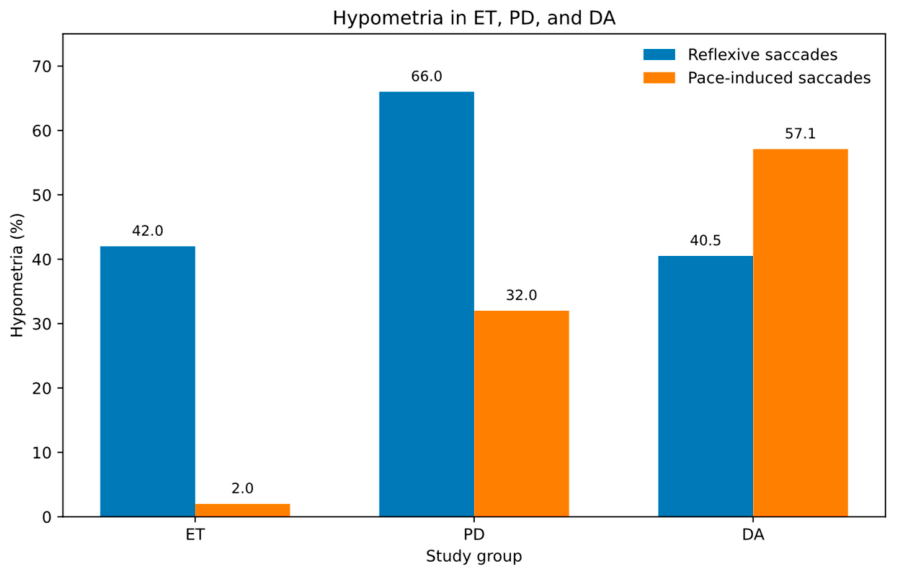
| Reflexive saccades Hypometria (%) | 35.3 | 50.0 | 40.0 | 57.1 | 66.0 | 40.5 | p = 0.016 | - | - |
| Pace-induced saccades Hypometria (%) | 5.9 | 0 | 0 | 0 | 32.0 | 57.1 | p = 0.006 | p = 0.003 | p = 0.020 |
| Cued saccades Mean error rate (%) | 24.1 ± 24.2 | 26.4 ± 14.2 | 31.6 ± 15.2 | 37.0 ± 18.7 | 35.0 ± 16.7 | 26.5 ± 16.7 | - | - | - |
Disclaimer/Publisher’s Note: The statements, opinions and data contained in all publications are solely those of the individual author(s) and contributor(s) and not of MDPI and/or the editor(s). MDPI and/or the editor(s) disclaim responsibility for any injury to people or property resulting from any ideas, methods, instructions or products referred to in the content. |
© 2026 by the authors. Licensee MDPI, Basel, Switzerland. This article is an open access article distributed under the terms and conditions of the Creative Commons Attribution (CC BY) license.
Share and Cite
Wójcik-Pędziwiatr, M.; Rudzińska-Bar, M. Pace-Induced Saccades in Essential Tremor Differ from Those in Parkinson’s Disease and Degenerative Ataxias. J. Clin. Med. 2026, 15, 4054. https://doi.org/10.3390/jcm15114054
Wójcik-Pędziwiatr M, Rudzińska-Bar M. Pace-Induced Saccades in Essential Tremor Differ from Those in Parkinson’s Disease and Degenerative Ataxias. Journal of Clinical Medicine. 2026; 15(11):4054. https://doi.org/10.3390/jcm15114054
Chicago/Turabian StyleWójcik-Pędziwiatr, Magdalena, and Monika Rudzińska-Bar. 2026. "Pace-Induced Saccades in Essential Tremor Differ from Those in Parkinson’s Disease and Degenerative Ataxias" Journal of Clinical Medicine 15, no. 11: 4054. https://doi.org/10.3390/jcm15114054
APA StyleWójcik-Pędziwiatr, M., & Rudzińska-Bar, M. (2026). Pace-Induced Saccades in Essential Tremor Differ from Those in Parkinson’s Disease and Degenerative Ataxias. Journal of Clinical Medicine, 15(11), 4054. https://doi.org/10.3390/jcm15114054

