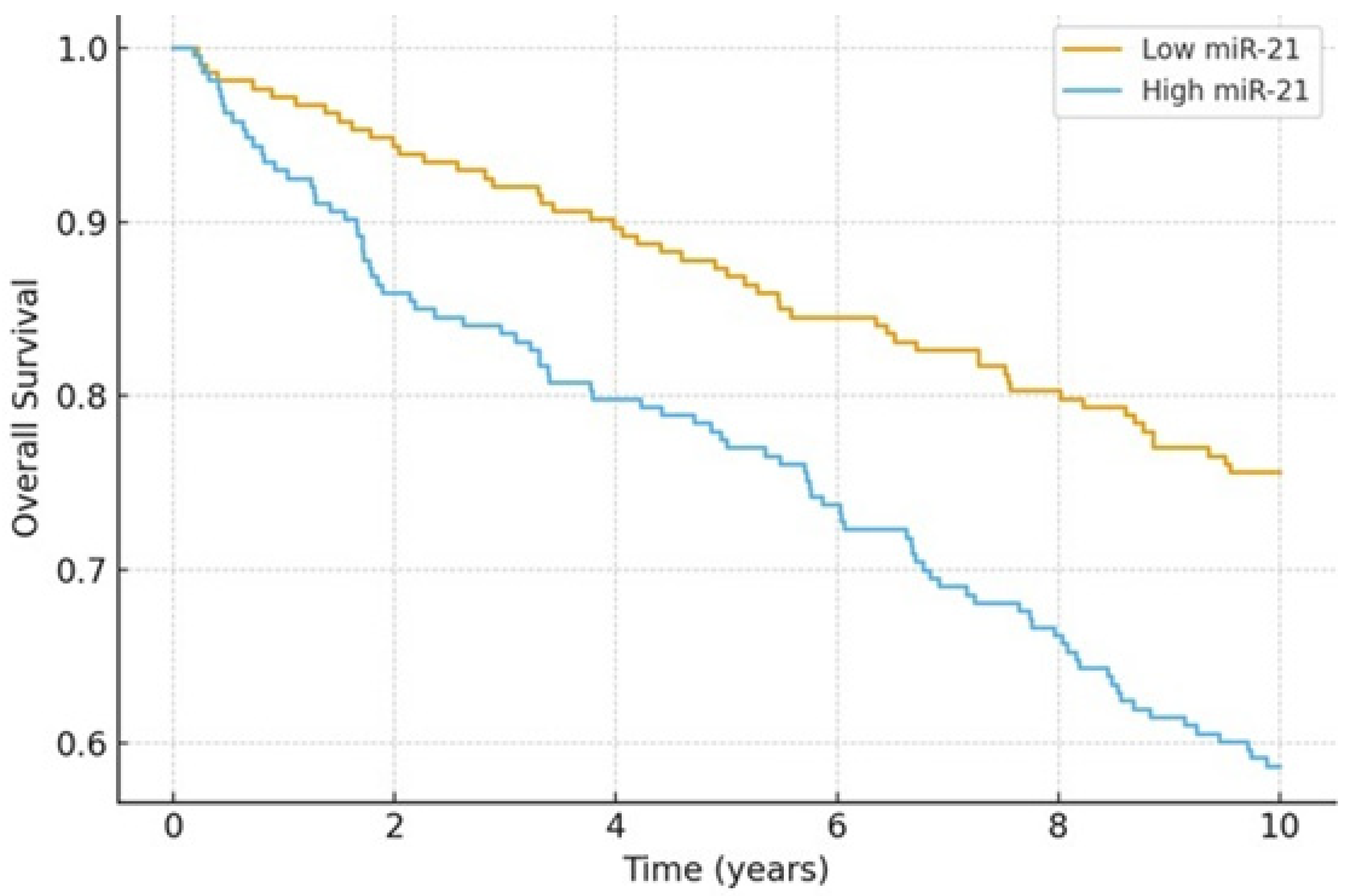
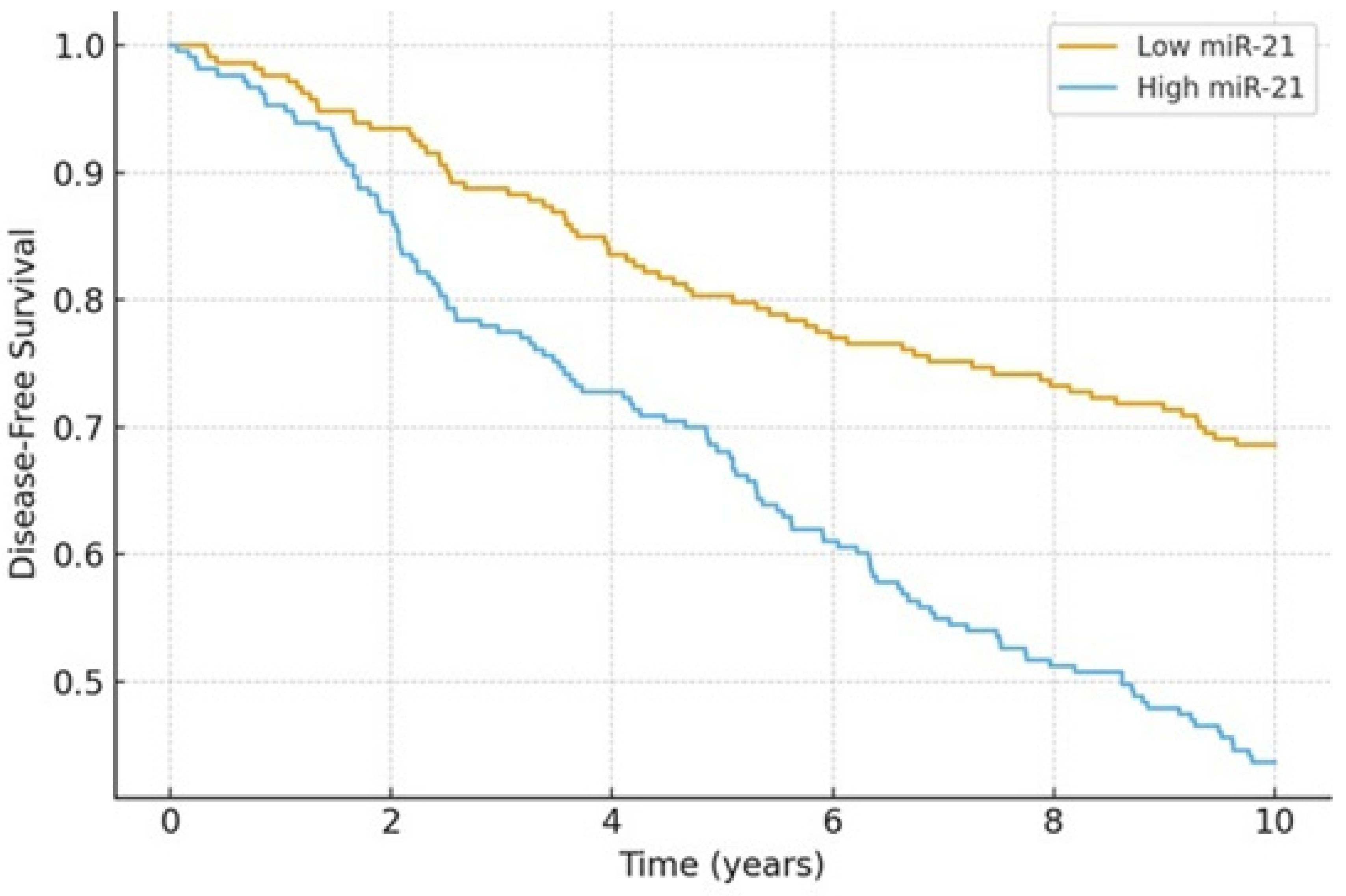
MicroRNA-21 Emerges as Key Prognostic Indicator After Breast Cancer Surgery

Abstract
1. Introduction
2. Materials and Methods
2.1. Study Design and Setting
2.2. Study Population
2.3. Data Collection
2.4. Measurement of miR-21 Expression
2.5. Outcome Measures
2.6. Statistical Analysis
3. Results
3.1. Baseline Characteristics
3.2. MiR-21 Expression and Survival Outcomes
3.3. Univariable and Multivariable Cox Regression
4. Discussion
5. Conclusions
Author Contributions
Funding
Institutional Review Board Statement
Informed Consent Statement
Data Availability Statement
Conflicts of Interest
References
- Davies, C.F.; Macefield, R.; Avery, K.; Blazeby, J.M.; Potter, S. Patient-Reported Outcome Measures for Post-mastectomy Breast Reconstruction: A Systematic Review of Development and Measurement Properties. Ann. Surg. Oncol. 2021, 28, 386–404. [Google Scholar] [CrossRef] [PubMed]
- Jones, C.; Lancaster, R. Evolution of Operative Technique for Mastectomy. Surg. Clin. N. Am. 2018, 98, 835–844. [Google Scholar] [CrossRef] [PubMed]
- Gooch, J.C.; McClelland, Q.Y.; Paschalis, K.; Anand, M.; Magnuson, A.; Dobbins, J.; Skinner, K.A.; Olzinski-Kunze, A.; Weiss, A. Patient-Reported Outcomes After Same-Day Mastectomy Among Older Breast Cancer Patients: Results from a Prospective Clinical Trial. Breast J. 2025, 2025, 9953747. [Google Scholar] [CrossRef] [PubMed]
- Darrigues, L.; Reyal, F.; Binder, J.P.; Laas, E.; Gaillard, T.; Feron, J.G.; Couturaud, B. Indications for total mastectomy with immediate breast reconstruction in oncology: Surgical strategies tailored to breast morphology and adjuvant treatments. Ann. Chir. Plast. Esthet. 2025, 70, 539–550. [Google Scholar] [CrossRef] [PubMed]
- Cao, D.; Sun, Y.; Pan, H. Impact of Neoadjuvant Chemotherapy Combined with Modified Radical Mastectomy on Immune Function, Oxidative Stress, and Prognosis in Patients with Different Molecular Subtypes of Breast Cancer. Ann. Ital. Chir. 2025, 96, 1530–1540. [Google Scholar] [CrossRef] [PubMed]
- Kozlov, D.S.; Rodimova, S.A.; Kuznetsova, D.S. The Role of MicroRNAs in Liver Functioning: From Biogenesis to Therapeutic Approaches (Review). Sovrem. Tekhnologii Med. 2023, 15, 54–79. [Google Scholar] [CrossRef] [PubMed]
- Lu, T.X.; Rothenberg, M.E. MicroRNA. J. Allergy Clin. Immunol. 2018, 141, 1202–1207. [Google Scholar] [CrossRef] [PubMed]
- Li, B.; Cao, Y.; Sun, M.; Feng, H. Expression, regulation, and function of exosome-derived miRNAs in cancer progression and therapy. FASEB J. 2021, 35, e21916. [Google Scholar] [CrossRef] [PubMed]
- Wang, M.; Wang, Y.; Tian, X.; Wang, Q.; Huang, H.; Lu, X.; Qi, M.; Cao, X.; Lei, J. Diagnostic and predictive value of liquid biopsy-derived exosome miR-21 for breast cancer: A systematic review and meta-analysis. Expert Rev. Mol. Diagn. 2023, 23, 315–324. [Google Scholar] [CrossRef] [PubMed]
- Conte, L.; Tumolo, M.R.; De Nunzio, G.; De Giorgi, U.; Guarino, R.; Cascio, D.; Cucci, F. The Prognostic Power of miR-21 in Breast Cancer: A Systematic Review and Meta-Analysis. Int. J. Mol. Sci. 2025, 26, 9713. [Google Scholar] [CrossRef] [PubMed]
- Wang, Y.; Gao, X.; Wei, F.; Zhang, X.; Yu, J.; Zhao, H.; Sun, Q.; Yan, F.; Yan, C.; Li, H.; et al. Diagnostic and prognostic value of circulating miR-21 for cancer: A systematic review and meta-analysis. Gene 2014, 533, 389–397. [Google Scholar] [CrossRef] [PubMed]
- Pfeffer, S.R.; Yang, C.H.; Pfeffer, L.M. The Role of miR-21 in Cancer. Drug Dev. Res. 2015, 76, 270–277. [Google Scholar] [CrossRef] [PubMed]
- Petrović, N. miR-21 Might be Involved in Breast Cancer Promotion and Invasion Rather than in Initial Events of Breast Cancer Development. Mol. Diagn. Ther. 2016, 20, 97–110. [Google Scholar] [CrossRef] [PubMed]
- Qi, L.; Bart, J.; Tan, L.P.; Platteel, I.; Sluis, T.; Huitema, S.; Harms, G.; Fu, L.; Hollema, H. Expression of miR-21 and its targets (PTEN, PDCD4, TM1) in flat epithelial atypia of the breast in relation to ductal carcinoma in situ and invasive carcinoma. BMC Cancer 2009, 9, 163. [Google Scholar] [CrossRef] [PubMed]
- Kim, E.H.; Ryu, Y.; Choi, J.; Park, D.; Lee, J.W.; Chi, S.G.; Kim, S.H.; Yang, Y. Targeting miR-21 to Overcome P-glycoprotein Drug Efflux in Doxorubicin-Resistant 4T1 Breast Cancer. Biomater. Res. 2024, 28, 0095. [Google Scholar] [CrossRef] [PubMed]
- Saffari, F.; Momeni, A.; Ramezani, M.; Ansari, Y.; Moghbelinejad, S. Metformin Caused Radiosensitivity of Breast Cancer Cells through the Expression Modulation of miR-21-5p/SESN1axis. Asian Pac. J. Cancer Prev. 2023, 24, 3715–3727. [Google Scholar] [CrossRef] [PubMed]
- Amirfallah, A.; Knutsdottir, H.; Arason, A.; Hilmarsdottir, B.; Johannsson, O.T.; Agnarsson, B.A.; Barkardottir, R.B.; Reynisdottir, I. Hsa-miR-21-3p associates with breast cancer patient survival and targets genes in tumor suppressive pathways. PLoS ONE 2021, 16, e0260327. [Google Scholar] [CrossRef] [PubMed]
- MacKenzie, T.A.; Schwartz, G.N.; Calderone, H.M.; Graveel, C.R.; Winn, M.E.; Hostetter, G.; Wells, W.A.; Sempere, L.F. Stromal expression of miR-21 identifies high-risk group in triple-negative breast cancer. Am. J. Pathol. 2014, 184, 3217–3225. [Google Scholar] [CrossRef] [PubMed]
- Omarini, C.; Catani, V.; Mastrolia, I.; Toss, A.; Banchelli, F.; Isca, C.; Medici, D.; Ponzoni, O.; Brucale, M.; Valle, F.; et al. Extracellular vesicles-derived miR-21 as a biomarker for early diagnosis and tumor activity in breast cancer subtypes. Biomark. Res. 2025, 13, 14. [Google Scholar] [CrossRef] [PubMed]


| Variable | Total (N = 426) | Low miR-21 (n = 213) | High miR-21 (n = 213) | p-Value |
|---|---|---|---|---|
| Age (years, mean ± SD) | 54.8 ± 10.9 | 54.2 ± 11.0 | 55.4 ± 10.7 | 0.312 |
| Tumor size ≥ 2 cm | 243 (57.0%) | 111 (52.1%) | 132 (62.0%) | 0.012 |
| Grade III | 138 (32.4%) | 57 (26.8%) | 81 (38.0%) | 0.021 |
| Lymph node positive | 261 (61.3%) | 117 (54.9%) | 144 (67.6%) | 0.008 |
| ER positive | 281 (66.0%) | 146 (68.5%) | 135 (63.4%) | 0.271 |
| PR positive | 233 (54.7%) | 121 (56.8%) | 112 (52.6%) | 0.382 |
| HER2 positive | 79 (18.5%) | 30 (14.1%) | 49 (23.0%) | 0.033 |
| Ki-67 ≥ 20% | 198 (46.5%) | 86 (40.4%) | 112 (52.6%) | 0.013 |
| Adjuvant chemotherapy | 344 (80.7%) | 169 (79.3%) | 175 (82.2%) | 0.468 |
| Adjuvant radiotherapy | 256 (60.1%) | 123 (57.8%) | 133 (62.4%) | 0.342 |
| Outcome | Low miR-21 (n = 213) | High miR-21 (n = 213) | p-Value |
|---|---|---|---|
| Recurrence events | 45 (21.1%) | 73 (34.3%) | 0.002 |
| Distant metastasis | 28 (13.1%) | 53 (24.9%) | 0.003 |
| Deaths (all-cause) | 33 (15.5%) | 63 (29.6%) | 0.001 |
| 5-year DFS | 84.0% | 67.1% | <0.001 |
| 5-year OS | 89.2% | 74.6% | <0.001 |
| Variable | DFS HR (95% CI) | p-Value | OS HR (95% CI) | p-Value |
|---|---|---|---|---|
| High miR-21 | 2.01 (1.45–2.79) | <0.001 | 2.34 (1.58–3.46) | <0.001 |
| Tumor size ≥ 2 cm | 1.52 (1.11–2.10) | 0.009 | 1.47 (1.02–2.12) | 0.037 |
| Lymph node positive | 2.18 (1.54–3.07) | <0.001 | 2.42 (1.61–3.63) | <0.001 |
| Grade III | 1.63 (1.16–2.28) | 0.005 | 1.71 (1.15–2.55) | 0.008 |
| HER2 positive | 1.48 (1.02–2.16) | 0.039 | 1.61 (1.04–2.50) | 0.030 |
| Ki-67 ≥ 20% | 1.39 (1.01–1.91) | 0.045 | 1.52 (1.04–2.22) | 0.031 |
| Variable | Adjusted DFS HR (95% CI) | p-Value | Adjusted OS HR (95% CI) | p-Value |
|---|---|---|---|---|
| High miR-21 | 1.82 (1.28–2.59) | 0.001 | 2.05 (1.36–3.09) | 0.001 |
| Tumor size ≥ 2 cm | 1.36 (0.98–1.90) | 0.065 | 1.28 (0.87–1.90) | 0.205 |
| Lymph node positive | 1.94 (1.33–2.83) | <0.001 | 2.18 (1.41–3.37) | <0.001 |
| Grade III | 1.32 (0.92–1.90) | 0.124 | 1.39 (0.91–2.15) | 0.124 |
| HER2 positive | 1.31 (0.88–1.95) | 0.180 | 1.42 (0.91–2.23) | 0.122 |
Disclaimer/Publisher’s Note: The statements, opinions and data contained in all publications are solely those of the individual author(s) and contributor(s) and not of MDPI and/or the editor(s). MDPI and/or the editor(s) disclaim responsibility for any injury to people or property resulting from any ideas, methods, instructions or products referred to in the content. |
© 2026 by the authors. Licensee MDPI, Basel, Switzerland. This article is an open access article distributed under the terms and conditions of the Creative Commons Attribution (CC BY) license.
Share and Cite
Gökçe, K.; Üner, M.; Adil, N.; Sheikhvatan, M. MicroRNA-21 Emerges as Key Prognostic Indicator After Breast Cancer Surgery. J. Clin. Med. 2026, 15, 4053. https://doi.org/10.3390/jcm15114053
Gökçe K, Üner M, Adil N, Sheikhvatan M. MicroRNA-21 Emerges as Key Prognostic Indicator After Breast Cancer Surgery. Journal of Clinical Medicine. 2026; 15(11):4053. https://doi.org/10.3390/jcm15114053
Chicago/Turabian StyleGökçe, Kağan, Murat Üner, Nur Adil, and Mehrdad Sheikhvatan. 2026. "MicroRNA-21 Emerges as Key Prognostic Indicator After Breast Cancer Surgery" Journal of Clinical Medicine 15, no. 11: 4053. https://doi.org/10.3390/jcm15114053
APA StyleGökçe, K., Üner, M., Adil, N., & Sheikhvatan, M. (2026). MicroRNA-21 Emerges as Key Prognostic Indicator After Breast Cancer Surgery. Journal of Clinical Medicine, 15(11), 4053. https://doi.org/10.3390/jcm15114053