This is an early access version, the complete PDF, HTML, and XML versions will be available soon.
Article

Interdisciplinary Study of the Clinical Phenotype of Patients with Fibrodysplasia Ossificans Progressiva (FOP) in Dental Practice: A Cross-Sectional Clinical–Statistical Analysis


Borovskiy Institute of Dentistry, FSAEI HE I.M. Sechenov First MSMU of MOH of Russia (Sechenovskiy University), 8/2 Trubetskaya St., Moscow 119991, Russia
*
Author to whom correspondence should be addressed.
J. Clin. Med. 2026, 15(10), 3951; https://doi.org/10.3390/jcm15103951
Submission received: 26 April 2026 / Revised: 14 May 2026 / Accepted: 17 May 2026 / Published: 20 May 2026
(This article belongs to the Special Issue Interaction Between Systemic Diseases and Oral Diseases: 2nd Edition)

Abstract

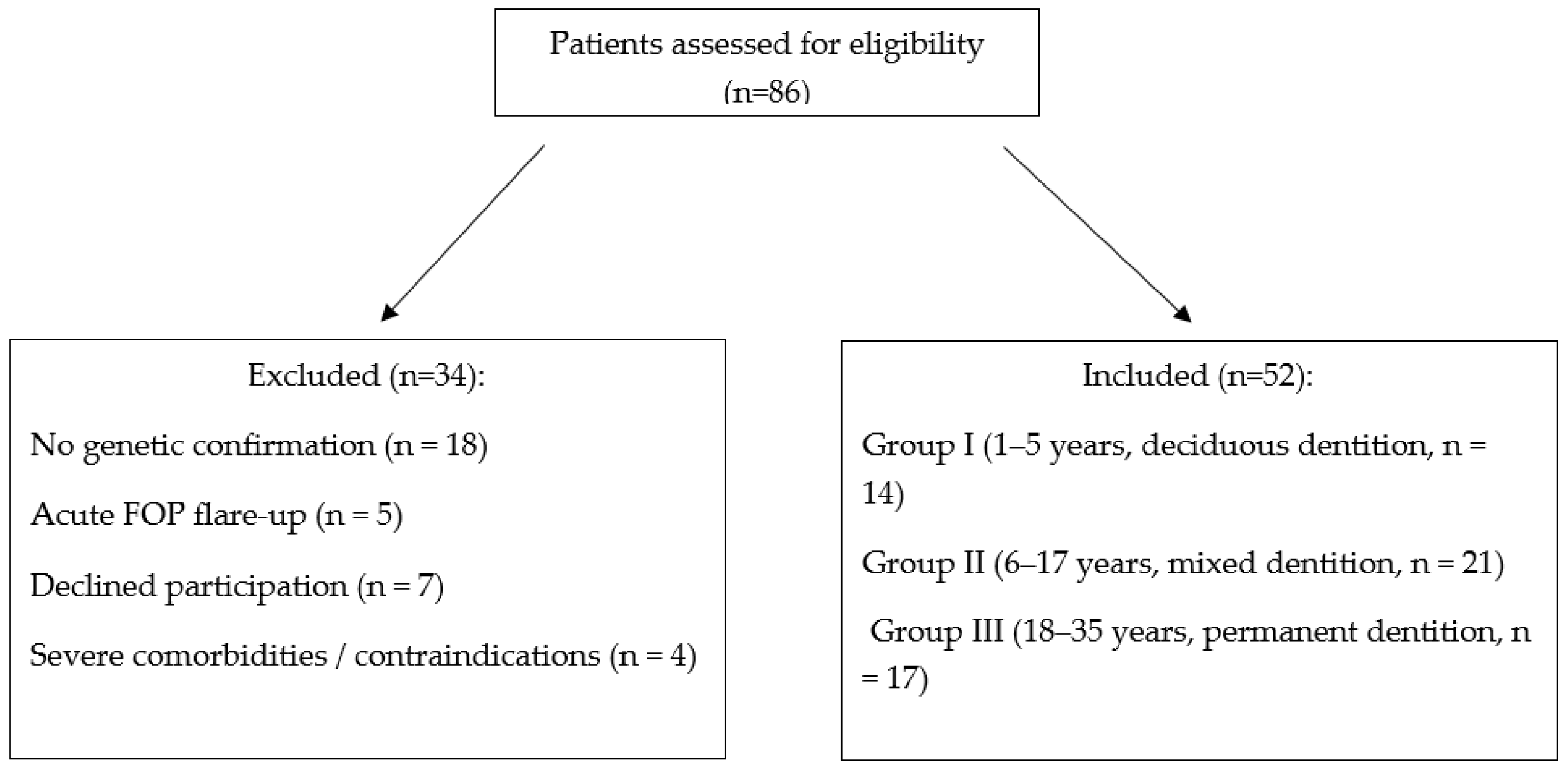
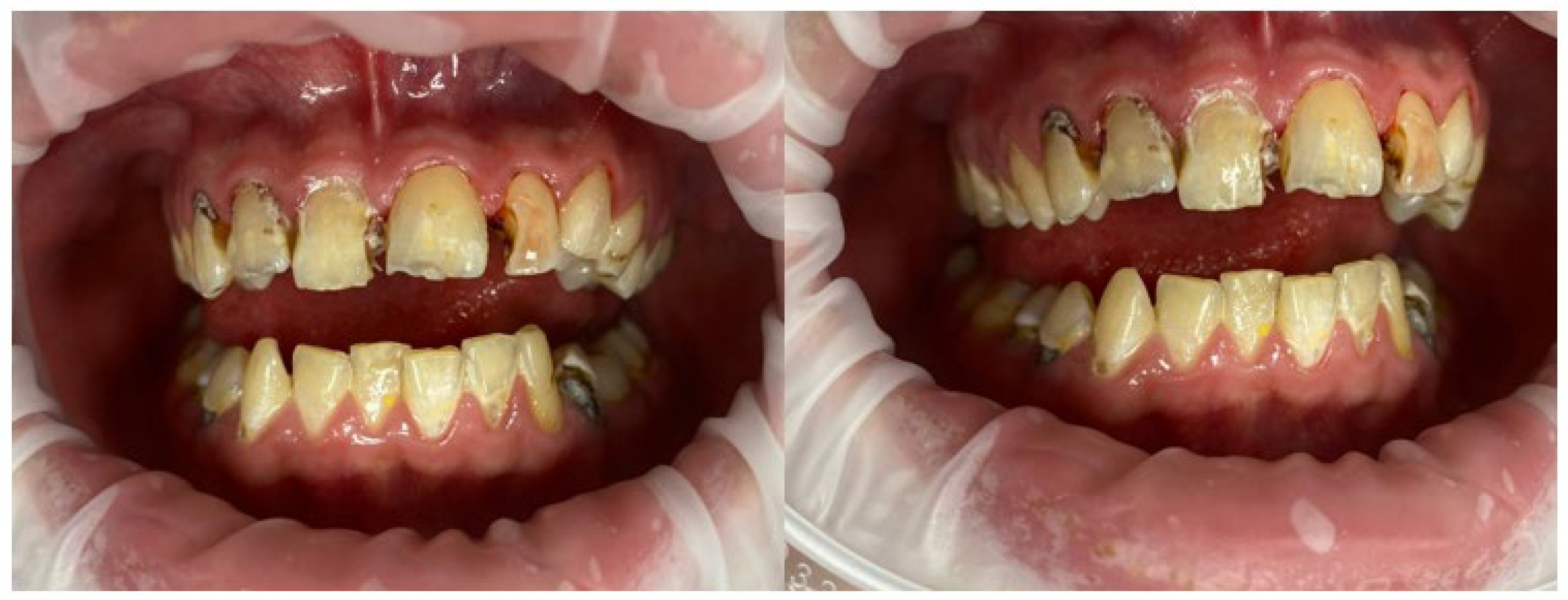
Background/Objectives: Fibrodysplasia ossificans progressiva (FOP) is an ultra-rare genetic disorder causing progressive heterotopic ossification. The dental phenotype has never been systematically characterised. We quantified dental pathologies and oral health-related quality of life across three age groups of genetically confirmed FOP patients and compared them with 156 matched healthy controls (2022–2025). Methods: A total of 52 FOP patients (Group I: 1–5 y, n = 14; Group II: 6–17 y, n = 21; Group III: 18–35 y, n = 17) underwent standardised dental examination (Decayed, Missing, and Filled Teeth index (DMFT), Oral Hygiene Index Simplified (OHI-S), Angle classification, temporomandibular joint (TMJ) assessment), computed tomography (CT) densitometry, sialometry, salivary crystal analysis, and Oral Health Impact Profile-14 (OHIP-14). Statistical analysis used Kruskal–Wallis, Mann–Whitney U, Benjamini–Hochberg false discovery rate (FDR) correction, and effect sizes. Results: Caries (DMFT ≥ 4) was highly prevalent across all FOP groups (82–86%) and significantly higher than in controls (84.6% vs. 38.5%, p < 0.001). Chronic stomatitis showed large age-group differences: 7.1% in Group I vs. 100% in Group III (p < 0.001); it was universal in FOP adults vs. 6.4% in controls. Enamel hypoplasia (21.4% → 58.8%) and Angle class II malocclusion (0% → 47.1%) also showed large age-group differences. Total TMJ disorders were observed in 7.1% of Group I and 100% of Group III (p < 0.001); maximal mouth opening was lower by 17.4 mm in Group III (Cohen’s d = 2.1). Salivary flow rate was 20% lower in adults (0.35 → 0.28 mL/min, p = 0.01). Calcium phosphate crystals were detected in 3/17 adults (17.6%) and showed a preliminary correlation with CT calcification grade (ρ = 0.67, p = 0.003); given the small number of crystal-positive patients, this finding should be considered hypothesis-generating. OHIP-14 total score was higher (worse) in Group III (48.9 vs. 12.4 in Group I, Cohen’s d = 1.95). Conclusions: This cross-sectional study provides a systematic characterisation of the dental phenotype in FOP across three age groups. It shows that chronic stomatitis and TMJ dysfunction become nearly universal by early adulthood, severely impairing quality of life. The correlation between salivary calcium phosphate crystals and CT calcification generates the hypothesis of a non-invasive biomarker, requiring prospective validation. The proposed clinical phenotype and minimally invasive recommendations provide a framework for safer dental management of FOP patients.
Keywords: fibrodysplasia ossificans progressiva; BMP; pathological ossification; salivary gland calcification; ACVR1; non-invasiveness fibrodysplasia ossificans progressiva; BMP; pathological ossification; salivary gland calcification; ACVR1; non-invasiveness