1. Introduction
Neonatal hypoglycemia represents one of the most frequent metabolic disturbances encountered during the early neonatal period, particularly among at-risk newborns such as preterm infants, small-for-gestational-age (SGA) neonates, infants of diabetic mothers, and critically ill neonates. The incidence varies depending on the population studied and the operational threshold applied, but transient low blood glucose concentrations occur in a substantial proportion of healthy newborns during the first hours after birth.
Physiologically, the transition from continuous maternal glucose supply in utero to intermittent enteral feeding after birth requires rapid metabolic adaptation involving glycogenolysis, gluconeogenesis, lipolysis, and ketogenesis. Failure of these adaptive mechanisms, excessive insulin secretion, inadequate substrate availability, or increased metabolic demand may result in clinically significant hypoglycemia.
Although transient neonatal hypoglycemia is often self-limited, prolonged or recurrent episodes have been associated with adverse neurodevelopmental outcomes, including seizures, cognitive impairment, visual dysfunction, and executive dysfunction [
1].
Nevertheless, the precise blood glucose concentration associated with neurological injury remains controversial, and no universally accepted diagnostic threshold exists.
International scientific societies have therefore adopted “operational thresholds” intended to guide clinical intervention rather than define a strict biochemical diagnosis. However, substantial variability persists between guideline frameworks regarding screening indications, timing of blood glucose measurements, treatment thresholds, escalation strategies, and criteria for NICU admission.
Given these inconsistencies, a comparative review of current international and local recommendations is clinically relevant. The objective of this systematic review was to compare major neonatal hypoglycemia guideline frameworks regarding screening protocols, operational thresholds, treatment strategies, and recommendations for persistent hypoglycemia, while identifying convergent principles and areas of ongoing controversy.
2. Historical Overview of Diagnosis and Treatment
Neonatal hypoglycemia became widely recognized as a clinical entity in the mid-20th century with the development of biochemical glucose assays. Early reports linked low neonatal glucose levels to severe neurological manifestations, including seizures and brain injury. Bedside glucometers introduced in the 1980s enabled rapid detection and monitoring, supporting the distinction between transitional and persistent hypoglycemia. Management evolved from delayed intravenous glucose administration to preventive, stepwise strategies emphasizing early feeding, risk-based screening, and rapid escalation for severe or symptomatic cases. In the past two decades, adoption of operational thresholds and incorporation of 40% oral dextrose gel have reduced the need for intravenous therapy and NICU admission to selected cases.
3. Materials and Methods
This systematic review was conducted in accordance with the Preferred Reporting Items for Systematic Reviews and Meta-Analyses (PRISMA 2020,
Supplementary Materials File S1) guidelines. No laboratory reagents, commercial materials, instruments, or specialized software requiring manufacturer specification were used in this systematic review.
3.1. Search Strategy
A systematic search was performed to identify international and national clinical guidelines on neonatal hypoglycemia. The literature and guideline search was conducted between January and March 2026. Searches included PubMed, Google Scholar, official websites of pediatric and neonatal scientific societies, national health authority publications, and institutional guideline repositories. The search strategy combined the following keywords and Boolean operators: (“neonatal hypoglycemia” OR “newborn hypoglycaemia”) AND (“guideline” OR “recommendation” OR “screening” OR “management” OR “clinical protocol”). Only English-language and Romanian-language documents were included. When multiple versions of the same guidelines existed, the most recent version was selected.
Data synthesis was performed narratively because of the heterogeneity of guideline structures and reported thresholds. The following sources were used: official websites of professional societies and health authorities, including the American Academy of Pediatrics (AAP), British Association of Perinatal Medicine (BAPM), Pediatric Endocrine Society (PES), Canadian Paediatric Society (CPS), Te Tohu Waihonga (New Zealand), and Australian state-based guidance (Queensland Health and Safer Care Victoria), as well as relevant UK and Romanian clinical guidelines (
Table 1 and
Table 2).
The search covered documents published up to March 2026. Keywords included: “neonatal hypoglycemia”, “guidelines”, “screening”, “blood glucose”, “newborn”, and “management” (
Table 3 and
Table 4).
3.2. Eligibility Criteria
Inclusion criteria included guidelines that
- -
Addressed neonatal hypoglycemia management;
- -
Provided recommendation on screening, diagnosis or treatment;
- -
Were issued by recognized organization.
Exclusion criteria included
- -
Non-guideline documents;
- -
Duplicate/outdated versions;
- -
Unclear recommendations.
3.3. Study Selection
The selection process was performed by two independent reviewers. Titles and full-text documents were screened for eligibility. Discrepancies were resolved by consensus.
3.4. Data Extraction
Data extracted from each guideline included
- -
Target population;
- -
Screening timing and frequency;
- -
Operational thresholds;
- -
Treatment strategies (feeding, oral dextrose gel, or intravenous glucose);
- -
Criteria for discontinuation of screening;
- -
Recommendations for persistent hypoglycemia.
3.5. Registration
This systematic review was not registered in a prospective database (e.g., PROSPERO).
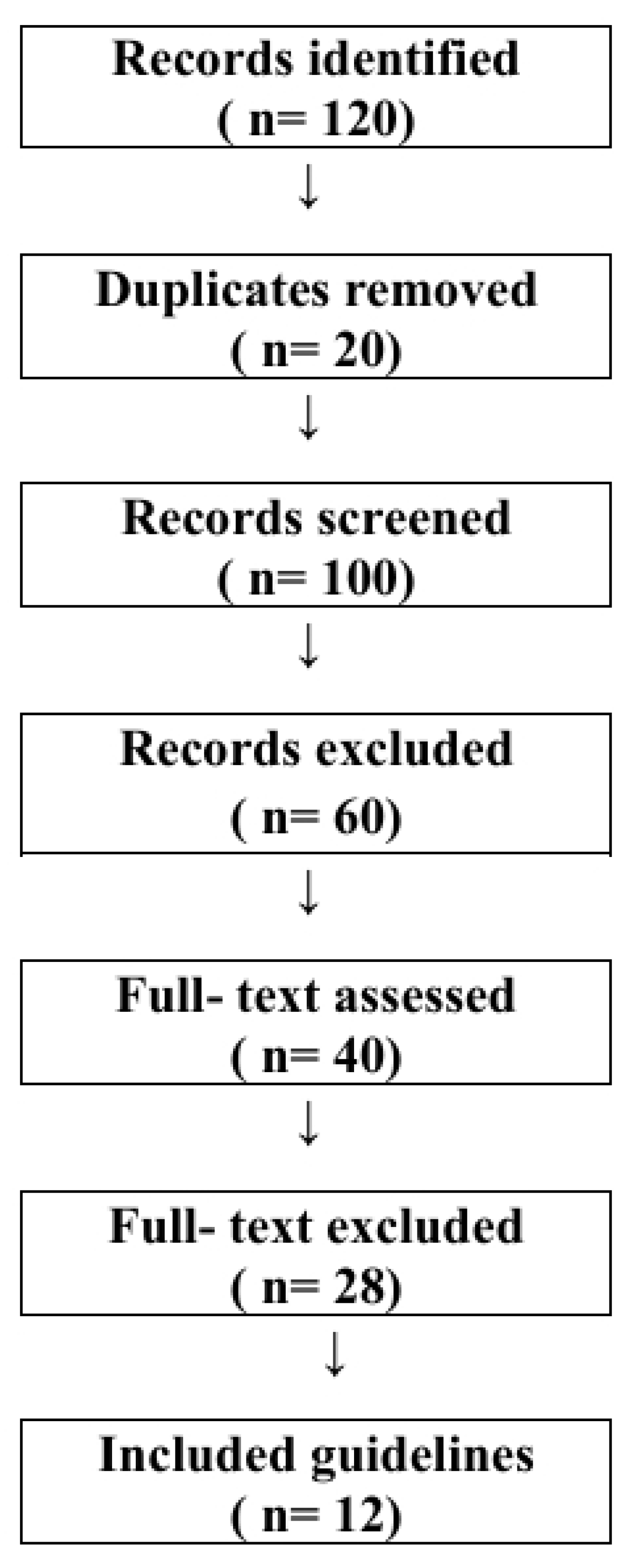
The study selection process is illustrated in
Figure 1.
4. Results
The major international and local neonatal hypoglycemia guideline frameworks included in this review are comparatively summarized in
Table 1,
Table 2,
Table 3,
Table 4,
Table 5,
Table 6,
Table 7 and
Table 8, highlighting differences in screening strategies, operational thresholds, and therapeutic approaches.
5. Integrated Clinical Algorithm for Practice
Identification: Symptomatic neonates—measure immediately and treat without delay. Asymptomatic at-risk neonates—screen according to postnatal age and risk factors.
Confirmation: Low glucometer values should be confirmed via blood gas analyzer or laboratory testing when diagnostic decisions are required.
Transitional Management: Early and frequent feeding; consider 40% oral dextrose gel; re-test at 30–60 min.
Escalation: Severe or symptomatic cases require IV glucose infusion and continuous monitoring.
Persistent Hypoglycemia (>48–72 h): Obtain critical sample; target higher glucose levels; initiate endocrine–metabolic evaluation (
Table 5 and
Table 6,
Appendix A).
6. Discussion
This review highlights substantial convergence across international and local guidance regarding the core principles of neonatal hypoglycemia management, despite variability in numerical thresholds. Across frameworks, early identification of at-risk neonates, prompt intervention for symptomatic hypoglycemia, and avoidance of prolonged or recurrent hypoglycemia remain central objectives. Operational thresholds reflect pragmatic decisions in the context of uncertain outcome-based cut-offs; neurological risk is influenced by severity, duration, recurrence, and individual vulnerability.
The broad endorsement of 40% oral dextrose gel as first-line therapy for selected asymptomatic or mildly symptomatic neonates has major clinical implications: it may reduce the need for intravenous therapy, decrease NICU admissions, preserve mother–infant bonding, and support breastfeeding. These benefits are particularly relevant in settings with limited NICU capacity. Screening strategies remain heterogeneous; therefore, institutions should implement standardized risk-based screening pathways with clear escalation criteria and reassessment intervals (
Table 7 and
Table 8).
Persistent or recurrent hypoglycemia beyond the transitional period warrants timely etiologic evaluation, including endocrine and metabolic assessment where appropriate. Delayed recognition may postpone diagnosis of conditions such as congenital hyperinsulinism or inborn errors of metabolism.
A further challenge in neonatal hypoglycemia management is the limited accuracy of point-of-care glucometers at low glucose concentrations. False-positive results may prompt unnecessary NICU admission and mother–infant separation, whereas false-negative results may delay treatment of clinically significant hypoglycemia. Accordingly, most contemporary guidelines recommend confirming low readings with laboratory testing or a blood gas analyzer when feasible—without delaying treatment disproportionately.
7. Limitations
This review has several limitations. First, the included guidelines differed substantially in structure, terminology, operational thresholds, and year of last update, all aspects limiting direct comparability. Second, some local protocols were institution-based rather than nationally standardized. Third, only English-language and Romanian-language documents were included, potentially excluding relevant recommendations from other regions. Finally, because this review focused on guideline comparison rather than patient-level outcomes, no meta-analysis could be performed.
8. Conclusions
There is clear consensus across major clinical guidelines regarding principal risk factors for neonatal hypoglycemia; however, no universal agreement exists concerning the timing of the first postnatal BG measurement in at-risk neonates, the optimal frequency of BG monitoring, or the minimum BG value at which therapy should be initiated during the transitional period. Measurement techniques also vary (portable glucometer, blood gas analyzer, and laboratory confirmation), and each has limitations—particularly at low glucose ranges—which may influence clinical decisions. Further comparative studies are required to define evidence-based intervention thresholds, establish optimal monitoring strategies, identify the most accurate measurement techniques, and clarify long-term neurodevelopmental outcomes. Across guidelines, the overarching objective remains prevention of neuroglycopenia while minimizing unnecessary medicalization and avoidable mother–infant separation.
Nevertheless, important controversies persist regarding optimal intervention thresholds, duration of monitoring, and long-term neurodevelopmental significance of transient low glucose concentrations. Future multicenter comparative studies are needed to establish evidence-based standardized protocols with meaningful outcomes that balance neurological safety with avoidance of unnecessary medicalization.



 ,
,