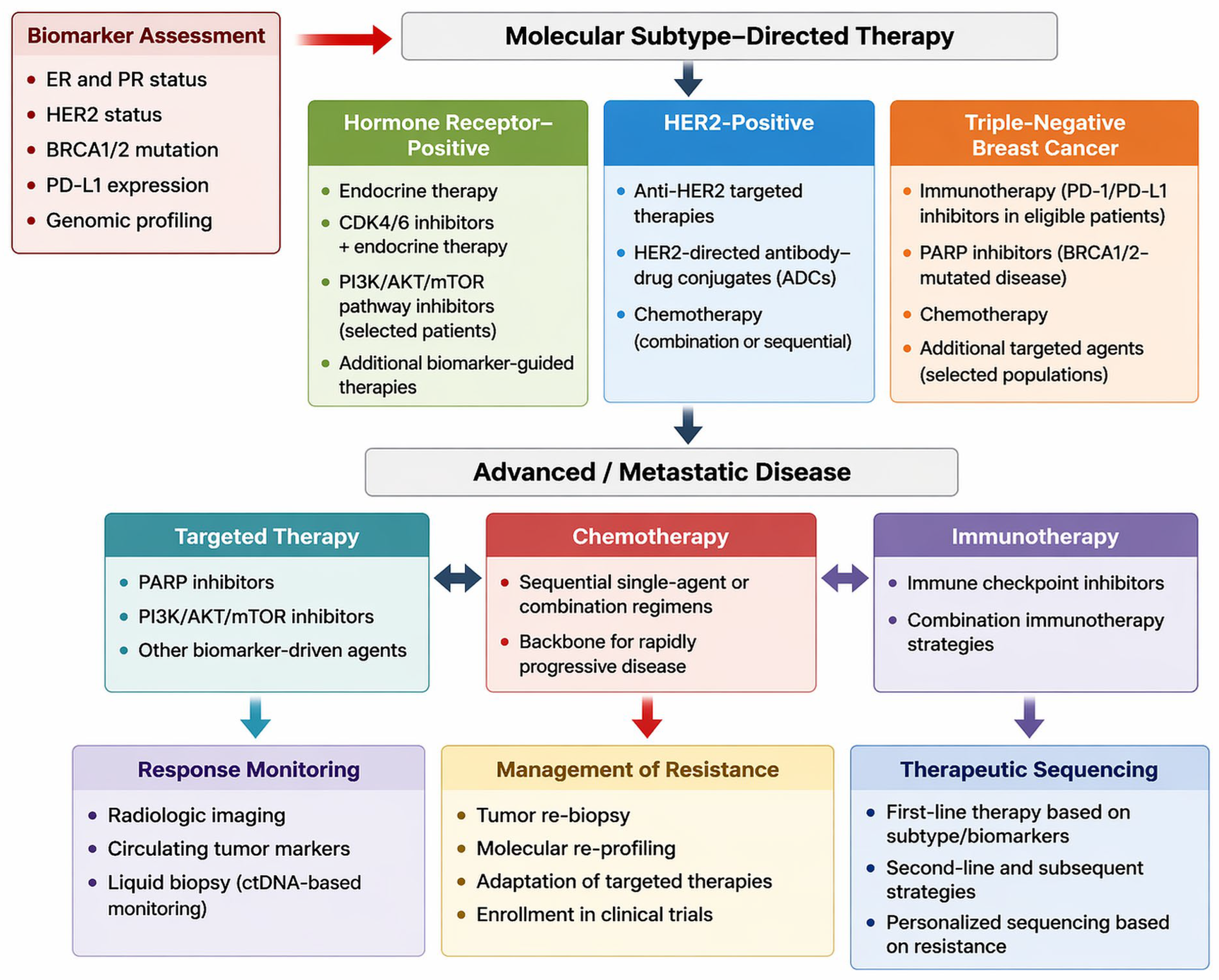
Molecular Profiling and Targeted Therapeutic Strategies in Breast Cancer: Clinical Integration of HER2, CDK4/6, and PI3K Inhibition with Trastuzumab, Abemaciclib and Alpelisib


Abstract
1. Introduction
2. Trastuzumab
3. Abemaciclib
4. Alpelisib
5. Emerging Therapeutic Strategies and Translational Perspectives in Breast Cancer
6. Conclusions
Author Contributions
Funding
Institutional Review Board Statement
Informed Consent Statement
Data Availability Statement
Acknowledgments
Conflicts of Interest
Abbreviations
| AC | doxorubicin (Adriamycin) plus cyclophosphamide |
| ADC | antibody–drug conjugate |
| ADCC | antibody-dependent cellular cytotoxicity |
| AI | aromatase inhibitor |
| AKT | protein kinase B (AKT serine/threonine kinase) |
| ALT | alanine aminotransferase |
| APHINITY | adjuvant pertuzumab and trastuzumab in initial therapy |
| AST | aspartate aminotransferase |
| B-31/9831 | National Surgical Adjuvant Breast and Bowel Project (NSABP) B-31/North Central Cancer Treatment Group (NCCTG) N9831 trials |
| BC | breast cancer |
| BCIRG | Breast Cancer International Research Group |
| BCS | breast-conserving surgery |
| BRCA | breast cancer gene (BRCA1/2) |
| CBC | complete blood count |
| CDK2 | cyclin-dependent kinase 2 |
| CDK4/6 | cyclin-dependent kinases 4 and 6 |
| Cip/Kip | CDK-interacting protein/kinase inhibitory protein family |
| CLEOPATRA | clinical evaluation of pertuzumab and trastuzumab |
| ctDNA | circulating tumor DNA |
| DESTINY-Breast03/04 | trastuzumab deruxtecan clinical trials in breast cancer |
| DFS | disease-free survival |
| E2F | E2F transcription factor (E2 factor/promoter of adenovirus genes) |
| EFS | event-free survival |
| EGFR | epidermal growth factor receptor |
| EMILIA | T-DM1 vs. lapatinib plus capecitabine trial |
| ER | estrogen receptor |
| ET | endocrine therapy |
| FcR | Fc receptor |
| FGFR1 | fibroblast growth factor receptor 1 |
| G1 | gap 1 phase |
| G2 | gap 2 phase |
| HERA | Herceptin Adjuvant Trial |
| HER2(+/−) | human epidermal growth factor receptor 2 (-positive/negative) |
| HER2-low | HER2 low expression (IHC 1+ or IHC 2+/ISH−) |
| HR+ | hormone receptor positive |
| Hippo pathway | Hippo signaling pathway |
| IHC | immunohistochemistry |
| ILD | interstitial lung disease |
| IO | immuno-oncology |
| IRR | infusion-related reactions |
| ISH | in situ hybridization |
| KATHERINE | trastuzumab emtansine vs. trastuzumab in residual disease |
| Ki-67 | proliferation marker |
| LVEF | left ventricular ejection fraction |
| MAPK | mitogen-activated protein kinase |
| M | mitosis phase |
| monarchE | abemaciclib in high-risk early breast cancer |
| mTOR | mechanistic target of rapamycin |
| NeoSphere | neoadjuvant study of pertuzumab and trastuzumab |
| NOAH | neoadjuvant Herceptin trial |
| NR | not reported |
| ORR | objective response rate |
| OS | overall survival |
| p16 | cyclin-dependent kinase inhibitor 2A (CDKN2A) |
| p21 | cyclin-dependent kinase inhibitor 1A (CDKN1A) |
| p27 | cyclin-dependent kinase inhibitor 1B (CDKN1B) |
| p85 | regulatory subunit of PI3K |
| p110 | catalytic subunit of PI3K |
| p110α | catalytic subunit alpha isoform of PI3K |
| PARP | poly(ADP-ribose) polymerase |
| pCR | pathologic complete response |
| PD-L1 | programmed death-ligand 1 |
| PFS | progression-free survival |
| PI3K(α/CA) | phosphatidylinositol-3-kinase (alpha isoform/catalytic subunit alpha) |
| PIP2 | phosphatidylinositol 4,5-bisphosphate |
| PIP3 | phosphatidylinositol 3,4,5-trisphosphate |
| PR | progesterone receptor |
| PTEN | phosphatase and tensin homolog |
| RAS | rat sarcoma small GTPase |
| Rb | retinoblastoma protein |
| pRb | retinoblastoma protein |
| RT | radiotherapy |
| S | synthesis phase |
| SERD(s) | selective estrogen receptor degrader(s) |
| SRC | SRC proto-oncogene tyrosine kinase |
| SJS | Stevens–Johnson syndrome |
| SLNB | sentinel lymph node biopsy |
| T | docetaxel (taxane chemotherapy drug) |
| TCH | docetaxel, carboplatin, and trastuzumab |
| T-DM1 | trastuzumab emtansine |
| T-DXd | trastuzumab deruxtecan |
| TEAE | treatment-emergent adverse event |
| TEN | toxic epidermal necrolysis |
| TH | docetaxel plus trastuzumab |
| TNBC | triple-negative breast cancer |
| VTE | venous thromboembolism |
References
- Ben-Dror, J.; Shalamov, M.; Sonnenblick, A. The history of early breast cancer treatment. Genes 2022, 13, 960. [Google Scholar] [CrossRef]
- Sung, H.; Ferlay, J.; Siegel, R.L.; Laversanne, M.; Soerjomataram, I.; Jemal, A.; Bray, F. Global Cancer Statistics 2020: GLOBOCAN estimates of incidence and mortality worldwide for 36 cancers in 185 countries. CA Cancer J. Clin. 2021, 71, 209–249. [Google Scholar] [CrossRef]
- Siegel, R.L.; Miller, K.D.; Wagle, N.S.; Jemal, A. Cancer statistics, 2023. CA Cancer J. Clin. 2023, 73, 17–48. [Google Scholar] [CrossRef] [PubMed]
- Ye, F.; Dewanjee, S.; Li, Y.; Jha, N.K.; Chen, Z.S.; Kumar, A.; Vishakha; Behl, T.; Jha, S.K.; Tang, H. Advancements in clinical aspects of targeted therapy and immunotherapy in breast cancer. Mol. Cancer 2023, 22, 105. [Google Scholar] [CrossRef] [PubMed]
- Hong, R.; Xu, B. Breast cancer: An up-to-date review and future perspectives. Cancer Commun. 2022, 42, 913–936. [Google Scholar] [CrossRef]
- Perou, C.M.; Sørlie, T.; Eisen, M.B.; van de Rijn, M.; Jeffrey, S.S.; Rees, C.A.; Pollack, J.R.; Ross, D.T.; Johnsen, H.; Akslen, L.A.; et al. Molecular portraits of human breast tumours. Nature 2000, 406, 747–752. [Google Scholar] [CrossRef] [PubMed]
- Sørlie, T.; Perou, C.M.; Tibshirani, R.; Aas, T.; Geisler, S.; Johnsen, H.; Hastie, T.; Eisen, M.B.; van de Rijn, M.; Jeffrey, S.S.; et al. Gene expression patterns of breast carcinomas distinguish tumor subclasses with clinical implications. Proc. Natl. Acad. Sci. USA 2001, 98, 10869–10874. [Google Scholar] [CrossRef]
- Cancer Genome Atlas Network. Comprehensive molecular portraits of human breast tumours. Nature 2012, 490, 61–70. [Google Scholar] [CrossRef]
- Liang, Y.; Zhang, H.; Song, X.; Yang, Q. Metastatic heterogeneity of breast cancer: Molecular mechanism and potential therapeutic targets. Semin. Cancer Biol. 2020, 60, 14–27. [Google Scholar] [CrossRef]
- Xiong, X.; Zheng, L.W.; Ding, Y.; Chen, Y.F.; Cai, Y.W.; Wang, L.P.; Huang, L.; Liu, C.C.; Shao, Z.M.; Yu, K.D. Breast cancer: Pathogenesis and treatments. Signal Transduct. Target. Ther. 2025, 10, 49. [Google Scholar] [CrossRef]
- Prat, A.; Pineda, E.; Adamo, B.; Galván, P.; Fernández, A.; Gaba, L.; Díez, M.; Viladot, M.; Arance, A.; Muñoz, M. Clinical implications of the intrinsic molecular subtypes of breast cancer. Breast 2015, 24, S26–S35. [Google Scholar] [CrossRef]
- Baselga, J.; Swain, S.M. Novel anticancer targets: Revisiting ERBB2 and discovering ERBB3. Nat. Rev. Cancer 2009, 9, 463–475. [Google Scholar] [CrossRef] [PubMed]
- Arteaga, C.L.; Sliwkowski, M.X.; Osborne, C.K.; Perez, E.A.; Puglisi, F.; Gianni, L. Treatment of HER2-positive breast cancer: Current status and future perspectives. Nat. Rev. Clin. Oncol. 2012, 9, 16–32. [Google Scholar] [CrossRef]
- Turner, N.C.; Reis-Filho, J.S. Genetic heterogeneity and cancer drug resistance. Lancet Oncol. 2012, 13, e178–e185. [Google Scholar] [CrossRef]
- Jacobs, A.T.; Martinez Castaneda-Cruz, D.; Rose, M.M.; Connelly, L. Targeted therapy for breast cancer: An overview of drug classes and outcomes. Biochem. Pharmacol. 2022, 204, 115209. [Google Scholar] [CrossRef] [PubMed]
- Mohamed, A.; Krajewski, K.; Cakar, B.; Ma, C.X. Targeted therapy for breast cancer. Am. J. Pathol. 2013, 183, 1096–1112. [Google Scholar] [CrossRef]
- Gu, G.; Dustin, D.; Fuqua, S.A. Targeted therapy for breast cancer and molecular mechanisms of resistance to treatment. Curr. Opin. Pharmacol. 2016, 31, 97–103. [Google Scholar] [CrossRef] [PubMed]
- Goldhirsch, A.; Winer, E.P.; Coates, A.S.; Gelber, R.D.; Piccart-Gebhart, M.; Thürlimann, B.; Senn, H.-J.; Panel Members. Personalizing the treatment of women with early breast cancer: Highlights of the St Gallen International Expert Consensus on the Primary Therapy of Early Breast Cancer 2013. Ann. Oncol. 2013, 24, 2206–2223. [Google Scholar] [CrossRef]
- Prat, A.; Cheang, M.C.U.; Martín, M.; Parker, J.S.; Carrasco, E.; Caballero, R.; Tyldesley, S.; Gelmon, K.; Bernard, P.S.; Nielsen, T.O.; et al. Prognostic significance of progesterone receptor-positive tumor cells within immunohistochemically defined luminal A breast cancer. J. Clin. Oncol. 2013, 31, 203–209. [Google Scholar] [CrossRef]
- Won, K.A.; Spruck, C. Triple-negative breast cancer therapy: Current and future perspectives. Int. J. Oncol. 2020, 57, 1245–1261. [Google Scholar] [CrossRef]
- Li, Y.; Zhang, H.; Merkher, Y.; Chen, L.; Liu, N.; Leonov, S.; Chen, Y. Recent advances in therapeutic strategies for triple-negative breast cancer. J. Hematol. Oncol. 2022, 15, 121. [Google Scholar] [CrossRef] [PubMed]
- Schmid, P.; Adams, S.; Rugo, H.S.; Schneeweiss, A.; Barrios, C.H.; Iwata, H.; Diéras, V.; Hegg, R.; Im, S.A.; Shaw Wright, G.; et al. Atezolizumab and nab-paclitaxel in advanced triple-negative breast cancer. N. Engl. J. Med. 2018, 379, 2108–2121. [Google Scholar] [CrossRef] [PubMed]
- Robson, M.; Im, S.-A.; Senkus, E.; Xu, B.; Domchek, S.M.; Masuda, N.; Delaloge, S.; Li, W.; Tung, N.; Armstrong, A.; et al. Olaparib for metastatic breast cancer in patients with a germline BRCA mutation. N. Engl. J. Med. 2017, 377, 523–533. [Google Scholar] [CrossRef]
- Bianchini, G.; Balko, J.M.; Mayer, I.A.; Sanders, M.E.; Gianni, L. Triple-negative breast cancer: Challenges and opportunities of a heterogeneous disease. Nat. Rev. Clin. Oncol. 2016, 13, 674–690. [Google Scholar] [CrossRef]
- Kang, S.; Kim, S.B. HER2-Low Breast Cancer: Now and in the Future. Cancer Res. Treat. 2024, 56, 700–720. [Google Scholar] [CrossRef]
- Modi, S.; Jacot, W.; Yamashita, T.; Sohn, J.; Vidal, M.; Tokunaga, E.; Tsurutani, J.; Ueno, N.T.; Prat, A.; Chae, Y.S.; et al. Trastuzumab Deruxtecan in Previously Treated HER2-Low Advanced Breast Cancer. N. Engl. J. Med. 2022, 387, 9–20. [Google Scholar] [CrossRef]
- Tarantino, P.; Hamilton, E.; Tolaney, S.M.; Cortes, J.; Morganti, S.; Ferraro, E.; Marra, A.; Viale, G.; Trapani, D.; Cardoso, F.; et al. HER2-Low Breast Cancer: Pathological and Clinical Landscape. J. Clin. Oncol. 2020, 38, 1951–1962. [Google Scholar] [CrossRef]
- Yarden, Y.; Sliwkowski, M.X. Untangling the ErbB signalling network. Nat. Rev. Mol. Cell Biol. 2001, 2, 127–137. [Google Scholar] [CrossRef]
- Sherr, C.J.; Roberts, J.M. CDK inhibitors: Positive and negative regulators of G1-phase progression. Genes Dev. 1999, 13, 1501–1512. [Google Scholar] [CrossRef]
- Fruman, D.A.; Chiu, H.; Hopkins, B.D.; Bagrodia, S.; Cantley, L.C.; Abraham, R.T. The PI3K pathway in human disease. Cell 2017, 170, 605–635. [Google Scholar] [CrossRef] [PubMed]
- Cheng, X. A comprehensive review of HER2 in cancer biology and therapeutics. Genes 2024, 15, 903. [Google Scholar] [CrossRef] [PubMed]
- Lawler, M.; Keeling, P.; Kholmanskikh, O.; Minnaard, W.; Moehlig-Zuttermeister, H.; Normanno, N.; Philip, R.; Popp, C.; Salgado, R.; Santiago-Walker, A.E.; et al. Empowering effective biomarker-driven precision oncology: A call to action. Eur. J. Cancer 2024, 209, 114225. [Google Scholar] [CrossRef] [PubMed]
- Quinn, R.; Patel, R.; Sison, C.; Singh, A.; Zhu, X.-H. Impact of precision medicine on clinical outcomes: A single-institution retrospective study. Front. Oncol. 2021, 11, 659113. [Google Scholar] [CrossRef]
- Tsimberidou, A.M.; Eggermont, A.M.M.; Schilsky, R.L. Precision cancer medicine: The future is now, only better. Am. Soc. Clin. Oncol. Educ. Book 2014, 61–69. [Google Scholar] [CrossRef]
- Sarhangi, N.; Hajjari, S.; Heydari, S.F.; Ganjizadeh, M.; Rouhollah, F.; Hasanzad, M. Breast cancer in the era of precision medicine. Mol. Biol. Rep. 2022, 49, 10023–10037. [Google Scholar] [CrossRef]
- O’Leary, B.; Finn, R.S.; Turner, N.C. Treating cancer with selective CDK4/6 inhibitors. Nat. Rev. Clin. Oncol. 2016, 13, 417–430. [Google Scholar] [CrossRef]
- Formisano, L.; Lu, Y.; Servetto, A.; Hanker, A.B.; Jansen, V.M.; Bauer, J.A.; Sudhan, D.R.; Guerrero-Zotano, A.L.; Croessmann, S.; Guo, Y.; et al. Aberrant FGFR signaling mediates resistance to CDK4/6 inhibitors in ER+ breast cancer. Nat. Commun. 2019, 10, 1373. [Google Scholar] [CrossRef]
- Wander, S.A.; Cohen, O.; Gong, X.; Johnson, G.N.; Buendia-Buendia, J.E.; Lloyd, M.R.; Kim, D.; Luo, F.; Mao, P.; Helvie, K.; et al. The genomic landscape of intrinsic and acquired resistance to cyclin-dependent kinase 4/6 inhibitors in patients with hormone receptor-positive metastatic breast cancer. Cancer Discov. 2020, 10, 1174–1193. [Google Scholar] [CrossRef] [PubMed]
- Condorelli, R.; Spring, L.; O’Shaughnessy, J.; Lacroix, L.; Bailleux, C.; Scott, V.; Dubois, J.; Nagy, R.J.; Lanman, R.B.; Iafrate, A.J.; et al. Polyclonal RB1 mutations and acquired resistance to CDK4/6 inhibitors in patients with metastatic breast cancer. Ann. Oncol. 2018, 29, 640–645. [Google Scholar] [CrossRef]
- Dawson, S.-J.; Tsui, D.W.Y.; Murtaza, M.; Biggs, H.; Rueda, O.M.; Chin, S.-F.; Dunning, M.J.; Gale, D.; Forshew, T.; Mahler-Araujo, B.; et al. Analysis of circulating tumor DNA to monitor metastatic breast cancer. N. Engl. J. Med. 2013, 368, 1199–1209. [Google Scholar] [CrossRef]
- Turner, N.C.; Kingston, B.; Kilburn, L.S.; Kernaghan, S.; Wardley, A.M.; Macpherson, I.R.; Baird, R.D.; Roylance, R.; Stephens, P.; Oikonomidou, O.; et al. Circulating tumour DNA analysis to direct therapy in advanced breast cancer (plasmaMATCH): A multicentre, multicohort, phase 2a, platform trial. Lancet Oncol. 2020, 21, 1296–1308. [Google Scholar] [CrossRef]
- Seo, J.; Koh, J.; Lee, D.-W.; Kim, J.; Ryu, H.S.; Lee, K.-H.; Kim, T.-Y.; Im, S.-A. HER2 amplification level by in situ hybridization predicts survival outcome in advanced HER2-positive breast cancer treated with pertuzumab, trastuzumab, and docetaxel regardless of HER2 IHC results. Breast Cancer Res. 2023, 25, 154. [Google Scholar] [CrossRef]
- Wolff, A.C.; Somerfield, M.R.; Dowsett, M.; Hammond, M.E.H.; Hayes, D.F.; McShane, L.M.; Saphner, T.J.; Spears, P.A.; Allison, K.H. Human epidermal growth factor receptor 2 testing in breast cancer: ASCO-College of American Pathologists guideline update. J. Clin. Oncol. 2023, 41, 3867–3872. [Google Scholar] [CrossRef]
- Kunte, S.; Abraham, J.; Montero, A.J. Novel HER2-targeted therapies for HER2-positive metastatic breast cancer. Cancer 2020, 126, 4278–4288. [Google Scholar] [CrossRef]
- Slamon, D.J.; Leyland-Jones, B.; Shak, S.; Fuchs, H.; Paton, V.; Bajamonde, A.; Fleming, T.; Eiermann, W.; Wolter, J.; Pegram, M.; et al. Use of chemotherapy plus a monoclonal antibody against HER2 for metastatic breast cancer that overexpresses HER2. N. Engl. J. Med. 2001, 344, 783–792. [Google Scholar] [CrossRef] [PubMed]
- Piccart-Gebhart, M.J.; Procter, M.; Leyland-Jones, B.; Goldhirsch, A.; Untch, M.; Smith, I.; Gianni, L.; Baselga, J.; Bell, R.; Jackisch, C.; et al. Trastuzumab after adjuvant chemotherapy in HER2-positive breast cancer. N. Engl. J. Med. 2005, 353, 1659–1672. [Google Scholar] [CrossRef]
- Aitelhaj, M.; Lkhoyaali, S.; Rais, G.; Boutayeb, S.; Errihani, H. First line chemotherapy plus trastuzumab in metastatic breast cancer HER2 positive—Observational institutional study. Pan Afr. Med. J. 2016, 24, 324. [Google Scholar] [CrossRef]
- Swain, S.M.; Miles, D.; Kim, S.B.; Im, Y.H.; Im, S.A.; Semiglazov, V.; Ciruelos, E.; Schneeweiss, A.; Loi, S.; Monturus, E.; et al. Pertuzumab, trastuzumab, and docetaxel for HER2-positive metastatic breast cancer (CLEOPATRA): End-of-study results from a double-blind, randomised, placebo-controlled, phase 3 study. Lancet Oncol. 2020, 21, 519–530. [Google Scholar] [CrossRef] [PubMed]
- Valabrega, G.; Montemurro, F.; Aglietta, M. Trastuzumab: Mechanism of action, resistance and future perspectives in HER2-overexpressing breast cancer. Ann. Oncol. 2007, 18, 977–984. [Google Scholar] [CrossRef]
- Vivekanandhan, S.; Knutson, K.L. Resistance to Trastuzumab. Cancers 2022, 14, 5115. [Google Scholar] [CrossRef] [PubMed]
- Wang, L.; Wang, Y.; Li, Y.; Zhou, L.; Du, J.; Wang, J.; Liu, S.; Cao, Y.; Li, Y.; Yang, W.; et al. Resistance mechanisms and prospects of trastuzumab. Front. Oncol. 2024, 14, 1389390. [Google Scholar] [CrossRef]
- Clynes, R.A.; Towers, T.L.; Presta, L.G.; Ravetch, J.V. Inhibitory Fc receptors modulate in vivo cytotoxicity against tumor targets. Nat. Med. 2000, 6, 443–446. [Google Scholar] [CrossRef]
- Shang, Q.; Lin, Z.; Plichta, J.; Thomas, S.; Ouyang, M.; Luo, S.; Wang, X. Comprehensive analysis and prediction of HER2-targeted therapy insensitivity among HER2-positive breast cancer patients undergoing neoadjuvant treatment. Cancers 2026, 18, 989. [Google Scholar] [CrossRef] [PubMed]
- Finn, R.S.; Martin, M.; Rugo, H.S.; Jones, S.; Im, S.A.; Gelmon, K.; Harbeck, N.; Lipatov, O.N.; Walshe, J.M.; Moulder, S.; et al. Palbociclib and Letrozole in Advanced Breast Cancer. N. Engl. J. Med. 2016, 375, 1925–1936. [Google Scholar] [CrossRef]
- Matthews, H.K.; Bertoli, C.; de Bruin, R.A.M. Cell cycle control in cancer. Nat. Rev. Mol. Cell Biol. 2022, 23, 74–88. [Google Scholar] [CrossRef] [PubMed]
- Gao, T.; Sun, Y.; Leng, P.; Liu, D.; Guo, Q.; Li, J. CDK4/6 inhibitors in breast cancer therapy: Mechanisms of drug resistance and strategies for treatment. Front. Pharmacol. 2025, 16, 1549520. [Google Scholar] [CrossRef]
- Goetz, M.P.; Toi, M.; Campone, M.; Sohn, J.; Paluch-Shimon, S.; Huober, J.; Park, I.H.; Trédan, O.; Chen, S.-C.; Manso, L.; et al. MONARCH 3: Abemaciclib as initial therapy for advanced breast cancer. J. Clin. Oncol. 2017, 35, 3638–3646. [Google Scholar] [CrossRef] [PubMed]
- Sledge, G.W.; Toi, M.; Neven, P.; Sohn, J.; Inoue, K.; Pivot, X.; Burdaeva, O.; Okera, M.; Masuda, N.; Kaufman, P.A.; et al. MONARCH 2: Abemaciclib in combination with fulvestrant in women with HR+/HER2− advanced breast cancer who had progressed while receiving endocrine therapy. J. Clin. Oncol. 2017, 35, 2875–2884. [Google Scholar] [CrossRef]
- Johnston, S.; Martin, M.; O’Shaughnessy, J.; Hegg, R.; Tolaney, S.M.; Guarneri, V.; Del Mastro, L.; Campone, M.; Sohn, J.; Boyle, F.; et al. Overall survival with abemaciclib in early breast cancer. Ann. Oncol. 2026, 37, 155–165. [Google Scholar] [CrossRef]
- Lloyd, M.R.; Jhaveri, K.; Kalinsky, K.; Bardia, A.; Wander, S.A. Precision therapeutics and emerging strategies for HR-positive metastatic breast cancer. Nat. Rev. Clin. Oncol. 2024, 21, 743–761. [Google Scholar] [CrossRef]
- Pavlovic, D.; Niciforovic, D.; Papic, D.; Milojevic, K.; Markovic, M. CDK4/6 inhibitors: Basics, pros, and major cons in breast cancer treatment with specific regard to cardiotoxicity—A narrative review. Ther. Adv. Med. Oncol. 2023, 15, 17588359231205848. [Google Scholar] [CrossRef]
- Shanabag, A.; Armand, J.; Son, E.; Yang, H.W. Targeting CDK4/6 in breast cancer. Exp. Mol. Med. 2025, 57, 312–322. [Google Scholar] [CrossRef]
- Glaviano, A.; Wander, S.A.; Baird, R.D.; Yap, K.C.-H.; Lam, H.Y.; Toi, M.; Carbone, D.; Geoerger, B.; Serra, V.; Jones, R.H.; et al. Mechanisms of sensitivity and resistance to CDK4/CDK6 inhibitors in hormone receptor-positive breast cancer treatment. Drug Resist. Updat. 2024, 76, 101103. [Google Scholar] [CrossRef]
- Wang, Y.; Rozen, V.; Zhao, Y.; Wang, Z. Oncogenic activation of PI3KCA in cancers: Emerging targeted therapies in precision oncology. Genes Dis. 2024, 12, 101430. [Google Scholar] [CrossRef] [PubMed]
- He, Y.; Sun, M.M.; Zhang, G.G.; Yang, J.; Chen, K.S.; Xu, W.W.; Li, B. Targeting PI3K/Akt signal transduction for cancer therapy. Signal Transduct. Target Ther. 2021, 6, 425. [Google Scholar] [CrossRef] [PubMed]
- Hossain, M.T.; Hossain, M.A. Targeting PI3K in cancer treatment: A comprehensive review with insights from clinical outcomes. Eur. J. Pharmacol. 2025, 996, 177432. [Google Scholar] [CrossRef] [PubMed]
- Mukohara, T. PI3K mutations in breast cancer: Prognostic and therapeutic implications. Breast Cancer 2015, 7, 111–123. [Google Scholar] [CrossRef]
- LoRusso, P.M. Inhibition of the PI3K/AKT/mTOR Pathway in Solid Tumors. J. Clin. Oncol. 2016, 34, 3803–3815. [Google Scholar] [CrossRef]
- Juric, D.; Rodon, J.; Tabernero, J.; Janku, F.; Burris, H.A.; Schellens, J.H.M.; Middleton, M.R.; Berlin, J.; Schuler, M.; Gil-Martin, M.; et al. Phosphatidylinositol 3-Kinase α-Selective Inhibition With Alpelisib (BYL719) in PIK3CA-Altered Solid Tumors: Results From the First-in-Human Study. J. Clin. Oncol. 2018, 36, 1291–1299. [Google Scholar] [CrossRef]
- André, F.; Ciruelos, E.; Rubovszky, G.; Campone, M.; Loibl, S.; Rugo, H.S.; Iwata, H.; Conte, P.; Mayer, I.A.; Kaufman, B.; et al. Alpelisib for PIK3CA-Mutated, Hormone Receptor-Positive Advanced Breast Cancer. N. Engl. J. Med. 2019, 380, 1929–1940. [Google Scholar] [CrossRef]
- Mosele, M.F.; Westphalen, C.B.; Stenzinger, A.; Barlesi, F.; Bayle, A.; Bièche, I.; Bonastre, J.; Castro, E.; Dienstmann, R.; Krämer, A.; et al. Recommendations for the use of next-generation sequencing (NGS) for patients with advanced cancer in 2024: A report from the ESMO Precision Medicine Working Group. Ann. Oncol. 2024, 35, 588–606. [Google Scholar] [CrossRef]
- Lev, S. Targeted therapy and drug resistance in triple-negative breast cancer: The EGFR axis. Biochem. Soc. Trans. 2020, 48, 657–665. [Google Scholar] [CrossRef]
- Harris, M.A.; Savas, P.; Virassamy, B.; O’Malley, M.M.R.; Kay, J.; Mueller, S.N.; Mackay, L.K.; Salgado, R.; Loi, S. Towards targeting the breast cancer immune microenvironment. Nat. Rev. Cancer 2024, 24, 554–577. [Google Scholar] [CrossRef]
- Vijayakumar, S.; Dhakshanamoorthy, R.; Baskaran, A.; Krishnan, B.S.; Maddaly, R. Drug resistance in human cancers—Mechanisms and implications. Life Sci. 2024, 352, 122907. [Google Scholar] [CrossRef]
- Walcher, L.; Kistenmacher, A.K.; Suo, H.; Kitte, R.; Dluczek, S.; Strauß, A.; Blaudszun, A.R.; Yevsa, T.; Fricke, S.; Kossatz-Boehlert, U. Cancer Stem Cells—Origins and Biomarkers: Perspectives for Targeted Personalized Therapies. Front. Immunol. 2020, 11, 1280. [Google Scholar] [CrossRef] [PubMed]
- Loi, S.; Giobbie-Hurder, A.; Gombos, A.; Bachelot, T.; Hui, R.; Curigliano, G.; Campone, M.; Biganzoli, L.; Bonnefoi, H.; Jerusalem, G.; et al. Pembrolizumab plus trastuzumab in trastuzumab-resistant, advanced, HER2-positive breast cancer (PANACEA): A single-arm, multicentre, phase 1b–2 trial. Lancet Oncol. 2019, 20, 371–382. [Google Scholar] [CrossRef]
- Emens, L.A.; Esteva, F.J.; Beresford, M.; Saura, C.; De Laurentiis, M.; Kim, S.-B.; Im, S.-A.; Wang, Y.; Salgado, R.; Mani, A.; et al. Trastuzumab emtansine plus atezolizumab versus trastuzumab emtansine plus placebo in previously treated, HER2-positive advanced breast cancer (KATE2): A phase 2, multicentre, randomised, double-blind trial. Lancet Oncol. 2020, 21, 1283–1295. [Google Scholar] [CrossRef] [PubMed]
- Cortés, J.; Kim, S.-B.; Chung, W.-P.; Im, S.-A.; Park, Y.H.; Hegg, R.; Kim, M.H.; Tseng, L.-M.; Petry, V.; Chung, C.-F.; et al. Trastuzumab Deruxtecan versus Trastuzumab Emtansine for Breast Cancer. N. Engl. J. Med. 2022, 386, 1143–1154. [Google Scholar] [CrossRef] [PubMed]
- Modi, S.; Saura, C.; Yamashita, T.; Park, Y.H.; Kim, S.-B.; Tamura, K.; André, F.; Iwata, H.; Ito, Y.; Tsurutani, J.; et al. Trastuzumab deruxtecan in previously treated HER2-positive breast cancer. N. Engl. J. Med. 2020, 382, 610–621. [Google Scholar] [CrossRef]
- Baselga, J.; Albanell, J.; Molina, M.A.; Arribas, J. Mechanism of action of trastuzumab and scientific update. Semin. Oncol. 2001, 28, 4–11. [Google Scholar] [CrossRef]
- Hudis, C.A. Trastuzumab—Mechanism of action and use in clinical practice. N. Engl. J. Med. 2007, 357, 39–51. [Google Scholar] [CrossRef] [PubMed]
- Maadi, H.; Soheilifar, M.H.; Choi, W.-S.; Moshtaghian, A.; Wang, Z. Trastuzumab mechanism of action: 20 years of research to unravel a dilemma. Cancers 2021, 13, 3540. [Google Scholar] [CrossRef]
- Boz, A.B.; Er, I.; Picher, E.A.; Smarakan, S. AXL-Driven Stemness and Hedgehog Signaling in HER2-Positive Breast Cancer with Acquired Trastuzumab Resistance: Synergistic Potential of AXL and HER2 Co-Targeting. Life 2026, 16, 371. [Google Scholar] [CrossRef]
- Yamamoto, Y. Overcoming Trastuzumab-Pertuzumab Resistance and Optimizing Sequential Anti-HER2 Therapy in HER2-Positive Metastatic Breast Cancer. Cancers 2026, 18, 932. [Google Scholar] [CrossRef]
- Lu, Y.; Lee, B.P.; Eli, A.V.; Lynch, S.E.; Faisal, A.R.M.; Moye, J.; Sorace, A.G. Characterization of HER2-Positive Murine Breast Cancer Models for Investigating HER2-Targeted Therapy and Immunotherapy. Cancers 2026, 18, 997. [Google Scholar] [CrossRef]
- Dursun, B.; Yaslıkaya, Ş.; Sekmek, S.; Önder, T.; Yıldırım, H.Ç.; Acar, Ö.; Sever, N.; Gökçek, S.; Ön, S.; Aslan, F.; et al. Clinical Significance of Achieving No Evidence of Disease in HER2-Positive Metastatic Breast Cancer: A Multicenter Study by Turkish Oncology Group (TOG). Cancers 2026, 18, 915. [Google Scholar] [CrossRef] [PubMed]
- Nahta, R.; Yu, D.; Hung, M.-C.; Hortobagyi, G.N.; Esteva, F.J. Mechanisms of disease: Understanding resistance to HER2-targeted therapy in human breast cancer. Nat. Clin. Pract. Oncol. 2006, 3, 269–280. [Google Scholar] [CrossRef]
- Rexer, B.N.; Arteaga, C.L. Intrinsic and acquired resistance to HER2-targeted therapies in HER2 gene-amplified breast cancer: Mechanisms and clinical implications. Crit. Rev. Oncog. 2012, 17, 1–16. [Google Scholar] [CrossRef] [PubMed]
- Bayramgil, A.; Yücel, M.H.; Turkoglu, E.; Guren, A.K.; Kemik, F.; Ulufer, B.; Çakan Demirel, B.; Yildiz, A.; Sacli, O.; Ercin, E.; et al. Real-World Outcomes of Neoadjuvant Dual Blockade in HER2-Positive Breast Cancer: The Role of Tumor Biology and pCR. J. Clin. Med. 2026, 15, 2217. [Google Scholar] [CrossRef]
- Trastuzumab Overview. Mechanism of Action of Trastuzumab. Available online: https://www.creativebiolabs.net/trastuzumab-overview.htm (accessed on 28 March 2026).
- Burstein, H.J. The distinctive nature of HER2-positive breast cancers. N. Engl. J. Med. 2005, 353, 1652–1654. [Google Scholar] [CrossRef] [PubMed]
- Denkert, C.; Liedtke, C.; Tutt, A.; von Minckwitz, G. Molecular Alterations in Triple-Negative Breast Cancer—The Road to New Treatment Strategies. Lancet 2017, 389, 2430–2442. [Google Scholar] [CrossRef]
- Marty, M.; Cognetti, F.; Maraninchi, D.; Snyder, R.; Mauriac, L.; Tubiana-Hulin, M.; Chan, S.; Grimes, D.; Antón, A.; Lluch, A.; et al. Randomized phase II trial of the efficacy and safety of trastuzumab combined with docetaxel in patients with human epidermal growth factor receptor 2-positive metastatic breast cancer administered as first-line treatment: The M77001 study group. J. Clin. Oncol. 2005, 23, 4265–4274. [Google Scholar] [CrossRef]
- Irelli, A.; Sidoni, T.; Pavese, F.; Rotondaro, S.; Luzi, C.; Zelli, V.; Centonze, S.; Patruno, L.V.; Zazzeroni, F.; Tessitore, A.; et al. Anthracycline-Free Neoadjuvant Pertuzumab-Trastuzumab-Taxane in Patients with HER2-Positive Early Breast Cancer: Hormone Receptor Status as a Key Determinant of Pathological Complete Response. Biomedicines 2026, 14, 717. [Google Scholar] [CrossRef] [PubMed]
- Pivot, X.; Suter, T.; Nabholtz, J.M.; Pierga, J.Y.; Espie, M.; Lortholary, A.; Khayat, D.; Pauporte, I.; Romieu, G.; Kramar, A.; et al. Cardiac toxicity events in the PHARE trial, an adjuvant trastuzumab randomised phase III study. Eur. J. Cancer 2015, 51, 1660–1666. [Google Scholar] [CrossRef] [PubMed]
- Romond, E.H.; Perez, E.A.; Bryant, J.; Suman, V.J.; Geyer, C.E., Jr.; Davidson, N.E.; Tan-Chiu, E.; Martino, S.; Paik, S.; Kaufman, P.A.; et al. Trastuzumab plus adjuvant chemotherapy for operable HER2-positive breast cancer. N. Engl. J. Med. 2005, 353, 1673–1684. [Google Scholar] [CrossRef] [PubMed]
- Slamon, D.; Eiermann, W.; Robert, N.; Pienkowski, T.; Martin, M.; Press, M.; Mackey, J.; Glaspy, J.; Chan, A.; Pawlicki, M.; et al. Adjuvant trastuzumab in HER2-positive breast cancer. N. Engl. J. Med. 2011, 365, 1273–1283. [Google Scholar] [CrossRef]
- Denkert, C.; von Minckwitz, G.; Darb-Esfahani, S.; Lederer, B.; Heppner, B.I.; Weber, K.E.; Budczies, J.; Huober, J.; Klauschen, F.; Furlanetto, J.; et al. Tumour-infiltrating lymphocytes and prognosis in different subtypes of breast cancer: A pooled analysis of 3771 patients treated with neoadjuvant therapy. Lancet Oncol. 2018, 19, 40–50. [Google Scholar] [CrossRef]
- Gianni, L.; Eiermann, W.; Semiglazov, V.; Manikhas, A.; Lluch, A.; Tjulandin, S.; Zambetti, M.; Vazquez, F.; Byakhow, M.; Lichinitser, M.; et al. Neoadjuvant chemotherapy with trastuzumab followed by adjuvant trastuzumab versus neoadjuvant chemotherapy alone, in patients with HER2-positive locally advanced breast cancer (the NOAH trial): A randomised controlled superiority trial with a parallel HER2-negative cohort. Lancet 2010, 375, 377–384. [Google Scholar] [CrossRef]
- Gianni, L.; Pienkowski, T.; Im, Y.-H.; Tseng, L.-M.; Liu, M.-C.; Lluch, A.; Starosławska, E.; de la Haba-Rodriguez, J.; Im, S.-A.; Pedrini, J.L.; et al. 5-year analysis of neoadjuvant pertuzumab and trastuzumab in patients with locally advanced, inflammatory, or early-stage HER2-positive breast cancer (NeoSphere): A multicentre, open-label, phase 2 randomised trial. Lancet Oncol. 2016, 17, 791–800. [Google Scholar] [CrossRef]
- von Minckwitz, G.; Procter, M.; de Azambuja, E.; Zardavas, D.; Benyunes, M.; Viale, G.; Suter, T.; Arahmani, A.; Rouchet, N.; Clark, E.; et al. Adjuvant Pertuzumab and Trastuzumab in Early HER2-Positive Breast Cancer. N. Engl. J. Med. 2017, 377, 122–131. [Google Scholar] [CrossRef]
- Poli, I.; Oliva, G.R.; Mongelli, G.; Rotondi, A.; Frescura, V.; Arcuri, G.; Garufi, G.; Pontolillo, L.; Mastrantoni, L.; Di Monte, E.; et al. Next Frontier in HER2+/HR+ Breast Cancer: Leveraging Cell Cycle Control with CDK4/6 Inhibitors. J. Pers. Med. 2026, 16, 143. [Google Scholar] [CrossRef] [PubMed]
- Zeng, Z.; Zhong, L.; Zhu, L.; Liao, L.; Zhu, Z.; Cao, Y.; Zheng, D.; Huang, G.; Chen, W.; Zhang, L. Subcutaneous versus intravenous trastuzumab for HER2-positive breast cancer: A global systematic review and meta-analysis with a cost-minimization analysis from the Chinese healthcare system perspective. Front. Pharmacol. 2026, 16, 1730175. [Google Scholar] [CrossRef]
- von Minckwitz, G.; Huang, C.S.; Mano, M.S.; Loibl, S.; Mamounas, E.P.; Untch, M.; Wolmark, N.; Rastogi, P.; Schneeweiss, A.; Redondo, A.; et al. Trastuzumab Emtansine for Residual Invasive HER2-Positive Breast Cancer. N. Engl. J. Med. 2019, 380, 617–628. [Google Scholar] [CrossRef] [PubMed]
- Martín, M.; Pandiella, A.; Vargas-Castrillón, E.; Díaz-Rodríguez, E.; Iglesias-Hernangómez, T.; Martínez Cano, C.; Fernández-Cuesta, I.; Winkow, E.; Perelló, M.F. Trastuzumab Deruxtecan in Breast Cancer. Crit. Rev. Oncol. Hematol. 2024, 198, 104355. [Google Scholar] [CrossRef]
- Untch, M.; Jackisch, C.; Schneeweiss, A.; Conrad, B.; Aktas, B.; Denkert, C.; Eidtmann, H.; Wiebringhaus, H.; Kümmel, S.; Hilfrich, J.; et al. Nab-paclitaxel versus solvent-based paclitaxel in neoadjuvant chemotherapy for early breast cancer (GeparSepto-GBG 69): A randomised, phase 3 trial. Lancet Oncol. 2016, 17, 345–356. [Google Scholar] [CrossRef]
- Cronin, M.; Kieran, R.; Steele, C.; Cooke, K.; O’Reilly, S. Breast Cancer Patient Attitudes Towards Oncology Drug Costs in Ireland. Curr. Oncol. 2026, 33, 161. [Google Scholar] [CrossRef]
- Shin, P.; Niu, F.; Nguyen, D.D.; Ho, S.L.; Shah, N.; Durna, L.; Hui, R.L. Effectiveness and Safety of Trastuzumab-anns Compared to Reference Trastuzumab Among Patients with HER2-Positive Breast Cancer: A Non-Inferiority Study. J. Oncol. Pharm. Pract. 2026. online ahead of print. [Google Scholar] [CrossRef] [PubMed]
- Loibl, S.; Gianni, L. HER2-Positive Breast Cancer. Lancet 2017, 389, 2415–2429. [Google Scholar] [CrossRef]
- Swain, S.M.; Baselga, J.; Kim, S.-B.; Ro, J.; Semiglazov, V.; Campone, M.; Ciruelos, E.; Ferrero, J.-M.; Schneeweiss, A.; Heeson, S.; et al. Pertuzumab, Trastuzumab, and Docetaxel in HER2-Positive Metastatic Breast Cancer. N. Engl. J. Med. 2015, 372, 724–734. [Google Scholar] [CrossRef]
- Verma, S.; Miles, D.; Gianni, L.; Krop, I.E.; Welslau, M.; Baselga, J.; Pegram, M.; Oh, D.-Y.; Diéras, V.; Guardino, E.; et al. Trastuzumab Emtansine for HER2-Positive Advanced Breast Cancer. N. Engl. J. Med. 2012, 367, 1783–1791. [Google Scholar] [CrossRef]
- Lee, J.; Park, Y.H. Trastuzumab Deruxtecan for HER2+ Advanced Breast Cancer. Future Oncol. 2022, 18, 7–19. [Google Scholar] [CrossRef]
- Murthy, R.K.; Loi, S.; Okines, A.; Paplomata, E.; Hamilton, E.; Hurvitz, S.A.; Lin, N.U.; Borges, V.; Abramson, V.; Anders, C.; et al. Tucatinib, Trastuzumab, and Capecitabine for HER2-Positive Metastatic Breast Cancer. N. Engl. J. Med. 2020, 382, 597–609. [Google Scholar] [CrossRef]
- Modi, S.; Park, H.; Murthy, R.K.; Iwata, H.; Tamura, K.; Tsurutani, J.; Kim, S.B.; Saura, C.; Andre, F.; Krop, I.E.; et al. Antitumor Activity and Safety of Trastuzumab Deruxtecan in Patients With HER2-Low-Expressing Advanced Breast Cancer: Results From a Phase Ib Study. J. Clin. Oncol. 2020, 38, 1887–1896. [Google Scholar] [CrossRef]
- Shaaban, A.M.; Kaur, T.; Provenzano, E. HER2-Low Breast Cancer—Current Knowledge and Future Directions. Medicina 2025, 61, 644. [Google Scholar] [CrossRef]
- Xing, F.; Gao, H.; Chen, G.; Sun, L.; Sun, J.; Qiao, X.; Xue, J.; Liu, C. CMTM6 Overexpression Confers Trastuzumab Resistance in HER2-Positive Breast Cancer. Mol. Cancer 2023, 22, 6. [Google Scholar] [CrossRef] [PubMed]
- Yang, M.; Li, Y.; Kong, L.; Huang, S.; He, L.; Liu, P.; Mo, S.; Lu, X.; Lin, X.; Xiao, Y.; et al. Inhibition of DPAGT1 Suppresses HER2 Shedding and Trastuzumab Resistance in Human Breast Cancer. J. Clin. Investig. 2023, 133, e164428. [Google Scholar] [CrossRef]
- Zheng, F.; Du, F.; Yuan, P. Trastuzumab Deruxtecan for Breast Cancer. N. Engl. J. Med. 2022, 386, 2346–2347. [Google Scholar] [CrossRef] [PubMed]
- Stanowicka-Grada, M.; Senkus, E. Anti-HER2 Drugs for the Treatment of Advanced HER2 Positive Breast Cancer. Curr. Treat. Options Oncol. 2023, 24, 1633–1650. [Google Scholar] [CrossRef] [PubMed]
- Derakhshani, A.; Rezaei, Z.; Safarpour, H.; Sabri, M.; Mir, A.; Sanati, M.A.; Vahidian, F.; Gholamiyan Moghadam, A.; Aghadoukht, A.; Hajiasgharzadeh, K.; et al. Overcoming Trastuzumab Resistance in HER2-Positive Breast Cancer Using Combination Therapy. J. Cell. Physiol. 2020, 235, 3142–3156. [Google Scholar] [CrossRef]
- Tolaney, S.M.; Krop, I.E. Mechanisms of Trastuzumab Resistance in Breast Cancer. Anticancer Agents Med. Chem. 2009, 9, 348–355. [Google Scholar] [CrossRef]
- Schneeweiss, A.; Chia, S.; Hickish, T.; Harvey, V.; Eniu, A.; Hegg, R.; Tausch, C.; Seo, J.H.; Tsai, Y.F.; Ratnayake, J.; et al. Pertuzumab plus Trastuzumab in Combination with Standard Neoadjuvant Anthracycline-Containing and Anthracycline-Free Chemotherapy Regimens in Patients with HER2-Positive Early Breast Cancer: A Randomized Phase II Cardiac Safety Study (TRYPHAENA). Ann. Oncol. 2013, 24, 2278–2284. [Google Scholar] [CrossRef]
- Perez, E.A.; Rodeheffer, R. Clinical Cardiac Tolerability of Trastuzumab. J. Clin. Oncol. 2004, 22, 322–329. [Google Scholar] [CrossRef]
- Jackisch, C.; Kim, S.-B.; Semiglazov, V.; Melichar, B.; Pivot, X.; Hillenbach, C.; Stroyakovskiy, D.; Lum, B.L.; Elliott, R.; Weber, H.A.; et al. Subcutaneous versus intravenous formulation of trastuzumab for HER2-positive early breast cancer: Updated results from the phase III HannaH study. Ann. Oncol. 2015, 26, 320–325. [Google Scholar] [CrossRef]
- Heo, Y.A.; Syed, Y.Y. Subcutaneous Trastuzumab: A Review in HER2-Positive Breast Cancer. Target Oncol. 2019, 14, 749–758. [Google Scholar] [CrossRef]
- Fujiwara, S.; Saito, N.; Yasukawa, M.; Narita, A.; Sakurai-Yageta, M.; Sato, S.; Yamashita, T.; Hoshino, D. Association Between Single-Nucleotide Polymorphism and Trastuzumab Deruxtecan-Induced Interstitial Lung Disease in Breast Cancer Using the Japonica Array NEO. Cancers 2026, 18, 927. [Google Scholar] [CrossRef]
- Swain, S.M.; Ewer, M.S.; Viale, G.; Delaloge, S.; Ferrero, J.M.; Verrill, M.; Colomer, R.; Vieira, C.; Werner, T.L.; Douthwaite, H.; et al. Cardiac Tolerability of Pertuzumab plus Trastuzumab plus Docetaxel in Patients with HER2-Positive Metastatic Breast Cancer. Oncologist 2013, 18, 257–264. [Google Scholar] [CrossRef]
- Barzaman, K.; Karami, J.; Zarei, Z.; Hosseinzadeh, A.; Kazemi, M.H.; Moradi-Kalbolandi, S.; Safari, E.; Farahmand, L. Breast Cancer: Biology, Biomarkers, and Treatments. Int. Immunopharmacol. 2020, 84, 106535. [Google Scholar] [CrossRef]
- Genentech, Inc. Herceptin (Trastuzumab) Prescribing Information. Available online: https://www.gene.com/download/pdf/herceptin_prescribing.pdf (accessed on 24 March 2026).
- European Medicines Agency. Herceptin: EPAR—Product Information. Available online: https://www.ema.europa.eu/en/medicines/human/EPAR/herceptin (accessed on 24 March 2026).
- Vogel, C.L.; Cobleigh, M.A.; Tripathy, D.; Gutheil, J.C.; Harris, L.N.; Fehrenbacher, L.; Slamon, D.J.; Murphy, M.; Novotny, W.F.; Burchmore, M.; et al. Efficacy and safety of trastuzumab as a single agent in first-line treatment of HER2-overexpressing metastatic breast cancer. J. Clin. Oncol. 2002, 20, 719–726. [Google Scholar] [CrossRef] [PubMed]
- Finn, R.S.; Crown, J.P.; Lang, I.; Boer, K.; Bondarenko, I.M.; Kulyk, S.O.; Ettl, J.; Patel, R.; Pinter, T.; Schmidt, M.; et al. The cyclin-dependent kinase 4/6 inhibitor palbociclib in combination with letrozole versus letrozole alone as first-line treatment of oestrogen receptor-positive, HER2-negative, advanced breast cancer (PALOMA-1/TRIO-18): A randomised phase 2 study. Lancet Oncol. 2015, 16, 25–35. [Google Scholar] [CrossRef] [PubMed]
- Spring, L.M.; Wander, S.A.; Andre, F.; Moy, B.; Turner, N.C.; Bardia, A. Cyclin-dependent kinase 4 and 6 inhibitors for hormone receptor-positive breast cancer: Past, present, and future. Lancet 2020, 395, 817–827. [Google Scholar] [CrossRef] [PubMed]
- Sherr, C.J.; Beach, D.; Shapiro, G.I. Targeting CDK4 and CDK6: From discovery to therapy. Cancer Discov. 2015, 6, 353–367. [Google Scholar] [CrossRef]
- Fassl, A.; Geng, Y.; Sicinski, P. CDK4 and CDK6 kinases: From basic science to cancer therapy. Science 2022, 375, eabc1495. [Google Scholar] [CrossRef]
- Malumbres, M.; Barbacid, M. Cell cycle, CDKs and cancer: A changing paradigm. Nat. Rev. Cancer 2009, 9, 153–166. [Google Scholar] [CrossRef] [PubMed]
- Patnaik, A.; Rosen, L.S.; Tolaney, S.M.; Tolcher, A.W.; Goldman, J.W.; Gandhi, L.; Papadopoulos, K.P.; Beeram, M.; Rasco, D.W.; Hilton, J.F.; et al. Efficacy and safety of abemaciclib, an inhibitor of CDK4 and CDK6, for patients with breast cancer, non-small cell lung cancer, and other solid tumors. Cancer Discov. 2016, 6, 740–753. [Google Scholar] [CrossRef]
- Kotake, T.; Toi, M. Abemaciclib for the treatment of breast cancer. Expert Opin. Pharmacother. 2018, 19, 517–524. [Google Scholar] [CrossRef]
- Goel, S.; DeCristo, M.J.; Watt, A.C.; BrinJones, H.; Sceneay, J.; Li, B.B.; Khan, N.; Ubellacker, J.M.; Xie, S.; Metzger-Filho, O.; et al. CDK4/6 inhibition triggers anti-tumour immunity. Nature 2017, 548, 471–475. [Google Scholar] [CrossRef]
- Hurvitz, S.A.; Martin, M.; Press, M.F.; Chan, D.; Fernandez-Abad, M.; Petru, E.; Rostorfer, R.; Guarneri, V.; Huang, C.S.; Barriga, S.; et al. Potent Cell-Cycle Inhibition and Upregulation of Immune Response with Abemaciclib and Anastrozole in neoMONARCH, Phase II Neoadjuvant Study in HR(+)/HER2(−) Breast Cancer. Clin. Cancer Res. 2020, 26, 566–580. [Google Scholar] [CrossRef] [PubMed]
- Dickler, M.N.; Tolaney, S.M.; Rugo, H.S.; Cortés, J.; Diéras, V.; Patt, D.; Wildiers, H.; Hudis, C.A.; O’Shaughnessy, J.; Zamora, E.; et al. MONARCH 1, a phase II study of abemaciclib, a CDK4 and CDK6 inhibitor, as a single agent, in patients with refractory HR+/HER2− metastatic breast cancer. Clin. Cancer Res. 2017, 23, 5218–5224. [Google Scholar] [CrossRef]
- O’Shaughnessy, J.; Petrakova, K.; Sonke, G.S.; Conte, P.; Arteaga, C.L.; Cameron, D.A.; Hart, L.L.; Villanueva, C.; Jakobsen, E.; Beck, J.T.; et al. Ribociclib plus letrozole versus letrozole alone in patients with de novo HR+, HER2− advanced breast cancer in the randomized MONALEESA-2 trial. Breast Cancer Res. Treat. 2018, 168, 127–134. [Google Scholar] [CrossRef] [PubMed]
- Slamon, D.; Lipatov, O.; Nowecki, Z.; McAndrew, N.; Kukielka-Budny, B.; Stroyakovskiy, D.; Yardley, D.A.; Huang, C.-S.; Fasching, P.A.; Crown, J.; et al. Ribociclib plus endocrine therapy in early breast cancer. N. Engl. J. Med. 2024, 390, 1080–1091. [Google Scholar] [CrossRef]
- Takada, M.; Gunarathna, S.; Nguyen, R.; Yu, M.; Bonnet, P.; Yamada, H.; Nagashima, T.; Fujimoto, H.; Sakakibara, J.; Yamamoto, H.; et al. Exploring the mechanism of action of abemaciclib in breast cancer through circulating chromatin fragments. Commun. Med. 2026, 6, 270. [Google Scholar] [CrossRef]
- Network of Cancer Research. Abemaciclib Is a Selective CDK4/6 Inhibitor for Kinds of Cancers Research. Available online: https://www.cancer-research-network.com/2024/10/09/abemaciclib-is-a-selective-cdk4-6-inhibitor-for-kinds-of-cancers-research/ (accessed on 28 March 2026).
- Duchnowska, R.; Soter, K.; Pogoda, K.; Smok-Kalwat, J.; Grela-Wojewoda, A.; Winsko-Szczęsnowicz, K.; Kowalewska-Felczak, A.; Szwiec, M.; Danielewicz, I.; Streb, J.; et al. Real-world outcomes with palbociclib, ribociclib, and abemaciclib plus endocrine therapy in HR+/HER2− advanced breast cancer: A multicenter retrospective study. Breast 2026, 85, 104665. [Google Scholar] [CrossRef] [PubMed]
- Spring, L.M.; Zangardi, M.L.; Moy, B.; Bardia, A. Clinical management of potential toxicities and drug interactions related to cyclin-dependent kinase 4/6 inhibitors in breast cancer: Practical considerations and recommendations. Oncologist 2017, 22, 1039–1048. [Google Scholar] [CrossRef]
- Sledge, G.W., Jr.; Toi, M.; Neven, P.; Sohn, J.; Inoue, K.; Pivot, X.; Burdaeva, O.; Okera, M.; Masuda, N.; Kaufman, P.A.; et al. The Effect of Abemaciclib Plus Fulvestrant on Overall Survival in Hormone Receptor-Positive, ERBB2-Negative Breast Cancer That Progressed on Endocrine Therapy—MONARCH 2: A Randomized Clinical Trial. JAMA Oncol. 2020, 6, 116–124. [Google Scholar] [CrossRef]
- Johnston, S.; Martin, M.; Di Leo, A.; Im, S.-A.; Awada, A.; Forrester, T.; Frenzel, M.; Hardebeck, M.C.; Cox, J.; Barriga, S.; et al. MONARCH 3 final PFS: A randomized study of abemaciclib as initial therapy for advanced breast cancer. npj Breast Cancer 2019, 5, 5. [Google Scholar] [CrossRef] [PubMed]
- Goetz, M.P.; Toi, M.; Huober, J.; Sohn, J.; Trédan, O.; Park, I.H.; Campone, M.; Chen, S.C.; Manso, L.M.; Paluch-Shimon, S.; et al. Abemaciclib plus a nonsteroidal aromatase inhibitor as initial therapy for HR+, HER2− advanced breast cancer: Final overall survival results of MONARCH 3. Ann. Oncol. 2024, 35, 718–727. [Google Scholar] [CrossRef] [PubMed]
- Hortobagyi, G.N.; Stemmer, S.M.; Burris, H.A.; Yap, Y.-S.; Sonke, G.S.; Paluch-Shimon, S.; Campone, M.; Blackwell, K.L.; André, F.; Winer, E.P.; et al. Ribociclib as first-line therapy for HR-positive, advanced breast cancer. N. Engl. J. Med. 2016, 375, 1738–1748. [Google Scholar] [CrossRef]
- Cejuela, M.; Gil-Torralvo, A.; Castilla, M.Á.; Domínguez-Cejudo, M.Á.; Falcón, A.; Benavent, M.; Molina-Pinelo, S.; Ruiz-Borrego, M.; Salvador Bofill, J. Abemaciclib, Palbociclib, and Ribociclib in Real-World Data: A Direct Comparison of First-Line Treatment for Endocrine-Receptor-Positive Metastatic Breast Cancer. Int. J. Mol. Sci. 2023, 24, 8488. [Google Scholar] [CrossRef]
- Brufsky, A.M.; Finn, R.S.; Metzger, O.; Goncalves, R.; Huang-Bartlett, C.; Sreenivasan, S.; Nur, U.; Davies, J.; Grigorenko, A.; Long, G.H. Comparative effectiveness of CDK4/6 inhibitors in metastatic breast cancer: Using the target trial emulation framework to investigate overall survival in routine care. Breast Cancer Res. Treat. 2026, 216, 22. [Google Scholar] [CrossRef]
- Blancas, I.; de la Peña, M.G.; Abad, M.F.; Novoa, S.A.; Cebrián, E.A.; Bayona, R.S.; Adelantado, E.Z.; Conejero, R.A.; Del Barco Berrón, S.; Atienza, M.; et al. Clinical experience and satisfaction in patients with advanced breast cancer participating in the abemaciclib patient support program in Spain: A prospective observational study. Clin. Transl. Oncol. 2026. online ahead of print. [Google Scholar] [CrossRef]
- Rastogi, P.; O’Shaughnessy, J.; Martin, M.; Boyle, F.; Cortes, J.; Rugo, H.S.; Goetz, M.P.; Hamilton, E.P.; Huang, C.-S.; Senkus, E.; et al. Adjuvant abemaciclib plus endocrine therapy for hormone receptor-positive, human epidermal growth factor receptor 2-negative, high-risk early breast cancer: Results from a preplanned monarchE overall survival interim analysis, including 5-year efficacy outcomes. J. Clin. Oncol. 2024, 42, 987–993. [Google Scholar] [CrossRef]
- Harbeck, N.; Rastogi, P.; Martin, M.; Tolaney, S.M.; Shao, Z.M.; Fasching, P.A.; Huang, C.S.; Jaliffe, G.G.; Tryakin, A.; Goetz, M.P.; et al. Adjuvant abemaciclib combined with endocrine therapy for high-risk early breast cancer: Updated efficacy and Ki-67 analysis from the monarchE study. Ann. Oncol. 2021, 32, 1571–1581. [Google Scholar] [CrossRef] [PubMed]
- Rugo, H.S.; O’Shaughnessy, J.; Boyle, F.; Toi, M.; Broom, R.; Blancas, I.; Gumus, M.; Yamashita, T.; Im, Y.H.; Rastogi, P.; et al. Adjuvant abemaciclib combined with endocrine therapy for high-risk early breast cancer: Safety and patient-reported outcomes from the monarchE study. Ann. Oncol. 2022, 33, 616–627. [Google Scholar] [CrossRef]
- Tolaney, S.M.; Guarneri, V.; Seo, J.H.; Cruz, J.; Henriques Abreu, M.; Takahashi, M.; Barrios, C.; McIntyre, K.; Wei, R.; Munoz, M.; et al. Long-term patient-reported outcomes from monarchE: Abemaciclib plus endocrine therapy as adjuvant therapy for HR+, HER2−, node-positive, high-risk, early breast cancer. Eur. J. Cancer 2024, 199, 113555. [Google Scholar] [CrossRef]
- Obispo, B.; Bailleux, C.; Cantos, B.; Zamora, P.; Jhawar, S.R.; Varghese, J.; Cabal-Hierro, L.; Luz, P.; Berrocal-Almanza, L.; Xu, X.; et al. Long-term adverse events following early breast cancer treatment with a focus on the BRCA-mutated population. Cancers 2025, 17, 2506. [Google Scholar] [CrossRef] [PubMed]
- Freelander, A.; Brown, L.J.; Parker, A.; Segara, D.; Portman, N.; Lau, B.; Lim, E. Molecular biomarkers for contemporary therapies in hormone receptor-positive breast cancer. Genes 2021, 12, 285. [Google Scholar] [CrossRef]
- Di Grazia, G.; Sánchez-Bayona, R.; Casals-Pascual, C.; Pascual, T.; Generali, D.; Gennari, A.; Vigneri, P.; Harbeck, N.; Cortés, J.; Prat, A.; et al. Dynamic biomarkers in hormone receptor-positive/HER2-negative breast cancer trials: A new hope for precision oncology. npj Breast Cancer 2026, 12, 34. [Google Scholar] [CrossRef]
- Pauls, M.; Chia, S. Clinical utility of genomic assay in node-positive early-stage breast cancer. Curr. Oncol. 2022, 29, 5139–5149. [Google Scholar] [CrossRef] [PubMed]
- Braun, M.; Gluz, O.; Kuemmel, S.; Nitz, U.; Luedtke-Heckenkamp, K.; Darsow, M.; Forstbauer, H.; Polata, S.; Grischke, E.M.; Uleer, C.; et al. Refining risk assessment for adjuvant CDK4/6 inhibitors beyond trial inclusion criteria: Integrating recurrence score and endocrine responsiveness according to ADAPT. Breast Care 2026. online ahead of print. [Google Scholar] [CrossRef]
- Bartsch, R.; Dormann, C.; Egle, D.; Gampenrieder, S.P.; Pristauz-Telsnigg, G.; Rinnerthaler, G.; Singer, C.F.; Gnant, M. Austrian treatment algorithms 2025: CDK 4/6 inhibitors in the adjuvant therapy of HR+/HER2− early breast cancer. Wien. Klin. Wochenschr. 2026. online ahead of print. [Google Scholar] [CrossRef]
- Xu, Z.; Zeng, Y.; Shen, K.; Hu, C.; Gao, W. Omitting axillary lymph node dissection or not? A multicenter, retrospective study for breast cancer patients potentially eligible for abemaciclib since the SENOMAC trial. World J. Surg. Oncol. 2026, 24, 162. [Google Scholar] [CrossRef]
- Rugo, H.S.; Lerebours, F.; Ciruelos, E.; Drullinsky, P.; Ruiz-Borrego, M.; Neven, P.; Park, Y.H.; Prat, A.; Bachelot, T.; Juric, D.; et al. Alpelisib plus fulvestrant in PIK3CA-mutated, hormone receptor-positive advanced breast cancer after a CDK4/6 inhibitor (BYLieve): One cohort of a phase 2, multicentre, open-label, non-comparative study. Lancet Oncol. 2024, 25, e629–e638. [Google Scholar] [CrossRef]
- Juric, D.; Janku, F.; Rodón, J.; Burris, H.A.; Mayer, I.A.; Schuler, M.; Seggewiss-Bernhardt, R.; Gil-Martin, M.; Middleton, M.R.; Baselga, J.; et al. Alpelisib plus fulvestrant in PIK3CA-altered and PIK3CA-wild-type estrogen receptor-positive advanced breast cancer: A phase 1b clinical trial. JAMA Oncol. 2019, 5, e184475. [Google Scholar] [CrossRef] [PubMed]
- Papadimitriou, M.C.; Pazaiti, A.; Iliakopoulos, K.; Markouli, M.; Michalaki, V.; Papadimitriou, C.A. Resistance to CDK4/6 inhibition: Mechanisms and strategies to overcome a therapeutic problem in the treatment of hormone receptor-positive metastatic breast cancer. Biochim. Biophys. Acta Mol. Cell Res. 2022, 1869, 119346. [Google Scholar] [CrossRef]
- Herrera-Abreu, M.T.; Palafox, M.; Asghar, U.; Rivas, M.A.; Cutts, R.J.; Garcia-Murillas, I.; Pearson, A.; Guzman, M.; Rodriguez, O.; Grueso, J.; et al. Early adaptation and acquired resistance to CDK4/6 inhibition in estrogen receptor-positive breast cancer. Cancer Res. 2016, 76, 2301–2313. [Google Scholar] [CrossRef]
- Kalinsky, K.; Bianchini, G.; Hamilton, E.; Graff, S.L.; Park, K.H.; Jeselsohn, R.; Demirci, U.; Martin, M.; Layman, R.M.; Hurvitz, S.A.; et al. Abemaciclib Plus Fulvestrant in Advanced Breast Cancer After Progression on CDK4/6 Inhibition: Results From the Phase III postMONARCH Trial. J. Clin. Oncol. 2025, 43, 1101–1112. [Google Scholar] [CrossRef]
- Tolaney, S.M.; Wardley, A.M.; Zambelli, S.; Hilton, J.F.; Troso-Sandoval, T.A.; Ricci, F.; Im, S.A.; Kim, S.B.; Johnston, S.R.; Chan, A.; et al. Abemaciclib plus trastuzumab with or without fulvestrant versus trastuzumab plus standard-of-care chemotherapy in women with hormone receptor-positive, HER2-positive advanced breast cancer (monarcHER): A randomised, open-label, phase 2 trial. Lancet Oncol. 2020, 21, 763–775. [Google Scholar] [CrossRef] [PubMed]
- Jhaveri, K.; Bidard, F.C.; Kalinsky, K.; Neven, P.; Rugo, H.S.; Tolaney, S.M.; Litchfield, L.M.; von Laue, C.C.; Traore, S.; Sapunar, F.; et al. Imlunestrant plus abemaciclib versus fulvestrant plus abemaciclib in ER-positive, HER2-negative advanced breast cancer: An indirect treatment comparison of three phase III trials. ESMO Open 2026, 11, 106091. [Google Scholar] [CrossRef]
- Dent, S.; Cortés, J.; Im, Y.-H.; Diéras, V.; Harbeck, N.; Krop, I.E.; Wilson, T.R.; Cui, N.; Schimmoller, F.; Hsu, J.Y.; et al. Phase III randomized study of taselisib or placebo with fulvestrant in estrogen receptor-positive, PIK3CA-mutant, HER2-negative, advanced breast cancer: The SANDPIPER trial. Ann. Oncol. 2020, 32, 197–207. [Google Scholar] [CrossRef]
- Baselga, J.; Im, S.-A.; Iwata, H.; Cortés, J.; De Laurentiis, M.; Jiang, Z.; Arteaga, C.L.; Jonat, W.; Clemons, M.; Ito, Y.; et al. Buparlisib plus fulvestrant versus placebo plus fulvestrant in postmenopausal, hormone receptor-positive, HER2-negative, advanced breast cancer (BELLE-2): A randomised, double-blind, placebo-controlled, phase 3 trial. Lancet Oncol. 2017, 18, 904–916. [Google Scholar] [CrossRef] [PubMed]
- Di Leo, A.; Johnston, S.; Lee, K.S.; Ciruelos, E.; Lønning, P.E.; Janni, W.; O’Regan, R.; Mouret-Reynier, M.-A.; Kalev, D.; Egle, D.; et al. Buparlisib plus fulvestrant in postmenopausal women with hormone-receptor-positive, HER2-negative, advanced breast cancer progressing on or after mTOR inhibition (BELLE-3): A randomised, double-blind, placebo-controlled, phase 3 trial. Lancet Oncol. 2018, 19, 87–100. [Google Scholar] [CrossRef]
- Jhaveri, K.L.; Neven, P.; Casalnuovo, M.L.; Kim, S.B.; Tokunaga, E.; Aftimos, P.; Saura, C.; O’Shaughnessy, J.; Harbeck, N.; Carey, L.A.; et al. Imlunestrant with or without Abemaciclib in Advanced Breast Cancer. N. Engl. J. Med. 2025, 392, 1189–1202. [Google Scholar] [CrossRef]
- Jhaveri, K.L.; Neven, P.; Casalnuovo, M.L.; Kim, S.B.; Tokunaga, E.; Aftimos, P.; Saura, C.; O’Shaughnessy, J.; Harbeck, N.; Carey, L.A.; et al. Imlunestrant with or without abemaciclib in advanced breast cancer: Updated efficacy results from the phase III EMBER-3 trial. Ann. Oncol. 2026, 37, 532–543. [Google Scholar] [CrossRef]
- Hua, M.; Xiong, F.; Chong, S.; Zhang, Z.; Liu, Q.; Hou, J.; Zhang, Z.; Gu, Z.; Cui, X.; Cui, Y.; et al. Abemaciclib increases the risk of venous thromboembolism in breast cancer: Integrated meta-analysis, pharmacovigilance database analysis, and in vitro validation. Cancer Treat. Rev. 2024, 130, 102827. [Google Scholar] [CrossRef] [PubMed]
- Alsuhebany, N.; Alanazi, A.; Alzahrani, M.Y.; Alyousef, S.; Aldawish, B.S.; Aljardan, S.; Abu Alnasr, R.; Althumali, I.M.; AlDoughaim, M.; Alfehaid, L.; et al. Assessing thrombotic risk in patients with HR+/HER2− breast cancer receiving CDK4/6 inhibitors: Insights from real-world data from the Middle East. Breast Cancer 2026, 18, 554024. [Google Scholar] [CrossRef]
- Davis, N.E.; Herrmann, J.; Hodge, D.O.; Blumenfeld, S.; Ruddy, K.J.; Tan, N.Y. Incidence and outcomes of atrial arrhythmia with cyclin dependent kinase 4/6 inhibitors in hormone receptor-positive/human epidermal growth factor receptor 2-negative breast cancer. Int. J. Cardiol. 2026, 454, 134466. [Google Scholar] [CrossRef]
- Xie, M.; Yang, F.; Zhu, S.; Xu, Y.; Li, X. Post-marketing safety surveillance and adverse event risk factors of abemaciclib: A pharmacoepidemiologic study. Naunyn Schmiedebergs Arch. Pharmacol. 2026. online ahead of print. [Google Scholar] [CrossRef] [PubMed]
- Finn, R.S.; Rugo, H.S.; Gelmon, K.A.; Cristofanilli, M.; Colleoni, M.; Loi, S.; Schnell, P.; Lu, D.R.; Puyana Theall, K.; Mori, A.; et al. Long-term pooled safety analysis of palbociclib in combination with endocrine therapy for hormone receptor-positive/human epidermal growth factor receptor 2-negative advanced breast cancer: Updated analysis with up to 5 years of follow-up. Oncologist 2021, 26, e749–e755. [Google Scholar] [CrossRef]
- Fisusi, F.A.; Akala, E.O. Drug combinations in breast cancer therapy. Pharm. Nanotechnol. 2019, 7, 3–23. [Google Scholar] [CrossRef] [PubMed]
- Sisodiya, S.; Kasherwal, V.; Rani, J.; Mishra, N.; Kumar, S.; Khan, A.; Aftab, M.; Shagufta; Singh, P.; Gupta, E.; et al. Impact of combinatorial immunotherapies in breast cancer: A systematic review and meta-analysis. Front. Immunol. 2024, 15, 1469441. [Google Scholar] [CrossRef]
- Lee, J.S.; Yost, S.E.; Li, S.M.; Cui, Y.; Frankel, P.H.; Yuan, Y.-C.; Schmolze, D.; Egelston, C.A.; Guo, W.; Murga, M.; et al. Genomic markers of CDK 4/6 inhibitor resistance in hormone receptor positive metastatic breast cancer. Cancers 2022, 14, 3159. [Google Scholar] [CrossRef]
- Ogata, R.; Kishino, E.; Saitoh, W.; Koike, Y.; Kurebayashi, J. Resistance to cyclin-dependent kinase (CDK) 4/6 inhibitors confers cross-resistance to other CDK inhibitors but not to chemotherapeutic agents in breast cancer cells. Breast Cancer 2021, 28, 206–215. [Google Scholar] [CrossRef]
- Villarreal-Garza, C.; Meraz-Brenez, A.; Reyes Morales, A.; Mushtaq, A.W.; Moreno-Jaime, B.; Landaverde, D.U.; Petracci, F.E.; Idrobo Quintero, H.; Moreno Ríos, J.; Pérez-Vargas, J.C.S.; et al. Preferences in Cyclin-Dependent Kinase 4/6 Inhibitors for Advanced Breast Cancer Among Medical Oncologists in Latin America. JCO Glob. Oncol. 2026, 12, e2500425. [Google Scholar] [CrossRef]
- Sandeep, K.S.; Appachu, S.; Diwaker, R.B.; Vivek, S.; Simha, V.V.S. Clinical outcomes and safety study of CDK4/6 inhibitors in hormone-positive metastatic breast cancer—A real-world tertiary cancer center experience. Indian J. Cancer 2025, 62, 541–547. [Google Scholar] [CrossRef] [PubMed]
- Cristofanilli, M.; Turner, N.C.; Bondarenko, I.; Ro, J.; Im, S.-A.; Masuda, N.; Colleoni, M.; DeMichele, A.; Loi, S.; Verma, S.; et al. Fulvestrant plus palbociclib versus fulvestrant plus placebo for treatment of hormone-receptor-positive, HER2-negative metastatic breast cancer that progressed on previous endocrine therapy (PALOMA-3): Final analysis of the multicentre, double-blind, phase 3 randomised controlled trial. Lancet Oncol. 2016, 17, 425–439. [Google Scholar] [CrossRef] [PubMed]
- Ismaili, N. A systematic review of major advances in breast cancer therapeutics in 2025: Synthesis of conference and published evidence. Int. J. Mol. Sci. 2026, 27, 1971. [Google Scholar] [CrossRef]
- Eli Lilly and Company. Verzenio (Abemaciclib) Prescribing Information. Available online: https://pi.lilly.com/us/verzenio-uspi.pdf (accessed on 24 March 2026).
- European Medicines Agency. Verzenio: EPAR—Product Information. Available online: https://www.ema.europa.eu/en/medicines/human/EPAR/verzenios (accessed on 24 March 2026).
- Zhang, Q.Y.; Sun, T.; Yin, Y.M.; Li, H.P.; Yan, M.; Tong, Z.S.; Oppermann, C.P.; Liu, Y.P.; Costa, R.; Li, M.; et al. MONARCH plus: Abemaciclib plus endocrine therapy in women with HR+/HER2- advanced breast cancer: The multinational randomized phase III study. Ther. Adv. Med. Oncol. 2020, 12, 1758835920963925. [Google Scholar] [CrossRef]
- Johnston, S.R.D.; Harbeck, N.; Hegg, R.; Toi, M.; Martin, M.; Shao, Z.M.; Zhang, Q.Y.; Martinez Rodriguez, J.L.; Campone, M.; Hamilton, E.; et al. Abemaciclib combined with endocrine therapy for the adjuvant treatment of HR+, HER2-, node-positive, high-risk, early breast cancer (monarchE). J. Clin. Oncol. 2020, 38, 3987–3998. [Google Scholar] [CrossRef]
- Hamilton, E.; Cortés, J.; Ozyilkan, O.; Chen, S.-C.; Petrakova, K.; Manikhas, A.; Jerusalem, G.; Hegg, R.; Huober, J.; Zhang, W.; et al. nextMONARCH phase 2 randomized clinical trial: Overall survival analysis of abemaciclib monotherapy or in combination with tamoxifen in patients with endocrine-refractory HR+, HER2- metastatic breast cancer. Breast Cancer Res. Treat. 2022, 195, 55–64. [Google Scholar] [CrossRef] [PubMed]
- Samuels, Y.; Waldman, T. Oncogenic mutations of PIK3CA in human cancers. Curr. Top. Microbiol. Immunol. 2010, 347, 21–41. [Google Scholar] [CrossRef]
- Martínez-Sáez, O.; Chic, N.; Pascual, T.; Adamo, B.; Vidal, M.; González-Farré, B.; Sanfeliu, E.; Schettini, F.; Conte, B.; Brasó-Maristany, F.; et al. Frequency and spectrum of PIK3CA somatic mutations in breast cancer. Breast Cancer Res. 2020, 22, 45. [Google Scholar] [CrossRef]
- Mavratzas, A.; Marmé, F. Alpelisib in the treatment of metastatic HR+ breast cancer with PIK3CA mutations. Future Oncol. 2021, 17, 13–36. [Google Scholar] [CrossRef] [PubMed]
- Fruman, D.A.; Rommel, C. PI3K and cancer: Lessons, challenges and opportunities. Nat. Rev. Drug Discov. 2014, 13, 140–156. [Google Scholar] [CrossRef]
- Copur, M.S. Alpelisib to treat breast cancer. Drugs Today 2020, 56, 357–363. [Google Scholar] [CrossRef] [PubMed]
- Chandak, S.M.; Kumbhare, M.R.; Patole, V.P. Unlocking the potential of alpelisib in breast cancer: A comprehensive review. Chin. J. Appl. Physiol. 2025, 41, e20250005. [Google Scholar] [CrossRef]
- Miller, T.W.; Balko, J.M.; Arteaga, C.L. Phosphatidylinositol 3-kinase and antiestrogen resistance in breast cancer. J. Clin. Oncol. 2011, 29, 4452–4461. [Google Scholar] [CrossRef] [PubMed]
- Alves, C.L.; Ditzel, H.J. Drugging the PI3K/AKT/mTOR pathway in ER+ breast cancer. Int. J. Mol. Sci. 2023, 24, 4522. [Google Scholar] [CrossRef]
- Hao, C.; Wei, Y.; Meng, W.; Zhang, J.; Yang, X. PI3K/AKT/mTOR inhibitors for hormone receptor-positive advanced breast cancer. Cancer Treat. Rev. 2025, 132, 102861. [Google Scholar] [CrossRef]
- Baselga, J. Targeting the phosphoinositide-3 (PI3) kinase pathway in breast cancer. Oncologist 2011, 16, 12–19. [Google Scholar] [CrossRef]
- Porta, C.; Paglino, C.; Mosca, A. Targeting PI3K/Akt/mTOR signaling in cancer. Front. Oncol. 2014, 4, 64. [Google Scholar] [CrossRef]
- Browne, I.M.; André, F.; Chandarlapaty, S.; Carey, L.A.; Turner, N.C. Optimal targeting of PI3K–AKT and mTOR in advanced oestrogen receptor-positive breast cancer. Lancet Oncol. 2024, 25, e139–e151. [Google Scholar] [CrossRef] [PubMed]
- Turner, N.C.; Neven, P.; Loibl, S.; André, F. Advances in the treatment of advanced oestrogen-receptor-positive breast cancer. Lancet 2017, 389, 2403–2414. [Google Scholar] [CrossRef]
- Armaghani, A.J.; Han, H.S. Alpelisib in the treatment of breast cancer: A short review on the emerging clinical data. Breast Cancer 2020, 12, 251–258. [Google Scholar] [CrossRef]
- Alves, C.L.; Karimi, L.; Terp, M.G.; Jakobsen, M.K.; Zhou, F.H.; Policastro, B.; Nissen, N.; Johansen, L.E.; Ravnsborg, T.; Eshraghi, L.; et al. Dual PI3K/mTOR inhibition is required to combat resistance to CDK4/6 inhibitor and endocrine therapy in PIK3CA-mutant breast cancer. Sci. Transl. Med. 2025, 17, eadp5088. [Google Scholar] [CrossRef]
- Network of Cancer Research. Alpelisib Is an Orally Active PI3Kα Inhibitor for Breast Cancer Research. Available online: https://www.cancer-research-network.com/2024/09/03/alpelisib-is-an-orally-active-pi3k%CE%B1-inhibitor-for-breast-cancer-research/ (accessed on 28 March 2026).
- André, F.; Ciruelos, E.M.; Juric, D.; Loibl, S.; Campone, M.; Mayer, I.A.; Rubovszky, G.; Yamashita, T.; Kaufman, B.; Lu, Y.-S.; et al. Alpelisib plus fulvestrant for PIK3CA-mutated, hormone receptor-positive, human epidermal growth factor receptor-2-negative advanced breast cancer: Final overall survival results from SOLAR-1. Ann. Oncol. 2021, 32, 208–217. [Google Scholar] [CrossRef]
- Cardoso, F.; Paluch-Shimon, S.; Senkus, E.; Curigliano, G.; Aapro, M.S.; André, F.; Barrios, C.H.; Bergh, J.; Bhattacharyya, G.S.; Biganzoli, L.; et al. 5th ESO-ESMO international consensus guidelines for advanced breast cancer (ABC 5). Ann. Oncol. 2020, 31, 1623–1649. [Google Scholar] [CrossRef]
- Alshehri, A.; Altwairgi, A.K.; AlTourah, A.; Alwbari, A.; Chehal, A.; Calaud, F.; Al-Hashem, H.; Marashi, H.; Elsamany, S.; Tirmazy, S.H. Optimizing second-line endocrine-based treatment in HR-positive HER2-negative metastatic breast cancer: A comprehensive expert statement from the Gulf Cooperation Council region. Front. Oncol. 2026, 15, 1706670. [Google Scholar] [CrossRef] [PubMed]
- Mayer, I.A.; Abramson, V.G.; Formisano, L.; Balko, J.M.; Estrada, M.V.; Sanders, M.E.; Juric, D.; Solit, D.; Berger, M.F.; Won, H.H.; et al. A Phase Ib Study of Alpelisib (BYL719), a PI3Kα-Specific Inhibitor, with Letrozole in ER+/HER2- Metastatic Breast Cancer. Clin. Cancer Res. 2017, 23, 26–34. [Google Scholar] [CrossRef] [PubMed]
- Rugo, H.S.; André, F.; Yamashita, T.; Cerda, H.; Toledano, I.; Stemmer, S.M.; Jurado, J.C.; Juric, D.; Mayer, I.; Ciruelos, E.M.; et al. Time course and management of key adverse events during the randomized phase III SOLAR-1 study of PI3K inhibitor alpelisib plus fulvestrant in patients with HR-positive advanced breast cancer. Ann. Oncol. 2020, 31, 1001–1010. [Google Scholar] [CrossRef]
- Shen, S.; Teysir, J.; Safonov, A.; Bromberg, M.; Chen, Y.; Ahmed, M.; Razavi, P.; Jhaveri, K. Sequential use of PI3K/AKT/mTOR pathway inhibitors alpelisib and everolimus in patients with hormone receptor-positive metastatic breast cancer. Breast Cancer Res. 2026, 28, 56. [Google Scholar] [CrossRef]
- Jhaveri, K.L.; Iyengar, N.M.; Turner, N.C.; Rugo, H.S.; O’Shaughnessy, J.; Barrios, C.H.; Curigliano, G.; André, F.; Im, S.-A.; Goncalves, M.D.; et al. Clinical management of common toxicities with inhibitors targeting the PI3K/AKT/mTOR pathway in breast cancer. ESMO Open 2026, 11, 105936. [Google Scholar] [CrossRef]
- Loizidis, S.; Michaelides, D.; Marcou, Y.; Kakouri, E.; Konstantinou, I.; Constantinidou, A.; Theophanous-Kitiri, S.; Papageorgiou, E.; Michailidou, K.; Galazi, M. Comparison between alpelisib plus endocrine therapy and everolimus plus endocrine therapy after CDK4/6 inhibitor progression in patients with PIK3CA-mutant metastatic breast cancer: A single-center retrospective study. Cancers 2026, 18, 468. [Google Scholar] [CrossRef]
- Rodon, J.; Dienstmann, R.; Serra, V.; Tabernero, J. Development of PI3K inhibitors: Lessons learned from early clinical trials. Nat. Rev. Clin. Oncol. 2013, 10, 143–153. [Google Scholar] [CrossRef] [PubMed]
- Harbeck, N.; Gnant, M. Breast cancer. Lancet 2017, 389, 1134–1150. [Google Scholar] [CrossRef] [PubMed]
- Peixe, C.; Vicente Rocha, J.; Inês Alexandre, M. Severe hyperglycemia induced by alpelisib in breast cancer: A call for early monitoring. Med. Clin. 2026, 166, 107272. [Google Scholar] [CrossRef]
- Marni, M.; Simoens, D.; Romero, N.; Jones, W.K.; Kaja, S. Disproportionality analysis of oral toxicities associated with PI3K/AKT/mTOR pathway inhibitors using the FAERS database. Pharmaceuticals 2025, 18, 1580. [Google Scholar] [CrossRef]
- Liu, Y.; Hu, Y.; Xue, J.; Li, J.; Yi, J.; Bu, J.; Zhang, Z.; Qiu, P.; Gu, X. Advances in immunotherapy for triple-negative breast cancer. Mol. Cancer 2023, 22, 145. [Google Scholar] [CrossRef]
- Wu, W.; He, Y.; Zhang, C. Emerging targeted and multimodal therapeutic strategies in breast cancer: A comprehensive review. Breast Cancer 2026, 18, 575936. [Google Scholar] [CrossRef] [PubMed]
- Annoor, A.; Rahman Marzan, M.; Iqbal, R.B.; Ferdausi, A.; Yasmeen, A.; Tarannum, P.; John, P. Alpelisib-induced hyperglycemia in PIK3CA(+) breast cancer patients. South. Med. J. 2025, 118, 97–101. [Google Scholar] [CrossRef]
- Yap, T.A.; Bjerke, L.; Clarke, P.A.; Workman, P. Drugging PI3K in cancer: Refining targets and therapeutic strategies. Curr. Opin. Pharmacol. 2015, 23, 98–107. [Google Scholar] [CrossRef]
- Janku, F.; Yap, T.A.; Meric-Bernstam, F. Targeting the PI3K pathway in cancer: Are we making headway? Nat. Rev. Clin. Oncol. 2018, 15, 273–291. [Google Scholar] [CrossRef] [PubMed]
- Vasan, N.; Toska, E.; Scaltriti, M. Overview of the relevance of PI3K pathway in HR-positive breast cancer. Ann. Oncol. 2019, 30, x3–x11. [Google Scholar] [CrossRef] [PubMed]
- Gough, S.M.; Flanagan, J.J.; Teh, J.; Andreoli, M.; Rousseau, E.; Pannone, M.; Bookbinder, M.; Willard, R.; Davenport, K.; Bortolon, E.; et al. Oral estrogen receptor PROTAC vepdegestrant (ARV-471) is highly efficacious as monotherapy and in combination with CDK4/6 or PI3K/mTOR pathway inhibitors in preclinical ER+ breast cancer models. Clin. Cancer Res. 2024, 30, 3549–3563. [Google Scholar] [CrossRef]
- Jhaveri, K.L.; Lim, E.; Jeselsohn, R.; Ma, C.X.; Hamilton, E.P.; Osborne, C.; Bhave, M.; Kaufman, P.A.; Beck, J.T.; Manso Sanchez, L.; et al. Imlunestrant, an oral selective estrogen receptor degrader, as monotherapy and in combination with targeted therapy in estrogen receptor-positive, human epidermal growth factor receptor 2-negative advanced breast cancer: Phase Ia/Ib EMBER study. J. Clin. Oncol. 2024, 42, 4173–4186. [Google Scholar] [CrossRef]
- Turner, N.C.; Liu, Y.; Zhu, Z.; Loi, S.; Colleoni, M.; Loibl, S.; DeMichele, A.; Harbeck, N.; André, F.; Bayar, M.A.; et al. Cyclin E1 Expression and Palbociclib Efficacy in Previously Treated Hormone Receptor-Positive Metastatic Breast Cancer. J. Clin. Oncol. 2019, 37, 1169–1178. [Google Scholar] [CrossRef]
- Mosele, F.; Stefanovska, B.; Lusque, A.; Tran Dien, A.; Garberis, I.; Droin, N.; Le Tourneau, C.; Sablin, M.-P.; Lacroix, L.; Enrico, D.; et al. Outcome and molecular landscape of patients with PIK3CA-mutated metastatic breast cancer. Ann. Oncol. 2020, 31, 377–386. [Google Scholar] [CrossRef]
- Zhu, K.; Wu, Y.; He, P.; Fan, Y.; Zhong, X.; Zheng, H.; Luo, T. PI3K/AKT/mTOR-Targeted Therapy for Breast Cancer. Cells 2022, 11, 2508. [Google Scholar] [CrossRef]
- Lee, Y.; Ni, J.; Beretov, J.; Wasinger, V.C.; Graham, P.; Li, Y. Recent advances of small extracellular vesicle biomarkers in breast cancer diagnosis and prognosis. Mol. Cancer 2023, 22, 33. [Google Scholar] [CrossRef]
- Shi, Y.; Niu, P.; Cheng, Q.; Chen, L.; Weng, Y.; Yang, X. Metformin enhances alpelisib sensitivity in HER2+ breast cancer by suppressing cancer stemness and oncogenic signaling. Front. Oncol. 2025, 15, 1631415. [Google Scholar] [CrossRef]
- Hou, Y.; Qin, H.; Zheng, X.; Zhu, Y.; Wang, X.; Wang, L.; Min, W.; Cao, S.; Yang, P. Structure-guided design of a highly selective PI3Kα inhibitor overcoming metabolic dysregulation with potent anti-breast cancer efficacy. J. Med. Chem. 2025, 68, 24404–24423. [Google Scholar] [CrossRef] [PubMed]
- Weigelt, B.; Downward, J. Genomic determinants of PI3K pathway inhibitor response in cancer. Front. Oncol. 2012, 2, 109. [Google Scholar] [CrossRef]
- Hanker, A.B.; Sudhan, D.R.; Arteaga, C.L. Overcoming endocrine resistance in breast cancer. Cancer Cell 2020, 37, 496–513. [Google Scholar] [CrossRef] [PubMed]
- Pontolillo, L.; Davis, A.A.; Gerratana, L.; Medford, A.J.; Wang, J.; Nicolo’, E.; Clifton, K.; Velimirovic, M.; Warrior, S.; Podany, E.; et al. Circulating genomic landscape following cyclin-dependent kinase 4/6 inhibitors exposure in HR+/HER2- metastatic breast cancer: A retrospective multi-institutional Consortium analysis. npj Breast Cancer 2025, 11, 93. [Google Scholar] [CrossRef]
- Juric, D.; Castel, P.; Griffith, M.; Griffith, O.L.; Won, H.H.; Ellis, H.; Ebbesen, S.H.; Ainscough, B.J.; Ramu, A.; Iyer, G.; et al. Convergent loss of PTEN leads to clinical resistance to a PI(3)Kα inhibitor. Nature 2015, 518, 240–244. [Google Scholar] [CrossRef] [PubMed]
- Boonma, T.; Nutho, B.; Kanjanasirirat, P.; Rajchakom, C.; Nunthaboot, N. Discovery of a novel PI3Kα inhibitor for breast cancer therapy via virtual screening method, molecular dynamics simulation and biological evaluation. J. Mol. Graph. Model. 2026, 144, 109289. [Google Scholar] [CrossRef] [PubMed]
- Novartis Pharmaceuticals Corporation. Piqray (Alpelisib) Prescribing Information. Available online: https://www.novartis.com/us-en/sites/novartis_us/files/piqray.pdf (accessed on 24 March 2026).
- European Medicines Agency. Piqray: EPAR—Product Information. Available online: https://www.ema.europa.eu/en/medicines/human/EPAR/piqray (accessed on 24 March 2026).
- Campone, M.; Im, S.-A.; Iwata, H.; Clemons, M.; Ito, Y.; Awada, A.; Chia, S.; Jagiełło-Gruszfeld, A.; Pistilli, B.; Tseng, L.-M.; et al. Buparlisib plus fulvestrant versus placebo plus fulvestrant for postmenopausal, hormone receptor-positive, human epidermal growth factor receptor 2-negative, advanced breast cancer: Overall survival results from BELLE-2. Eur. J. Cancer 2018, 103, 147–154. [Google Scholar] [CrossRef]
- Cardoso, F.; Paluch-Shimon, S.; Schumacher-Wulf, E.; Matos, L.; Gelmon, K.; Aapro, M.S.; Bajpai, J.; Barrios, C.H.; Bergh, J.; Bergsten-Nordström, E.; et al. 6th and 7th International consensus guidelines for the management of advanced breast cancer (ABC guidelines 6 and 7). Breast 2024, 76, 103756. [Google Scholar] [CrossRef]
- Harbeck, N.; Penault-Llorca, F.; Cortes, J.; Gnant, M.; Houssami, N.; Poortmans, P.; Ruddy, K.; Tsang, J.; Cardoso, F. Breast cancer. Nat. Rev. Dis. Primers 2019, 5, 66. [Google Scholar] [CrossRef]
- Loibl, S.; Poortmans, P.; Morrow, M.; Denkert, C.; Curigliano, G. Breast cancer. Lancet 2021, 397, 1750–1769. [Google Scholar] [CrossRef]
- Demir Cetinkaya, B.; Biray Avci, C. Molecular perspective on targeted therapy in breast cancer: A review of current status. Med. Oncol. 2022, 39, 149. [Google Scholar] [CrossRef]
- Lin, T.S.; Wan, J.; He, J.; Cui, S.; Huang, Y.; Zhang, B.; Huang, H.Y.; Zhu, K.; Chen, J.; Zhang, T.; et al. Arecoline as a Novel Scaffold Targeting the ATAD2 Bromodomain for Cell Cycle Modulation. Pharmaceutics 2026, 18, 324. [Google Scholar] [CrossRef]
- Fisher, B.; Anderson, S.; Bryant, J.; Margolese, R.G.; Deutsch, M.; Fisher, E.R.; Jeong, J.-H.; Wolmark, N. Twenty-year follow-up of a randomized trial comparing total mastectomy, lumpectomy, and lumpectomy plus irradiation for the treatment of invasive breast cancer. N. Engl. J. Med. 2002, 347, 1233–1241. [Google Scholar] [CrossRef]
- Darby, S.; McGale, P.; Correa, C.; Taylor, C.; Arriagada, R.; Clarke, M.; Cutter, D.; Davies, C.; Ewertz, M.; Godwin, J.; et al. Effect of radiotherapy after breast-conserving surgery on 10-year recurrence and 15-year breast cancer death: Meta-analysis of individual patient data for 10,801 women in 17 randomised trials. Lancet 2011, 378, 1707–1716. [Google Scholar] [CrossRef]
- Burstein, H.J.; Curigliano, G.; Thürlimann, B.; Weber, W.P.; Poortmans, P.; Regan, M.M.; Senn, H.J.; Winer, E.P. Customizing local and systemic therapies for women with early breast cancer: The St. Gallen International Consensus Guidelines for treatment of early breast cancer 2021. Ann. Oncol. 2021, 32, 1216–1235. [Google Scholar] [CrossRef] [PubMed]
- Baum, M.; Budzar, A.U.; Cuzick, J.; Forbes, J.; Houghton, J.H.; Klijn, J.G.M.; Sahmoud, T. Anastrozole alone or in combination with tamoxifen versus tamoxifen alone for adjuvant treatment of postmenopausal women with early breast cancer: First results of the ATAC randomised trial. Lancet 2002, 359, 2131–2139. [Google Scholar] [CrossRef] [PubMed]
- Thürlimann, B.; Keshaviah, A.; Coates, A.S.; Mouridsen, H.; Mauriac, L.; Forbes, J.F.; Paridaens, R.; Castiglione-Gertsch, M.; Gelber, R.D.; Rabaglio, M.; et al. A comparison of letrozole and tamoxifen in postmenopausal women with early breast cancer. N. Engl. J. Med. 2005, 353, 2747–2757. [Google Scholar] [CrossRef]
- Turner, N.C.; Slamon, D.J.; Ro, J.; Bondarenko, I.; Im, S.-A.; Masuda, N.; Colleoni, M.; DeMichele, A.; Loi, S.; Verma, S.; et al. Overall survival with palbociclib and fulvestrant in advanced breast cancer. N. Engl. J. Med. 2018, 379, 1926–1936. [Google Scholar] [CrossRef]
- Hortobagyi, G.N.; Stemmer, S.M.; Burris, H.A.; Yap, Y.S.; Sonke, G.S.; Paluch-Shimon, S.; Campone, M.; Petrakova, K.; Blackwell, K.L.; Winer, E.P.; et al. Updated results from MONALEESA-2, a phase III trial of first-line ribociclib plus letrozole versus placebo plus letrozole in hormone receptor-positive, HER2-negative advanced breast cancer. Ann. Oncol. 2018, 29, 1541–1547. [Google Scholar] [CrossRef]
- Sturzu, A.; Ma, R.; Xi, Y. Circulating MicroRNA in Breast Cancer. Cancers 2026, 18, 900. [Google Scholar] [CrossRef] [PubMed]
- Bardia, A.; Cortés, J.; Bidard, F.-C.; Neven, P.; Garcia-Sáenz, J.; Aftimos, P.; O’Shaughnessy, J.; Lu, J.; Tonini, G.; Scartoni, S.; et al. Elacestrant in ER+, HER2− metastatic breast cancer with ESR1-mutated tumors: Subgroup analyses from the phase III EMERALD trial by prior duration of endocrine therapy plus CDK4/6 inhibitor and in clinical subgroups. Clin. Cancer Res. 2024, 30, 4299–4309. [Google Scholar] [CrossRef]
- Agostinetto, E.; Curigliano, G.; Piccart, M. Emerging treatments in HER2-positive advanced breast cancer: Keep raising the bar. Cell Rep. Med. 2024, 5, 101575. [Google Scholar] [CrossRef]
- Holohan, C.; Van Schaeybroeck, S.; Longley, D.B.; Johnston, P.G. Cancer drug resistance: An evolving paradigm. Nat. Rev. Cancer 2013, 13, 714–726. [Google Scholar] [CrossRef] [PubMed]
- Turner, N.C.; Oliveira, M.; Howell, S.J.; Dalenc, F.; Cortes, J.; Gomez Moreno, H.L.; Hu, X.; Jhaveri, K.; Krivorotko, P.; Loibl, S.; et al. Capivasertib in hormone receptor-positive advanced breast cancer. N. Engl. J. Med. 2023, 388, 2058–2070. [Google Scholar] [CrossRef]
- Krasniqi, E.; Goeman, F.; Pulito, C.; Palcau, A.C.; Ciuffreda, L.; Di Lisa, F.S.; Filomeno, L.; Barba, M.; Pizzuti, L.; Cappuzzo, F.; et al. Biomarkers of response and resistance to CDK4/6 inhibitors in breast cancer: Hints from liquid biopsy and microRNA exploration. Int. J. Mol. Sci. 2022, 23, 14534. [Google Scholar] [CrossRef]
- Xu, L.; Kong, X.; Zhang, B.; Ma, H.; Li, X.; Deng, Y.; Liu, W.; Ren, W.; Tang, X.; Zhang, D. Interplay Between Poly(ADP-ribosyl)ation and Specific Inner Cellular Events That Suggest Combination Strategies for Overcoming PARP Inhibitor Resistance. Pharmaceutics 2026, 18, 355. [Google Scholar] [CrossRef]
- Huang, L.; Yang, Y.; Duan, D.; Dai, L.; Zhai, B.; Qian, B. Epacadostat and Olaparib Synergistically Inhibit the Growth of BRCA-Proficient Triple-Negative Breast Cancer by Suppressing the Expression of BRCA1 and RAD51. Molecules 2026, 31, 1039. [Google Scholar] [CrossRef] [PubMed]
- Cortazar, P.; Zhang, L.; Untch, M.; Mehta, K.; Costantino, J.P.; Wolmark, N.; Bonnefoi, H.; Cameron, D.; Gianni, L.; Valagussa, P.; et al. Pathological complete response and long-term clinical benefit in breast cancer: The CTNeoBC pooled analysis. Lancet 2014, 384, 164–172. [Google Scholar] [CrossRef]
- Schmid, P.; Cortes, J.; Pusztai, L.; McArthur, H.; Kümmel, S.; Bergh, J.; Denkert, C.; Park, Y.H.; Hui, R.; Harbeck, N.; et al. Pembrolizumab for early triple-negative breast cancer. N. Engl. J. Med. 2020, 382, 810–821. [Google Scholar] [CrossRef] [PubMed]
- Tsagkaraki, I.; Gannon, I.; Rampotas, A.; Singh, D.; Roddy, H.; Ottaviani, D.; Roddie, C. Immunotherapies for Breast Cancer: From Checkpoint Inhibition to Emerging Cellular Therapies. Cancers 2026, 18, 911. [Google Scholar] [CrossRef]
- Leon-Ferre, R.A.; Goetz, M.P. Advances in systemic therapies for triple negative breast cancer. BMJ 2023, 381, e071674. [Google Scholar] [CrossRef]
- Akbari, B.; Hasan, M.M.; Islam, S.M. Advances in targeted therapy for triple-negative breast cancer: A review of key antigens and recent advances. J. Drug Target. 2025, 33, 1555–1574. [Google Scholar] [CrossRef]
- Deepak, K.G.K.; Vempati, R.; Nagaraju, G.P.; Dasari, V.R.; S, N.; Rao, D.N.; Malla, R.R. Tumor microenvironment: Challenges and opportunities in targeting metastasis of triple negative breast cancer. Pharmacol. Res. 2020, 153, 104683. [Google Scholar] [CrossRef]
- Litton, J.K.; Rugo, H.S.; Ettl, J.; Hurvitz, S.A.; Gonçalves, A.; Lee, K.-H.; Fehrenbacher, L.; Yerushalmi, R.; Mina, L.A.; Martin, M.; et al. Talazoparib in patients with advanced breast cancer and a germline BRCA mutation. N. Engl. J. Med. 2018, 379, 753–763. [Google Scholar] [CrossRef]
- Bardia, A.; Hurvitz, S.A.; Tolaney, S.M.; Loirat, D.; Punie, K.; Oliveira, M.; Brufsky, A.; Sardesai, S.D.; Kalinsky, K.; Zelnak, A.B.; et al. Sacituzumab govitecan in metastatic triple-negative breast cancer. N. Engl. J. Med. 2021, 384, 1529–1541. [Google Scholar] [CrossRef]
- Coleman, R.; Hadji, P.; Body, J.-J.; Santini, D.; Chow, E.; Terpos, E.; Oudard, S.; Bruland, Ø.; Flamen, P.; Kurth, A.; et al. Bone health in cancer: ESMO Clinical Practice Guidelines. Ann. Oncol. 2020, 31, 1650–1663. [Google Scholar] [CrossRef]
- Arjsri, P.; Semmarath, W.; Srisawad, K.; Intanil, I.; Thippraphan, P.; Dejkriengkraikul, P. Pectolinarigenin from Tiliacora triandra Exhibits Potent Anticancer Activity in Triple-Negative Breast Cancer Cells through Cell Cycle Arrest, Apoptosis, and MAPK Signaling Inhibition. Pharmaceuticals 2026, 19, 384. [Google Scholar] [CrossRef]
- He, Q.; Luo, L.; Zhang, D.; Zhou, W.; Bai, N.; Du, C.; Li, S. Molecular Mechanisms Underlying the Anti-Tumor Activity of Lotus-Derived Alkaloids in Breast Cancer. Molecules 2026, 31, 947. [Google Scholar] [CrossRef]
- Gülüm, L.; Güler, E.; Çapkınoğlu, E.; Çelik, A.B.; Tutar, Y. From Phytochemical Characterization to Energy Metabolism-Driven Molecular Responses: The Anticancer Potential of Lactarius deliciosus (L.) Gray in Breast Cancer Cells. Nutrients 2026, 18, 1008. [Google Scholar] [CrossRef] [PubMed]
- Crintea, A.; Bocșan, C.I.; Jianu, E.M.; Șovrea, A.S.; Munteanu, C.; Kubelac, M.P.; Crăciun, A.M.; Silaghi, C.N. Overcoming Chemotherapy Resistance in Triple-Negative Breast Cancer with Nanocarrier-Delivered siRNA Therapeutics. J. Clin. Med. 2026, 15, 2311. [Google Scholar] [CrossRef] [PubMed]
- Mukherjee, D.; Raikwar, S. Recent Update on Nanocarrier(s) as the Targeted Therapy for Breast Cancer. AAPS PharmSciTech 2024, 25, 153. [Google Scholar] [CrossRef] [PubMed]
- Smith, S.; Kim, A.; Sony, A.; Aslam, M.; Torruella, E.; de la Parra, C.; Sauane, M. Inhibitory Effect of Interleukin-24 on Programmed Death Ligand 1 Expression via a Eukaryotic Translation Initiation Factor 2 Alpha Kinase 2-Dependent Pathway in Human Triple-Negative Breast Cancer. Genes 2026, 17, 339. [Google Scholar] [CrossRef]
- Dogan Turacli, I.; Cingir Koker, S.; Paspal Eroglu, K.; Yalcin, B. Targeting Activated Pathways in Doxorubicin-Resistant TNBC Alters Signaling, Survival and EMT: A Double-Edged Sword. Int. J. Mol. Sci. 2026, 27, 2792. [Google Scholar] [CrossRef]
- Chowaniec, H.; Ślubowska, A.; Mroczek, M.; Borowczyk, M.; Braszka, M.; Dworacki, G.; Dobosz, P.; Wichtowski, M. New hopes for the breast cancer treatment: Perspectives on the oncolytic virus therapy. Front. Immunol. 2024, 15, 1375433. [Google Scholar] [CrossRef]
- Zhang, B.; Shi, H.; Wang, H. Machine learning and AI in cancer prognosis, prediction, and treatment selection: A critical approach. J. Multidiscip. Healthc. 2023, 16, 1779–1791. [Google Scholar] [CrossRef] [PubMed]
- Lee, E.Y.; Lee, D.-W.; Lee, K.-H.; Im, S.-A. Recent developments in the therapeutic landscape of advanced or metastatic hormone receptor–positive breast cancer. Cancer Res. Treat. 2023, 55, 1065–1076. [Google Scholar] [CrossRef]
- Bruxelles, Q.; Hamel-Côté, G.; Scott-Boyer, M.P.; Ouellette, V.; C-Gaudreault, R.; Durocher, F.; Diorio, C.; Droit, A.; Fortin, S. FOXA1 and RAB25 as Biomarkers of Breast Cancer Cell Response to CYP1A1-Activated Prodrugs: Insights from CEU-938. Pharmaceuticals 2026, 19, 357. [Google Scholar] [CrossRef]
- Wolff, A.C.; Hammond, M.E.H.; Allison, K.H.; Harvey, B.E.; Mangu, P.B.; Bartlett, J.M.S.; Bilous, M.; Ellis, I.O.; Fitzgibbons, P.; Hanna, W.; et al. Human Epidermal Growth Factor Receptor 2 Testing in Breast Cancer: American Society of Clinical Oncology/College of American Pathologists Clinical Practice Guideline Focused Update. J. Clin. Oncol. 2018, 36, 2105–2122. [Google Scholar] [CrossRef]
- Allison, K.H.; Hammond, M.E.H.; Dowsett, M.; McKernin, S.E.; Carey, L.A.; Fitzgibbons, P.L.; Hayes, D.F.; Lakhani, S.R.; Chavez-MacGregor, M.; Perlmutter, J.; et al. Estrogen and Progesterone Receptor Testing in Breast Cancer: ASCO/CAP Guideline Update. J. Clin. Oncol. 2020, 38, 1346–1366. [Google Scholar] [CrossRef] [PubMed]
- Compton, C.C.; Robb, J.A.; Anderson, M.W.; Berry, A.B.; Birdsong, G.G.; Bloom, K.J.; Branton, P.A.; Crothers, J.W.; Cushman-Vokoun, A.M.; Hicks, D.G.; et al. Preanalytics and Precision Pathology: Pathology Practices to Ensure Molecular Integrity of Cancer Patient Biospecimens for Precision Medicine. Arch. Pathol. Lab. Med. 2019, 143, 1346–1363. [Google Scholar] [CrossRef] [PubMed]
- Curtit, E.; Nerich, V.; Mansi, L.; Chaigneau, L.; Cals, L.; Villanueva, C.; Bazan, F.; Montcuquet, P.; Meneveau, N.; Perrin, S.; et al. Discordances in Estrogen Receptor Status, Progesterone Receptor Status, and HER2 Status Between Primary Breast Cancer and Metastasis. Oncologist 2013, 18, 667–674. [Google Scholar] [CrossRef]
- Shanthala, S.; Amirtham, U.; Gopal, C.; M.N., S.; Jacob, L.; Babu, G. Study of Biomarker Discordance between Primary and Recurrent Sites and Its Clinical Implications in Metastatic Breast Cancer: A Single Institutional Study from India. South Asian J. Cancer 2023, 13, 90–98. [Google Scholar] [CrossRef]
- Ross, J.S.; Ali, S.M.; Wang, K.; Khaira, D.; Palma, N.A.; Chmielecki, J.; Palmer, G.A.; Morosini, D.; Elvin, J.A.; Fernandez, S.V.; et al. Comprehensive Genomic Profiling of Inflammatory Breast Cancer Cases Reveals a High Frequency of Clinically Relevant Genomic Alterations. Breast Cancer Res. Treat. 2015, 154, 155–162. [Google Scholar] [CrossRef] [PubMed]
- Cristofanilli, M.; Rugo, H.S.; Im, S.-A.; Slamon, D.J.; Harbeck, N.; Bondarenko, I.; Masuda, N.; Colleoni, M.; DeMichele, A.; Loi, S.; et al. Overall survival with palbociclib and fulvestrant in women with HR+/HER2- ABC: Updated exploratory analyses of PALOMA-3, a double-blind, phase III randomized study. Clin. Cancer Res. 2022, 28, 3433–3442. [Google Scholar] [CrossRef] [PubMed]
- Early Breast Cancer Trialists’ Collaborative Group (EBCTCG); Peto, R.; Davies, C.; Godwin, J.; Gray, R.; Pan, H.C.; Clarke, M.; Cutter, D.; Darby, S.; McGale, P.; et al. Comparisons between different polychemotherapy regimens for early breast cancer: Meta-analyses of long-term outcome among 100,000 women in 123 randomised trials. Lancet 2012, 379, 432–444. [Google Scholar] [CrossRef]
- Cortés, J.; Rugo, H.S.; Cescon, D.W.; Im, S.-A.; Yusof, M.M.; Gallardo, C.; Lipatov, O.; Barrios, C.H.; Perez-Garcia, J.; Iwata, H.; et al. Pembrolizumab plus chemotherapy in advanced triple-negative breast cancer. N. Engl. J. Med. 2022, 387, 217–226. [Google Scholar] [CrossRef]
- Modi, S.; Jacot, W.; Iwata, H.; Park, Y.H.; Vidal Losada, M.; Li, W.; Tsurutani, J.; Ueno, N.T.; Zaman, K.; Prat, A.; et al. Trastuzumab deruxtecan in HER2-low metastatic breast cancer: Long-term survival analysis of the randomized, phase 3 DESTINY-Breast04 trial. Nat. Med. 2025, 31, 4205–4213. [Google Scholar] [CrossRef]
- Schiavon, G.; Hrebien, S.; Garcia-Murillas, I.; Cutts, R.J.; Pearson, A.; Tarazona, N.; Fenwick, K.; Kozarewa, I.; Lopez-Knowles, E.; Ribas, R.; et al. Analysis of ESR1 mutation in circulating tumor DNA demonstrates evolution during therapy for metastatic breast cancer. Sci. Transl. Med. 2015, 7, 313ra182. [Google Scholar] [CrossRef] [PubMed]



| TEAE | Frequency/ Severity | Timing/ Clinical Features | Recommended Management |
|---|---|---|---|
| Infusion-related reactions (IRR) | Common (~20–40% overall; Grade ≥ 3 rare) | Typically during first infusion; fever, chills, nausea, dyspnea, hypotension, rash | Premedication not routinely required but may be considered; slow/interrupt infusion; symptomatic treatment (antipyretics, antihistamines); discontinue if severe |
| Cardiotoxicity (↓LVEF, heart failure) | Uncommon but clinically significant (~2–7%; higher with anthracyclines) | Usually asymptomatic LVEF decline; may progress to heart failure; increased risk with prior anthracycline exposure | Baseline and periodic LVEF monitoring; withhold if significant decline; initiate standard heart failure therapy; consider discontinuation if persistent |
| Hematologic toxicity (including neutropenia, anemia) | Uncommon; more frequent in combination regimens | Often associated with concurrent chemotherapy; neutropenia may increase infection risk | Monitor blood counts; manage per standard oncology guidelines; adjust concomitant chemotherapy if needed |
| Pulmonary toxicity (including interstitial lung disease, pneumonitis) | Rare but potentially serious | Dyspnea, cough, hypoxia; may occur at any time during treatment | Prompt evaluation; interrupt trastuzumab; corticosteroids if indicated; permanently discontinue in severe cases |
| Gastrointestinal events (nausea, diarrhea) | Common; usually mild (Grade 1–2) | Occur early during treatment; typically self-limited | Supportive care (antiemetics, antidiarrheals); hydration; no dose modification usually required |
| General and constitutional symptoms (fatigue, fever) | Common; mostly mild to moderate | Fatigue may persist; fever often infusion-related | Symptomatic management; exclude infection if persistent fever |
| Hypersensitivity and rare severe reactions (including anaphylaxis, angioedema) | Very rare but potentially life-threatening | Acute onset during or shortly after infusion | Immediate discontinuation; emergency management (epinephrine, corticosteroids, antihistamines); contraindication to rechallenge |
| Trial | Population | Cancer Setting | Design | Combination | Key Findings | Inclusion/ Eligibility Criteria |
|---|---|---|---|---|---|---|
| HERA [46] | Early HER2+ breast cancer after adjuvant chemotherapy | Adjuvant | Phase III, randomized | Trastuzumab vs. observation | Significant improvement in DFS and OS; established 1-year trastuzumab standard | HER2-positive, completed locoregional therapy and chemotherapy |
| NSABP B-31/NCCTG N9831 [96] | Early HER2+ breast cancer | Adjuvant | Phase III, randomized | Chemotherapy ± trastuzumab | Marked improvement in DFS and OS with trastuzumab addition | Node-positive or high-risk node-negative HER2+ patients |
| BCIRG 006 [97] | Early HER2+ breast cancer | Adjuvant | Phase III, randomized | AC→TH vs. TCH vs. AC→T | Comparable efficacy; reduced cardiotoxicity in non-anthracycline arm (TCH) | HER2-positive early-stage breast cancer |
| NOAH [99] | Locally advanced/inflammatory HER2+ breast cancer | Neoadjuvant | Phase III, randomized | Chemotherapy ± trastuzumab | Increased pCR and event-free survival | HER2+ locally advanced or inflammatory breast cancer |
| NeoSphere [100] | Early HER2+ breast cancer | Neoadjuvant | Phase II, randomized | Trastuzumab ± pertuzumab + docetaxel | Higher pCR with dual HER2 blockade | HER2-positive, operable, locally advanced, or inflammatory BC |
| APHINITY [101] | Early HER2+ breast cancer | Adjuvant | Phase III, randomized | Trastuzumab + pertuzumab + chemotherapy vs. trastuzumab + chemotherapy | Improved invasive DFS, especially in node-positive disease | HER2-positive, node-positive or high-risk node-negative |
| KATHERINE [104] | Residual HER2+ disease after neoadjuvant therapy | Adjuvant (post-neoadjuvant) | Phase III, randomized | T-DM1 vs. trastuzumab | Significantly improved invasive DFS with T-DM1 | Residual invasive HER2+ disease after neoadjuvant therapy |
| CLEOPATRA [110] | Metastatic HER2+ breast cancer | Metastatic (1st-line) | Phase III, randomized | Trastuzumab + pertuzumab + docetaxel | Significant OS and PFS improvement; new standard of care | HER2+ metastatic, no prior anti-HER2 therapy for metastasis |
| DESTINY-Breast03 [78] | Previously treated HER2+ metastatic breast cancer | Metastatic (2nd-line) | Phase III, randomized | Trastuzumab deruxtecan vs. T-DM1 | Markedly improved PFS and OS; established T-DXd as preferred second-line therapy | HER2+, prior trastuzumab and taxane |
| DESTINY-Breast04 [26] | HER2-low metastatic breast cancer | Metastatic (pretreated) | Phase III, randomized | Trastuzumab deruxtecan vs. physician’s choice chemotherapy | Significant OS and PFS benefit; established HER2-low as a new therapeutic category | HER2-low (IHC 1+ or 2+/ISH−), prior chemotherapy |
| EMILIA [111] | Previously treated HER2+ metastatic breast cancer | Metastatic (2nd-line) | Phase III, randomized | T-DM1 vs. lapatinib + capecitabine | Improved OS and PFS; better safety profile | HER2+, prior trastuzumab and taxane |
| M77001 [93] | HER2+ metastatic breast cancer | Metastatic (1st-line) | Phase II/III | Trastuzumab + docetaxel vs. docetaxel | Improved response rate, PFS, and OS | HER2-positive metastatic disease |
| Slamon trial [45] | HER2+ metastatic breast cancer | Metastatic | Phase III, randomized | Chemotherapy ± trastuzumab | First demonstration of survival benefit with trastuzumab | HER2-overexpressing metastatic breast cancer |
| TEAE | Frequency/Severity | Timing/ Clinical Features | Recommended Management |
|---|---|---|---|
| Diarrhea | Very common (~80–85%; Grade ≥ 3~7–10%) | Early onset (often within first week); may be recurrent; dehydration risk if untreated | Initiate antidiarrheal therapy (e.g., loperamide) at first sign; dose interruption/reduction for persistent ≥ Grade 2; ensure hydration and electrolyte monitoring |
| Neutropenia | Common (~40–50%; Grade ≥ 3 ~20–25%) | Typically occurs during first cycles; less febrile neutropenia than with chemotherapy | Monitor CBC regularly; dose interruption/reduction for ≥Grade 3; G-CSF rarely required |
| Fatigue | Common (~30–40%; mostly Grade 1–2) | May occur early or persist during treatment | Supportive care; evaluate for contributing factors (e.g., anemia); dose adjustment if severe |
| Nausea and vomiting | Common (~30–45%; mostly mild–moderate) | Early onset; usually manageable | Antiemetics as needed; dietary modification; maintain hydration |
| Hepatotoxicity (↑ALT/AST) | Common (~15–20%; Grade ≥ 3 ~5–10%) | Typically within first 2–3 months; often asymptomatic | Monitor liver function tests regularly; dose interruption/reduction for ≥Grade 3; discontinue if severe or persistent |
| Venous thromboembolism (VTE) | Uncommon but clinically significant (~2–5%) | Deep vein thrombosis or pulmonary embolism; can occur at any time | Initiate anticoagulation; assess risk–benefit for continuation; interrupt or discontinue in severe cases |
| Interstitial lung disease/pneumonitis | Rare but potentially serious | Dyspnea, cough, hypoxia; variable onset | Interrupt treatment; evaluate promptly; corticosteroids if indicated; discontinue for severe cases |
| Hematologic toxicity (anemia, thrombocytopenia | Uncommon; usually mild–moderate | Develops during treatment; often asymptomatic | Monitor CBC; supportive care; dose modification if clinically indicated |
| Trial | Population | Cancer Setting | Design | Combination | Key Findings | Inclusion/ Eligibility Criteria |
|---|---|---|---|---|---|---|
| MONARCH 1 [141] | Heavily pretreated HR+/HER2− metastatic breast cancer | Metastatic (≥2nd-line) | Phase II, single-arm | Abemaciclib monotherapy | Demonstrated clinically meaningful ORR and PFS as monotherapy | HR+/HER2−, prior endocrine therapy and chemotherapy |
| MONARCH 2 [58] | HR+/HER2− advanced breast cancer progressing on endocrine therapy | Metastatic (1st/2nd-line) | Phase III, randomized | Abemaciclib + fulvestrant vs. placebo + fulvestrant | Significant improvement in PFS and OS | HR+/HER2−, progression on prior endocrine therapy |
| MONARCH 3 [57] | HR+/HER2− advanced breast cancer (endocrine therapy-naïve) | Metastatic (1st-line) | Phase III, randomized | Abemaciclib + aromatase inhibitor vs. placebo + AI | Significant improvement in PFS | Postmenopausal women, HR+/HER2−, no prior systemic therapy for advanced disease |
| MONARCH plus [193] | HR+/HER2− advanced breast cancer (Asian population) | Metastatic | Phase III, randomized | Abemaciclib + endocrine therapy vs. placebo + endocrine therapy | Confirmed PFS benefit in Asian population | HR+/HER2− advanced breast cancer |
| monarchE [194] | High-risk early HR+/HER2− breast cancer | Adjuvant | Phase III, randomized | Abemaciclib + endocrine therapy vs. endocrine therapy alone | Improved invasive DFS; established adjuvant role in high-risk patients | HR+/HER2−, node-positive, high-risk features (e.g., Ki-67 ≥ 20%) |
| nextMONARCH [195] | HR+/HER2− metastatic breast cancer | Metastatic (pretreated) | Phase II, randomized | Abemaciclib ± tamoxifen | Improved PFS with combination; dose/schedule optimization | HR+/HER2−, prior chemotherapy |
| TEAE | Frequency/Severity | Timing/ Clinical Features | Recommended Management |
|---|---|---|---|
| Hyperglycemia | Very common (~60–65%; Grade ≥ 3~30–40%) | Early onset (often within first 2 weeks); may be severe; risk higher in prediabetes/diabetes | Baseline and frequent glucose monitoring; initiate metformin as first-line; add insulin or other agents if needed; dose interruption/reduction for ≥Grade 3 |
| Rash (maculopapular) | Common (~35–40%; Grade ≥ 3~10%) | Typically within first 2–3 weeks; may be pruritic | Prophylactic antihistamines may reduce incidence; topical/systemic corticosteroids; dose interruption/reduction for ≥Grade 2–3 |
| Diarrhea | Common (~55–60%; Grade ≥ 3~5–10%) | Early onset; may lead to dehydration if untreated | Antidiarrheal agents (e.g., loperamide); hydration; dose modification for persistent or severe cases |
| Stomatitis/mucositis | Common (~25–30%; mostly Grade 1–2) | Occurs early during treatment | Good oral hygiene; topical corticosteroids or analgesics; dose adjustment if severe |
| Fatigue | Common (~30–40%; mostly mild–moderate) | May persist throughout therapy | Supportive care; assess for contributing factors; dose adjustment if severe |
| Hepatotoxicity (↑ALT/AST) | Uncommon (~10–15%; Grade ≥ 3~5%) | Usually within first months; often asymptomatic | Monitor liver function tests; dose interruption/reduction for ≥Grade 3; discontinue if severe |
| Non-infectious pneumonitis/ILD | Rare but potentially serious | Dyspnea, cough, hypoxia; variable onset | Interrupt treatment; evaluate promptly; corticosteroids if indicated; discontinue if confirmed and severe |
| Hypersensitivity and severe cutaneous reactions (e.g., SJS/TEN grouped) | Very rare but life-threatening | Severe rash, mucosal involvement, systemic symptoms | Immediate discontinuation; urgent specialist care; contraindication to rechallenge |
| Trial | Population | Cancer Setting | Design | Combination | Key Findings | Inclusion/ Eligibility Criteria |
|---|---|---|---|---|---|---|
| SOLAR-1 [70] | HR+/HER2− advanced breast cancer with PIK3CA mutation | Metastatic (1st/2nd-line) | Phase III, randomized | Alpelisib + fulvestrant vs. placebo + fulvestrant | Significant improvement in PFS in PIK3CA-mutant cohort; established biomarker-driven therapy | HR+/HER2−, PIK3CA-mutated, progression on or after endocrine therapy |
| BYLieve [166] | HR+/HER2− advanced breast cancer with PIK3CA mutation after CDK4/6 inhibitor | Metastatic (post-CDK4/6i) | Phase II, non-randomized | Alpelisib + endocrine therapy (fulvestrant or AI) | Clinically meaningful activity post-CDK4/6 inhibitor; supports real-world sequencing | HR+/HER2−, PIK3CA-mutated, prior CDK4/6 inhibitor |
| BELLE-2 [245] | HR+/HER2− advanced breast cancer | Metastatic | Phase III, randomized | Buparlisib + fulvestrant vs. placebo + fulvestrant | Improved PFS in PIK3CA-altered tumors; limited by toxicity | HR+/HER2−, progression on aromatase inhibitor |
| BELLE-3 [175] | HR+/HER2− advanced breast cancer after mTOR inhibitor | Metastatic | Phase III, randomized | Buparlisib + fulvestrant vs. placebo + fulvestrant | Improved PFS; highlights PI3K pathway relevance after mTOR resistance | HR+/HER2−, prior mTOR inhibitor |
| SANDPIPER [173] | HR+/HER2− advanced breast cancer (PIK3CA-mutant subgroup) | Metastatic | Phase III, randomized | Taselisib + fulvestrant vs. placebo + fulvestrant | Modest PFS benefit; higher toxicity; supports class effect of PI3K inhibition | HR+/HER2−, PIK3CA-mutated, prior endocrine therapy |
| Modality | Indication/ When Used | Example Regimens/Agents | Key Evidence | Biomarkers/ Toxicity |
|---|---|---|---|---|
| Surgery | Early-stage (I–III); selected oligometastatic disease | Breast-conserving surgery + SLNB; mastectomy ± reconstruction | NSABP B-06: survival equivalence of BCS + RT vs. mastectomy [251] | ER/PR/HER2 guide adjuvant therapy; lymphedema, surgical complications |
| Radiotherapy | Adjuvant after BCS; post-mastectomy (node+ or high risk); palliation | Whole-breast RT ± boost; regional nodal irradiation | EBCTCG meta-analyses: ↓ recurrence and mortality [252] | No predictive biomarkers; dermatitis, fibrosis, rare cardiotoxicity |
| Endocrine therapy (ET) | HR+ early and metastatic disease | Tamoxifen; aromatase inhibitors (letrozole, anastrozole); fulvestrant | ATAC, BIG 1-98: improved DFS/OS [254,255] | ER/PR+; menopausal symptoms, osteoporosis, thromboembolism |
| CDK4/6 inhibitors + ET | First-line HR+/HER2− advanced/metastatic | Abemaciclib, palbociclib, ribociclib + AI or fulvestrant | MONARCH, PALOMA, MONALEESA: improved PFS/OS [58,151,292] | ER+, intact Rb; neutropenia (palbociclib), diarrhea (abemaciclib), QT prolongation (ribociclib) |
| HER2-targeted therapy | HER2+ early and metastatic disease | Trastuzumab ± pertuzumab; T-DM1; trastuzumab deruxtecan; neratinib | CLEOPATRA, EMILIA, DESTINY-Breast [48,79,111] | HER2 amplification/overexpression; cardiotoxicity, ILD (T-DXd), diarrhea |
| Chemotherapy | Neoadjuvant (TNBC, HER2+); adjuvant (high risk); metastatic | Anthracycline + taxane (AC→T); carboplatin (TNBC) | Standard backbone; improves pCR and survival [293] | TNBC subtype; myelosuppression, neuropathy, cardiotoxicity |
| Immunotherapy | PD-L1+ metastatic TNBC; high-risk early TNBC (neoadjuvant) | Pembrolizumab + chemotherapy; atezolizumab + nab-paclitaxel | KEYNOTE-355, KEYNOTE-522 [267,294] | PD-L1 expression; immune-related AEs (thyroiditis, pneumonitis) |
| PARP inhibitors | gBRCA1/2-mutated HER2− metastatic or high-risk early | Olaparib, talazoparib | OlympiAD, EMBRACA [23,272] | Germline BRCA mutations; anemia, fatigue, nausea |
| PI3K/AKT pathway inhibitors | HR+/HER2− metastatic with pathway alterations after ET | Alpelisib + fulvestrant; capivasertib + fulvestrant | SOLAR-1, CAPItello-291 [70,262] | PIK3CA, AKT1, PTEN; hyperglycemia, rash, diarrhea |
| Antibody–drug conjugates (ADCs) | HER2+ and HER2-low metastatic; pretreated disease | Trastuzumab deruxtecan; sacituzumab govitecan | DESTINY-Breast04; ASCENT [273,295] | HER2 (incl. low); ILD, neutropenia |
| Bone-targeted therapy | Bone metastases | Zoledronic acid; denosumab | Reduce skeletal-related events [274] | No specific biomarkers; osteonecrosis of jaw, hypocalcemia |
| Emerging/precision strategies | Resistance-driven sequencing; biomarker-adapted therapy | Oral SERDs (e.g., camizestrant); novel combinations | Ongoing biomarker-driven trials [296] | ESR1 mutations, ctDNA; class-specific toxicities |
Disclaimer/Publisher’s Note: The statements, opinions and data contained in all publications are solely those of the individual author(s) and contributor(s) and not of MDPI and/or the editor(s). MDPI and/or the editor(s) disclaim responsibility for any injury to people or property resulting from any ideas, methods, instructions or products referred to in the content. |
© 2026 by the authors. Licensee MDPI, Basel, Switzerland. This article is an open access article distributed under the terms and conditions of the Creative Commons Attribution (CC BY) license.
Share and Cite
Kawczak, P.; Bączek, T. Molecular Profiling and Targeted Therapeutic Strategies in Breast Cancer: Clinical Integration of HER2, CDK4/6, and PI3K Inhibition with Trastuzumab, Abemaciclib and Alpelisib. J. Clin. Med. 2026, 15, 3715. https://doi.org/10.3390/jcm15103715
Kawczak P, Bączek T. Molecular Profiling and Targeted Therapeutic Strategies in Breast Cancer: Clinical Integration of HER2, CDK4/6, and PI3K Inhibition with Trastuzumab, Abemaciclib and Alpelisib. Journal of Clinical Medicine. 2026; 15(10):3715. https://doi.org/10.3390/jcm15103715
Chicago/Turabian StyleKawczak, Piotr, and Tomasz Bączek. 2026. "Molecular Profiling and Targeted Therapeutic Strategies in Breast Cancer: Clinical Integration of HER2, CDK4/6, and PI3K Inhibition with Trastuzumab, Abemaciclib and Alpelisib" Journal of Clinical Medicine 15, no. 10: 3715. https://doi.org/10.3390/jcm15103715
APA StyleKawczak, P., & Bączek, T. (2026). Molecular Profiling and Targeted Therapeutic Strategies in Breast Cancer: Clinical Integration of HER2, CDK4/6, and PI3K Inhibition with Trastuzumab, Abemaciclib and Alpelisib. Journal of Clinical Medicine, 15(10), 3715. https://doi.org/10.3390/jcm15103715