1. Introduction
Advancements in surgical and anesthetic techniques have increased the number of elderly patients undergoing surgery [
1], often with higher comorbidity, impaired renal/hepatic function, and complex chronic pharmacotherapy [
2]. These factors are associated with lower survival and a higher incidence of adverse events [
3].
During the perioperative period, most chronic treatments can be continued without additional risk; however, certain medications may amplify anesthesia- or surgery-related risks, and abrupt interruption may worsen underlying conditions or trigger withdrawal syndromes when surgical stress increases vulnerability [
4].
One of the available tools to address this issue is medication reconciliation, defined as the formal and standardized process of obtaining a complete list of a patient’s prior medications, comparing it with the current hospital prescription, and analyzing and resolving any discrepancies identified [
5]. The aim of the medication reconciliation process is to ensure that, throughout the entire continuum of healthcare, patients receive all necessary medications they were previously taking, prescribed with the correct dose, route, and frequency [
6], and adapted to the patient’s clinical condition and the new hospital prescription. Medication reconciliation should be based on current evidence-based recommendations regarding the perioperative management of chronic medications [
7,
8,
9]. Although these recommendations are rarely supported by randomized controlled trials, they are grounded in expert opinion, isolated clinical cases, or theoretical considerations extrapolated from experience with similar drugs. These recommendations serve as a guide to prevent omissions and/or unjustified delays once the patient regains oral tolerance to fluids and, consequently, the ability to resume their medication.
In this regard, the pharmacist’s role has been shown to be crucial in the medication reconciliation process. Numerous studies have demonstrated that pharmaceutical interventions can potentially reduce the occurrence of medication errors in perioperative settings, serving as a fundamental pillar for the successful implementation of medication reconciliation [
10,
11].
2. Materials and Methods
A cross-sectional study was conducted on patients undergoing scheduled surgery within the General Surgery department at a tertiary-level hospital. All surgical patients scheduled under the General Surgery service were selected based on the following inclusion criteria: patients aged 18 years or older, patients with polypharmacy (defined as taking more than three chronic medications), patients with oral intake reestablished after surgery or with tolerance to liquids at the time of the interview, patients with a hospital stay longer than 48 h, and those who had signed informed consent.
Exclusion criteria included: patients undergoing emergency surgery, patients with postoperative complications requiring extended stay in the Recovery Unit or with oral intake not yet reestablished, patients with cognitive impairment and/or without a caregiver.
The variables collected are presented in
Table 1.
The variables were collected to obtain the most comprehensive pharmacotherapeutic history for each patient. Data collection followed a structured process: First, the hospital’s electronic prescribing systems were reviewed to gather information on medications administered during hospitalization, nursing instructions regarding oral tolerance, blood glucose monitoring, and other relevant clinical details. Second, primary care pharmacotherapeutic records were consulted to identify active chronic medications, documented allergies, and pertinent demographic information. Third, the electronic medical record was examined for additional variables of interest, including the pre-anesthesia report and surgical notes. Furthermore, a semi-structured interview was conducted with each patient and/or their caregiver by a nurse specifically trained for this task. Each interview lasted approximately 10–30 min and aimed to verify and supplement previously collected data, compiling the most complete list of chronic medications, including over-the-counter products (e.g., NSAIDs, antacids, vitamin and mineral supplements, herbal preparations). To ensure methodological rigor and minimize interviewer-related variability, all interviews were performed by the same trained nurse. Finally, discrepancies were analyzed and classified as either justified or real (see
Table 2) by two independent pharmacists, in accordance with the 2009 SEFH consensus document on terminology and classification in medication reconciliation programs [
5].
Data analysis was conducted using SPSS version 19, applying a 95% confidence interval and a significance threshold of p < 0.05. Qualitative variables were summarized using frequencies and percentages, while quantitative variables were described through means and confidence intervals, with normality assessed via the Shapiro–Wilk test and visual inspection. Event-based outcomes were analyzed using generalized linear models with a log link, evaluating model fit under a Poisson framework and considering a negative binomial approach when indicated. Multivariable models incorporated clinically relevant covariates, and results were expressed as incidence rate ratios with 95% confidence intervals.
3. Results
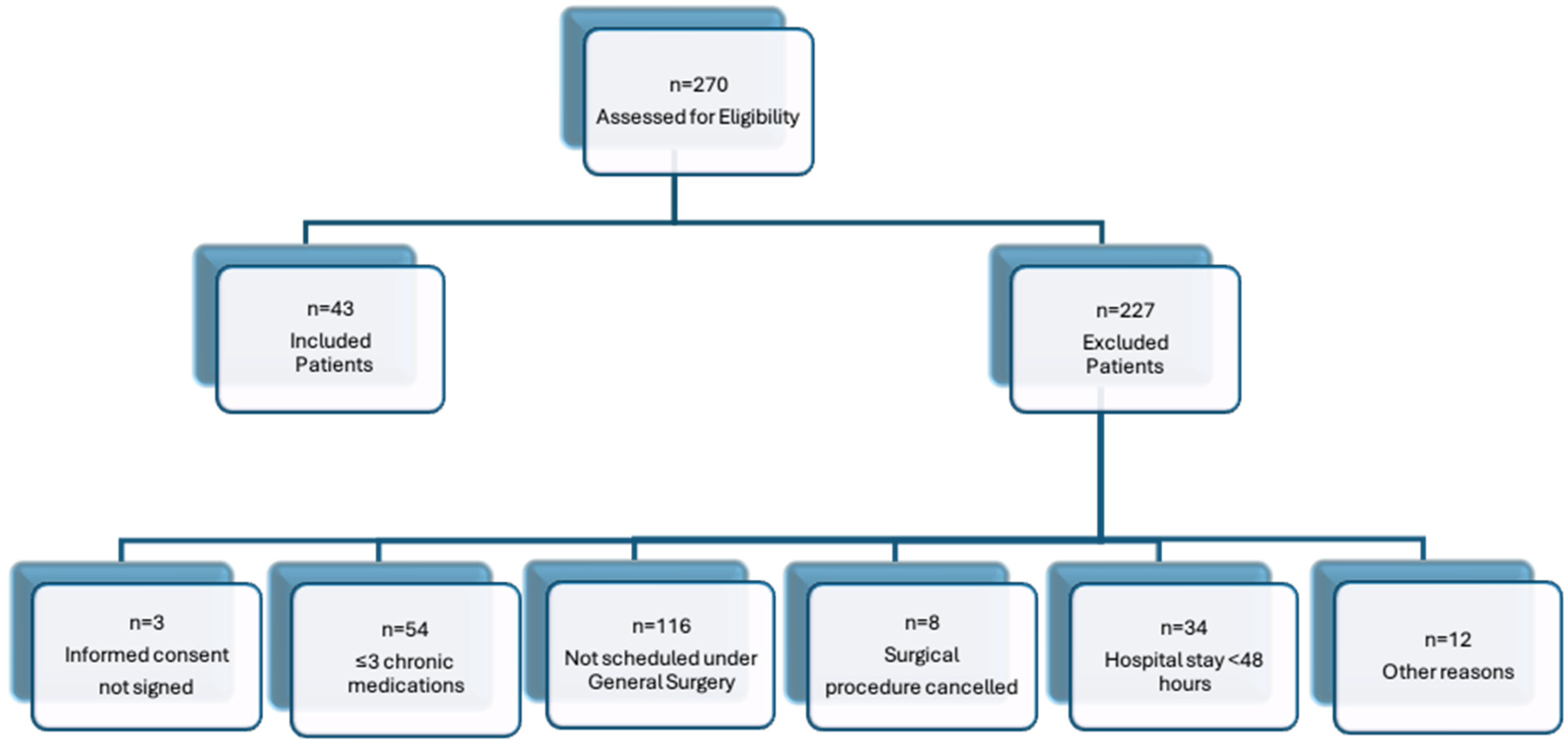
A total of 43 patients were included from an initial pool of 270 eligible individuals who underwent scheduled surgery without complications at a tertiary-level hospital (
Figure 1).
A total of 282 medications were recorded during the reconciliation process. The characteristics of the study population are presented in
Table 3.
Regarding the general surgery procedures undergone by the included patients, the most frequent was bariatric surgery (23.3%), followed by hernia repair (20.9%), biliary surgery (11.6%), and colorectal surgery (11.6%).
The pre-anesthesia report was attached for nearly all patients (95.3%) and included recommendations regarding the management of chronic medication during the perioperative period. In 3.5% of cases, discontinuation of treatment was advised; in 20.2%, continuation of medication was recommended; and in 3.5%, substitution with an equivalent drug was suggested. However, in 73% of cases, no specific recommendations were provided in the pre-anesthesia report, despite patients being on chronic medication.
The average time to the onset of oral tolerance was 13.1 h post-surgery (95% CI: 11.1–15.0), although some patients tolerated oral intake as early as 6 h (11.6% of cases). Oral medication was reintroduced, on average, 6.3 h after the onset of oral tolerance (95% CI: 4.3–8.4).
When comparing the hospital prescription with the patient’s usual chronic medication and after conducting the interview, a total of 243 discrepancies were identified. Among these, the most frequent were justified discrepancies due to therapeutic substitution according to the hospital’s pharmacotherapeutic guidelines, accounting for 20% of cases (
Table 4). On the other hand, 44% of the medications analyzed presented discrepancies classified as real, with omission of the prescribed medication being the most common.
A total of 93% of patients presented at least one real discrepancy, with an average of 43% of their chronic treatment affected by such discrepancies. No statistically significant differences were observed in the distribution of real discrepancies between sex-stratified groups (p = 0.684). The analysis identified a clear and statistically significant association between the number of chronic medications and the likelihood of real discrepancies. Both Pearson’s (r = 0.65; 95% CI: 0.44–0.80) and Spearman’s coefficients (ρ = 0.52; p < 0.001) demonstrated a moderate, positive correlation. In the adjusted Poisson model, medication count remained an independent predictor of discrepancies (IRR = 1.212; 95% CI: 1.141–1.288), corresponding to a 21% rise in expected discrepancies per added medication after controlling for age, sex, and presence of a caregiver.
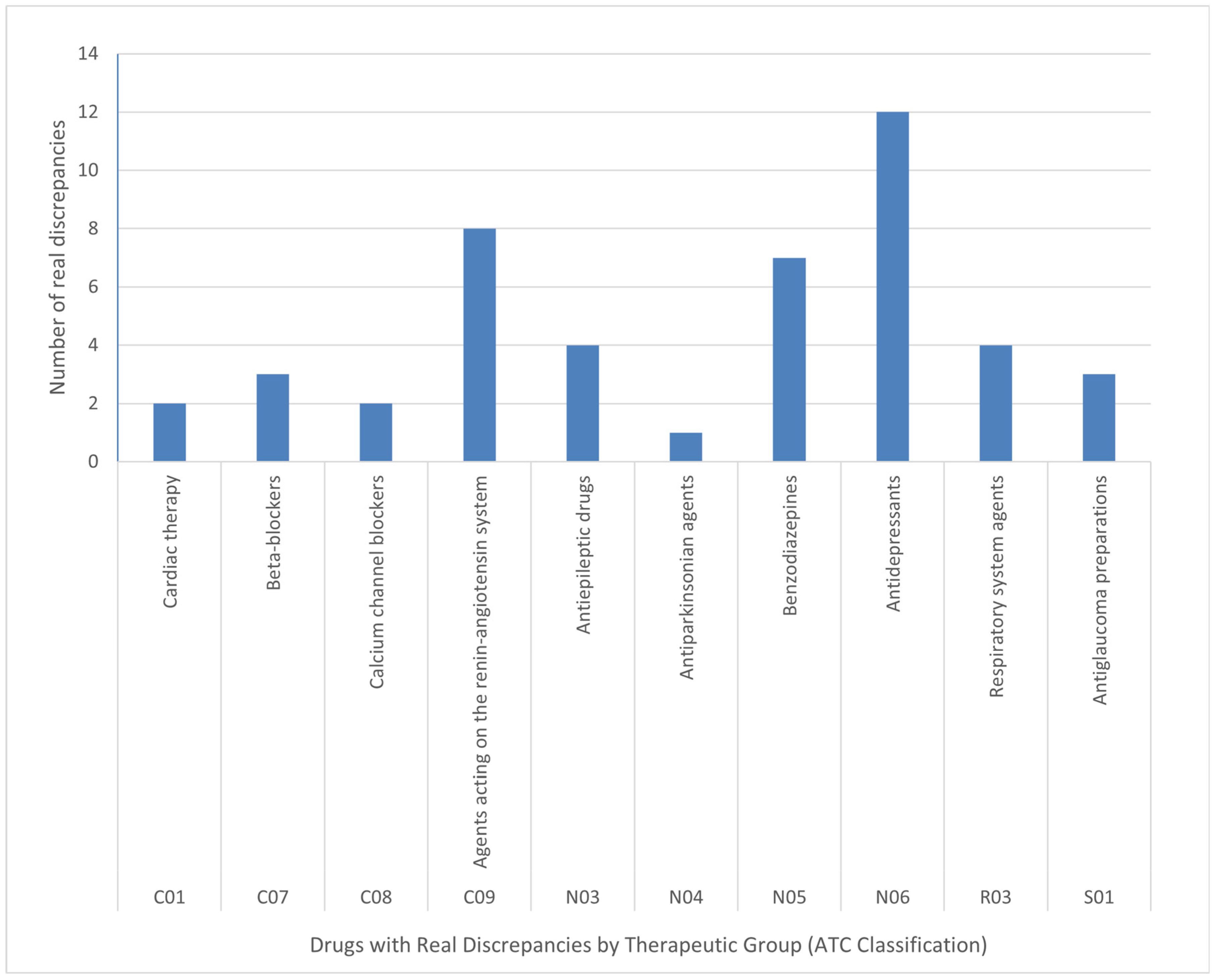
Medications were classified according to the Anatomical Therapeutic Chemical (ATC) Classification System for evaluation. Among the ATC groups associated with real discrepancies, the cardiovascular system category (ATC group C) accounted for the highest proportion (35.2%), with lipid-lowering agents (C10) being the most prevalent subgroup (19.2%). This was followed by the nervous system category (ATC group N), which represented 23.2% of discrepancies, with antidepressants (N06) being the most frequently involved subgroup (9.6%).
Regarding the assessment of the severity of identified real discrepancies, the potentially most serious cases—those involving medications that should not be discontinued due to the high risk of acute withdrawal syndromes, clinically relevant adverse effects, and/or postoperative complications—accounted for 36.8% of real discrepancies. These cases predominantly involved drugs acting on the cardiovascular system (e.g., antiarrhythmics, antihypertensives) and the nervous system (e.g., antidepressants) (
Figure 2).
Among the most clinically relevant events identified was an asthma exacerbation secondary to the omission of the patient’s usual inhalation therapy, which led to bronchospasm in a patient with compromised pulmonary function following abdominal surgery. This required urgent treatment with aerosolized medications.
Another case involved a withdrawal syndrome resulting from the interruption of chronic treatment with opioids, anxiolytics, and antidepressants (tricyclics, SSRIs, and SNRIs), which triggered symptoms such as anxiety, insomnia, and abdominal cramps. The patient required rescue opioid doses following the event.
Additionally, a case of persistent insomnia was observed following the withdrawal of anxiolytics, and a hypertensive crisis (systolic blood pressure > 140 mmHg) occurred after the suspension of antihypertensive therapy, requiring rescue treatment with sublingual captopril and clinical monitoring.
4. Discussion
Surgical patients are particularly vulnerable to risks and complications arising from the withdrawal of chronic medications [
12]. If we add to this fact that more than half of the patients who undergo surgery are usually elderly, with chronic pathologies and polypharmacy, this risk of suffering conciliation errors may be increased [
13]. In addition, the risk of reconciliation errors increases proportionally with the duration of treatment interruption. Therefore, it is essential to include these patients in medication reconciliation programs to optimize clinical safety throughout the care process.
The findings of this study indicate the presence of a high incidence of real discrepancies within this cohort of surgical patients with polypharmacy. Of the 282 medications analyzed, 86% exhibited some type of discrepancy, with 44% classified as real discrepancies and an average of 5.7 real discrepancies per patient. These results are consistent with previous evidence showing that more than half of surgical patients experience unjustified differences between their usual medication regimens and in-hospital prescriptions [
14,
15]. Unjustified omission was the most frequent discrepancy (43%), aligning with published data [
16,
17] highlighting a significant clinical risk for polymedicated patients with chronic diseases. Furthermore, the study confirms that the number of medications is a strong and consistent predictor of real discrepancies.
In the analysis of the severity of identified real discrepancies, a greater involvement was observed among therapeutic groups corresponding to antidepressants (ATC group N06), followed by medications acting on the renin–angiotensin system (ATC group C09). This finding is consistent with various published guidelines [
7,
8,
9,
18] that identify these groups as critical in perioperative management due to their impact on the patient’s clinical stability. Although this study was not specifically designed to detect complications directly attributable to the withdrawal of chronic medications, the four clinical cases observed show similarities with those described in previous research [
4,
16].
Regarding the reintroduction of medication following surgery, in our study this occurred, on average, 6.3 h after the onset of oral tolerance. Oral tolerance was achieved at a mean of 13.1 h post-surgery. This interval exceeds the recommendations established in clinical guidelines [
19], which advocate for earlier reintroduction of nutrition—and consequently oral medication—whenever the patient’s clinical condition permits.
With respect to pre-anesthesia reports, a significant lack of specific guidance regarding the management of chronic medication was identified. In 73% of cases, no concrete recommendations were provided. Although these reports adequately address the withdrawal of drugs that may interfere with the surgical procedure, they do not offer equally precise guidance on the need to maintain or reintroduce chronic medication after surgery.
One of the main limitations of this study is its cross-sectional design, which restricts the assessment of delays or omissions in the administration of chronic medications to those identified at the time of the interview. The relatively small sample size further limits the strength and external validity of the findings. Additionally, a methodological limitation arises from the exclusion of cases in which the attending physician modified the prescription based on pharmacist recommendations following appropriate validation prior to the research team’s review, as these instances were not classified as real discrepancies. Nonetheless, in all instances where a real discrepancy with potential clinical relevance was detected, immediate notification was provided to the responsible healthcare professional to ensure prompt resolution.
In conclusion, our findings suggest that polymedicated surgical patients may be at risk of postoperative complications related to the omission of chronic medications during the perioperative period, as observed in our cohort. This underscores the importance of expanding pre-anesthesia reports to include explicit recommendations for postoperative pharmacological management. Moreover, the results highlight the essential role of pharmacists in the medication reconciliation process, together with the contribution of nursing staff, whose active involvement supports early identification of oral tolerance and timely reintroduction of chronic therapies. Integrating these actions within a framework of interdisciplinary communication and standardized clinical practices is crucial to enhance patient safety throughout the continuum of care. However, larger and more representative studies are needed to confirm these observations and to determine their broader applicability.
Author Contributions
Conceptualization, M.J.-H., C.C.-C., M.G.-S., J.O.S. and D.C.-B.; Data curation, M.J.-H.; Formal analysis, M.J.-H., D.C.-B. and V.Z.-M.; Investigation, V.Z.-M.; Methodology, M.J.-H. and D.C.-B.; Supervision, J.O.S. and D.C.-B.; Visualization, V.Z.-M., C.C.-C., M.G.-S. and J.O.S.; Writing—review and editing, M.J.-H. All authors have read and agreed to the published version of the manuscript.
Funding
This research received no external funding.
Institutional Review Board Statement
The study was conducted in accordance with the Declaration of Helsinki, and approved by Ethics Committee of Hospital Clínico Universitario de Valencia (Registration number: 2019/027 and date of approval 14 February 2019).
Informed Consent Statement
Informed consent was obtained from all subjects involved in the study.
Data Availability Statement
The original contributions presented in this study are included in the article. Further inquiries can be directed to the corresponding authors.
Conflicts of Interest
The authors declare no conflicts of interest.
References
- Leigard, E.; Hertzberg, D.; Konrad, D.; Bell, M. Increasing perioperative age and comorbidity: A 16-year cohort study at two University hospital sites in Sweden. Int. J. Surg. 2024, 110, 4124–4131. [Google Scholar] [CrossRef] [PubMed]
- Lertkovit, S.; Siriussawakul, A.; Suraarunsumrit, P.; Lertpipopmetha, W.; Manomaiwong, N.; Wivatdechakul, W.; Srinonprasert, V. Polypharmacy in Older Adults Undergoing Major Surgery: Prevalence, Association with Postoperative Cognitive Dysfunction and Potential Associated Anesthetic Agents. Front. Med. 2022, 9, 811954. [Google Scholar] [CrossRef] [PubMed]
- McIsaac, D.I.; Wong, C.A.; Bryson, G.L.; van Walraven, C. Association of polypharmacy with survival, complications, and healthcare resource use after elective noncardiac surgery: A population-based cohort study. Anesthesiology 2018, 128, 1140–1150. [Google Scholar] [CrossRef] [PubMed]
- Kennedy, J.M.; van Rij, A.M.; Spears, G.F.; Pettigrew, R.A.; Tucker, I.G. Polypharmacy in a general surgical unit and consequences of drug withdrawal. Br. J. Clin. Pharmacol. 2000, 49, 353–362. [Google Scholar] [CrossRef] [PubMed]
- Sociedad Española de Farmacia Hospitalaria. Documento de Consenso en Terminología y Clasificación de los Programas de Conciliación de la Medicación; Ediciones Mayo: Madrid, Spain, 2009; ISBN 978-84-9905-044-7. [Google Scholar]
- Rogers, G.; Alper, E.; Brunelle, D.; Federico, F.; Fenn, C.A.; Leape, L.L.; Kirle, L.; Ridley, N.; Clarridge, B.R.; Bolcic-Jankovic, D.; et al. Reconciling medications at admission: Safe practice recommendations and implementation strategies. Jt. Comm. J. Qual. Patient Saf. 2006, 32, 37–50. [Google Scholar] [CrossRef] [PubMed]
- Roure Nuez, C.; López Sisamón, D.; Prats Riera, M.; Broto Sumalla, T. Protocol pel Maneig Perioperatori de la Medicació Crònica 2012; Grup de treball sobre el maneig perioperatori de la medicació habitual de la Societat Catalana de Farmàcia Clínica: Barcelona, Spain, 2012. [Google Scholar]
- Cuellar Obispo, E.; Alvaro Sanz, E.; Faus Felipe, V.; Hinojosa Jiménez, A.; Gómez Luque, A.; Moreno Villar, A.; Vela Vázquez, D.M.C. Manejo Perioperatorio de Medicación Crónica: Documento de Apoyo al PAI Atención al Paciente Quirúrgico; Junta de Andalucía—Consejería de Salud: Sevilla, Spain, 2015. [Google Scholar]
- INFAC. Manejo de la medicación crónica en el periodo perioperatorio. Acercamiento Multidiscip. 2017, 25, 77–85. [Google Scholar]
- Naseralallah, L.; Koraysh, S.; Alasmar, M.; Aboujabal, B. The role of pharmacists in mitigating medication errors in the perioperative setting: A systematic review. Syst. Rev. 2025, 14, 12. [Google Scholar] [CrossRef] [PubMed]
- Léguillon, R.; Varin, R.; Pressat-Laffouilhère, T.; Chenailler, C.; Chassagne, P.; Roca, F. Clinical Pharmacist Intervention Reduces Potentially Inappropriate Prescriptions in a Geriatric Perioperative Care Unit Dedicated to Hip Fracture. Gerontology 2023, 69, 386–395. [Google Scholar] [CrossRef] [PubMed]
- Noble, D.W.; Kehlet, H. Risks of interrupting drug treatment before surgery. BMJ 2000, 321, 719–720. [Google Scholar] [CrossRef] [PubMed]
- Sánchez, O.D.; Picó, J.N.; López, I.M.; Fabiá, A.S.; Jiménez, L.A.; Cortés, F.F. Errores de conciliación en el ingreso y en el alta hospitalaria en pacientes ancianos polimedicados. Estudio prospectivo aleatorizado multicéntrico. Med. Clín. 2009, 133, 741–744. [Google Scholar] [CrossRef] [PubMed]
- Gjerde, A.M.; Aa, E.; Sund, J.K.; Stenumgard, P.; Johnsen, L.G. Medication reconciliation of patients with hip fracture by clinical pharmacists. Eur. J. Hosp. Pharm. 2016, 23, 166–170. [Google Scholar] [CrossRef] [PubMed]
- Hellström, L.M.; Bondesson, Å.; Höglund, P.; Eriksson, T. Errors in medication history at hospital admission: Prevalence and predicting factors. BMC Clin. Pharmacol. 2012, 12, 9. [Google Scholar] [CrossRef] [PubMed]
- Sund, J.K.; Sletvold, O.; Mellingsæter, T.C.; Hukari, R.; Hole, T.; Uggen, P.E.; Vadset, P.T.; Spigset, O. Discrepancies in drug histories at admission to gastrointestinal surgery, internal medicine and geriatric hospital wards in Central Norway: A cross-sectional study. BMJ Open 2017, 7, e013427. [Google Scholar] [CrossRef] [PubMed]
- González-García, L.; Salmerón-García, A.; García-Lirola, M.; Moya-Roldán, S.; Belda-Rustarazo, S.; Cabeza-Barrera, J. Medication reconciliation at admission to surgical departments. J. Eval. Clin. Pract. 2016, 22, 20–25. [Google Scholar] [CrossRef] [PubMed]
- Valdeolmillos Carbó, L.V.; Esteban Gómez, M.J.; Ruiz-Jarabo Gómez, I.; Ribed Sánchez, A.; Vicente Oliveros, N.; Belén Guisado Gil, A.; Campino Villegas, A.; Campillos, P.; Martínez, P.O.; de Pourcq, J.T. Guidelines on the perioperative management of chronic medication in surgical patients. Farm. Hosp. 2025, in press. [Google Scholar] [CrossRef] [PubMed]
- Stenberg, E.; Dos Reis Falcão, L.F.; O’Kane, M.; Liem, R.; Pournaras, D.J.; Salminen, P.; Urman, R.D.; Wadhwa, A.; Gustafsson, U.O.; Thorell, A. Guidelines for Perioperative Care in Bariatric Surgery: Enhanced Recovery After Surgery (ERAS) Society Recommendations: A 2021 Update. World J. Surg. 2022, 46, 729–751. [Google Scholar] [CrossRef] [PubMed]
| Disclaimer/Publisher’s Note: The statements, opinions and data contained in all publications are solely those of the individual author(s) and contributor(s) and not of MDPI and/or the editor(s). MDPI and/or the editor(s) disclaim responsibility for any injury to people or property resulting from any ideas, methods, instructions or products referred to in the content. |





 ,
,