Article

Association Between the Prognostic Nutritional Index and Outcomes in Patients Undergoing Emergency Laparotomy


by
Sithdharthan Ravikumar
1,*,
Kasun Wanigasooriya
1,2,
Shashikanth Vijayaraghavalu
1,
Lanoayo Agbabiaka
1,
Shuker Yahia
1,
Christian Katz
1,
Balasubramanian Piramanayagam
1,
Aravindan Narayanan
1,
Altaf Haji
1,
Muhammad Imran Aslam
1 and
Kalimuthu Marimuthu
1
1
George Eliot Hospital NHS Trust, College Street, Nuneaton CV10 7DJ, UK
2
Institute of Biomedical Research, College of Medical and Dental Science, University of Birmingham, Vincent Drive, Edgbaston, Birmingham B15 2TT, UK
*
Author to whom correspondence should be addressed.
J. Clin. Med. 2026, 15(1), 164; https://doi.org/10.3390/jcm15010164
Submission received: 30 November 2025 / Revised: 19 December 2025 / Accepted: 22 December 2025 / Published: 25 December 2025
(This article belongs to the Section Emergency Medicine)

Abstract

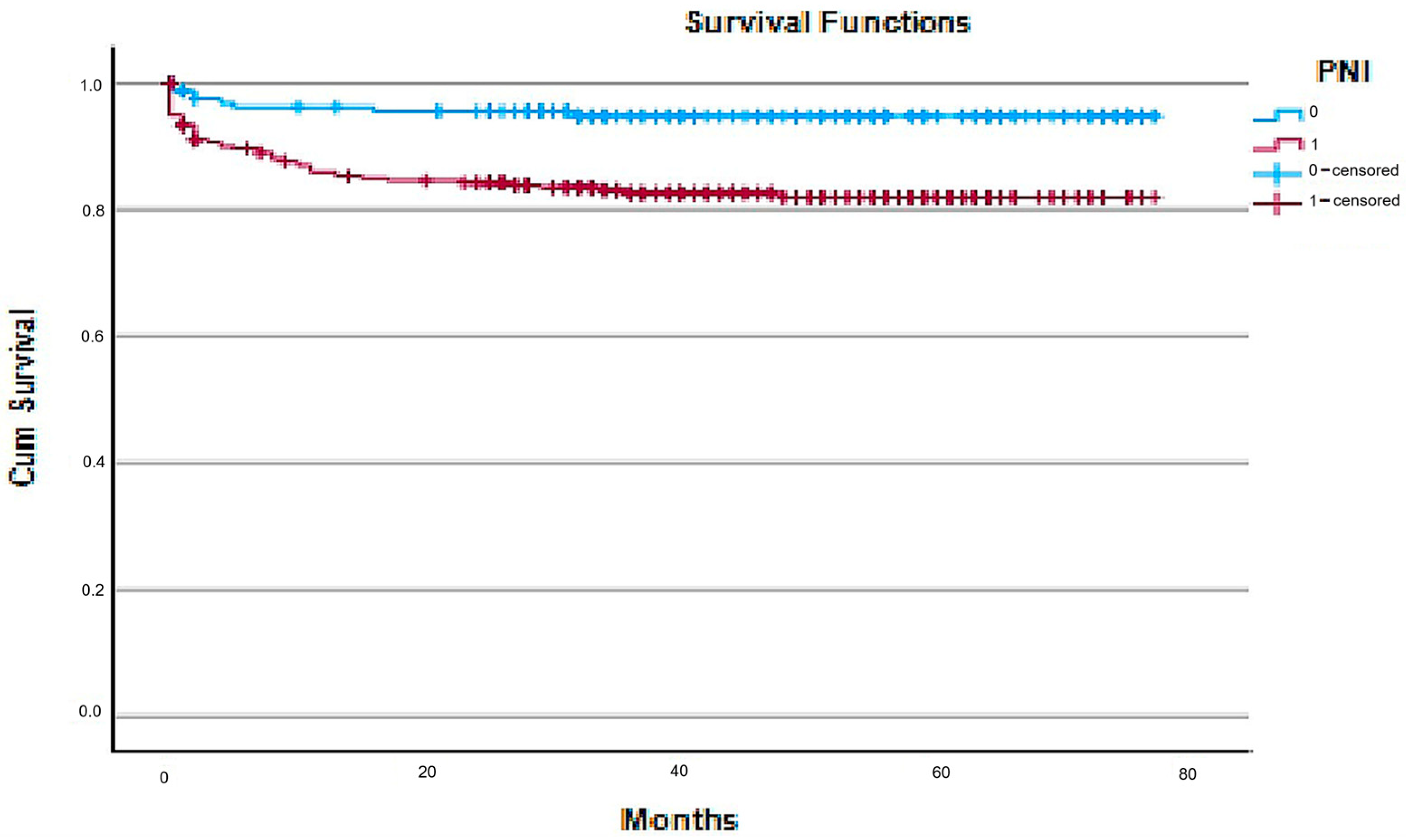
Background: Nutritional status is a key determinant of surgical outcomes, but its assessment in emergency settings remains challenging. The prognostic nutritional index (PNI), which is derived from the serum ALB concentration and lymphocyte count, is a rapid, objective measure of nutritional and immune status. This study evaluated the associations between the PNI and postoperative outcomes in patients undergoing emergency laparotomy. Methods: A retrospective observational study was conducted at a single district general hospital in England, including adult patients who underwent emergency laparotomy between January 2019 and December 2023. The PNI was calculated as PNI = serum albumin (g/L) + 0.005 × total lymphocyte count (cells/μL). Patients were classified as malnourished (PNI < 50) or not malnourished (PNI ≥ 50). The outcomes assessed included postoperative complications, length of hospital stay (LOS), 30-day readmission, and three-year all-cause mortality. Statistical analyses included chi-square, Mann–Whitney U, logistic regression, and Kaplan–Meier survival analyses. Preoperative albumin and lymphocyte counts were obtained on admission or within 24 h prior to surgery to calculate the PNI. Results: Among 482 patients (median age 68 years; 57% male), 66% were malnourished. Malnutrition was significantly associated with higher ASA grade (p < 0.001), frailty (p = 0.028), and comorbidity burden (p < 0.001). Malnourished patients had longer LOSs (≥12 days; p < 0.001) and higher 30-day readmissions (p = 0.026). After adjustment for key confounders, low PNI remained independently associated with stoma formation and prolonged length of stay. After adjustment for ASA grade, frailty, comorbidity burden, hypotension, and sepsis, low PNI remained independently associated with stoma formation and prolonged length of stay. Kaplan–Meier analysis revealed reduced three-year survival in malnourished patients (log-rank p < 0.01). Conclusions: Malnutrition, as defined by a low PNI, is highly prevalent and associated with adverse postoperative outcomes in emergency laparotomy. PNI is a simple, objective, and clinically useful tool that should be incorporated into preoperative assessments to guide early nutritional optimization. However, albumin and lymphocyte counts may be influenced by acute inflammation and resuscitation in emergency presentations, and nutritional interventions were not captured in this retrospective dataset.
Keywords: nutrition; emergency laparotomy; prognostic nutritional index; surgical outcomes nutrition; emergency laparotomy; prognostic nutritional index; surgical outcomes