
Bridging Imaging and Pathohistology in Pancreatic Hamartoma: A Systematic Review of the Literature with an Integrated Case Report
 , , , ,
  and
and
Abstract
1. Introduction
2. Materials and Methods
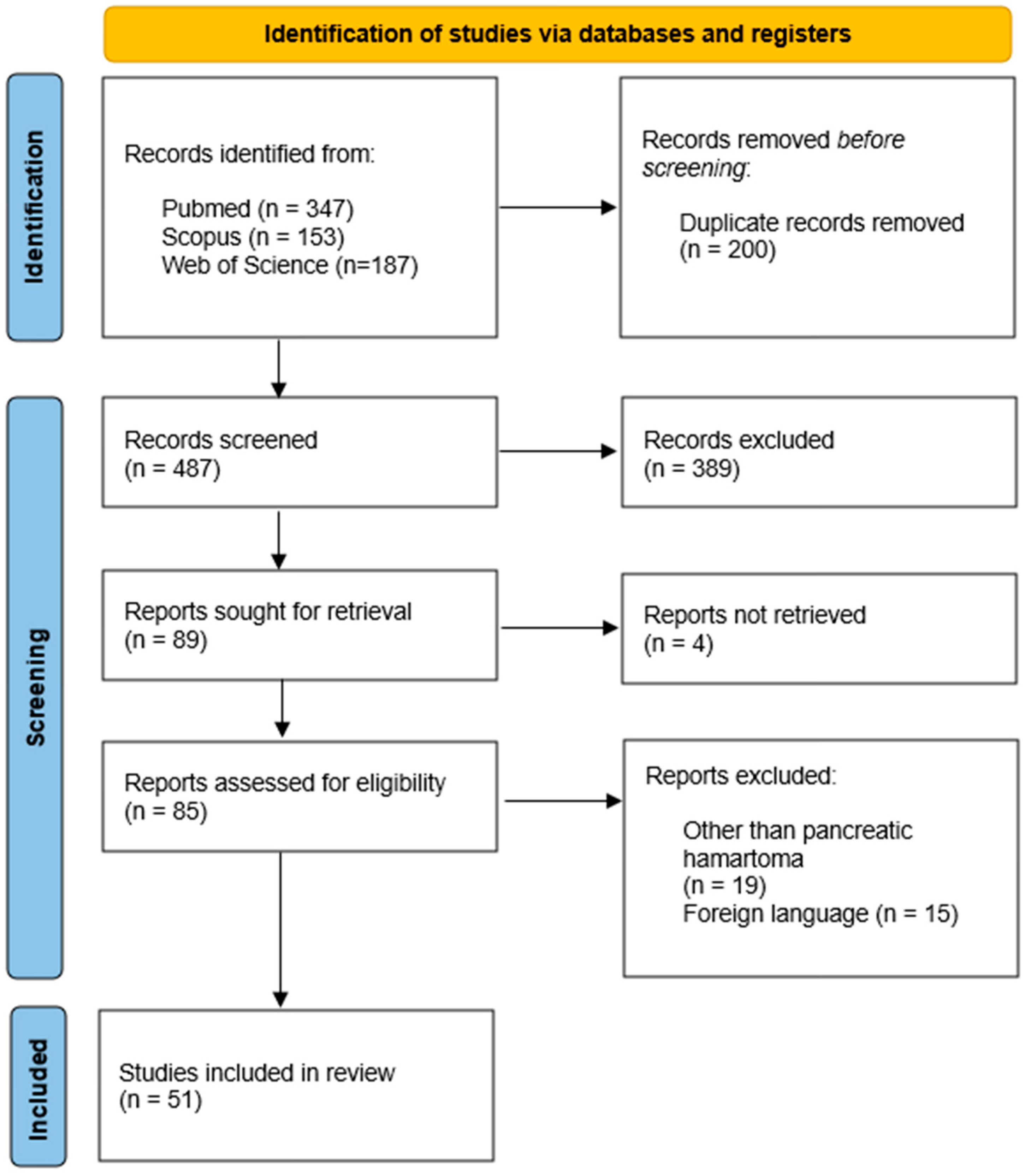
2.1. Selection of Studies
2.2. Search Strategy
2.3. Data Abstraction
2.4. Statistical Analysis
3. Results
3.1. Case Presentation
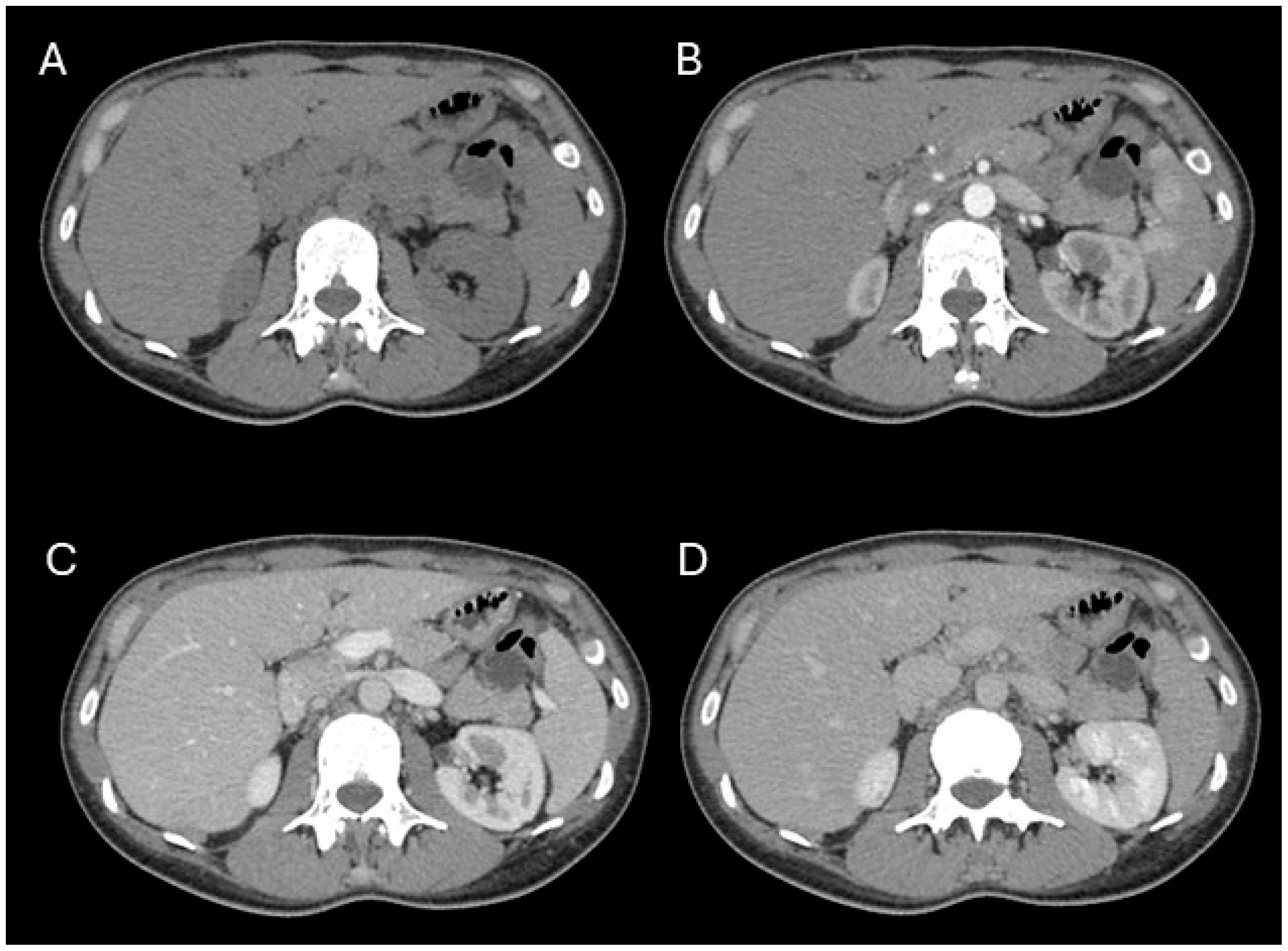
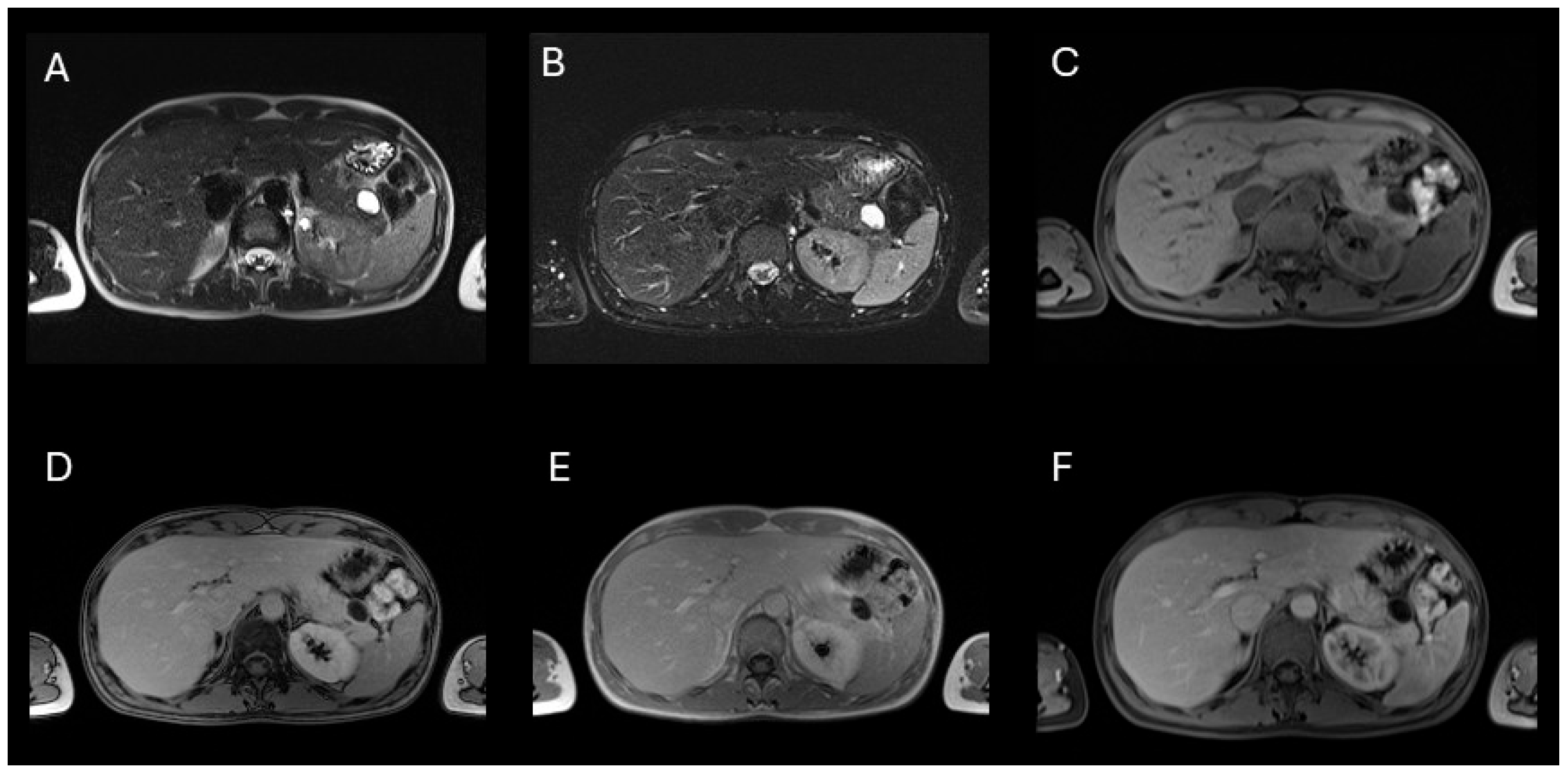
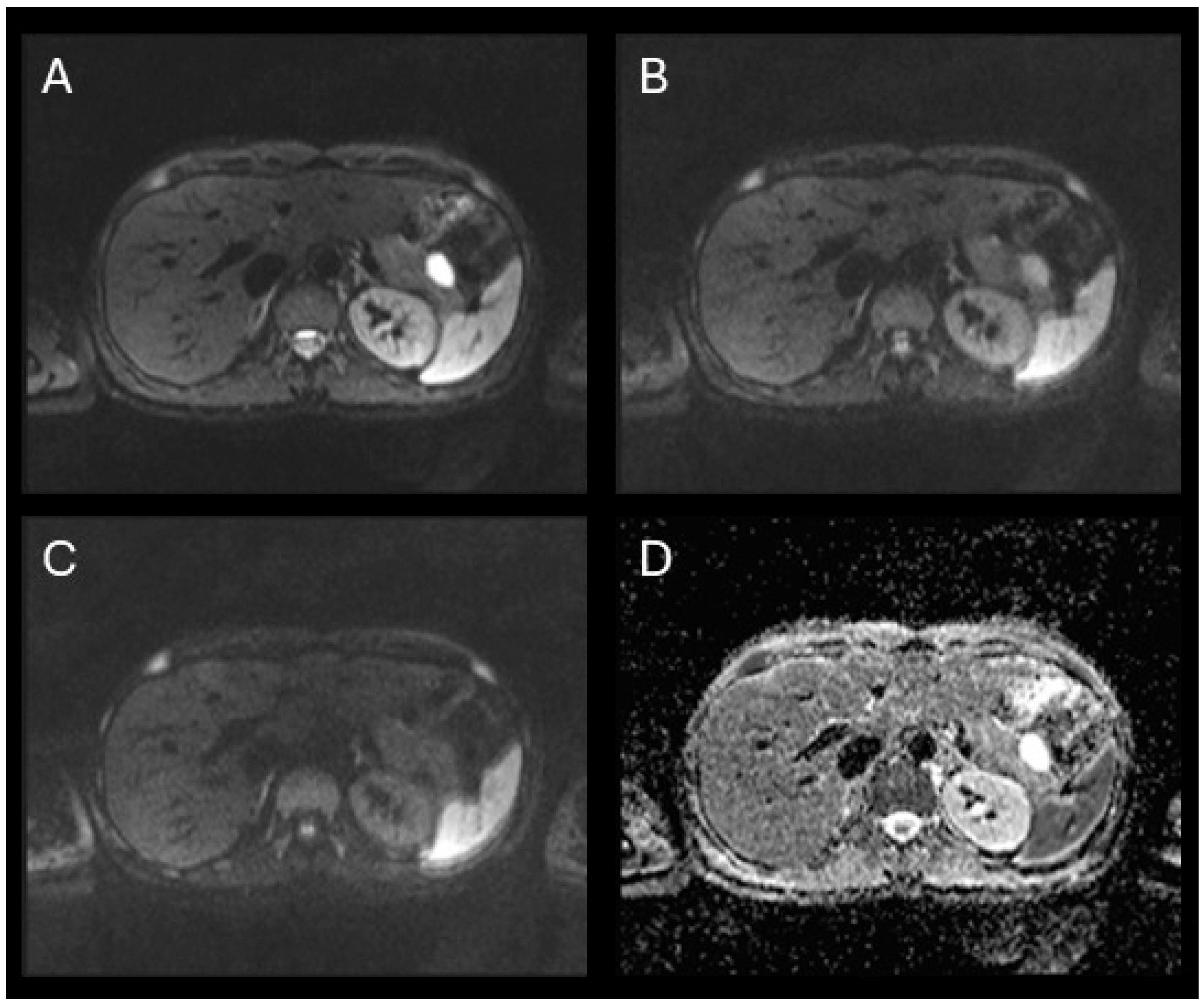
3.1.1. Imaging Findings
3.1.2. Surgical Findings
3.1.3. Gross Pathological Findings
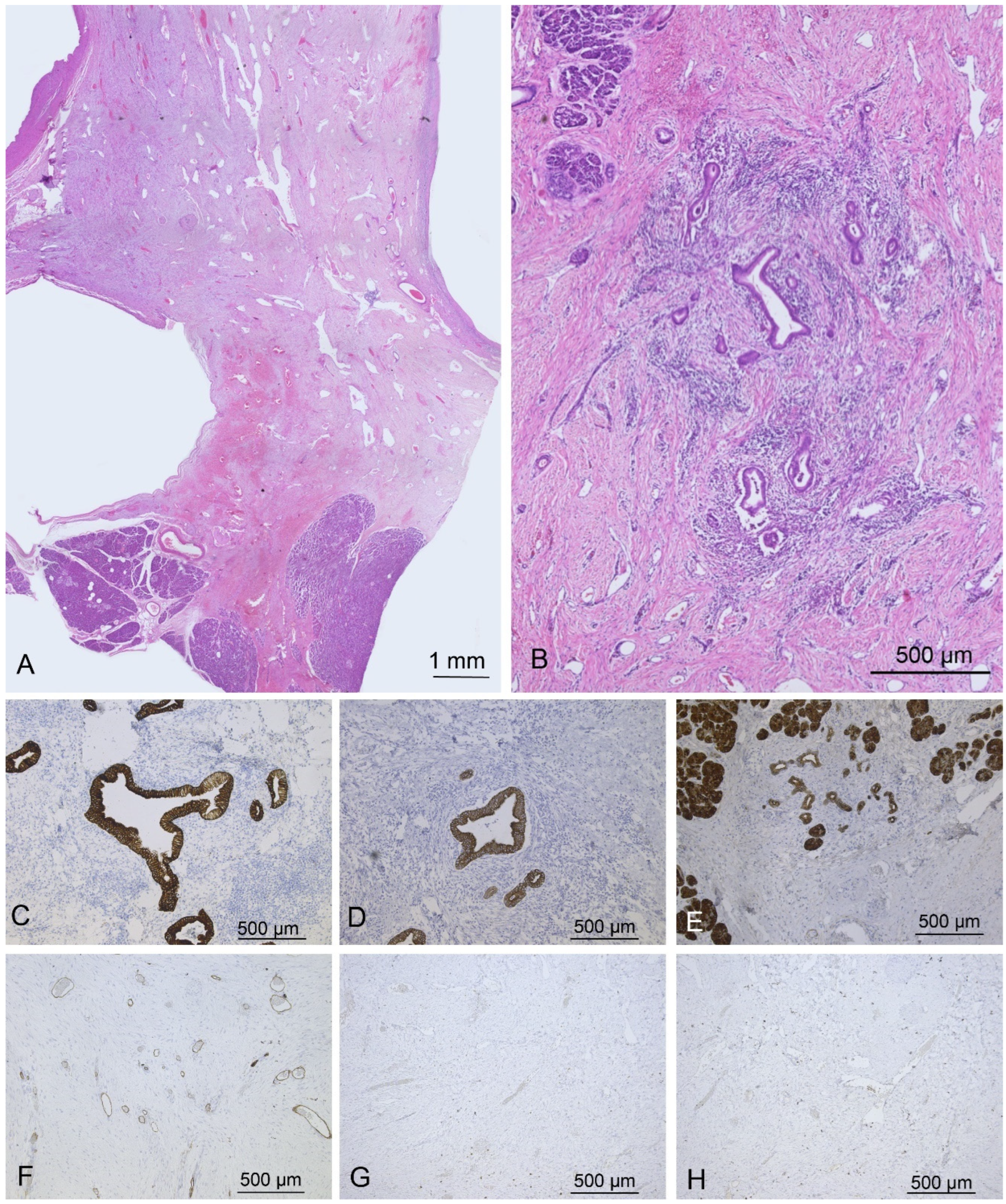
3.1.4. Pathohistological Findings
3.2. Systematic Review
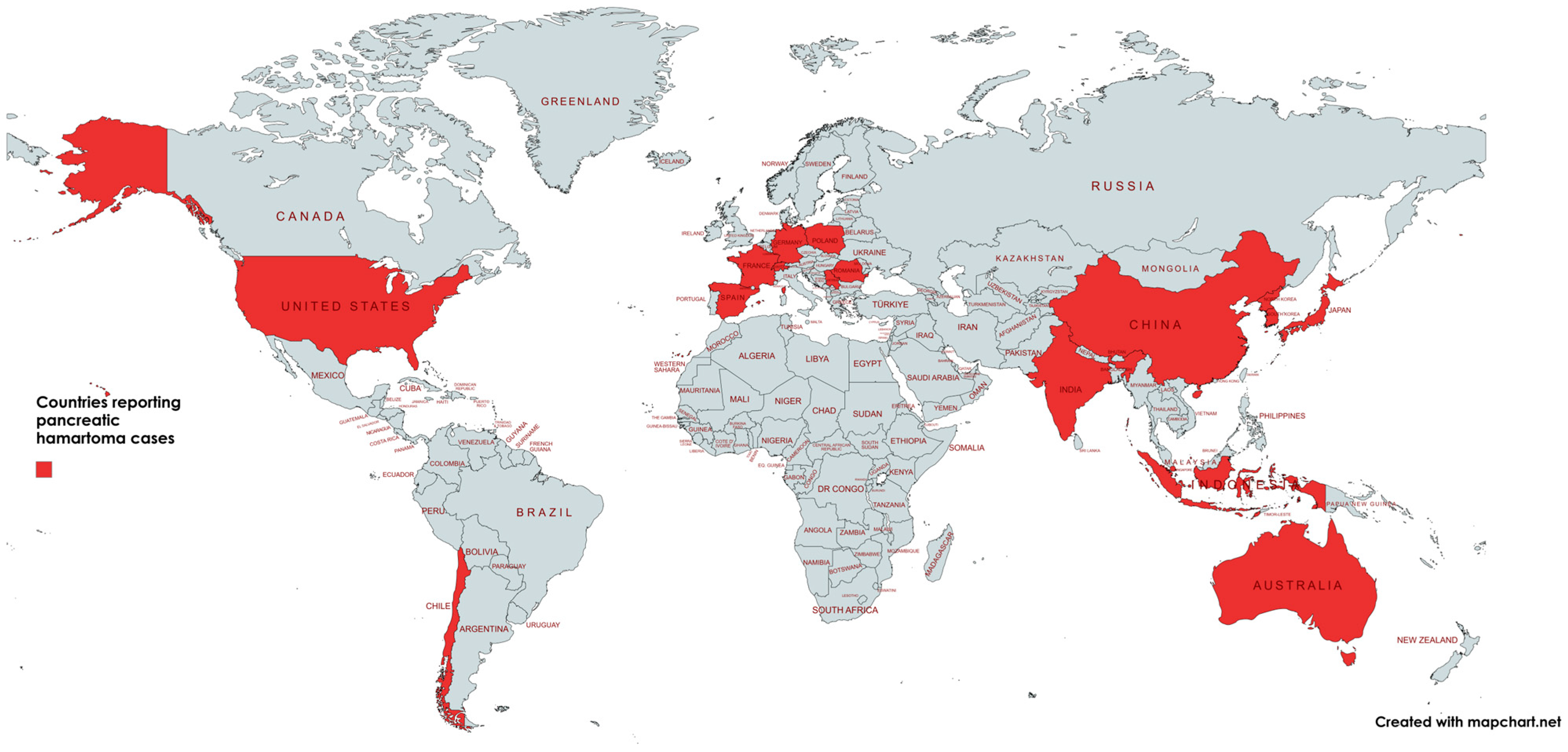
3.3. Characteristics of Eligible Studies

| Author | Year | Country | Gender/Age | Presentation | Duration of Symptoms (Months) | Site | Size (cm) | Provisional Diagnosis | Treatment | Post-Op Complications | Follow-Up and Outcome |
|---|---|---|---|---|---|---|---|---|---|---|---|
| Izibicki et al. [17] | 1994 | Germany | M/25 | Abdominal pain, nausea | / | H | 10.6 | / | / | / | / |
| Wu et al. [18] | 1998 | USA | M/39 | Transient prandial midepigastric pain and a 15 kg weight loss over the past year. | 10 years | H | 8.0 × 8.0 × 6.0 | / | Whipple | / | Recovered well since surgery without recurrence of pain after 9 mo |
| McFaul et al. [19] | 2004 | Switzerland | M/29 | Heartburn, vomiting and intermittent right upper quadrant pain associated with a 15 kg weight loss | 13 mo | H | 1.0 | Chronic pancreatitis and a pancreatic neoplasm; calcification also suggested a non-functioning islet cell neoplasm. | Pylorus-preserving PD | / | Alive and well after 2 years |
| M/62 | Intermittent abdominal pain associated with vomiting 1–2 h after eating and a 25 kg-weight loss | 2 years | H | 3.5 | / | Kausch-Whipple procedure | / | Alive and well after 3 mo | |||
| Pauser et al. [5] | 2005 | Germany | F/36 | Epigastric pain | 1.0 | H | 7.0 | Pseudotumor | Whipple | No | Relapse-free after 15 mo |
| F/55 | Abdominal pain | 1 mo | N | 2.7 | Pseudotumor | Distal pancreatectomy and splenectomy | No | Relapse-free after 23 mo | |||
| Pauser et al. [6] | 2005 | Germany | M/51 | Asymptomatic | / | T | 3.0 | / | Surgery | No | Relapse-free after 2 years |
| M/54 | Slight abdominal discomfort | / | B | 2.0 | / | Left-sided pancreatic resection | No | Relapse-free after 4 years | |||
| Nagata et al. [1] | 2007 | Japan | F/58 | Asymptomatic | / | B | 1.9 | Pancreatic endocrine tumor | Distal pancreatectomy | No | Relapse-free after 6 mo |
| Samplean et al. [20] | 2009 | Romania | M/46 | Abdominal pain | 9 mo | H | 8 × 6 | / | Cephalic duodenopancreatectomy | / | / |
| Durczynski et al. [9] | 2010 | Poland | M/69 | Asymptomatic | / | B | 3.0 | / | Central pancreatic resection with Roux-en-Y pancreaticojejunostomy to the distal pancreatic remnant | Yes | Relapse-free after 55 mo |
| Kawakami et al. [8] | 2012 | Japan | F/78 | Asymptomatic | / | H | 1.4 | Pancreatic cancer | PD | / | Relapse-free after 30 mo |
| Kim et al. [21] | 2012 | Korea | F/52 | Postprandial abdominal discomfort | 1 mo | H | 2.2 × 1.4 | SPN or SCN | Pylorus-preserving PD | No | Relapse-free after 10 mo |
| Kwon et al. [22] | 2012 | Korea | F/41 | Asymptomatic | / | H | 2 × 1 | NET or SPN | Pylorus preserving PD | No | / |
| Yamaguchi et al. [7] | 2013 | Japan | F/78 | Asymptomatic | / | H | 1.7 | Pancreatic cancer | Surgical resection | / | Relapse-free after 32 mo |
| F/61 | Abdominal pain | / | H | 4.0 | SPN | Surgical resection | / | Relapse-free after 7 mo | |||
| F/71 | Asymptomatic | / | B and T | 5.0 | Cystic tumor | Surgical resection | / | Relapse-free after 68 mo | |||
| F/58 | Asymptomatic | / | B | 2.0 | NET | Surgical resection | / | Relapse-free after 6 mo | |||
| F/59 | Abdominal pain | / | T | 1.0 | NET | Surgical resection | / | Relapse-free after 10 mo | |||
| M/53 | Abdominal pain | / | H | 8.0 | SPN | Surgical resection | / | Relapse-free after 9 mo | |||
| M/53 | Asymptomatic | / | H | 2.5 | Mass-formatting pancreatitis | Surgical resection | / | Relapse-free after 12 mo | |||
| Addeo et al. [10] | 2013 | France | F/61 | Asymptomatic | / | B | 2.7 × 2.3 × 2.1 | / | A robotic distal pancreatectomy with a splenectomy | / | / |
| Inoue et al. [23] | 2014 | Japan | M/65 | Obstructive jaundice | / | H | 4.0 | / | PD | / | Relapse-free after 3 years |
| Shahbaz et al. [24] | 2015 | USA | F/62 | Abdominal pain | 3–4 mo | H | 1.4 | Pancreatic tumor | Whipple | / | / |
| Zhang et al. [25] | 2016 | China | F/53 | Abdominal pain, anorexia, 2 kg weight loss | 2 mo | H | 2.3 × 1.5 × 1.5 | / | Formal PD | No | No recurrence after 55 mo |
| Murakami et al. [26] | 2016 | Japan | F/62 | Pancreatitis attacks | 30 years | H | 7.0 × 5.7 × 4.0 | Pancreatitis | Subtotal stomach-preserving PD | No | Pancreatitis has not recurred since surgery |
| Matsushita et al. [27] | 2016 | Japan | M/68 | Asymptomatic | / | U | 4.0 × 4.0 × 2.8 | Benign tumor such as lipoma, dermoid cyst or the other rare benign tumor | Pyloric preserving PD | No | No recurrence after 50 mo |
| Han et al. [14] | 2017 | Republic of Korea | F/35 | Hypoglycemia | / | T | 1 | NET | Distal pancreatectomy | / | / |
| Nahm et al. [13] | 2017 | Australia | F/42 | Abdominal pain | 3 mo | N | 2.8 | SPN | Central pancreatectomy | / | No recurrence after 8 mo |
| Nagano et al. [28] | 2017 | Japan | F/72 | Asymptomatic | / | H | 2.0 | / | Subtotal pyloric preserving PD | / | No recurrence afer 36 mo |
| Tanaka et al. [29] | 2018 | Japan | M/54 | Asymptomatic | / | T | 3.6 | IPMN, SCN, malignant tumor | Distal pancreatectomy | / | / |
| M/74 | Asymptomatic | / | H | 5.0 | IPMN | PD | / | / | |||
| M/67 | Asymptomatic | / | T | 6.5 | Liposarcoma | Distal pancreatectomy | / | / | |||
| Shin et al. [30] | 2019 | Republic of Korea | F/54 | Asymptomatic | / | H | 2.2 | SPN or NET | Robot-assisted pylorus-preserving PD | No | No evidence of local tumor recurrence or distant metastasis after 6 mo |
| Dasaraju et al. [31] | 2020 | USA | M/74 | Asymptomatic | / | U | 2.3 | NET | PD | / | / |
| Zhou et al. [32] | 2020 | China | M/73 | Abdominal pain | / | H | 4 × 3.5 | Pancreatic liposarcoma | PD | No | No sign of local recurrence after 3 mo |
| Katayama et al. [12] | 2020 | Japan | M/78 | Asymptomatic | / | T | 2.9 × 2.3 | NET | Whipple | No | Disease-free after 34 mo |
| Cui et al. [33] | 2020 | China | F/57 | Asymptomatic | / | U | 2.5 | NET | Whipple | / | Disease-free after 34 mo |
| M/69 | Asymptomatic | / | H | 1.5 | / | Whipple | / | Disease-free after 44 mo | |||
| Toyama et al. [11] | 2020 | Japan | M/53 | Asymptomatic | / | H | 3.7 | Mixed solid and cystic type SCN, NET with cystic degeneration, IPMC, SPN, and slow flow vascular malformation (the so-called hemangioma) | PD | / | / |
| Yang et al. [34] | 2021 | Republic of Korea | M/68 | Asymptomatic | / | H | 1.8 | NET | Pylorus-preserving PD | / | / |
| Jha et al. [35] | 2021 | India | M/68 | Progressively enlarging lump | 7 mo | B and T | 19 × 18 | / | Distal pancreatectomy with splenectomy | / | / |
| Noguchi et al. [36] | 2021 | Japan | F/70 | Asymptomatic | / | B | 1.9 × 1.6 × 1.4 | Nonfunctional pancreatic NET | Surgical resection | / | / |
| Ahn et al. [37] | 2021 | Republic of Korea | M/68 | Asymptomatic | / | H | 1.8 | NET | Pylorus-preserving PD | / | No recurrence or metastasis after 6 mo |
| Woo et al. [38] | 2022 | Japan | F/49 | Asymptomatic | / | B | 1.3 × 0.9 | NEN and SPN | Laparoscopic distal pancreatectomy | / | / |
| Santana et al. [39] | 2022 | Spain | M/41 | Asymptomatic | / | B | 1.8 | Mucinous tumor | Distal pancreatectomy | / | Alive after 5 mo |
| Tanigawa et al. [40] | 2022 | Japan | F/78 | Asymptomatic | / | H | 1.7 | Pancreatic cancer | / | / | No recurrence after 98 mo |
| F/71 | Asymptomatic | / | B | 5.0 | Cystic tumor | / | / | / | |||
| M/66 | Asymptomatic | / | H | 1.5 | Pancreatic cancer | / | / | / | |||
| F/58 | Asymptomatic | / | B | 2.0 | PanNET | / | / | No recurrence after 6 mo | |||
| M/65 | Weight loss | / | H | 4.0 | Acinar cell carcinoma | / | / | No recurrence after 10 mo | |||
| F/67 | Asymptomatic | / | B | 2.5 | Pancreatic tumor | / | / | No recurrence after 6 mo | |||
| M/75 | Asymptomatic | / | T | 1.0 | Pancreatic cancer | / | / | No recurrence after 37 mo | |||
| F/75 | Asymptomatic | / | T | 0.8 | PanNET | / | / | No recurrence after 3 mo | |||
| F/63 | Asymptomatic | / | B | 1.9 | Paraganglioma | / | / | No recurrence after 48 mo | |||
| F/59 | Abdominal pain | / | T | 1.0 | PanNET | / | / | No recurrence after 9 mo | |||
| M/53 | Abdominal pain | / | H | 8.0 | SPN | / | / | No recurrence after 15 mo | |||
| M/53 | Asymptomatic | / | H | 2.5 | Mass forming pancreatitis | / | / | No recurrence after 16 mo | |||
| M/68 | Abdominal pain | / | H | 4.0 | Dermoid cyst | / | / | No recurrence after 132 mo | |||
| Tee et al. [41] | 2022 | Singapore | M/Middle age | Asymptomatic | / | B | 13 | Pancreatic lipoma and well-differentiated liposarcoma | Surgical resection | Yes | Well after 3 mo |
| Kim et al. [2] | 2023 | Republic of Korea | F/57 | Asymptomatic | / | H | 3.2 | Primary hyperaldosteronism | Pylorus-preserving PD | No | No sign of recurrence after 6 mo |
| Jeo et al. [42] | 2023 | Indonesia | M/39 | Jaundice | 7 days | All pancreas | Multiple cysts ranging ±0.5–5 | von-Hippel-Lindau disease | Total PD | Yes | Well after 6 mo |
| Shintaku et al. [3] | 2023 | Japan | F/68 | Asymptomatic | / | H | 1.8 | NET | Subtotal stomach-preserving PD | No | Relapse-free after 9 mo |
| Das et al. [43] | 2024 | USA | M/73 | Abdominal pain | / | T | 2.3 | / | Laparoscopic distal pancreatectomy and splenectomy | / | Patient alive and well after 5 years |
| F/68 | Abdominal pain | / | H | 2.7 | / | PD | / | Patient alive and well after 6 years | |||
| M/73 | Abdominal pain | / | T | 0.6 | / | Pancreatectomy | / | Patient alive and well after 6 years | |||
| Liu et al. [44] | 2024 | China | M/63 | Abdominal distension with abdominal pain | 15days | H | 2.1 | NET | PD | / | No sign of recurrence after 16 mo |
| Wan et al. [45] | 2024 | China | M/33 | Asymptomatic | / | H | 6 × 4 | Clinical benign tumor | Laparoscopic enucleation | Yes | Relapse-free after 11 mo |
| Present case | 2021 | Serbia | F/37 | Abdominal pain | Several years | T | 3.5 × 3 × 2 | Mucinous cystic neoplasm, mucinous cystadenoma | Distal pancreatectomy with splenectomy | No | Alive and well after 4 years |
| Author | Year | Country | Gender/Age | Site | Size (cm) | PH | Treatment | Follow-Up and Outcome |
|---|---|---|---|---|---|---|---|---|
| Burt et al. [46] | 1983 | USA | F/34 w | Diffuse | 11.5 | Solid and cystic | PD and splenectomy | Alive at 3 mo |
| Flaherthy et al. [47] | 1992 | USA | F/20 mo | H | 9 | Solid and cystic | Local resection | Alive at 9 mo |
| Sepulveda et al. [48] | 2000 | Chile | M/27 w | Diffuse | 12 | Large multicystic | Excision of the tumor and partial duodenectomy | Symptom-free at the age of 1 y |
| Thrall et al. [49] | 2007 | USA | M/3 y | H | 3 | Multicystic adenomatoid | PD | / |
| Sueyoshi et al. [50] | 2009 | Japan | M/14 mo | T | 14 | Multicystic adenomatoid | Local resection | Alive at 26 mo |
| Delgado et al. [51] | 2017 | USA | F/33 w | / | 1.2 | Cysts | / | Trisomy 18, autopsy case, alive 1 h |
| Shah et al. [52] | 2017 | USA | F/8 mo | / | 14.5 × 11 × 5.5 | Solid and cystic | Resection | Well after 3 mo |
| Hosfield et al. [53] | 2019 | USA | M/4 years | H | 9.5 | Multicystic adenomatoid | Whipple | Well after 3 mo |
| Varlas et al. [54] | 2022 | Romania | F/36 weeks | Diffuse | 11 | Multicystic adenomatoid | Local resection | Alive at 11 mo |
| Author | Year | Pathologic Type | Provisional Diagnosis | Spindle Cells Cellularity | Langerhans Islets | Peripheral Nerves | Elastic Fibers * |
|---|---|---|---|---|---|---|---|
| Wu et al. [18] | 1998 | / | Mucinous cystic tumor Suspicion of malignancy | / | / | / | / |
| McFaul et al. [19] | 2004 | S | Chronic pancreatitis, pancreatic neoplasm, islet cell neoplasm | / | / | / | / |
| S | / | / | / | / | |||
| Pauser et al. [5] | 2005 | S/C | / | High | No | / | / |
| S/C | / | Low | No | / | / | ||
| Pauser et al. [6] | 2005 | S | / | / | No | / | / |
| S | / | / | No | / | / | ||
| Nagata et al. [1] | 2007 | S | Pancreatic endocrine tumor | Low | No | / | / |
| Sampelean et al. [20] | 2009 | /, myoepithelial | / | / | / | / | / |
| Durczynski et al. [9] | 2011 | S | / | Low | Yes | / | / |
| Kawakami et al. [8] | 2012 | S | / | Low | No | / | / |
| Kim et al. [21] | 2012 | S/C | SPN, SCN | ||||
| Kwon et al. [22] | 2012 | S, myoepithelial | / | / | / | / | / |
| Yamaguchi et al. [7] | 2013 | S | Pancreatic cancer | Moderate | No | No | No |
| S | SPN | Low | No | No | No | ||
| S/C | Cystic tumor | High | No | No | No | ||
| S | NET | Moderate | No | No | No | ||
| S | NET | Moderate | No | No | No | ||
| S/C | SPN | Moderate | No | No | No | ||
| S/C | Mass-forming pancreatitis | Low | No | No | No | ||
| Addeo et al. [10] | 2014 | S | Suspicion of malignancy | / | / | / | / |
| Inoue et al. [23] | 2014 | S | / | Low | / | / | / |
| Shasbaz et al. [24] | 2015 | S | Pancreatic carcinoma | / | Yes | / | / |
| Zhang et al. [25] | 2016 | S | / | / | / | / | / |
| Murakami et al. [26] | 2016 | S, myoepithelial | / | / | / | / | / |
| Matsushita et al. [27] | 2016 | S/C, lipomatous | Suspicion of malignancy | / | / | / | / |
| Han et al. [14] | 2017 | S/C | NET | / | Present | / | / |
| Nahm et al. [13] | 2017 | S/C, lipomatous | SPN | / | No | No | No |
| Nagano et al. [28] | 2017 | S | Suspicion of malignancy | / | No | / | / |
| Tanaka et al. [29] | 2018 | S, lipomatous | SCN, IPMN, malignant tumor with lipoid degeneration | / | No | No | No |
| S, lipomatous | Lipoma | / | No | No | No | ||
| S, lipomatous | Liposarcoma | / | No | No | No | ||
| Shin et al. [30] | 2019 | S | SPN, NET | / | / | / | / |
| Dasaraju et al. [31] | 2020 | S | Suspicion of malignancy | / | / | / | / |
| Zhou et al. [32] | 2020 | S, lipomatous | Pancreatic liposarcoma | / | No | No | / |
| Katayama et al. [12] | 2020 | S, lipomatous | NET, SPN | / | No | No | No |
| Cui et al. [33] | 2020 | S/C | NET | / | / | / | / |
| S | Suspicion of malignancy | / | / | / | / | ||
| Toyama et al. [11] | 2020 | S/C | Mixed solid and cystic type SCN, NET, IPMN, SPN | / | No | No | / |
| Yang et al. [34] | 2021 | S | NET | / | / | / | / |
| Ahn et al. [37] | 2021 | S | NET | / | No | No | No |
| Noguchi et al. [36] | 2021 | S | NET | / | No | No | / |
| Woo et al. [38] | 2022 | S | Hypovascular NET, SPN | / | No | No | / |
| Santana et al. [39] | 2022 | S/C | NET | / | / | / | / |
| Tanigawa et al. [40] | 2022 | S | Pancreatic cancer | High | No | No | No |
| S/C | Cystic tumor | High | No | No | No | ||
| S | Pancreatic cancer | High | No | No | No | ||
| S | NET | High | No | No | No | ||
| S | Acinar cell carcinoma | High | No | No | No | ||
| S | Pancreatic tumor | High | No | No | No | ||
| S | Pancreatic cancer | Low | No | No | No | ||
| S | NET | High | No | No | No | ||
| S | Paraganglioma | Low | No | No | No | ||
| S | NET | High | No | No | No | ||
| S/C | SPN | Low | No | No | No | ||
| S/C | Mass-forming pancreatitis | Low | No | No | No | ||
| S/C, lipomatous | Dermoid cyst | Low | No | No | No | ||
| Tee at al. [41] | 2022 | S, lipomatous | Pancreatic lipoma, liposarcoma | / | No | No | No |
| Kim et al. [2] | 2023 | S/C | NET | / | / | / | / |
| Jeo et al. [42] | 2023 | S/C | Existing von-Hippel- Lindau disease | / | Yes | / | / |
| Shintaku et al. [3] | 2023 | S | NET, MNP, SPN | / | No | No | No |
| Das et al. [43] | 2024 | S/C | IPMN | / | No | / | / |
| S/C | IPMN | / | No | / | / | ||
| S/C | IPMN | / | / | / | / | ||
| Liu et al. [44] | 2024 | S | NET | / | / | / | / |
| Wan et al. [45] | 2024 | S/C, lipomatous | Teratoma | / | / | / | / |
| Present case | 2025 | S/C | / | Low | No | Yes | / |
| Characteristic | n/N (%) |
|---|---|
| Size mm * | 29 (20, 50) |
| Mass Effect | 11/34 (32%) |
| Biliary Obstruction | 2/31 (6.5%) |
| NECT | |
| fat density | 3/18 (17%) |
| hypodense | 6/18 (33%) |
| isodense | 3/18 (17%) |
| mixed density | 6/18 (33%) |
| CT+C A | |
| hyperdense | 10/24 (42%) |
| hypodense | 8/24 (33%) |
| isodense | 3/24 (13%) |
| peripheral hyperdense | 3/24 (13%) |
| CT+C PVP | |
| hyperdense | 8/16 (50%) |
| hypodense | 2/16 (13%) |
| isodense | 2/16 (13%) |
| peripheral hyperdense | 4/16 (25%) |
| CT+C DP | |
| hyperdense | 7/8 (88%) |
| isodense | 1/8 (13%) |
| Calcification | 3/23 (13%) |
| P duct dil. | 4/28 (14%) |
| Biopsy | 8/24 (33%) |
| Demarcation | |
| ill | 1/36 (2.8%) |
| well | 35/36 (97%) |
| Inside | |
| cystic | 5/35 (14%) |
| heterogenous | 8/35 (23%) |
| homogenous | 1/35 (2.9%) |
| lipomatous | 5/35 (14%) |
| multicystic | 5/35 (14%) |
| solid | 1/35 (2.9%) |
| solid-cystic | 10/35 (29%) |
| T1WI | |
| high intensity | 2/17 (12%) |
| isointensity | 2/17 (12%) |
| low intensity | 13/17 (76%) |
| T2WI | |
| high intensity | 17/19 (89%) |
| isointensity | 2/19 (11%) |
| T1+C | |
| delayed enhancement | 2/11 (18%) |
| enhancement | 8/11 (73%) |
| hypoenhancing | 1/11 (9.1%) |
| DWI | |
| high signal | 3/12 (25%) |
| isointense | 3/12 (25%) |
| marginal | 4/12 (33%) |
| no signal | 2/12 (17%) |
| Fat | 2/7 (29%) |
| FDG-PET | |
| high accumulation | 1/11 (9.1%) |
| low accumulation | 1/11 (9.1%) |
| no accumulation | 9/11 (82%) |
| Description of size change | |
| enlarged | 5/6 (83%) |
| stable | 1/6 (17%) |
4. Discussion
Strengths and Limitations
5. Conclusions
Supplementary Materials
Author Contributions
Funding
Institutional Review Board Statement
Informed Consent Statement
Data Availability Statement
Conflicts of Interest
References
- Nagata, S.; Yamaguchi, K.; Inoue, T.; Yamaguchi, H.; Ito, T.; Gibo, J.; Tanaka, M.; Tsuneyoshi, M. Solid pancreatic hamartoma. Pathol. Int. 2007, 57, 276–280. [Google Scholar] [CrossRef]
- Kim, J.H.; Yoon, S.H.; Choi, J.A.; Kwak, J.H.; Kim, M.; Kim, S.H. Pathologically confirmed pancreatic hamartoma after surgical resection with an aldosterone-producing adrenal tumor: A case report. J. Surg. Case Rep. 2023, 8, rjad475. [Google Scholar] [CrossRef]
- Shintaku, H.; Gokita, K.; Oshima, T.; Suzuki, K.; Fujii, K.; Sugaya, N.; Tomii, S.; Onishi, I.; Shimada, K.; Ohashi, K. Pancreatic hamartoma: Possibility of a preoperative diagnosis via endoscopic ultrasound–guided fine-needle aspiration biopsy. Diagn. Cytopathol. 2023, 51, E267–E272. [Google Scholar] [CrossRef]
- Anthony, P.P.; Faber, R.G.; Russell, R.C. Pseudotumours of the pancreas. Br. Med. J. 1977, 1, 814. [Google Scholar] [CrossRef]
- Pauser, U.; Kosmahl, M.; Krušlin, B.; Klimstra, D.S.; Klöppel, G. Pancreatic Solid and Cystic Hamartoma in Adults: Characterization of a New Tumorous Lesion. Am. J. Surg. Pathol. 2005, 29, 797–800. [Google Scholar] [CrossRef]
- Pauser, U.; Da Silva, M.T.S.; Placke, J.; Klimstra, D.S.; Klöppel, G. Cellular hamartoma resembling gastrointestinal stromal tumor: A solid tumor of the pancreas expressing c-kit (CD117). Mod. Pathol. 2005, 18, 1211–1216. [Google Scholar] [CrossRef] [PubMed]
- Yamaguchi, H.; Aishima, S.; Oda, Y.; Mizukami, H.; Tajiri, T.; Yamada, S.; Tasaki, T.; Yamakita, K.; Imai, K.; Kawakami, F.; et al. Distinctive Histopathologic Findings of Pancreatic Hamartomas Suggesting Their “Hamartomatous” Nature: A Study of 9 Cases. Am. J. Surg. Pathol. 2013, 37, 1006–1013. [Google Scholar] [CrossRef]
- Kawakami, F. Multiple solid pancreatic hamartomas: A case report and review of the literature. World J. Gastrointest. Oncol. 2012, 4, 202. [Google Scholar] [CrossRef] [PubMed]
- Durczynski, A.; Wiszniewski, M.; Olejniczak, W.; Polkowski, M.; Sporny, S.; Strzelczyk, J. Asymptomatic solid pancreatic hamartoma. Arch. Med. Sci. 2011, 7, 1082–1084. [Google Scholar] [CrossRef]
- Addeo, P.; Tudor, G.; Oussoultzoglou, E.; Averous, G.; Bachellier, P. Pancreatic hamartoma. Surgery 2014, 156, 1284–1285. [Google Scholar] [CrossRef] [PubMed]
- Toyama, K.; Matsusaka, Y.; Okuda, S.; Miura, E.; Kubota, N.; Masugi, Y.; Kitago, M.; Hori, S.; Yokose, T.; Shinoda, M.; et al. A case of pancreatic hamartoma with characteristic radiological findings: Radiological-pathological correlation. Abdom. Radiol. 2020, 45, 2244–2248. [Google Scholar] [CrossRef] [PubMed]
- Katayama, H.; Azuma, K.; Koneri, K.; Murakami, M.; Hirono, Y.; Hatta, S.; Imamura, Y.; Goi, T. A typical case of resected pancreatic hamartoma: A case report and literature review on imaging and pathology. Surg. Case Rep. 2020, 6, 107. [Google Scholar] [CrossRef] [PubMed]
- Nahm, C.B.; Najdawi, F.; Reagh, J.; Kaufman, A.; Mittal, A.; Gill, A.J.; Samra, J.S. Pancreatic hamartoma: A sheep in wolf’s clothing. ANZ J. Surg. 2019, 89, E265–E267. [Google Scholar] [CrossRef]
- Han, Y.E.; Park, B.J.; Sung, D.J.; Kim, M.J.; Han, N.Y.; Sim, K.C.; Cho, S.B.; Kim, J.Y. Computed tomography and magnetic resonance imaging findings of pancreatic hamartoma: A case report and literature review. Clin. Imaging 2018, 52, 32–35. [Google Scholar] [CrossRef]
- Riley, D.S.; Barber, M.S.; Kienle, G.S.; Aronson, J.K.; von Schoen-Angerer, T.; Tugwell, P.; Kiene, H.; Helfand, M.; Altman, D.G.; Sox, H.; et al. CARE guidelines for case reports: Explanation and elaboration document. J. Clin. Epidemiol. 2017, 89, 218–235. [Google Scholar] [CrossRef]
- Liberati, A.; Altman, D.G.; Tetzlaff, J.; Mulrow, C.; Gøtzsche, P.C.; Ioannidis, J.P.; Clarke, M.; Devereaux, P.J.; Kleijnen, J.; Moher, D. The PRISMA statement for reporting systematic reviews and meta-analyses of studies that evaluate healthcare interventions: Explanation and elaboration. BMJ 2009, 339, b2700. [Google Scholar] [CrossRef]
- Izbicki, J.R.; Knoefel, W.T.; Müller-Höcker, J.; Mandelkow, H.K. Pancreatic hamartoma: A benign tumor of the pancreas. Am. J. Gastroenterol. 1994, 89, 1261–1262. [Google Scholar]
- Wu, S.S.; Vargas, H.I.; French, S.W. Pancreatic hamartoma with Langerhans cell histiocytosis in a draining lymph node. Histopathology 1998, 33, 485–487. [Google Scholar] [CrossRef]
- McFaul, C.; Vitone, L.; Campbell, F.; Azadeh, B.; Hughes, M.; Garvey, C.; Ghaneh, P.; Neoptolemos, J.; Longnecker, D.S. Pancreatic hamartoma. Pancreatology 2004, 4, 533–538. [Google Scholar] [CrossRef] [PubMed]
- Sampelean, D.; Adam, M.; Muntean, V.; Hanescu, B.; Domsa, I. Pancreatic hamartoma and SAPHO syndrome: A case report. J. Gastrointestin Liver Dis. 2009, 18, 483–486. [Google Scholar]
- Kim, H.H.; Cho, C.K.; Hur, Y.H.; Koh, Y.S.; Kim, J.C.; Kim, H.J.; Lee, J.H. Pancreatic hamartoma diagnosed after surgical resection. J. Korean Surg. Soc. 2012, 83, 330. [Google Scholar] [CrossRef]
- Kwon, W.; Kim, S.-W.; Lee, K.B.; Jang, J.-Y.; Park, J.W.; Han, I.W.; Kang, M.J. Myoepithelial hamartoma as a solitary mass in the pancreatic parenchyma: The first case report. Korean J. Hepato-Biliary-Pancreat. Surg. 2012, 16, 80. [Google Scholar] [CrossRef] [PubMed]
- Inoue, H.; Tameda, M.; Yamada, R.; Tano, S.; Kasturahara, M.; Hamada, Y.; Tanaka, K.; Horiki, N.; Takei, Y. Pancreatic hamartoma: A rare cause of obstructive jaundice. Endoscopy 2014, 46, E157–E158. [Google Scholar] [CrossRef]
- Shahbaz, O.; Mitesh, B.P. Pancreatic Hamartoma: A Mimicker of Pancreatic Adenocarcinoma: 252. Am. J. Gastroenterol. 2015, 110, S109. [Google Scholar] [CrossRef]
- Zhang, J.; Wang, H.; Tang, X.; Jiang, Q.; Wang, C. Pancreatic hamartoma, a rare benign disease of the pancreas: A case report. Oncol. Lett. 2016, 11, 3925–3928. [Google Scholar] [CrossRef] [PubMed]
- Murakami, T.; Yamazaki, M.; Yamazaki, K.; Matsuo, K.; Hirano, A.; Hiroshima, Y.; Kawaguchi, D.; Ishida, Y.; Suzuki, Y.; Sugiyama, M.; et al. A distinctive myoepithelial hamartoma of the pancreas histologically confirmed in the mother of a previously reported patient. Pancreatology 2016, 16, 464–468. [Google Scholar] [CrossRef]
- Matsushita, D.; Kurahara, H.; Mataki, Y.; Maemura, K.; Higashi, M.; Iino, S.; Sakoda, M.; Shinchi, H.; Ueno, S.; Natsugoe, S. Pancreatic hamartoma: A case report and literature review. BMC Gastroenterol. 2016, 16, 3. [Google Scholar] [CrossRef]
- Nagano, H.; Nakajo, M.; Fukukura, Y.; Kajiya, Y.; Tani, A.; Tanaka, S.; Toyota, M.; Niihara, T.; Kitazono, M.; Suenaga, T.; et al. A small pancreatic hamartoma with an obstruction of the main pancreatic duct and avid FDG uptake mimicking a malignant pancreatic tumor: A systematic case review. BMC Gastroenterol. 2017, 17, 146. [Google Scholar] [CrossRef]
- Tanaka, M.; Ushiku, T.; Ikemura, M.; Takazawa, Y.; Igari, T.; Shimizu, M.; Yamaguchi, H.; Fukushima, N.; Sakuma, K.; Arita, J.; et al. Pancreatic Lipomatous Hamartoma: A Hitherto Unrecognized Variant. Am. J. Surg. Pathol. 2018, 42, 891–897. [Google Scholar] [CrossRef]
- Shin, D.H.; Rho, S.Y.; Hwang, H.K.; Lee, W.J.; Kang, C.M. A case of pancreatic hamartoma pathologically confirmed after robot-assisted pancreaticoduodenectomy. Ann. Hepato-Biliary-Pancreat. Surg. 2019, 23, 286. [Google Scholar] [CrossRef] [PubMed]
- Dasaraju, S.; Liu, S.; Kelly, R.; Mneimneh, W. A Case Of Pancreatic Hamartoma Mimicking Malignancy: An Uncommon Pitfall. Am. J. Clin. Pathol. 2020, 154, S73–S74. [Google Scholar] [CrossRef]
- Zhou, B.; Li, G.; Xu, S.; Zhan, C.; Zheng, X.; Yan, S. Pancreatic lipomatous hamartoma mimicking other pancreatic tumor: A case report and literature review. Am. J. Transl. Res. 2020, 12, 6682–6688. [Google Scholar] [PubMed]
- Cui, H.; Lian, Y.; Chen, F. Imaging findings for pancreatic Hamartoma: Two case reports and a review of the literature. BMC Gastroenterol. 2020, 20, 37. [Google Scholar] [CrossRef] [PubMed]
- Yang, J.D.; Lee, M.R.; Ahn, S.W.; Yu, H.C. Pancreatic solid harmatoma mimicking neuroendocrine tumor: Case report. Ann. Hepato-Biliary-Pancreat. Surg. 2021, 25, S373. [Google Scholar] [CrossRef]
- Jha, A.K. Vascular Hamartoma of the Pancreas. Am. J. Gastroenterol. 2021, 116, 1356–1357. [Google Scholar] [CrossRef]
- Noguchi, T.; Ryozawa, S.; Mizuide, M.; Tanisaka, Y.; Fujita, A.; Ogawa, T.; Suzuki, M.; Katsuda, H.; Nagata, K.; Kawasaki, T.; et al. Pancreatic Hamartoma Difficult to Diagnose Preoperatively. Intern. Med. 2021, 60, 2055–2059. [Google Scholar] [CrossRef]
- Ahn, A.R.; Song, J.S.; Do Yang, J.; Moon, W.S. Pancreatic hamartoma mimicking neuroendocrine tumor. Pathol. Int. 2021, 71, 789–791. [Google Scholar] [CrossRef]
- Woo, J.; Haradome, H.; Adachi, K.; Iwai, T.; Nishizawa, N.; Murakumo, Y.; Kusano, C.; Kumamoto, Y.; Inoue, Y.; Ojiri, H. A case of solid-type pancreatic hamartoma presenting high apparent diffusion coefficient value: Histopathological correlation and literature review. Abdom. Radiol. 2022, 47, 1939–1947. [Google Scholar] [CrossRef] [PubMed]
- Santana Valenciano, Á.; Molina Villar, J.M.; Barranquero, A.G.; Sanjuanbenito Dehesa, A.; Fernández Cebrián, J.M. Pancreatic hamartoma: A rare and benign cause of pancreatic incidentaloma. Cir. Esp. Engl. Ed. 2022, 100, 250–254. [Google Scholar] [CrossRef]
- Tanigawa, M.; Koga, Y.; Naito, Y.; Yamaguchi, H.; Iwasaki, T.; Kohashi, K.; Ohike, N.; Hanada, K.; Higashi, M.; Komatsu, M.; et al. Pancreatic hamartoma: Detection of harbouring NAB2::STAT6 fusion gene. Histopathology 2022, 81, 319–328. [Google Scholar] [CrossRef]
- Tee, C.L.; Lin, E.Y.; Bundele, M.M.; Low, J.K. Rare case of pancreatic lipomatous hamartoma. BMJ Case Rep. 2022, 15, e248132. [Google Scholar] [CrossRef]
- Jeo, W.S.; Razi, K.; Setiawan, A.; Hartono, R.W. Total pancreatoduodenectomy for multiple pancreatic cysts in von Hippel-Lindau disease presenting as obstructive jaundice: A case report. Int. J. Surg. Case Rep. 2023, 109, 108481. [Google Scholar] [CrossRef] [PubMed]
- Das, D.; Gonzalez, I.A.; Yeh, M.M.; Wu, T.T.; Jain, D. Ductal hamartoma of the pancreas: A clinicopathologic study. Hum. Pathol. 2024, 153, 105669. [Google Scholar] [CrossRef]
- Liu, S.; Yang, L.; Wu, J.; Lin, X.; Zhang, Z. Imaging and histopathologic characteristics of typical pancreatic hamartoma: A case report and literature review. Front. Oncol. 2024, 14, 1418244. [Google Scholar] [CrossRef]
- Wan, D.-L.; Tong, R.-L.; Tong, X.-Y.; Hu, C.; Ke, Q.-H.; Yang, X.; Wu, J. Laparoscopic enucleation for pancreatic lipomatous hamartoma. Hepatobiliary Pancreat. Dis. Int. 2024, 23, 541–544. [Google Scholar] [CrossRef] [PubMed]
- Burt, T.B.; Condon, V.R.; Matlak, M.E. Fetal pancreatic hamartoma. Pediatr. Radiol. 1983, 13, 287–289. [Google Scholar] [CrossRef]
- Flaherty, M.J.; Benjamin, D.R. Multicystic pancreatic hamartoma: A distinctive lesion with immunohistochemical and ultrastructural study. Hum. Pathol. 1992, 23, 1309–1312. [Google Scholar] [CrossRef]
- Sepulveda, W.; Carstens, E.; Sanchez, J.; Gutierrez, J. Prenatal diagnosis of congenital pancreatic cyst: Case report and review of the literature. J. Ultrasound Med. 2000, 19, 349–352. [Google Scholar] [CrossRef] [PubMed]
- Thrall, M.; Jessurun, J.; Stelow, E.B.; Adsay, N.V.; Vickers, S.M.; Whitson, A.K.; Saltzman, D.A.; Pambuccian, S.E. Multicystic Adenomatoid Hamartoma of the Pancreas: A Hitherto Undescribed Pancreatic Tumor Occurring in a 3-Year-Old Boy. Pediatr. Dev. Pathol. 2008, 11, 314–320. [Google Scholar] [CrossRef]
- Sueyoshi, R.; Okazaki, T.; Lane, G.J.; Arakawa, A.; Yao, T.; Yamataka, A. Multicystic adenomatoid pancreatic hamartoma in a child: Case report and literature review. Int. J. Surg. Case Rep. 2013, 4, 98–100. [Google Scholar] [CrossRef]
- Delgado, P.I.; Correa-Medina, M.; Rojas, C.P. Pancreatic hamartoma in a premature Trisomy 18 female. Autops. Case Rep. 2017, 7, 26–29. [Google Scholar] [CrossRef] [PubMed]
- Shah, U.; Goldstein, A.M.; Gee, M.S.; Deshpande, V. Case 24-2017: An 8-Month-Old Girl with Fever and an Abdominal Mass. N. Engl. J. Med. 2017, 377, 574–582. [Google Scholar] [CrossRef]
- Hosfield, B.D.; Grayson, B.L.; Nakeeb, A.; Albright, E.A.; Markel, T.A. Multicystic adenomatoid hamartoma of the pancreas. J. Pediatr. Surg. Case Rep. 2019, 48, 101258. [Google Scholar] [CrossRef]
- Varlas, V.; Neagu, O.; Moga, A.; Bălănescu, R.; Bohiltea, R.; Vladareanu, R.; Balanescu, L. Fetal Pancreatic Hamartoma Associated with Hepatoblastoma—An Unusual Tumor Association. Diagnostics 2022, 12, 758. [Google Scholar] [CrossRef] [PubMed]
- Crinò, S.F.; Bernardoni, L.; Manfrin, E.; Parisi, A.; Gabbrielli, A. Endoscopic ultrasound features of pancreatic schwannoma. Endosc. Ultrasound 2016, 5, 396–398. [Google Scholar] [CrossRef] [PubMed]
- Page, M.J.; McKenzie, J.E.; Bossuyt, P.M.; Boutron, I.; Hoffmann, T.C.; Mulrow, C.D.; Shamseer, L.; Tetzlaff, J.M.; Akl, E.J.; Brennan, S.E.; et al. The PRISMA 2020 statement: An updated guideline for reporting systematic reviews. BMJ 2021, 372, n71. [Google Scholar] [CrossRef]


| T1W1 | Provisional Diagnosis | p-Value | |
|---|---|---|---|
| Other (n = 6) | NET (n = 8) | ||
| High-intensity | 2 (33.3) | 0 (0.0) | 0.015 |
| Isointensity | 2 (33.3) | 0 (0.0) | |
| Low-intensity | 2 (33.3) | 8 (100.0) | |
Disclaimer/Publisher’s Note: The statements, opinions and data contained in all publications are solely those of the individual author(s) and contributor(s) and not of MDPI and/or the editor(s). MDPI and/or the editor(s) disclaim responsibility for any injury to people or property resulting from any ideas, methods, instructions or products referred to in the content. |
© 2025 by the authors. Licensee MDPI, Basel, Switzerland. This article is an open access article distributed under the terms and conditions of the Creative Commons Attribution (CC BY) license.
Share and Cite
Stankic, D.; Rajovic, N.; Grubor, N.; Rakocevic, J.; Ninic, A.; Micev, M.; Masic, J.V.; Joksimovic, L.; Milic, N.; Davidovic, K.; et al. Bridging Imaging and Pathohistology in Pancreatic Hamartoma: A Systematic Review of the Literature with an Integrated Case Report. J. Clin. Med. 2026, 15, 136. https://doi.org/10.3390/jcm15010136
Stankic D, Rajovic N, Grubor N, Rakocevic J, Ninic A, Micev M, Masic JV, Joksimovic L, Milic N, Davidovic K, et al. Bridging Imaging and Pathohistology in Pancreatic Hamartoma: A Systematic Review of the Literature with an Integrated Case Report. Journal of Clinical Medicine. 2026; 15(1):136. https://doi.org/10.3390/jcm15010136
Chicago/Turabian StyleStankic, Dunja, Nina Rajovic, Nikola Grubor, Jelena Rakocevic, Aleksandar Ninic, Marjan Micev, Jelena Vladicic Masic, Luka Joksimovic, Natasa Milic, Kristina Davidovic, and et al. 2026. "Bridging Imaging and Pathohistology in Pancreatic Hamartoma: A Systematic Review of the Literature with an Integrated Case Report" Journal of Clinical Medicine 15, no. 1: 136. https://doi.org/10.3390/jcm15010136
APA StyleStankic, D., Rajovic, N., Grubor, N., Rakocevic, J., Ninic, A., Micev, M., Masic, J. V., Joksimovic, L., Milic, N., Davidovic, K., & Grubor, N. (2026). Bridging Imaging and Pathohistology in Pancreatic Hamartoma: A Systematic Review of the Literature with an Integrated Case Report. Journal of Clinical Medicine, 15(1), 136. https://doi.org/10.3390/jcm15010136