Hybrid Fixation for Syndesmotic Stabilisation: A Systematic Review of Clinical and Biomechanical Evidence
 ,
,  ,
, 
Abstract
1. Introduction
2. Methods
2.1. Search Methodology
2.2. Eligibility Criteria
2.3. Screening
2.4. Data Extraction and Outcomes of Interest
2.5. Data Synthesis
2.6. Quality Assessment
3. Results
3.1. Quality Assessment of Clinical Studies
3.2. Clinical Results
3.3. Quality Assessment of Biomechanical Studies
3.4. Biomechanical Results
4. Discussion
5. Conclusions
Supplementary Materials
Author Contributions
Funding
Institutional Review Board Statement
Informed Consent Statement
Data Availability Statement
Acknowledgments
Conflicts of Interest
References
- Norkus, S.A.; Floyd, R.T. The anatomy and mechanisms of syndesmotic ankle sprains. J. Athl. Train. 2001, 36, 68–73. [Google Scholar]
- Hunt, K.J. Syndesmosis injuries. Curr. Rev. Musculoskelet. Med. 2013, 6, 304–312. [Google Scholar] [CrossRef] [PubMed]
- Zalavras, C.; Thordarson, D. Ankle syndesmotic injury. J. Am. Acad. Orthop. Surg. 2007, 15, 330–339. [Google Scholar] [CrossRef]
- Van Zuuren, W.J.; Schepers, T.; Beumer, A.; Sierevelt, I.; van Noort, A.; van den Bekerom, M.P.J. Acute syndesmotic instability in ankle fractures: A review. Foot Ankle Surg. 2017, 23, 135–141. [Google Scholar] [CrossRef] [PubMed]
- Hopkinson, W.J.; St Pierre, P.; Ryan, J.B.; Wheeler, J.H. Syndesmosis sprains of the ankle. Foot Ankle 1990, 10, 325–330. [Google Scholar] [CrossRef] [PubMed]
- Katznelson, A.; Lin, E.; Militiano, J. Ruptures of the ligaments about the tibio-fibular syndesmosis. Injury 1983, 15, 170–172. [Google Scholar] [CrossRef]
- Fort, N.M.; Aiyer, A.A.; Kaplan, J.R.; Smyth, N.A.; Kadakia, A.R. Management of acute injuries of the tibiofibular syndesmosis. Eur. J. Orthop. Surg. Traumatol. 2017, 27, 449–459. [Google Scholar] [CrossRef]
- Jensen, S.L.; Andresen, B.K.; Mencke, S.; Nielsen, P.T. Epidemiology of ankle fractures: A prospective population-based study of 212 cases in Aalborg, Denmark. Acta Orthop. Scand. 1998, 69, 48–50. [Google Scholar] [CrossRef]
- Weening, B.; Bhandari, M. Predictors of functional outcome following transsyndesmotic screw fixation of ankle fractures. J. Orthop. Trauma. 2005, 19, 102–108. [Google Scholar] [CrossRef]
- Cornu, O.; Manon, J.; Tribak, K.; Putineanu, D. Traumatic injuries of the distal tibiofibular syndesmosis. Orthop. Traumatol. Surg. Res. 2021, 107, 102778. [Google Scholar] [CrossRef]
- Van Vlijmen, N.; Denk, K.; van Kampen, A.; Jaarsma, R.L. Long-term Results After Ankle Syndesmosis Injuries. Orthopedics 2015, 38, e1001-1006. [Google Scholar] [CrossRef]
- Gräff, P.; Alanazi, S.; Alazzawi, S.; Weber-Spickschen, S.; Krettek, C.; Dratzidis, A.; Fleischer-Lueck, B.; Hawi, N.; Liodakis, E. Screw fixation for syndesmotic injury is stronger and provides more contact area of the joint surface than TightRope®: A biomechanical study. Technol. Health Care 2020, 28, 533–539. [Google Scholar] [CrossRef] [PubMed]
- Lehtola, R.; Leskelä, H.-V.; Flinkkilä, T.; Pakarinen, H.; Niinimäki, J.; Savola, O.; Ohtonen, P.; Kortekangas, T. Suture button versus syndesmosis screw fixation in pronation-external rotation ankle fractures: A minimum 6-year follow-up of a randomised controlled trial. Injury 2021, 52, 3143–3149. [Google Scholar] [CrossRef] [PubMed]
- Van den Bekerom, M.P.; Kloen, P.; Luitse, J.S.; Raaymakers, E.L. Complications of distal tibiofibular syndesmotic screw stabilization: Analysis of 236 patients. J. Foot Ankle Surg. 2013, 52, 456–459. [Google Scholar] [CrossRef] [PubMed]
- Huber, T.; Schmoelz, W.; Bölderl, A. Motion of the fibula relative to the tibia and its alterations with syndesmosis screws: A cadaver study. Foot Ankle Surg. 2012, 18, 203–209. [Google Scholar] [CrossRef]
- Needleman, R.L.; Skrade, D.A.; Stiehl, J.B. Effect of the syndesmotic screw on ankle motion. Foot Ankle 1989, 10, 17–24. [Google Scholar] [CrossRef]
- Andersen, M.R.; Figved, W. Use of Suture Button in the Treatment of Syndesmosis Injuries. JBJS Essent. Surg. Tech. 2018, 8, e13. [Google Scholar] [CrossRef]
- Xu, Y.; Kang, R.; Li, M.; Li, Z.; Ma, T.; Ren, C.; Wang, Q.; Lu, Y.; Zhang, K. The Clinical Efficacy of Suture-Button Fixation and Trans-Syndesmotic Screw Fixation in the Treatment of Ankle Fracture Combined With Distal Tibiofibular Syndesmosis Injury: A Retrospective Study. J. Foot Ankle Surg. 2022, 61, 143–148. [Google Scholar] [CrossRef]
- Kortekangas, T.; Savola, O.; Flinkkilä, T.; Lepojärvi, S.; Nortunen, S.; Ohtonen, P.; Katisko, J.; Pakarinen, H. A prospective randomised study comparing TightRope and syndesmotic screw fixation for accuracy and maintenance of syndesmotic reduction assessed with bilateral computed tomography. Injury 2015, 46, 1119–1126. [Google Scholar] [CrossRef]
- Laflamme, M.; Belzile, E.L.; Bédard, L.; van den Bekerom, M.P.; Glazebrook, M.; Pelet, S. A prospective randomized multicenter trial comparing clinical outcomes of patients treated surgically with a static or dynamic implant for acute ankle syndesmosis rupture. J. Orthop. Trauma. 2015, 29, 216–223. [Google Scholar] [CrossRef]
- Thornes, B.; Shannon, F.; Guiney, A.M.; Hession, P.; Masterson, E. Suture-button syndesmosis fixation: Accelerated rehabilitation and improved outcomes. Clin. Orthop. Relat. Res. 2005, 431, 207–212. [Google Scholar] [CrossRef]
- Willmott, H.J.; Singh, B.; David, L.A. Outcome and complications of treatment of ankle diastasis with tightrope fixation. Injury 2009, 40, 1204–1206. [Google Scholar] [CrossRef] [PubMed]
- Degroot, H.; Al-Omari, A.A.; El Ghazaly, S.A. Outcomes of suture button repair of the distal tibiofibular syndesmosis. Foot Ankle Int. 2011, 32, 250–256. [Google Scholar] [CrossRef] [PubMed]
- Schepers, T. Acute distal tibiofibular syndesmosis injury: A systematic review of suture-button versus syndesmotic screw repair. Int. Orthop. 2012, 36, 1199–1206. [Google Scholar] [CrossRef]
- Xie, L.; Xie, H.; Wang, J.; Chen, C.; Zhang, C.; Chen, H.; Zheng, W. Comparison of suture button fixation and syndesmotic screw fixation in the treatment of distal tibiofibular syndesmosis injury: A systematic review and meta-analysis. Int. J. Surg. 2018, 60, 120–131. [Google Scholar] [CrossRef]
- Xu, K.; Zhang, J.; Zhang, P.; Liang, Y.; Hu, J.-L.; Wang, X.; Wang, J. Comparison of Suture-Button Versus Syndesmotic Screw in the Treatment of Distal Tibiofibular Syndesmosis Injury: A Meta-analysis. J. Foot Ankle Surg. Off. Publ. Am. Coll. Foot Ankle Surg. 2021, 60, 555–566. [Google Scholar] [CrossRef]
- Xu, B.; Wang, S.; Tan, J.; Chen, W.; Tang, K.-L. Comparison of Suture Button and Syndesmotic Screw for Ankle Syndesmotic Injuries: A Meta-analysis of Randomized Controlled Trials. Orthop. J. Sports Med. 2023, 11, 23259671221127665. [Google Scholar] [CrossRef]
- Murphy, S.C.; Murphy, B.; O’Loughlin, P. Syndesmotic injury with ankle fracture: A systematic review of screw vs dynamic fixation. Ir. J. Med. Sci. 2024, 193, 1323–1330. [Google Scholar] [CrossRef]
- Onggo, J.R.; Nambiar, M.; Phan, K.; Hickey, B.; Ambikaipalan, A.; Hau, R.; Bedi, H. Suture button versus syndesmosis screw constructs for acute ankle diastasis injuries: A meta-analysis and systematic review of randomised controlled trials. Foot Ankle Surg. Off. J. Eur. Soc. Foot Ankle Surg. 2020, 26, 54–60. [Google Scholar] [CrossRef]
- Zhang, P.; Liang, Y.; He, J.; Fang, Y.; Chen, P.; Wang, J. A systematic review of suture-button versus syndesmotic screw in the treatment of distal tibiofibular syndesmosis injury. BMC Musculoskelet Disord. 2017, 18, 286. [Google Scholar] [CrossRef]
- Migliorini, F.; Maffulli, N.; Cocconi, F.; Schafer, L.; Bell, A.; Katusic, D.; Vaishya, R. Better outcomes using suture button compared to screw fixation in talofibular syndesmotic injuries of the ankle: A level I evidence-based meta-analysis. Arch. Orthop. Trauma Surg. 2024, 144, 2641–2653. [Google Scholar] [CrossRef] [PubMed]
- Elabd, A.; Abdullah, S.; Kandel, W.; Hegazy, M. Syndesmotic Stabilization: Syndesmotic Screw Versus Flexible Fixation: A Systematic Review. J. Foot Ankle Surg. Off. Publ. Am. Coll. Foot Ankle Surg. 2021, 60, 998–1007. [Google Scholar] [CrossRef] [PubMed]
- Hunt, K.J.; Bartolomei, J.; Challa, S.C.; McCormick, J.J.; D’Hooghe, P.; Tuffiash, M.; Amendola, A. Significant variations in surgical construct and return to sport protocols with syndesmotic injuries: An ISAKOS global perspective. J. Isakos 2022, 7, 13–18. [Google Scholar] [CrossRef] [PubMed]
- Shaath, M.K.; Williams, W.A.; Kelly, J.J.; Garrett, C.H.; Munro, M.W.; Avilucea, F.R.; Langford, J.R.; Haidukewych, G.J. Clinical and Radiographic Results After Treatment of Traumatic Syndesmotic Instability Using a Novel Screw-Suture Syndesmotic Fixation Device. J. Orthop. Trauma. 2024, 38, e302–e306. [Google Scholar] [CrossRef]
- Xu, G.; Chen, W.; Zhang, Q.; Wang, J.; Su, Y.; Zhang, Y. Flexible fixation of syndesmotic diastasis using the assembled bolt-tightrope system. Scand. J. Trauma Resusc. Emerg. Med. 2013, 21, 71. [Google Scholar] [CrossRef][Green Version]
- Kim, G.B.; Park, C.H. Hybrid Fixation for Danis-Weber Type C Fractures With Syndesmosis Injury. Foot Ankle Int. 2021, 42, 137–144. [Google Scholar] [CrossRef]
- Spindler, F.T.; Bocker, W.; Polzer, H.; Baumbach, S.F. A 3-Ligament Syndesmotic Injury Is at Higher Risk for Malreduction Than a 2-Ligament Injury: A CT-Based Analysis. Foot Ankle Int. 2024, 45, 812–821. [Google Scholar] [CrossRef]
- Patel, N.K.; Chan, C.; Murphy, C.I.; Debski, R.E.; Musahl, V.; Hogan, M.V. Hybrid Fixation Restores Tibiofibular Kinematics for Early Weightbearing After Syndesmotic Injury. Orthop. J. Sports Med. 2020, 8, 2325967120946744. [Google Scholar] [CrossRef]
- Mercan, N.; Yıldırım, A.; Dere, Y. Biomechanical Analysis of Tibiofibular Syndesmosis Injury Fixation Methods: A Finite Element Analysis. J. Foot Ankle Surg. 2023, 62, 107–114. [Google Scholar] [CrossRef]
- Page, M.J.; McKenzie, J.E.; Bossuyt, P.M.; Boutron, I.; Hoffmann, T.C.; Mulrow, C.D.; Shamseer, L.; Tetzlaff, J.M.; Akl, E.A.; Brennan, S.E.; et al. The PRISMA 2020 statement: An updated guideline for reporting systematic reviews. Bmj 2021, 372, n71. [Google Scholar] [CrossRef]
- Team, T.E. EndNote, 21st ed.; Clarivate: Philadelphia, PA, USA, 2013. [Google Scholar]
- Corporation, M. Microsoft Excel, 16.99.1 ed.; Microsoft Corporation: Redmond, WA, USA, 2025. [Google Scholar]
- Slim, K.; Nini, E.; Forestier, D.; Kwiatkowski, F.; Panis, Y.; Chipponi, J. Methodological index for non-randomized studies (minors): Development and validation of a new instrument. ANZ J. Surg. 2003, 73, 712–716. [Google Scholar] [CrossRef] [PubMed]
- Wilke, J.; Krause, F.; Niederer, D.; Engeroff, T.; Nürnberger, F.; Vogt, L.; Banzer, W. Appraising the methodological quality of cadaveric studies: Validation of the QUACS scale. J. Anat. 2015, 226, 440–446. [Google Scholar] [CrossRef] [PubMed]
- Lenz, C.; Shepherd, D.W. Syndesmotic stabilisation with tightrope and internal brace-technique and clinical outcome (8534). Swiss Med. Wkly. 2020, 150, 34S. [Google Scholar]
- Szukics, P.F.; Murray, D.P.; Robaina, J.; Potter, T.; Vargas, L.; Chapman, C.; Yagnik, G. Sideline Management of Syndesmotic Injuries in the Athlete: Evaluation, Management, and Return to Play. Video J. Sports Med. 2025, 5, 26350254241291596. [Google Scholar] [CrossRef]
- Tucker, S.; Milne, I.; Pitcher, M.; Benedict, C.; Olson, S.N.; MacDonald, A.; Aynardi, M. A Review of Syndesmosis Injuries and Preferred Treatment in Football Players. Curr. Rev. Musculoskelet Med. 2025, 18, 190–200. [Google Scholar] [CrossRef]
- Vohra, R.; Singh, A.; Thorat, B.; Patel, D. Instability of the distal tibiofibular syndesmosis. J. Orthop. Surg. 2023, 31, 10225536231182349. [Google Scholar] [CrossRef]
- Chuzhak, A.; Sulyma, V.; Ropyak, L.; Velychkovych, A.; Vytvytskyi, V. Mathematical Modelling of Destabilization Stress Factors of Stable-Elastic Fixation of Distal Trans- and Suprasyndesmotic Fibular Fractures. J. Healthc. Eng. 2021, 2021, 6607364. [Google Scholar] [CrossRef]
- Goetz, J.E.; Davidson, N.P.; Rudert, M.J.; Szabo, N.; Karam, M.D.; Phisitkul, P. Biomechanical Comparison of Syndesmotic Repair Techniques During External Rotation Stress. Foot Ankle Int. 2018, 39, 1345–1354. [Google Scholar] [CrossRef]
- Jia, Y.; Huang, H.; Gagnier, J.J. A systematic review of measurement properties of patient-reported outcome measures for use in patients with foot or ankle diseases. Qual. Life Res. 2017, 26, 1969–2010. [Google Scholar] [CrossRef]
- Kubik, J.F.; Rollick, N.C.; Bear, J.; Diamond, O.; Nguyen, J.T.; Kleeblad, L.J.; Wellman, D.S.; Helfet, D.L. Assessment of malreduction standards for the syndesmosis in bilateral CT scans of uninjured ankles. Bone Jt. J. 2021, 103-B, 178–183. [Google Scholar] [CrossRef]
- Prior, C.P.; Widnall, J.C.; Rehman, A.K.; Weller, D.M.; Wood, E.V. A simplified, validated protocol for measuring fibular reduction on ankle CT. Foot Ankle Surg. 2017, 23, 53–56. [Google Scholar] [CrossRef]
- Gardner, M.J.; Demetrakopoulos, D.; Briggs, S.M.; Helfet, D.L.; Lorich, D.G. Malreduction of the Tibiofibular Syndesmosis in Ankle Fractures. Foot Ankle Int. 2006, 27, 788–792. [Google Scholar] [CrossRef]
- Naqvi, G.A.; Cunningham, P.; Lynch, B.; Galvin, R.; Awan, N. Fixation of ankle syndesmotic injuries: Comparison of tightrope fixation and syndesmotic screw fixation for accuracy of syndesmotic reduction. Am. J. Sports Med. 2012, 40, 2828–2835. [Google Scholar] [CrossRef]
- Amendola, A.; Williams, G.; Foster, D. Evidence-based approach to treatment of acute traumatic syndesmosis (high ankle) sprains. Sports Med. Arthrosc. Rev. 2006, 14, 232–236. [Google Scholar] [CrossRef]
- Cottom, J.M.; Hyer, C.F.; Philbin, T.M.; Berlet, G.C. Transosseous fixation of the distal tibiofibular syndesmosis: Comparison of an interosseous suture and endobutton to traditional screw fixation in 50 cases. J. Foot Ankle Surg. 2009, 48, 620–630. [Google Scholar] [CrossRef] [PubMed]
- Hermans, J.J.; Wentink, N.; Beumer, A.; Hop, W.C.; Heijboer, M.P.; Moonen, A.F.; Ginai, A.Z. Correlation between radiological assessment of acute ankle fractures and syndesmotic injury on MRI. Skelet. Radiol. 2012, 41, 787–801. [Google Scholar] [CrossRef] [PubMed]
- Schepers, T.; Van Lieshout, E.M.; de Vries, M.R.; Van der Elst, M. Complications of syndesmotic screw removal. Foot Ankle Int. 2011, 32, 1040–1044. [Google Scholar] [CrossRef] [PubMed]
- Hsu, Y.-T.; Wu, C.-C.; Lee, W.-C.; Fan, K.-F.; Tseng, I.C.; Lee, P.-C. Surgical treatment of syndesmotic diastasis: Emphasis on effect of syndesmotic screw on ankle function. Int. Orthop. 2011, 35, 359–364. [Google Scholar] [CrossRef]



| Database | Search Terms | Search Fields | Filters | Date of Search |
|---|---|---|---|---|
| EMBASE | (exp ankle injury/) OR (ankle* adj6 (injur* OR instabilit* OR laxity OR trauma* OR lesion* OR sprain* OR fracture* OR ruptur* OR broke* OR dislocat* OR syndesmo*)) OR “distal tibiofibular injur*” OR “distal tibiofibular joint*” OR “distal tibiofibular syndesmo*” OR “tibiofibular injur*” OR “tibiofibular syndesmo*” OR “high ankle sprain*” OR (syndesmo* adj3 (injur* OR ruptur* OR disrupt*)) OR “syndesmo*” OR (foot OR feet OR ankle*) OR exp foot/ OR exp ankle/ OR exp foot injury/ AND (“combined fixation” OR “dual fixation” OR “flexible fixation” OR “mixed fixation” OR “hybrid fixation” OR hybrid OR (screw* adj2 “suture button*”) OR (screw* adj2 tightrope*) OR (screw* adj2 “tight rope*”) OR “suture button construct*” OR “suturebutton construct*” OR “screw sutur*” OR “screwsutur*” OR “stable elastic” OR “elastic stable” OR (screw* adj2 endobutton*) OR (bolt* adj2 tightrope*) OR (bolt* adj2 “tight rope*”) OR “bolt-tightrope*” OR “tightrope-bolt*” OR “bolt* sutur*” OR “bolt-sutur*” OR “suture button-bolt*” OR (bolt* adj2 “suture button*”)) AND (“outcome*” OR “biomechanic* outcome*” OR exp treatment outcome/ OR (clinical adj2 outcome*) OR “clinical scor*” OR “functional scor*” OR “functional outcome*” OR “olerud-molander ankle scor*” OR “olerud-molander” OR exp complication/ OR “complication*” OR exp implant complication/ OR (implant* adj3 remov*) OR (implant* adj3 complication*) OR (implant* adj3 fail*) OR exp infection/ OR “malreduction” OR exp reoperation/ OR “reoperat*” OR “re-operat*” OR exp pain/ OR “pain*” OR (radiograph* adj3 outcome*) OR exp weight bearing/ OR “weight bear*” OR “weightbear*” OR exp joint dislocation/ OR “diastasis” OR (“American Orthopaedic Foot” adj2 “Ankle Society”)) | Title, Abstract, Keywords | English Language | 13 May 2025 |
| Medline | exp Ankle Injuries/ OR (ankle* adj6 (injur* OR instabilit* OR laxity OR trauma* OR lesion* OR sprain* OR fracture* OR ruptur* OR broke* OR dislocatT OR syndesmoa)) OR “distal tibiofibular injurb” OR “distal tibiofibular joint*” OR “distal tibiofibular syndesmo*” OR “tibiofibular injurle” OR “tibiofibular syndesmo ” OR “high ankle sprain*” OR (syndesmo* adj3 (injur* OR ruptur* OR disrupt*)) OR “syndesmo*” OR (foot OR feet OR ankle*) OR exp Foot/ OR exp Ankle/ OR exp Foot Injuries/ AND (“combined fixation” OR “dual fixation” OR “flexible fixation” OR “mixed fixation” OR “hybrid fixation” OR hybrid OR (screw* adj2 “suture button*”) OR (screw* adj2 tightrope*) OR (screw* adj2 “tight rope*”) OR “suture button construct*” OR “suturebutton construct*” OR “screw sutur*” OR “screwsutur*” OR “stable elastic” OR “elastic stable” OR (screw* adj2 endobutton*) OR (bolt* adj2 tightrope*) OR (bolt* adj2 “tight rope*”) OR “bolt-tightrope*” OR “tightrope-bolt*” OR “bolt* sutur*” OR “bolt-sutur*” OR “suture button-bolt*” OR (bolt* adj2 “suture button*”)) AND (“outcome*” OR “biomechanic* outcome*” OR exp Treatment Outcome/ OR (clinical adj2 outcome*) OR “clinical scor*” OR “functional scor*” OR “functional outcome*” OR “olerud-molander ankle scor*” OR “olerud-molander” OR exp Postoperative Complications/ OR “complication*” OR (implant* adj3 remov*) OR (implant* adj3 complication*) OR (implant* adj3 fail*) OR exp Infections/ OR “malreduction” OR exp Reoperation/ OR “reoperat*” OR “re-operat*” OR exp Pain/ OR “pain*” OR (radiograph* adj3 outcome*) OR exp Weight-Bearing/ OR “weight bear*” OR “weightbear*” OR exp Joint Dislocations/ OR “diastasis” OR (“American Orthopaedic Foot” adj2 “Ankle Society”)) | Title, Abstract, Keywords | English Language | 15 May 2025 |
| the Cochrane Library | MeSH descriptor: (Ankle Injuries) explode all trees OR ((injur* OR instabilit* OR laxity OR trauma* OR lesion* OR sprain* OR fracture* OR ruptur* OR broke* OR dislocat* OR syndesmo*) NEAR/6 ankle*) OR (“distal tibiofibular” NEXT injur*) OR (“distal tibiofibular” NEXT joint*) OR (“distal tibiofibular” NEXT syndesmo*) OR (tibiofibular NEXT injur*) OR (tibiofibular NEXT syndesmo*) OR (“high ankle” NEXT sprain*) OR ((injur* OR ruptur* OR disrupt*) NEAR/3 syndesmo*) OR (syndesmo*) OR (foot OR feet OR ankle OR ankles) OR MeSH descriptor: (Foot) explode all trees OR MeSH descriptor: (Ankle) explode all trees OR MeSH descriptor: (Foot Injuries) explode all trees AND (“combined fixation” OR “dual fixation” OR “flexible fixation” OR “mixed fixation” OR “hybrid fixation” OR “hybrid” OR (screw* NEAR/2 “suture button”) OR (screw* NEAR/2 tightrope*) OR (screw* NEAR/2 “tight rope”) OR (“suture button” NEXT construct*)) AND (“outcome*” OR “biomechanic* outcome*” OR MeSH descriptor: (Treatment Outcome) OR “clinical outcome*” OR “clinical scor*” OR “functional scor*” OR “functional outcome*” OR “olerud molander ankle scor*” OR “olerud-molander” OR MeSH descriptor: (Postoperative Complications) OR “complication*” OR “implant removal” OR “implant complications” OR “implant failure” OR MeSH descriptor: (Infections) OR “malreduction” OR MeSH descriptor: (Reoperation) OR “reoperat*” OR “pain*” OR “radiographical outcomes” OR MeSH descriptor: (Weight-Bearing) OR “weight bear*” OR “weightbear*” OR MeSH descriptor: (Joint Dislocations) OR “diastasis” OR “American Orthopaedic Foot Ankle Society”) | Title, Abstract, Keywords | English Language | 21 May 2025 |
| PubMed | (“Ankle Injuries”(MeSH) OR “ankle injury” OR “ankle instability” OR “ankle laxity” OR “ankle trauma” OR “ankle lesion” OR “ankle sprain” OR “ankle fracture” OR “ankle rupture” OR “broken ankle” OR “dislocated ankle” OR “ankle syndesmosis” OR “distal tibiofibular joint” OR “tibiofibular syndesmo*” OR “high ankle sprain*” OR “syndesmosis injury” OR “syndesmo*” OR “Foot” OR “feet” OR “ankle*”) AND (“combined fixation” OR “dual fixation” OR “flexible fixation” OR “mixed fixation” OR “hybrid fixation” OR “hybrid” OR “screw suture button” OR “screw tightrope” OR “screw tight rope” OR “suture button construct*” OR “screw sutur*” OR “screwsutur*” OR “stable elastic” OR “elastic stable” OR “screw endobutton” OR “bolt tightrope” OR “bolt tight rope” OR “bolt tightrope*” OR “bolt suture button”) AND (“outcome*” OR “biomechanic* outcome*” OR “Treatment Outcome”(MeSH) OR “clinical outcome” OR “clinical scor*” OR “functional scor*” OR “functional outcome*” OR “olerud molander ankle scor*” OR “olerud-molander” OR “Postoperative Complications”(MeSH) OR “complication*” OR “implant removal” OR “implant complications” OR “implant failure” OR “Infections”(MeSH) OR “malreduction” OR “Reoperation”(MeSH) OR “reoperat*” OR “pain*” OR “radiographical outcomes” OR “Weight-Bearing”(MeSH) OR “weight bear*” OR “weightbear*” OR “Joint Dislocations”(MeSH) OR “diastasis” OR “American Orthopaedic Foot Ankle Society”) | Title, Abstract, Keywords | English Language | 27 May 2025 |
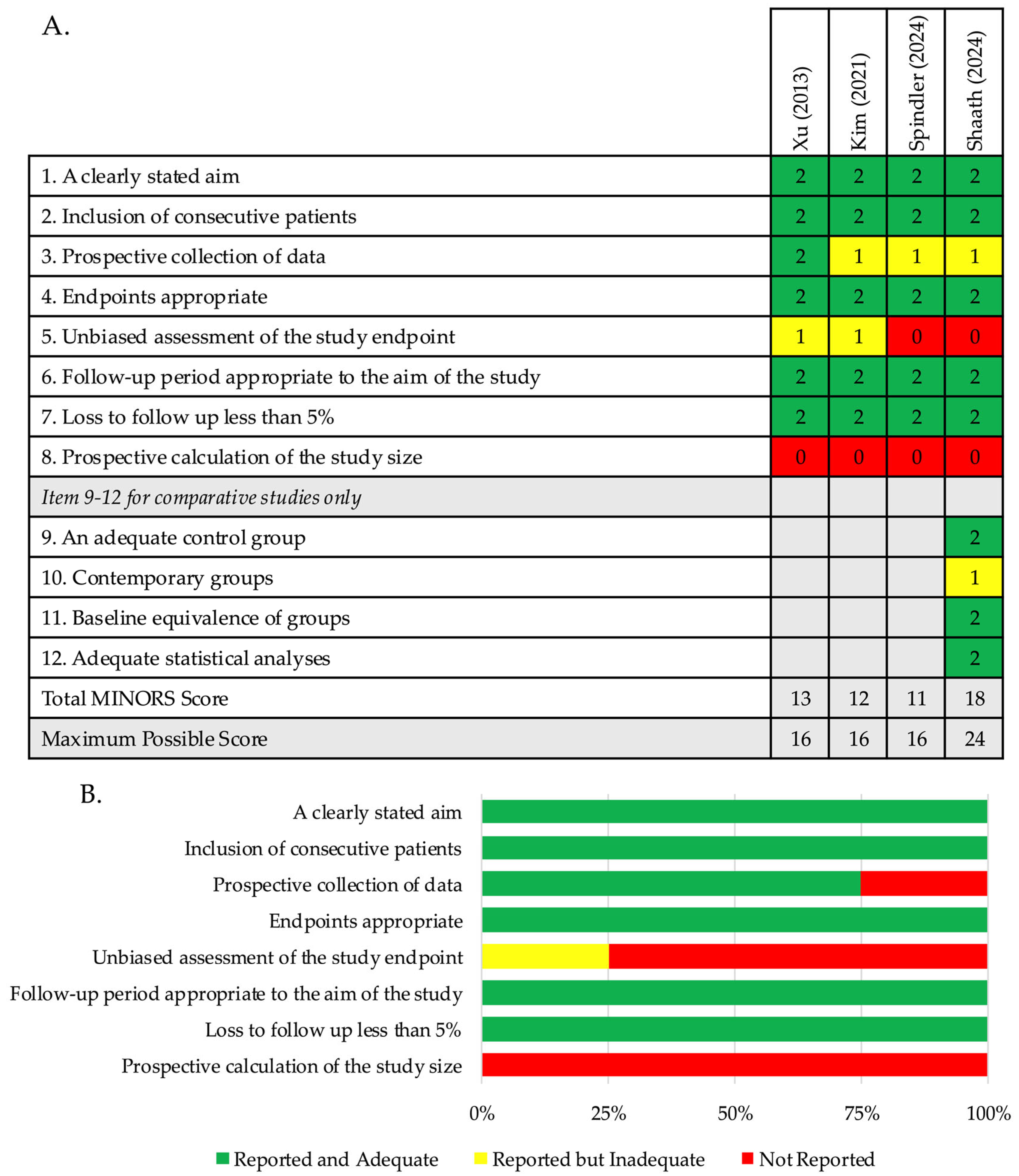
| Xu (2013) [35] | Kim (2021) [36] | Spindler (2024) [37] | Shaath (2024) [34] | |
|---|---|---|---|---|
| 1. A clearly stated aim | 2 | 2 | 2 | 2 |
| 2. Inclusion of consecutive patients | 2 | 2 | 2 | 2 |
| 3. Prospective collection of data | 2 | 1 | 1 | 1 |
| 4. Endpoints appropriate | 2 | 2 | 2 | 2 |
| 5. Unbiased assessment of the study endpoint | 1 | 1 | 0 | 0 |
| 6. Follow-up period appropriate to the aim of the study | 2 | 2 | 2 | 2 |
| 7. Loss to follow up less than 5% | 2 | 2 | 2 | 2 |
| 8. Prospective calculation of the study size | 0 | 0 | 0 | 0 |
| 9. An adequate control group | NA | NA | NA | 2 |
| 10. Contemporary groups | NA | NA | NA | 1 |
| 11. Baseline equivalence of groups | NA | NA | NA | 2 |
| 12. Adequate statistical analyses | NA | NA | NA | 2 |
| Maximum possible score | 16 | 16 | 16 | 24 |
| Total score | 13 | 12 | 11 | 18 |
| Overall methodological quality | Moderate | Moderate | Moderate | Moderate |
| Study | Year | Level of Evidence | Study Design | Intervention | Patients (n) | Mean Age (Years) | Fixation Construct | Follow-Up (Months), Mean (Range) | Outcome Measures | MINORS Score |
|---|---|---|---|---|---|---|---|---|---|---|
| Xu et al. [35] | 2013 | IV | P | HF | 12 | 39.5 | Assembled Bolt-Tightrope System (ABTS) | 28 (25–33) | 1, 2, 3, 4, 5, 6, 7, 8 | 13 |
| Kim et al. [36] | 2021 | IV | R | HF | 14 | 37.2 | 1 screw and 1 suture-button | 19.7 (12–36) | 1, 4, 5, 6, 7, 8, 9, 0 | 12 |
| Spindler et al. [37] | 2024 | IV | R | HF | 8 | NR | 1 screw and 1 suture-button | NR | 5 | 11 |
| Shaath et al. [34] | 2024 | III | R | HF | 59 | 47 | Novel Syndesmotic Repair Implant (NSRI) | 7 (3–24) | 2, 3, 5, 6, 7, 8 | 18 |
| DF | 52 | 41 | 1 suture-button |
| Study | Intervention | AOFAS Score | MCS (mm) | TFO (mm) | TFCS (mm) | OMAS | VAS | |||||||
|---|---|---|---|---|---|---|---|---|---|---|---|---|---|---|
| 12 Months | Final Follow-Up | Post-Op | 12 Months | Final Follow-Up | Post-Op | 12 Months | Final Follow-Up | Post-Op | 12 Months | Final Follow-Up | ||||
| Xu et al. [35] | HF | 95.4 | 96.3 | NR | 3.1 | 3.2 | NR | 8.4 | 8.4 | NR | 4.1 | 4.1 | NR | NR |
| Kim et al. [36] | HF | 90.3 | NR | NR | NR | NR | NR | NR | NR | 3.5 | NR | NR | 85 | 1.7 |
| Spindler et al. [37] | HF | NR | NR | NR | NR | NR | NR | NR | NR | NR | NR | NR | NR | NR |
| Shaath et al. [34] | HF | NR | NR | 3.6 | NR | 3.7 | 7.9 | NR | 7.9 | NR | NR | NR | NR | NR |
| DF | NR | NR | 3.1 | NR | 3.2 | 8.3 | NR | 8.3 | NR | NR | NR | NR | NR | |
| Study | Intervention | Malreduction (n) | Unplanned Implant Removal (n) | Implant Failure (n) | Complications (n) | Weightbearing Protocol | Important Findings | Routine Implant Removal (Y/N) |
|---|---|---|---|---|---|---|---|---|
| Xu et al. [35] | HF | 0 | 0 | 0 | 0 | Partial weightbearing at 2 weeks Normal weightbearing at 6 weeks | ABTS showed strong short- to mid-term functional outcomes with no complications | Y |
| Kim et al. [36] | HF | 1 | 0 | 14 | 0 | Partial weightbearing at 4 weeks Normal weightbearing at 6 weeks | HF showed strong functional outcomes; implant failure, but not clinically significant | N |
| Spindler et al. [37] | HF | 2 | NR | NR | NR | NR | Malreduction was observed in 25% of patients who received HF | NR |
| Shaath et al. [34] | HF | 0 | 3 | 0 | 0 | Weightbearing at 6 weeks for fractures, 3 months for ligamentous injuries | NSRI showed comparable radiographic outcomes compared to suture-button fixation with low complication rates | N |
| DF | 0 | 2 | 0 | 2 |
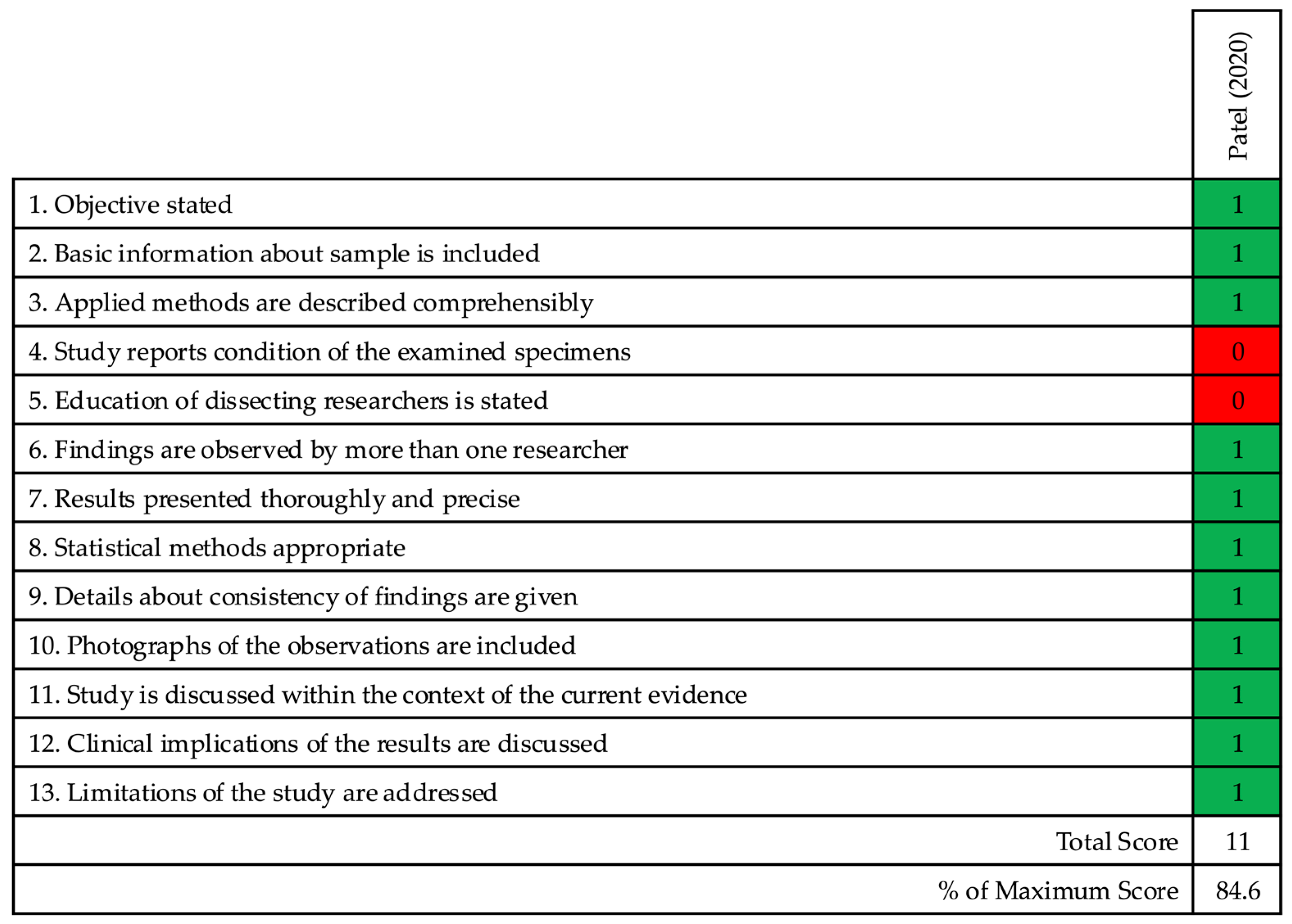
| Patel (2020) [38] | |
|---|---|
| 1. Objective stated | 1 |
| 2. Basic information about sample is included | 1 |
| 3. Applied methods are described comprehensibly | 1 |
| 4. Study reports condition of the examined specimens | 0 |
| 5. Education of dissecting researchers is stated | 0 |
| 6. Findings are observed by more than one researcher | 1 |
| 7. Results presented thoroughly and precisely | 1 |
| 8. Statistical methods appropriate | 1 |
| 9. Details about consistency of findings are given | 1 |
| 10. Photographs of the observations are included | 1 |
| 11. Study is discussed within the context of the current evidence | 1 |
| 12. Clinical implications of the results are discussed | 1 |
| 13. Limitations of the study are addressed | 1 |
| Maximum possible score | 13 |
| Total score | 11 |
| Overall methodological quality | Good |
| Study | Year | Level of Evidence | Study Design | Testing Material | Hybrid Fixation Constructs | Comparison Intervention | Testing Protocol | Testing Variables | Key Findings |
|---|---|---|---|---|---|---|---|---|---|
| Patel et al. [38] | 2020 | V | Cadaveric | 9 fresh-frozen human cadaveric ankles | Proximal 3.5 mm screw and distal suture-button | Intact Injured SSF DSF SDF DDF (divergent) | 200 N axial compression with 5 Nm external rotation or inversion torque Early weightbearing simulated at: 0°, 10° dorsiflexion, and 15° and 30° plantarflexion | Lateral fibula translation (mm) Posterior fibula translation (mm) External fibula rotation (°) | HF with a suture-button and tricortical screw most closely restored ankle joint kinematics for early weightbearing Overconstraint of motion in inversion observed |
| Mercan et al. [39] | 2023 | V | Finite Element Analysis | Finite element model from CT of one male subject | Hybrid-1: Proximal 3.5 mm screw and distal suture-button Hybrid-2: Distal 3.5 mm screw and proximal suture-button | Intact Injured SSF-2 cm * SSF-4 cm * DSF SDF-2 cm * SDF-4 cm * DDF (parallel) | 2352 N axial compression and 235 N anterior tangential forces applied at tibial plateau Ankle tested in neutral position | Lateral translation (mm) Posterior translation (mm) External fibula rotation (°) Von Mises stress (MPa) | In Hybrid-1 model, the screw controlled posterior fibular translation and external rotation with the suture-button controlling lateral fibular translation Hybrid-1 construct is a suitable treatment alternative for syndesmotic injuries |
Disclaimer/Publisher’s Note: The statements, opinions and data contained in all publications are solely those of the individual author(s) and contributor(s) and not of MDPI and/or the editor(s). MDPI and/or the editor(s) disclaim responsibility for any injury to people or property resulting from any ideas, methods, instructions or products referred to in the content. |
© 2025 by the authors. Licensee MDPI, Basel, Switzerland. This article is an open access article distributed under the terms and conditions of the Creative Commons Attribution (CC BY) license.
Share and Cite
Bailey, J.; Huynh, R.; Tsikopoulos, K.; Mason, L.; Lampridis, V. Hybrid Fixation for Syndesmotic Stabilisation: A Systematic Review of Clinical and Biomechanical Evidence. J. Clin. Med. 2026, 15, 107. https://doi.org/10.3390/jcm15010107
Bailey J, Huynh R, Tsikopoulos K, Mason L, Lampridis V. Hybrid Fixation for Syndesmotic Stabilisation: A Systematic Review of Clinical and Biomechanical Evidence. Journal of Clinical Medicine. 2026; 15(1):107. https://doi.org/10.3390/jcm15010107
Chicago/Turabian StyleBailey, Jed, Richard Huynh, Konstantinos Tsikopoulos, Lyndon Mason, and Vasileios Lampridis. 2026. "Hybrid Fixation for Syndesmotic Stabilisation: A Systematic Review of Clinical and Biomechanical Evidence" Journal of Clinical Medicine 15, no. 1: 107. https://doi.org/10.3390/jcm15010107
APA StyleBailey, J., Huynh, R., Tsikopoulos, K., Mason, L., & Lampridis, V. (2026). Hybrid Fixation for Syndesmotic Stabilisation: A Systematic Review of Clinical and Biomechanical Evidence. Journal of Clinical Medicine, 15(1), 107. https://doi.org/10.3390/jcm15010107