Article

Comparative Analysis of Two-Lead DX-Based CRT Versus Conventional Three-Lead CRT-D: Results from a Single-Center Prospective Study


1
Department of Medical and Surgical Sciences, Institute of Cardiology, University of Bologna, Via Massarenti 9, 40138 Bologna, Italy
2
Institute of Cardiology, IRCCS Azienda Ospedaliero-Universitaria di Bologna, Via Massarenti 9, 40138 Bologna, Italy
3
Cardiovascular Department, San Donato Hospital, 52100 Arezzo, Italy
*
Author to whom correspondence should be addressed.
These authors contributed equally to this work.
J. Clin. Med. 2025, 14(24), 8746; https://doi.org/10.3390/jcm14248746
Submission received: 5 November 2025 / Revised: 4 December 2025 / Accepted: 6 December 2025 / Published: 10 December 2025
(This article belongs to the Special Issue Updates on Cardiac Pacing and Electrophysiology)

Abstract

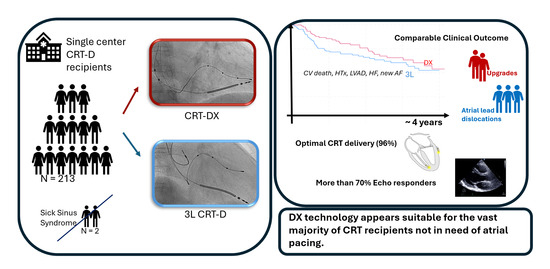
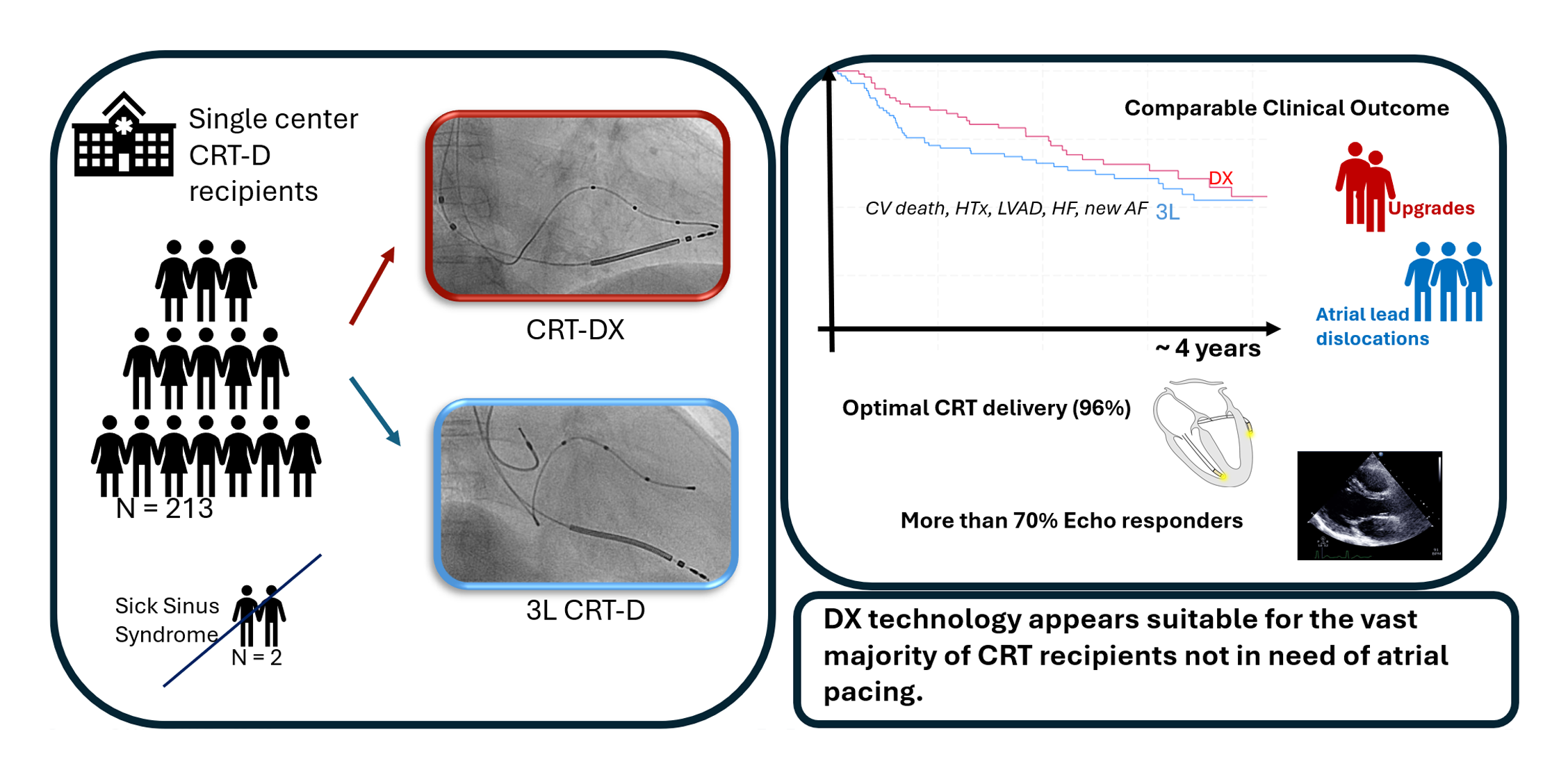
Background/Objectives: Cardiac resynchronization therapy with defibrillator (CRT-D) is a well-established therapy for patients with heart failure (HF) and intraventricular conduction delays, but a non-negligible risk of infection and of lead functionality loss overtime is related to intravascular hardware. The novel DX system enables atrial sensing through a floating dipole integrated into the ICD lead, reducing the intravascular burden. In this prospective non-randomized study, we aimed to evaluate the safety and efficacy of a two-lead DX-based CRT system compared to a conventional three-lead (3L) CRT-D system. Methods: A total of 210 patients meeting CRT indications and no signs of sick sinus syndrome (SSS) (baseline HR ≥ 45 bpm, or at least 85 bpm at 6 min walking test) were enrolled. Patients were assigned to either the CRT-DX or conventional 3L CRT-D group. The primary endpoint was a composite clinical response, defined as the freedom from cardiovascular death, HF hospitalization, or new-onset atrial fibrillation (AF). Results: After a mean follow-up of 46.5 ± 1.9 months, both groups had comparable clinical and instrumental outcomes. CRT-DX patients exhibited higher atrial sensing amplitudes and no significant differences in loss of lead function. Conclusions: In conclusion, the CRT-DX system provides equivalent clinical and echocardiographic benefits compared to conventional CRT-D in patients without an indication for atrial pacing. This supports the use of the DX system as a safe and effective alternative in the majority of CRT recipients.

Graphical Abstract

1. Introduction

Cardiac resynchronization therapy (CRT) represents one of the major advancements in the treatment of heart failure (HF) with reduced ejection fraction (HFrEF) in recent years [1]. In fact, in patients with intraventricular electro-mechanical dyssynchrony (mainly with left bundle branch block -LBBB- and wide QRS > 150 ms) and reduced ejection fraction (≤35%), CRT has unequivocally demonstrated its ability to promote favorable left ventricular (LV) remodeling, decreased HF hospitalizations, mortality, and improved quality of life [2,3,4,5,6]. Despite its benefits, CRT implantation carries a considerable risk of complications, particularly those related to the presence of intravascular hardware. In a retrospective study of over 20,500 implanted devices (ICD or CRT-D), a mechanical complication rate (requiring catheter revision) at 5 years was observed to be approximately 10% (10.7% for CRT and 8% for ICD), rising to 25% as the follow-up was extended to 10 years. The infection rate at 5 years was 2.9% for ICDs and 3.9% for CRT-Ds [7]. Similar results have been confirmed in other patient cohorts, with risks increasing as the number of procedures (battery replacement, revision, upgrade) increases [8]. Factors associated with a higher risk of developing mechanical complications both in the short and long term included female sex, CRT-D, and younger age at implantation; meanwhile, male sex, older age, diabetes mellitus, kidney disease, atrial fibrillation (AF), and HF were more strongly associated with the risk of infectious complications [9].
In recent years, the introduction of the DX lead, a 7.8 French single-coil active-fixation ICD bipolar lead provided with a wide atrial dipole capable of atrial sensing, has enabled CRT delivery by only two leads (one DX lead and one coronary sinus lead), while maintaining adequate atrioventricular synchrony [10,11].
The atrial dipole is provided by two electrodes, spaced 15 mm apart and positioned 15–17 cm proximally from the catheter tip, ensuring atrial sensing and diagnostics. The recorded signal is amplified four-fold and then filtered with a band-pass filter to allow the detection of the P-wave while excluding frequencies outside the atrial signal range.
It has been demonstrated that the DX system provides equivalent capability in detecting atrial activity and discriminating supraventricular tachyarrhythmias (SVT) compared to ICDs with a dedicated atrial lead [12,13,14,15]. This system can therefore be considered in patients who do not require atrial pacing, including those with AF defined as “permanent” based on surface electrocardiography, considering that around 13% of these patients have proven to spontaneously revert to sinus rhythm during follow-up [16].
The potential advantages of using a CRT-D with DX system (CRT-DX) include a possible reduction in procedural times and a decrease in complications related to catheter use, both those specific to the atrial catheter and those caused by the additional burden of intravascular hardware. In 2017, our group published a first comparative study between CRT-DX and CRT-D in a cohort of 37 patients, showing that the CRT-DX system can provide adequate resynchronization therapy at an average 3 year follow-up, provided there is no indication for atrial pacing, during a 3-year follow-up period [10].
However, to our knowledge, there are still no prospective studies in the literature comparing CRT-DX with two catheters to traditional three-lead (3L) CRT-D.
This study aims to investigate the efficacy and safety of a CRT-DX compared to traditional 3L CRT-D in a single-center prospective study in the long term.

2. Materials and Methods

Since 2017 until 1 January 2023, we have consecutively screened CRT recipients: adult patients in sinus rhythm at the time of implantation with a class I or IIa indication for CRT according to the available ESC guidelines and without evidence of sick sinus syndrome (SSS) during titrated beta blocker treatment (resting heart rate > 40 bpm on baseline ECG and maximum heart rate > 85 bpm during the 6 min walk test) were considered suitable either for a DX or a 3L CRTD system. The decision regarding system type was left to the discretion of the electrophysiologist performing the implantation.
Patients with an indication for atrial pacing, upgrade recipients, and permanent AF patients were not considered for the implantation of a DX system. An atrial signal amplitude ≥ 0.6 mV without the DX amplification during respiratory cycles without far-field R-wave oversensing (FFRWO) was the criterion for the DX implantation, whereas an atrial signal amplitude of at least 1 mV without FFRWO was the implanting criterion for atrial leads.
After implantation, CRT setting was optimized in each patient before hospital discharge or at the 2 weeks follow-up visit by echocardiography, ensuring the longest diastolic filling time without A-wave truncation. LV-only pacing was considered in every patient with a PR interval ≤ 240 ms, otherwise biventricular pacing with individualized VV interval was programmed. The lower rate was programmed as 35 bpm in the DX group to avoid VVI pacing at the lower rate, whereas it was programmed as 40 bpm in the 3L group.
Clinical and device-related data were collected at implantation and during follow-up, including echocardiography and device interrogation. Any change in device programming, percentage of biventricular/LV-only pacing, and any arrhythmic events recorded or treated by the device were documented.
The clinical endpoint is a combination of cardiovascular death, HF hospitalization, and new-onset AF. The echocardiographic endpoint was measured by two cut-offs used in the literature: left ventricular end-systolic volume (LVESV) reduction ≥15% or ≥9.3%, as in the most recent and larger CRT trials, respectively [17,18,19].
We also assessed the comparability of the two systems in terms of freedom from lead failure, specifically the durability of atrial sensing in the long term of the DX lead.
Eventually, atrial sensing detected by the two systems and need for atrial pacing during follow-up were evaluated.
The statistical analysis was performed using Stata® software (StataSe 18, StataCorp LLC, College Station, TX, USA). Categorical data are presented as counts and percentages and tested with either χ2 tests or Fisher’s exact tests, as appropriate. Continuous variables are expressed as the mean ± standard error, and have been tested with two-tailed Student’s t-test. Univariate and then multivariate analysis were conducted if significant differences between the two groups had emerged, in order to test for possible variables interference. Kaplan–Meier survival curves were generated for visual comparison of clinical endpoints and different leads performance. Events during follow-up were analyzed using the Cox proportional hazards model. The chosen level of statistical significance was 0.05.

3. Results

3.1. Screening and Enrollment

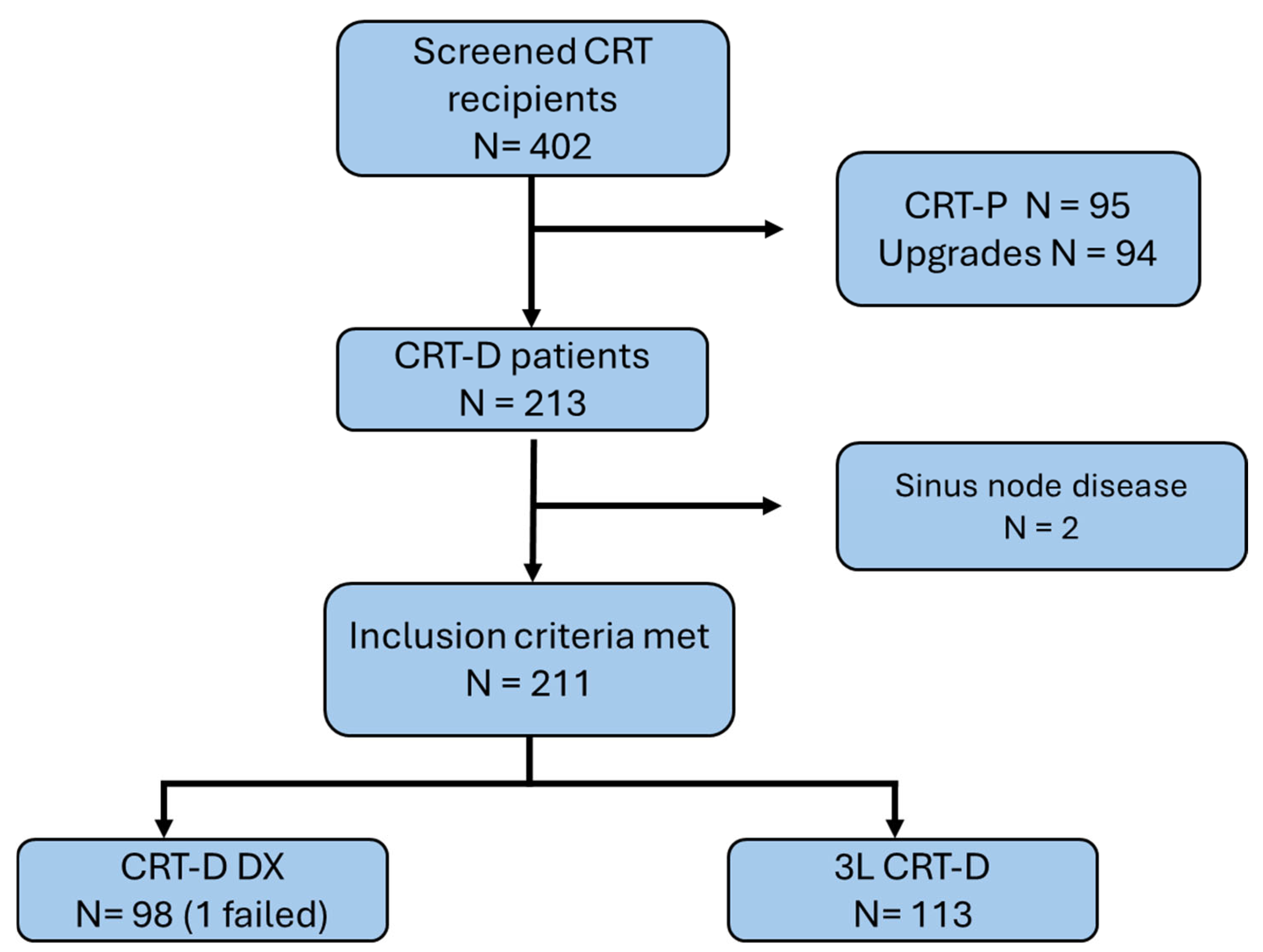
Overall, we screened 402 consecutive CRT recipients: 95 received a CRTP, 94 were upgrades from an existing ICD or pacemaker, and 213 were first-time CRT-D implants. Amongst them, 5/402 (1.2%) had SSS with indication to atrial stimulation and received devices with an atrial lead programmed in the rate responsive mode (2 CRTP recipients, 2CRTD recipients, 1 upgrade patient). Hence, 211/213 met the criteria for implantation of a DX system, which represents 99% of first-time CRTD recipients. Based on the implanter decision, 97 received a DX system and 113 a 3L system. One patient initially enrolled in the CRT-DX group experienced a failure in the implantation of the LV lead due to inadequate coronary venous anatomy and was therefore excluded from the analysis, resulting in a total of 210 patients analyzed Figure 1.
All DX lead implants were achieved successfully owing to atrial sensing, and similarly no atrial lead implant failed because of an inadequate atrial signal. Although no statistically significant differences were observed, a slight trend toward reduced procedural and fluoroscopy times was observed in the DX group (procedural time: 104 ± 3.5 vs. 113 ± 3.7 min, p = 0.09; fluoroscopy time: 18 ± 1.6 vs. 21 ± 1.7 min, p = 0.21).
All 97 devices implanted in the DX group were manufactured by Biotronik ® (Berlin, Germany), while in the 3L group (n = 113), devices were distributed as follows: Medtronic (Dublin, Ireland)® (77), Biotronik® (Berlin, Germany) (25), Boston Scientific® (Marlborough, MA, USA) (6), and St. Jude-Abbott® (Abbott Park, IL, USA) (5). Leads from the same manufacturer as the device were generally implanted, except when an LV active-fixation lead (Medtronic®) was employed.
The clinical characteristics of the population at the time of implantation are shown in Table 1, with substantial homogeneity between the two groups, except for a higher rate of LBBB, higher LVESV, and a lower rate of antiarrhythmic therapy in the DX group.

3.2. Clinical and Echocardiographic Results

The two groups did not differ significantly in terms of the composite endpoint, evaluated both at one year and at the last available follow-up. At one year, 87% of patients in the DX group and 80% in the 3L group were free from the clinical endpoint (risk ratio, 0.64; 95% CI, 0.33–1.21; p = 0.23) (Table 2).
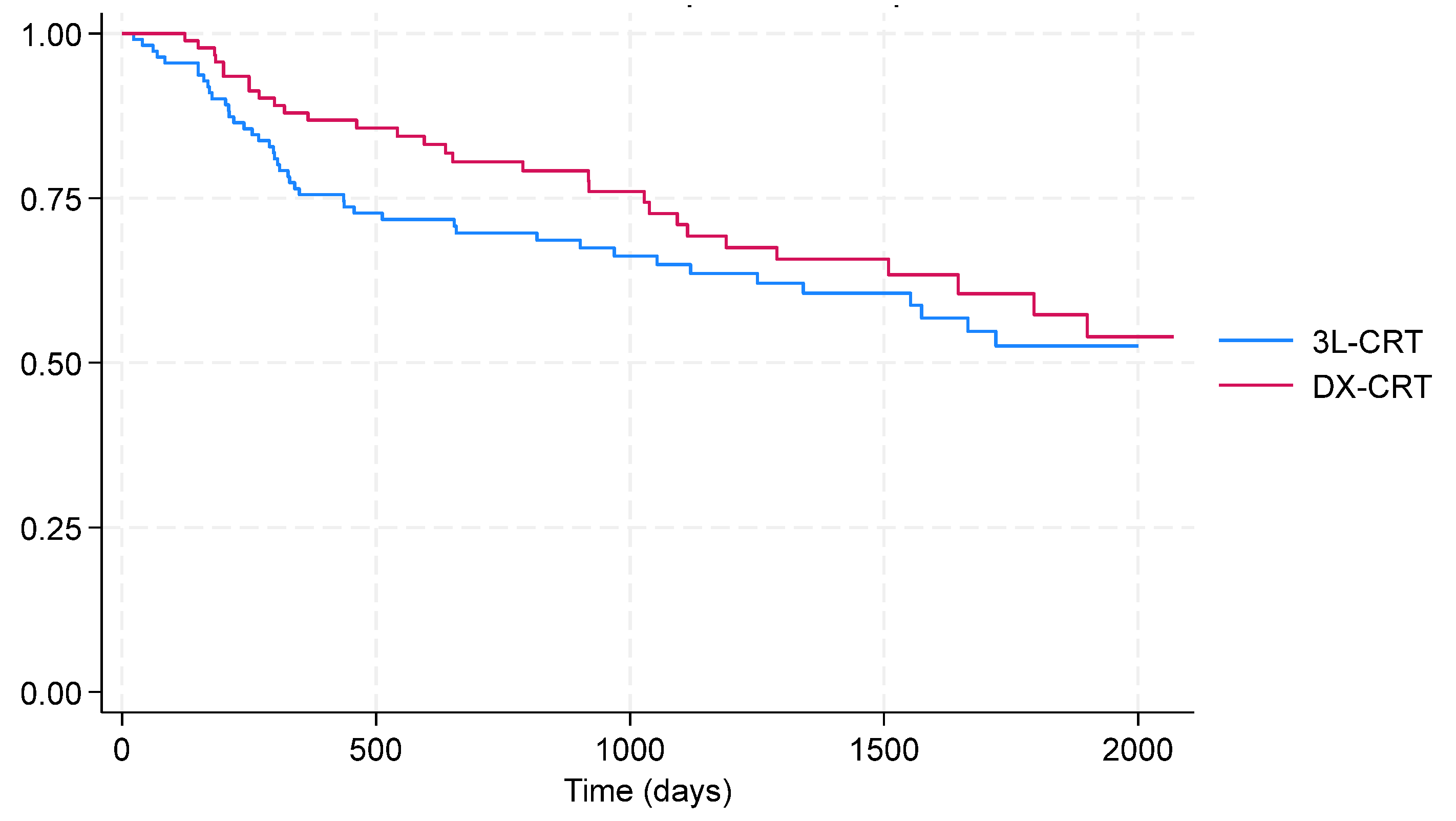
During a mean follow-up of 46.5 ± 1.9 months, 68% of DX patients and 60% of 3L patients remained free from the clinical endpoint. The Kaplan–Meier analysis showed no significant difference between groups (log-rank p = 0.23, Figure 2), and in the Cox proportional hazards model, the hazard ratio was 0.76 (95% CI, 0.47–1.20; p = 0.23). See Table 2.
The trend toward a lower risk of the composite endpoint in the DX group was no longer evident after adjustment for LBBB, QRS duration, renal disease, and LV-only pacing (adjusted HR = 0.98; 95% CI, 0.58–1.65; p = 0.87) (Table 3).
No statistically significant differences were observed between the two groups regarding HF events, new-onset AF, heart transplantation/LVAD implantation, all-cause mortality, or cardiovascular mortality, both at one year and at the end of follow-up.
Based on the echocardiographic criteria of at least 9.3% reduction in LVESV, an overall CRT response rate of 80% at one year and 75% at the end of follow-up was observed. Using the stricter cut-off of −15% LVESV reduction, we observed a 75% response rate at 1 y and 71% at the end of follow-up (Table 4).
Since a higher rate of echocardiographic response (≥9.3% reduction in LVESV) at one year was initially observed in the DX group (88 vs. 75%, p = 0.02), we subsequently performed a multivariate analysis, adjusting for the other clinically significant variables that had tested positive at univariate analysis (LBBB, QRS duration, chronic kidney disease-CKD): only the presence of baseline LBBB or CKD retained the ability to distinguish responders from non-responders (Table 5).

3.3. Device Data and Leads Performance

Electrical parameters remained stable throughout the follow-up, as shown in Table 6. Notably, atrial sensing values in the DX were significantly higher than in the 3L group both at implantation and during overall follow-up, thanks to the system’s intrinsic signal amplification (DX 5.6 ± 0.4 mV vs. 3-lead 3.3 ± 0.2 mV; p < 0.01). In this regard, only four patients in the DX group recorded atrial sensing values below 1 mV, compared to two patients in the 3L. No clinically significant differences were recorded in the electrical parameters of the right and left ventricular leads.
Both groups showed an optimal CRT delivery percentage with preserved AV synchrony (DX 94 ± 1.6% vs. 96 ± 1.5%; p = 0.30), and a greater number of LV-only paced patients in the DX (64 ± 5% vs. 50 ± 4.8%, p = 0.04). No significant differences in PVC % between groups were recorded (2.5 ± 0.5 vs. 2.2 ± 0.3, p = 0.59).
As shown in Table 1, around 88% of patients were on beta blocker treatment at baseline. Mean beta blocker dosage, expressed as metoprolol equivalents (see Supplementary Table S1 for drug dosage conversion), was 85 mg, with a mean increase of 19% by the end of follow-up (DX: 18.9 ± 2.1% vs. 3L: 19.2 ± 2.3%, p = 0.7).
Atrial arrhythmia burden was low in both populations (4.5 ± 1.9% vs. 5.2 ± 2.1%; p = 0.80), and the atrial pacing percentage in the 3L was 3.6 ± 1.2%.
A total of 31/210 patients (15%) received device therapy for sustained ventricular arrhythmias, 61% of which occurred in the VF zone (HR > 200 bpm). The first arrhythmic event occurred on average 2.8 ± 0.4 years after implantation, with a mean duration of 19.5 ± 2.01 s. The overall ATP efficacy rate was 60% (84% in the VT zone and 25% in the VF zone), with no statistically significant differences between the two groups.
As expected, the rate of VA events was significantly higher in the non-responder population (28.6% vs. 8.8%, p = 0.01).
During follow-up, 3 out of 210 patients (one left-sided and two right-sided implants) experienced inappropriate shocks, all caused by inappropriate detection of SVT: all were managed by device reprogramming.
The overall complication rate related to the RV leads requiring system revision was 2.1% in the CRT-DX group and 0.9% in the 3L group at one year (p = 0.59), while by the end of follow-up, the lead-related complication rate was 5.2% in the DX group and 1.8% in the 3L group (p = 0.25) (Table 7).
In the CRT-DX group, five patients had ventricular oversensing due to insulation defects, two of which proved to be a lead fracture. In two cases, switching of the right and left ventricular leads was possible owing to IS-1 lead connections, an approach previously described by our group for DF-1 devices [20,21]. In one case, repairing the lead insulation was sufficient, while in the remaining two cases, replacement of the damaged lead was necessary.
In the 3L group, one right ventricular lead dislodgement and one lead fracture were observed.
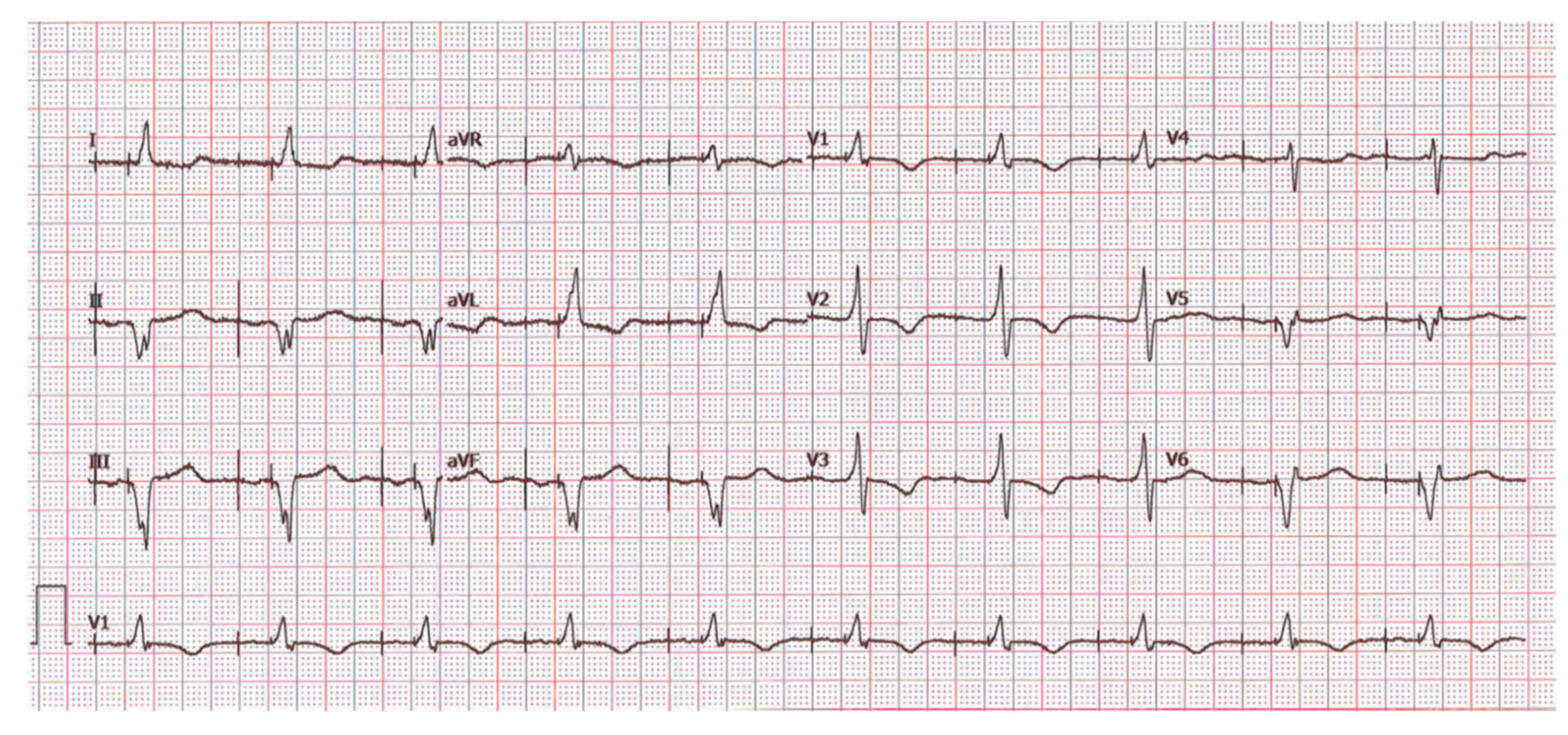
By the end of follow-up, the atrial complication rate was as follows: three atrial lead displacements occurred in the three-lead group; one case of atrial undersensing requiring revision to enable CRT (the dipole had moved up in the SVC due to coiling in the atrium with poor tightening of the sleeve suture); and one case of upgrade to three leads due to onset of sick sinus syndrome in the DX group. The latter patient developed marked sinus bradycardia and chronotropic incompetence (max heart rate 50 bpm) at 83 years, 4 years after implantation despite withdrawal of bisoprolol; thus, the floating atrial dipole was used for atrial pacing at an output of 4 V@0.4 ms (Figure 3). An upgrade to 3L occurred at the time of generator replacement.

4. Discussion

Our observation reports enduring performance at long-term follow-up either in terms of clinical response to CRT or lead-related complications when the DX technology is compared to 3L CRT technology in patients without indication to atrial stimulation.

4.1. Feasibility and Applicability of the DX Technology in CRT Recipients

Currently, no randomized trials comparing conventional CRT-D and CRT-DX are available in the literature. In a prospective single-center study published by our group in 2017, it was shown for the first time that CRT could be effectively achieved using a DX system, provided there was no indication for atrial pacing [10].
In a retrospective registry Shaik et al. reported similar CRT response and reduction in complications by DX technology compared to 3L system on 240 patients over an average follow-up of about 15 months. Specifically, six patients had atrial lead displacement in the 3L group requiring revision vs. none in the DX group [11].
The recent prospective multicenter observational experience by Kolb et al. clearly reports that the DX technology may be safely proposed to any CRT candidate by a simple screening method to test sinus node competence: a resting heart rate > 40 bpm and an increase in sinus rate above 100 bpm during exercise, detected by any available electrocardiographic means [22]. This method is very similar to ours, for the heart rate during ordinary activity, which is lower in our study (>85 bpm) but requires that maximum tolerated beta blockers or ivabradine, has been achieved. Though follow-up duration is remarkably different across studies, by gathering all the 327 CRT-DX recipients it appears that only 1 patient needed atrial stimulation 4 years after device implantation as an octogenarian [11,22].

4.2. Clinical Endpoints

In our study, cardiac resynchronization therapy (CRT) using a two-lead DX system demonstrated effectiveness that was at least similar to that reported in the literature, and comparable to our reference cohort treated with 3L-CRT. Over a mean follow-up of approximately 4 years, no statistically significant differences were observed in terms of clinical events, LV reverse remodeling, and lead failures. The development of sinus node disease with need of atrial stimulation occurred in 1/211 patients.
The composite endpoint of cardiovascular death, heart transplantation or LVAD implantation, HF events, and/or new-onset AF occurred in 16% of patients at one year and 36% at approximately four years. These results—along with a 2.5% annual cardiovascular mortality rate—are consistent with the most recent and largest randomized CRT trial, which reported an annual cardiovascular mortality of 3% [23].

4.3. CRT Delivery

In our population, the percentage of CRT delivery (94 ± 1.6% vs. 96 ± 1.5%; p = 0.3) and PVC percentage (2.5 ± 0.5 vs. 2.2 ± 0.3, p = 0.59) did not show statistically significant differences between systems, and only one patient required a system revision due to undersensing over a long follow-up. The high CRT percentage together with the low PVC percentage, with no significant differences between the two groups, confirms that AV synchrony was 100%, as shown by device counters. This finding is consistent with our previous pioneering experience, since an increase in the PVC counter can indicate P-wave undersensing and any potential underperformance of atrial sensing with the DX system would reduce CRT delivery [10]. Similarly, other observational studies have reported extents of CRT delivery with DX systems comparable to 3L-CRT [10,11].

4.4. Ecocardiographic Response

The high CRT delivery rate corresponded to 80% mean echocardiographic response. Left ventricular end-systolic volume decreased by an average of 47 mL (−58 vs. −36 mL; p = 0.04) and left ventricular ejection fraction increased by 11.6% on average (12.7% vs. 10.4%; p = 0.3). These response rates are notably higher than typically reported in the literature, where non-response rates range from 30% to 50% [24].
In 2020, Shaik et al. published a sub-analysis showing that the CRT-DX system offers a similar reverse remodeling response compared to 3L-CRT similarly to our observation, with a lower lead-related complication rate [11]. Similarly, the recent report of Kolb et al. shows a very high quality CRT with DX technology [22].
These results highlight the importance of patient selection, accurate identification of the venous target with the greatest electro-mechanical delay for LV leads positioning (as evidenced by optimal intraoperative Q-LV and RV-LV timing measurements), and post-implant optimization process by means of AV and VV delays tailoring.
The most recent data acquired on CRT over the years, together with technological advancements in LV lead performance that sustain CRT efficacy during follow-up, compel us to reconsider CRT expected response and establish new benchmarks for the comparison with alternative resynchronization strategies (i.e., conduction system pacing).

4.5. Arrhythmic Events

The low atrial pacing rate in the 3L group (3.6 ± 1.2% vs. 0% in the CRT-DX group) was associated with a very low AF burden (4.5 ± 1.9 vs. 5.2 ± 2.1; p = 0.8), aligning with the hypothesis that reduced atrial pacing may help prevent AF onset [25,26,27].
The long-term ventricular arrhythmic event rate is consistent with the most recent data reported in the literature [28]; notably, we observed in both groups a very low incidence of inappropriate shocks (1.4%), largely inferior to the results of most large trials on transvenous and subcutaneous ICDs (ranging 7–13%) which can be at least be partially attributed to the routine programming strategy adopted at our center, characterized by high-rate VF cut-offs and prolonged detection [5,14,29,30].
This also aligns with findings from several studies supporting the DX lead’s performance in terms of atrial sensing quality [14,15,31,32].

4.6. Leads’ Performance

Overall, no significant differences were observed in terms of right lead complications (DX vs. conventional) or of atrial sensing performance (DX sensing dipole vs. standard atrial lead).
We did not observe a higher rate of complications related to Linox ICD leads compared to later models (2/5), as it had previously been raised by Oosterwerff et al. [33].
The development of SSS in the CRT population was a rare event, with only one upgrade involving the atrial lead, which was performed at the time of generator replacement. On the contrary, there were three system revisions due to atrial lead dislodgement in the 3L group (1.8%).
The complication rate associated with CRT implantation varies widely across studies, ranging from approximately 3% to 11%, primarily due to lead revisions—particularly of the left ventricular lead [34,35,36]—as well as a higher risk of infection compared to PM/ICD implantation. In fact, lead burden is now included in major risk scores for predicting implant-related infections [37].
This variability is attributable to several factors, foremost among them the operator’s experience and the implanting center’s volume, but also patient-related factors such as sex, comorbidities, presence of advanced HF, or a high burden of AF [35].
In the 3L, three cases of symptomatic left subclavian vein thrombosis (associated with arm edema) were reported, necessitating prolonged oral anticoagulation (no cases occurred in the DX group; p = 0.25).
Though the number is small, this finding could support the rationale for minimizing the number of implanted leads in order to reduce venous crowding, which may underlie such complications. It is well-established that the presence of three or more leads in a thoracic venous axis increases the risk of venous occlusion eightfold [38]. Furthermore, three or more leads double the risk of clinical failure of lead extraction due to infection and/or system malfunction, as shown in the ELECTRa European registry [29].

4.7. Limitations

This study is a prospective non-randomized single-center study. The potential confounding factors related to partial heterogeneity in the population were attenuated performing univariate and then multivariate analysis if significant differences between the two groups had emerged. Our observations should be confirmed also by randomized clinical trials, but the population numerosity and the long follow-up add importance to the results we observed.

5. Conclusions

In real-world CRT practice, atrial pacing indication is present in fewer than 2% of patients, making DX technology suitable for the vast majority of CRT recipients. Our single-center study shows that the CRT-DX system enables clinical and instrumental CRT response in the long term, and complication rates were comparable to 3L CRT-D systems in patients without a need for atrial pacing. This may confer a long-term advantage due to reduced intravascular hardware.

Supplementary Materials

The following supporting information can be downloaded at https://www.mdpi.com/article/10.3390/jcm14248746/s1, Table S1: beta blockers equivalent dosages.

Author Contributions

Conceptualization, A.C., M.B., M.L., and A.Q.; methodology, M.B. and M.Z.; validation, M.Z., M.L., and M.B.; formal analysis, A.Q., L.B., A.S., A.A., and C.M.; investigation, M.Z., A.C., M.L., and A.A.; data curation A.C., C.M., A.A., G.M., and L.B.; writing—original draft preparation, A.C. and M.B.; writing—review and editing, A.C., M.Z., M.L., and I.D.; supervision, M.B., I.D., and C.M.; project administration, A.C., M.B. and M.Z. All authors have read and agreed to the published version of the manuscript.

Funding

This research received no external funding.

Institutional Review Board Statement

This study was conducted in accordance with the Declaration of Helsinki and approved by the Hospital Ethics Committee (10/2016/U/Oss), approval date 7 October 2016.

Informed Consent Statement

All patients treated using CRT-D gave their written consent for participation in clinical trials or registries.

Data Availability Statement

The data presented in this study are available on request from the corresponding author due to privacy restrictions.

Conflicts of Interest

The authors declare no conflicts of interest.

Abbreviations

The following abbreviations are used in this manuscript:
3LTraditional three leads CRT
AAtrial
ACEiAngiotensin converting enzyme inhibitor
AFAtrial fibrillation
ARBAngiotensin receptor blocker
ARNIAngiotensin Receptor–Neprilysin Inhibitor
AVBAtrioventricular block
BMIBody mass index
CKDChronic kidney disease
CMPCardiomyopathy
COPDChronic obstructive pulmonary disease
CRT (-D)Cardiac Resynchronization Therapy (with defibrillator)
CIConfidence interval
DXTwo Leads CRT with DX system
EFEjection fraction
FFRWOFar-field-R-wave oversensing
GUCHGrown Up Congenital Heart
HDHeart disease
HFHeart failure
HFrEFHF with reduced ejection fraction
HRHeart rate/Hazard ratio
IVCDIntraventricular conduction delay
LAFBLeft anterior fascicular block
LBBBLeft bundle branch block
LVLeft ventricle
LVADLeft Ventricular Assist Device
LVEDVLeft ventricular end diastolic volume
LVEFLeft ventricular ejection fraction
LVESVLeft ventricular end-systolic volume
LVESV(i)Left ventricular end-systolic volume (indexed)
MRAMineralocorticoid receptor inhibitors
OROdds ratio
PADPeripheral artery disease
Q-LVQRS–LV sensing time interval
RBBBRight bundle branch block
RVRight ventricle
RV-LVRight ventricle–Left ventricle sensing interval
SSSSick sinus syndrome
SVTSupraventricular tachycardia
TIATransient ischemic attack
TxTransplant

References

  1. McDonagh, T.A.; Metra, M.; Adamo, M.; Gardner, R.S.; Baumbach, A.; Böhm, M.; Burri, H.; Butler, J.; Čelutkienė, J.; Chioncel, O.; et al. 2021 ESC Guidelines for the diagnosis and treatment of acute and chronic heart failure. Eur. Heart J. 2021, 42, 3599–3726. [Google Scholar] [CrossRef]
  2. Abraham, W.T.; Fisher, W.G.; Smith, A.L.; Delurgio, D.B.; Leon, A.R.; Loh, E.; Kocovic, D.Z.; Packer, M.; Clavell, A.L.; Hayes, D.L.; et al. Cardiac resynchronization in chronic heart failure. N. Engl. J. Med. 2002, 346, 1845–1853. [Google Scholar] [CrossRef] [PubMed]
  3. Bristow, M.R.; Saxon, L.A.; Boehmer, J.; Krueger, S.; Kass, D.A.; De Marco, T.; Carson, P.; DiCarlo, L.; DeMets, D.; White, B.G.; et al. Cardiac-resynchronization therapy with or without an implantable defibrillator in advanced chronic heart failure. N. Engl. J. Med. 2004, 350, 2140–2150. [Google Scholar] [CrossRef] [PubMed]
  4. Cleland, J.G.F.; Daubert, J.-C.; Erdmann, E.; Freemantle, N.; Gras, D.; Kappenberger, L.; Tavazzi, L.; Poole-Wilson, P.A.; Rydén, L.; Wedel, H.; et al. The effect of cardiac resynchronization on morbidity and mortality in heart failure. N. Engl. J. Med. 2005, 352, 1539–1549. [Google Scholar] [CrossRef] [PubMed]
  5. Moss, A.J.; Hall, W.J.; Cannom, D.S.; Klein, H.; Brown, M.W.; Daubert, J.P.; Estes, N.A., III; Foster, E.; Greenberg, H.M.; Higgins, S.L.; et al. Cardiac-resynchronization therapy for the prevention of heart-failure events. N. Engl. J. Med. 2009, 361, 1329–1338. [Google Scholar] [CrossRef]
  6. Tang, A.S.L.; Wells, G.A.; Talajic, M.; Arnold, M.O.; Sheldon, R.; Connolly, S.; Hohnloser, S.H.; Nichol, G.; Birnie, D.H.; Sapp, J.L.; et al. Cardiac-Resynchronization Therapy for Mild-to-Moderate Heart Failure. N. Engl. J. Med. 2010, 363, 2385–2395. [Google Scholar] [CrossRef]
  7. Koneru, J.N.; Jones, P.W.; Hammill, E.F.; Wold, N.; Ellenbogen, K.A. Risk Factors and Temporal Trends of Complications Associated With Transvenous Implantable Cardiac Defibrillator Leads. J. Am. Heart Assoc. 2018, 7, e007691. [Google Scholar] [CrossRef]
  8. Borleffs, C.J.W.; van Erven, L.; van Bommel, R.J.; van der Velde, E.T.; van der Wall, E.E.; Bax, J.J.; Rosendaal, F.R.; Schalij, M.J. Risk of failure of transvenous implantable cardioverter-defibrillator leads. Circ. Arrhythm. Electrophysiol. 2009, 2, 411–416. [Google Scholar] [CrossRef]
  9. Barca, L.; Mascia, G.; Di Donna, P.; Sartori, P.; Bianco, D.; Della Bona, R.; Benenati, S.; Merlo, A.C.; Buongiorno, A.L.; Kaufman, N.; et al. Long-Term Outcomes of Transvenous Lead Extraction: A Comparison in Patients with or without Infection from the Italian Region with the Oldest Population. J. Clin. Med. 2023, 12, 4543. [Google Scholar] [CrossRef]
  10. Biffi, M.; Massaro, G.; Candelora, A.; Angeletti, A.; Valzania, C.; Martignani, C.; Grassini, D.; Diemberger, I.; Ziacchi, M. Less is more: Can we achieve cardiac resynchronization with 2 leads only? Int. J. Cardiol. 2017, 249, 184–190. [Google Scholar] [CrossRef]
  11. Shaik, N.A.; Drucker, M.; Pierce, C.; Duray, G.Z.; Gillett, S.; Miller, C.; Harrell, C.; Thomas, G. Novel two-lead cardiac resynchronization therapy system provides equivalent CRT responses with less complications than a conventional three-lead system: Results from the QP ExCELs lead registry. J. Cardiovasc. Electrophysiol. 2020, 31, 1784–1792. [Google Scholar] [CrossRef]
  12. Sticherling, C.; Zabel, M.; Spencker, S.; Meyerfeldt, U.; Eckardt, L.; Behrens, S.; Niehaus, M. Comparison of a novel, single-lead atrial sensing system with a dual-chamber implantable cardioverter-defibrillator system in patients without antibradycardia pacing indications: Results of a randomized study. Circ. Arrhythm. Electrophysiol. 2011, 4, 56–63. [Google Scholar] [CrossRef]
  13. Thomas, G.; Choi, D.Y.; Doppalapudi, H.; Richards, M.; Iwai, S.; Daoud, E.G.; Houmsse, M.; Kanagasundram, A.N.; Mainigi, S.K.; Lubitz, S.A.; et al. Subclinical atrial fibrillation detection with a floating atrial sensing dipole in single lead implantable cardioverter-defibrillator systems: Results of the SENSE trial. J. Cardiovasc. Electrophysiol. 2019, 30, 1994–2001. [Google Scholar] [CrossRef]
  14. Biffi, M.; Statuto, G.; Calvi, V.; Iori, M.; De Maria, E.; Bolognesi, M.G.; Golcca, G.; Notarangelo, F.; Carinci, V.; Ammendola, E.; et al. Inappropriate therapies in modern implantable cardioverter-defibrillators: A propensity score-matched comparison between single- and dual-chamber discriminators in single-chamber devices THe sINGle lead Study (THINGS Study). Heart Rhythm. 2025, 22, e141–e148. [Google Scholar] [CrossRef]
  15. Biffi, M.; Iori, M.; De Maria, E.; Bolognesi, M.G.; Golcca, G.; Notarangelo, F.; Carinci, V.; Ammendola, E.; Biffi, G.; Statuto, G.; et al. The role of atrial sensing for new-onset atrial arrhythmias diagnosis and management in single-chamber implantable cardioverter-defibrillator recipients: Results from the THINGS registry. J. Cardiovasc. Electrophysiol. 2020, 31, 846–853. [Google Scholar] [CrossRef]
  16. Palmisano, P.; Parlavecchio, A.; Vetta, G.; Crea, P.; Guido, A.; Accogli, M.; Coluccia, G.; Senes, J.; Bartoli, L.; Patti, G.; et al. Spontaneous Sinus Rhythm Restoration in Patients With Refractory, Permanent Atrial Fibrillation Who Underwent Conduction System Pacing and Atrioventricular Junction Ablation. Am. J. Cardiol. 2023, 209, 76–84. [Google Scholar] [CrossRef]
  17. Singh, J.P.; Rinaldi, C.A.; Sanders, P.; Kubo, S.H.; James, S.; Niazi, I.K.; Betts, T.; Butter, C.; Okabe, T.; Cunnane, R.; et al. Leadless Ultrasound-Based Cardiac Resynchronization System in Heart Failure. JAMA Cardiol. 2024, 9, 871–879. [Google Scholar] [CrossRef] [PubMed]
  18. Ypenburg, C.; van Bommel, R.J.; Borleffs, C.J.W.; Bleeker, G.B.; Boersma, E.; Schalij, M.J.; Bax, J.J. Long-Term Prognosis After Cardiac Resynchronization Therapy Is Related to the Extent of Left Ventricular Reverse Remodeling at Midterm Follow-Up. JACC 2009, 53, 483–490. [Google Scholar] [CrossRef] [PubMed]
  19. Bax, J.J.; Gorcsan, J. Echocardiography and Noninvasive Imaging in Cardiac Resynchronization Therapy. JACC 2009, 53, 1933–1943. [Google Scholar] [CrossRef]
  20. Biffi, M.; de Zan, G.; Massaro, G.; Angeletti, A.; Martignani, C.; Boriani, G. Is ventricular sensing always right, when it is left? Clin. Cardiol. 2018, 41, 1238–1245. [Google Scholar] [CrossRef] [PubMed]
  21. Sticherling, C.; Ellenbogen, K.A.; Burri, H. Stepping back for good reasons: A reappraisal of the DF-1 connector for defibrillator leads. Europace 2024, 26, euae057. [Google Scholar] [CrossRef]
  22. Kolb, C.; Zima, E.; Arnold, M.; Fedorco, M.; Bonnemeier, H.; Deneke, T.; Schumacher, B.; Nordbeck, P.; Steinwender, C.; Storz, T.; et al. Biventricular Cardiac Resynchronization Therapy with Atrial Sensing but No Atrial Lead: A Prospective Registry of Patients, Complications, and Therapy Responses. J. Clin. Med. 2025, 14, 5009. [Google Scholar] [CrossRef]
  23. Wilkoff, B.L.; Filippatos, G.; Leclercq, C.; Gold, M.R.; Hersi, A.S.; Kusano, K.; Mullens, W.; Gerritse, B.; van Wel, J.; Gerasimos, F.; et al. Adaptive versus conventional cardiac resynchronisation therapy in patients with heart failure (AdaptResponse): A global, prospective, randomised controlled trial. Lancet 2023, 402, 1147–1157. [Google Scholar] [CrossRef]
  24. Sieniewicz, B.J.; Gould, J.; Porter, B.; Sidhu, B.S.; Teall, T.; Webb, J.; Carr-White, G.; Rinaldi, C.A. Understanding non-response to cardiac resynchronisation therapy: Common problems and potential solutions. Heart Fail Rev. 2019, 24, 41–54. [Google Scholar] [CrossRef] [PubMed]
  25. Biffi, M.; D’Onofrio, A.; Pignalberi, C.; Pisanò, E.C.; Iacopino, S.; Curnis, A.; Senatore, G.; Capucci, A.; Della Bella, P.; Calvi, V.; et al. Rate-responsive pacing and atrial high rate episodes in cardiac resynchronization therapy patients: Is low heart rate the key? Clin. Cardiol. 2019, 42, 820–828. [Google Scholar] [CrossRef] [PubMed]
  26. Martens, P.; Deferm, S.; Bertrand, P.B.; Verbrugge, F.H.; Ramaekers, J.; Verhaert, D.; Dupont, M.; Vandervoort, P.M.; Mullens, W. The Detrimental Effect of RA Pacing on LA Function and Clinical Outcome in Cardiac Resynchronization Therapy. JACC Cardiovasc. Imaging 2020, 13, 895–906. [Google Scholar] [CrossRef]
  27. Kronborg, M.B.; Frausing, M.H.J.P.; Malczynski, J.; Riahi, S.; Haarbo, J.; Fiedler Holm, K.; Larroudé, C.E.; Albertsen, A.E.; Svendstrup, L.; Hintze, U.; et al. Atrial pacing minimization in sinus node dysfunction and risk of incident atrial fibrillation: A randomized trial. Eur. Heart J. 2023, 44, 4246–4255. [Google Scholar] [CrossRef] [PubMed]
  28. Dichtl, W.; De Sousa, J.; Rubin Lopez, J.M.; Garcia Campo, E.; Gutleben, K.-J.; Poezevara, Y.; Probst, V. Low rates of inappropriate shocks in contemporary real-world implantable cardioverter defibrillator patients: The CARAT observational study. Europace 2023, 25, euad186. [Google Scholar] [CrossRef]
  29. Bongiorni, M.G.; Kennergren, C.; Butter, C.; Deharo, J.C.; Kutarski, A.; Rinaldi, C.A.; Romano, S.L.; Maggioni, A.P.; Andarala, M.; Auricchio, A.; et al. The European Lead Extraction ConTRolled (ELECTRa) study: A European Heart Rhythm Association (EHRA) Registry of Transvenous Lead Extraction Outcomes. Eur. Heart J. 2017, 38, 2995–3005. [Google Scholar] [CrossRef]
  30. Knops, R.E.; Nordkamp, L.R.A.O.; Delnoy, P.-P.H.M.; Boersma, L.V.A.; Kuschyk, J.; El-Chami, M.F.; Bonnemeier, H.; Behr, E.R.; Brouwer, T.F.; Kääb, S.; et al. Subcutaneous or Transvenous Defibrillator Therapy. N. Engl. J. Med. 2020, 383, 526–536. [Google Scholar] [CrossRef]
  31. Kurt, M.; Jathanna, N.; Babady, M.; Schmidt, J.; Müller, P.; Gerguri, S.; Clasen, L.; Bejinariu, A.; Kelm, M.; Fürnkranz, A.; et al. Avoiding inappropriate therapy of single-lead implantable cardioverter-defibrillator by using atrial-sensing electrodes. J. Cardiovasc. Electrophysiol. 2018, 29, 1682–1689. [Google Scholar] [CrossRef] [PubMed]
  32. Worden, N.E.; Alqasrawi, M.; Mazur, A. Long-Term Stability and Clinical Utility of Amplified Atrial Electrograms in a Single-Lead ICD System with Floating Atrial Electrodes. Pacing Clin. Electrophysiol. 2016, 39, 1327–1334. [Google Scholar] [CrossRef] [PubMed]
  33. Oosterwerff, E.F.J.; Theuns, D.A.M.J.; Maass, A.H.; van Erven, L. Remarkably high and accelerating failure rate of a widely used implantable cardioverter-defibrillator lead: A large-scale manufacturer-independent multicenter study with long accurate follow-up. Heart Rhythm. O2 2024, 5, 614–622. [Google Scholar] [CrossRef] [PubMed]
  34. Schuchert, A.; Muto, C.; Maounis, T.; Frank, R.; Boulogne, E.; Polauck, A.; Padeletti, L. MASCOT study group. Lead complications, device infections, and clinical outcomes in the first year after implantation of cardiac resynchronization therapy-defibrillator and cardiac resynchronization therapy-pacemaker. Europace 2013, 15, 71–76. [Google Scholar] [CrossRef]
  35. Kirkfeldt, R.E.; Johansen, J.B.; Nohr, E.A.; Jørgensen, O.D.; Nielsen, J.C. Complications after cardiac implantable electronic device implantations: An analysis of a complete, nationwide cohort in Denmark. Eur. Heart J. 2014, 35, 1186–1194. [Google Scholar] [CrossRef]
  36. Köbe, J.; Andresen, D.; Maier, S.; Stellbrink, C.; Kleemann, T.; Gonska, B.-D.; Reif, S.; Hochadel, M.; Senges, J.; Eckardt, L. Complications and 1-year benefit of cardiac resynchronization therapy in patients over 75 years of age—Insights from the German Device Registry. Int. J. Cardiol. 2017, 228, 784–789. [Google Scholar] [CrossRef]
  37. Krahn, A.D.; Longtin, Y.; Philippon, F.; Birnie, D.H.; Manlucu, J.; Angaran, P.; Rinne, C.; Coutu, B.; Low, R.A.; Essebag, V.; et al. Prevention of Arrhythmia Device Infection Trial: The PADIT Trial. J. Am. Coll. Cardiol. 2018, 72, 3098–3109. [Google Scholar] [CrossRef]
  38. Santini, M.; Di Fusco, S.A.; Santini, A.; Magris, B.; Pignalberi, C.; Aquilani, S.; Colivicchi, F.; Gargaro, A.; Ricci, R.P. Prevalence and predictor factors of severe venous obstruction after cardiovascular electronic device implantation. Europace 2016, 18, 1220–1226. [Google Scholar] [CrossRef]
Figure 1. CRT patients screening.
Jcm 14 08746 g001
Figure 2. Freedom from composite endpoint Kaplan–Meier curves.
Jcm 14 08746 g002
Figure 3. Paced atrial rhythm at the lower right atrium by the floating dipole of the DX lead in 83-year-old patient who developed sinus node disease.
Jcm 14 08746 g003
Table 1. Patients’ characteristics at baseline.
All
(n = 211)
DX
(n = 98)
3L
(n = 113)
p Value
Age (years)66.4 ± 1.565.5 ± 1.167.2 ± 1.10.28
Female %30.329.530.90.82
BMI (Kg/m2) 27.0 ± 0.327.3 ± 0.526.7 ± 0.40.37
NYHA class I-II, n (%)138 (65%)68 (69%)70 (62%)0.25
Underlying HD n (%)
  Ischemic post-MI HD 43 (20)21 (21)22 (19)0.69
  Ischemic HD12 (6)3 (3)9 (8)0.15
  Hypertrophic HD11 (5)4 (4)7 (6)0.55
  Valvular HD16 (8)8 (8)8 (7)0.75
  Dilated CMP112 (53)53 (54)59 (52)0.73
  Other *14 (7)8 (8)6 (5)0.40
Diabetes n (%)61 (29)29 (30)32 (28)0.83
  Insulin-dependent19 (9)10 (10)9 (8)0.57
Creatinine (mg/dL) 1.18 ± 0.51.19 ± 0.7 1.18 ± 0.40.87
COPD, %28 (13)13 (13)15 (13)0.99
Stroke/TIA/PAD n (%)15 (7)4 (4)11 (10)0.11
History of AF, n (%)51 (24)24 (25)27 (24)0.92
History of AVB, n (%)
  I° AVB45 (21)16 (16)29 (26)0.09
  II° AVB11 (5)4 (4)7 (6)0.48
  III° AVB3 (1)1 (1)2 (2)1
HR (bpm)65 ± 1366 ± 1565 ± 120.37
QRS duration (ms)159 ± 17160 ± 18159 ± 170.75
  LBBB143 (68)75 (77)68 (60)0.01
  RBBB6 (3)3 (3)3 (3)0.84
  LAFB16 (8)4 (4)12 (11)0.08
  RBBB + LAFB 16 (8)5 (5)11 (10)0.22
  IVCD33 (16)11 (11)22 (19)0.11
EF (%)30 ± 629 ± 630 ± 60.37
LVESV (mL)140 ± 3.4149 ± 5.5133 ± 4.10.02
LVESV(i) (mL/m2)73 ± 1.877.1 ± 2.868.5 ± 2.30.04
Medical therapy (n, %)
  Beta blockers186 (88)87 (89)99 (88)0.76
  ARNI, ARB, ACEi183 (87)85 (88)98 (88)0.98
  SGLT2i46 (22)25 (26)21 (19)0.22
  MRA133 (63)64 (66)69 (62)0.51
  Loop diuretic166 (79)75 (77)91 (81)0.48
  Antiarrhythmic drugs38 (18)12 (12)26 (23)0.04
Continuous variables are expressed as mean ± mean standard error. * Chemotherapy and/or radiotherapy, infiltrative diseases (amyloidosis, Fabry disease), GUCH (Grown Up Congenital Heart). BMI: body mass index, HD: heart disease, CMP: cardiomyopathy COPD: chronic obstructive pulmonary disease, TIA: transient ischemic attack, PAD: peripheral artery disease, AF: atrial fibrillation, AVB: atrioventricular block, HR: heart rate, LBBB: left bundle branch block, RBBB right bundle branch block, LAFB: left anterior fascicular block, IVCD: intraventricular conduction delay, EF: ejection fraction, LVESV(i): left ventricular end-systolic volume (indexed); ARNI: Angiotensin Receptor–Neprilysin Inhibitor, ARB: angiotensin receptor blocker, ACEi: angiotensin converting enzyme inhibitor, MRA: mineralocorticoid receptor inhibitor.
Table 2. Clinical follow-up.
AllDX3L p Value
Primary clinical endpoint at 1 year (%)34 (16.1) 13 (13.4)23 (20.3) 0.23
Primary clinical endpoint last follow-up (%)76 (36.1)31 (31.9)45 (39.8)0.24
  HF events (%) after 1 year20 (9.5)8 (8.2)12 (10.6)0.62
  HF events (%) last follow-up22 (10.5)10 (1.3)12 (10.6)0.95
  New AF (%) after 1 year12 (5.7)5 (5.2)7 (6.2)0.79
  New AF (%) at last follow-up25 (11.9)14 (14.4)11 (9.7)0.28
  Heart Tx/LVAD 1 (%) at 1 year4 (1.9)0 (0)4 (3.5)0.13
  Heart Tx/LVAD (%) at last fup10 (4.8)3 (3.1)7 (6.2)0.35
  Death for all causes (%) at 1 year8 (3.8)2 (2.1)6 (5.3)0.30
  Death for all causes (%) at last fup35 (16.7)14 (14.4)21 (18.6)0.45
  CV death (%) at 1 year5 (2.4)1 (1)4 (3.5)0.99
  CV death (%) at last follow-up19 (9)8 (8.2)11 (9.7)0.73
Follow-up duration, months46.5 ± 1.949.6 ± 3.243.9 ± 2.20.14
1 Heart transplant/Left Ventricular Assist Device.
Table 3. Multivariate Cox proportional hazards model.
Composite Endpoint at Final Follow-UpHR95% CIp Value
DX group0.980.58–1.650.93
LBBB0.640.35–1.150.14
QRS duration1.000.98–1.010.73
CKD2.521.56–4.09<0.001
LV-only pacing0.960.54–1.680.88
HR = Hazard ratio; CI = confidence interval. LBBB: Left bundle branch block. CKD: Chronic kidney disease.
Table 4. Echocardiographic response.
All DX3L p Value
Echocardiographic responders 1 year FUP
-
<9.3% LVESV criteria
80%88%75%0.02
-
<15% LVESV criteria
75%81%70%0.08
Echocardiographic responders Last FUP
-
<9.3% LVESV criteria
75%78%71%0.39
-
<15% LVESV criteria
71%75%67%0.42
  LVEDV mean variation 1 year FUP (mL)−38.1 ± 4−53.2 ± 6.2−27 ± 50.01
  LVEDV mean variation last FUP (mL)−46.1 ± 6.2−58.7 ± 9−33.7 ± 8.2 0.04
  LVESV mean variation 1 year FUP (mL)−44 ± 3.6−62.4 ± 6.2−31 ± 4.2 0.001
  LVESV mean variation last FUP (mL)−47.4 ± 5.6−58.7 ± 8.4−36.2 ± 7.40.04
  LVEF mean variation 1 year FUP (%)11.4 ± 0.7414.1 ± 19.4 ± 10.001
  LVEF mean variation last FUP (%)11.57 ± 112.7 ± 1.610.4 ± 1.50.30
Values expressed as % for parametrical variables and mean ± standard error for continuous variables. LVESV: left ventricular end-systolic volume, LVEDV: left ventricular end diastolic volume, LVEF: left ventricular ejection fraction.
Table 5. Multivariate logistic regression.
Echocardiographic Response at 1 Year (−9.3% LVESV)OR95% CIp Value
DX group2.060.75–5.670.16
LBBB5.772.16–15.4<0.01
QRS duration1.000.98–1.030.75
CKD0.320.13–0.780.01
LV-only pacing1.400.51–3.810.88
OR = Odds ratio; CI = confidence interval. LBBB: Left bundle branch block. CKD: Chronic kidney disease.
Table 6. Device parameters at baseline and follow-up.
Baseline Follow-up
DX3Lp ValueDX3Lp Value
A sensing (mV)6.3 ± 0.53.2 ± 0.52<0.015.6 ± 0.43.3 ± 0.2<0.01
RV sensing (mV)16.8 ± 0.513.2 ± 0.65<0.0115.5 ± 0.612.4 ± 0.60.03
RV impedence (ohm)586 ± 13543 ± 120.02535 ± 13453 ± 10 0.01
RV threshold
(V@0.4 ms)
0.6 ± 0.30.8 ± 0.20.340.7 ± 0.10.8 ± 0.10.20
LV impedence (ohm)611 ± 18678 ± 230.03625 ± 19608 ± 160.50
LV threshold (V@0.4 ms)1 ± 0.71 ± 0.50.691 ± 0.51.1 ± 0.50.18
Q-LV (ms)123 ± 4.6130 ± 6.40.32--
RV-LV (ms)97 ± 5.199 ± 5.60.88--
Tot. CRT delivered (%) 94 ± 1.696 ± 1.50.30
  Biventricular 36 ± 5.147 ± 4.80.10
  LV-only 64 ± 550 ± 4.80.04
AF burden (%) 4.5 ± 1.95.2 ± 2.10.8
Arrhyth. events n (%) 4 (4.5)5 (4.8) 0.93
PVC counter (%) 2.5 ± 0.52.2 ± 0.30.59
A pacing (%) 03.6 ± 1.2
Continuous variables are expressed as mean ± standard error. A: Atrial. RV: Right ventricular. LV: Left ventricular. Q-LV: QRS-LV sensing time interval. RV: RV-LV sensing interval. AF: Atrial fibrillation.
Table 7. Device and lead complications.
AllDX3Lp Value
Device/lead infections3 (1.4)1 (1)2 (1.8)0.56
Lead failures:
   - Atrial lead/upgrade n (%) 1 year2 (1)02 (1.8)0.50
   - Atrial lead/upgrade n (%) last fup5 (2.4)2 (2.1)3 (2.7)0.99
   - RV lead n (%) 1 year3 (1.4)2 (2.1)1 (0.9)0.33
   - RV lead n (%) last fup7 (3.3) 5 (5.2)2 (1.8)0.25
   - LV lead n (%) 1 year5 (2.4)4 (4.1)1 (0.9)0.18
   - LV lead n (%) last fup9 (4.3)7 (7.2)2 (1.8)0.08
RV: Right ventricular. LV: Left ventricular.
Disclaimer/Publisher’s Note: The statements, opinions and data contained in all publications are solely those of the individual author(s) and contributor(s) and not of MDPI and/or the editor(s). MDPI and/or the editor(s) disclaim responsibility for any injury to people or property resulting from any ideas, methods, instructions or products referred to in the content.