Insights from the Pre-Molecular Era in Advanced Endometrial Cancer: Benchmarking Prognostic Indicators in High-Risk Tumours
 , , , , , , , , ,
  ,
,  ,
,  and
and 
Abstract
1. Introduction
2. Materials and Methods
3. Results
3.1. Descriptive Analysis
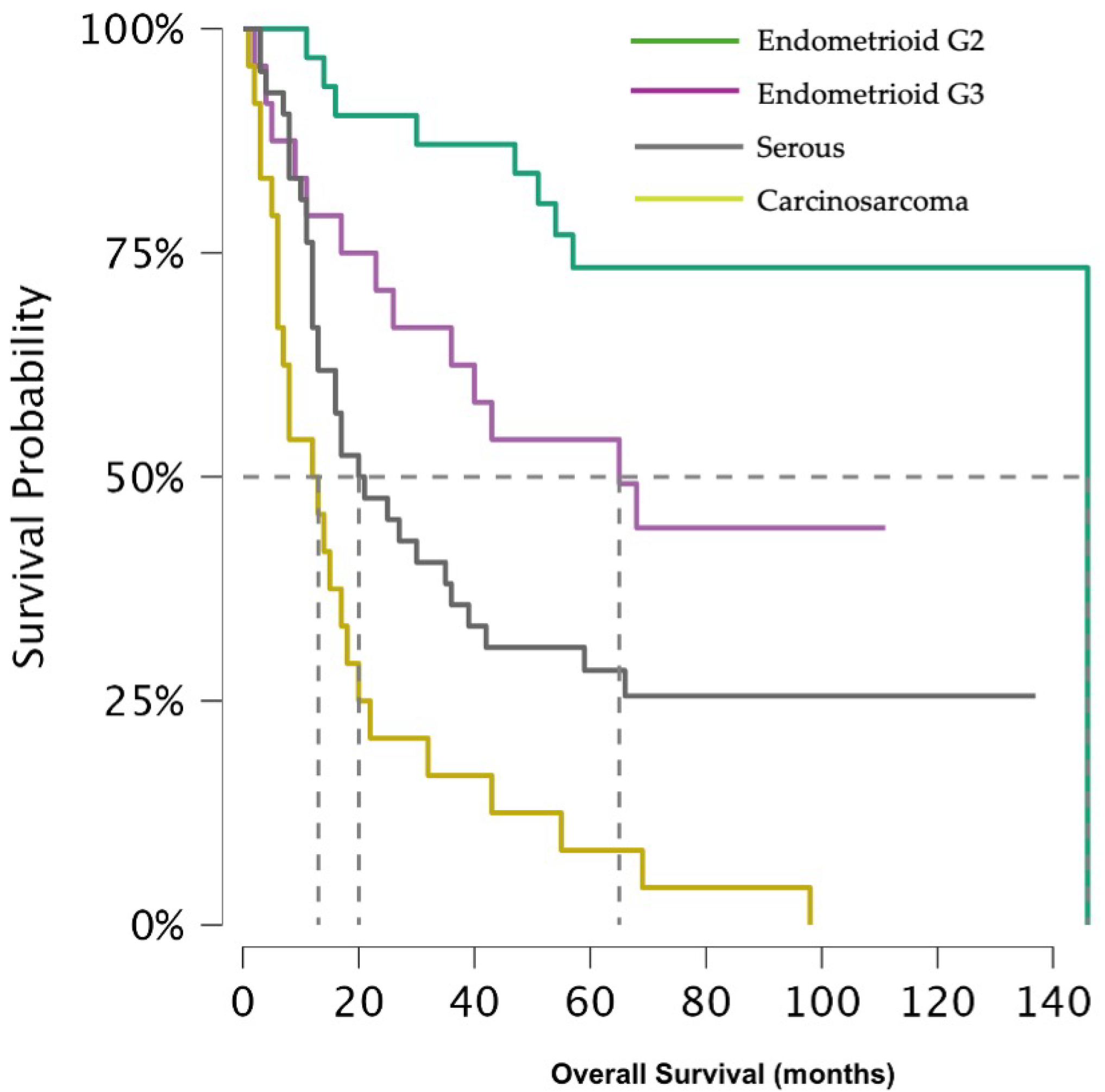
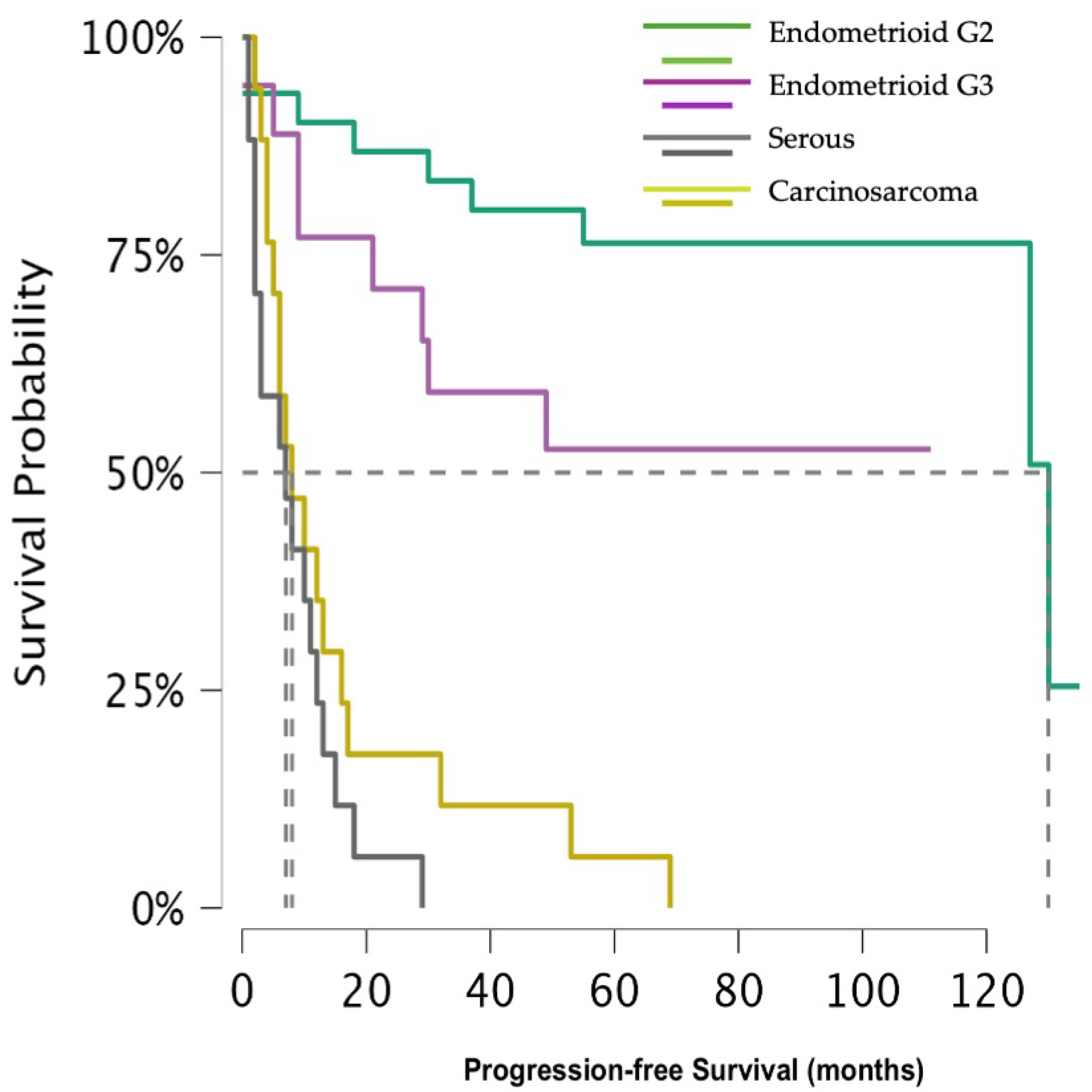
3.2. Survival and Univariate Analysis
3.3. Multivariate Analysis
4. Discussion
5. Conclusions
Author Contributions
Funding
Institutional Review Board Statement
Informed Consent Statement
Data Availability Statement
Acknowledgments
Conflicts of Interest
Abbreviations
| EC | Endometrial cancer |
| FIGO | The International Federation of Gynaecologist and Obstetrics |
| G1/G2 | Low-grade |
| EEC | Endometrioid endometrial carcinoma |
| G3 | High-grade |
| SC | Serous carcinoma |
| CS | Carcinosarcoma |
| CCC | Clear Cell carcinoma |
| TGCA | The Genome Cancer Atlas |
| RAINBO | Refining Adjuvant Treatment in Endometrial Cancer Based on Molecular Features |
| MDT | Multidisciplinary team |
| RECORD | Reporting od studies Conducted using Observational Routinely collected Health Data |
| EQUATOR | Enhancing the Quality and Transparency of Health Research Network |
| LVSI | Lymphovascular space invasion |
| OS | Overall survival |
| PFS | Progression-free survival |
| HR | Hazard ratio |
| CI | Confidence interval |
References
- World Cancer Research Fund. Endometrial Cancer Statistics. Available online: https://www.wcrf.org/preventing-cancer/cancer-statistics/endometrial-cancer-statistics/ (accessed on 19 October 2025).
- Berek, J.S.; Matias-Guiu, X.; Creutzberg, C.; Fotopoulou, C.; Gaffney, D.; Kehoe, S.; Lindemann, K.-T.; Mutch, D.; Concin, N. Endometrial Cancer Staging Subcommittee; et al. FIGO staging of endometrial cancer: 2023. Int. J. Gynecol. Obstet. 2023, 162, 383–394. [Google Scholar] [CrossRef]
- Llobet, D.; Pallares, J.; Yeramian, A.; Santacana, M.; Eritja, N.; Velasco, A.; Dolcet, X.; Matias-Guiu, X. Molecular pathology of endometrial carcinoma: Practical aspects from the diagnostic and therapeutic viewpoints. J. Clin. Pathol. 2009, 62, 777–785. [Google Scholar] [CrossRef]
- Cancer Genome Atlas Research Network; Levine, D.A. Integrated genomic characterization of endometrial carcinoma. Nature 2013, 497, 67–73. [Google Scholar] [CrossRef]
- Höhn, A.K.; Brambs, C.E.; Hiller, G.G.R.; May, D.; Schmoeckel, E.; Horn, L.-C. 2020 WHO Classification of Female Genital Tumors. Geburtshilfe Frauenheilkd 2021, 81, 1145–1153. [Google Scholar] [CrossRef]
- Bogani, G.; Ray-Coquard, I.; Concin, N.; Ngoi, N.Y.L.; Morice, P.; Caruso, G.; Enomoto, T.; Takehara, K.; Denys, H.; Lorusso, D.; et al. Endometrial carcinosarcoma. Int. J. Gynecol. Cancer 2023, 33, 147–174. [Google Scholar] [CrossRef]
- Bogani, G.; Ray-Coquard, I.; Concin, N.; Ngoi, N.Y.L.; Morice, P.; Enomoto, T.; Takehara, K.; Denys, H.; Nout, R.A.; Lorusso, D.; et al. Uterine serous carcinoma. Gynecol. Oncol. 2021, 162, 226–234. [Google Scholar] [CrossRef]
- Bogani, G.; Ray-Coquard, I.; Concin, N.; Ngoi, N.Y.L.; Morice, P.; Enomoto, T.; Takehara, K.; Denys, H.; Lorusso, D.; Vaughan, M.M.; et al. Clear cell carcinoma of the endometrium. Gynecol. Oncol. 2022, 164, 658–666. [Google Scholar] [CrossRef] [PubMed]
- Zouridis, A.; Zarrindej, K.; Rencher, J.; Pappa, C.; Kashif, A.; Smyth, S.L.; Sadeghi, N.; Sattar, A.; Damato, S.; Ferrari, F.; et al. The Prognostic Characteristics and Recurrence Patterns of High Grade Endometrioid Endometrial Cancer: A Large Retrospective Analysis of a Tertiary Center. J. Clin. Med. 2023, 12, 3141. [Google Scholar] [CrossRef] [PubMed]
- Smyth, S.L.; Ripullone, K.; Zouridis, A.; Pappa, C.; Spain, G.; Gkorila, A.; McCulloch, A.; Tupper, P.; Bibi, F.; Sadeghi, N.; et al. Uterine Carcinosarcoma—A Retrospective Cohort Analysis from a Tertiary Centre on Epidemiology, Management Approach, Outcomes and Survival Patterns. Cancers 2025, 17, 635. [Google Scholar] [CrossRef] [PubMed]
- Zouridis, A.; Kashif, A.; Darwish, A.; Pappa, C.; Ferrari, F.; Smyth, S.L.; Sadeghi, N.; Sattar, A.; Damato, S.; Abdalla, M.; et al. Challenging the Binary Classification of Endometrioid Endometrial Adenocarcinoma: The Evaluation of Grade 2 as an Independent Entity Based on Prognostic Characteristics and Recurrence Patterns. Cancers 2025, 17, 127. [Google Scholar] [CrossRef]
- McGunigal, M.; Liu, J.; Kalir, T.; Chadha, M.; Gupta, V. Survival Differences Among Uterine Papillary Serous, Clear Cell and Grade 3 Endometrioid Adenocarcinoma Endometrial Cancers: A National Cancer Database Analysis. Int. J. Gynecol. Cancer 2017, 27, 85–92. [Google Scholar] [CrossRef]
- Mhawech-Fauceglia, P.; Herrmann, R.F.; Kesterson, J.; Izevbaye, I.; Lele, S.; Odunsi, K. Prognostic factors in stages II/III/IV and stages III/IV endometrioid and serous adenocarcinoma of the endometrium. Eur. J. Surg. Oncol. 2010, 36, 1195–1201. [Google Scholar] [CrossRef]
- Alektiar, K.M.; McKee, A.; Lin, O.; Venkatraman, E.; Zelefsky, M.J.; McKee, B.; Hoskins, W.J.; Barakat, R.R. Is there a difference in outcome between stage I–II endometrial cancer of papillary serous/clear cell and endometrioid FIGO Grade 3 cancer? Int. J. Radiat. Oncol. Biol. Phys. 2002, 54, 79–85. [Google Scholar] [CrossRef] [PubMed]
- Tuomi, T.; Pasanen, A.; Leminen, A.; Bützow, R.; Loukovaara, M. Prediction of Site-Specific Tumor Relapses in Patients With Stage I-II Endometrioid Endometrial Cancer. Int. J. Gynecol. Cancer 2017, 27, 923–930. [Google Scholar] [CrossRef] [PubMed]
- Singh, N.; Hirschowitz, L.; Zaino, R.; Alvarado-Cabrero, I.; Duggan, M.A.; Ali-Fehmi, R.; Euscher, E.; Hecht, J.L.; Horn, L.-C.; Ioffe, O.; et al. Pathologic Prognostic Factors in Endometrial Carcinoma (Other Than Tumor Type and Grade). Int. J. Gynecol. Pathol. 2019, 38, S93. [Google Scholar] [CrossRef] [PubMed]
- Wang, J.; Jia, N.; Li, Q.; Wang, C.; Tao, X.; Hua, K.; Feng, W. Analysis of recurrence and survival rates in grade 3 endometrioid endometrial carcinoma. Oncol. Lett. 2016, 12, 2860–2867. [Google Scholar] [CrossRef]
- Galaal, K.; Kew, F.M.; Tam, K.F.; Lopes, A.; Meirovitz, M.; Naik, R.; Godfrey, K.A.; Hatem, M.H.; Edmondson, R.J. Evaluation of prognostic factors and treatment outcomes in uterine carcinosarcoma. Eur. J. Obstet. Gynecol. Reprod. Biol. 2009, 143, 88–92. [Google Scholar] [CrossRef]
- Zhu, J.; Wen, H.; Bi, R.; Wu, X. Clinicopathological characteristics, treatment and outcomes in uterine carcinosarcoma and grade 3 endometrial cancer patients: A comparative study. J. Gynecol. Oncol. 2016, 27, e18. [Google Scholar] [CrossRef]
- Barquet-Muñoz, S.; Bandala-Jaques, A.; Perez-Montiel, M.D.; Prada, D.; Martínez-Flores, M.; Salcedo-Hernández, R.A.; Pérez-Plasencia, C.; Gonzalez-Enciso, A.; Leon, D.C.-D. Factors Associated with Parametrial Involvement in Endometrial Carcinoma in Patients Treated with Radical Hysterectomy. Int. J. Surg. Pathol. 2024, 32, 1241–1247. [Google Scholar] [CrossRef]
- Vance, S.; Yechieli, R.; Cogan, C.; Hanna, R.; Munkarah, A.; Elshaikh, M.A. The prognostic significance of age in surgically staged patients with Type II endometrial carcinoma. Gynecol. Oncol. 2012, 126, 16–19. [Google Scholar] [CrossRef]
- Loizzi, V.; Del Vecchio, V.; Pisani, E.; Ranieri, G.; Resta, L.; Cicinelli, E.; Cormio, G. Prognostic factors in endometrial cancer Stages III and IV: A single academic institution experience of 49 patients. Eur. J. Gynaecol. Oncol. 2019, 40, 1000–1005. [Google Scholar] [CrossRef]
- Ferrari, F.; Gozzini, E.; Conforti, J.; Giannini, A.; Barra, F.; Fichera, A.; Ferrari, F.A.; Majd, H.S.; Odicino, F. Impact of the FIGO 2023 Staging System on the Adjuvant Treatment of Endometrial Cancer: A Comparative Analysis with FIGO 2009. Cancers 2025, 17, 934. [Google Scholar] [CrossRef] [PubMed]
- Dagher, C.; Mueller, J.J.; Sonoda, Y.; Momeni-Boroujeni, A.; Makker, V.; O’cEarbhaill, R.E.; Alektiar, K.; Abu-Rustum, N.R.; Leitao, M.M. Prognostic value of ‘aggressive’ histology in surgically staged clinically uterine-confined endometrial carcinoma. Int. J. Gynecol. Cancer 2025, 35, 102656. [Google Scholar] [CrossRef] [PubMed]



| EEC G1 | EEC G2 | EEC G3 | Serous Carcinoma | Carcinosarcoma | Clear Cell | ||
|---|---|---|---|---|---|---|---|
| (%) | (%) | (%) | (%) | (%) | (%) | ||
| Number | 14 (9.5) | 31 (20.9) | 24 (16.2) | 42 (28.4) | 32 (21.6) | 5 (3.4) | |
| General | |||||||
| Mean age (years) | 58.1 | 70.2 | 69.9 | 69.2 | 71.3 | 66.0 | |
| Laparoscopy | 11 (7.4) | 26 (17.6) | 17 (12.2) | 24 (16.2) | 28 (18.9) | 1 (0.7) | |
| Laparotomy | 3 (2.0) | 2 (1.4) | 7 (4.7) | 17 (11.5) | 4 (2.7) | 4 (2.7) | |
| Missing data | 0 | 3 | 0 | 1 | 0 | 0 | |
| Surgery | |||||||
| Lymph node | 1 (0.7) | 2 (1.4) | 5 (3.4) | 4 (2.7) | 3 (2.0) | 1 (0.7) | |
| sampling | |||||||
| Systematic lymph | 1 (0.7) | 6 (4.1) | 12 (8.1) | 20 (13.5) | 20 (13.5) | 4 (2.7) | |
| node dissection |
| EEC G1 | EEC G2 | EEC G3 | Serous Carcinoma | Carcinosarcoma | Clear Cell | |
|---|---|---|---|---|---|---|
| (%) | (%) | (%) | (%) | (%) | (%) | |
| Myometrial invasion > 50% | 10 (6.8) | 23 (15.5) | 20 (13.5) | 31 (20.9) | 29 (19.6) | 5 (3.4) |
| Cervical invasion | 4 (2.7) | 17 (11.5) | 10 (6.8) | 21 (14.2) | 14 (9.5) | 1 (0.7) |
| Adnexa invasion | 5 (3.4) | 7 (4.7) | 6 (4.1) | 23 (15.5) | 10 (6.8) | 1 (0.7) |
| Serosal invasion | 4 (2.7) | 8 (5.4) | 10 (6.8) | 19 (12.8) | 18 (12.2) | 1 (0.7) |
| Parametrial invasion | 1 (0.7) | 14 (9.5) | 9 (6.1) | 15 (10.1) | 12 (8.1) | 1 (0.7) |
| Lymphovascular | 6 (4.1) | 24 (16.2) | 20 (13.5) | 34 (23.0) | 29 (19.6) | 5 (3.4) |
| space invasion |
| EEC G1 | EEC G2 | EEC G3 | Serous Carcinoma | Carcinosarcoma | Clear Cell | |
|---|---|---|---|---|---|---|
| (%) | (%) | (%) | (%) | (%) | (%) | |
| IIIA | 10 (6.8) | 13 (8.8) | 7 (4.7) | 12 (8.1) | 10 (6.8) | 0 |
| IIIB | 1 (0.7) | 14 (9.5) | 5 (3.4) | 7 (4.7) | 2 (1.4) | 2 (1.4) |
| IIIC1 | 1 (0.7) | 3 (2.0) | 7 (4.7) | 12 (8.1) | 10 (6.8) | 3 (2.0) |
| IIIC2 | 0 | 1 (0.7) | 3 (2.0) | 2 (1.4) | 2 (1.4) | 0 |
| IVA | 0 | 0 | 0 | 0 | 1 (0.7) | 0 |
| IVB | 2 (1.4) | 0 | 2 (1.4) | 9 (6.1) | 7 (4.7) | 0 |
| All Histotypes | EEC G2 | EEC G3 | Carcinosarcoma | Serous Carcinoma | ||||||
|---|---|---|---|---|---|---|---|---|---|---|
| OS | PFS | OS | PFS | OS | PFS | OS | PFS | OS | PFS | |
| Log-rank test | ||||||||||
| p-value | 0.107 | 0.135 | 0.340 | 0.039 | 0.465 | 0.568 | 0.827 | 0.288 | 0.134 | 0.320 |
| Cox univariate analysis | ||||||||||
| p-value | 0.113 | 0.138 | 0.353 | 0.060 | 0.471 | 0.671 | 0.847 | 0.308 | 0.149 | 0.303 |
| 95% CI | 0.352–1.118 | 0.288–1.188 | 0.081–2.448 | 0.043–1.066 | 0.119–2.675 | 0.075–5.282 | 0.293–2.739 | 0.367–23.889 | 0.216–1.262 | 0.151–1.801 |
Disclaimer/Publisher’s Note: The statements, opinions and data contained in all publications are solely those of the individual author(s) and contributor(s) and not of MDPI and/or the editor(s). MDPI and/or the editor(s) disclaim responsibility for any injury to people or property resulting from any ideas, methods, instructions or products referred to in the content. |
© 2025 by the authors. Licensee MDPI, Basel, Switzerland. This article is an open access article distributed under the terms and conditions of the Creative Commons Attribution (CC BY) license (https://creativecommons.org/licenses/by/4.0/).
Share and Cite
Conforti, J.; Nistor, S.I.; Sadeghi, N.; Zouridis, A.; Kashif, A.; Darwish, A.; Smyth, S.L.; Sattar, A.; Addley, S.; Pappa, C.; et al. Insights from the Pre-Molecular Era in Advanced Endometrial Cancer: Benchmarking Prognostic Indicators in High-Risk Tumours. J. Clin. Med. 2025, 14, 8726. https://doi.org/10.3390/jcm14248726
Conforti J, Nistor SI, Sadeghi N, Zouridis A, Kashif A, Darwish A, Smyth SL, Sattar A, Addley S, Pappa C, et al. Insights from the Pre-Molecular Era in Advanced Endometrial Cancer: Benchmarking Prognostic Indicators in High-Risk Tumours. Journal of Clinical Medicine. 2025; 14(24):8726. https://doi.org/10.3390/jcm14248726
Chicago/Turabian StyleConforti, Jacopo, Sabina Ioana Nistor, Negin Sadeghi, Andreas Zouridis, Ammara Kashif, Ahmed Darwish, Sarah Louise Smyth, Alisha Sattar, Susan Addley, Christina Pappa, and et al. 2025. "Insights from the Pre-Molecular Era in Advanced Endometrial Cancer: Benchmarking Prognostic Indicators in High-Risk Tumours" Journal of Clinical Medicine 14, no. 24: 8726. https://doi.org/10.3390/jcm14248726
APA StyleConforti, J., Nistor, S. I., Sadeghi, N., Zouridis, A., Kashif, A., Darwish, A., Smyth, S. L., Sattar, A., Addley, S., Pappa, C., Damato, S., Abdalla, M., Kehoe, S., Giannini, A., Ferrari, F., & Soleymani Majd, H. (2025). Insights from the Pre-Molecular Era in Advanced Endometrial Cancer: Benchmarking Prognostic Indicators in High-Risk Tumours. Journal of Clinical Medicine, 14(24), 8726. https://doi.org/10.3390/jcm14248726