Abstract
Mantle cell lymphoma (MCL) is an aggressive subtype of non-Hodgkin lymphoma (NHL) whose clinical course is largely shaped by molecular and biological features. Among the most impactful prognostic markers, TP53 mutations have emerged as critical determinants of treatment resistance since their first identification in MCL in 1996. Regardless of the detection method, TP53 mutations have been consistently associated with primary refractoriness to chemoimmunotherapy and significantly reduced overall survival. In this perspective, we explored recent advances in applying integrated-omics approaches to assess TP53 status. Despite its prognostic value, routine testing for TP53 at diagnosis remains uncommon, hindered by the lack of standardized protocols and costs for Next-Generation Sequencing (NGS), and the suboptimal reliability of immunohistochemistry (IHC) as a surrogate. This gap between research evidence and clinical practice represents a critical barrier to risk-adapted therapy. The broad implementation of standardized and accessible genomic techniques is essential to identify patients who deserve a personalized therapeutic approach. Several clinical trials have recently explored alternative chemo-free or targeted regimens specifically tailored to TP53-mutated patients (i.e., NCT03824483, NCT03567876), with promising results. This risk-adapted approach reflects a paradigm shift in MCL management, emphasizing the need for early molecular risk assessment to guide treatment decisions. In this scenario, TP53 mutations are no longer supporting actors, but a game-changer for the prognosis and treatment of patients with MCL.
1. Introduction
Mantle cell lymphoma (MCL) is a rare non-Hodgkin lymphoma (NHL) of mature B cells, accounting for 4–7%. It is commonly divided into two distinct groups: aggressive classic MCL (cMCL) and indolent leukemic non-nodal MCL (nnMCL) [], which display a heterogeneous clinical course. The indices regularly adopted to discriminate the aggressiveness of MCL are: the Mantle Cell Lymphoma International Prognostic Index (MIPI) [,,,]; the morphologic features (classic vs. blastoid) [,,,]; and the evaluation of tumor kinetics (i.e., Ki67 expression).
A complex genomic landscape also characterizes MCL. The common genetic hallmark is the presence of t(11;14), which juxtaposes the cyclin D1 gene (CCND1) with the immunoglobulin heavy chain locus (IGH), leading to overexpression of cyclin D1 [,,,]. Moreover, MCL presents a high degree of genetic heterogeneity, which poses a significant challenge in identifying possible predictive and prognostic biomarkers [,]. A set of “driver” genes has been widely described, which are strongly involved in MCL pathogenesis, such as ATM, TP53, NOTCH1/2, KMT2D, CCND1, and HNRNPH1 [,,,]. Secondary genomic events are also well-known, with losses at 17p, 13q33-q34, 1p22, 11q22-q23, 6q, 13q14 (RB1), 9p21 (CDKN2A/B), 9q22q31, and 10p15-p13, and gains at 3q25-q29, 18q21-q22 (BCL2), and 12q13 (CDK4) [] being the most frequent.
TP53, a tumor-suppressor gene, is one of the major players in cancer development, holding a strong role in the pathogenesis and therapy resistance of several tumors, including MCL [,]. Indeed, TP53, encoded on the short arm of chromosome 17, is also known as the “guardian of the genome” due to its role in regulating multiple cellular responses to stress stimuli through various mechanisms, including cell-cycle arrest, apoptosis, and senescence []. The dysregulation of TP53 leads to two main groups of mutations: loss-of-function (LOF) and gain-of-function (GOF) mutations. TP53 mutations occur in 5–20% of MCL cases at disease presentation, and their identification is becoming more and more important in the diagnostic/prognostic work-up of MCL patients at the time of diagnosis [,]. For instance, the missense mutations, classified as GOF, account for around 30% of all the mutations [], principally occurring in the so-called hotspots of p53, leading to the activation or inactivation of several genes involved in cell-cycle regulation and survival, such as ATM, CDKN2A, and NOTCH1. The co-occurrence of these alterations leads to an increase in genomic instability, a more aggressive and accelerated tumor progression related to the blastoid variant of MCL [], and a tendency to treatment resistance []. Indeed, TP53 mutations may increase the expression of MDR1 (multidrug resistance gene 1), thereby enhancing the possibility of displaying various chemo-resistant mechanisms []. Furthermore, the TP53 perturbation could have an impact on the BCR/PI3K/AKT signaling. The B-cell receptor (BCR) engagement initiates the formation of a complex signalosome, which phosphorylates a series of protein tyrosine kinases (PTKs), thereby regulating the physiological fate of B-cells, including survival and proliferation [,]. The loss of TP53 leads to a highly inflammatory and immunosuppressive tumoral microenvironment, activating the NF-κB pathway (directly linked to BCR signaling) [,], which allows for possible immune escape and increases the likelihood of treatment resistance, for example, to Bruton kinase inhibitors (BTKi) [], targeted therapies against CD20 and BCL2 [,], and possibly to CAR-T []. To overcome this issue, some trials have attempted different combinations of drugs (NCT06482684, NCT05495464, NCT05861050). However, it is desirable to increase the research in the identification of new potential druggable targets in MCL p53-mutated cells.
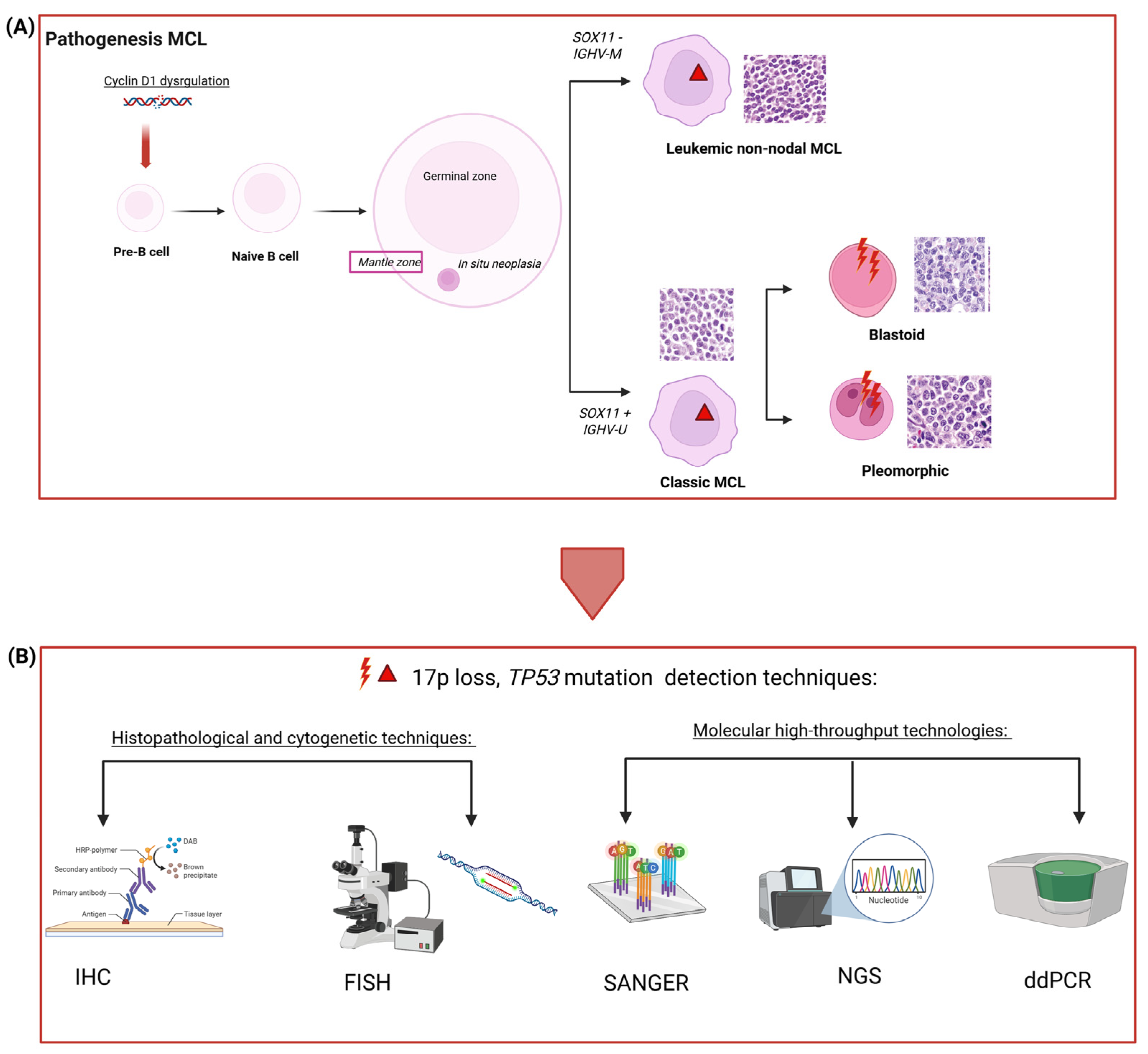
The use of different techniques supported the detection of TP53 mutations and aberrations with different accuracy and sensitivity, namely (I) immunohistochemistry (IHC), through p53 expression indirectly predicts TP53 mutations; (II) Fluorescence In Situ Hybridization (FISH), a cytogenetic technique employed to detect TP53 aberrations, and multiple molecular analysis of DNA conducted through (III) Sanger sequencing, (IV) Next-Generation Sequencing (NGS), and (V) droplet digital PCR (ddPCR) which are able to detect mutations, hotspots and copy number variations (CNVs), and deletions of TP53 with different degrees of accuracy (Figure 1, Table 1). However, a comprehensive comparative analysis assessing which technique presents the highest sensitivity, reproducibility, and accuracy of TP53 mutational status detection is still lacking [].
Figure 1.
(A) shows the pathogenesis of MCL. A morphologic evaluation of the tumor-associated B-cells is commonly performed to classify MCL as indolent (leukemic-non-nodal morphology) or aggressive (classic morphology subdivided into two even more aggressive shapes: blastoid and pleomorphic). (B) represents the technologies (IHC, FISH, Sanger Sequencing, NGS, or ddPCR) available to determine the TP53 status (mutation and/or aberration) for prognostication or risk prediction in patients.
Table 1.
The table summarizes the main characteristics of the techniques commonly used to detect TP53 mutations and aberrations. These methods differ not only in accuracy and sensitivity, but also in cost and in the type and depth of information they provide.
In this prospective study, we review the clinical studies showing the prognostic relevance of TP53 mutations in MCL, their impact on therapeutic decision-making [], and the technologies used in most diagnostic and research laboratories.
2. Clinical Evidence of TP53’s Role in Resistance to Treatments and Poor Prognosis

TP53 was identified as a strong and independent prognostic factor associated with inferior outcomes and treatment resistance in several prospective studies (see Table 2).
In younger, fit patients eligible for high-dose chemotherapy and autologous stem cell transplantation, TP53 mutations confer a particularly dismal prognosis. In the pivotal study by Delfau-Larue et al., the addition of rituximab and high-dose cytarabine failed to overcome the adverse impact of TP53 and CDKN2A deletions []. The Nordic MCL2 and MCL3 trials confirmed that patients harboring TP53 mutations had markedly shorter progression-free survival (PFS) and overall survival (OS) compared to TP53 wild-type (WT) cases (median OS 1.8 vs. >10 years; median PFS 0.9 vs. >10 years) [].
In older patients treated with bendamustine and rituximab (BR), similar trends have been observed with TP53-mutated patients characterized by inferior survival, highlighting the persistence of the negative prognostic impact, even when following less intensive regimens []. Recent therapeutic strategies have focused on incorporating targeted agents earlier in the treatment algorithm. For instance, in the TRIANGLE trial, adding ibrutinib to intensive chemoimmunotherapy reduced the risk of failure in patients with high p53 expression by IHC. However, TP53 mutational status was not reported []. Conversely, in the SHINE and ECHO trials, the addition of BTK inhibitors (ibrutinib or acalabrutinib) to BR did not significantly impact an outcome, and TP53-mutated patients continued to fare poorly [,].
Chemo-free combinations may represent a more promising approach in this setting. The combination of ibrutinib and rituximab in elderly patients with newly diagnosed MCL in the ENRICH trial yielded high overall response rates, yet those with TP53 aberrations had inferior OS and a trend toward poorer outcomes []. More recent chemo-free triplet combinations have demonstrated greater efficacy. In the BoVen study, zanubrutinib, obinutuzumab, and venetoclax TP53-mutated patients achieved an overall response rate (ORR) of 86%, a complete response (CR) rate of 64%, and a 2-year PFS of 72% []. However, due to the small size of the TP53-mutated cohort and the relatively short follow-up, further studies with larger patient populations and longer follow-up are needed to confirm these findings. Similarly, the SYMPATICO trial combining ibrutinib and venetoclax reported an ORR of 84%, CR rate of 57%, median PFS of 20.9 months, and OS of 47.1 months in this population—a significant improvement compared to historical data []. The VR-BAC trial represented a prospective study stratifying treatment based on biological risk, including TP53 mutations. The results suggest an enhanced activity of R-BAC plus venetoclax in high-risk subgroups, although outcomes remained poor in patients with concurrent blastoid morphology and TP53 mutations [].
As for cellular therapies, particularly CD19-directed CAR T-cells, have also shown promise. In the ZUMA-2 trial, brexucabtagene autoleucel demonstrated a 1-year PFS of 61% and a CR rate of 83%, with exploratory analyses suggesting benefits as well in TP53-mutated patients, although the numbers are small []. The TARMAC study, combining CAR-T and ibrutinib, achieved deep responses, including MRD negativity, regardless of TP53 status []. More recently, a three-year follow-up of KTE-X19 by Wang et al. confirmed the durability of responses across most subgroups, including those with TP53 mutations. Although the precise outcomes for TP53-mutated patients were not separately reported, the authors noted that this high-risk subgroup appeared to derive clinical benefit, with ongoing responses observed. Although clinical benefit was observed in this high-risk population, the number of TP53-mutated patients was limited, and the exploratory nature of the subgroup analysis warrants caution [].
A recent multicenter analysis consistently reported TP53 mutations in 51% of patients relapsing after CAR-T, reinforcing that TP53 alterations contribute substantially to resistance and poor clinical outcomes []. Likewise, the bispecific antibodies, such as glofitamab, are also being evaluated. In the original phase I/II study on glofitamab in relapsed/refractory (R/R) MCL, five patients with TP53 mutations were reported, of whom three (60%) achieved a complete response (CR) []. The updated data presented at ASH 2024 expanded this subgroup to nine patients with high-p53 expression (>50%), showing a CR rate of 67% compared to 76% in patients with a p53 expression below 50%, indicating a slightly lower response in the high-p53 subgroup. Survival analyses combining all high-risk features (including p53 expression > 50%, Ki-67 > 50%, and blastoid morphology) demonstrated that these patients had durable responses, with a median duration of CR of 21.5 months versus 19.2 months in patients without high-risk features []. Despite the encouraging activity of glofitamab in this difficult-to-treat subgroup [,], the small sample size and combined analysis of multiple high-risk markers warrant cautious interpretation, and further studies with larger, genetically defined cohorts are needed to confirm these findings. Building on the promising results from chemo-free combinations, as well as CAR-T and bispecific antibody studies in TP53-mutated MCL, several ongoing trials are now exploring risk-adapted strategies, specifically targeting high-risk patients. The CARMAN phase II trial is investigating early intensification with brexucabtagene autoleucel after abbreviated induction in patients with TP53 mutation or p53 overexpression (NCT06482684). Another pilot study, WINDOW-3, is evaluating the combination therapy with acalabrutinib and rituximab as a “window” followed by CAR-T in newly diagnosed high-risk MCL (NCT05495464). Moreover, another phase I/II trial is testing the combination of glofitamab, venetoclax, and lenalidomide (NCT05861050) in front-line high-risk MCL (including TP53-mutated).
Emerging evidence indicates that innovative combinations can induce meaningful responses in TP53-mutated MCL. While these results are encouraging, many studies are still ongoing, and further data will be needed to determine their full impact in high-risk patients. Enrollment in clinical trials currently represents the most effective avenue to advance treatment for this population. Collectively, these findings confirm the central role of TP53, underscoring the importance of TP53 testing with standardized, sensitive, and cost-effective tools to guide risk-adapted therapeutic strategies from the diagnosis.
Table 2.
The table reports the trials cited in the main text and the technologies adopted to detect the TP53 status. In all, TP53 played a prominent role in the resistance to treatment or progression of MCL, regardless of the method applied for its identification.
Table 2.
The table reports the trials cited in the main text and the technologies adopted to detect the TP53 status. In all, TP53 played a prominent role in the resistance to treatment or progression of MCL, regardless of the method applied for its identification.
| Clinical Trials | TP53 Mutations and\or Deletion Assessment | Treatment Resistance |
|---|---|---|
| European MCL Younger trial [] | RQ-PCR | High-dose chemotherapy and autologous stem cell transplantation |
| Nordic MCL2 and MCL3 [] | IHC, NGS | cytarabine, rituximab, and autologous stem-cell transplant (ASCT) |
| Korean, Multicenter, Retrospective Analysis [] | IHC | Bendamustine and rituximab (BR) |
| TRIANGLE [] | IHC | Ibrutinib in addition to chemoimmunotherapy |
| SHINE and ECHO [,] | IHC | Ibrutinib or acalabrutinib in addition to chemotherapy |
| BoVen [] | IHC, NGS | Zanabrutinib, obinutuzumab, and venetoclax |
| SYMPATICO [] | NGS | Ibrutinib combined with venetoclax |
| VR-BAC [] | FISH, Sanger, NGS | Venetoclax in high-risk subgroups |
| ZUMA2 [] | NGS, ddPCR | Brexucabtagene autoleucel |
| TARMAC [] | FISH, NGS | CAR-T in combination with ibrutinib |
| NP30179 and NCT03075696 [,] | IHC | Glofitamab |
3. Immunohistochemistry and Fluorescence In Situ Hybridization to Detect TP53 Point Mutation and Aberrations: Strengths and Limitations
Immunohistochemistry (IHC) is a technique commonly used to localize the presence of specific antigens in a tissue. In MCL, the lymph nodes or extra-nodal sites are removed and embedded in the formalin-fixed paraffin (FFPE) blocks for diagnostic purposes. The expression of p53 can be inserted in the diagnostic panel routinely applied for MCL diagnosis, which includes at least Ki-67, SOX11, CD20, and cyclin D1. Indeed, the European MCL Network (EMCL) recommends applying IHC to identify TP53 expression due to the easy execution of the technique [,], although this approach has several pitfalls. IHC has high interobserver variability, a risk of cross-reactions [], low sensitivity in detecting small amounts of protein mutation, and the inability to identify nonsense mutations. Regarding missense mutations, they may accumulate in the tumoral cell, allowing for their detection through IHC []. This procedure is currently well accepted in other types of cancers [,] and could be considered an effective surrogate for the laboratories that cannot perform targeted sequencing. Finally, IHC may lose the signal of truncating mutations, which represent 10–25% of all mutations [].
It is acknowledged that the reproducibility and the standardization of the quantification of the image analysis in IHC could be challenging. The reproducibility of Ki-67 and p53 assessments was investigated by involving different hematopathology laboratories. Although the results were promising, it was highlighted that the major limitation in interpreting the results was related to the analyses of the samples performed by highly specialized pathologists under controlled conditions, which does not reflect routine diagnostic practice []. Computer-based IHC analysis using specific software, such as QuPath [] or HALO [], is able to quantify the antibody signals using continuous measurements of positive cells, and dichotomizing at a previously defined threshold; such computer image analysis overestimates results [], but remains more precise than classic IHC, and could promote greater standardization and reproducibility of results.
In specific cases, the investigation of TP53 gene alterations with IHC could be supported by Fluorescence In Situ Hybridization (FISH) to identify p53 aberrations. FISH could detect cytogenetic abnormalities such as amplifications, deletions, translocations, or chromosomal abnormalities []. The employment of FISH on FFPE is challenging due to the possible cellular overlapping and signal attenuation caused by nuclear truncations and heterogeneity of the tumoral region []. Furthermore, FISH entails more expensive stains than IHC, requiring specialized personnel to analyze the stained-tumoral sections []. In clinical practice, FISH is applied to detect the deletion of the p arm of chromosome 17 (del17p), which contains the TP53 gene. This aberration is commonly correlated with adverse behavior in MCL []. The prognostic predictivity of the 17p deletion seems lower than TP53 mutations themselves in several studies [,], both in nodal and nnMCL [].
IHC and FISH represent practical and expedient initial diagnostic approaches for stratifying MCL patients. However, the low sensitivity, lack of standardization, and tissue requirements limit their clinical appeal when compared with molecular assays. For this reason, the combined use of IHC and high-throughput analysis may provide a more informative and precise approach for identifying high-risk patients.
4. Comparison Between Sanger and Next Generation Sequencing: Strengths and Limitations
Sanger sequencing is the first sequencing technology developed by Friedrich Sanger in 1977 []. This method is based on the capillary electrophoresis of individual fluorescently labeled sequencing reaction products []. Otherwise, NGS is a high-throughput technology able to simultaneously sequence millions of DNA fragments, providing comprehensive insight into the genomic mutational landscape of cancers [], which could use DNA derived from tumoral tissue biopsies, blood, or body secretions [].
The advantage of using Sanger sequencing is the high accuracy in detecting chromosomal abnormalities such as rearrangements, aberrations, clones, and hotspot mutations of a specific gene of interest. However, it presented several limitations, such as low throughput (one fragment per reaction), the ability to detect variants present in >15–20% of DNA, and it is not suitable for comprehensive genomic analysis, such as genome or exome sequencing [,]. Nowadays, Sanger sequencing is preferentially adopted as a validation method of specific genomic results derived from massive sequencing. For instance, Eskelund et al. performed Sanger sequencing to confirm the presence of TP53 mutation in a small number of previously sequenced samples []. Another recent application in MCL was performed by Khouja et al., which verified the translocations and clonal IGH-V-(D)-J rearrangements []. Overall, Sanger sequencing is preferentially used to validate and confirm the presence of TP53 mutations and deletions (or further gene mutations or translocations of interest) in samples with low NGS coverage outcomes.
NGS highlighted the strong impact of specific genes, including TP53, on prognosis and treatment resistance [,,] by determining a comprehensive genomic landscape of MCL. The significant advantage of identifying clonal (VAF >10%) and subclonal (VAF 2–5%) mutations allows for integrating clinical data, such as B-symptoms, MIPI score, and line of treatments, with a multitude of mutational data, which may predict worse outcomes and potential mechanisms of resistance, like the co-existence of del CDKN2A together with TP53 mutations [,].
The challenges related to NGS are the high cost, the need for highly trained professionals, and the lack of standardization of the platforms in use. In an effort to standardize the procedure, the EuroClonality-NGS working group created the EuroClonality (EC)-NDC assay, which is able to detect clonal immunoglobulin (IG) and T-cell receptor (TCR) rearrangements, chromosomal translocations, copy number alterations (CNAs), and somatic nucleotide variants (SNVs). It was validated in multiple European centers []. In particular, it was employed on cohorts from the European MCL network (NCT00209222 and NCT00209209) []. Through the EuroClonality (EC)-NDC assay, the accuracy and sensitivity in trial MCL0208 molecular targets (not detected by Sanger sequencing and PCR) were successfully identified []. Another platform frequently adopted by the centers is the Cancer Personalized Profiling by Deep Sequencing (CAPP-Seq). It is prevalently used for the detection of circulating tumor DNA (ct-DNA) in plasma for MRD in order to monitor the follow-up of the disease, and track clonal evolution [,,].
However, these two extremely valuable assays require a multistep workflow, making their application difficult to use in a clinical practice routine. Indeed, the data analysis is complex, time-consuming, and requires specialized biologists and bioinformaticians to prepare the samples and analyze the genomic outcomes. To address this limitation, a targeted Next-Generation Sequencing (tNGS) approach could be employed. For instance, Lorraine M. de Haan et al. employed tNGS to evaluate TP53 alterations, demonstrating that IHC is an unreliable surrogate for accurately assessing TP53 mutational status when compared to molecular profiling through tNGS []. Notably, the targeted approach was associated with significantly lower costs and shorter turnaround times compared to comprehensive NGS panels, thereby enhancing its feasibility for routine clinical implementation. Indeed, this strategy may be valuable in the research of TP53 single-nucleotide polymorphisms (SNPs), which could have a higher incidence in the prognostication, monitoring, and prediction of disease progression and treatment resistance. Sequencing technologies vary widely in their approaches and depth of analysis. The choice of the most suitable method should be guided by several factors: (I) the availability and type of starting material (tissue sections, peripheral blood, or bone marrow), (II) the purpose of the study (diagnostic versus research), (III) overall costs.
5. Could Droplet-Digital PCR Be a Valuable Tool in Detecting TP53 Hotspots in the Hematological Field?
Droplet-digital PCR (ddPCR) is a molecular technique not widely used in clinical practice; it involves partitioning the sample into sub-reactions that are counted as either negative or positive by applying an analysis method based on Poisson statistics []. In comparison to NGS, ddPCR is not able to sequence the whole gene, such as Sanger sequencing, but it is useful to identify hotspots, sub-clonal mutations, and CNVs of the gene of interest with high sensitivity (VAF 0.01–0.1), reproducibility, rapidity, and at lower costs [,]. The use of this tool has multiple evidences in solid cancers, while in hematological malignancies, its potential has not been fully understood, even though there is evidence of its application in leukemias, lymphomas, myeloma, and chronic myeloproliferative neoplasms, as well as in the transplant field [].
Notably, the ddPCR could also support the monitoring of MRD []. For instance, Chen L. et al. detected 29 different mutations of TP53 in a cohort of patients during CAR-T treatment. Interestingly, the patients with the TP53 mutation presented shorter OS and PFS in comparison with those without mutations [].
These results suggest the importance of following the disease over time and the great efficacy and sensitivity of ddPCR in identifying pathogenic targets, such as TP53, compared to other high-throughput technologies.
However, in MCL, its use remains largely confined to research settings, where ddPCR is mainly applied as a validation tool (similar to Sanger sequencing) or for the detection of sub-clonal mutations in longitudinal studies, which are relatively few and typically involve small patient cohorts.
6. Finding the Right Method: Key Considerations
The implications of TP53 in the progression and treatment resistance of MCL are evident, regardless of the VAF or type of mutation (nonsense, frameshift, or missense).
The IHC is the technique most commonly performed. The detection of p53 is commonly referred to as an overexpression of the protein, while the absence may be related to the complete deletion of p53. The presence of p53 overexpression is commonly associated with high-risk patients. However, it is important to note that the lack of p53 overexpression on IHC does not necessarily exclude the presence of an underlying TP53 mutation, as some mutations do not result in protein accumulation and may therefore remain undetected by IHC. Therefore, to identify such cases and accurately define the type of mutation, sequencing and ddPCR are essential tools, as they allow precise characterization of TP53 alterations and assessment of the VAF.
To confirm this result, it is recommended to investigate at the molecular level the presence of TP53. Indeed, sequencing and ddPCR allow us to define the type of mutation and the VAF. Typically, clonal mutations (VAF > 15–20%) are considered those with a greater impact on the disease’s aggressiveness, while subclonal mutations (VAF < 10%) are crucial in longitudinal studies to determine if treatment pressure affects them [,,]. The assessment of the VAF and the type of mutation (LOF or GOF) may also help clinicians in the treatment choice. Moreover, the application of highly sensitive techniques, such as ddPCR and tNGS, could facilitate the implementation of TP53 genomic knowledge and its implications in a longitudinal landscape.
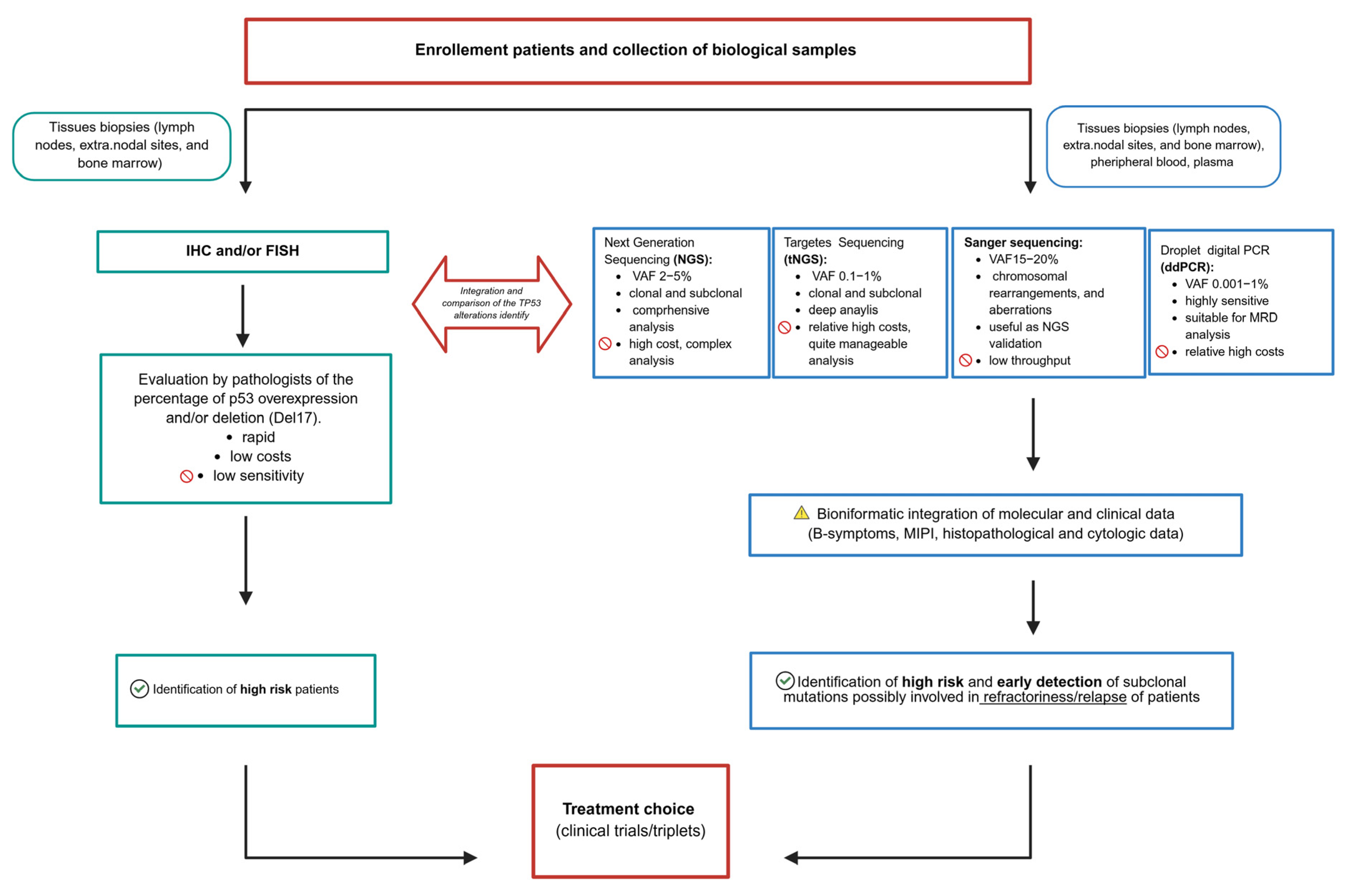
Ultimately, a clear initial set-up and a well-defined objective—starting from patient enrollment—are essential, as the biological material available remains the main constraint in selecting the optimal technique for TP53 detection. Choosing the right approach is therefore key not only to identifying high-risk patients but also to clarifying the biological and clinical significance of TP53 mutations in MCL (Figure 2).
Figure 2.
Flow chart summarizing key TP53 detection strategies and their sensitivity, with an emphasis on their implications for clinical decision-making and guidance on method selection based on the available biological material.
7. Conclusions and Future Perspectives
The involvement of TP53 in the progression and treatment resistance of MCL patients is highlighted by multiple clinical studies, which report its importance in the prognostic evaluation and therapy management. Indeed, patients with TP53 mutations generally have poor outcomes with conventional therapies. Nevertheless, durable responses remain challenging, making enrolment in dedicated clinical trials essential to provide access to innovative treatments and improve the management of these patients. Therefore, early TP53 screening is becoming increasingly necessary to improve risk stratification and guide personalized treatment approaches, while promoting participation in clinical trials whenever possible. However, in clinical practice, the TP53 screening is almost completely lacking due to the high cost and absence of specialized staff.
At the moment, IHC is the technique that is prevalently adopted to obtain results quickly and at low costs, although its accuracy could be poor. Moreover, the sequencing is predominantly performed in retrospective studies to characterize the genomic landscape of the cohort of interest, and only a few studies have performed molecular analysis routinely or in prospective studies due to the high costs. The future premises to overcome these issues could be to preferentially perform tNGS and ddPCR to obtain an accurate result about the TP53 status in a short time and at a lower cost.
In conclusion, it is crucial to improve TP53 detection in research and diagnostic laboratories and implement mutual protocols to improve standardization, accuracy, and reliability of the tests. Future integration of TP53 testing into risk-adapted MCL management algorithms could optimize therapeutic outcomes and enable precision oncology. Indeed, TP53 is no longer a marginal biomarker, but a true game changer in the management of MCL.
Author Contributions
M.E.C. and A.M. designed and conducted the research. C.V. approved the final version and supported the design of the study. All authors have read and agreed to the published version of the manuscript.
Funding
This research received no external funding.
Institutional Review Board Statement
Not applicable.
Informed Consent Statement
Not applicable.
Data Availability Statement
No new data were created or analyzed in this study.
Conflicts of Interest
Maria Elena Carazzolo, Alessia Moioli, and Carlo Visco declare that the research was conducted in the absence of any commercial or financial relationships that could be construed as a potential conflict of interest.
References
- Navarro, A.; Beà, S.; Jares, P.; Campo, E. Molecular Pathogenesis of Mantle Cell Lymphoma. Hematol. Oncol. Clin. N. Am. 2020, 34, 795–807. [Google Scholar] [CrossRef]
- Kumar, A.; Eyre, T.A.; Lewis, K.L.; Thompson, M.C.; Cheah, C.Y. New Directions for Mantle Cell Lymphoma in 2022. Am. Soc. Clin. Oncol. Educ. Book 2022, 42, 614–628. [Google Scholar] [CrossRef]
- Hansen, S.V.; Nyvold, C.G.; Hansen, M.H. Mantle cell lymphoma and the evidence of an immature lymphoid component. Leuk. Res. 2022, 115, 106824. [Google Scholar] [CrossRef]
- Bomben, R.; Ferrero, S.; D’Agaro, T.; Dal Bo, M.; Re, A.; Evangelista, A.; Carella, A.M.; Zamò, A.; Vitolo, U.; Omedè, P.; et al. A B-cell receptor-related gene signature predicts survival in mantle cell lymphoma: Results from the Fondazione Italiana Linfomi MCL-0208 trial. Haematologica 2018, 103, 849–856. [Google Scholar] [CrossRef] [PubMed]
- Obr, A.; Procházka, V.; Jirkuvová, A.; Urbánková, H.; Kriegova, E.; Schneiderová, P.; Vatolíková, M.; Papajík, T. TP53 Mutation and Complex Karyotype Portends a Dismal Prognosis in Patients with Mantle Cell Lymphoma. Clin. Lymphoma Myeloma Leuk. 2018, 18, 762–768. [Google Scholar] [CrossRef]
- Slotta-Huspenina, J.; Koch, I.; de Leval, L.; Keller, G.; Klier, M.; Bink, K.; Kremer, M.; Raffeld, M.; Fend, F.; Quintanilla-Martinez, L. The impact of cyclin D1 mRNA isoforms, morphology and p53 in mantle cell lymphoma: p53 alterations and blastoid morphology are strong predictors of a high proliferation index. Haematologica 2012, 97, 1422–1430. [Google Scholar] [CrossRef] [PubMed]
- Izban, K.F.; Alkan, S.; Singleton, T.P.; Hsi, E.D. Multiparameter Immunohistochemical Analysis of the Cell Cycle Proteins Cyclin D1, Ki-67, p21WAF1, p27KIP1, and p53 in Mantle Cell Lymphoma. Arch. Pathol. Lab. Med. 2000, 124, 1457–1462. [Google Scholar] [CrossRef]
- Rodrigues, J.M.; Hassan, M.; Freiburghaus, C.; Eskelund, C.W.; Geisler, C.; Räty, R.; Kolstad, A.; Sundström, C.; Glimelius, I.; Grønbæk, K.; et al. p53 is associated with high-risk and pinpoints TP53 missense mutations in mantle cell lymphoma. Br. J. Haematol. 2020, 191, 796–805. [Google Scholar] [CrossRef] [PubMed]
- Sakhdari, A.; Ok, C.Y.; Patel, K.P.; Kanagal-Shamanna, R.; Yin, C.C.; Zuo, Z.; Hu, S.; Routbort, M.J.; Luthra, R.; Medeiros, L.J.; et al. TP53 mutations are common in mantle cell lymphoma, including the indolent leukemic non-nodal variant. Ann. Diagn. Pathol. 2019, 41, 38–42. [Google Scholar] [CrossRef]
- Eskelund, C.W.; Dahl, C.; Hansen, J.W.; Westman, M.; Kolstad, A.; Pedersen, L.B.; Montano-Almendras, C.P.; Husby, S.; Freiburghaus, C.; Ek, S.; et al. TP53 mutations identify younger mantle cell lymphoma patients who do not benefit from intensive chemoimmunotherapy. Blood 2017, 130, 1903–1910. [Google Scholar] [CrossRef]
- Mareckova, A.; Malcikova, J.; Tom, N.; Pal, K.; Radova, L.; Salek, D.; Janikova, A.; Moulis, M.; Smardova, J.; Kren, L.; et al. ATM and TP53 mutations show mutual exclusivity but distinct clinical impact in mantle cell lymphoma patients. Leuk. Lymphoma 2019, 60, 1420–1428. [Google Scholar] [CrossRef]
- Nadeu, F.; Martin-Garcia, D.; Clot, G.; Díaz-Navarro, A.; Duran-Ferrer, M.; Navarro, A.; Vilarrasa-Blasi, R.; Kulis, M.; Royo, R.; Gutiérrez-Abril, J.; et al. Genomic and epigenomic insights into the origin, pathogenesis, and clinical behavior of mantle cell lymphoma subtypes. Blood 2020, 136, 1419–1432. [Google Scholar] [CrossRef]
- Pararajalingam, P.; Coyle, K.M.; Arthur, S.E.; Thomas, N.; Alcaide, M.; Meissner, B.; Boyle, M.; Qureshi, Q.; Grande, B.M.; Rushton, C.; et al. Coding and noncoding drivers of mantle cell lymphoma identified through exome and genome sequencing. Blood 2020, 136, 572–584. [Google Scholar] [CrossRef]
- Sönmez, E.E.; Hatipoğlu, T.; Kurşun, D.; Hu, X.; Akman, B.; Yuan, H.; Danyeli, A.E.; Alacacıoğlu, İ.; Özkal, S.; Olgun, A.; et al. Whole Transcriptome Sequencing Reveals Cancer-Related, Prognostically Significant Transcripts and Tumor-Infiltrating Immunocytes in Mantle Cell Lymphoma. Cells 2022, 11, 3394. [Google Scholar] [CrossRef]
- López, C.; Silkenstedt, E.; Dreyling, M.; Beà, S. Biological and clinical determinants shaping heterogeneity in mantle cell lymphoma. Blood Adv. 2024, 8, 3652–3664. [Google Scholar] [CrossRef]
- Kastenhuber, E.R.; Lowe, S.W. Putting p53 in Context. Cell 2017, 170, 1062–1078. [Google Scholar] [CrossRef]
- Guo, W.; Wang, X.; Li, Y.; Bai, O. Function and regulation of lipid signaling in lymphomagenesis: A novel target in cancer research and therapy. Crit. Rev. Oncol. Hematol. 2020, 154, 103071. [Google Scholar] [CrossRef] [PubMed]
- Obr, A.; Klener, P.; Furst, T.; Kriegova, E.; Zemanova, Z.; Urbankova, H.; Jirkuvova, A.; Petrackova, A.; Malarikova, D.; Forsterova, K.; et al. A high TP53 mutation burden is a strong predictor of primary refractory mantle cell lymphoma. Br. J. Haematol. 2020, 191, e103–e106. [Google Scholar] [CrossRef]
- Roszkowska, K.A.; Piecuch, A.; Sady, M.; Gajewski, Z.; Flis, S. Gain of Function (GOF) Mutant p53 in Cancer—Current Therapeutic Approaches. Int. J. Mol. Sci. 2022, 23, 13287. [Google Scholar] [CrossRef] [PubMed]
- Jain, P.; Wang, M. High-risk MCL: Recognition and treatment. Blood 2025, 145, 683–695. [Google Scholar] [CrossRef]
- Kagiyama, Y.; Fujita, S.; Shima, Y.; Yamagata, K.; Katsumoto, T.; Nakagawa, M.; Honma, D.; Adachi, N.; Araki, K.; Kato, A.; et al. CDKN1C-mediated growth inhibition by an EZH1/2 dual inhibitor overcomes resistance of mantle cell lymphoma to ibrutinib. Cancer Sci. 2021, 112, 2314–2324. [Google Scholar] [CrossRef]
- Rudelius, M.; Pittaluga, S.; Nishizuka, S.; Pham, T.H.-T.; Fend, F.; Jaffe, E.S.; Quintanilla-Martinez, L.; Raffeld, M. Constitutive activation of Akt contributes to the pathogenesis and survival of mantle cell lymphoma. Blood 2006, 108, 1668–1676. [Google Scholar] [CrossRef] [PubMed]
- Gambino, S.; Quaglia, F.M.; Galasso, M.; Cavallini, C.; Chignola, R.; Lovato, O.; Giacobazzi, L.; Caligola, S.; Adamo, A.; Putta, S.; et al. B-cell receptor signaling activity identifies patients with mantle cell lymphoma at higher risk of progression. Sci. Rep. 2024, 14, 6595. [Google Scholar] [CrossRef] [PubMed]
- Rahal, R.; Frick, M.; Romero, R.; Korn, J.M.; Kridel, R.; Chan, F.C.; Meissner, B.; Bhang, H.-E.; Ruddy, D.; Kauffmann, A.; et al. Pharmacological and genomic profiling identifies NF-κB–targeted treatment strategies for mantle cell lymphoma. Nat. Med. 2014, 20, 87–92. [Google Scholar] [CrossRef]
- Sharma, S.; Ali, R.; Bouska, A.; Jochum, D.; Kesireddy, M.; Mahov, S.; Lownik, J.; Zhang, W.; Lone, W.; Soma, M.A.; et al. Functional genomics and tumor microenvironment analysis reveal prognostic biological subtypes in Mantle cell lymphoma. Nat. Commun. 2025, 16, 9762. [Google Scholar] [CrossRef]
- Decombis, S.; Bellanger, C.; Le Bris, Y.; Madiot, C.; Jardine, J.; Santos, J.C.; Boulet, D.; Dousset, C.; Menard, A.; Kervoelen, C.; et al. CARD11 gain of function upregulates BCL2A1 expression and promotes resistance to targeted therapies combination in B-cell lymphoma. Blood 2023, 142, 1543–1555. [Google Scholar] [CrossRef]
- Granau, A.M.; Andersen, P.A.; Jakobsen, T.; Taouxi, K.; Dalila, N.; Mogensen, J.B.; Kristensen, L.S.; Grønbæk, K.; Dimopoulos, K. Concurrent Inhibition of Akt and ERK Using TIC-10 Can Overcome Venetoclax Resistance in Mantle Cell Lymphoma. Cancers 2023, 15, 510. [Google Scholar] [CrossRef]
- Jain, P.; Dreyling, M.; Seymour, J.F.; Wang, M. High-Risk Mantle Cell Lymphoma: Definition, Current Challenges, and Management. J. Clin. Oncol. 2020, 38, 4302–4316. [Google Scholar] [CrossRef]
- Stefancikova, L.; Moulis, M.; Fabian, P.; Ravcukova, B.; Vasova, I.; Muzik, J.; Malcikova, J.; Falkova, I.; Slovackova, J.; Smardova, J. Loss of the p53 tumor suppressor activity is associated with negative prognosis of mantle cell lymphoma. Int. J. Oncol. 2010, 36, 699–706. [Google Scholar] [CrossRef] [PubMed]
- Delfau-Larue, M.H.; Klapper, W.; Berger, F.; Jardin, F.; Briere, J.; Salles, G.; Casasnovas, O.; Feugier, P.; Haioun, C.; Ribrag, V.; et al. High-dose cytarabine does not overcome the adverse prognostic value of CDKN2A and TP53 deletions in mantle cell lymphoma. Blood 2015, 126, 604–611. [Google Scholar] [CrossRef]
- Yi, J.H.; Kim, S.J.; Lee, J.O.; Lee, G.W.; Kwak, J.Y.; Eom, H.S.; Jo, J.C.; Choi, Y.S.; Oh, S.Y.; Kim, W.S. Bendamustine Plus Rituximab for Mantle Cell Lymphoma: A Korean, Multicenter Retrospective Analysis. Anticancer Res. 2022, 42, 6083–6089. [Google Scholar] [CrossRef]
- Dreyling, M.; Doorduijn, J.; Giné, E.; Jerkeman, M.; Walewski, J.; Hutchings, M.; Mey, U.; Riise, J.; Trneny, M.; Vergote, V.; et al. Ibrutinib combined with immunochemotherapy with or without autologous stem-cell transplantation versus immunochemotherapy and autologous stem-cell transplantation in previously untreated patients with mantle cell lymphoma (TRIANGLE): A three-arm, randomised, open-label, phase 3 superiority trial of the European Mantle Cell Lymphoma Network. Lancet 2024, 403, 2293–2306. [Google Scholar] [CrossRef]
- Wang, M.L.; Jurczak, W.; Jerkeman, M.; Trotman, J.; Zinzani, P.L.; Belada, D.; Boccomini, C.; Flinn, I.W.; Giri, P.; Goy, A.; et al. Ibrutinib plus Bendamustine and Rituximab in Untreated Mantle-Cell Lymphoma. N. Engl. J. Med. 2022, 386, 2482–2494. [Google Scholar] [CrossRef]
- Wang, M.; Salek, D.; Belada, D.; Song, Y.; Jurczak, W.; Kahl, B.S.; Paludo, J.; Chu, M.P.; Kryachok, I.; Fogliatto, L.; et al. Acalabrutinib Plus Bendamustine-Rituximab in Untreated Mantle Cell Lymphoma. J. Clin. Oncol. 2025, 43, 2276–2284. [Google Scholar] [CrossRef]
- Wang, M.L.; Lee, H.; Chuang, H.; Wagner-Bartak, N.; Hagemeister, F.; Westin, J.; Fayad, L.; Samaniego, F.; Turturro, F.; Oki, Y.; et al. Ibrutinib in combination with rituximab in relapsed or refractory mantle cell lymphoma: A single-centre, open-label, phase 2 trial. Lancet Oncol. 2016, 17, 48–56. [Google Scholar] [CrossRef]
- Kumar, A.; Soumerai, J.; Abramson, J.S.; Barnes, J.A.; Caron, P.; Chhabra, S.; Chabowska, M.; Dogan, A.; Falchi, L.; Grieve, C.; et al. Zanubrutinib, obinutuzumab, and venetoclax for first-line treatment of mantle cell lymphoma with a TP53 mutation. Blood 2025, 145, 497–507. [Google Scholar] [CrossRef] [PubMed]
- Wang, M.; Jurczak, W.; Trneny, M.; Belada, D.; Wrobel, T.; Ghosh, N.; Keating, M.M.; van Meerten, T.; Alvarez, R.F.; von Keudell, G.; et al. Ibrutinib plus venetoclax in relapsed or refractory mantle cell lymphoma (SYMPATICO): A multicentre, randomised, double-blind, placebo-controlled, phase 3 study. Lancet Oncol. 2025, 26, 200–213. [Google Scholar] [CrossRef] [PubMed]
- Visco, C.; Tabanelli, V.; Sacchi, M.V.; Evangelista, A.; Quaglia, F.M.; Fiori, S.; Bomben, R.; Tisi, M.C.; Riva, M.; Merli, A.; et al. Rituximab, bendamustine, and cytarabine followed by venetoclax in older patients with high-risk mantle cell lymphoma (FIL_V-RBAC): A multicentre, single-arm, phase 2 study. Lancet Haematol. 2025, 12, e777–e788. [Google Scholar] [CrossRef]
- Wang, M.; Munoz, J.; Goy, A.; Locke, F.L.; Jacobson, C.A.; Hill, B.T.; Timmerman, J.M.; Holmes, H.; Jaglowski, S.; Flinn, I.W.; et al. KTE-X19 CAR T-Cell Therapy in Relapsed or Refractory Mantle-Cell Lymphoma. N. Engl. J. Med. 2020, 382, 1331–1342. [Google Scholar] [CrossRef]
- Minson, A.; Hamad, N.; Cheah, C.Y.; Tam, C.S.; Blombery, P.; Westerman, D.; Ritchie, D.S.; Morgan, H.; Holzwart, N.; Lade, S.; et al. CAR T cells and time-limited ibrutinib as treatment for relapsed/refractory mantle cell lymphoma: The phase 2 TARMAC study. Blood 2024, 143, 673–684. [Google Scholar] [CrossRef] [PubMed]
- Wang, M.; Munoz, J.; Goy, A.; Locke, F.L.; Jacobson, C.A.; Hill, B.T.; Timmerman, J.M.; Holmes, H.; Jaglowski, S.; Flinn, I.W.; et al. Three-Year Follow-Up of KTE-X19 in Patients With Relapsed/Refractory Mantle Cell Lymphoma, Including High-Risk Subgroups, in the ZUMA-2 Study. J. Clin. Oncol. 2023, 41, 555–567. [Google Scholar] [CrossRef] [PubMed]
- Phillips, T.J.; Carlo-Stella, C.; Morschhauser, F.; Bachy, E.; Crump, M.; Trněný, M.; Bartlett, N.L.; Zaucha, J.; Wrobel, T.; Offner, F.; et al. Glofitamab in Relapsed/Refractory Mantle Cell Lymphoma: Results from a Phase I/II Study. J. Clin. Oncol. 2025, 43, 318–328. [Google Scholar]
- Phillips, T.J.; Trněný, M.; Carlo-Stella, C.; Zaucha, J.M.; Wrobel, T.; Offner, F.; Dickinson, M.J.; Tani, M.; Crump, M.; Bartlett, N.L.; et al. Paper: Glofitamab Induces High Response Rates and Durable Remissions in Patients (Pts) with Heavily Pretreated Relapsed/Refractory (R/R) Mantle Cell Lymphoma (MCL), Including Those with a Poor Prognosis: Subgroup Results from a Phase I/II Study. Blood 2024, 144, 1631. [Google Scholar]
- Croci, G.A.; Hoster, E.; Beà, S.; Clot, G.; Enjuanes, A.; Scott, D.W.; Cabeçadas, J.; Veloza, L.; Campo, E.; Clasen-Linde, E.; et al. Reproducibility of histologic prognostic parameters for mantle cell lymphoma: Cytology, Ki67, p53 and SOX11. Virchows Arch. 2020, 477, 259–267. [Google Scholar] [CrossRef] [PubMed]
- Tan, W.C.C.; Nerurkar, S.N.; Cai, H.Y.; Ng, H.H.M.; Wu, D.; Wee, Y.T.F.; Lim, J.C.T.; Yeong, J.; Lim, T.K.H. Overview of multiplex immunohistochemistry/immunofluorescence techniques in the era of cancer immunotherapy. Cancer Commun. 2020, 40, 135–153. [Google Scholar] [CrossRef] [PubMed]
- Yemelyanova, A.; Vang, R.; Kshirsagar, M.; Lu, D.; A Marks, M.; Shih, I.M.; Kurman, R.J. Immunohistochemical staining patterns of p53 can serve as a surrogate marker for TP53 mutations in ovarian carcinoma: An immunohistochemical and nucleotide sequencing analysis. Mod. Pathol. 2011, 24, 1248–1253. [Google Scholar] [CrossRef]
- Cole, A.J.; Dwight, T.; Gill, A.J.; Dickson, K.-A.; Zhu, Y.; Clarkson, A.; Gard, G.B.; Maidens, J.; Valmadre, S.; Clifton-Bligh, R.; et al. Assessing mutant p53 in primary high-grade serous ovarian cancer using immunohistochemistry and massively parallel sequencing. Sci. Rep. 2016, 6, 26191. [Google Scholar] [CrossRef]
- Scheubeck, G.; Jiang, L.; Hermine, O.; Kluin-Nelemans, H.C.; Schmidt, C.; Unterhalt, M.; Rosenwald, A.; Klapper, W.; Evangelista, A.; Ladetto, M.; et al. Clinical outcome of Mantle Cell Lymphoma patients with high-risk disease (high-risk MIPI-c or high p53 expression). Leukemia 2023, 37, 1887–1894. [Google Scholar] [CrossRef]
- Bankhead, P.; Loughrey, M.B.; Fernández, J.A.; Dombrowski, Y.; McArt, D.G.; Dunne, P.D.; McQuaid, S.; Gray, R.T.; Murray, L.J.; Coleman, H.G.; et al. QuPath: Open source software for digital pathology image analysis. Sci. Rep. 2017, 7, 16878. [Google Scholar] [CrossRef]
- HALO Quantitative Image Analysis for Pathology. Available online: https://www.leicabiosystems.com/it-it/digital-pathology/analyze/halo/ (accessed on 21 July 2025).
- Zhang, Y.-H.; Gao, L.-M.; Xiang, X.-Y.; Zhang, W.-Y.; Liu, W.-P. Prognostic value and computer image analysis of p53 in mantle cell lymphoma. Ann. Hematol. 2022, 101, 2271–2279. [Google Scholar] [CrossRef]
- Huber, D.; Von Voithenberg, L.V.; Kaigala, G.V. Fluorescence in situ hybridization (FISH): History, limitations and what to expect from micro-scale FISH? Micro Nano Eng. 2018, 1, 15–24. [Google Scholar] [CrossRef]
- Ferrero, S.; Ragaini, S. Advancing Mantle Cell Lymphoma Risk Assessment: Navigating a Moving Target. Hematol. Oncol. 2025, 43, e70072. [Google Scholar] [CrossRef] [PubMed]
- Abbasi, A.; Alexandrov, L.B. Significance and limitations of the use of next-generation sequencing technologies for detecting mutational signatures. DNA Repair 2021, 107, 103200. [Google Scholar] [CrossRef]
- Advantages and Limitations of Sanger Sequencing. Genetic Education. Available online: https://geneticeducation.co.in/advantages-and-limitations-of-sanger-sequencing/ (accessed on 23 September 2025).
- Khouja, M.; Jiang, L.; Pal, K.; Stewart, P.J.; Regmi, B.; Schwarz, M.; Klapper, W.; Alig, S.K.; Darzentas, N.; Kluin-Nelemans, H.C.; et al. Comprehensive genetic analysis by targeted sequencing identifies risk factors and predicts patient outcome in Mantle Cell Lymphoma: Results from the EU-MCL network trials. Leukemia 2024, 38, 2675–2684. [Google Scholar] [CrossRef]
- Ouyang, Z.; Zeng, R.; Wang, S.; Wu, X.; Li, Y.; He, Y.; Wang, C.; Xia, C.; Ou, Q.; Bao, H.; et al. Genomic signatures in plasma circulating tumor DNA reveal treatment response and prognostic insights in mantel cell lymphoma. Cancer Cell Int. 2025, 25, 172. [Google Scholar] [CrossRef]
- Jung, D.; Jain, P.; Yao, Y.; Wang, M. Advances in the assessment of minimal residual disease in mantle cell lymphoma. J. Hematol. Oncol. 2020, 13, 127. [Google Scholar] [CrossRef]
- Malarikova, D.; Berkova, A.; Obr, A.; Blahovcova, P.; Svaton, M.; Forsterova, K.; Kriegova, E.; Prihodova, E.; Pavlistova, L.; Petrackova, A.; et al. Concurrent TP53 and CDKN2A Gene Aberrations in Newly Diagnosed Mantle Cell Lymphoma Correlate with Chemoresistance and Call for Innovative Upfront Therapy. Cancers 2020, 12, 2120. [Google Scholar] [CrossRef]
- EuroClonality—NDC Assay by Univ8 Genomics. Available online: https://univ8genomics.com/euroclonality-ndc/ (accessed on 22 July 2025).
- Genuardi, E.; Romano, G.; Beccuti, M.; Alessandria, B.; Mannina, D.; Califano, C.; Scalabrini, D.R.; Cortelazzo, S.; Ladetto, M.; Ferrero, S.; et al. Application of the Euro Clonality next-generation sequencing-based marker screening approach to detect immunoglobulin heavy chain rearrangements in mantle cell lymphoma patients: First data from the Fondazione Italiana Linfomi MCL0208 trial. Br. J. Haematol. 2021, 194, 378–381. [Google Scholar] [CrossRef]
- Roschewski, M.; Rossi, D.; Kurtz, D.M.; Alizadeh, A.A.; Wilson, W.H. Circulating Tumor DNA in Lymphoma Principles and Future Directions. Blood Cancer Discov. 2022, 3, 5–15. [Google Scholar] [CrossRef]
- Moia, R.; Carazzolo, M.E.; Cosentino, C.; Almasri, M.; Talotta, D.; Tabanelli, V.; Motta, G.; Melle, F.; Sacchi, M.V.; Evangelista, A.; et al. TP53, CD36 Mutations and CDKN2A Loss Predict Poor Outcome in Mantle Cell Lymphoma: Molecular Analysis of the FIL V-Rbac Phase 2 Trial. Blood 2024, 144 (Suppl. S1), 1577. [Google Scholar] [CrossRef]
- De Haan, L.M.; de Groen, R.A.L.; de Groot, F.A.; Noordenbos, T.; van Wezel, T.; van Eijk, R.; Ruano, D.; Diepstra, A.; Koens, L.; Nicolae-Cristea, A.; et al. Real-world routine diagnostic molecular analysis for TP53 mutational status is recommended over p53 immunohistochemistry in B-cell lymphomas. Virchows Arch. 2024, 485, 643–654. [Google Scholar] [CrossRef]
- Galimberti, S.; Balducci, S.; Guerrini, F.; Del Re, M.; Cacciola, R. Digital Droplet PCR in Hematologic Malignancies: A New Useful Molecular Tool. Diagnostics 2022, 12, 1305. [Google Scholar] [CrossRef] [PubMed]
- Coccaro, N.; Tota, G.; Anelli, L.; Zagaria, A.; Specchia, G.; Albano, F. Digital PCR: A Reliable Tool for Analyzing and Monitoring Hematologic Malignancies. Int. J. Mol. Sci. 2020, 21, 3141. [Google Scholar] [CrossRef] [PubMed]
- Chen, L.; Mu, W.; Gu, J.; Xiao, M.; Huang, L.; Zheng, M.; Li, C.; Xiao, Y.; Zhou, J.; Long, X. TP53-Mutated Circulating Tumor DNA for Disease Monitoring in Lymphoma Patients after CAR T Cell Therapy. Diagnostics 2021, 11, 844. [Google Scholar] [CrossRef] [PubMed]
- Obr, A.; Klener Jr, P.; Kriegova, E.; Zemanova, Z.; Urbankova, H.; Jirkuvova, A.; Petrackova, A.; Cudova, B.; Sedlarikova, L.; Prochazka, V.K.; et al. High TP53 Mutation Load Predicts Primary Refractory Mantle Cell Lymphoma. Blood 2019, 134, 3995. [Google Scholar] [CrossRef]
Disclaimer/Publisher’s Note: The statements, opinions and data contained in all publications are solely those of the individual author(s) and contributor(s) and not of MDPI and/or the editor(s). MDPI and/or the editor(s) disclaim responsibility for any injury to people or property resulting from any ideas, methods, instructions or products referred to in the content. |
© 2025 by the authors. Licensee MDPI, Basel, Switzerland. This article is an open access article distributed under the terms and conditions of the Creative Commons Attribution (CC BY) license (https://creativecommons.org/licenses/by/4.0/).