


Quality of Online Patient Information on Surgical Management of Hidradenitis Suppurativa: A Comprehensive Assessment Using the mEQIP Tool

 , ,
, ,  and
and
Abstract
1. Introduction
2. Materials and Methods
2.1. Search Strategy
2.2. Screening and Eligibility Criteria
2.3. Classification and Scoring
3. Results
3.1. Website Characteristics and Scores
3.2. mEQIP Scores Across Websites
3.3. Domain-Specific Performance
3.3.1. Surgical and Risk Communication
3.3.2. Transparency and Credibility
3.3.3. Structural Quality
3.4. Temporal Trends
3.5. Additional Analyses
4. Discussion
4.1. Integration with Current Guidelines
4.2. Aesthetic Outcomes and Quality of Life
4.3. Comparison with Related Literature
4.4. Implications for Patient Education
- (a)
- Comprehensive content: Websites should systematically describe all relevant surgical and reconstructive techniques, emphasizing how choices depend on disease stage and anatomical site. Non-surgical alternatives, such as biologic therapy and lifestyle modification, should also be mentioned to contextualize surgery within multimodal care [37].
- (b)
- (c)
- Balanced risk–benefit discussion: Clear information on complications, pain, healing time, and recurrence should be mandatory, including quantitative data where available. Potential benefits—such as pain relief, improved mobility, enhanced body image, and quality of life—should be communicated with realistic expectations [40,41,42,43].
- (d)
- Postoperative care information: Instructions on wound care, dressings, activity limits, and warning signs should be provided, along with long-term maintenance strategies like smoking cessation, weight control, and ongoing systemic therapy.
- (e)
- Transparency and credibility: Authorship, credentials, and affiliations should be clearly disclosed. Including publication dates ensures information is current, while references add credibility and enable further reading. Any sponsorship or advertising influence must be transparently stated [44,45].
- (f)
- Interactive tools and quality standards: Visual aids like diagrams, videos, and interactive tools can improve patient understanding of HS surgery and wound care, while decision aids may boost engagement. Implementing quality standards, such as HON code certification or HS-specific checklists, can help identify reliable resources [46,47].
5. Conclusions
6. Limitations and Future Research
Supplementary Materials
Author Contributions
Funding
Institutional Review Board Statement
Informed Consent Statement
Data Availability Statement
Acknowledgments
Conflicts of Interest
References
- Saunte, D.M.; Jemec, G.B. Hidradenitis Suppurativa: Advances in Diagnosis and Treatment. JAMA 2017, 318, 2019–2032. [Google Scholar] [CrossRef]
- Ingram, J.R. The epidemiology of hidradenitis suppurativa. Br. J. Dermatol. 2020, 183, 990–998. [Google Scholar] [CrossRef]
- Gierek, M.; Niemiec, P.; Szyluk, K.; Ochala-Gierek, G.; Bergler-Czop, B. Hidradenitis suppurativa and squamous cell carcinoma: A systematic review of the literature. Postep. Dermatol. Alergol. 2023, 40, 350–354. [Google Scholar] [CrossRef] [PubMed]
- Zouboulis, C.C.; Desai, N.; Emtestam, L.; Hunger, R.E.; Ioannides, D.; Juhász, I.; Lapins, J.; Matusiak, L.; Prens, E.P.; Revuz, J.; et al. European S1 guideline for the treatment of hidradenitis suppurativa/acne inversa. J. Eur. Acad. Dermatol. Venereol. 2015, 29, 619–644. [Google Scholar] [CrossRef]
- Alikhan, A.; Sayed, C.; Alavi, A.; Alhusayen, R.; Brassard, A.; Burkhart, C.; Crowell, K.; Eisen, D.B.; Gottlieb, A.B.; Hamzavi, I.; et al. North American Clinical Management Guidelines for Hidradenitis Suppurativa: A Publication from the United States and Canadian Hidradenitis Suppurativa Foundations. Part I: Diagnosis, Evaluation, and the use of Complementary and Procedural Management. J. Am. Acad. Dermatol. 2019, 81, 76–90. [Google Scholar] [CrossRef]
- Gierek, M.; Ochała-Gierek, G.; Kitala, D.; Łabuś, W.; Bergler-Czop, B. Surgical management of hidradenitis suppurativa. Postep. Dermatol. Alergol. 2022, 39, 1015–1020. [Google Scholar] [CrossRef]
- Ellis, L.Z. Hidradenitis Suppurativa: Surgical and Other Management Techniques. Dermatol. Surg. 2012, 38, 517–536. [Google Scholar] [CrossRef]
- Mehdizadeh, A.; Hazen, P.G.; Bechara, F.G.; Zwingerman, N.; Moazenzadeh, M.; Bashash, M.; Sibbald, R.G.; Alavi, A. Recurrence of hidradenitis suppurativa after surgical management: A systematic review and meta-analysis. J. Am. Acad. Dermatol. 2015, 73 (Suppl. S1), S70–S77. [Google Scholar] [CrossRef] [PubMed]
- Sousa, V.P. Risk factors for postoperative complications of hidradenitis suppurativa: A review article. Surg. Cosmet. Dermatol. 2023, 15, e20230169. [Google Scholar] [CrossRef]
- Gierek, M.; Łabuś, W.; Słaboń, A.; Ziółkowska, K.; Ochała-Gierek, G.; Kitala, D.; Szyluk, K.; Niemiec, P. Co-Graft of Acellular Dermal Matrix and Split Thickness Skin Graft-A New Reconstructive Surgical Method in the Treatment of Hidradenitis Suppurativa. Bioengineering 2022, 9, 389. [Google Scholar] [CrossRef] [PubMed]
- Alikhan, A.; Sayed, C.; Alavi, A.; Alhusayen, R.; Brassard, A.; Burkhart, C.; Crowell, K.; Eisen, D.B.; Gottlieb, A.B.; Hamzavi, I.; et al. North American clinical management guidelines for hidradenitis suppurativa: A publication from the United States and Canadian Hidradenitis Suppurativa Foundations: Part II: Topical, intralesional, and systemic medical management. J. Am. Acad. Dermatol. 2019, 81, 91–101. [Google Scholar] [CrossRef]
- Silberg, W.M.; Lundberg, G.D.; Musacchio, R.A. Assessing, controlling, and assuring the quality of medical information on the internet: Caveant lector et viewor—Let the reader and viewer beware. JAMA 1997, 277, 1244–1245. [Google Scholar] [CrossRef]
- Clarke, M.A.; Moore, J.L.; Steege, L.M.; Koopman, R.J.; Belden, J.L.; Canfield, S.M.; Meadows, S.E.; Elliott, S.G.; Kim, M.S. Health information needs, sources and barriers of primary care patients to achieve patient-centred care: A literature review. Health Inform. J. 2016, 22, 992–1016. [Google Scholar] [CrossRef] [PubMed]
- Karamitros, G.; Vlachos, G.A.; Kok, C.; Goulas, S.; Lamaris, G. Evaluating the internet as a source of information for patients with hidradenitis suppurativa: A review of websites’ content, insights into engagement, and access. Dermatol. Surg. 2024, 50, 116–125. [Google Scholar] [CrossRef]
- von Elm, E.; Altman, D.G.; Egger, M.; Pocock, S.J.; Gøtzsche, P.C.; Vandenbroucke, J.P.; STROBE Initiative. The Strengthening the Reporting of Observational Studies in Epidemiology (STROBE) statement: Guidelines for reporting observational studies. Ann. Intern. Med. 2007, 147, 573–577. [Google Scholar] [CrossRef]
- White, R.W.; Horvitz, E. Web search behavior of patients and consumers: A framework for understanding and implications for decision making. J. Am. Med. Inform. Assoc. 2014, 21, 1036–1042. [Google Scholar]
- Marcasciano, M.; Vittori, E.; Ciriaco, A.G.; Lo Torto, F.; Giannaccare, G.; Scorcia, V.; D’Alcontres, F.S.; Chang, C.; Colica, C.; Greco, M. A systematic quality assessment of online resources on eyelid ptosis using the mEQIP tool. Aesthetic Plast. Surg. 2024, 48, 1321–1330. [Google Scholar] [CrossRef] [PubMed]
- Marcasciano, M.; Frattaroli, J.M.; Mori, F.L.R.; Lo Torto, F.; Fioramonti, P.; Cavalieri, E.; Kaciulyte, J.; Greco, M.; Casella, D.; Ribuffo, D. The new trend of pre-pectoral breast reconstruction: An objective evaluation of the quality of online information for patients. Aesthetic Plast. Surg. 2019, 43, 1532–1540. [Google Scholar] [CrossRef]
- Frattaroli, J.M.; Lo Torto, F.; Turriziani, G.; Bruno, E.; Marcasciano, M.; Ribuffo, D. Quality of online information about migraine headache surgery. J. Plast. Reconstr. Aesthetic Surg. 2022, 75, 3603–3607. [Google Scholar] [CrossRef] [PubMed]
- Moynihan, R.; Sanders, S.; Michaleff, Z.A.; Scott, A.M.; Clark, J.; To, E.J.; Jones, M.; Kitchener, E.; Fox, M.; Johansson, M.; et al. Impact of COVID-19 pandemic on utilisation of healthcare services: A systematic review. BMJ Open 2021, 11, e045343. [Google Scholar] [CrossRef]
- Zimmerman, M.S.; Shaw, G., Jr. Health information seeking behaviour: A concept analysis. Health Inf. Libr. J. 2020, 37, 173–191. [Google Scholar] [CrossRef]
- World Health Organization. Coronavirus Disease (COVID-19) Pandemic. 2023. Available online: https://www.who.int/europe/emergencies/situations/covid-19 (accessed on 25 October 2023).
- Goldburg, S.R.; Strober, B.E.; Payette, M.J. Hidradenitis suppurativa: Epidemiology, clinical presentation, and diagnosis. J. Am. Acad. Dermatol. 2020, 82, 1045–1058. [Google Scholar] [CrossRef] [PubMed]
- Lee, E.Y.; Alhusayen, R.; Lansang, P.; Shear, N.; Yeung, J. What is hidradenitis suppurativa? Can. Med. Assoc. J. 2017, 189, E255. [Google Scholar]
- Sotiriou, E.; Goussi, C.; Lallas, A.; Chovarda, E.; Apalla, Z.; Lazaridou, E.; Ioannides, D. A prospective open-label clinical trial of efficacy of the every week administration of adalimumab in the treatment of hidradenitis suppurativa. J. Drugs Dermatol. JDD 2012, 11 (Suppl. S5), s15–s20. [Google Scholar] [PubMed]
- Kimball, A.B.; Okun, M.M.; Williams, D.A.; Gottlieb, A.B.; Papp, K.A.; Zouboulis, C.C.; Armstrong, A.W.; Kerdel, F.; Gold, M.H.; Forman, S.B.; et al. Two phase 3 trials of adalimumab for hidradenitis suppurativa. N. Engl. J. Med. 2016, 375, 422–434. [Google Scholar] [CrossRef]
- Lu, J.W.; Huang, Y.W.; Chen, T.L. Efficacy and safety of adalimumab in hidradenitis suppurativa: A systematic review and meta-analysis of randomized controlled trials. Medicine 2021, 100, e26190. [Google Scholar] [CrossRef]
- Rompel, R.; Petres, J. Long-term results of wide surgical excision in 106 patients with hidradenitis suppurativa. Dermatol. Surg. 2000, 26, 638–643. [Google Scholar] [CrossRef]
- Prens, L.M.; Huizinga, J.; Janse, I.C.; Horváth, B. Surgical outcomes and the impact of major surgery on quality of life, activity impairment and sexual health in hidradenitis suppurativa patients: A prospective single centre study. J. Eur. Acad. Dermatol. Venereol. 2019, 33, 1941–1946. [Google Scholar] [CrossRef] [PubMed]
- Martorell, A.; Caballero, A.; González Lama, Y.; Jiménez-Gallo, D.; Lázaro Serrano, M.; Miranda, J.; Pascual, J.C.; Salgado-Boquete, L.; Marín-Jiménez, I. Management of patients with hidradenitis suppurativa. Actas Dermosifiliogr. 2016, 107 (Suppl. S2), 32–42. [Google Scholar] [CrossRef]
- Ravi, S.; Miles, J.A.; Steele, C.; Christiansen, M.K.; Sayed, C.J. Patient Impressions and Outcomes After Clinic-Based Hidradenitis Suppurativa Surgery. JAMA Dermatol. 2022, 158, 132–141. [Google Scholar] [CrossRef]
- Zouboulis, C.C.; Bechara, F.G.; Benhadou, F.; Bettoli, V.; Bukvić Mokos, Z.; Del Marmol, V.; Dolenc-Voljč, M.; Giamarellos-Bourboulis, E.J.; Grimstad, Ø.; Guillem, P.; et al. European S2k guidelines for hidradenitis suppurativa/acne inversa part 2: Treatment. J. Eur. Acad. Dermatol. Venereol. 2024, 39, 899–941. [Google Scholar] [CrossRef]
- Nilforoushzadeh, M.A.; Heidari, A.; Ghane, Y.; Heidari, N.; Azizi, H.; Fakhim, T.; Shahverdi, M.; Rafiee, S.; Lotfi, Z.; Nobari, N.N. The Endo-lift laser (intralesional 1470 nm diode laser) for dermatological aesthetic conditions: A systematic review. Aesthetic Plast Surg. 2024, 48, 5097–5114. [Google Scholar] [CrossRef]
- Kirby, J.S.; Thorlacius, L.; Villumsen, B.; Ingram, J.R.; Garg, A.; Christensen, K.B.; Butt, M.; Esmann, S.; Tan, J.; Jemec, G.B.E. The Hidradenitis Suppurativa Quality of Life (HiSQOL) score: Development and validation of a measure for clinical trials. Br. J. Dermatol. 2020, 183, 340–348. [Google Scholar] [CrossRef] [PubMed]
- Gierek, M.; Klama-Baryła, A.; Łabuś, W.; Bergler-Czop, B.; Pietrauszka, K.; Niemiec, P. Platelet-Rich Plasma and Acellular Dermal Matrix in the Surgical Treatment of Hidradenitis Suppurativa: A Comparative Retrospective Study. J. Clin. Med. 2023, 12, 2112. [Google Scholar] [CrossRef] [PubMed]
- Maghfour, J.; Sivesind, T.E.; Dellavalle, R.P.; Dunnick, C. Trends in Hidradenitis Suppurativa Disease Severity and Quality of Life Outcome Measures: Scoping Review. JMIR Dermatol. 2021, 4, e27869. [Google Scholar] [CrossRef] [PubMed]
- Palma, A.F.; Zuk, G.; Raptis, D.A.; Franck, S.; Eylert, G.; Frueh, F.S.; Guggenheim, M.; Shafighi, M. Quality of information for women seeking breast augmentation in the Internet. J. Plast. Surg. Hand Surg. 2016, 50, 262–271. [Google Scholar] [CrossRef]
- Lo Torto, F.; Marcasciano, M.; Frattaroli, J.M.; Kaciulyte, J.; Mori, F.L.R.; Redi, U.; Casella, D.; Cigna, E.; Ribuffo, D. Quality assessment of online information on body contouring surgery in postbariatric patients. Aesthetic Plast. Surg. 2020, 44, 839–846. [Google Scholar] [CrossRef]
- Vetter, D.; Ruhwinkel, H.; Raptis, D.A.; Bueter, M. Quality assessment of information on bariatric surgery websites. Obes. Surg. 2018, 28, 1240–1247. [Google Scholar] [CrossRef]
- Basra, M.K.; Fenech, R.; Gatt, R.M.; Salek, M.S.; Finlay, A.Y. The dermatology life quality index 1994–2007: A comprehensive review of validation data and clinical results. Br. J. Dermatol. 2008, 159, 997–1035. [Google Scholar]
- Chernyshov, P.V.; Zouboulis, C.C.; Tomas-Aragones, L.; Jemec, G.B.; Svensson, A.; Manolache, L.; Tzellos, T.; Sampogna, F.; Pustisek, N.; van der Zee, H.H.; et al. Quality of life measurement in hidradenitis suppurativa: Position statement of the European Academy of Dermatology and Venereology task forces on Quality of Life and Patient-Oriented Outcomes and Acne, Rosacea and Hidradenitis Suppurativa. J. Eur. Acad. Dermatol. Venereol. 2019, 33, 1633–1643. [Google Scholar] [CrossRef]
- Shavit, E.; Dreiher, J.; Freud, T.; Halevy, S.; Vinker, S.; Cohen, A.D. Psychiatric comorbidities in 3207 patients with hidradenitis suppurativa. J. Eur. Acad. Dermatol. Venereol. 2015, 29, 371–376. [Google Scholar] [CrossRef] [PubMed]
- Kouris, A.; Platsidaki, E.; Christodoulou, C.; Efstathiou, V.; Dessinioti, C.; Tzanetakou, V.; Korkoliakou, P.; Zisimou, C.; Antoniou, C.; Kontochristopoulos, G. Quality of Life and Psychosocial Implications in Patients with Hidradenitis Suppurativa. Dermatology 2016, 232, 687–691. [Google Scholar] [CrossRef] [PubMed]
- Matusiak, Ł.; Bieniek, A.; Szepietowski, J.C. Psychophysical aspects of hidradenitis suppurativa. Acta Derm. Venereol. 2010, 90, 264–268. [Google Scholar] [CrossRef]
- Morahan-Martin, J.M. How internet users find, evaluate, and use online health information: A cross-cultural review. Cyberpsychol. Behav. 2004, 7, 497–510. [Google Scholar] [CrossRef]
- Boyer, C.; Selby, M.; Appel, R.D. The Health on the Net Code of Conduct for medical and health websites. Comput. Biol. Med. 2011, 41, 719–726. [Google Scholar] [CrossRef]
- Charnock, D.; Shepperd, S.; Needham, G.; Gann, R. DISCERN: An instrument for judging the quality of written consumer health information on treatment choices. J. Epidemiol. Community Health 1999, 53, 105–111. [Google Scholar] [CrossRef]
- Eysenbach, G.; Köhler, C. How do consumers search for and appraise health information on the world wide web? BMJ 2002, 324, 573–577. [Google Scholar] [CrossRef]
- Risk, A.; Dzenowagis, J. Review of internet health information quality initiatives. J. Med. Internet Res. 2001, 3, e28. [Google Scholar] [CrossRef] [PubMed]
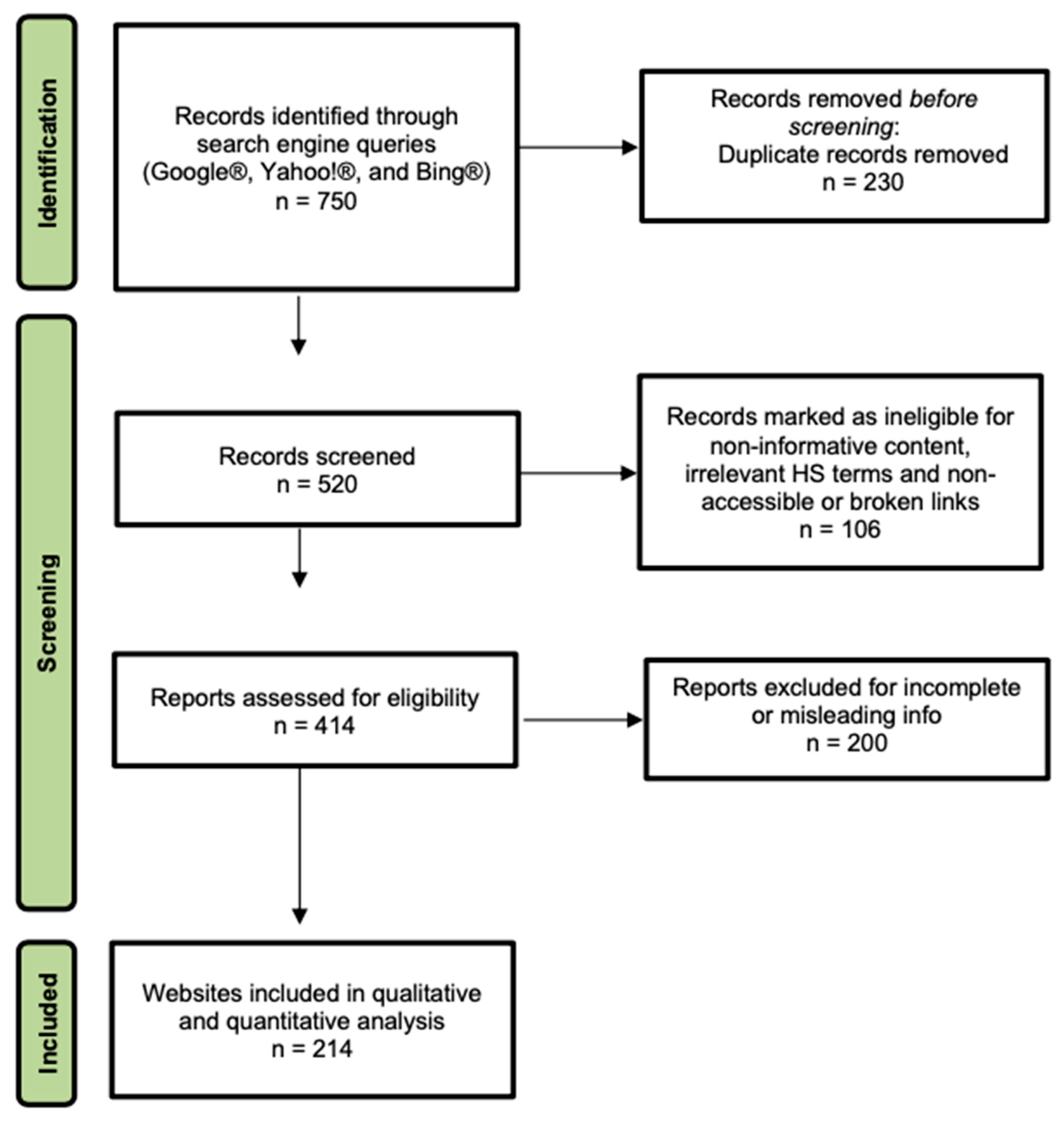

| Search Engine | Keywords Used | Initial Results Retrieved | Duplicates Removed | Eligible After Screening |
|---|---|---|---|---|
| 5 keywords | 250 | 91 | 159 | |
| Yahoo! | 5 keywords | 250 | 77 | 173 |
| Bing | 5 keywords | 250 | 62 | 188 |
| Domain | Item Numbers | Description |
|---|---|---|
| Content | 1–18 | Covers pathology, treatment options, benefits and risks. |
| Identification Data | 19–24 | Assesses authorship, institutional source, and date of publication. |
| Structure | 25–36 | Evaluates readability, navigation, and format accessibility for patients. |
| Question | Yes (%) | No (%) |
|---|---|---|
| Content | ||
| 206 (96.26%) | 8 (3.74%) |
| 205 (95.79%) | 9 (4.21%) |
| 206 (96.26%) | 8 (3.74%) |
| 180 (84.11%) | 34 (15.89%) |
| 95 (44.39%) | 119 (55.61%) |
| 88 (41.12%) | 126 (58.88%) |
| 130 (60.75%) | 84 (39.25%) |
| 40 (18.69%) | 174 (81.31%) |
| 8 (3.74%) | 206 (96.26%) |
| 7 (3.27%) | 207 (96.73%) |
| 79 (36.92%) | 135 (63.08%) |
| 82 (38.32%) | 132 (61.68%) |
| 85 (39.72%) | 129 (60.28%) |
| 150 (70.09%) | 64 (29.91%) |
| 20 (9.35%) | 194 (90.65%) |
| 110 (51.40%) | 104 (48.60%) |
| 115 (53.74%) | 99 (46.26%) |
| 60 (28.04%) | 154 (71.96%) |
| Identification Data | ||
| 80 (37.38%) | 134 (62.62%) |
| 170 (79.44%) | 44 (20.56%) |
| 120 (56.07%) | 94 (43.93%) |
| 18 (8.41%) | 196 (91.59%) |
| 40 (18.69%) | 174 (81.31%) |
| 10 (4.67%) | 204 (95.33%) |
| Structure | ||
| 214 (100%) | 0 (0%) |
| 190 (88.79%) | 24 (11.21%) |
| 200 (93.46%) | 14 (6.54%) |
| 150 (70.09%) | 64 (29.91%) |
| 210 (98.13%) | 4 (1.87%) |
| 210 (98.13%) | 4 (1.87%) |
| 160 (74.77%) | 54 (25.23%) |
| 190 (88.79%) | 24 (11.21%) |
| 200 (93.46%) | 14 (6.54%) |
| 100 (46.73%) | 114 (53.27%) |
| 10 (4.67%) | 204 (95.33%) |
| 5 (2.34%) | 209 (97.66%) |
| Category | High Score (≥23) | Low Score (<23) |
|---|---|---|
| Healthcare Portals | 18 | 47 |
| Practitioners | 7 | 26 |
| Hospitals | 25 | 75 |
| Professional Societies | 1 | 10 |
| Encyclopedias | 0 | 5 |
| Date of Publishing or Updating | High-Scoring Websites (n, %) | Mean Overall EQIP |
|---|---|---|
| Post-COVID-19 | 28 (54.9%) | 21.93 |
| Pre-COVID-19 | 8 (15.68%) | 21.75 |
| No data of publishing or updating | 15 (29.41%) | 19.04 |
Disclaimer/Publisher’s Note: The statements, opinions and data contained in all publications are solely those of the individual author(s) and contributor(s) and not of MDPI and/or the editor(s). MDPI and/or the editor(s) disclaim responsibility for any injury to people or property resulting from any ideas, methods, instructions or products referred to in the content. |
© 2025 by the authors. Licensee MDPI, Basel, Switzerland. This article is an open access article distributed under the terms and conditions of the Creative Commons Attribution (CC BY) license (https://creativecommons.org/licenses/by/4.0/).
Share and Cite
Marcasciano, M.; Astolfi, M.; Pintaudi, M.; Vittori, E.; D’Amico, G.A.; Pagnotta, A.; Bennardo, L.; Colonna, M.R.; Nisticò, S.P.; Greco, M. Quality of Online Patient Information on Surgical Management of Hidradenitis Suppurativa: A Comprehensive Assessment Using the mEQIP Tool. J. Clin. Med. 2025, 14, 7990. https://doi.org/10.3390/jcm14227990
Marcasciano M, Astolfi M, Pintaudi M, Vittori E, D’Amico GA, Pagnotta A, Bennardo L, Colonna MR, Nisticò SP, Greco M. Quality of Online Patient Information on Surgical Management of Hidradenitis Suppurativa: A Comprehensive Assessment Using the mEQIP Tool. Journal of Clinical Medicine. 2025; 14(22):7990. https://doi.org/10.3390/jcm14227990
Chicago/Turabian StyleMarcasciano, Marco, Martina Astolfi, Medea Pintaudi, Emanuele Vittori, Giuseppe Antonio D’Amico, Alessia Pagnotta, Luigi Bennardo, Michele Rosario Colonna, Steven Paul Nisticò, and Manfredi Greco. 2025. "Quality of Online Patient Information on Surgical Management of Hidradenitis Suppurativa: A Comprehensive Assessment Using the mEQIP Tool" Journal of Clinical Medicine 14, no. 22: 7990. https://doi.org/10.3390/jcm14227990
APA StyleMarcasciano, M., Astolfi, M., Pintaudi, M., Vittori, E., D’Amico, G. A., Pagnotta, A., Bennardo, L., Colonna, M. R., Nisticò, S. P., & Greco, M. (2025). Quality of Online Patient Information on Surgical Management of Hidradenitis Suppurativa: A Comprehensive Assessment Using the mEQIP Tool. Journal of Clinical Medicine, 14(22), 7990. https://doi.org/10.3390/jcm14227990

