CRT-D or CRT-P: When There Is a Dilemma and How to Solve It

 , ,
, ,  , , , ,
  , , , , , , and
Abstract
1. Introduction
2. Clinical Effectiveness of CRT
3. CRT Indications
4. CRT-D or CRT-P
5. Our Two-Step Approach
6. CRT Non-Responders
7. Role of Conduction System Pacing
8. Conclusions
Author Contributions
Funding
Conflicts of Interest
Abbreviations
| CRT | Cardiac resynchronization therapy |
| RCTs | Randomized clinical trials |
| LVEF | Left ventricular ejection fraction |
| LBBB | Left bundle branch block |
| AF | Atrial fibrillation |
| RV | Right ventricular |
| OGMT | Optimal guideline-directed medical therapy |
| PVS | Programmed ventricular stimulation |
| NIRFs | Non-invasive risk factors |
| NIPS | Non-invasive programmed stimulation |
| EP | Electrophysiology |
| SCD | Sudden cardiac death |
| SMVT | Sustained monomorphic ventricular tachycardia |
| CSP | Conduction system pacing |
| HBP | His bundle pacing |
| LBBAP | Left bundle branch area pacing |
| CMR | Cardiac magnetic resonance |
| NICM | Non-ischemic cardiomyopathy |
| ICM | Ischemic cardiomyopathy |
| LGE | Late gadolinium enhancement |
| DCM | Dilated cardiomyopathy |
References
- Conrad, N.; Judge, A.; Tran, J.; Mohseni, H.; Hedgecott, D.; Crespillo, A.P.; Allison, M.; Hemingway, H.; Cleland, J.G.; McMurray, J.J.V.; et al. Temporal trends and patterns in heart failure incidence: A population-based study of 4 million individuals. Lancet 2018, 391, 572–580. [Google Scholar] [CrossRef] [Scilit] [PubMed]
- Dunlay, S.M.; Weston, S.A.; Jacobsen, S.J.; Roger, V.L. Risk Factors for Heart Failure: A Population-Based Case-Control Study. Am. J. Med. 2009, 122, 1023–1028. [Google Scholar] [CrossRef] [Scilit] [PubMed]
- Virani, S.S.; Alonso, A.; Benjamin, E.J.; Bittencourt, M.S.; Callaway, C.W.; Carson, A.P.; Chamberlain, A.M.; Chang, A.R.; Cheng, S.; Delling, F.N.; et al. Heart Disease and Stroke Statistics—2020 Update: A Report from the American Heart Association. Circulation 2020, 141, e139–e596. [Google Scholar] [CrossRef] [Scilit] [PubMed]
- Leclercq, C.; Hare, J.M. Ventricular resynchronization: Current state of the art. Circulation 2004, 109, 296–299. [Google Scholar] [CrossRef] [Scilit]
- Leclercq, C.; Kass, D.A. Retiming the failing heart: Principles and current clinical status of cardiac resynchronization. J. Am. Coll. Cardiol. 2002, 39, 194–201. [Google Scholar] [CrossRef] [Scilit]
- Lund, L.H.; Jurga, J.; Edner, M.; Benson, L.; Dahlström, U.; Linde, C.; Alehagen, U. Prevalence, correlates, and prognostic significance of QRS prolongation in heart failure with reduced and preserved ejection fraction. Eur. Heart J. 2012, 34, 529–539. [Google Scholar] [CrossRef] [Scilit]
- Shamim, W.; Francis, D.P.; Yousufuddin, M.; Varney, S.; Pieopli, M.F.; Anker, S.D.; Coats, A.J. Intraventricular conduction delay: A prognostic marker in chronic heart failure. Int. J. Cardiol. 1999, 70, 171–178. [Google Scholar] [CrossRef] [Scilit]
- Cleland, J.G.; Daubert, J.C.; Erdmann, E.; Freemantle, N.; Gras, D.; Kappenberger, L.; Tavazzi, L. The effect of cardiac resynchro-nization on morbidity and mortality in heart failure. N. Engl. J. Med. 2005, 352, 1539–1549. [Google Scholar] [CrossRef] [Scilit]
- Bristow, M.R.; Saxon, L.A.; Boehmer, J.; Krueger, S.; Kass, D.A.; De Marco, T.; Carson, P.; DiCarlo, L.; DeMets, D.; White, B.G.; et al. Cardiac-Resynchronization Therapy with or without an Implantable Defibrillator in Advanced Chronic Heart Failure. N. Engl. J. Med. 2004, 350, 2140–2150. [Google Scholar] [CrossRef] [Scilit] [PubMed]
- Moss, A.J.; Hall, W.J.; Cannom, D.S.; Klein, H.; Brown, M.W.; Daubert, J.P.; Estes, N.A.M., III; Foster, E.; Greenberg, H.; Higgins, S.L.; et al. Cardiac-Resynchronization Therapy for the Prevention of Heart-Failure Events. N. Engl. J. Med. 2009, 361, 1329–1338. [Google Scholar] [CrossRef] [Scilit]
- Tang, A.S.; Wells, G.A.; Talajic, M.; Arnold, M.O.; Sheldon, R.; Connolly, S.; Hohnloser, S.H.; Nichol, G.; Birnie, D.H.; Sapp, J.L.; et al. Cardiac-Resynchronization Therapy for Mild-to-Moderate Heart Failure. N. Engl. J. Med. 2010, 363, 2385–2395. [Google Scholar] [CrossRef] [Scilit]
- Leyva, F.; Zegard, A.; Patel, P.; Stegemann, B.; Marshall, H.; Ludman, P.; de Bono, J.; Boriani, G.; Qiu, T. Improved prognosis after cardiac resyn-chronization therapy over a decade. Europace 2023, 25, euad141. [Google Scholar] [CrossRef] [Scilit]
- Abraham, W.T.; Fisher, W.G.; Smith, A.L.; Delurgio, D.B.; Leon, A.R.; Loh, E.; Kocovic, D.Z.; Packer, M.; Clavell, A.L.; Hayes, D.L.; et al. Cardiac resynchronization in chronic heart failure. N. Engl. J. Med. 2002, 346, 1845–1853. [Google Scholar] [CrossRef] [Scilit] [PubMed]
- Linde, C.; Abraham, W.T.; Gold, M.R.; John Sutton, M.; Ghio, S.; Daubert, C.; REVERSE Study Group. Randomized trial of cardiac resynchronization in mildly symptomatic heart failure patients and in asymptomatic patients with left ventricular dysfunction and previous heart failure symptoms. J. Am. Coll. Cardiol. 2008, 52, 1834–1843. [Google Scholar] [PubMed]
- Cleland, J.; Daubert, J.; Erdmann, E.; Freemantle, N.; Gras, D.; Kappenberger, L.; Klein, W.; Tavazzi, L. The CARE-HF study Steering Committee and Investigators The CARE-HF study (CArdiac REsynchronisation in Heart Failure study): Rationale, design and end-points. Eur. J. Heart Fail. 2001, 3, 481–489. [Google Scholar] [CrossRef] [Scilit] [PubMed]
- Cleland, J.G.; Freemantle, N.; Erdmann, E.; Gras, D.; Kappenberger, L.; Tavazzi, L.; Daubert, J. Long-term mortality with cardiac resynchronization therapy in the Cardiac Resynchronization-Heart Failure (CARE-HF) trial. Eur. J. Heart Fail. 2012, 14, 628–634. [Google Scholar] [CrossRef] [Scilit]
- Auricchio, A.; Stellbrink, C.; Sack, S.; Block, M.; Vogt, J.; Bakker, P.; Mortensen, P.; Klein, H.; PATH-CHF Study Group. The Pacing Therapies for Congestive Heart Fail-ure (PATH-CHF) study: Rationale, design, and endpoints of a prospective randomized multicenter study. Am. J. Cardiol. 1999, 83, 130D–135D. [Google Scholar] [CrossRef] [Scilit]
- Cazeau, S.; Leclercq, C.; Lavergne, T.; Walker, S.; Varma, C.; Linde, C.; Garrigue, S.; Kappenberger, L.; Haywood, G.A.; Santini, M.; et al. Effects of Multisite Biventricular Pacing in Patients with Heart Failure and Intraventricular Conduction Delay. N. Engl. J. Med. 2001, 344, 873–880. [Google Scholar] [CrossRef] [Scilit]
- Young, J.B.; Abraham, W.T.; Smith, A.L.; Leon, A.R.; Lieberman, R.; Wilkoff, B.; Canby, R.C.; Schroeder, J.S.; Liem, L.B.; Hall, S.; et al. Combined cardiac resynchronization and implantable cardioversion defibrillation in advanced chronic heart failure: The MIRACLE ICD Trial. JAMA 2003, 289, 2685–2694. [Google Scholar] [CrossRef] [Scilit]
- Higgins, S.L.; Hummel, J.D.; Niazi, I.K.; Giudici, M.C.; Worley, S.J.; Saxon, L.A.; Boehmer, J.P.; Higginbotham, M.B.; De Marco, T.; Foster, E.; et al. Cardiac resynchronization therapy for the treatment of heart failure in patients with intraventricular conduction delay and malignant ventricular tachyarrhythmias. J. Am. Coll. Cardiol. 2003, 42, 1454–1459. [Google Scholar] [CrossRef] [Scilit]
- Kindermann, M.; Hennen, B.; Jung, J.; Geisel, J.; Böhm, M.; Fröhlig, G. Biventricular versus conventional right ventricular stimulation for patients with standard pacing indication and left ventricular dysfunction: The Homburg Biventricular Pacing Evaluation (HOBIPACE). J. Am. Coll. Cardiol. 2006, 47, 1927–1937. [Google Scholar] [CrossRef] [Scilit]
- Hadwiger, M.; Dagres, N.; Haug, J.; Wolf, M.; Marschall, U.; Tijssen, J.; Katalinic, A.; Frielitz, F.S.; Hindricks, G. Survival of patients undergoing cardiac resynchronization therapy with or without defibrillator: The RESET-CRT project. Eur. Heart J. 2022, 43, 2591–2599. [Google Scholar] [CrossRef] [Scilit] [PubMed]
- Glikson, M.; Nielsen, J.C.; Kronborg, M.B.; Michowitz, Y.; Auricchio, A.; Barbash, I.M.; Barrabés, J.A.; Boriani, G.; Braunschweig, F.; Brignole, M.; et al. 2021 ESC Guidelines on cardiac pacing and cardiac resynchronization therapy. Eur. Heart J. 2021, 42, 3427–3520. [Google Scholar] [CrossRef] [Scilit] [PubMed]
- Merkely, B.; Hatala, R.; Wranicz, J.K.; Duray, G.; Földesi, C.; Som, Z.; Németh, M.; Goscinska-Bis, K.; Gellér, L.; Zima, E.; et al. Upgrade of right ventricular pacing to cardiac resynchronization therapy in heart failure: A randomized trial. Eur. Heart J. 2023, 44, 4259–4269. [Google Scholar] [CrossRef] [Scilit] [PubMed]
- Sideris, S.; Poulidakis, E.; Aggeli, C.; Gatzoulis, K.; Vlaseros, I.; Dilaveris, P.; Sotiropoulos, I.; Papoutis, D.; Xristakopoulos, S.; Manakos, K.; et al. Upgrading pacemaker to cardiac resynchronization therapy: An option for patients with chronic right ventricular pacing and heart failure. Hell. J. Cardiol. 2014, 55, 17–23. [Google Scholar]
- Sridhar, A.R.M.; Yarlagadda, V.; Parasa, S.; Reddy, Y.M.; Patel, D.; Lakkireddy, D.; Wilkoff, B.L.; Dawn, B. Cardiac Resynchronization Therapy: US Trends and Disparities in Utilization and Outcomes. Circ. Arrhythm. Electrophysiol. 2016, 9, e003108. [Google Scholar] [CrossRef] [Scilit]
- Yokoshiki, H.; Shimizu, A.; Mitsuhashi, T.; Furushima, H.; Sekiguchi, Y.; Manaka, T.; Nishii, N.; Ueyama, T.; Morita, N.; Nitta, T.; et al. Trends and determinant factors in the use of cardiac resynchronization therapy devices in Japan: Analysis of the Japan cardiac device treatment registry database. J. Arrhythmia 2016, 32, 486–490. [Google Scholar] [CrossRef] [Scilit]
- Banks, H.; Torbica, A.; Valzania, C.; Varabyova, Y.; Rupel, V.P.; Taylor, R.S.; Hunger, T.; Walker, S.; Boriani, G.; Fattore, G.; et al. Five year trends (2008–2012) in cardiac implantable electrical device utilization in five European nations: A case study in cross-country comparisons using administrative databases. Europace 2017, 20, 643–653. [Google Scholar] [CrossRef] [Scilit]
- Woods, B.; Hawkins, N.; Mealing, S.; Sutton, A.; Abraham, W.T.; Beshai, J.F.; Klein, H.; Sculpher, M.; Plummer, C.J.; Cowie, M.R. Individual patient data network meta-analysis of mortality effects of implantable cardiac devices. Heart 2015, 101, 1800–1806. [Google Scholar] [CrossRef] [Scilit]
- Liang, Y.; Wang, J.; Yu, Z.; Zhang, M.; Pan, L.; Nie, Y.; Su, Y.; Ge, J. Comparison between cardiac resynchronization therapy with and without defibrillator on long-term mortality: A propensity score matched analysis. J. Cardiol. 2020, 75, 432–438. [Google Scholar] [CrossRef] [Scilit]
- Veres, B.; Fehérvári, P.; Engh, M.A.; Hegyi, P.; Gharehdaghi, S.; Zima, E.; Duray, G.; Merkely, B.; Kosztin, A. Time-trend treatment effect of cardiac resynchronization therapy with or without defibrillator on mortality: A systematic review and meta-analysis. Europace 2023, 25, euad289. [Google Scholar] [CrossRef] [Scilit]
- Patel, D.; Kumar, A.; Black-Maier, E.; Morgan, R.L.; Trulock, K.; Wilner, B.; Nemer, D.; Donnellan, E.; Tarakji, K.G.; Cantillon, D.J.; et al. Cardiac Resynchronization Therapy With or Without Defibrillation in Patients with Nonischemic Cardiomyopathy: A Systematic Review and Meta-Analysis. Circ. Arrhythmia Electrophysiol. 2021, 14, e008991. [Google Scholar] [CrossRef] [Scilit]
- Køber, L.; Thune, J.J.; Nielsen, J.C.; Haarbo, J.; Videbæk, L.; Korup, E.; Jensen, G.; Hildebrandt, P.; Steffensen, F.H.; Bruun, N.E.; et al. Defibrillator Implantation in Patients with Nonischemic Systolic Heart Failure. N. Engl. J. Med. 2016, 375, 1221–1230. [Google Scholar] [CrossRef] [Scilit] [PubMed]
- Kutyifa, V.; Geller, L.; Bogyi, P.; Zima, E.; Aktas, M.K.; Ozcan, E.E.; Becker, D.; Nagy, V.K.; Kosztin, A.; Szilagyi, S.; et al. Effect of cardiac resynchronization therapy with implantable cardioverter defibrillator versus cardiac resynchronization therapy with pacemaker on mortality in heart failure patients: Results of a high-volume, single-centre experience. Eur. J. Heart Fail. 2014, 16, 1323–1330. [Google Scholar] [CrossRef] [Scilit] [PubMed]
- Barra, S.; Boveda, S.; Providência, R.; Sadoul, N.; Duehmke, R.; Reitan, C.; Borgquist, R.; Narayanan, K.; Hidden-Lucet, F.; Klug, D.; et al. Adding Defibrillation Therapy to Cardi-ac Resynchronization on the Basis of the Myocardial Substrate. J. Am. Coll. Cardiol. 2017, 69, 1669–1678. [Google Scholar] [CrossRef] [Scilit] [PubMed]
- Al-Sadawi, M.; Aslam, F.; Tao, M.; Salam, S.; Alsaiqali, M.; Singh, A.; Fan, R.; Rashba, E.J. Is CRT-D superior to CRT-P in patients with nonischemic cardiomyopathy? Int. J. Arrhythmia 2023, 24, 3. [Google Scholar] [CrossRef] [Scilit]
- Cleland, J.G.; Daubert, J.-C.; Erdmann, E.; Freemantle, N.; Gras, D.; Kappenberger, L.; Tavazzi, L.; The CARE-HF Study Investigators. Longer-term effects of cardiac resynchronization therapy on mortality in heart failure [the CArdiac REsynchronization-Heart Failure (CARE-HF) trial extension phase]. Eur. Heart J. 2006, 27, 1928–1932. [Google Scholar] [CrossRef] [Scilit]
- Gold, M.R.; Daubert, J.C.; Abraham, W.T.; Hassager, C.; Dinerman, J.L.; Hudnall, J.H.; Cerkvenik, J.; Linde, C. Implantable defibrillators im-prove survival in patients with mildly symptomatic heart failure receiving cardiac resynchronization therapy: Analysis of the long-term follow-up of remodeling in systolic left ventricular dysfunction (REVERSE). Circ. Arrhythm. Electro-physiol. 2013, 6, 1163–1168. [Google Scholar] [CrossRef] [Scilit]
- Gold, M.R.; Linde, C.; Abraham, W.T.; Gardiwal, A.; Daubert, J.-C. The impact of cardiac resynchronization therapy on the incidence of ventricular arrhythmias in mild heart failure. Heart Rhythm. 2011, 8, 679–684. [Google Scholar] [CrossRef] [Scilit]
- García-Lunar, I.; Castro-Urda, V.; Toquero-Ramos, J.; Mingo-Santos, S.; Moñivas-Palomero, V.; Mitroi, C.D.; Sánchez-García, M.; Pérez-Pereira, E.; Delgado, H.E.; Fernández-Lozano, I. Ventricular Arrhythmias in Super-responders to Cardiac Resynchronization Therapy. Rev. Esp. Cardiol. 2014, 67, 883–889. [Google Scholar] [CrossRef] [Scilit]
- Fang, F.; Yu, C.-M. Shall CRT-D be downgraded to CRT-P in super-responders of cardiac resynchronization therapy? Rev. Esp. Cardiol. 2014, 67, 875–877. [Google Scholar] [CrossRef] [Scilit]
- Gatzoulis, K.A.; Tsiachris, D.; Arsenos, P.; Antoniou, C.-K.; Dilaveris, P.; Sideris, S.; Kanoupakis, E.; Simantirakis, E.; Korantzopoulos, P.; Goudevenos, I.; et al. Arrhythmic risk stratification in post-myocardial infarction patients with preserved ejection fraction: The PRESERVE EF study. Eur. Heart J. 2019, 40, 2940–2949. [Google Scholar] [CrossRef] [Scilit]
- Steffel, J.; Milosevic, G.; Hurlimann, A.; Krasniqi, N.; Namdar, M.; Ruschitzka, F.; Luscher, T.F.; Duru, F.; Holzmeister, J.; Hurlimann, D. Characteristics and long-term outcome of echocardiographic super-responders to cardiac resynchronisation therapy: ‘real world’ experience from a single tertiary care centre. Heart 2011, 97, 1668–1674. [Google Scholar] [CrossRef] [Scilit]
- de Waard, D.; Manlucu, J.; Gillis, A.M.; Sapp, J.; Bernick, J.; Doucette, S.; Tang, A.; Wells, G.; Parkash, R. Cardiac Resynchronization in Women: A Substudy of the Resynchronization-Defibrillation for Ambulatory Heart Failure Trial. JACC Clin. Electrophysiol. 2019, 5, 1036–1044. [Google Scholar] [CrossRef] [Scilit] [PubMed]
- Zannad, F.; Ferreira, J.P.; Pocock, S.J.; Anker, S.D.; Butler, J.; Filippatos, G.; Brueckmann, M.; Ofstad, A.P.; Pfarr, E.; Jamal, W.; et al. SGLT2 inhibitors in patients with heart failure with reduced ejection fraction: A meta-analysis of the EMPEROR-Reduced and DAPA-HF trials. Lancet 2020, 396, 819–829. [Google Scholar] [CrossRef] [Scilit] [PubMed]
- Mcmurray, J.J.V.; Packer, M.; Desai, A.S.; Gong, J.; Lefkowitz, M.P.; Rizkala, A.R.; Rouleau, J.L.; Shi, V.C.; Solomon, S.D.; Swedberg, K.; et al. Angiotensin–Neprilysin Inhibition versus Enalapril in Heart Failure. PARADIGM-HF Investigators and Committees. N. Engl. J. Med. 2014, 371, 993–1004. [Google Scholar] [CrossRef] [Scilit] [PubMed]
- Pun, P.H.; Al-Khatib, S.M.; Han, J.Y.; Edwards, R.; Bardy, G.H.; Bigger, J.T.; Buxton, A.E.; Moss, A.J.; Lee, K.L.; Steinman, R.; et al. Implantable Cardioverter-Defibrillators for Primary Prevention of Sudden Cardiac Death in CKD: A Meta-analysis of Patient-Level Data From 3 Randomized Trials. Am. J. Kidney Dis. 2014, 64, 32–39. [Google Scholar] [CrossRef] [Scilit]
- Theuns, D.A.; Schaer, B.A.; Soliman, O.I.; Altmann, D.; Sticherling, C.; Geleijnse, M.L.; Osswald, S.; Jordaens, L. The prognosis of implantable defibrillator patients treated with cardiac resynchronization therapy: Comorbidity burden as predictor of mortality. Europace 2010, 13, 62–69. [Google Scholar] [CrossRef] [Scilit]
- Goldenberg, I.; Vyas, A.K.; Hall, W.J.; Moss, A.J.; Wang, H.; He, H.; Zareba, W.; McNitt, S.; Andrews, M.L.; MADIT-II Investigators. Risk Stratification for Primary Implantation of a Cardioverter-Defibrillator in Patients With Ischemic Left Ventricular Dysfunction. J. Am. Coll. Cardiol. 2008, 51, 288–296. [Google Scholar] [CrossRef] [Scilit]
- Leyva, F.; Zegard, A.; Okafor, O.; de Bono, J.; McNulty, D.; Ahmed, A.; Marshall, H.; Ray, D.; Qiu, T. Survival after cardiac resynchronization therapy: Results from 50 084 implantations. Europace 2019, 21, 754–762. [Google Scholar] [CrossRef] [Scilit]
- Wang, Y.; Sharbaugh, M.S.; Althouse, A.D.; Mulukutla, S.; Saba, S. Cardiac resynchronization therapy pacemakers versus defibrillators in older non-ischemic cardiomyopathy patients. Indian Pacing Electrophysiol. J. 2019, 19, 4–6. [Google Scholar] [CrossRef] [Scilit]
- Döring, M.; Ebert, M.; Dagres, N.; Müssigbrodt, A.; Bode, K.; Knopp, H.; Kühl, M.; Hindricks, G.; Richter, S. Cardiac resynchronization therapy in the ageing population—With or without an implantable defibrillator? Int. J. Cardiol. 2018, 263, 48–53. [Google Scholar] [CrossRef] [Scilit] [PubMed]
- Acosta, J.; Fernández-Armenta, J.; Borràs, R.; Anguera, I.; Bisbal, F.; Martí-Almor, J.; Tolosana, J.M.; Penela, D.; Andreu, D.; Soto-Iglesias, D.; et al. Scar Characterization to Predict Life-Threatening Arrhythmic Events and Sudden Cardiac Death in Patients with Cardiac Resynchronization Therapy: The GAUDI-CRT Study. JACC Cardiovasc. Imaging 2018, 11, 561–572. [Google Scholar] [CrossRef] [Scilit] [PubMed]
- Leyva, F.; Zegard, A.; Acquaye, E.; Gubran, C.; Taylor, R.; Foley, P.W.; Umar, F.; Patel, K.; Panting, J.; Marshall, H.; et al. Outcomes of Cardiac Resynchronization Therapy with or Without Defibrillation in Patients with Nonischemic Cardiomyopathy. J. Am. Coll. Cardiol. 2017, 70, 1216–1227. [Google Scholar] [CrossRef] [Scilit] [PubMed]
- Barra, S.; Providência, R.; Boveda, S.; Duehmke, R.; Narayanan, K.; Chow, A.W.; Piot, O.; Klug, D.; Defaye, P.; Gras, D.; et al. Device complications with addition of defibrillation to cardiac resynchronisation therapy for primary prevention. Heart 2018, 104, 1529–1535. [Google Scholar] [CrossRef] [Scilit]
- Doran, B.; Mei, C.; Varosy, P.D.; Kao, D.P.; Saxon, L.A.; Feldman, A.M.; DeMets, D.; Bristow, M.R. The Addition of a Defibrillator to Resynchronization Therapy Decreases Mortality in Patients With Nonischemic Cardiomyopathy. JACC Heart Fail. 2021, 9, 439–449. [Google Scholar] [CrossRef] [Scilit]
- Morani, G.; Gasparini, M.; Zanon, F.; Casali, E.; Spotti, A.; Reggiani, A.; Bertaglia, E.; Solimene, F.; Molon, G.; Accogli, M.; et al. Cardiac resynchronization therapy-defibrillator improves long-term survival compared with cardiac resynchronization therapy-pacemaker in patients with a class IA indication for cardiac resynchronization therapy: Data from the Contak Italian Registry. Europace 2013, 15, 1273–1279. [Google Scholar] [CrossRef] [Scilit]
- Looi, K.-L.; Gajendragadkar, P.R.; Khan, F.Z.; Elsik, M.; Begley, D.A.; Fynn, S.P.; Grace, A.A.; Heck, P.M.; Virdee, M.; Agarwal, S. Cardiac resynchronisation therapy: Pacemaker versus internal cardioverter-defibrillator in patients with impaired left ventricular function. Heart 2014, 100, 794–799. [Google Scholar] [CrossRef] [Scilit]
- Gold, M.R.; Padhiar, A.; Mealing, S.; Sidhu, M.K.; Tsintzos, S.I.; Abraham, W.T. Long-Term Extrapolation of Clinical Benefits Among Patients With Mild Heart Failure Receiving Cardiac Resynchronization Therapy: Analysis of the 5-Year Follow-Up From the REVERSE Study. JACC Heart Fail. 2015, 3, 691–700. [Google Scholar] [CrossRef] [Scilit]
- Marijon, E.; Leclercq, C.; Narayanan, K.; Boveda, S.; Klug, D.; Lacaze-Gadonneix, J.; Defaye, P.; Jacob, S.; Piot, O.; Deharo, J.-C.; et al. Causes-of-death analysis of patients with cardiac resynchronization therapy: An analysis of the CeRtiTuDe cohort study. Eur. Heart J. 2015, 36, 2767–2776. [Google Scholar] [CrossRef] [Scilit]
- Reitan, C.; Chaudhry, U.; Bakos, Z.; Brandt, J.; Wang, L.; Platonov, P.G.; Borgquist, R. Long-Term Results of Cardiac Resynchronization Therapy: A Comparison between CRT-Pacemakers versus Primary Prophylactic CRT-Defibrillators. Pacing Clin. Electrophysiol. 2015, 38, 758–767. [Google Scholar] [CrossRef] [Scilit]
- Munir, M.B.; Althouse, A.D.; Rijal, S.; Shah, M.B.; Abu Daya, H.; Adelstein, E.; Saba, S. Clinical Characteristics and Outcomes of Older Cardiac Resynchronization Therapy Recipients Using a Pacemaker versus a Defibrillator. J. Cardiovasc. Electrophysiol. 2016, 27, 730–734. [Google Scholar] [CrossRef] [Scilit] [PubMed]
- Witt, C.T.; Kronborg, M.B.; Nohr, E.A.; Mortensen, P.T.; Gerdes, C.; Jensen, H.K.; Nielsen, J.C. Adding the implantable cardioverter-defibrillator to cardiac resynchronization therapy is associated with improved long-term survival in ischaemic, but not in non-ischaemic cardiomyopathy. Europace 2016, 18, 413–419. [Google Scholar] [CrossRef] [Scilit] [PubMed]
- Drozd, M.; Gierula, J.; Lowry, J.E.; Paton, M.F.; Joy, E.; Jamil, H.A.; Cubbon, R.M.; Kearney, M.T.; Cairns, D.A.; Witte, K.K. Cardiac resynchronization therapy outcomes in patients with chronic heart failure: Cardiac resynchronization therapy with pacemaker versus cardiac resynchronization therapy with defibrillator. J. Cardiovasc. Med. 2017, 18, 962–967. [Google Scholar] [CrossRef] [Scilit] [PubMed]
- Laish-Farkash, A.; Bruoha, S.; Katz, A.; Goldenberg, I.; Suleiman, M.; Michowitz, Y.; Shlomo, N.; Einhorn-Cohen, M.; Khalameizer, V. Morbidity and mortality with cardiac resynchronization therapy with pacing vs. with defibrillation in octogenarian patients in a real-world setting. Europace 2017, 19, 1357–1363. [Google Scholar] [CrossRef] [Scilit]
- Martens, P.; Verbrugge, F.H.; Nijst, P.; Dupont, M.; Nuyens, D.; Herendael, H.V.; Rivero-Ayerza, M.; Tang, W.H.; Mullens, W. Incremental benefit of cardiac resynchronisation therapy with versus without a defibrillator. Heart 2017, 103, 1977–1984. [Google Scholar] [CrossRef] [Scilit]
- Yokoshiki, H.; Shimizu, A.; Mitsuhashi, T.; Furushima, H.; Sekiguchi, Y.; Manaka, T.; Nishii, N.; Ueyama, T.; Morita, N.; Okamura, H.; et al. Survival and Heart Failure Hospitalization in Patients With Cardiac Resynchronization Therapy With or Without a Defibrillator for Primary Prevention in Japan—Analysis of the Japan Cardiac Device Treatment Registry Database. Circ. J. 2017, 81, 1798–1806. [Google Scholar] [CrossRef] [Scilit]
- Leyva, F.; Zegard, A.; Umar, F.; Taylor, R.J.; Acquaye, E.; Gubran, C.; Chalil, S.; Patel, K.; Panting, J.; Marshall, H.; et al. Long-term clinical outcomes of cardiac resynchronization therapy with or without defibrillation: Impact of the aetiology of cardiomyopathy. Europace 2018, 20, 1804–1812. [Google Scholar] [CrossRef] [Scilit]
- Saba, S.; McLaughlin, T.; He, M.; Althouse, A.; Mulukutla, S.; Hernandez, I. Cardiac resynchronization therapy using pacemakers vs defibrillators in patients with nonischemic cardiomyopathy: The United States experience from 2007 to 2014. Heart Rhythm. 2019, 16, 1065–1071. [Google Scholar] [CrossRef] [Scilit] [PubMed]
- Barra, S.; Duehmke, R.; Providência, R.; Narayanan, K.; Reitan, C.; Roubicek, T.; Polasek, R.; Chow, A.; Defaye, P.; Fauchier, L.; et al. Very long-term survival and late sudden cardiac death in cardiac resynchronization therapy patients. Eur. Heart J. 2019, 40, 2121–2127. [Google Scholar] [CrossRef] [Scilit]
- Gras, M.; Bisson, A.; Bodin, A.; Herbert, J.; Babuty, D.; Pierre, B.; Clementy, N.; Fauchier, L. Mortality and cardiac resynchronization therapy with or without defibrillation in primary prevention. Europace 2020, 22, 1224–1233. [Google Scholar] [CrossRef] [Scilit]
- Huang, W.; Wu, S.; Vijayaraman, P.; Su, L.; Chen, X.; Cai, B.; Zou, J.; Lan, R.; Fu, G.; Mao, G.; et al. Cardiac Resynchronization Therapy in Patients With Nonischemic Cardiomyopathy Using Left Bundle Branch Pacing. JACC Clin. Electrophysiol. 2020, 6, 849–858. [Google Scholar] [CrossRef] [Scilit] [PubMed]
- Schrage, B.; Lund, L.H.; Melin, M.; Benson, L.; Uijl, A.; Dahlström, U.; Braunschweig, F.; Linde, C.; Savarese, G. Cardiac resynchronization therapy with or without defibrillator in patients with heart failure. Europace 2022, 24, 48–57. [Google Scholar] [CrossRef] [Scilit] [PubMed]
- Farouq, M.; Rorsman, C.; Marinko, S.; Mörtsell, D.; Chaudhry, U.; Wang, L.; Platonov, P.G.; Borgquist, R. Age-stratified comparison of prognosis in cardiac resynchronization therapy with or without prophylactic defibrillator for nonischemic cardiomyopathy-a nationwide cohort study. Europace 2023, 25, euad187. [Google Scholar] [CrossRef] [Scilit] [PubMed]
- Liu, F.; Gao, X.; Luo, J. An updated meta-analysis of cardiac resynchronization therapy with or without defibrillation in patients with nonischemic cardiomyopathy. Front. Cardiovasc. Med. 2023, 10, 1078570. [Google Scholar] [CrossRef] [Scilit]
- Devesa Neto, V.; Costa, G.; Santos, L.F.; Costa, A.; Teixeira, R.; Goncalves, L. Systematic review and meta-analysis comparing cardiac resynchronization therapy with versus without defibrillation in patients with non-ischemic cardiomyopathy. Europace 2024, 26, euae102.488. [Google Scholar] [CrossRef] [Scilit]
- Gatzoulis, K.A.; Arsenos, P.; Trachanas, K.; Dilaveris, P.; Antoniou, C.; Tsiachris, D.; Sideris, S.; Kolettis, T.M.; Tousoulis, D. Signal-averaged electrocardiography: Past, present. Signal-averaged electrocardiography: Past, present, and future. J. Arrhythm. 2018, 34, 222–229. [Google Scholar] [CrossRef] [Scilit]
- Milaras, N.; Dourvas, P.; Doundoulakis, I.; Sotiriou, Z.; Nevras, V.; Xintarakou, A.; Laina, A.; Soulaidopoulos, S.; Zachos, P.; Kordalis, A.; et al. Noninvasive electrocardiographic risk factors for sudden cardiac death in dilated ca rdiomyopathy: Is ambulatory electrocardiography still relevant? Heart Fail. Rev. 2023, 28, 865–878. [Google Scholar] [CrossRef] [Scilit]
- Stecker, E.C.; Vickers, C.; Waltz, J.; Socoteanu, C.; John, B.T.; Mariani, R.; McAnulty, J.H.; Gunson, K.; Jui, J.; Chugh, S.S. Population-based analysis of sudden cardiac death with and without left ventricular systolic dysfunction: Two-year findings from the Oregon Sudden Unexpected Death Study. J. Am. Coll. Cardiol. 2006, 47, 1161–1166. [Google Scholar] [CrossRef] [Scilit]
- Gorgels, A.P.; Gijsbers, C.; de Vreede-Swagemakers, J.; Lousberg, A.; Wellens, H.J. Out-of-hospital cardiac arrest-the relevance of heart failure. The Maastricht Circulatory Arrest Registry. Eur. Heart J. 2003, 24, 1204–1209. [Google Scholar] [CrossRef] [Scilit]
- Gatzoulis, K.A.; Dilaveris, P.; Arsenos, P.; Tsiachris, D.; Antoniou, C.-K.; Sideris, S.; Kolettis, T.; Kanoupakis, E.; Sideris, A.; Flevari, P.; et al. Arrhythmic risk stratification in nonischemic dilated cardiomyopathy: The ReCONSIDER study design—A two-step, multifactorial, electrophysiology-inclusive approach. Hell. J. Cardiol. 2021, 62, 169–172. [Google Scholar] [CrossRef] [Scilit]
- Laina, A.; Gatzoulis, K.; Soulaidopoulos, S.; Arsenos, P.; Doundoulakis, I.; Tsiachris, D.; Sideris, S.; Kordalis, A.; Tousoulis, D.; Tsioufis, K. Time to reconsider risk stratification in dilated cardiomyopathy. Hell. J. Cardiol. 2021, 62, 392–393. [Google Scholar] [CrossRef] [Scilit]
- Doundoulakis, I.; Tsiachris, D.; Kordalis, A.; Soulaidopoulos, S.; Arsenos, P.; Xintarakou, A.; Koliastasis, L.; Vlachakis, P.K.; Tsioufis, K.; Gatzoulis, K.A. Management of Patients with Unexplained Syncope and Bundle Branch Block: Predictive Factors of Recurrent Syncope. Cureus 2023, 15, e35827. [Google Scholar] [CrossRef] [Scilit]
- Demir, E.; Köse, M.R.; Şimşek, E.; Orman, M.N.; Zoghi, M.; Gürgün, C.; Nalbantgil, S. Comparative analysis of implantable cardioverter-defibrillator efficacy in ischemic and non-ischemic cardiomyopathy in patients with heart failure. Sci. Rep. 2025, 15, 24631. [Google Scholar] [CrossRef] [Scilit]
- Frontera, A.; Prolic Kalinsek, T.; Hadjis, A.; Della Bella, P. Noninvasive programmed stimulation in the setting of ven-tricular tachycardia catheter ablation. J. Cardiovasc. Electrophysiol. 2020, 31, 1828–1835. [Google Scholar] [CrossRef] [Scilit] [PubMed]
- Kariki, O.; Antoniou, C.-K.; Mavrogeni, S.; Gatzoulis, K.A. Updating the Risk Stratification for Sudden Cardiac Death in Cardiomyopathies: The Evolving Role of Cardiac Magnetic Resonance Imaging. An Approach for the Electrophysiologist. Diagnostics 2020, 10, 541. [Google Scholar] [CrossRef] [Scilit] [PubMed]
- Xintarakou, A.; Kariki, O.; Doundoulakis, I.; Arsenos, P.; Soulaidopoulos, S.; Laina, A.; Xydis, P.; Kordalis, A.; Nakas, N.; Theofilou, A.; et al. The Role of Genetics in Risk Stratification Strategy of Dilated Cardiomyopathy. Rev. Cardiovasc. Med. 2022, 23, 305. [Google Scholar] [CrossRef] [Scilit] [PubMed]
- Halliday, B.P.; Gulati, A.; Ali, A.; Guha, K.; Newsome, S.; Arzanauskaite, M.; Vassiliou, V.S.; Lota, A.; Izgi, C.; Tayal, U.; et al. Association Between Midwall Late Gadolinium Enhancement and Sudden Cardiac Death in Patients With Dilated Cardiomyopathy and Mild and Moderate Left Ventricular Systolic Dysfunction. Circulation 2017, 135, 2106–2115. [Google Scholar] [CrossRef] [Scilit]
- Keil, L.; Chevalier, C.; Kirchhof, P.; Blankenberg, S.; Lund, G.; Müllerleile, K.; Magnussen, C. CMR-Based Risk Stratification of Sudden Cardiac Death and Use of Implantable Cardioverter–Defibrillator in Non-Ischemic Cardiomyopathy. Int. J. Mol. Sci. 2021, 22, 7115. [Google Scholar] [CrossRef] [Scilit]
- Antonopoulos, A.S.; Xintarakou, A.; Protonotarios, A.; Lazaros, G.; Miliou, A.; Tsioufis, K.; Vlachopoulos, C. Imagenetics for Precision Medicine in Dilated Cardiomyopathy. Circ. Genom. Precis. Med. 2024, 17, e004301. [Google Scholar] [CrossRef] [Scilit]
- Arbelo, E.; Protonotarios, A.; Gimeno, J.R.; Arbustini, E.; Barriales-Villa, R.; Basso, C.; Bezzina, C.R.; Biagini, E.; Blom, N.A.; de Boer, R.A.; et al. 2023 ESC Guidelines for the management of cardiomyopathies. Eur. Heart J. 2023, 44, 3503–3626. [Google Scholar] [CrossRef] [Scilit]
- Gigli, M.; Merlo, M.; Graw, S.L.; Barbati, G.; Rowland, T.J.; Slavov, D.B.; Stolfo, D.; Haywood, M.E.; Ferro, M.D.; Altinier, A.; et al. Genetic Risk of Arrhythmic Phenotypes in Patients with Dilated Cardiomyopathy. J. Am. Coll. Cardiol. 2019, 74, 1480–1490. [Google Scholar] [CrossRef] [Scilit] [PubMed]
- Gasperetti, A.; Carrick, R.T.; Costa, S.; Compagnucci, P.; Bosman, L.P.; Chivulescu, M.; Tichnell, C.; Murray, B.; Tandri, H.; Tadros, R.; et al. Programmed Ventricular Stimulation as an Additional Primary Prevention Risk Stratification Tool in Arrhythmogenic Right Ventricular Cardiomyopathy: A Multinational Study. Circulation 2022, 146, 1434–1443. [Google Scholar] [CrossRef] [Scilit] [PubMed]
- Zeppenfeld, K.; Tfelt-Hansen, J.; de Riva, M.; Winkel, B.G.; Behr, E.R.; Blom, N.A.; Charron, P.; Corrado, D.; Dagres, N.; de Chillou, C.; et al. 2022 ESC Guidelines for the management of patients with ventricular arrhythmias and the prevention of sudden cardiac death. Eur. Heart J. 2022, 43, 3997–4126. [Google Scholar] [CrossRef] [Scilit] [PubMed]
- Trayanova, N.A.; Popescu, D.M.; Shade, J.K. Machine Learning in Arrhythmia and Electrophysiology. Circ. Res. 2021, 128, 544–566. [Google Scholar] [CrossRef] [Scilit]
- Ellenbogen, K.A.; Huizar, J.F. Foreseeing super-response to cardiac resynchronization therapy: A perspective for clini-cians. J. Am. Coll. Cardiol. 2012, 59, 2374–2377. [Google Scholar] [CrossRef] [Scilit]
- Daubert, C.; Behar, N.; Martins, R.P.; Mabo, P.; Leclercq, C. Avoiding non-responders to cardiac resynchronization therapy: A practical guide. Eur. Heart J. 2017, 38, 1463–1472. [Google Scholar] [CrossRef] [Scilit]
- Hummel, J.D.; Coppess, M.A.; Osborn, J.S.; Yee, R.; Fung, J.W.; Augostini, R.; Li, S.; Hine, D.; Singh, J.P. Real-World Assessment of Acute Left Ventricular Lead Implant Success and Complication Rates: Results from the Attain Success Clinical Trial. Pacing Clin. Electrophysiol. 2016, 39, 1246–1253. [Google Scholar] [CrossRef] [Scilit]
- Pujol-Lopez, M.; Jiménez-Arjona, R.; Garre, P.; Guasch, E.; Borràs, R.; Doltra, A.; Ferró, E.; García-Ribas, C.; Niebla, M.; Carro, E.; et al. Conduction System Pacing vs Biventricular Pacing in Heart Failure and Wide QRS Patients. JACC Clin. Electrophysiol. 2022, 8, 1431–1445. [Google Scholar] [CrossRef] [Scilit]
- Antoniou, C.-K.; Chrysohoou, C.; Manolakou, P.; Tsiachris, D.; Kordalis, A.; Tsioufis, K.; Gatzoulis, K.A. Multipoint Left Ventricular Pacing as Alternative Approach in Cases of Biventricular Pacing Failure. J. Clin. Med. 2025, 14, 1065. [Google Scholar] [CrossRef] [Scilit]
- Dilaveris, P.; Antoniou, C.-K.; Chrysohoou, C.; Xydis, P.; Konstantinou, K.; Manolakou, P.; Kordalis, A.; Gatzoulis, K.; Tsioufis, C. Comparative Trial of the Effects of Left Ventricular and Biventricular Pacing on Indices of Cardiac Function and Clinical Course of Patients with Heart Failure: Rationale and Design of the READAPT Randomized Trial. Angiology 2021, 72, 961–970. [Google Scholar] [CrossRef] [Scilit]
- Herweg, B.; Sharma, P.S.; Cano, Ó.; Ponnusamy, S.S.; Zanon, F.; Jastrzebski, M.; Zou, J.; Chelu, M.G.; Vernooy, K.; Whinnett, Z.I.; et al. Arrhythmic Risk in Biventricular Pacing Compared with Left Bundle Branch Area Pacing: Results From the I-CLAS Study. Circulation 2024, 149, 379–390. [Google Scholar] [CrossRef] [Scilit]
- Fish, J.M.; Brugada, J.; Antzelevitch, C. Potential Proarrhythmic Effects of Biventricular Pacing. J. Am. Coll. Cardiol. 2005, 46, 2340–2347. [Google Scholar] [CrossRef] [Scilit]
- Nayak, H.M.; Verdino, R.J.; Russo, A.M.; Gerstenfeld, E.P.; Hsia, H.H.; Lin, D.; Dixit, S.; Cooper, J.M.; Callans, D.J.; Marchlinski, F.E. Ventricular Tachycardia Storm After Initiation of Biventricular Pacing: Incidence, Clinical Characteristics, Management, and Outcome. J. Cardiovasc. Electrophysiol. 2008, 19, 708–715. [Google Scholar] [CrossRef] [Scilit]
- Bradfield, J.S.; Shivkumar, K. Cardiac Resynchronization Therapy–Induced Proarrhythmia. Circ. Arrhythmia Electrophysiol. 2014, 7, 1000–1002. [Google Scholar] [CrossRef] [Scilit]
- Vouliotis, A.I.; Tsiachris, D.; Dilaveris, P.; Sideris, S.; Gatzoulis, K.A. Cardiac Resynchronization Therapy and Proarrhythmia: Weathering the Storm. Hosp. Chron. 2012, 7, 234–240. [Google Scholar]
- Shukla, G.; Chaudhry, G.M.; Orlov, M.; Hoffmeister, P.; Haffajee, C. Potential proarrhythmic effect of biventricular pacing: Fact or myth? Heart Rhythm. 2005, 2, 951–956. [Google Scholar] [CrossRef] [Scilit] [PubMed]
- Deif, B.; Ballantyne, B.; Almehmadi, F.; Mikhail, M.; McIntyre, W.F.; Manlucu, J.; Yee, R.; Sapp, J.L.; Roberts, J.D.; Healey, J.S.; et al. Cardiac resynchronization is pro-arrhythmic in the absence of reverse ventricular remodelling: A systematic review and meta-analysis. Cardiovasc. Res. 2018, 114, 1435–1444. [Google Scholar] [CrossRef] [Scilit] [PubMed]
- Wang, Y.; Zhu, H.; Hou, X.; Wang, Z.; Zou, F.; Qian, Z.; Wei, Y.; Wang, X.; Zhang, L.; Li, X.; et al. Randomized Trial of Left Bundle Branch vs Biventricular Pacing for Cardiac Resynchronization Therapy. J. Am. Coll. Cardiol. 2022, 80, 1205–1216. [Google Scholar] [CrossRef] [Scilit]
- Upadhyay, G.A.; Vijayaraman, P.; Nayak, H.M.; Verma, N.; Dandamudi, G.; Sharma, P.S.; Saleem, M.; Mandrola, J.; Genovese, D.; Tung, R. His Corrective Pacing or Biventricular Pacing for Cardiac Resynchronization in Heart Failure. J. Am. Coll. Cardiol. 2019, 74, 157–159. [Google Scholar] [CrossRef] [Scilit]
- Vinther, M.; Risum, N.; Svendsen, J.H.; Møgelvang, R.; Philbert, B.T. A Randomized Trial of His Pacing Versus Biventricular Pacing in Symptomatic HF Patients with Left Bundle Branch Block (His-Alternative). JACC Clin. Electrophysiol. 2021, 7, 1422–1432. [Google Scholar] [CrossRef] [Scilit] [PubMed]
- Archontakis, S.; Sideris, K.; Laina, A.; Arsenos, P.; Paraskevopoulou, D.; Tyrovola, D.; Gatzoulis, K.; Tousoulis, D.; Tsioufis, K.; Sideris, S. His bundle pacing: A promising alternative strategy for anti-bradycardic pacing—Report of a single-center experience. Hell. J. Cardiol. 2021, 64, 77–86. [Google Scholar] [CrossRef] [Scilit] [PubMed]
- Lustgarten, D.L.; Crespo, E.M.; Arkhipova-Jenkins, I.; Lobel, R.; Winget, J.; Koehler, J.; Liberman, E.; Sheldon, T. His-bundle pacing versus biventricular pacing in cardiac resynchronization therapy patients: A crossover design comparison. Heart Rhythm. 2015, 12, 1548–1557. [Google Scholar] [CrossRef] [Scilit] [PubMed]
- Vijayaraman, P.; Herweg, B.; Verma, A.; Sharma, P.S.; Batul, S.A.; Ponnusamy, S.S.; Schaller, R.D.; Cano, O.; Molina-Lerma, M.; Curila, K.; et al. Rescue left bundle branch area pacing in coronary venous lead failure or nonresponse to biventricular pacing: Results from International LBBAP Collaborative Study Group. Heart Rhythm. 2022, 19, 1272–1280. [Google Scholar] [CrossRef] [Scilit]
- Vijayaraman, P.; Ponnusamy, S.; Cano, Ó.; Sharma, P.S.; Naperkowski, A.; Subsposh, F.A.; Moskal, P.; Bednarek, A.; Dal Forno, A.R.; Young, W.; et al. Left Bundle Branch Area Pacing for Cardiac Resynchronization Therapy: Results from the International LBBAP Collaborative Study Group. JACC Clin. Electrophysiol. 2021, 7, 135–147. [Google Scholar] [CrossRef] [Scilit]
- Vijayaraman, P.; Sharma, P.S.; Cano, Ó.; Ponnusamy, S.S.; Herweg, B.; Zanon, F.; Jastrzebski, M.; Zou, J.; Chelu, M.G.; Vernooy, K.; et al. Comparison of Left Bundle Branch Area Pacing and Biventricular Pacing in Candidates for Resynchronization Therapy. J. Am. Coll. Cardiol. 2023, 82, 228–241. [Google Scholar] [CrossRef] [Scilit]
- Leventopoulos, G.; Travlos, C.K.; Anagnostopoulou, V.; Patrinos, P.; Papageorgiou, A.; Perperis, A.; Gale, C.P.; Gatzoulis, K.A.; Davlouros, P. Clinical Out-comes of Left Bundle Branch Area Pacing Compared with Biventricular Pacing in Patients with Heart Failure Requiring Cardiac Resynchronization Therapy: Systematic Review and Meta-Analysis. Rev. Cardiovasc. Med. 2023, 24, 312. [Google Scholar] [CrossRef] [Scilit]
- Vijayaraman, P.; Pokharel, P.; Subzposh, F.A.; Oren, J.W.; Storm, R.H.; Batul, S.A.; Beer, D.A.; Hughes, G.; Leri, G.; Manganiello, M.; et al. His-Purkinje Conduction System Pacing Optimized Trial of Cardiac Resynchronization Therapy vs Biventricular Pacing: HOT-CRT Clinical Trial. JACC Clin. Electrophysiol. 2023, 9, 2628–2638. [Google Scholar] [CrossRef] [Scilit]
- Pujol-López, M.; Graterol, F.R.; Borràs, R.; Garcia-Ribas, C.; Guichard, J.B.; Regany-Closa, M.; Jiménez-Arjona, R.; Niebla, M.; Poza, M.; Carro, E.; et al. Clinical Response to Resynchronization Therapy: Conduction System Pacing vs. Biventricular Pacing: The CONSYST-CRT trial. JACC Clin. Electrophysiol. 2025, 11, 1820–1831. [Google Scholar] [CrossRef] [Scilit]

| Trial Name | Year | Population | Sample Size | Comparison | Endpoints |
|---|---|---|---|---|---|
| PATH-CHF [17] | 1999 | NYHA III-IV | 42 | Univentricular pacing vs. BiVP | Trends for improvement regarding VO2 max and 6MWT |
| MUSTIC [18] | 2002 | NYHA III LVEF < 35% QRS > 150 ms | 67 | BiVP vs. no pacing (sinus) BiVP vs. univentricular (patients with Af) | 6MWT + 20% VO2 max + 10% LVEF + 5% Mitral regurgitation improved by 45–50% |
| MIRACLE [13] | 2002 | NYHA III-IV LVEF ≤ 35% QRS > 130 ms, | 453 | OMT vs. CRT | Improved quality of life, 6MWT, NYHA class, LVEF |
| MIRACLE-ICD [19] | 2003 | NYHA III-IV LVEF ≤ 35% QRS > 130 ms | 369 | BiVP + ICD vs. ICD | BiVP favorably affected quality of life, functional status, and exercise capacity No significant difference in LV function or survival |
| CONTAK-CD [20] | 2003 | NYHA) II -IV LVEF ≤ 35% QRS ≥ 120 ms | 490 | BiVP + ICD vs. ICD | 6MWT + 20 m VO2 max + 0.8 mL/kg/min LVEF + 2.3% |
| COMPANION [9] | 2004 | NYHA III-IV LVEF ≤ 35% QRS ≥ 120 ms | 1520 | OMT vs. CRT/CRT-D | CRT-D reduced all-cause mortality by 36% CRT-P by 24% |
| CARE-HF [15] | 2005 | NYHA III-IV LVEF ≤35% QRS ≥ 120 ms | 813 | OMT vs. CRT | CRT-P reduced mortality and HF hospitalization |
| HOBIPACE [21] | 2006 | LVEF ≤ 40% Symptomatic bradycardia and impaired AV conduction | 33 | BiVP vs. Univentricular pacing | Favorable effects of BiVP on LV dimensions, LVEF, NT-proBNP levels, and functional status |
| MADIT-CRT [10] | 2009 | NYHA I-II LVEF ≤ 30% QRS ≥ 130 ms, | 1820 | CRT-D vs. ICD | Reduced HF events and improved LV function, especially in LBBB |
| REVERSE [14] | 2008 | NYHA I-II LVEF ≤ 40% QRS ≥ 120 ms | 610 | OMT vs. CRT | CRT-P improved LV function and reduced HF progression |
| RAFT [11] | 2010 | NYHA II-III LVEF ≤ 30% QRS ≥ 120 ms | 1798 | CRT-D vs. ICD | CRT-D reduced mortality and HF hospitalizations |
| RESET-CRT [22] | 2023 | NYHA II-IV LVEF ≤ 35% QRS ≥ 120 ms | 3569 | CRT-P vs. CRT-D | Non-inferior mortality with CRT-P vs. CRT-D |
| 2021 ESC Guidelines on cardiac pacing and cardiac resynchronization therapy | ||
| Recommendations | Class a | Level b |
| Sinus Rhythm | ||
| SR and LBBB QRS morphology | ||
| CRT is recommended for symptomatic patients with HF in SR with LVEF ≤ 35%, QRS duration ≥ 150 ms, and LBBB QRS morphology despite OMT in order to improve symptoms and reduce morbidity and mortality. | I | A |
| CRT should be considered for symptomatic patients with HF in SR with LVEF ≤ 35%, QRS duration 130–149 ms, and LBBB QRS morphology despite OMT in order to improve symptoms and reduce morbidity and mortality. | IIa | B |
| SR and Non-LBBB QRS morphology | ||
| CRT should be considered for symptomatic patients with HF in SR with LVEF ≤ 35%, QRS duration ≥ 150 ms, and non-LBBB QRS morphology despite OMT in order to improve symptoms and reduce morbidity. | IIa | B |
| CRT may be considered for symptomatic patients with HF in SR with LVEF ≤ 35%, QRS duration 130–149 ms, and non-LBBB QRS morphology despite OMT in order to improve symptoms and reduce morbidity and mortality. | IIb | B |
| QRS duration | ||
| CRT is not indicated in patients with HF and QRS duration < 130 ms without an indication for RV pacing. | III | A |
| Atrial Fibrillation | ||
| (1) In patients with HF with permanent AF who are candidates for CRT: | ||
| (1A) CRT should be considered for patients with HF and LVEF < 35% in NYHA class III or IV despite OMT if they are in AF and have intrinsic QRS ≥ 130 ms, provided a strategy to ensure biventricular capture is in place, in order to improve symptoms and reduce morbidity and mortality. | IIa | C |
| (1B) AVJ ablation should be added in the case of incomplete biventricular pacing (<90–95%) due to conducted AF. | IIa | B |
| (2) In patients with symptomatic AF and an uncontrolled heart rate who are candidates for AVJ ablation (irrespective of QRS duration): | ||
| (2A) CRT is recommended in patients with HFrEF. | I | B |
| (2B) CRT rather than standard RV pacing should be considered in patients with HFmrEF. | IIa | C |
| (2C) RV pacing should be considered in patients with HFpEF. | IIa | B |
| (2D) CRT may be considered in patients with HFpEF. | IIb | C |
| Upgrade to CRT | ||
| Patients who have received a conventional pacemaker or an ICD and who subsequently develop symptomatic HF with LVEF < 35% despite OMT, and who have a significant proportion of DV pacing, should be considered for upgrade to CRT. | IIa | B |
| CRT rather than RV pacing is recommended for patients with HFrEF (<40%) regardless of NYHA class who have an indication for ventricular pacing and high-degree AVB in order to reduce morbidity. This includes patients with AF. | I | A |
| In patients who are candidates for an ICD and who have CRT indication, implantation of a CRT-D is recommended. | I | A |
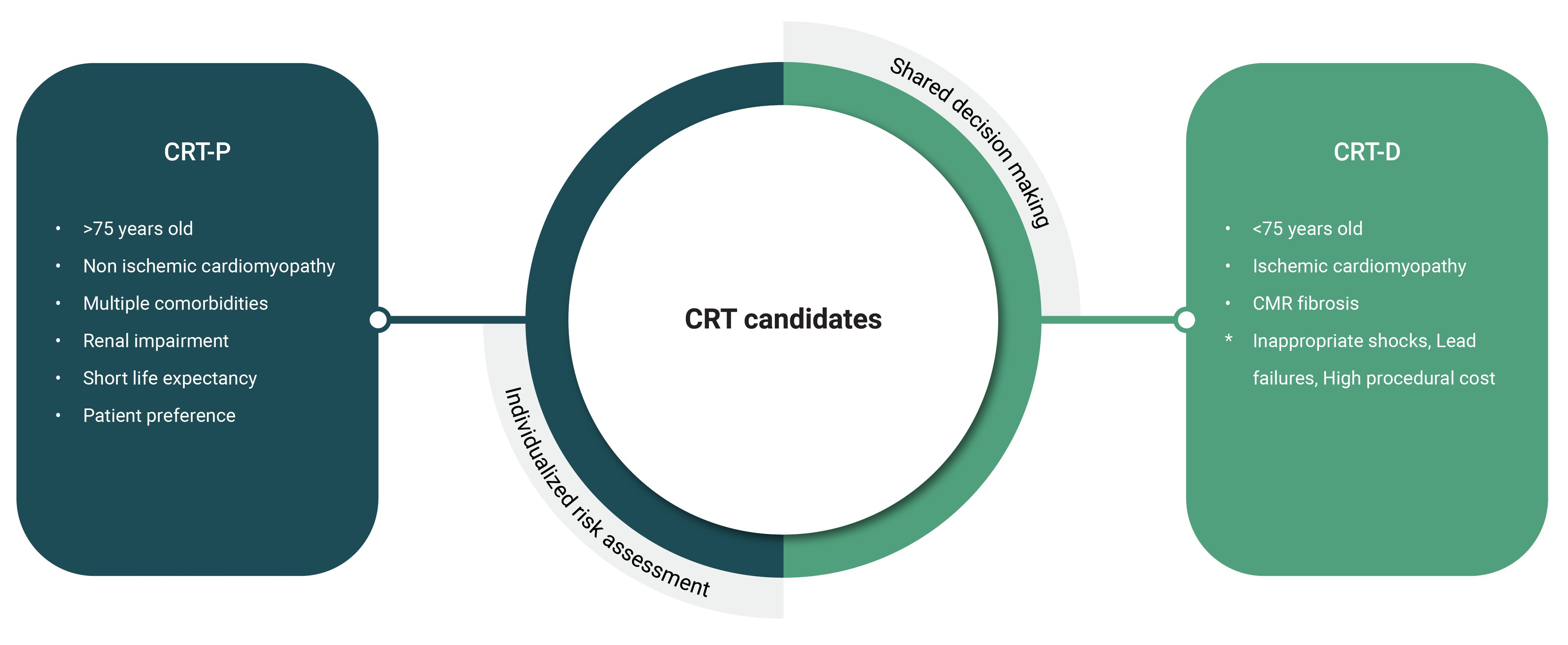
| In patients who are candidates for CRT, implantation of a CRT-D should be considered after individual risk assessment and using shared decision-making. | IIa | B |
| LBBB = left bundle branch block; AF = atrial fibrillation; AVJ = atrioventricular junction; CRT = cardiac resynchronization therapy; EF = ejection fraction; HF = heart failure; HFrEF = heart failure with reduced ejection fraction (<40%); HFmrEF = heart failure with mildly reduced ejection fraction (40–49%); HFpEF = heart failure with preserved ejection fraction (≥50%) according to the 2021 ESC HF Guidelines; LVEF = left ventricular ejection fraction; NYHA = New York Heart Association; RV = right ventricular; ICD = implantable cardioverter-defibrillator; OMT = optimal medical therapy; AVB = atrioventricular block; NYHA = New York Heart Association. a Class of recommendation b Level of evidence | ||
| 2022 AHA/ACC/HFSA Guideline for the Management of Heart Failure: A Report of the American College of Cardiology/American Heart Association Joint Committee on Clinical Practice Guidelines | ||
| Recommendations | Class a | Level b |
| SR and LBBB QRS morphology | ||
| For patients who have LVEF ≤ 35%, sinus rhythm, left bundle branch block (LBBB) with a QRS duration ≥ 150 ms, and NYHA class II, III, or ambulatory IV symptoms on GDMT, CRT is indicated to reduce total mortality, reduce hospitalizations, and improve symptoms and QOL. | 1 | B-R |
| For patients who have LVEF ≤ 35%, sinus rhythm, LBBB with a QRS duration of 120 to 149 ms, and NYHA class II, III, or ambulatory IV symptoms on GDMT, CRT can be useful to reduce total mortality, reduce hospitalizations, and improve symptoms and QOL. | 2a | B-NR |
| For patients who have LVEF ≤ 30%, ischemic cause of HF, sinus rhythm, LBBB with a QRS duration ≥ 150 ms, and NYHA class I symptoms on GDMT, CRT may be considered to reduce hospitalizations and improve symptoms and QOL. | 2b | B-NR |
| SR and non-LBBB QRS morphology | ||
| For patients who have LVEF ≤ 35%, sinus rhythm, a non-LBBB pattern with a QRS duration ≥150 ms, and NYHA class II, III, or ambulatory class IV symptoms on GDMT, CRT can be useful to reduce total mortality, reduce hospitalizations, and improve symptoms and QOL. | 2a | B-R |
| For patients who have LVEF ≤ 35%, sinus rhythm, a non-LBBB pattern with QRS duration of 120 to 149 ms, and NYHA class III or ambulatory class IV on GDMT, CRT may be considered to reduce total mortality, reduce hospitalizations, and improve symptoms and QOL. | 2b | B-NR |
| High burden RVP | ||
| In patients with high-degree or complete heart block and LVEF of 36% to 50%, CRT is reasonable to reduce total mortality, reduce hospitalizations, and improve symptoms and QOL. | 2a | B-R |
| For patients on GDMT who have LVEF ≤ 35% and are undergoing placement of a new or replacement device implantation with anticipated requirement for significant (>40%) ventricular pacing, CRT can be useful to reduce total mortality, reduce hospitalizations, and improve symptoms and QOL. | 2a | B-NR |
| Atrial fibrillation | ||
| In patients with AF and LVEF ≤ 35% on GDMT, CRT can be useful to reduce total mortality, improve symptoms and QOL, and increase LVEF if: (a) the patient requires ventricular pacing or otherwise meets CRT criteria and (b) atrioventricular nodal ablation or pharmacological rate control will allow for near 100% ventricular pacing with CRT. | 2a | B-R |
| For patients with AF and LVEF ≤ 50%, if a rhythm control strategy fails or is not desired and ventricular rates remain rapid despite medical therapy, atrioventricular nodal ablation with implantation of a CRT device is reasonable. | 2a | B-R |
| No benefit | ||
| In patients with QRS duration < 120 ms, CRT is not recommended | No benefit | B-R |
| For patients with NYHA class I or II symptoms and non-LBBB pattern with QRS duration < 150 ms, CRT is not recommended. | No benefit | B-NR |
| For patients whose comorbidities or frailty limit survival with good functional capacity to <1 year, ICD and cardiac resynchronization therapy with defibrillation (CRT-D) are not indicated. | No benefit | C-LD |
| Study (Year) | Population | Study Period | Follow-Up | CRT-P (n) | CRT-D (n) | Outcomes |
|---|---|---|---|---|---|---|
| RCTs | ||||||
| Køber (2016) [33] | NICM | 2008–2014 | 67 months (median) | 323 | 322 |
|
| Doran (2021) [56] | ICM and NICM | 2000–2002 | 16.5 months (median) | 617 | 595 |
|
| Observational studies | ||||||
| Auricchio (2007) [17] | ICM and NICM | 1994–2004 | 34 months (median) | 572 | 726 | CRT-D
|
| Morani (2013) [57] | ICM and NICM | 2004–2007 | 55 months (median) | 108 | 266 |
|
| Kutyifa (2014) [34] | ICM and NICM | 2000–2011 | 28 months (median) | 693 | 429 |
|
| Looi (2014) [58] | ICM and NICM | 2006–2010 | 29 months (mean) | 354 | 146 |
|
| Gold (2015) [59] | ICM and NICM | 2004–2006 | 60 months (median) | 74 | 345 |
|
| Marijon (2015) [60] | ICM and NICM | 2008–2010 | 222 months (mean) | 535 | 1170 |
|
| Reitan (2015) [61] | ICM and NICM | 1999–2012 | 59 months (median) | 448 | 257 |
|
| Munir (2016) [62] | ICM and NICM | 2002–2013 | 40.8 months (median) | 107 | 405 |
|
| Witt (2016) [63] | ICM and NICM | 2000–2010 | 48 months (median) | 489 | 428 |
|
| Drozd (2016) [64] | ICM and NICM | 2008–2012 | 36 months (mean) | 544 | 251 |
|
| Laish-Farkas (2017) [65] | Elderly with ICM and NICM | 2006–2015 | 60 months (median) | 142 | 104 |
|
| Barra (2017) [35] | ICM and NICM | 2002–2012 | 41.4 months (mean) | 1270 | 4037 |
|
| Martens (2017) [66] | ICM and NICM | 2008–2015 | 38 months (mean) | 361 | 326 |
|
| Yokoshiki (2017) [67] | ICM and NICM | 2011–2015 | 21 months (mean) | 97 | 620 |
|
| Leyva (2018) [68] | ICM and NICM | 2000–2017 | 56.4 months (median) | 999 | 551 |
|
| Döring (2018) [52] | Elderly with ICM and NICM | 2008–2014 | 26 months (mean) | 80 | 97 |
|
| Wang (2019) [51] | NICM | 2002–2013 | 46 months (median) | 42 | 93 |
|
| Saba (2019) [69] | NICM | 2007–2014 | 60 months | 1236 | 4359 |
|
| Barra (2019) [70] | ICM and NICM | 2002–2013 | 30 months (mean) | 534 | 1241 |
|
| Leyva (2019) [50] | 2009–2017 | 32.4 months (median) | 24,811 | 25,273 |
| |
| Liang (2020) [30] | ICM and NICM | 2005–2016 | 36 months (median) | 126 | 219 |
|
| Gras (2020) [71] | ICM and NICM | 2010–2017 | 913 ± 841 days | 19,266 | 26,431 |
|
| Huang (2020) [72] | ICM and NICM | 2012–2013 | 27.7 months (mean) | 237 | 362 |
|
| Schrage (2022) [73] | ICM and NICM | 2000–2016 | 28.2 months (median) | 880 | 1108 |
|
| Hadwiger (2022) [22] | ICM and NICM | 2014–2019 | 28.2 months (median) | 847 | 2722 |
|
| Farouq (2023) [74] | NICM | 2005–2020 | 51.6 months (median) | 2334 | 1693 |
|
| Meta-Analysis (year) | No. of Studies Included | Population (n) | CRT-P (n) | CRT-D (n) | Outcomes |
|---|---|---|---|---|---|
| Ischemic and non-ischemic cardiomyopathy | |||||
| Veres (2023) [31] | 26 observational studies | 128.030 | 55.469 | 72.561 |
|
| Non-ischemic cardiomyopathy | |||||
| Patel (2021) [32] | 7 observational studies | 9.944 | 3.079 | 6.865 |
|
| Al Sadawi (2023) [36] | 13 observational and 2 RCTs | 22.763 | 9.596 | 13.167 |
|
| Liu (2023) [75] | 9 observational and 2 RCTs | 28.768 | 11.980 | 16.788 |
|
| Neto (2024) [76] | 11 observational and 2 RCTs | 61.326 | 7.338 | 9.108 |
|
| Trial Name | Year | Study Type | Population | Intervention | Comparator | Key Findings |
|---|---|---|---|---|---|---|
| His-SYNC [110] | 2017 | RCT | 41 | HBP | BiV CRT | Similar improvements in LV function; HBP had higher crossover (48%) due to technical limitations. |
| His-Alternative [111] | 2021 | RCT | 50 | HBP or LBBAP | BiV CRT | CSP showed non-inferior clinical response and better electrical resynchronization. |
| LBBP-RESYNC [109] | 2022 | RCT | 40 | LBBAP | BiV CRT | LBBAP showed greater LVEF improvement and QRS narrowing than BiV CRT. |
| HOT CRT [118] | 2023 | RCT | 160 | HBP | BiV CRT | HBP was superior to BiVP in LVEF; similar QRS narrowing and symptoms. |
| LEVEL-AT [99] | 2023 | Prospective, non-randomized | 70 | LBBAP | CRT cohort | LBBAP showed better LVEF recovery and symptom improvement compared to historical BiV CRT. |
| CONSYST CRT [119] | 2025 | RCT | 134 | CSP | BiV CRT | Non inferiority in clinical and echocardiographic response. |
Disclaimer/Publisher’s Note: The statements, opinions and data contained in all publications are solely those of the individual author(s) and contributor(s) and not of MDPI and/or the editor(s). MDPI and/or the editor(s) disclaim responsibility for any injury to people or property resulting from any ideas, methods, instructions or products referred to in the content. |
© 2025 by the authors. Licensee MDPI, Basel, Switzerland. This article is an open access article distributed under the terms and conditions of the Creative Commons Attribution (CC BY) license (https://creativecommons.org/licenses/by/4.0/).
Share and Cite
Laina, A.; Antoniou, C.-K.; Tsiachris, D.; Kordalis, A.; Arsenos, P.; Doundoulakis, I.; Dilaveris, P.; Xintarakou, A.; Xydis, P.; Soulaidopoulos, S.; et al. CRT-D or CRT-P: When There Is a Dilemma and How to Solve It. J. Clin. Med. 2025, 14, 6933. https://doi.org/10.3390/jcm14196933
Laina A, Antoniou C-K, Tsiachris D, Kordalis A, Arsenos P, Doundoulakis I, Dilaveris P, Xintarakou A, Xydis P, Soulaidopoulos S, et al. CRT-D or CRT-P: When There Is a Dilemma and How to Solve It. Journal of Clinical Medicine. 2025; 14(19):6933. https://doi.org/10.3390/jcm14196933
Chicago/Turabian StyleLaina, Ageliki, Christos-Konstantinos Antoniou, Dimitrios Tsiachris, Athanasios Kordalis, Petros Arsenos, Ioannis Doundoulakis, Polychronis Dilaveris, Anastasia Xintarakou, Panagiotis Xydis, Stergios Soulaidopoulos, and et al. 2025. "CRT-D or CRT-P: When There Is a Dilemma and How to Solve It" Journal of Clinical Medicine 14, no. 19: 6933. https://doi.org/10.3390/jcm14196933
APA StyleLaina, A., Antoniou, C.-K., Tsiachris, D., Kordalis, A., Arsenos, P., Doundoulakis, I., Dilaveris, P., Xintarakou, A., Xydis, P., Soulaidopoulos, S., Karanikola, A.-E., Milaras, N., Sideris, S., Archontakis, S., Vouliotis, A., Kariki, O., Tsioufis, C., & Gatzoulis, K. (2025). CRT-D or CRT-P: When There Is a Dilemma and How to Solve It. Journal of Clinical Medicine, 14(19), 6933. https://doi.org/10.3390/jcm14196933