Review

Exploring the Effectiveness of Immersive Virtual Reality Rehabilitation for Parkinson’s Disease: A Narrative Review


by
Roxana Nartea
1,2,*,
Daniela Poenaru
1,2,
Mariana Isabela Constantinovici
1,2,
Claudia Gabriela Potcovaru
1,2 and
Delia Cinteza
1,2
1
Department of Physical and Rehabilitation Medicine, Carol Davila University of Medicine and Pharmacy, 050451 Bucharest, Romania
2
National Institute for Rehabilitation, Physical Medicine and Balneoclimatology, 030079 Bucharest, Romania
*
Author to whom correspondence should be addressed.
J. Clin. Med. 2025, 14(19), 6858; https://doi.org/10.3390/jcm14196858
Submission received: 25 August 2025 / Revised: 22 September 2025 / Accepted: 24 September 2025 / Published: 28 September 2025

Abstract

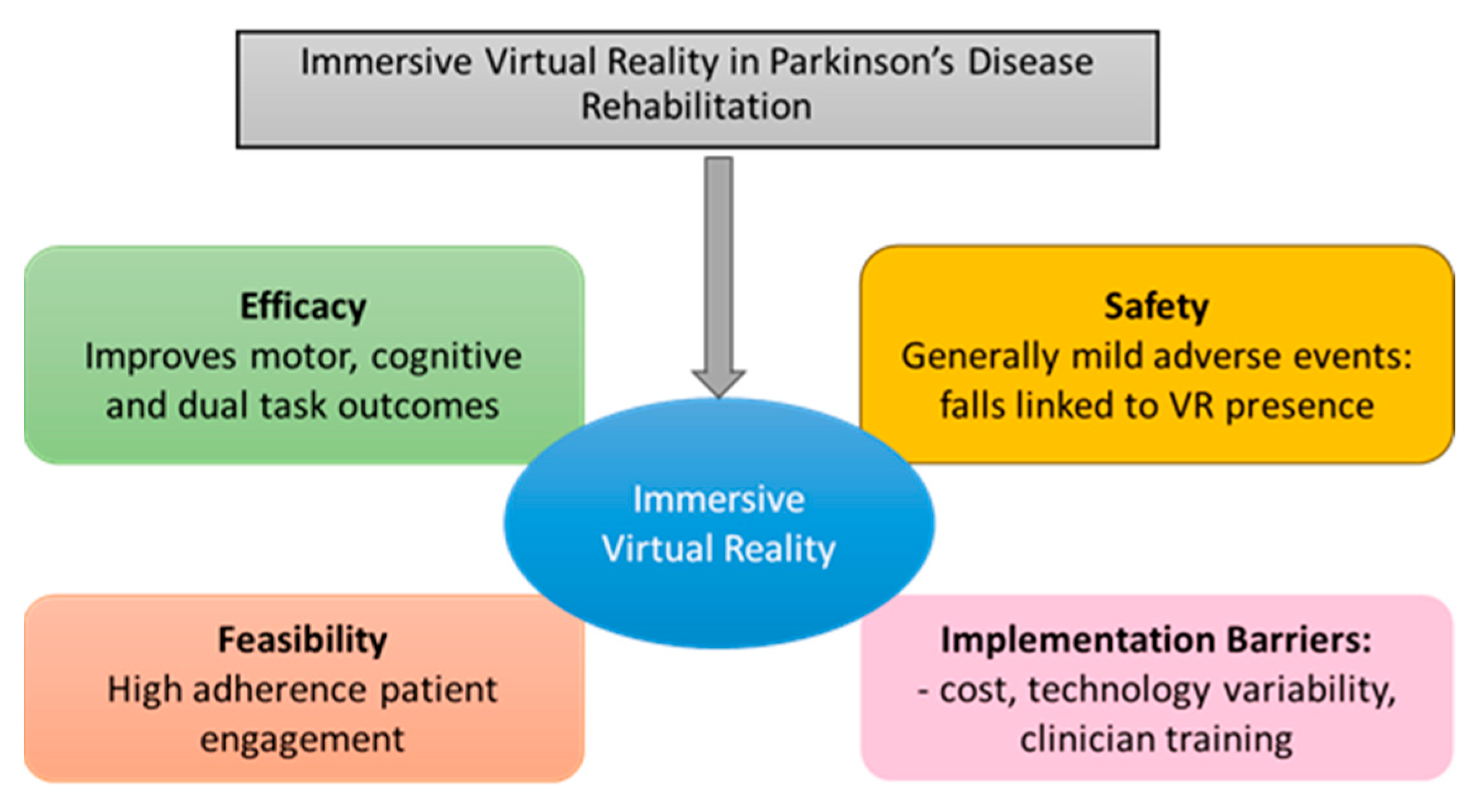
Parkinson’s disease (PD) presents an association of motor and non-motor impairments that impact the independence and quality of life of individuals. Rehabilitation programs must address multiple domains, simultaneously maintaining patients’ adherence and the implications of the disease. Immersive virtual-reality-based rehabilitation (IVRBR) is a promising alternative tool, or can be used in conjunction with traditional or passive programs, using interactive tasks in valid environments with specific training programs adapted to each individual’s needs. This narrative review synthesizes the medical literature published in the last decade from PubMed, Scopus, and Web of Science, on the effectiveness, limitations, and implementations of IVRBR in PD patients. Evidence from RTCs and non-RTCs suggests that IVRBR can improve balance, motor learning, and dual task performance. At the same time, the evidence suggests that it can improve cognitive and emotional status. The integration of objective assessment tools (motion and posture analyses, wearable sensors, center of pressures and machine learning models capable of predicting freezing gait-FoG) enhances clinical and individualized rehabilitation programs. However, the evidence base remains limited, with a small sample size, heterogeneity in measured outcomes, and short follow-up duration. In general, reported adverse reactions were minor, but required standardized reporting patterns. Implementation is challenging due to the equipment cost and varying technological demands, but also due to patient selection and training of the medical personnel. IVRBR is a feasible and engaging alternative or can form part of an individualized rehabilitation program in PD patients; however, future large RTCs, long-term follow-up with standardized protocols, cost-effectiveness analyses, and integration of predictive modeling are essential for its broader clinical usage.
Keywords: immersive virtual rehabilitation; Parkinson’s disease; rehabilitation; virtual reality immersive virtual rehabilitation; Parkinson’s disease; rehabilitation; virtual reality