Article

CARDS, a Novel Prognostic Index for Risk Stratification and In-Hospital Monitoring

1
Key Laboratory of Endocrinology of National Health Commission, Translation Medicine Centre, Department of Endocrinology, Peking Union Medical College Hospital, Peking Union Medical College, Chinese Academy of Medical Sciences (PUMCH, CAMS & PUMC), Beijing 100730, China
2
Medical Affairs, PUMCH, CAMS & PUMC, Beijing 100730, China
3
Central Research Laboratory, PUMCH, CAMS & PUMC, Beijing 100730, China
*
Authors to whom correspondence should be addressed.
These authors contributed equally to this work.
J. Clin. Med. 2024, 13(7), 1961; https://doi.org/10.3390/jcm13071961
Submission received: 14 January 2024 / Revised: 14 March 2024 / Accepted: 19 March 2024 / Published: 28 March 2024

Abstract

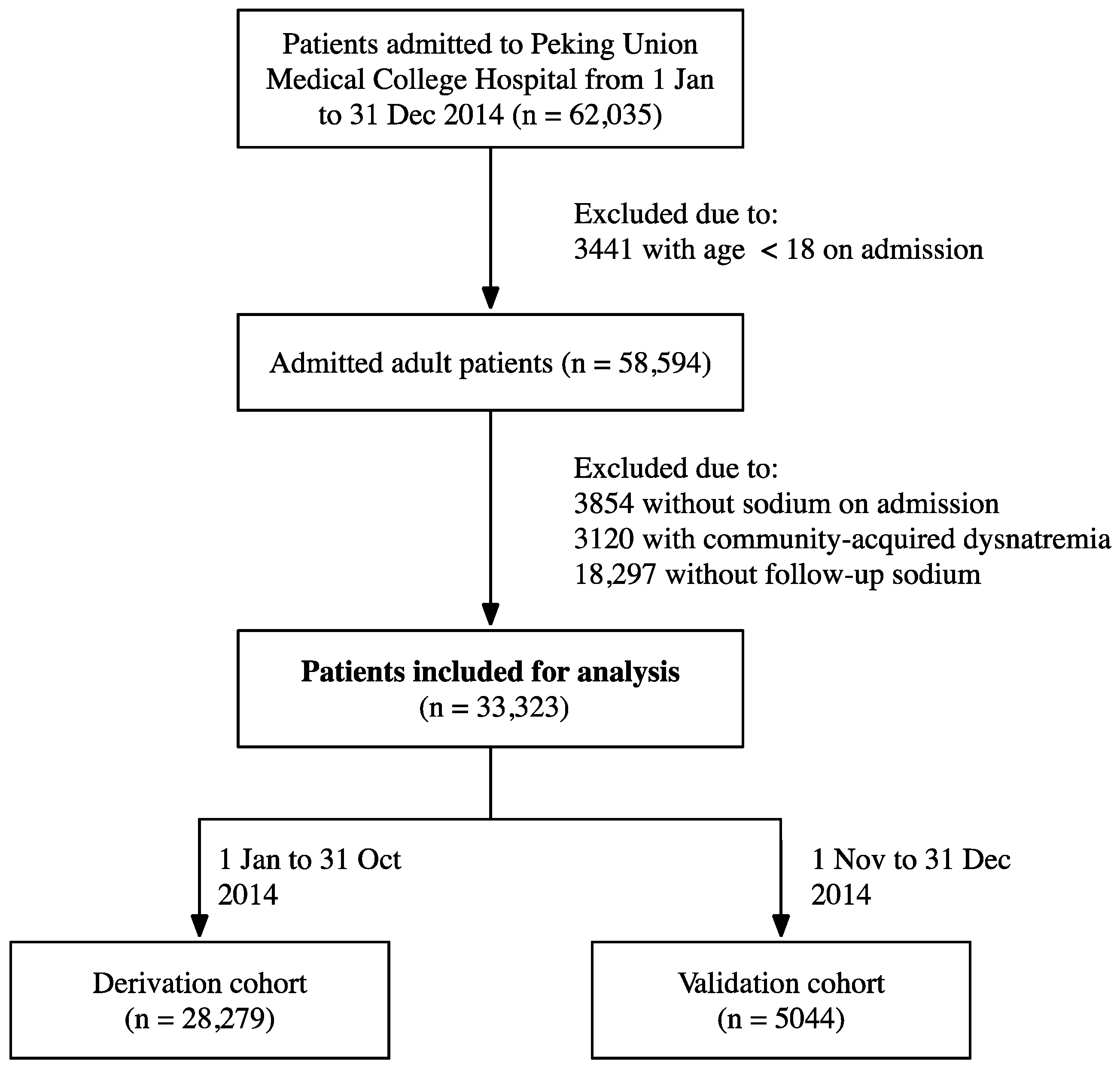
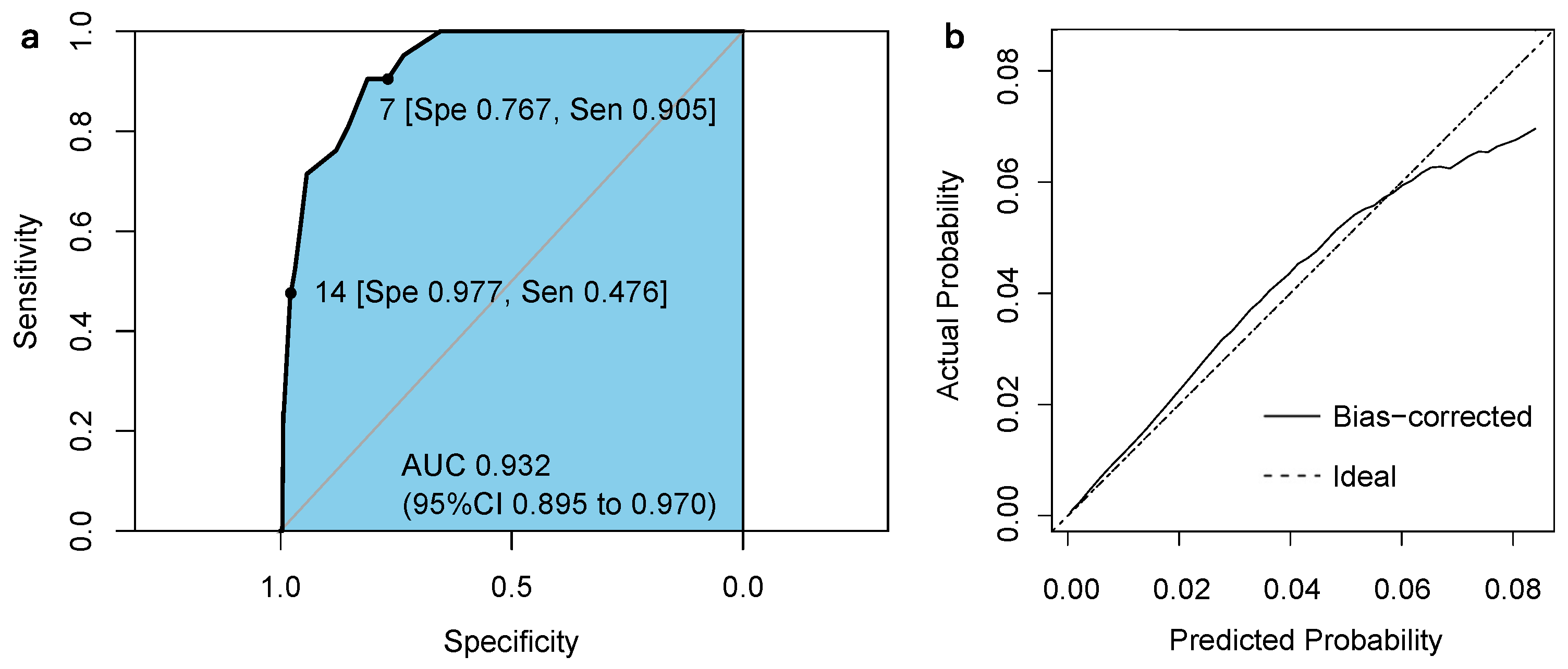
Background: Sodium fluctuation is independently associated with clinical deterioration. We developed and validated a prognostic index based on sodium fluctuation for risk stratification and in-hospital monitoring. Methods: This study included 33,323 adult patients hospitalized at a tertiary care hospital in 2014. The first 28,279 hospitalizations were analyzed to develop the model and then the validity of the model was tested using data from 5044 subsequent hospitalizations. We predict in-hospital mortality using age, comorbidity, range of sodium fluctuation, and duration of sodium fluctuation, abbreviated as CARDS. Results: In-hospital mortality was similar in the derivation (0.6%) and validation (0.4%) cohorts. In the derivation cohort, four independent risk factors for mortality were identified using logistic regression: age (66–75, 2 points; >75, 3 points); Charlson comorbidity index (>2, 5 points); range of sodium fluctuation (7–10, 4 points; >10, 10 points); and duration of fluctuation (≤3, 3 points). The AUC was 0.907 (95% CI: 0.885–0.928) in the derivation cohort and 0.932 (95% CI: 0.895–0.970) in the validation cohort. In the derivation cohort, in-hospital mortality was 0.106% in the low-risk group (0–7 points), 1.076% in the intermediate-risk group (8–14 points), and 8.463% in the high-risk group (15–21 points). In the validation cohort, in-hospital mortality was 0.049% in the low-risk group, 1.064% in the intermediate-risk group, and 8.403% in the high-risk group. Conclusions: These results suggest that patients at low, intermediate, and high risk for in-hospital mortality may be identified by CARDS mainly based on sodium fluctuation.
Keywords: sodium fluctuation; in-hospital mortality; hypernatremia; hyponatremia; monitoring sodium fluctuation; in-hospital mortality; hypernatremia; hyponatremia; monitoring