Article

OMI/NOMI: Time for a New Classification of Acute Myocardial Infarction
by
Martiola Kola
1,*,
Naltin Shuka
2,
Harvey Pendell Meyers
3,
Elizana Zaimi (Petrela)
4 and
Stephen W. Smith
5
1
Cardiology, University Hospital Center Mother Teresa, 1001 Tirana, Albania
2
Cardiovascular Medicine, University Hospital Center Mother Teresa, 1001 Tirana, Albania
3
Emergency Medicine, Carolinas Medical Center, Charlotte, NC 28203, USA
4
Public Health, Faculty of Medicine, University of Medicine, 1005 Tirana, Albania
5
Emergency Medicine, Hennepin Healthcare, Minneapolis, MN 55415, USA
*
Author to whom correspondence should be addressed.
J. Clin. Med. 2024, 13(17), 5201; https://doi.org/10.3390/jcm13175201
Submission received: 11 July 2024 / Revised: 25 August 2024 / Accepted: 25 August 2024 / Published: 2 September 2024

Abstract

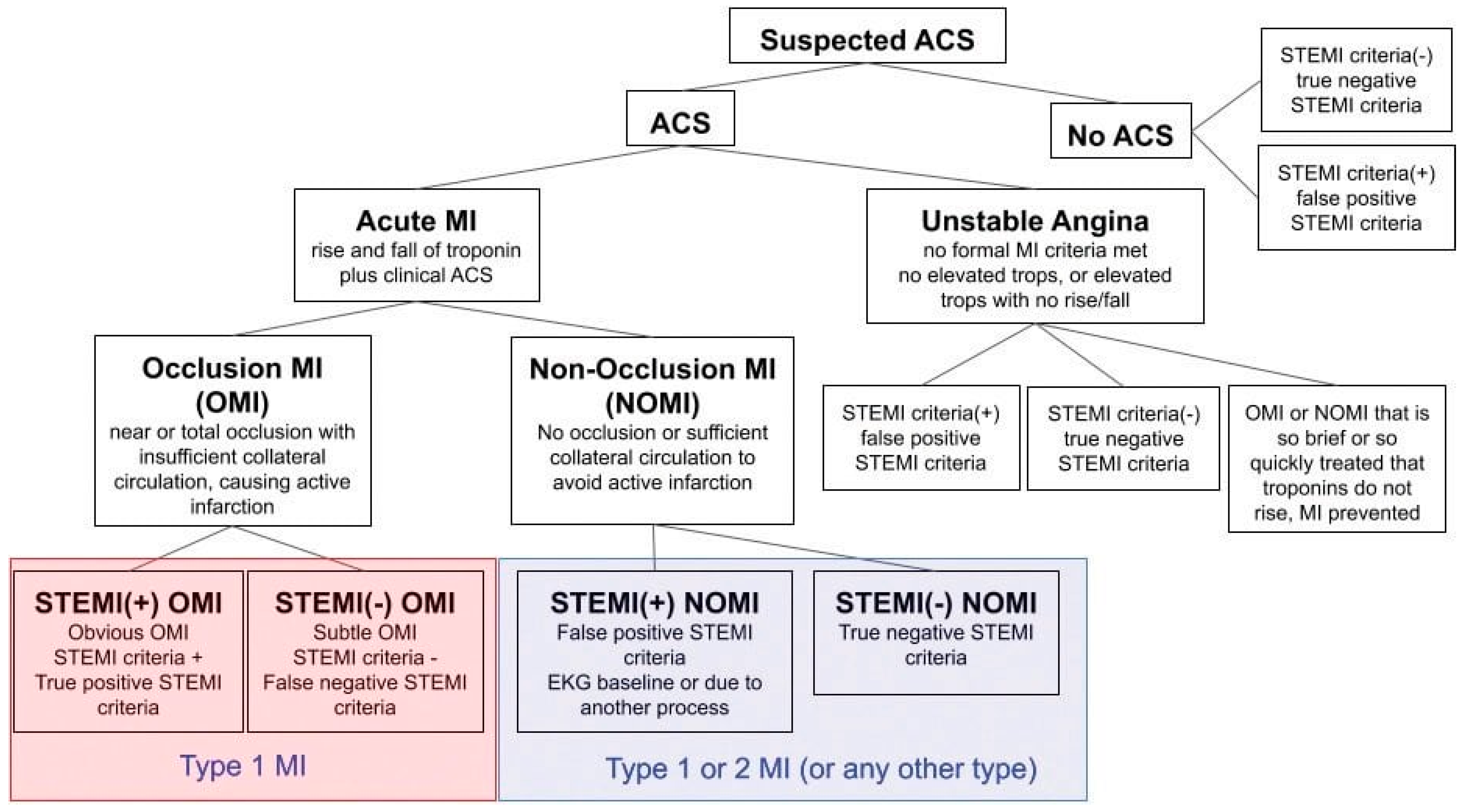
Forty percent of patients with acute coronary occlusion myocardial infarction (OMI) do not present with STEMI criteria, which delays their treatment and increases morbidity and mortality. The need to identify these patients promptly is crucial, and this sets the stage for the proposed reclassification. Many of these patients can be identified by other ECG and clinical features. Background/Objectives: We sought to evaluate cases of STEMI and NSTEMI that result in OMI. Additionally, we focused on the consequences of delayed revascularization in NSTEMI patients with acute coronary occlusion (NSTEMI-OMI). Methods: The study is a retrospective analysis conducted on 334 patients who underwent coronary angiography for acute coronary syndrome at UHC “Mother Teresa”, Tirana, Albania, during January–May 2023. “OMI was defined as an acute culprit lesion with TIMI 0–2 flow, or an acute culprit lesion with TIMI 3 flow intervened upon and with highly elevated troponin (cTnI > 10.0 ng/mL, hs-cTnI > 5000 ng/L)”. The presence or absence of STEMI criteria were determined in the final diagnosis written on the chart by a cardiologist using the third universal definition of MI. Ejection fraction (EF), total ischemia time, length of stay, and complications were compared between groups. Mechanical complications include acute ventricular failure, cardiogenic shock, rupture of the interventricular septum, rupture of the free wall, rupture of the papillary muscle, and pericarditis. Electrical complications include ventricular arrhythmias, supraventricular arrhythmias, and atrioventricular and interventricular blocks. Results: There were 334 patients included, 98 (29.3%) of whom were NSTEMI-OMI patients. Ninety-six patients (40%) of OMI patients did not fulfill the STEMI criteria. Only 11 patients (11%) of STEMI(−)OMI had PCI performed within the first 12 h vs. 76 patients (77%) with STEMI(+)OMI, p < 0.001. There was no difference in the percent of patients requiring PCI between the STEMI(+)OMI 98 patients (93%) and STEMI(−)OMI 87 patients (89%) (p = 0.496). The overall in-hospital mortality was 19 patients (5.7%), with subgroup mortality of 14 patients (4.2%) with STEMI(+)OMI, 2 patients (0.6%) with STEMI(+) NOMI, and 3 patients (0.9%) with STEMI(−)OMI, 0% STEMI(−)NOMI, (p = 0.013). Patients with mechanical complications included 67 patients (46.8%) with STEMI(+)OMI and 45 patients (46.4%) with STEMI(−)OMI. In addition, 26 patients (18.5%) with STEMI(+)OMI and 13 patients (13.1%) with STEMI(−)OMI developed electrical complications. Conclusions: STEMI(−)OMI patients had significant delays in catheterization, yet had angiographic findings, rates of PCI, and complications similar to STEMI(+)OMI. These data add further support to refocusing the paradigm of acute MI to improve recognition and rapid reperfusion of all OMIs, rather than only those with STEMI criteria.
Keywords: OMI; NOMI; STEMI; NSTEMI; PCI; PPCI OMI; NOMI; STEMI; NSTEMI; PCI; PPCI