Article

Association between Opioid–Benzodiazepine Trajectories and Injurious Fall Risk among US Medicare Beneficiaries


by
Grace Hsin-Min Wang
1,
Juan M. Hincapie-Castillo
2,3,
Walid F. Gellad
4,5,6,
Bobby L. Jones
1,
Ronald I. Shorr
7,
Seonkyeong Yang
1,
Debbie L. Wilson
1,
Jeannie K. Lee
8,
Gary M. Reisfield
9,
Chian K. Kwoh
10,11,
Chris Delcher
12,
Khoa A. Nguyen
13,
Christopher A. Harle
14,
Zachary A. Marcum
15 and
Wei-Hsuan Lo-Ciganic
4,5,7,*
1
Department of Pharmaceutical Outcomes and Policy, College of Pharmacy, University of Florida, Gainesville, FL 32610, USA
2
Department of Epidemiology, Gillings School of Global Public Health, University of North Carolina at Chapel Hill, Chapel Hill, NC 27599, USA
3
Injury Prevention Research Center, University of North Carolina at Chapel Hill, Chapel Hill, NC 27599, USA
4
Center for Pharmaceutical Policy and Prescribing, Health Policy Institute, University of Pittsburgh, Pittsburgh, PA 15261, USA
5
Department of Medicine, School of Medicine, University of Pittsburgh, Pittsburgh, PA 15213, USA
6
Center for Health Equity Research Promotion, Veterans Affairs Pittsburgh Healthcare System, Pittsburgh, PA 15240, USA
7
North Florida/South Georgia Veterans Health System Geriatric Research Education and Clinical Center, Gainesville, FL 32608, USA
8
Department of Pharmacy Practice and Science, College of Pharmacy, University of Arizona, Tucson, AZ 85724, USA
9
Divisions of Addiction Medicine & Forensic Psychiatry, Departments of Psychiatry & Anesthesiology, College of Medicine, University of Florida, Gainesville, FL 32611, USA
10
University of Arizona Arthritis Center, College of Medicine, University of Arizona, Tucson, AZ 85721, USA
11
Division of Rheumatology, College of Medicine, University of Arizona, Tucson, AZ 85724, USA
12
Pharmacy Practice & Science, Institute for Pharmaceutical Outcomes & Policy, College of Pharmacy, University of Kentucky, Lexington, KY 40506, USA
13
Department of Pharmacotherapy & Translational Research, College of Pharmacy, University of Florida, Gainesville, FL 32610, USA
14
Department of Health Policy and Management, School of Public Health, Indiana University, Indianapolis, IN 47405, USA
15
School of Pharmacy, University of Washington, Seattle, WA 98195, USA
*
Author to whom correspondence should be addressed.
J. Clin. Med. 2024, 13(12), 3376; https://doi.org/10.3390/jcm13123376
Submission received: 12 April 2024 / Revised: 23 May 2024 / Accepted: 4 June 2024 / Published: 7 June 2024
(This article belongs to the Section Epidemiology & Public Health)

Abstract

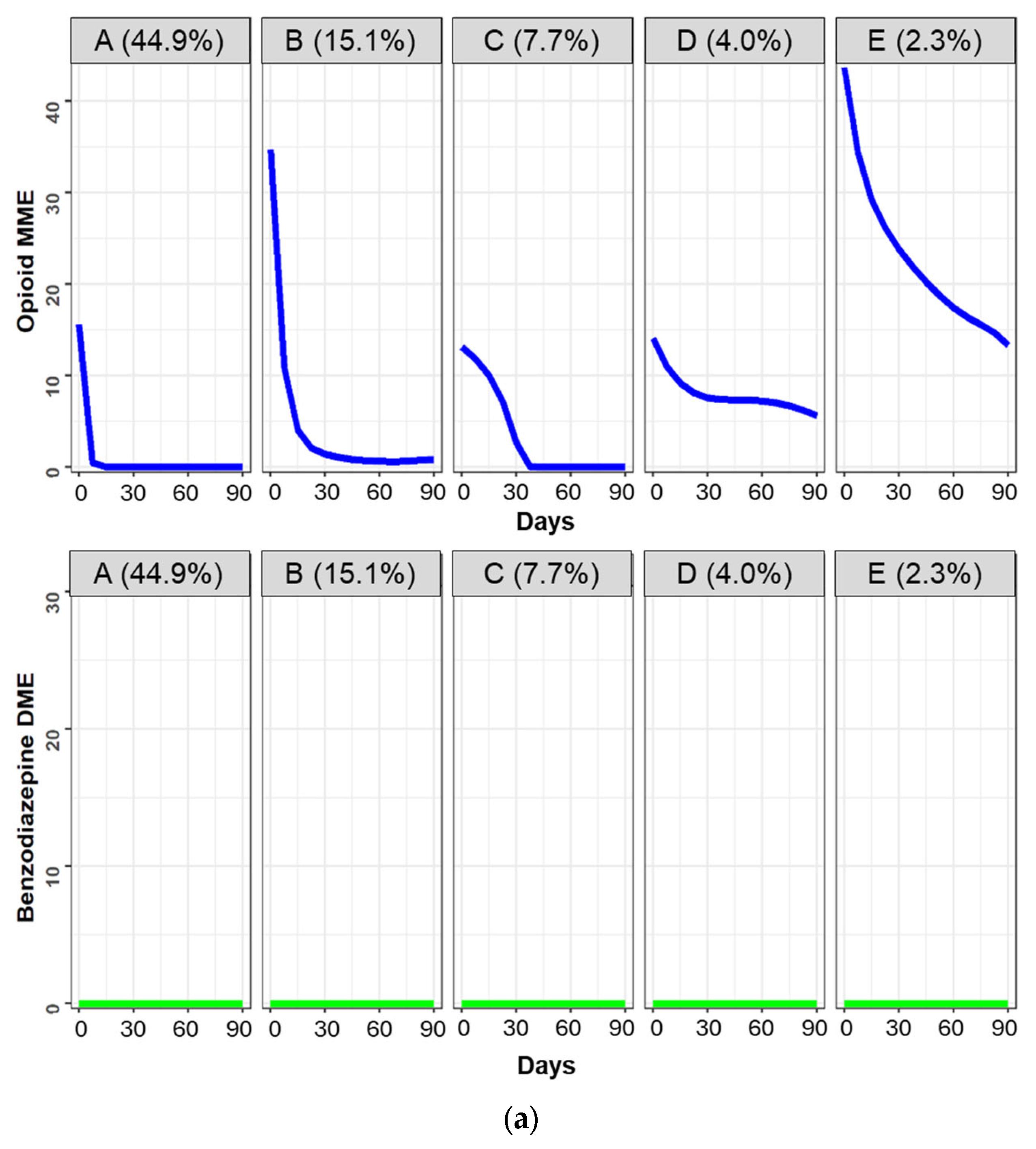
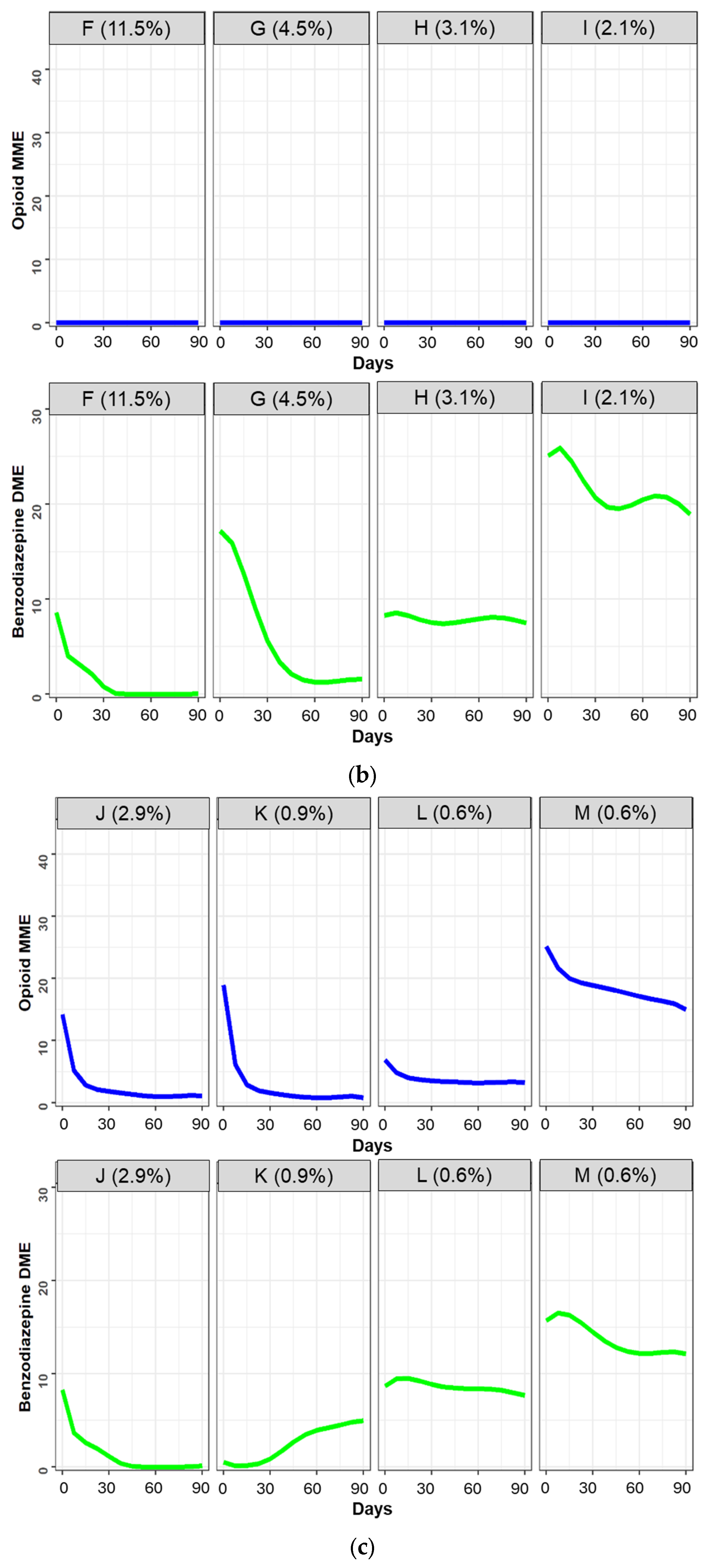
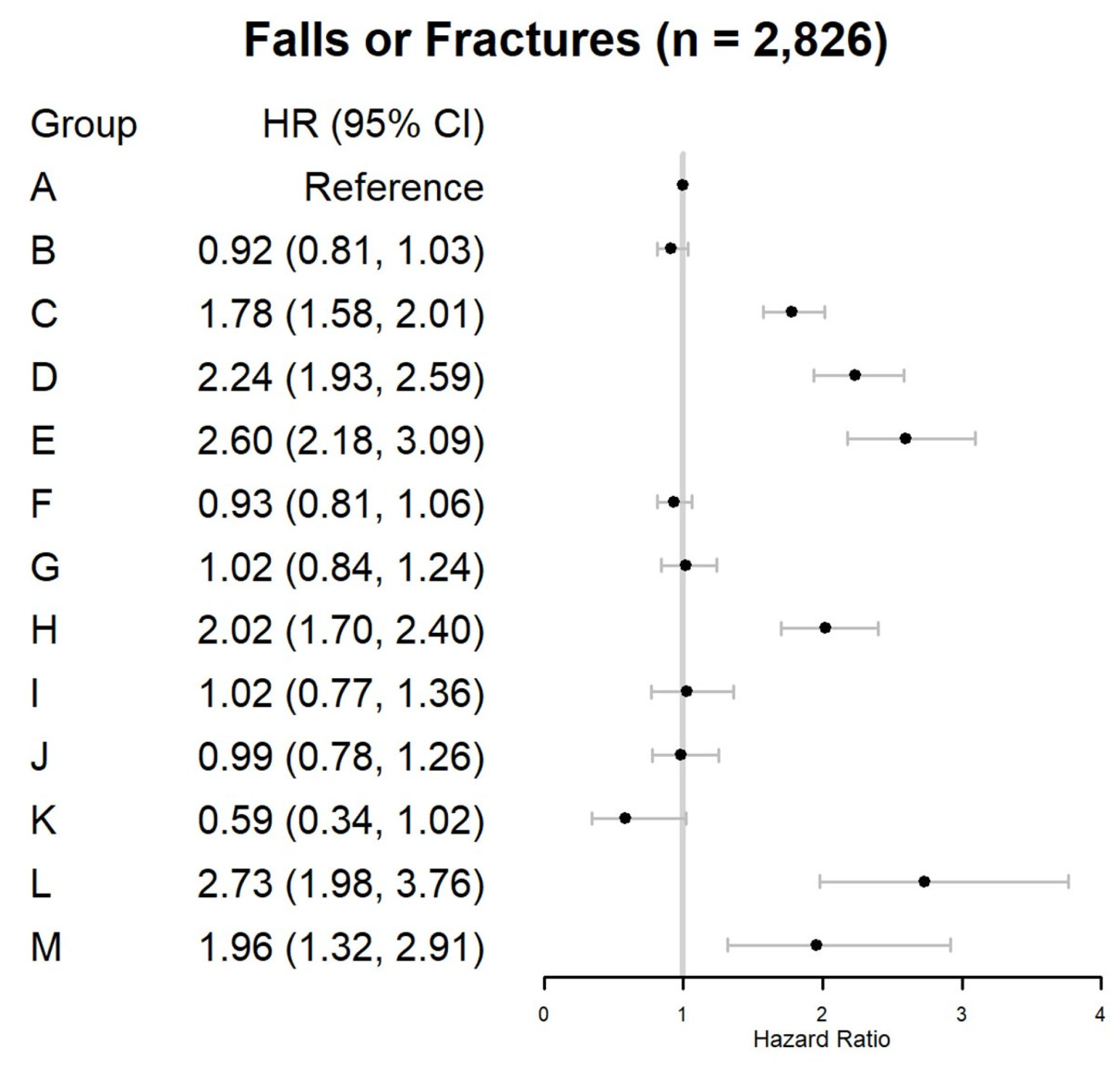
Background/Objectives: Concurrent opioid (OPI) and benzodiazepine (BZD) use may exacerbate injurious fall risk (e.g., falls and fractures) compared to no use or use alone. Yet, patients may need concurrent OPI-BZD use for co-occurring conditions (e.g., pain and anxiety). Therefore, we examined the association between longitudinal OPI-BZD dosing patterns and subsequent injurious fall risk. Methods: We conducted a retrospective cohort study including non-cancer fee-for-service Medicare beneficiaries initiating OPI and/or BZD in 2016–2018. We identified OPI-BZD use patterns during the 3 months following OPI and/or BZD initiation (i.e., trajectory period) using group-based multi-trajectory models. We estimated the time to first injurious falls within the 3-month post-trajectory period using inverse-probability-of-treatment-weighted Cox proportional hazards models. Results: Among 622,588 beneficiaries (age ≥ 65 = 84.6%, female = 58.1%, White = 82.7%; having injurious falls = 0.45%), we identified 13 distinct OPI-BZD trajectories: Group (A): Very-low OPI-only (early discontinuation) (44.9% of the cohort); (B): Low OPI-only (rapid decline) (15.1%); (C): Very-low OPI-only (late discontinuation) (7.7%); (D): Low OPI-only (gradual decline) (4.0%); (E): Moderate OPI-only (rapid decline) (2.3%); (F): Very-low BZD-only (late discontinuation) (11.5%); (G): Low BZD-only (rapid decline) (4.5%); (H): Low BZD-only (stable) (3.1%); (I): Moderate BZD-only (gradual decline) (2.1%); (J): Very-low OPI (rapid decline)/Very-low BZD (late discontinuation) (2.9%); (K): Very-low OPI (rapid decline)/Very-low BZD (increasing) (0.9%); (L): Very-low OPI (stable)/Low BZD (stable) (0.6%); and (M): Low OPI (gradual decline)/Low BZD (gradual decline) (0.6%). Compared with Group (A), six trajectories had an increased 3-month injurious falls risk: (C): HR = 1.78, 95% CI = 1.58–2.01; (D): HR = 2.24, 95% CI = 1.93–2.59; (E): HR = 2.60, 95% CI = 2.18–3.09; (H): HR = 2.02, 95% CI = 1.70–2.40; (L): HR = 2.73, 95% CI = 1.98–3.76; and (M): HR = 1.96, 95% CI = 1.32–2.91. Conclusions: Our findings suggest that 3-month injurious fall risk varied across OPI-BZD trajectories, highlighting the importance of considering both dose and duration when assessing injurious fall risk of OPI-BZD use among older adults.
Keywords: trajectory; opioid; benzodiazepine; falls; fractures trajectory; opioid; benzodiazepine; falls; fractures