Correction: Bertelli et al. Is Less Always More? A Prospective Two-Centre Study Addressing Clinical Outcomes in Leadless versus Transvenous Single-Chamber Pacemaker Recipients. J. Clin. Med. 2022, 11, 6071

 , , , ,
  , ,
, ,  , ,
, , 
 and
and 
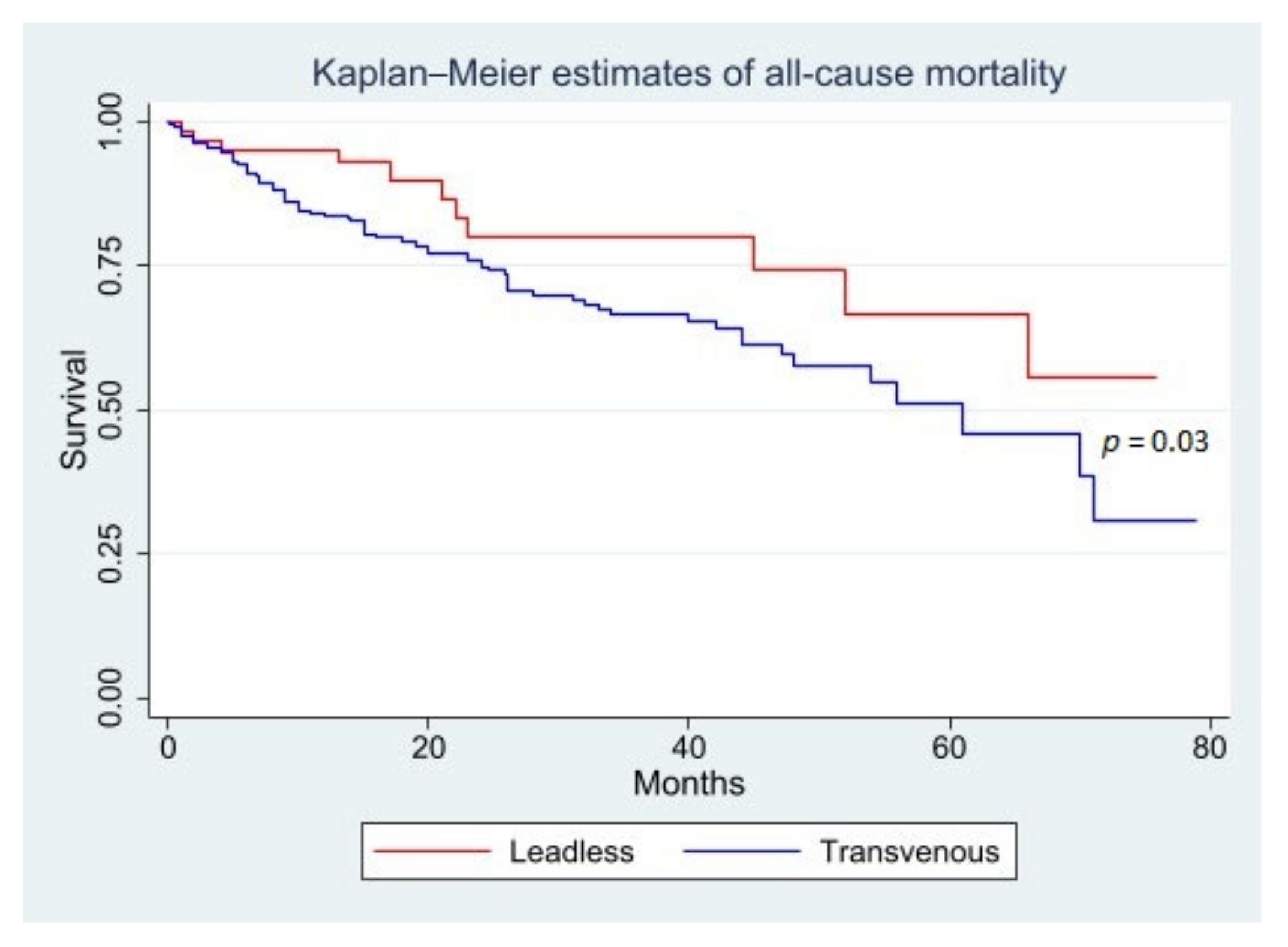
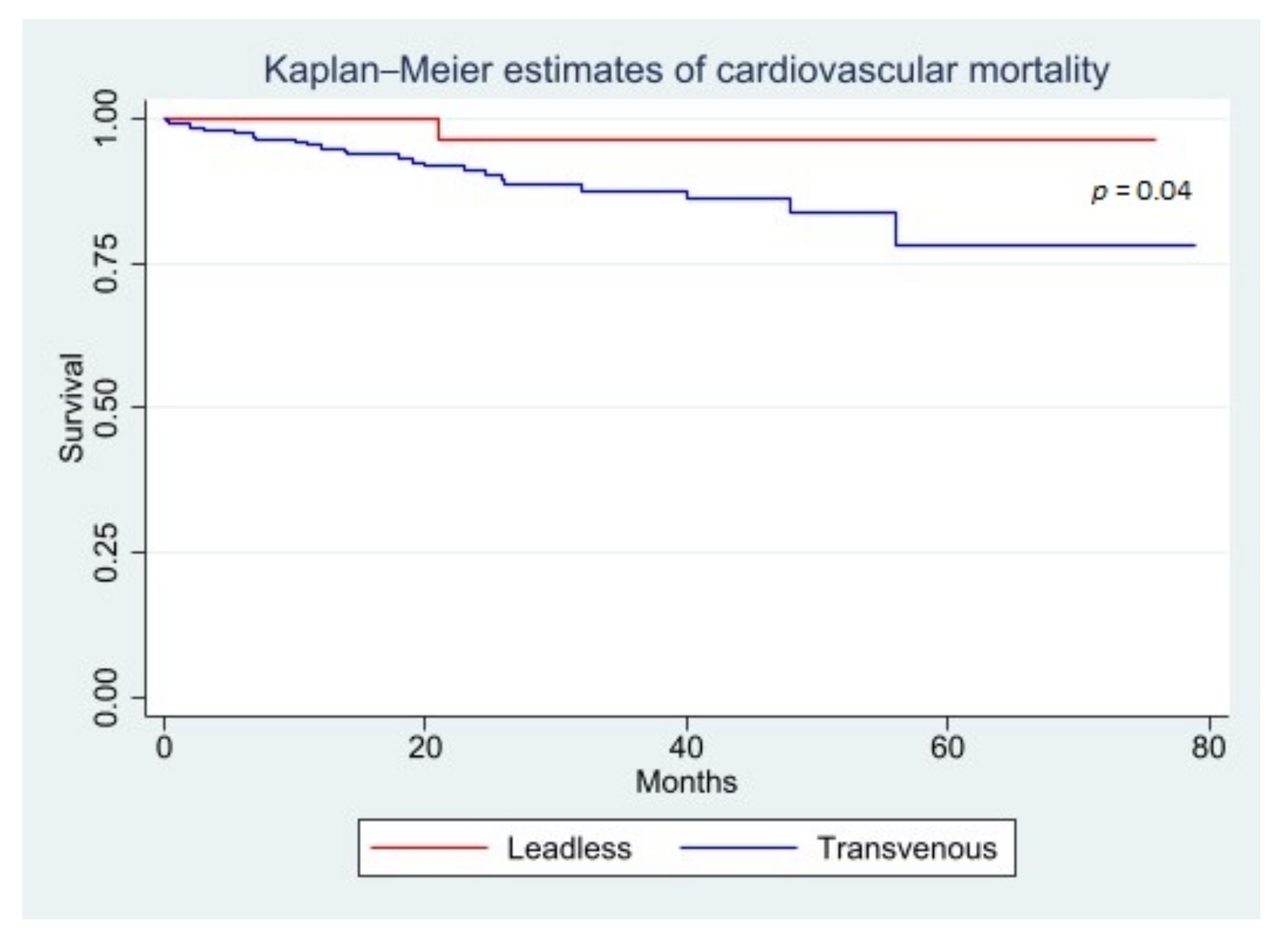
1. Error in Figure 2


2. Error in Table 3

| Multivariate Analysis of All-Cause Mortality in LL vs. TV | ||||
|---|---|---|---|---|
| Variable | Leadless (n = 72) | Transvenous (n = 272) | ||
| Hazard Ratio [95% CI] | p Value | Hazard Ratio [95% CI] | p Value | |
| Age | 1.019 [0.909–1.142] | 0.74 | 1.073 [1.026–1.122] | 0.002 |
| Female sex | 1.381 [0.227–8.394] | 0.73 | 1.507 [0.881–2.576] | 0.13 |
| Diabetes mellitus | 1.352 [0.1666–11.037] | 0.78 | 1.864 [1.020–3.406] | 0.05 |
| Chronic kidney disease * | 0.564 [0.078–4.069] | 0.57 | 1.774 [0.922–3.413] | 0.09 |
| Ischaemic heart disease | 2.109 [0.421–10.550] | 0.36 | 1.156 [0.666–2.005] | 0.61 |
| Left ventricular ejection fraction | 0.958 [0.878–1.045] | 0.33 | 1.000 [0.974–1.027] | 1.00 |
| Ventricular stimulation percentage | 5.856 [0.994–34.484] | 0.05 | 1.128 [0.655–1.943] | 0.66 |
| Multivariate Analysis of All-Cause Mortality in Both Cohorts | ||||
| Variable | Hazard Ratio [95% CI] | p Value | ||
| Leadless vs. transvenous | 0.929 [0.422–2.043] | 0.85 | ||
| Age | 1.071 [1.027–1.117] | 0.001 | ||
| Female sex | 1.473 [0.888–2.444] | 0.13 | ||
| Diabetes mellitus | 1.617 [0.911–2.869] | 0.10 | ||
| Chronic kidney disease * | 1.704 [0.953–3.047] | 0.07 | ||
| Ischaemic heart disease | 1.226 [0.741–2.031] | 0.43 | ||
| Left ventricular ejection fraction | 0.995 [0.971–1.019] | 0.67 | ||
| Percentage ventricular stimulation | 1.347 [0.805–2.253] | 0.26 | ||
3. Text Correction in Results Section Paragraph 3.5
4. Text Correction in Materials and Methods Section
5. Text Correction in Results Section
Reference
- Bertelli, M.; Toniolo, S.; Ziacchi, M.; Gasperetti, A.; Schiavone, M.; Arosio, R.; Capobianco, C.; Mitacchione, G.; Statuto, G.; Angeletti, A.; et al. Is Less Always More? A Prospective Two-Centre Study Addressing Clinical Outcomes in Leadless versus Transvenous Single-Chamber Pacemaker Recipients. J. Clin. Med. 2022, 11, 6071. [Google Scholar] [CrossRef] [Scilit] [PubMed]
Disclaimer/Publisher’s Note: The statements, opinions and data contained in all publications are solely those of the individual author(s) and contributor(s) and not of MDPI and/or the editor(s). MDPI and/or the editor(s) disclaim responsibility for any injury to people or property resulting from any ideas, methods, instructions or products referred to in the content. |
© 2023 by the authors. Licensee MDPI, Basel, Switzerland. This article is an open access article distributed under the terms and conditions of the Creative Commons Attribution (CC BY) license (https://creativecommons.org/licenses/by/4.0/).
Share and Cite
Bertelli, M.; Toniolo, S.; Ziacchi, M.; Gasperetti, A.; Schiavone, M.; Arosio, R.; Capobianco, C.; Mitacchione, G.; Statuto, G.; Angeletti, A.; et al. Correction: Bertelli et al. Is Less Always More? A Prospective Two-Centre Study Addressing Clinical Outcomes in Leadless versus Transvenous Single-Chamber Pacemaker Recipients. J. Clin. Med. 2022, 11, 6071. J. Clin. Med. 2023, 12, 2311. https://doi.org/10.3390/jcm12062311
Bertelli M, Toniolo S, Ziacchi M, Gasperetti A, Schiavone M, Arosio R, Capobianco C, Mitacchione G, Statuto G, Angeletti A, et al. Correction: Bertelli et al. Is Less Always More? A Prospective Two-Centre Study Addressing Clinical Outcomes in Leadless versus Transvenous Single-Chamber Pacemaker Recipients. J. Clin. Med. 2022, 11, 6071. Journal of Clinical Medicine. 2023; 12(6):2311. https://doi.org/10.3390/jcm12062311
Chicago/Turabian StyleBertelli, Michele, Sebastiano Toniolo, Matteo Ziacchi, Alessio Gasperetti, Marco Schiavone, Roberto Arosio, Claudio Capobianco, Gianfranco Mitacchione, Giovanni Statuto, Andrea Angeletti, and et al. 2023. "Correction: Bertelli et al. Is Less Always More? A Prospective Two-Centre Study Addressing Clinical Outcomes in Leadless versus Transvenous Single-Chamber Pacemaker Recipients. J. Clin. Med. 2022, 11, 6071" Journal of Clinical Medicine 12, no. 6: 2311. https://doi.org/10.3390/jcm12062311
APA StyleBertelli, M., Toniolo, S., Ziacchi, M., Gasperetti, A., Schiavone, M., Arosio, R., Capobianco, C., Mitacchione, G., Statuto, G., Angeletti, A., Martignani, C., Diemberger, I., Forleo, G. B., & Biffi, M. (2023). Correction: Bertelli et al. Is Less Always More? A Prospective Two-Centre Study Addressing Clinical Outcomes in Leadless versus Transvenous Single-Chamber Pacemaker Recipients. J. Clin. Med. 2022, 11, 6071. Journal of Clinical Medicine, 12(6), 2311. https://doi.org/10.3390/jcm12062311