Article

The Prescription Pattern of Heart Failure Medications in Reduced, Mildly Reduced, and Preserved Ejection Fractions


1
Centre d’Investigation Clinique Pierre Drouin—INSERM—CHRU de Nancy, Institut Lorrain du Coeur et des Vaisseaux Louis Mathieu, 54000 Nancy, France
2
Cardiology Department, CHU de Montpellier, PhyMedExp, Université de Montpellier, INSERM, CNRS, 34090 Montpellier, France
*
Author to whom correspondence should be addressed.
J. Clin. Med. 2023, 12(1), 99; https://doi.org/10.3390/jcm12010099
Submission received: 15 November 2022 / Revised: 1 December 2022 / Accepted: 20 December 2022 / Published: 22 December 2022
(This article belongs to the Section Cardiology)

Abstract

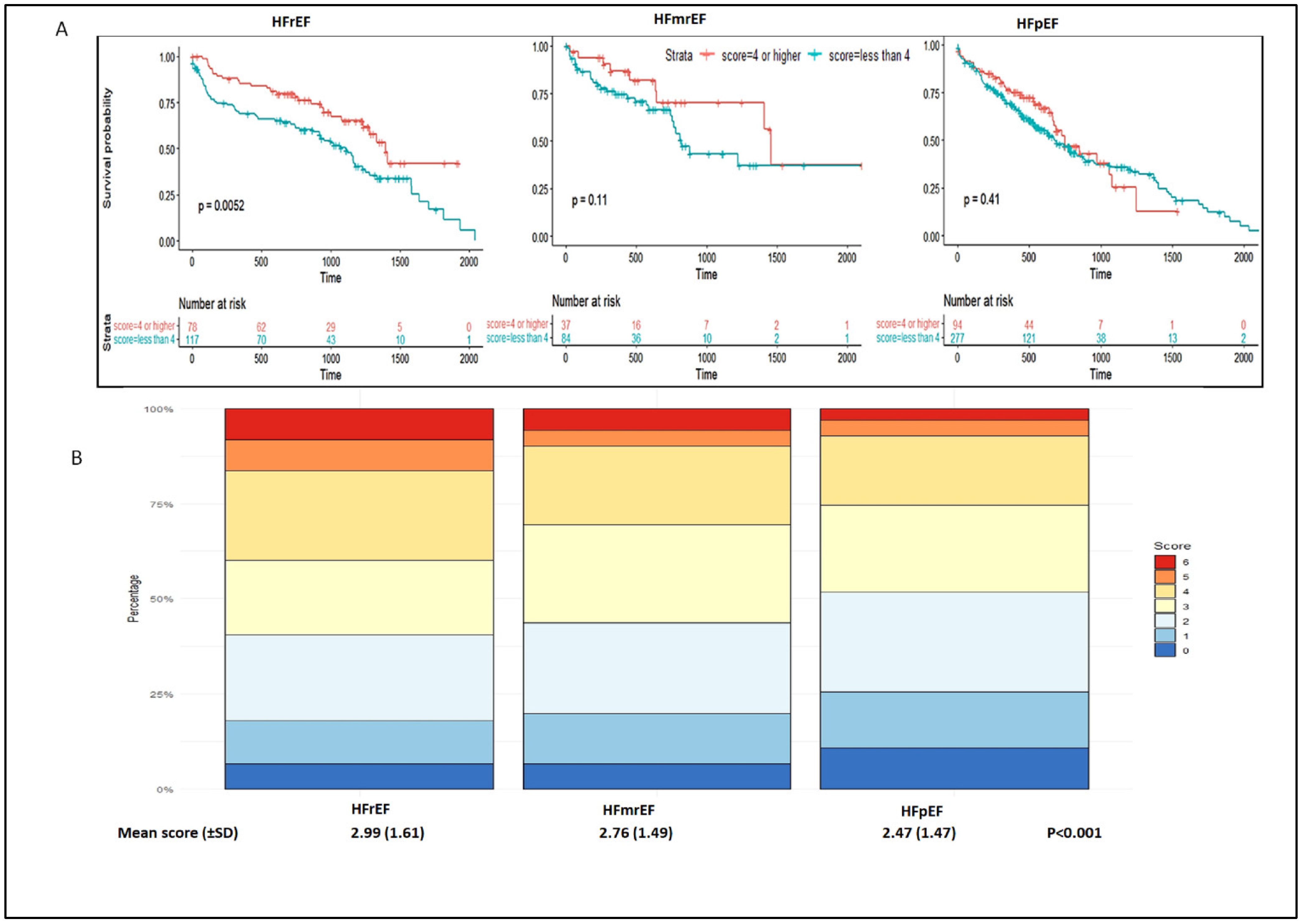
A substantial proportion of patients with heart failure (HF) receive suboptimal guideline-recommended therapy. We aimed to identify the factors leading to suboptimal drug prescription in HF and according to HF phenotypes. This retrospective, single-centre observational cohort study included 702 patients admitted for worsening HF (HF with a reduced ejection fraction [HFrEF], n = 198; HF with a mildly reduced EF [HFmrEF], n = 122; and HF with a preserved EF [HFpEF], n = 382). A score based on the prescription and dose percentage of ACEi/ARBs, β-blockers, and MRAs at discharge was calculated (a total score ranging from zero to six). Approximately 70% of patients received ACEi/ARBs/ARNi, 80% of patients received β-blockers, and 20% received MRAs. The mean HF drug dose was approximately 50% of the recommended dose, irrespective of the HF phenotype. Ischaemic heart disease was associated with a higher prescription score (ranging from 0.4 to 1) compared to no history of ischaemic heart disease, irrespective of the left ventricular EF (LVEF) level. A lower prescription score was associated with older age and male sex in HFrEF and diabetes in HFmrEF. The overall ability of the models to predict the optimal drug dose, including key HF variables (including natriuretic peptides at admission), was poor (R2 < 0.25). A higher prescription score was associated with a lower risk of re-hospitalization and death (HR: 0.75 (0.57–0.97), p = 0.03), irrespective of phenotype (p-interaction = 0.41). Despite very different HF management guidelines according to LVEF, the prescription pattern of HF drugs is poorly related to LVEF and clinical characteristics, thus suggesting that physician-driven factors may be involved in the setting of therapeutic inertia. It may also be related to drug intolerance or clinical stability that is not predicted by the patients’ profiles.
Keywords: heart failure; therapeutic inertia; cardiovascular diseases; prescription score; cardio-renal syndrome heart failure; therapeutic inertia; cardiovascular diseases; prescription score; cardio-renal syndrome