Effect of Coronal Alignment on 10-Year Survivorship of a Single Contemporary Total Knee Arthroplasty

 ,
,
Abstract
1. Introduction
2. Experimental Section
2.1. Patients
2.2. Surgical Technique and Indications
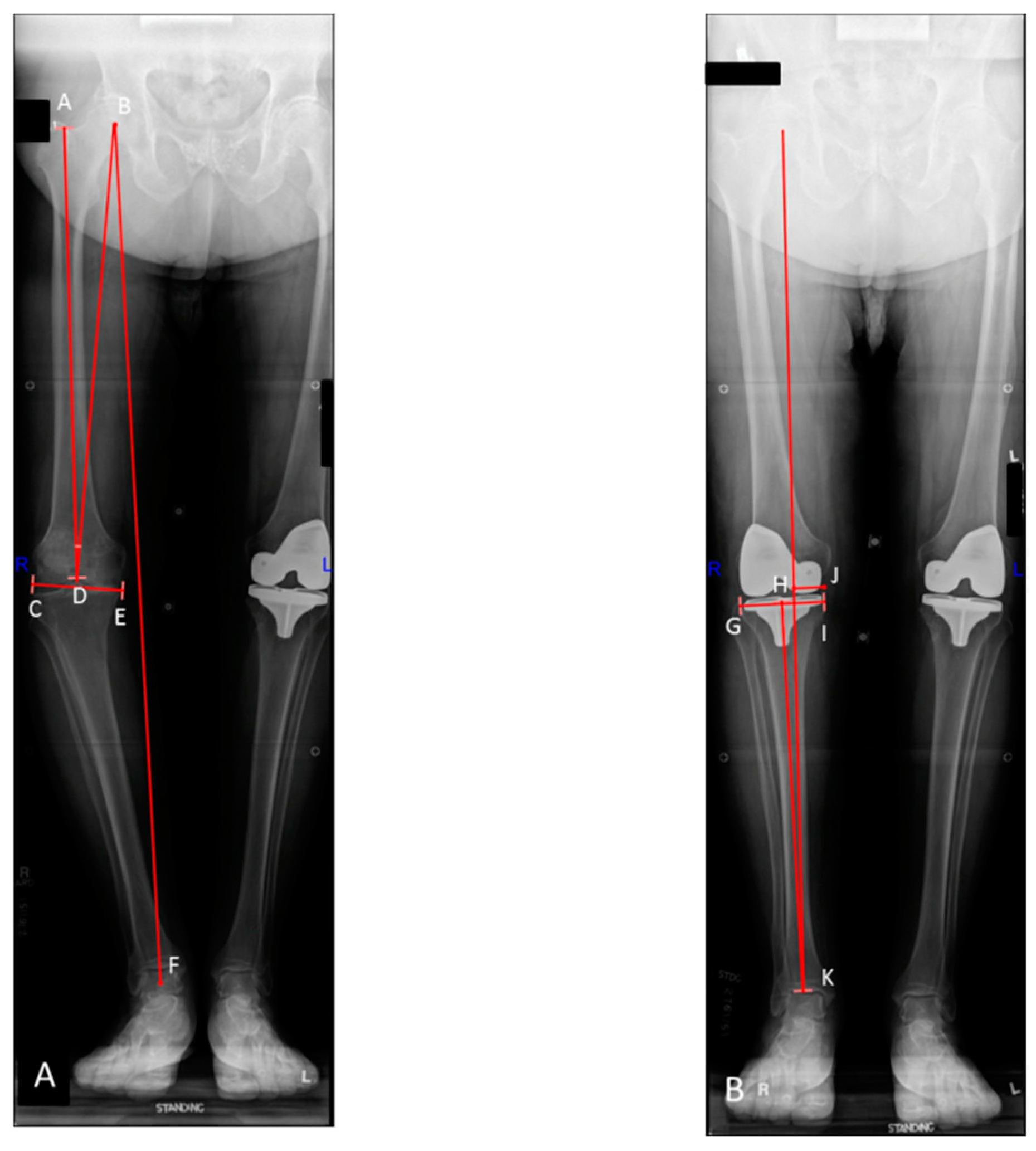
2.3. Radiographic Analysis
2.4. Clinical Outcomes
2.5. Statistical Methods
3. Results
3.1. Implant Survivorship
3.2. Clinical Outcomes
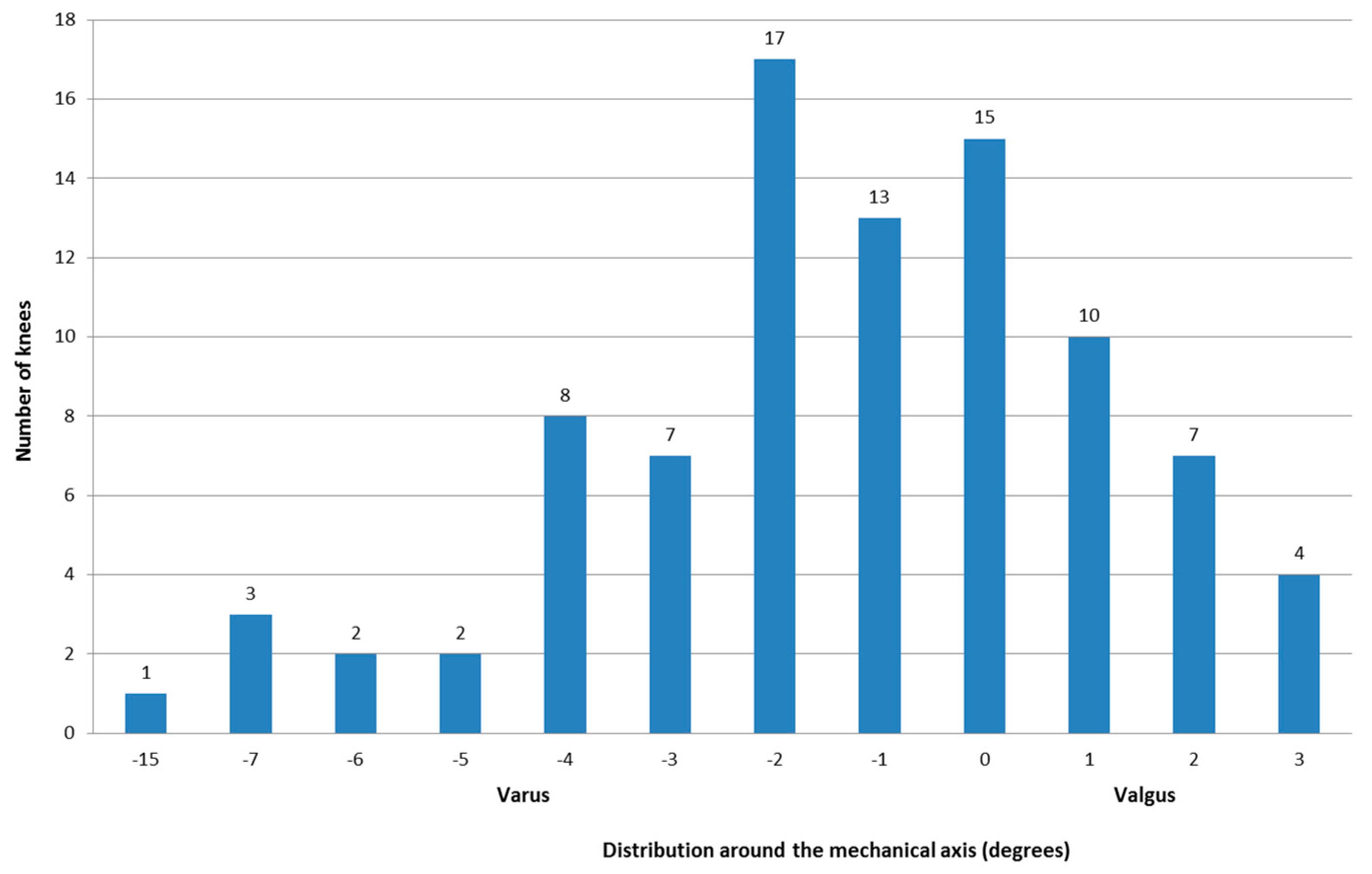
3.3. Radiographic Results
4. Discussion
5. Conclusions
Author Contributions
Funding
Institutional Review Board Statement
Informed Consent Statement
Data Availability Statement
Acknowledgments
Conflicts of Interest
References
- Mannan, A.; Vun, J.; Lodge, C.; Eyre-Brook, A.; Jones, S. Increased precision of coronal plane outcomes in robotic-assisted total knee arthroplasty: A systematic review and meta-analysis. Surgeon 2018, 16, 237–244. [Google Scholar] [CrossRef] [PubMed]
- Liow, M.H.; Xia, Z.; Wong, M.K.; Tay, K.J.; Yeo, S.J.; Chin, P.L. Robot-assisted total knee arthroplasty accurately restores the joint line and mechanical axis. A prospective randomised study. J. Arthroplast. 2014, 29, 2373–2377. [Google Scholar] [CrossRef] [PubMed]
- Abdel, M.P.; Ollivier, M.; Parratte, S.; Trousdale, R.T.; Berry, D.J.; Pagnano, M.W. Effect of Postoperative Mechanical Axis Alignment on Survival and Functional Outcomes of Modern Total Knee Arthroplasties with Cement: A Concise Follow-up at 20 Years. J. Bone Jt. Surg. Am. 2018, 100, 472–478. [Google Scholar] [CrossRef] [PubMed]
- Insall, J.N.; Hood, R.W.; Flawn, L.B.; Sullivan, D.J. The total condylar knee prosthesis in gonarthrosis. A five to nine-year follow-up of the first one hundred consecutive replacements. J. Bone Jt. Surg. Am. 1983, 65, 619–628. [Google Scholar] [CrossRef]
- Young, S.W.; Walker, M.L.; Bayan, A.; Briant-Evans, T.; Pavlou, P.; Farrington, B. The Chitranjan S. Ranawat Award: No Difference in 2-year Functional Outcomes Using Kinematic versus Mechanical Alignment in TKA: A Randomized Controlled Clinical Trial. Clin. Orthop. Relat. Res. 2017, 475, 9–20. [Google Scholar] [CrossRef] [PubMed]
- Bargren, J.H.; Blaha, J.D.; Freeman, M.A. Alignment in total knee arthroplasty. Correlated biomechanical and clinical observations. Clin. Orthop. Relat. Res. 1983, 173, 178–183. [Google Scholar]
- Hsu, R.W.; Himeno, S.; Coventry, M.B.; Chao, E.Y. Normal axial alignment of the lower extremity and load-bearing distribution at the knee. Clin. Orthop. Relat. Res. 1990, 255, 215–227. [Google Scholar] [CrossRef]
- Ritter, M.A.; Faris, P.M.; Keating, E.M.; Meding, J.B. Postoperative alignment of total knee replacement. Its effect on survival. Clin. Orthop. Relat. Res. 1994, 299, 153–156. [Google Scholar] [CrossRef]
- Jones, C.W.; Jerabek, S.A. Current Role of Computer Navigation in Total Knee Arthroplasty. J. Arthroplast. 2018, 33, 1989–1993. [Google Scholar] [CrossRef]
- Matassi, F.; Cozzi Lepri, A.; Innocenti, M.; Zanna, L.; Civinini, R.; Innocenti, M. Total Knee Arthroplasty in Patients with Extra-Articular Deformity: Restoration of Mechanical Alignment Using Accelerometer-Based Navigation System. J. Arthroplast. 2019, 34, 676–681. [Google Scholar] [CrossRef]
- Urish, K.L.; Conditt, M.; Roche, M.; Rubash, H.E. Robotic Total Knee Arthroplasty: Surgical Assistant for a Customized Normal Kinematic Knee. Orthopedics 2016, 39, e822–e827. [Google Scholar] [CrossRef] [PubMed]
- Yang, H.Y.; Seon, J.K.; Shin, Y.J.; Lim, H.A.; Song, E.K. Robotic Total Knee Arthroplasty with a Cruciate-Retaining Implant: A 10-Year Follow-up Study. Clin. Orthop. Surg. 2017, 9, 169–176. [Google Scholar] [CrossRef] [PubMed]
- Van der List, J.P.; Chawla, H.; Joskowicz, L.; Pearle, A.D. Current state of computer navigation and robotics in unicompartmental and total knee arthroplasty: A systematic review with meta-analysis. Knee Surg. Sports Traumatol. Arthrosc. 2016, 24, 3482–3495. [Google Scholar] [CrossRef]
- Cho, K.J.; Seon, J.K.; Jang, W.Y.; Park, C.G.; Song, E.K. Robotic versus conventional primary total knee arthroplasty: Clinical and radiological long-term results with a minimum follow-up of ten years. Int. Orthop. 2019, 43, 1345–1354. [Google Scholar] [CrossRef]
- Moon, Y.W.; Ha, C.W.; Do, K.H.; Kim, C.Y.; Han, J.H.; Na, S.E.; Lee, C.H.; Kim, J.G.; Park, Y.S. Comparison of robot-assisted and conventional total knee arthroplasty: A controlled cadaver study using multiparameter quantitative three-dimensional CT assessment of alignment. Comput. Aided Surg. 2012, 17, 86–95. [Google Scholar] [CrossRef]
- Blakeney, W.; Clément, J.; Desmeules, F.; Hagemeister, N.; Rivière, C.; Vendittoli, P.A. Kinematic alignment in total knee arthroplasty better reproduces normal gait than mechanical alignment. Knee Surg. Sports Traumatol. Arthrosc. 2019, 27, 1410–1417. [Google Scholar] [CrossRef] [PubMed]
- An, V.V.G.; Twiggs, J.; Leie, M.; Fritsch, B.A. Kinematic alignment is bone and soft tissue preserving compared to mechanical alignment in total knee arthroplasty. Knee 2019, 26, 466–476. [Google Scholar] [CrossRef]
- Li, Y.; Wang, S.; Wang, Y.; Yang, M. Does Kinematic Alignment Improve Short-Term Functional Outcomes after Total Knee Arthroplasty Compared with Mechanical Alignment? A Systematic Review and Meta-analysis. J. Knee Surg. 2018, 31, 78–86. [Google Scholar] [CrossRef]
- Oussedik, S.; Abdel, M.P.; Victor, J.; Pagnano, M.W.; Haddad, F.S. Alignment in total knee arthroplasty. Bone Jt. J. 2020, 102-B, 276–279. [Google Scholar] [CrossRef]
- Rivière, C.; Iranpour, F.; Auvinet, E.; Howell, S.; Vendittoli, P.A.; Cobb, J.; Parratte, S. Alignment options for total knee arthroplasty: A systematic review. Orthop. Traumatol. Surg. Res. 2017, 103, 1047–1056. [Google Scholar] [CrossRef]
- Howell, S.M.; Shelton, T.J.; Hull, M.L. Implant Survival and Function Ten Years After Kinematically Aligned Total Knee Arthroplasty. J. Arthroplast. 2018, 33, 3678–3684. [Google Scholar] [CrossRef] [PubMed]
- Howell, S.M.; Papadopoulos, S.; Kuznik, K.; Ghaly, L.R.; Hull, M.L. Does varus alignment adversely affect implant survival and function six years after kinematically aligned total knee arthroplasty? Int. Orthop. 2015, 39, 2117–2124. [Google Scholar] [CrossRef] [PubMed]
- Young, S.W.; Sullivan, N.P.T.; Walker, M.L.; Holland, S.; Bayan, A.; Farrington, B. No Difference in 5-year Clinical or Radiographic Outcomes Between Kinematic and Mechanical Alignment in TKA: A Randomized Controlled Trial. Clin. Orthop. Relat. Res. 2020, 478, 1271–1279. [Google Scholar] [CrossRef] [PubMed]
- Parratte, S.; Pagnano, M.W.; Trousdale, R.T.; Berry, D.J. Effect of postoperative mechanical axis alignment on the fifteen-year survival of modern, cemented total knee replacements. J. Bone Jt. Surg. Am. 2010, 92, 2143–2149. [Google Scholar] [CrossRef] [PubMed]
- Bonner, T.J.; Eardley, W.G.; Patterson, P.; Gregg, P.J. The effect of post-operative mechanical axis alignment on the survival of primary total knee replacements after a follow-up of 15 years. J. Bone Jt. Surg. Br. 2011, 93, 1217–1222. [Google Scholar] [CrossRef] [PubMed]
- McGrory, J.E.; Trousdale, R.T.; Pagnano, M.W.; Nigbur, M. Preoperative hip to ankle radiographs in total knee arthroplasty. Clin. Orthop. Relat. Res. 2002, 404, 196–202. [Google Scholar] [CrossRef]
- Cooke, T.D.; Scudamore, R.A.; Bryant, J.T.; Sorbie, C.; Siu, D.; Fisher, B. A quantitative approach to radiography of the lower limb. Principles and applications. J. Bone Jt. Surg. Br. 1991, 73, 715–720. [Google Scholar] [CrossRef]
- Cooke, T.D.; Sled, E.A.; Scudamore, R.A. Frontal plane knee alignment: A call for standardized measurement. J. Rheumatol. 2007, 34, 1796–1801. [Google Scholar]
- Cooke, T.D. Definition of axial alignment of the lower extremity. J. Bone Jt. Surg. Am. 2002, 84, 146–147. [Google Scholar] [CrossRef]
- Harris, W.H. Traumatic arthritis of the hip after dislocation and acetabular fractures: Treatment by mold arthroplasty. An end-result study using a new method of result evaluation. J. Bone Jt. Surg. Am. 1969, 51, 737–755. [Google Scholar] [CrossRef]
- Goel, M.K.; Khanna, P.; Kishore, J. Understanding survival analysis: Kaplan-Meier estimate. Int. J. Ayurveda Res. 2010, 1, 274–278. [Google Scholar] [CrossRef] [PubMed]
- Takahashi, T.; Ansari, J.; Pandit, H.G. Kinematically Aligned Total Knee Arthroplasty or Mechanically Aligned Total Knee Arthroplasty. J. Knee Surg. 2018, 31, 999–1006. [Google Scholar] [CrossRef] [PubMed]
- Carlson, V.R.; Post, Z.D.; Orozco, F.R.; Davis, D.M.; Lutz, R.W.; Ong, A.C. When Does the Knee Feel Normal Again: A Cross-Sectional Study Assessing the Forgotten Joint Score in Patients After Total Knee Arthroplasty. J. Arthroplast. 2018, 33, 700–703. [Google Scholar] [CrossRef] [PubMed]
- Lotke, P.A.; Ecker, M.L. Influence of positioning of prosthesis in total knee replacement. J. Bone Jt. Surg. Am. 1977, 59, 77–79. [Google Scholar] [CrossRef]



| Aligned | Outlier | Overall | |
|---|---|---|---|
| Preoperative Measurements * | |||
| Mechanical Femur | 1.0 ± 3.1 | 0.8 ± 2.6 | 1.0 ± 3.0 |
| FMA Angle | −6.0 ± 0.8 | −6.5 ± 1.3 | −6.1 ± 0.9 |
| TMA | −2.9 ± 3.7 | −4.5 ± 2.6 | −3.3 ± 3.6 |
| Overall Mechanical | −5.7 ± 6.9 | −8.1 ± 6.0 | −6.2 ± 6.7 |
| Plateau W (mm) | 83.1 ± 7.1 | 85.5 ± 9.5 | 83.5 ± 7.6 |
| Mechanical W (mm) | 21.1 ± 25.4 | 12.0 ± 14.5 | 19.4 ± 24.7 |
| Tibial Slope | 6.2 ± 3.9 | 7.5 ± 4.0 | 6.4 ± 3.9 |
| Post-operative Measurements * | |||
| Mechanical Femur | 0.3 ± 1.3 | −0.3 ± 2.4 | 0.2 ± 1.6 |
| Mechanical Tibia | −0.5 ± 1.6 | −5.5 ± 2.7 | −1.4 ± 2.7 |
| Overall Mechanical | 74.7 ± 4.7 | 77.8 ± 7.0 | 75.3 ± 5.2 |
| Plateau W (mm) | 35.0 ± 6.1 | 27.0 ± 14.1 | 33.6 ± 8.6 |
| Mechanical W (mm) | 12 ± 3.3 | 11.5 ± 3.3 | 11.9 ± 3.3 |
| Tibial Slope | 1.7 ± 2.8 | 2.1 ± 2.9 | 1.7 ± 2.8 |
| Aligned | Outlier | |
|---|---|---|
| Pre-op | ||
| Knee Society scores | 32.1 ± 21.1 (0.0–92.0) | 33.8 ± 11.0 (19.0–43.0) |
| Function Score | 55.8 ± 16.5 (20.0–100.0) | 53.2 ± 15.4 (30.0–80.0) |
| Pain Score | 16.5 ± 10.8 (0.0–50.0) | 17.9 ± 9.8 (0.0–30.0) |
| 2 Year Post-op | ||
| Knee Society Score | 90.7 ± 6.0 (74.0–95.0) | 88.9 ± 7.5 (73.0–95.0) |
| Function Score | 81.9 ± 18.7 (40.0–100.0) | 64.0 ± 21.3 (30.0–100.0) |
| Pain Score | 48.2 ± 5.0 (20.0–50.0) | 46.3 ± 7.7 (20.0–50.0) |
| 5 Year Post-op | ||
| Knee Society Score | 92.0 ± 3.9 (80.0–95.0) | 89.4 ± 5.9 (78.0–94.0) |
| Function Score | 78.0 ± 21.1 (20.0–100.0) | 76.2 ± 30.3 (0.0–100.0) |
| Pain Score | 48.3 ± 5.5 (10.0–50.0) | 46.2 ± 11.0 (10.0–50.0) |
| 10 Year Post-op | ||
| Knee Society Score | 92.4 ± 4.3 (74.0–95.0) | 93.7 ± 0.6 (93.0–94.0) |
| Function Score | 70.5 ± 25.4 (0.0–100.0) | 45.0 ± 31.3 (0.0–100.0) |
| Pain Score | 48.3 ± 6.1 (10.0–50.0) | 45.4 ± 9.1 (20.0–50.0) |
Publisher’s Note: MDPI stays neutral with regard to jurisdictional claims in published maps and institutional affiliations. |
© 2021 by the authors. Licensee MDPI, Basel, Switzerland. This article is an open access article distributed under the terms and conditions of the Creative Commons Attribution (CC BY) license (http://creativecommons.org/licenses/by/4.0/).
Share and Cite
Tibbo, M.E.; Limberg, A.K.; Perry, K.I.; Pagnano, M.W.; Stuart, M.J.; Hanssen, A.D.; Abdel, M.P. Effect of Coronal Alignment on 10-Year Survivorship of a Single Contemporary Total Knee Arthroplasty. J. Clin. Med. 2021, 10, 142. https://doi.org/10.3390/jcm10010142
Tibbo ME, Limberg AK, Perry KI, Pagnano MW, Stuart MJ, Hanssen AD, Abdel MP. Effect of Coronal Alignment on 10-Year Survivorship of a Single Contemporary Total Knee Arthroplasty. Journal of Clinical Medicine. 2021; 10(1):142. https://doi.org/10.3390/jcm10010142
Chicago/Turabian StyleTibbo, Meagan E., Afton K. Limberg, Kevin I. Perry, Mark W. Pagnano, Michael J. Stuart, Arlen D. Hanssen, and Matthew P. Abdel. 2021. "Effect of Coronal Alignment on 10-Year Survivorship of a Single Contemporary Total Knee Arthroplasty" Journal of Clinical Medicine 10, no. 1: 142. https://doi.org/10.3390/jcm10010142
APA StyleTibbo, M. E., Limberg, A. K., Perry, K. I., Pagnano, M. W., Stuart, M. J., Hanssen, A. D., & Abdel, M. P. (2021). Effect of Coronal Alignment on 10-Year Survivorship of a Single Contemporary Total Knee Arthroplasty. Journal of Clinical Medicine, 10(1), 142. https://doi.org/10.3390/jcm10010142