Article

Simple Analytical Approximations for Donnan Ion Partitioning in Permeable Ion-Exchange Membranes Under Reverse Electrodialysis Conditions


by
Antonio Ángel Moya
Departamento de Física, Universidad de Jaén, 23071 Jaén, Spain
Membranes 2025, 15(12), 365; https://doi.org/10.3390/membranes15120365 (registering DOI)
Submission received: 29 October 2025 / Revised: 19 November 2025 / Accepted: 22 November 2025 / Published: 1 December 2025

Abstract

Reverse electrodialysis (RED) is a relatively recent technology for renewable energy harvesting from the interaction of river and seawater. This paper revisits the thermodynamic equilibrium governing the ionic transport processes through ion-exchange membranes (IEMs) under RED conditions and theoretically derives approximate analytical expressions for the ionic concentrations at the inner boundaries of a permeable membrane with well-stirred baths. The equation for the Donnan ion partitioning at the membrane–solution interface, which is based on the equality of the electrochemical potential in the two phases, is analysed for binary salts with symmetric (1:1) and asymmetric (2:1) electrolytes, by considering bathing solutions with the equivalent concentrations 0.02 M in the dilute bath, and 0.5, 1, and 1.5 M in the concentrate one. Simple approximate analytical expressions exhibiting the evolution with the membrane fixed-charge concentration of the counter-ionic concentrations at the inner boundaries of the membrane, the concentration gradients inside the membrane, the total Donnan electric potential, and the ionic partitioning coefficients have been derived. The approximate generalised expressions for a general z1:z2 binary electrolyte are also presented for the first time.

1. Introduction

Electrodialysis (ED) and reverse electrodialysis (RED) are electro-membrane processes that play central roles in desalination, wastewater treatment, and energy harvesting from salinity gradients. The increasing global demand for freshwater and renewable energy continues to drive innovation and accelerate advancements in those technologies [1]. While ED is a well-established technique, current research is increasingly focused on boosting its sustainability and aligning with circular economy principles through membrane recycling and system miniaturization. RED, though still emerging, offers exciting potential for low-carbon energy generation [2], particularly when coupled with hybrid technologies such as Reverse Osmosis (RO) [3].
RED is a relatively recent technology for harvesting renewable energy from the interaction of river and seawater [4,5,6,7]. The salinity difference between these two water sources enables the selective transport of counter-ions from seawater to freshwater through an ion-exchange membrane (IEM), creating a voltage drop across the membrane that can power an external electrical device [8,9,10,11,12,13,14,15,16]. Current research is increasingly focused on understanding ionic transport through IEMs separating electrolyte solutions of differing salinities due to the rapid developments and promising future applications of this technology.
The Nernst–Planck (NP) analysis is the most widely used theoretical treatment to describe the transport processes of ionic species though IEMs on the basis of the Teorell–Meyer–Sievers model [17]. This analysis is also used when describing the ionic transport processes in a RED stack including hydrodynamic conditions in the diffusion boundary layers adjacent to the membranes [18,19,20,21]. The ionic concentration gradients in the IEMs play a central role in describing the behaviour of a permeable membrane under salinity gradients in RED stacks. They allow us to obtain the open circuit voltage (OCV) and the membrane resistance, which are key parameters to quantify the electric power density and to evaluate the performance of a RED stack [22]. The usual assumption in highly charged membranes by which the co-ion concentration is zero and that of the counter-ion is the equivalent concentration of the fixed-charge of the membrane [23], which is known as the total co-ion exclusion assumption [24], is not meaningful in permeable membranes under RED conditions. This is because the ionic concentrations in the bathing solutions take different values corresponding to the concentrate and dilute baths, and then the assumption would deal to zero ionic concentration gradients in the IEM, which only allows us to consider ohmic potential differences across the membrane. The Donnan equilibrium equation for the ionic partitioning at each membrane–solution interface must be analytically or numerically solved to obtain the ionic concentrations at the inner boundaries of the membrane [25]. This is particularly interesting in multi-ionic systems to assess the power loss due to the uphill transport of divalent ions [26,27]. Recently, interesting studies have used advanced models to include activity coefficients and steric effects in those surveys [28,29,30,31,32,33]. However, although there is real analytical solution for the ionic concentrations in IEMs with symmetric binary electrolytes, simple approximate analytical expressions, particularly those applicable to the concentrate bath, have been not explored enough.
The objective of this paper is to revisit the thermodynamic equilibrium governing the ionic transport processes through permeable IEMs with well-stirred baths under RED conditions and theoretically derive approximate analytical expressions for the ionic concentrations at the inner boundaries of the membrane, which are subsequently compared with exact solutions to evaluate their accuracy and applicability. The equation for the Donnan ion partitioning at the membrane–solution interface, which is based on the equality of the electrochemical potential in the two phases, is analysed for binary electrolytes of both symmetric (1:1) and asymmetric (2:1) types, by considering bathing solutions with the equivalent concentrations 0.02 M in the dilute bath and 0.5, 1, and 1.5 M in the concentrate one. Firstly, the ion partitioning equations expressed by using the counter-ionic concentration as the variable are expanded, and simple approximate analytical expressions for the counter-ion concentration gradients corresponding to small deviations from ideal behaviour are derived. Then, approximate expressions for the ionic concentrations at the inner boundaries of the membrane are obtained. The relative error in counter-ion concentrations when replacing the exact solution for a 1:1 electrolyte with the approximate solution and that of the total co-ion exclusion hypothesis is evaluated as a function of the membrane fixed-charge concentration. Secondly, the total Donnan electric potential, which results in the partial exclusion of co-ions providing the basis of the membrane permselectivity, is analysed at each membrane–solution interface. Finally, simple approximate expressions exhibiting the evolution with the membrane fixed-charge concentration of the ionic partitioning coefficients are derived. The approximate generalised expressions for a general z1:z2 binary electrolyte are also presented for the first time.

2. Ionic Partitioning in Permeable IEMs

Let us consider a membrane placed between two well-stirred bathing solutions constituted by a mixture of the binary salts with N ionic species of valence zi (i = 1, …, N). The membrane is an IEM of cationic type, i.e., a membrane having a fixed charge with negative sign. We will denote by ci0K the molar concentrations (mol/m3) of ion i in the bathing solution K (K = L for the left and K = R for the right), which obeys the electroneutrality condition of each solution:
i   =   1 N z i   c i 0 K   =   0
At the equilibrium state of the system, the electrochemical potential of each ionic species in both the membrane and solution phases is assumed to be equal. Consequently, the ionic partitioning at the interface K can be modelled by applying the Donnan equilibrium conditions given by the extended equation:
c i K   =   c i 0 K   γ i S γ i M   Φ i   exp       z i   F R   T   ϕ D K
where ciK is the molar concentration (mol/m3) of ion i at the inner boundary of the membrane of the interface K γ i S  and  γ i M , respectively, are the activity coefficients of ion i in the solution and membrane phases; Φi is the non-electrostatic partitioning coefficient of ion i accounting for the steric effects in the systems; ϕDK is the Donnan electric potential (V) at the interface K; F is the Faraday constant (C/mol); R is the gas constant (J/mol·K); and T is the absolute temperature (K). It should be noted that this analysis ignores the phenomenon of concentration polarization in the diffusion boundary layers adjacent to the membrane when considering well-stirred baths to equate the interfacial concentrations to the bulk values.
If X stands for the fixed-charge concentration inside the membrane (mol/m3), the electrical neutrality condition at the interface K can be written as follows:
i   =   1 N z i   c i K   =   X
It must be noted that X is usually expressed as a function of experimental data as follows:
X   =   ω   χ   =   ω   I E C S D   ρ
where ω is the valence of the fixed-charge groups, χ is the concentration of fixed-charge groups (mol/m3), SD is the swelling degree (kg water/kg dry membrane), ρ is the water density (kg/m3), and IEC is the ionic exchange capacity (mol·eq/kg). Here, we will consider homogeneous distributions of the fixed charge in the membrane, although inhomogeneous distributions with fixed-charge concentrations depending on position [34] and distributions due to ionic adsorption processes [35] are often found in the literature.
Therefore, if the partitioning coefficient at the interface K, kK, is defined as follows:
k K   =   exp       F R   T   ϕ D K
the extended equation for the ion partitioning is
i   =   1 N z i   c i 0 K   γ i S γ i M   Φ i   k K z i   =   X
which should consider models to describe non-ideal behaviours in membranes [36]. In this work, we are only interested in deriving analytical approximations for ionic concentrations based on the relationship between those in the bathing solutions and the fixed-charge concentration of the membrane [37]. Therefore, we will consider the activity coefficients, as well the coefficient for steric effects, to be unity ( γ i S  = 1,  γ i M  = 1, Φi = 1).
Now, the total Donnan electric potential, ϕD, is obtained from the Donnan potentials at each interface, ϕDK. Then, by evaluating it from the equilibrium of the ion with the valence zi, it can be written as follows:
ϕ D   =   ϕ D L     ϕ D R   =   R   T z i   F   ln   c i L c i 0 L   +   ln   c i 0 R c i R   =   R   T z i   F   ln   c i L c i R   +   ln   c i 0 R c i 0 L
It we account for the Nernst potential, ϕN, given by
ϕ N   =   R   T z i   F   ln   c i 0 R c i 0 L
the difference between the total Donnan electric potential, ϕD, and the Nernst potential, ϕN, which represents the maximum potential achievable across the membrane, is as follows:
Δ ϕ   =   ϕ D     ϕ N   =   R   T z i   F   ln   c i L c i R
It must be noted that this variation in the Donnan potential is zero when considering the total co-ion exclusion hypothesis, i.e., ideally selective membranes. Also, it must be considered that the OCV of an IEM system in a RED stack is mainly determined by the total Donnan electric potential with the corresponding sign reversal for ci0L > ci0R [22]. Additionally, according to the Teorell–Meyer–Sievers model, the electric potential arising from the contribution of the electric field inside the membrane must be included and added to the Donnan potential to obtain the system potential, even when simplifications are considered [38]. The total electric voltage and power in operando RED stacks are then derived from the OCV and the stack resistance [39].

3. Results and Discussion

3.1. Symmetric Electrolyte

For a 1:1 binary electrolyte (N = 2), such as NaCl, with z1 = 1, z2 = −1, and the ionic concentrations in the bathing solutions given by the following equation:
c 10 K   =   c 20 K   =   c 0 K
the ionic partitioning coefficient, by considering Equation (6), must be obtained from the numerical solution of the following algebraic equation:
k K 2     k K   X c 0 K     1   =   0
The solution of this equation gives the well-known ionic partitioning coefficient for a binary electrolyte [21]:
k K   =   X 2   c 0 K   +   1   +   X 2   c 0 K 2
At the limit X → 0 for weakly charged membranes, kK → 1, such as when corresponding to a neutral membrane. At the limit for strongly charged membranes when X >> c0K, this expression leads to
k K   =   X c 0 K
which is the solution of the ion partitioning equation under the total co-ion exclusion hypothesis. Now, the counter-ionic concentrations at the inner boundaries of the membrane are
c 1 K   =   k K   c 10 K   =   k K   c 0 K
and they can be expressed as follows:
c 1 K   =   X   1 2   +   1 2   1   +   2   c 0 K X 2
This result can also be obtained from the solution of the well-known equation:
c 1 K   c 2 K   =   c 1 K c 1 K     X   =   c 0 K 2
Equation (15) can now be developed into a Taylor series around the variable c0K/X, when it tends to zero, in the following way:
c 1 K   =   X   1 +   c 0 K X 2     c 0 K X 4   +  
Thus, by retaining terms up to the second order, it follows that
c 1 K   =   X   +   c 0 K 2 X
and the concentration gradient in the IEM (see sketch in Figure 1), which is defined as follows:
Δ c 1   =   c 1 L     c 1 R
can be written as follows:
Δ c 1   =   k L     k R   c 0 k   =   c 0 L 2 X     c 0 R 2 X
This term is positive whatever the value of X because c0L >> c0R, and it tends to zero for the highest values of the membrane fixed-charge concentration, X. Then, the counter-ion concentration in the dilute interface can be approximated by c1R = X, while the concentration gradient is as follows:
Δ   c 1   =   c 0 L 2 X
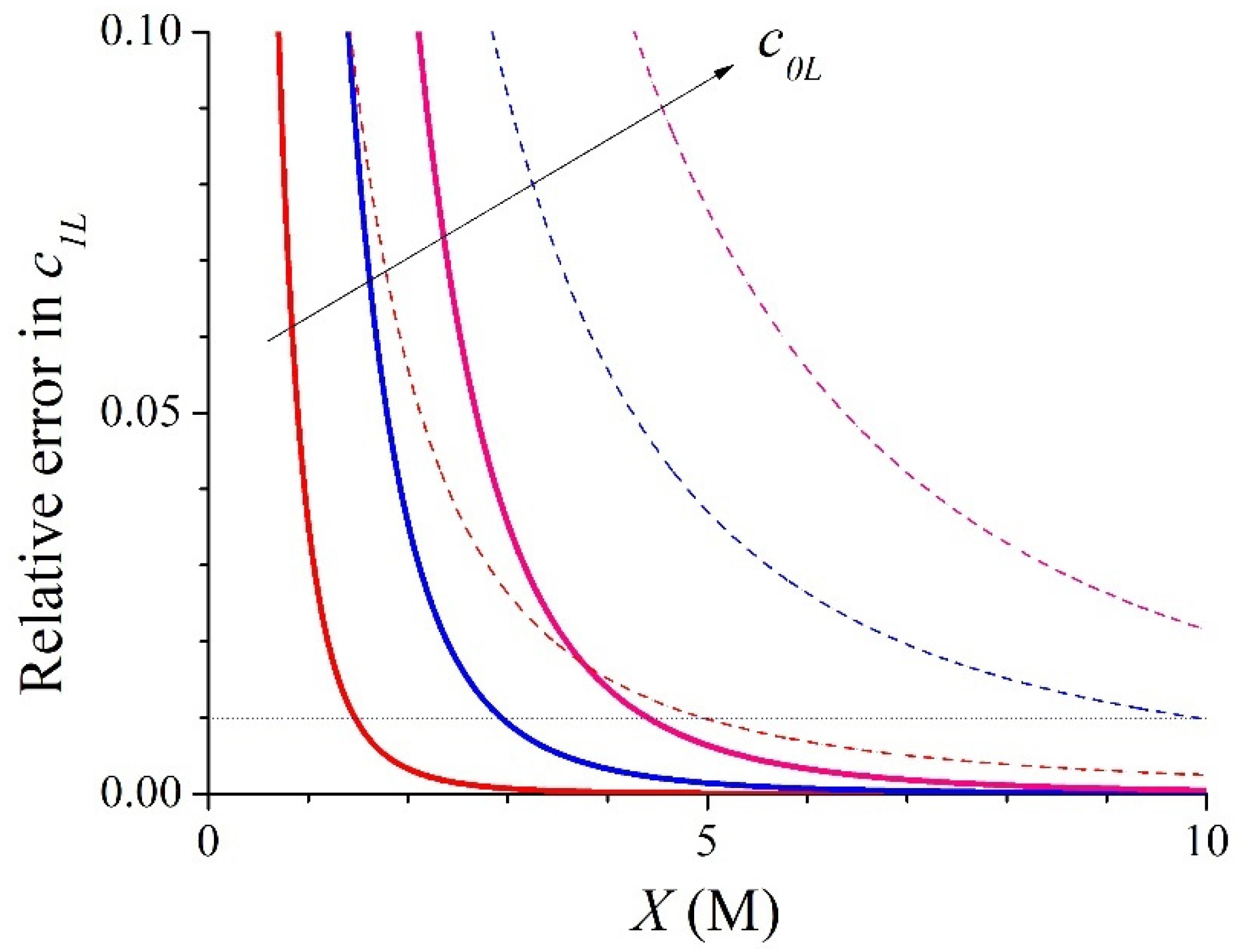
The relative error for the counter-ion concentration when considering Equation (18) instead of Equation (15) at the dilute interface with c0R = 20 mM is very small (<0.16% for X > 0.5 M). However, this relative error increases for the concentrate interface. Figure 2 shows the relative error for the counter-ion concentration when taking Equation (18) instead of the exact Equation (15). Now, it is lower than 1% for c0L = 0.5 M when X > 1.45 M, for c0L = 1 M when X > 2.9 M, and for c0L = 1.5 M when X > 4.4 M. In this figure, the relative errors when considering the total co-ion exclusion hypothesis, i.e., the value X for the counter-ion concentration instead of Equation (15), have been also plotted by means of dashed lines. Figure 2 shows the significant improvement in the accuracy of the counter-ionic concentration introduced by the approximate expression in Equation (18) with respect to an ideally selective membrane behaviour.
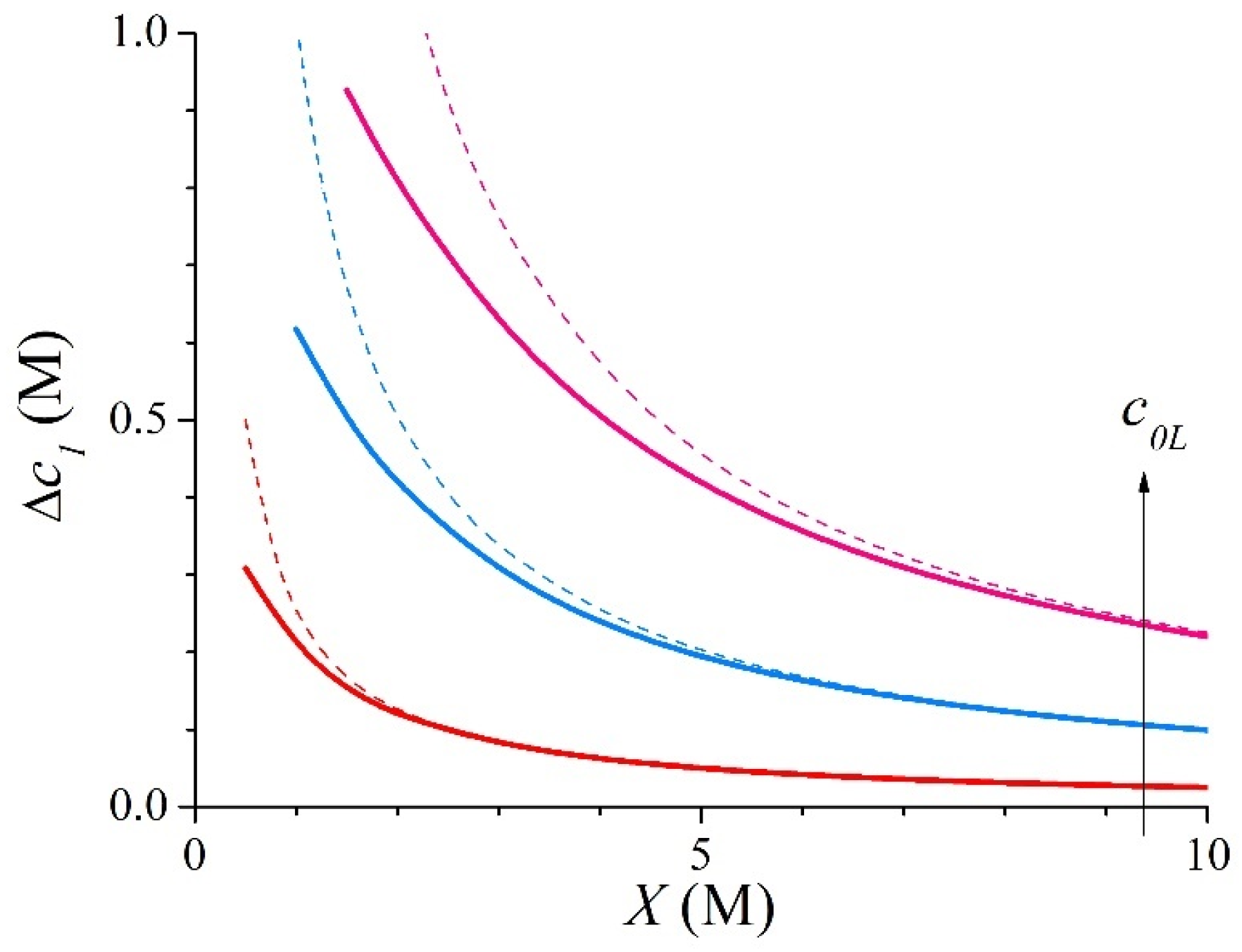
Figure 3 shows the evolution of the counter-ionic concentration gradient inside the membrane with X varying from 0.5 M to 10 M for systems with c0R = 0.02 M and c0L = 0.5, 1, and 1.5 M. In this figure, the results obtained from the approximate expression given by Equation (21) have also been plotted by means of dashed lines. This figure shows that the cationic concentration gradient increases as the salt concentration in the concentrate bath, c0L, increases. Also, Figure 3 shows that the cationic concentration gradient decreases as the membrane fixed-charge concentration, X, increases. The results shown in Figure 3 exhibit an excellent agreement with the approximate expression in Equation (21). The approximate values are higher than the exact ones for each value of X. This agreement is better for the highest values of X and the smallest values of c0L.
On the other hand, it must be noted that the corresponding approximation for the ionic partitioning coefficient is as follows:
k K   =   c 1 K c 0 K   =   X c 0 K   +   c 0 K X
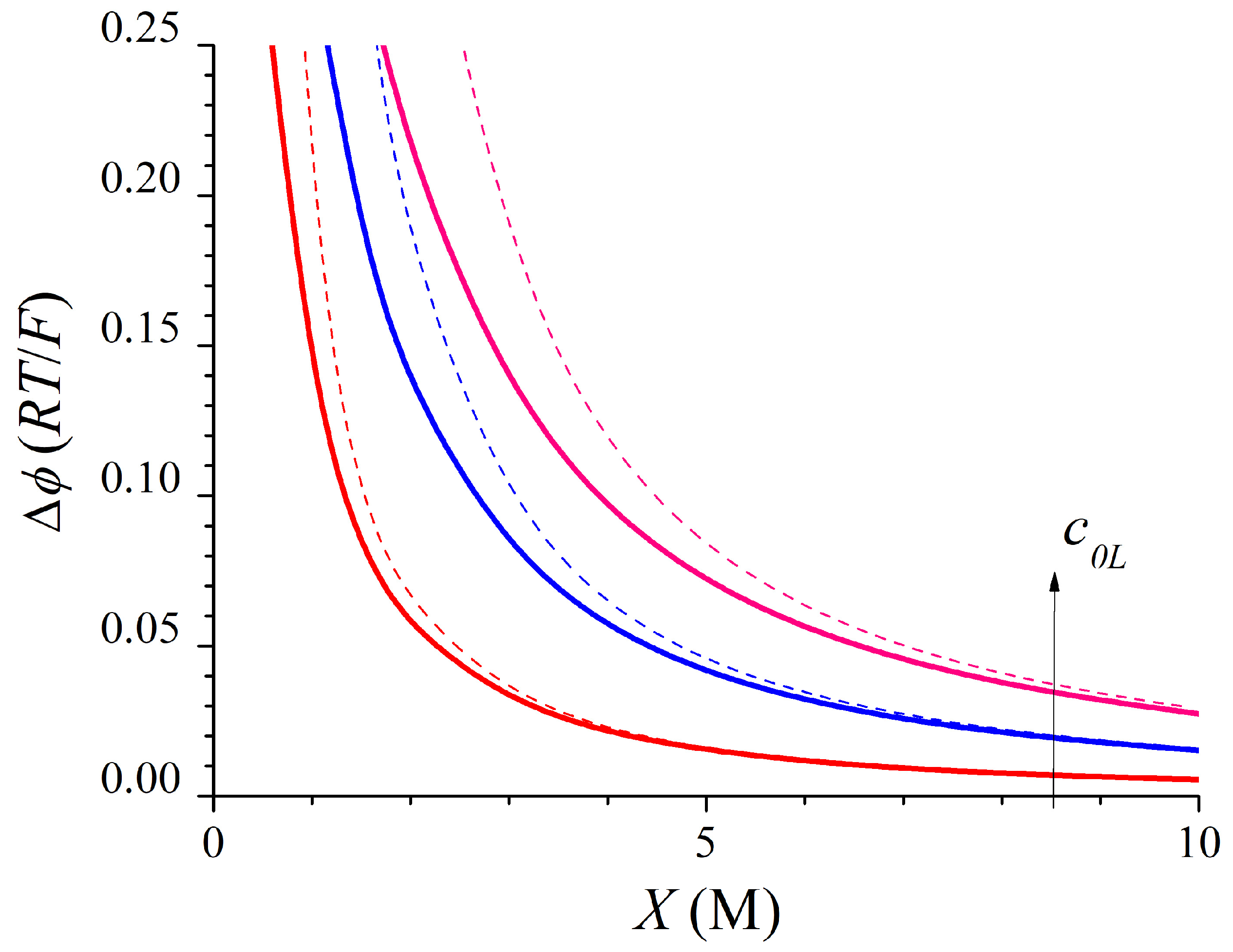
Now, the parameters needed to evaluate the performance of an RED stack require knowing of the diffusion coefficients inside the membrane and the membrane length. Then, for the sake of generality, we will evaluate only the difference between the total Donnan electric potential and the Nernst potential, ∆ϕ. This can be approximated by the following equation:
Δ ϕ   =   R   T F   ln   1   +   c 0 L 2 X 2
which, after the series expansion of the logarithmic function, gives the following:
Δ ϕ   =   R   T F   c 0 L X 2
The Nernst potential for the 1:1 binary electrolyte is given by the following equation:
ϕ N   =   R   T F   ln   c 0 R c 0 L
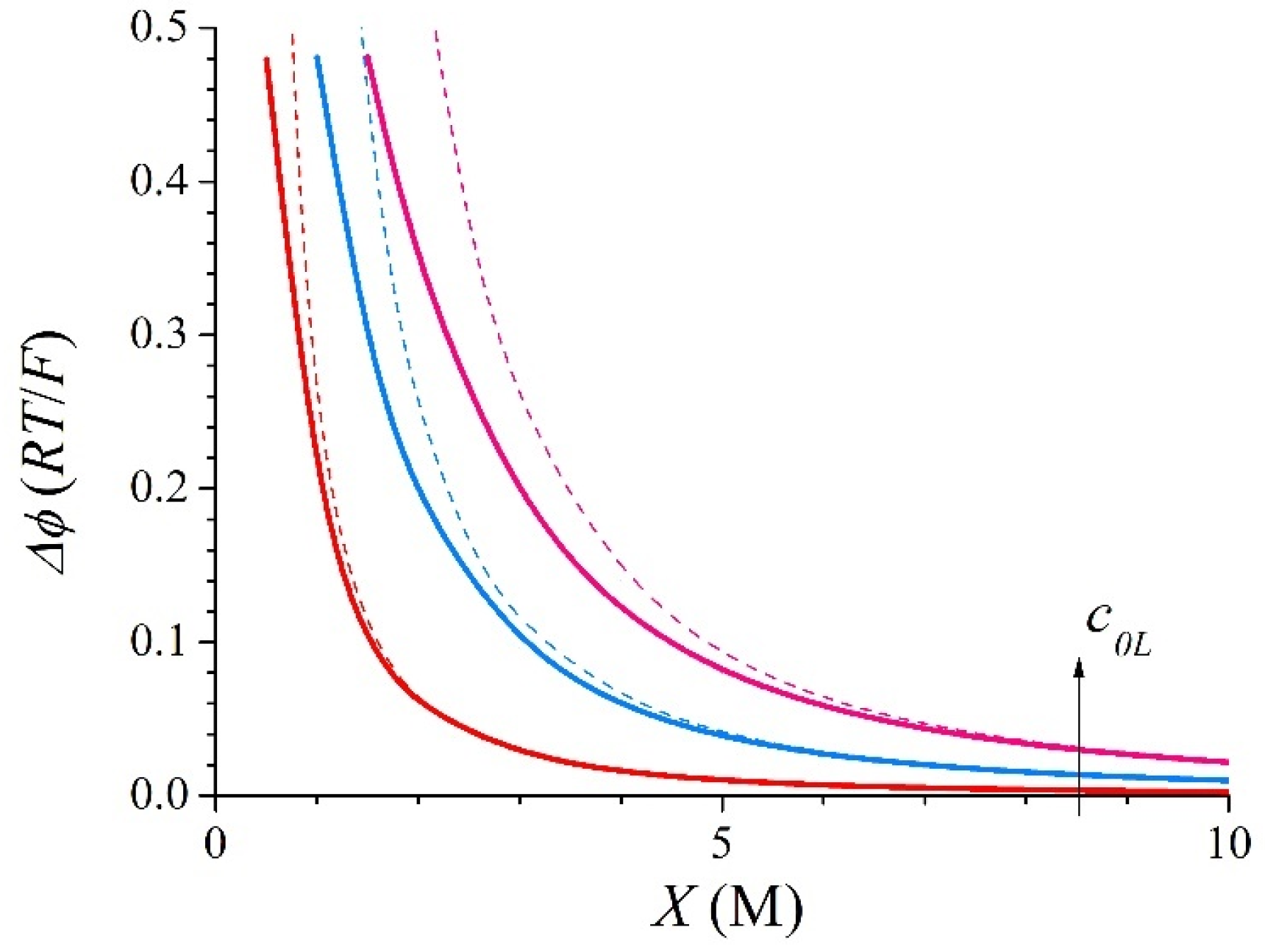
and it is negative because c0L >> c0R = 0.02 M. In particular, N/RT = −3.219 for c0L = 0.5 M, −3.912 for c0L = 1 M, and −4.317 for c0L = 1.5 M. Then, the absolute value of the total Donnan electric potential is lower than the absolute value of the Nernst potential for permeable membranes. Thus, the OCV in an RED stack decreases when employing permeable membranes with values of the fixed-charge concentrations comparable to the concentration of the concentrate bath [22]. Figure 4 shows the evolution with the membrane fixed-charge concentration, X, of the difference between the total Donnan electric potential and the Nernst potential, ∆ϕ. The terms corresponding to the approximate expressions given by Equation (24) have also been plotted by means of dashed lines. In Figure 4 the excellent agreement between the exact analytical results and those derived from the approximate expressions for the highest values of X and the smallest values of c0L can be clearly observed. It must be observed that, for a given value of X, the approximate values of the electric potentials are higher than the exact ones. Also, it must be noted that Equation (24) includes the approximation of the logarithmic function in Equation (23) and it leads to significant relative errors in the electric potential for the lowest values of the membrane fixed-charge concentration.
Finally, Table 1 shows the different approximate expressions and it compares different exact values with the approximate ones, including relative errors, corresponding to the cationic concentrations, the variation of the total Donnan electric potential, and the ionic partitioning coefficient, for c0L = 0.5 M, which is the usual value for RED with river and sea water. From the obtained results and those for the relative errors shown in Figure 2, we have found that the approximations we have considered can then be used to interpret experimental results in typical IEM systems [40], including RED stacks [41,42,43], because the commercial IEMs generally fall in the range of approximately 1–5 M.

3.2. Asymmetric Electrolyte

Results corresponding to the generalization of the above section for z1:z2 binary electrolytes can be found in Appendix A. Now, for a 2:1 binary salt, such as MgCl2, with N = 2, z1 = 2, z2 = −1, and the ionic concentrations in the bathing solutions given by the following equations:
c 10 K   =   c 0 K 2
c 20 K   =   c 0 K
where c0K represents equivalent ionic concentrations. Then, the ionic partitioning coefficient, by considering Equation (6), must be obtained from the numerical solution of the following third-degree algebraic equation:
k K 3     k K   X c 0 K     1   =   0
At the limit X → 0 for weakly charged membranes, kK → 1, such as when corresponding to a neutral membrane. At the limit when X >> c0K, this expression leads to the following equation:
k K   =   X c 0 K
which is the solution of the ion partitioning equation under the hypothesis of total co-ion exclusion:
k K 2     X c 0 K   =   0
Now, the ionic concentrations at the inner boundaries of the membrane are as follows:
c 1 K   =   k K 2   c 10 K   =   1 2   k K 2   c 0 K
Then, for X >> c0K, one obtains the well-known result X/2 for the cationic concentrations, which can be appropriately used in the inner boundary at the dilute interface.
In order to obtain approximate expressions for the counter-ionic concentration gradient, we will combine Equation (6) and Equation (31) instead of dealing with the analytical solution in a complex variable of Equation (28). Thus, one obtains the following:
c 1 K 3 / 2     X 2   c 1 K 1 / 2 =   c 0 K 2 3 / 2
Now, we will write the counter-ionic concentration as follows:
c 1 K   =   X 2   +   y K
and we will use the following series expansions [40]:
c 1 K 1 / 2 =   X 2   +   y K 1 / 2 =   X 2 1 / 2   +   1 2   2 X 1 / 2   y K
c 1 K 3 / 2 =   X 2   +   y K 3 / 2 =   X 2 3 / 2   +   3 2   X 2 1 / 2   y K
At the limit when X >> c0K, i.e., for small deviations of the counter-ion concentration with respect to the ideally selective behaviour, this expression leads to the following:
y K   =   c 0 K 3 4   X
Then, the counter-ion concentration gradient in the IEM can be written as follows:
Δ c 1   =   c 1 L     c 1 R   =   c 0 L 3 4   X     c 0 R 3 4   X
This term is positive whatever the value of X because c0L >> c0R, and it tends to zero for the highest values of the membrane fixed-charge concentration. Then, the counter-ionic concentration in the dilute interface can be approximated by c1R = X/2, while the concentration gradient is as follows:
Δ   c 1   =   c 0 L 3 4   X
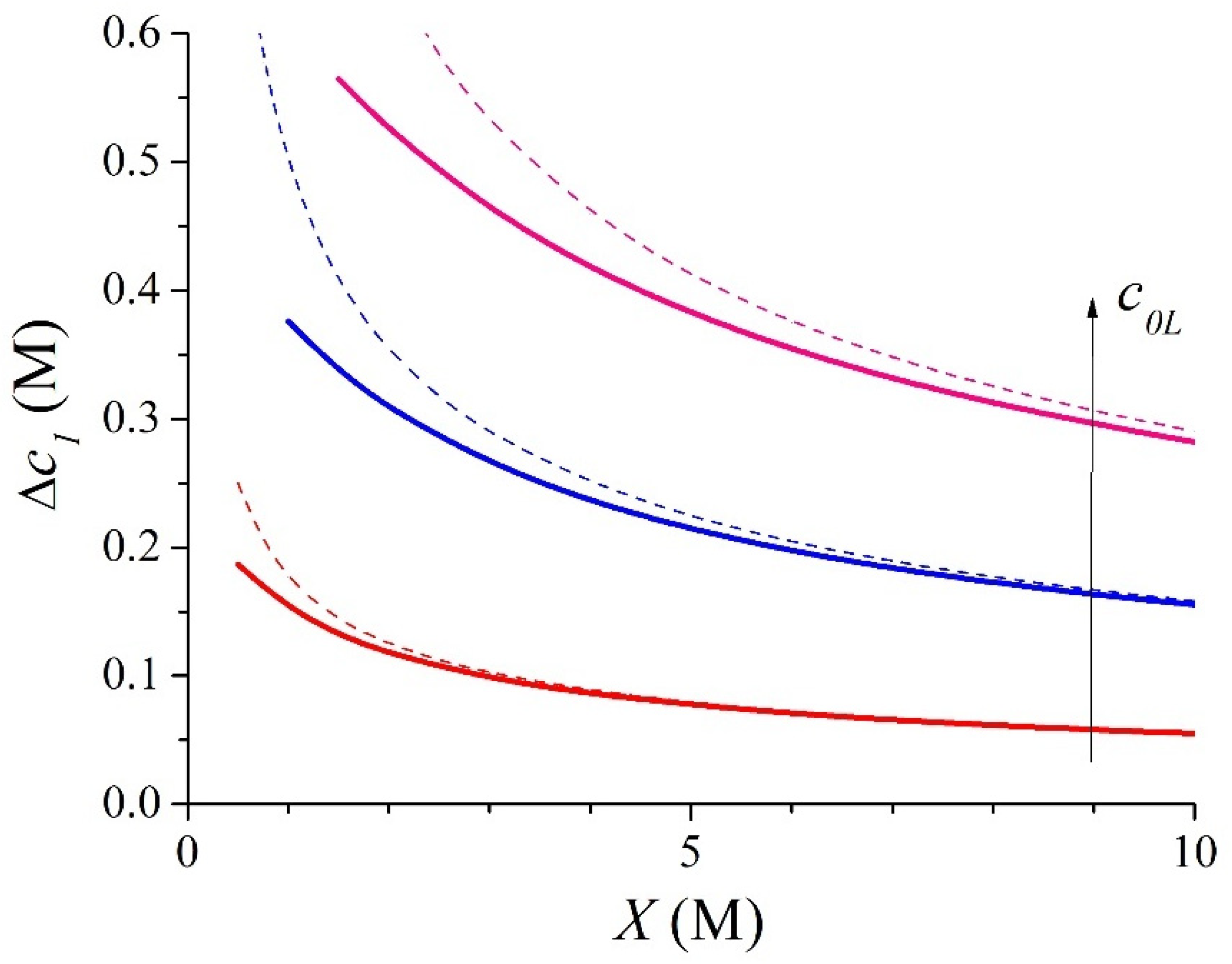
Figure 5 shows the evolution of the counter-ion concentration gradient inside the membrane with the membrane fixed-charge concentration, X, varying from 0.5 M to 10 M. The chosen bathing concentrations are c0R = 0.02 M and c0L = 0.5, 1, and 1.5 M. The exact values have been obtained by the numerical solution of Equation (32) in a symbolic computation software such as Mathematica (version 13.1), which uses a combination of the Newton–Raphson method and safeguarded line-search strategies to ensure convergence [44]. The approximate expressions given by Equation (38) have also been plotted in this figure by means of dashed lines. Figure 5 shows that the cationic concentration gradient, ∆c1, increases as the salt concentration in the concentrate bath, c0L, increases. Also, Figure 5 shows that the concentration gradient decreases as the membrane fixed-charge concentration, X, increases. The results shown in Figure 5 exhibit an excellent agreement with the approximate analytical expression in Equation (38). This agreement is better for the highest values of X and the smallest values of c0L. Again, the approximate values are higher than the exact ones for each value of X.
In this case, the ion partitioning coefficient can be approximated by the following equation:
k K   =   X c 0 K   +   c 0 K X
Finally, the difference between the total Donnan electric potential and the Nernst potential can be approximated as follows:
Δ ϕ   =   R   T 2   F   ln   1   +   c 0 L 3 X 3
which, after the series expansion of the logarithmic function for (X/c0L) → 0, gives the following equation:
Δ ϕ   =   R   T 2   F   c 0 L X 3 / 2
Now, for a binary salt with a divalent cation, the Nernst potential is as follows:
ϕ N   =   R   T 2   F   ln   c 0 R c 0 L
Again, the Nernst potential is negative because c0L >> c0R = 0.02 M. For a divalent counter-ion, one obtains N/RT = −1.609 for c0L = 0.5 M, −1.956 for c0L = 1 M, and −2.159 for c0L = 1.5 M. Then, the absolute value of the total Donnan electric potential is lower than that of the Nernst potential for permeable membranes. Thus, the OCV in an RED stack decreases when employing non-ideally selective membranes with values of the fixed-charge concentrations comparable to the ionic concentration of the concentrate bath [22]. Figure 6 shows the evolution with the membrane fixed-charge concentration, X, varying from 0.5 M to 10 M, of the difference between the total Donnan electric potential and the Nernst potential. The terms corresponding to the approximate expressions given by Equation (41) have also been plotted by means of dashed lines. In Figure 6 the excellent agreement between the exact results and those derived from the approximate expressions for the highest values of X and the smallest values of c0L can be clearly observed.
Now, Table 2 shows the approximate expressions corresponding to the parameters describing the ion partitioning for the 2:1 asymmetric electrolyte. Also, Table 2 compares different exact values with the approximate ones corresponding to the counter-ionic concentrations, the variation of the total Donnan electric potential, and the ionic partitioning coefficient for c0L = 0.5 M. From the obtained results, we have found that the relative error in the counter-ionic concentration is lower that 1% for X > 1.5 M.
Finally, it is worth highlighting the significant role of the asymmetry of the electrolyte in the ion partitioning equations, such as can be inferred from the results shown in Appendix A. In particular, for a 2:1 electrolyte, such as Na2SO4 (N = 2, z1 = 1, z2 = −2, c10K = c0K, and c20K = c0K/2) the approximate ion partitioning coefficient is given by the following equation:
k K   =   X c 0 K   +   c 0 K X 2
which significantly differs from that in Equation (39) for the 2:1 electrolyte. The counter-ionic concentration in the dilute interface can be approximated by c1R = X while the concentration gradient is as follows:
Δ   c 1   =   X   c O L X 3
and the variation of the total Donnan electric potential is as follows:
Δ ϕ   =   R   T F   c 0 L X 3

4. Conclusions

A simplified theoretical analysis of the thermodynamic equilibrium governing the ionic transport through IEMs under RED conditions has been presented and particularly analysed for both symmetric (1:1) and asymmetric (2:1) electrolytes. By examining the equilibrium conditions at the membrane–solution interfaces and the associated Donnan ion partitioning, approximate analytical expressions for the counter-ion concentration gradients inside the membrane have been successfully derived.
This study highlights that the ion partitioning coefficient strongly depends on the bathing ionic concentrations, on the membrane fixed-charge concentration, and on the asymmetry of the electrolyte. Therefore, the common assumption of the total co-ion exclusion is not meaningful in permeable membranes under RED conditions, especially when the bathing solutions exhibit large salinity differences.
The derived approximate expressions correspond to small deviations of the counter-ion concentration with respect to the ideally selective behaviour, and they provide useful theoretical tools to estimate ionic concentrations and Donnan potential differences within IEMs with realistic values of the fixed-charge concentration, without relying on complex exact or numerical solutions. The proposed formulations are the result of practical interest for the development of simplified and easy-to-implement models of electro-membrane processes. This approach will allow us to get a clearer physical interpretation of how membrane fixed-charge concentration and electrolyte asymmetry influence the energy conversion efficiency in RED systems.

Funding

This research received no external funding.

Data Availability Statement

The raw data supporting the conclusions of this article will be made available by the author on request.

Conflicts of Interest

The author declares no conflicts of interest.

Appendix A. Generalised Expressions for a z1:z2 Electrolyte (z1c1K = −z2c2K = c0K)

Total co-ion exclusion hypothesis
k K z 1     X c 0 K   =   0 c 1 K   =   c 10   k K z 1   =   X z 1
Ion partitioning equations
k K z 1     z 2     X c 0 K   k K   z 2     1   =   0 c 1 K z 1     z 2 z 1     X z 1   c 1 K   z 2 z 1   =   c 0 K z 1 z 1     z 2 z 1
Expansions
c 1 K z 1     z 2 z 1 =   X z 1   +   y K z 1     z 2 z 1 =   X z 1 z 1     z 2 z 1   +   z 1     z 2 z 1   X z 1   z 2 z 1   y K
c 1 K   z 2 z 1 =   X z 1   +   y K   z 2 z 1 =   X z 1   z 2 z 1     z 2 z 1   X z 1   z 2 z 1     1   y K
Counter-ion concentrations
c 1 L   =   X z 1   +   y L   =   X z 1   +   X z 1   c 0 L X z 1     z 2 z 1 c 1 R   =   X z 1
Counter-ion concentration gradient
Δ c 1   =   c 1 L     c 1 R   =   X z 1   c 0 L X z 1     z 2 z 1
Variation in total Donnan electric potential
Δ ϕ   =   R   T z 1   F   c 0 L X z 1     z 2 z 1
Ionic partitioning coefficient
k L   =   X c 0 L   +   c 0 L X   z 2 z 1 1 / z 1 k R   =   X c 0 L

References

  1. Lee, B.; Wang, L.; Wang, Z.; Coopera, N.J.; Elimelech, M. Directing the research agenda on water and energy technologies with process and economic analysis. Energy Environ. Sci. 2023, 16, 714–722. [Google Scholar] [CrossRef]
  2. Lin, S.; Wang, Z.; Wang, L.; Elimelech, M. Salinity gradient energy is not a competitive source of renewable energy. Joule 2024, 8, 334–343. [Google Scholar] [CrossRef]
  3. Vanoppen, M.; Criel, E.; Walpot, G.; Vermaas, D.A.; Verliefde, A. Assisted reverse electrodialysis—Principles; mechanisms; potential. Npj Clean Water 2018, 1, 9. [Google Scholar] [CrossRef]
  4. Logan, B.E.; Elimelech, M. Membrane-based processes for sustainable power generation using water. Nature 2012, 488, 313–319. [Google Scholar] [CrossRef]
  5. Hong, J.G.; Zhang, B.; Glabman, S.; Uzal, N.; Dou, X.; Zhang, H.; Wei, X.; Chen, Y. Potential ion exchange membranes and system performance in reverse electrodialysis for power generation: A review. J. Membr. Sci. 2015, 486, 71–88. [Google Scholar] [CrossRef]
  6. Tufa, R.A.; Pawlowski, S.; Veerman, J.; Bouzeka, K.; Fontananova, E.; di Profio, G.; Velizarov, S.; Crespo, J.G.; Nijmeijer, K.; Curcio, E. Progress and prospects in reverse electrodialysis for salinity gradient energy conversion and storage. Appl. Energy 2018, 225, 290–331. [Google Scholar] [CrossRef]
  7. Mei, Y.; Tang, C.Y. Recent developments and future perspectives of reverse electrodialysis technology: A review. Desalination 2018, 425, 156–174. [Google Scholar] [CrossRef]
  8. Turek, M.; Bandura, B. Renewable energy by reverse electrodialysis. Desalination 2007, 205, 67–74. [Google Scholar] [CrossRef]
  9. Post, J.W.; Hamelers, H.V.M.; Buisman, C.J.N. Energy recovery from controlled mixing salt and fresh water with a reverse electrodialysis system. Environ. Sci. Technol. 2008, 42, 5785–5790. [Google Scholar] [CrossRef]
  10. Veerman, J.; Saakes, M.; Nijmeijer, K.; Harmsen, G.J. Reverse electrodialysis: Performance of a stack with 50 cells on the mixing of sea and river water. J. Membr. Sci. 2009, 327, 136–144. [Google Scholar] [CrossRef]
  11. Dlugolecki, P.; Gambier, A.; Nijmeijer, K.; Wessling, M. Practical potential of reverse electrodialysis as process for sustainable energy generation. Environ. Sci. Technol. 2009, 43, 6888–6894. [Google Scholar] [CrossRef]
  12. Vermass, D.A.; Bajracharya, S.; Sales, B.B.; Saakes, M.; Hamelers, B.; Nijmeijer, K. Clean energy generation using capacitive electrodes in reverse electrodialysis. Energy Environ. Sci. 2013, 6, 643–651. [Google Scholar] [CrossRef]
  13. Kim, J.; Kim, S.J.; Kim, D.-K. Energy harvesting from salinity gradient by reverse electrodialysis with anodic alumina nanopores. Energy 2013, 51, 413–421. [Google Scholar] [CrossRef]
  14. Tedesco, M.; Brauns, E.; Cipollina, A.; Micale, G.; Modica, P.; Russo, G.; Helsen, J. Reverse electrodialysis with saline waters and concentrated brines: A laboratory investigation towards technology scale-up. J. Membr. Sci. 2015, 492, 9–20. [Google Scholar] [CrossRef]
  15. Kang, B.; Kim, H.J.; Kim, D.-K. Membrane electrode assembly for energy harvesting from salinity gradient by reverse electrodialysis. J. Membr. Sci. 2018, 550, 286–295. [Google Scholar] [CrossRef]
  16. Gómez-Coma, L.; Ortiz-Martínez, V.M.; Carmona, J.; Palacio, L.; Prádanos, P.; Fallanza, M.; Ortiz, A.; Ibañez, R.; Ortiz, I. Modeling the influence of divalent ions on membrane resistance and electric power in reverse electrodialysis. J. Membr. Sci. 2019, 592, 117385. [Google Scholar] [CrossRef]
  17. Helfferich, F. Ion Exchange; McGraw-Hill: Columbus, OH, USA, 1962. [Google Scholar]
  18. Tedesco, M.; Hamelers, H.V.M.; Biesheuvel, P.M. Nernst-Planck transport theory for (reverse) electrodialysis: I. Effect of co-ion transport through the membranes. J. Membr. Sci. 2016, 510, 370–381. [Google Scholar] [CrossRef]
  19. Moya, A.A. A numerical comparison of optimal load and internal resistances in ion-exchange membrane systems under reverse electrodialysis conditions. Desalination 2016, 392, 25–33. [Google Scholar] [CrossRef]
  20. Moya, A.A. Numerical simulation of ionic transport processes through bilayer ion-exchange membranes in reverse electrodialysis stacks. J. Membr. Sci. 2017, 524, 400–408. [Google Scholar] [CrossRef]
  21. Gurreri, L.; Battaglia, C.; Tamburini, A.; Cipollina, A.; Micalle, G.; Ciofalo, M. Multi-physical modelling of reverse electrodialysis. Desalination 2017, 423, 52–64. [Google Scholar] [CrossRef]
  22. Moya, A.A. A Nernst-Planck analysis on the contributions of the ionic transport in permeable ion-exchange membranes to the open circuit voltage and the membrane resistance in reverse electrodialysis stacks. Electrochim. Acta 2017, 238, 134–141. [Google Scholar] [CrossRef]
  23. Hu, J.; Hu, Y.; Zhang, M.; Huang, J.; Tan, X.; Zeng, J.; Liu, X.; Tao, Y.; Ma, S.; Zhang, J.; et al. Development of binary-salt working solutions for improving the performance of reverse electrodialysis. Desalination 2025, 614, 119176. [Google Scholar] [CrossRef]
  24. Kontturi, K.; Murtomäki, L.; Manzanares, J.A. Ionic Transport Processes; Oxford University Press: Oxford, UK, 2008. [Google Scholar]
  25. Gokturk, P.A.; Sujanani, R.; Qian, J.; Wang, Y.; Katz, L.E.; Freeman, B.D.; Crumlin, E.J. The Donnan potential revealed. Nat. Commun. 2022, 13, 5880. [Google Scholar] [CrossRef]
  26. Moya, A.A. Uphill transport in improved reverse electrodialysis by removal of divalent cations in the dilute solution: A Nernst-Planck based study. J. Membr. Sci. 2020, 598, 117784. [Google Scholar] [CrossRef]
  27. Emdadi, A.; Greenlee, L.F.; Logan, B. Uphill transport of sulfate and chloride ions under different operational conditions of a reverse electrodialysis (RED) stack. Chem. Eng. J. 2025, 508, 160897. [Google Scholar] [CrossRef]
  28. Luo, T.; Zhong, Y.; Xu, D.; Wang, X.; Wessling, M. Combining Manning’s theory and the ionic conductivity experimental approach to characterize selectivity of cation exchange membranes. J. Membr. Sci. 2021, 629, 119263. [Google Scholar] [CrossRef]
  29. Wang, R.; Duddu, R.; Lin, S. Extended Donnan-Manning theory for selective ion partition and transport in ion exchange membrane. J. Membr. Sci. 2023, 681, 121782. [Google Scholar] [CrossRef]
  30. Elozeiri, A.A.E.; Dykstra, J.E.; Rijnaarts, H.H.M.; Lammertink, R.G.H. Multi-component ion equilibria and transport in ion-exchange membranes. J. Colloid Interface Sci. 2024, 673, 971–984. [Google Scholar] [CrossRef]
  31. Purpura, G.; Papiewska, E.; Culcasi, A.; Filingeri, A.; Tamburini, A.; Ferrari, M.C.; Micale, G.; Cipollina, A. Modelling of selective ion partitioning between ion-exchange membranes and highly concentrated multi-ionic brines. J. Membr. Sci. 2024, 700, 122659. [Google Scholar] [CrossRef]
  32. Wang, R.; Biesheuvel, P.M.; Elimelech, M. Extended Donnan model for ion partitioning in charged nanopores: Application to ion-exchange membranes. J. Membr. Sci. 2024, 705, 122921. [Google Scholar] [CrossRef]
  33. Lim, Z.J.; Kho, M.; Che, X.; Goh, K.B. Selective divalent/monovalent ion partitioning in cation exchange membranes. Sep. Purif. Technol. 2025, 356, 129833. [Google Scholar] [CrossRef]
  34. Moleón, J.A.; Moya, A.A. Network simulation of the electrical response of ion-exchange membranes with fixed charge varying linearly with position. J. Electroanal. Chem. 2008, 613, 23–34. [Google Scholar] [CrossRef]
  35. Moleón, J.A.; Moya, A.A. Transient electrical response of ion-exchange membranes with fixed-charge due to ion adsorption. A network simulation approach. J. Electroanal. Chem. 2009, 633, 306–313. [Google Scholar] [CrossRef]
  36. Kamcev, J.; Galizia, M.; Benedetti, F.M.; Jang, E.-.S.; Paul, D.R.; Freeman, B.D.; Manning, G.S. Partitioning of mobile ions between ion exchange polymers and aqueous salt solutions: Importance of counter-ion condensation. Phys. Chem. Chem. Phys. 2016, 18, 6021. [Google Scholar] [CrossRef]
  37. Saavedra, A.; Valdés, H.; Velásquez, J.; Hernández, S. Comparative analysis of Donnan steric partitioning pore model and dielectric exclusion applied to the fractionation of aquous saline solutions through nanofiltration. Chemengineering 2024, 8, 39. [Google Scholar] [CrossRef]
  38. Green, Y. Goldman-Hodgkin-Katz equation; reverse electrodialysis, and everything in between. Phys. Rev. E 2025, 111, 064408. [Google Scholar] [CrossRef]
  39. Veerman, J.; Gómez-Coma, L.; Ortiz, A.; Ortiz, I. Resistance of ion exchange membranes in aqueous mixtures of monovalent and divalent ions and the effect on reverse electrodialysis. Membranes 2023, 13, 322. [Google Scholar] [CrossRef]
  40. Galama, A.H.; Post, J.W.; Stuart, M.A.C.; Biesheuvel, P.M. Validity of the Boltzmann equation to describe Donnan equilibrium at the membrane–solution interface. J. Membr. Sci. 2013, 442, 131–139. [Google Scholar] [CrossRef]
  41. Brauns, E. Salinity gradient power by reverse electrodialysis: Effect of model parameters on electrical power output. Desalination 2009, 237, 378–391. [Google Scholar] [CrossRef]
  42. Zhu, X.; He, W.; Logan, B.E. Reducing pumping energy by using different flow rates of high and low concentration solutions in reverse electrodialysis cells. J. Membr. Sci. 2015, 486, 215–221. [Google Scholar] [CrossRef]
  43. Luo, T.; Abdu, S.; Wessling, M. Selectivity of ion exchange membranes: A review. J. Membr. Sci. 2018, 555, 429–454. [Google Scholar] [CrossRef]
  44. Available online: https://www.wolfram.com/mathematica (accessed on 1 November 2025).
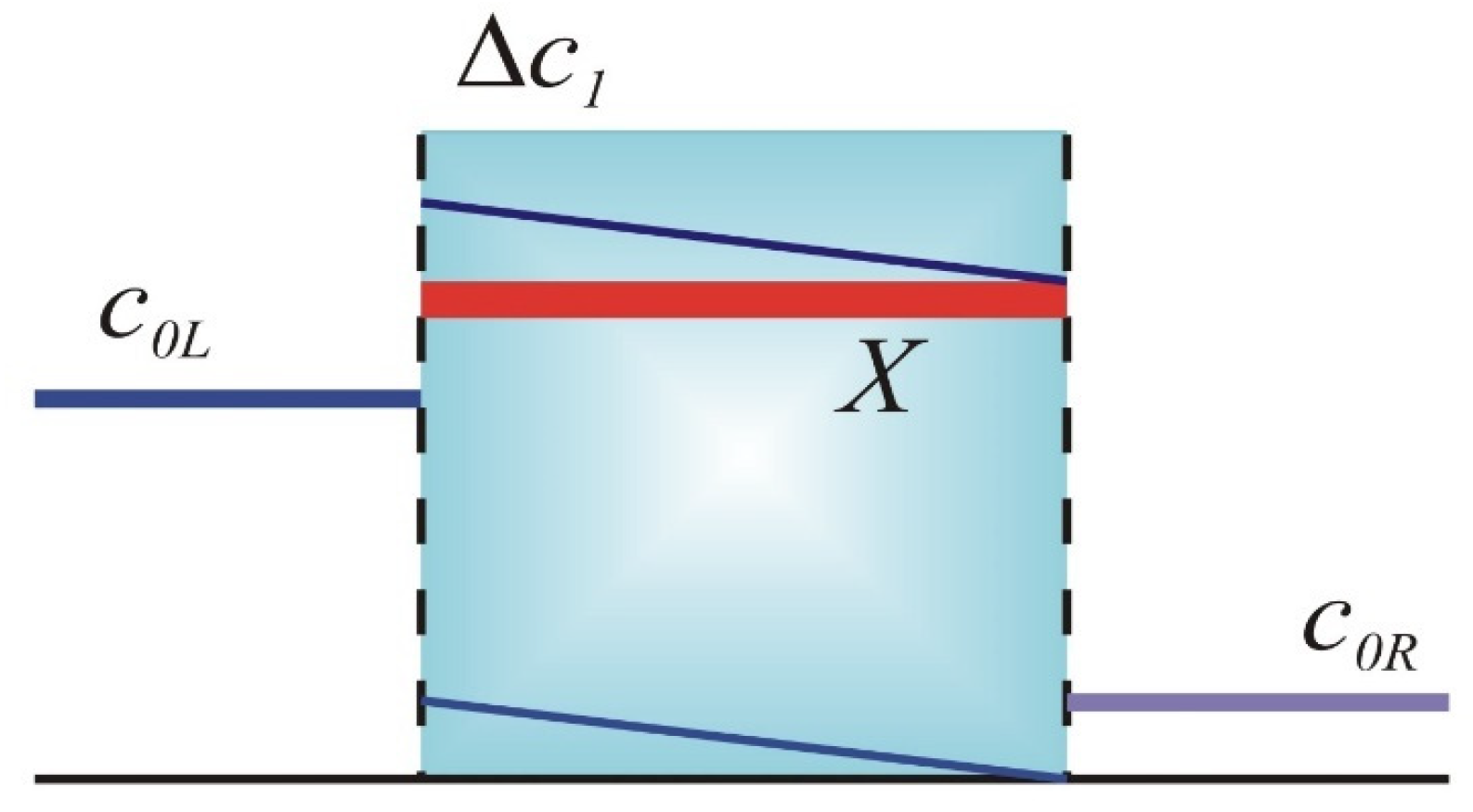
Figure 1. Sketch of an IEM system under RED conditions.
Membranes 15 00365 g001
Figure 2. Evolution with X of the relative errors in the counter-ion concentration (solid lines) and those obtained when using the total co-ion exclusion hypothesis (dashed lines) for the 1:1 binary system with c0R = 0.02 M and c0L = 0.5, 1, and 1.5 M.
Membranes 15 00365 g002
Figure 3. Evolution with X of the exact (solid lines) and approximate (dashed lines) values of the ionic concentration gradient for the 1:1 system with c0R = 0.02 M and c0L = 0.5, 1, and 1.5 M.
Membranes 15 00365 g003
Figure 4. Evolution with X of the exact (solid lines) and approximate (dashed lines) values of ∆ϕ for a 1:1 binary system with c0R = 0.02 M and c0L = 0.5, 1, and 1.5 M.
Membranes 15 00365 g004
Figure 5. Evolution with X of the exact (solid lines) and approximate (dashed lines) values of the ionic concentration gradient for the 2:1 binary system, with c0R = 0.02 M and c0L = 0.5, 1, and 1.5 M.
Membranes 15 00365 g005
Figure 6. Evolution with X of the exact (solid lines) and approximate (dashed lines) values of ∆ϕ for the 2:1 binary system with c0L = 0.5, 1, and 1.5 M and c0R = 0.02 M.
Membranes 15 00365 g006
Table 1. Comparisons of exact and approximate values, including relative errors, for ionic concentrations, variations of the total Donnan potential, and ionic partitioning coefficients in a 1:1 system with c0L = 0.5 M and c0R = 0.02 M, for the membrane fixed-charge concentrations X = 1, 3, and 5 M.
X (M)c1L (M)c1R (M)c1 (M)ϕ (RT/F)kLkR
X X   +   c 0 L 2 X X c 0 L 2 X c 0 L X 2 X c 0 L   +   c 0 L X X c 0 R
1Ex.1.2071.0000.2070.1802.41450.02
Ap.1.2501.0000.2500.2502.50050.00
% Err.3.6<0.120.933.13.6<0.1
3Ex.3.0813.0000.0810.0276.162150.01
Ap.3.0833.0000.0830.0286.167150.00
% Err.<0.1<0.12.94.3<0.1<0.1
5Ex.5.0505.0000.0490.01010.10250.00
Ap.5.0505.0000.0500.01010.10250.00
% Err.<0.1<0.11.21.6<0.1<0.1
Table 2. Comparisons of exact and approximate values, including relative errors, of the ionic concentrations for the 2:1 salt, the variation of the total Donnan potential, and the ionic partitioning coefficients in a system with c0L = 0.5 M and c0R = 0.02 M for the fixed-charge X = 1, 3, and 5 M.
X (M)c1L (M)c1R (M)c1 (M)ϕ (RT/F)kLkR
X X 2 + c 0 L 3 4 X X 2 c 0 L 3 4   X 1 2   c 0 L X 3 / 2 X c 0 L + c 0 L X X c 0 R
1Ex.0.6550.5000.1530.1331.6187.081
Ap.0.6770.5000.1770.1771.6457.071
% Err. 3.4<0.115.531.71.7<0.1
3Ex.1.5991.5010.0980.0322.52912.25
Ap.1.6021.5000.1020.0342.53112.25
% Err.<0.1<0.14.17.5<0.1<0.1
5Ex.2.5782.5010.0780.0153.21115.81
Ap.2.5792.5000.0790.0163.21915.81
% Err.<0.1<0.11.83.40.2<0.1
Disclaimer/Publisher’s Note: The statements, opinions and data contained in all publications are solely those of the individual author(s) and contributor(s) and not of MDPI and/or the editor(s). MDPI and/or the editor(s) disclaim responsibility for any injury to people or property resulting from any ideas, methods, instructions or products referred to in the content.