Vaccines Against Hantavirus Infections: A Systematic Literature Review

 , ,
, ,  and
and
Abstract
1. Introduction
2. Materials and Methods
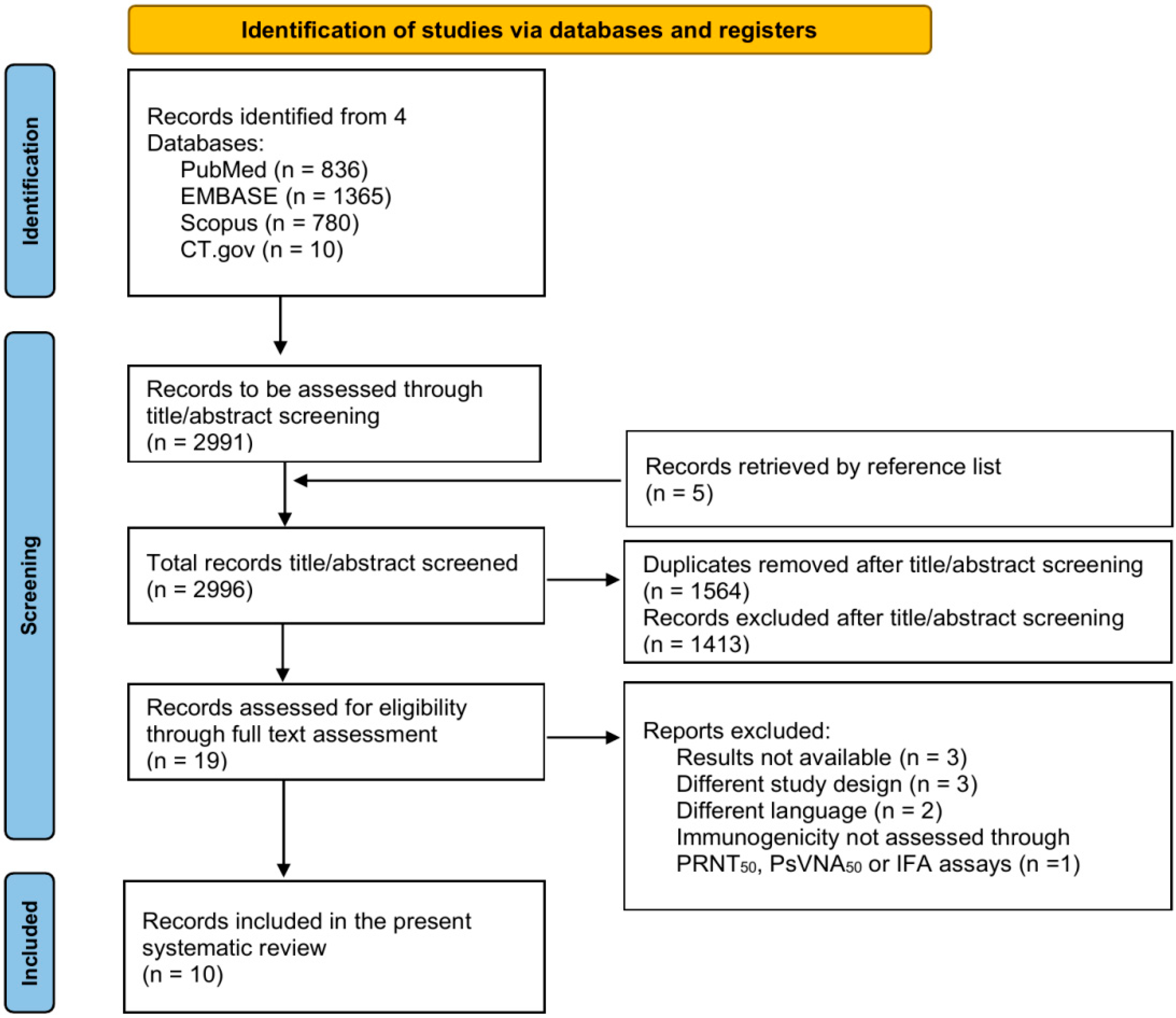
2.1. Search Strategy and Selection Criteria
2.2. Data Extraction
- -
- The 50% plaque reduction neutralization antibody test (PRNT50), defined as the highest serum dilution capable of reducing at least by 50% the average number of plaques observed in the virus-only control plates [23];
- -
- The 50% pseudovirion neutralization assay (PsVNA50) measures the neutralization of an engineered surrogate particle and systematically yields higher titers than PRNT50 in the same sera;
- -
- The immunofluorescence antibody assay (IFA) detects binding antibody and does not measure neutralization; IFA results are therefore reported as a separate, non-functional endpoint and excluded from every statement about neutralizing responses. Results obtained with different assays were not included in the present review.
3. Results
3.1. Characteristics of the Included Studies
3.2. Immunogenicity Outcomes
3.2.1. Inactivated Whole-Virus Vaccine (Hantavax®)
3.2.2. DNA Vaccines: HTNV and PUUV Constructs
3.2.3. DNA Vaccine: ANDV Construct
3.3. Safety Outcomes
3.4. Quality Evaluation of Included Studies
4. Discussion
5. Conclusions
Supplementary Materials
Author Contributions
Funding
Institutional Review Board Statement
Informed Consent Statement
Data Availability Statement
Conflicts of Interest
Abbreviations
| AEs | Adverse Events |
| ANDV | Andes Virus |
| BSL | BioSafety Level |
| DNA | DeoxyriboNucleic Acid |
| HCPS | Hantavirus Cardio-Pulmonary Syndrome |
| HFRS | Haemorrhagic Fever with Renal Syndrome |
| HTNV | Hantaan Virus |
| IFA | ImmunoFluorescence Antibody Assay |
| MV | Motor Vessel |
| PRISMA | Preferred Reporting Items for Systematic Reviews and Meta-Analyses |
| PRNT | Plaque Reduction Neutralization Antibody Test |
| PsVNA | PseudoVirion Neutralization Assay |
| PUUV | Puumala Virus |
| RoB 2 | Risk-of-Bias Tool |
| RNA | RiboNucleic Acid |
| SAEs | Serious Adverse Events |
References
- World Health Organization. Hantavirus—Key Facts. 2026. Available online: https://www.who.int/news-room/fact-sheets/detail/hantavirus (accessed on 18 May 2026).
- Schmaljohn, C.; Hjelle, B. Hantaviruses: A global disease problem. Emerg. Infect. Dis. 1997, 3, 95–104. [Google Scholar] [CrossRef] [Scilit] [PubMed]
- Maes, P.; Alkhovsky, S.V.; Bao, Y.; Beer, M.; Birkhead, M.; Briese, T.; Buchmeier, M.J.; Calisher, C.H.; Charrel, R.N.; Choi, I.R.; et al. Taxonomy of the family Arenaviridae and the order Bunyavirales: Update 2018. Arch. Virol. 2018, 163, 2295–2310. [Google Scholar] [CrossRef] [Scilit] [PubMed]
- Tortosa, F.; Perre, F.; Tognetti, C.; Lossetti, L.; Carrasco, G.; Guaresti, G.; Iglesias, A.; Espasandin, Y.; Izcovich, A. Seroprevalence of hantavirus infection in non-epidemic settings over four decades: A systematic review and meta-analysis. BMC Public Health 2024, 24, 2553. [Google Scholar] [CrossRef] [Scilit] [PubMed]
- Lang, K. Hantavirus: What you need to know. BMJ 2026, 393, s877. [Google Scholar] [CrossRef] [Scilit] [PubMed]
- Schmaljohn, C.S. Vaccines for hantaviruses: Progress and issues. Expert. Rev. Vaccines 2012, 11, 511–513. [Google Scholar] [CrossRef] [Scilit] [PubMed]
- Wu, W.; Liu, J.; Guo, S.; Zhao, H.; Yang, X. The protective efficacy of inactivated vaccine against hemorrhagic fever with renal syndrome: A meta-analysis. Medicine 2025, 104, e42463. [Google Scholar] [CrossRef] [Scilit] [PubMed]
- Rubin, R. Hantavirus Outbreak: First Test of US Public Health Response After WHO Withdrawal. JAMA 2026, 35, 2089–2091. [Google Scholar] [CrossRef] [Scilit] [PubMed]
- World Health Organization. Hantavirus Cluster Linked to Cruise Ship Travel, Multi-Country. 2026. Available online: https://www.who.int/emergencies/disease-outbreak-news/item/2026-DON601 (accessed on 18 May 2026).
- MacNeil, A.; Ksiazek, T.G.; Rollin, P.E. Hantavirus pulmonary syndrome, United States, 1993–2009. Emerg. Infect. Dis. 2011, 17, 1195–1201. [Google Scholar] [CrossRef] [Scilit] [PubMed]
- Vial, P.A.; Ferres, M.; Vial, C.; Klingstrom, J.; Ahlm, C.; Lopez, R.; Le Corre, N.; Mertz, G.J. Hantavirus in humans: A review of clinical aspects and management. Lancet Infect. Dis. 2023, 23, e371–e382. [Google Scholar] [CrossRef] [Scilit] [PubMed]
- Martinez, V.P.; Di Paola, N.; Alonso, D.O.; Perez-Sautu, U.; Bellomo, C.M.; Iglesias, A.A.; Coelho, R.M.; Lopez, B.; Periolo, N.; Larson, P.A.; et al. “Super-Spreaders” and Person-to-Person Transmission of Andes Virus in Argentina. N. Engl. J. Med. 2020, 383, 2230–2241. [Google Scholar] [CrossRef] [Scilit] [PubMed]
- Dheerasekara, K.; Sumathipala, S.; Muthugala, R. Hantavirus Infections-Treatment and Prevention. Curr. Treat. Options Infect. Dis. 2020, 12, 410–421. [Google Scholar] [CrossRef] [Scilit] [PubMed]
- Ricco, M.; Peruzzi, S.; Ranzieri, S.; Magnavita, N. Occupational Hantavirus Infections in Agricultural and Forestry Workers: A Systematic Review and Metanalysis. Viruses 2021, 13, 2150. [Google Scholar] [CrossRef] [Scilit] [PubMed]
- Basu, M. There is no vaccine for deadly hantavirus: What that means for future outbreaks. Nature 2026, 653, 342. [Google Scholar] [CrossRef] [Scilit] [PubMed]
- Kupferschmidt, K. Cruise ship outbreak spotlights a little-studied hantavirus. Science 2026, 392, 672–673. [Google Scholar] [CrossRef] [Scilit] [PubMed]
- Page, M.J.; McKenzie, J.E.; Bossuyt, P.M.; Boutron, I.; Hoffmann, T.C.; Mulrow, C.D.; Shamseer, L.; Tetzlaff, J.M.; Akl, E.A.; Brennan, S.E.; et al. The PRISMA 2020 statement: An updated guideline for reporting systematic reviews. BMJ 2021, 372, n71. [Google Scholar] [CrossRef] [Scilit] [PubMed]
- Higgins, J.P.T.; Savović, J.; Page, M.; Elbers, R.; Sterne, J.A.C. Assessing risk of bias in a randomized trial. In Cochrane Handbook for Systematic Reviews of Interventions, 2nd ed.; Higgins, J.P.T., Thomas, J., Chandler, J., Cumpston, M., Li, T., Page, M.J., Welch, V.A., Eds.; Wiley-Blackwell: Hoboken, NJ, USA, 2019; pp. 205–228. [Google Scholar] [CrossRef] [Scilit]
- National Heart Lung and Blood Institute. Quality Assessment Tool for Before–After (Pre–Post) Studies with no Control Group. Available online: https://www.nhlbi.nih.gov/health-topics/study-quality-assessment-tools (accessed on 23 September 2026).
- Song, J.Y.; Woo, H.J.; Cheong, H.J.; Noh, J.Y.; Baek, L.J.; Kim, W.J. Long-term immunogenicity and safety of inactivated Hantaan virus vaccine (Hantavax) in healthy adults. Vaccine 2016, 34, 1289–1295. [Google Scholar] [CrossRef] [Scilit] [PubMed]
- Song, J.Y.; Jeong, H.W.; Yun, J.W.; Lee, J.; Woo, H.J.; Bae, J.Y.; Park, M.S.; Choi, W.S.; Park, D.W.; Noh, J.Y.; et al. Immunogenicity and safety of a modified three-dose priming and booster schedule for the Hantaan virus vaccine (Hantavax): A multi-center phase III clinical trial in healthy adults. Vaccine 2020, 38, 8016–8023. [Google Scholar] [CrossRef] [Scilit] [PubMed]
- Paulsen, G.C.; Frenck, R., Jr.; Tomashek, K.M.; Alarcon, R.M.; Hensel, E.; Lowe, A.; Brocato, R.L.; Kwilas, S.A.; Josleyn, M.D.; Hooper, J.W. Safety and Immunogenicity of an Andes Virus DNA Vaccine by Needle-Free Injection: A Randomized, Controlled Phase 1 Study. J. Infect. Dis. 2024, 229, 30–38. [Google Scholar] [CrossRef] [Scilit] [PubMed]
- Hooper, J.W.; Kwilas, S.A.; Josleyn, M.; Norris, S.; Hutter, J.N.; Hamer, M.; Livezey, J.; Paolino, K.; Twomey, P.; Koren, M.; et al. Phase 1 clinical trial of Hantaan and Puumala virus DNA vaccines delivered by needle-free injection. npj Vaccines 2024, 9, 221. [Google Scholar] [CrossRef] [Scilit] [PubMed]
- Hooper, J.; Paolino, K.M.; Mills, K.; Kwilas, S.; Josleyn, M.; Cohen, M.; Somerville, B.; Wisniewski, M.; Norris, S.; Hill, B.; et al. A Phase 2a Randomized, Double-Blind, Dose-Optimizing Study to Evaluate the Immunogenicity and Safety of a Bivalent DNA Vaccine for Hemorrhagic Fever with Renal Syndrome Delivered by Intramuscular Electroporation. Vaccines 2020, 8, 377. [Google Scholar] [CrossRef] [Scilit] [PubMed]
- Hooper, J.W.; Moon, J.E.; Paolino, K.M.; Newcomer, R.; McLain, D.E.; Josleyn, M.; Hannaman, D.; Schmaljohn, C. A Phase 1 clinical trial of Hantaan virus and Puumala virus M-segment DNA vaccines for haemorrhagic fever with renal syndrome delivered by intramuscular electroporation. Clin. Microbiol. Infect. 2014, 20, 110–117. [Google Scholar] [CrossRef] [Scilit] [PubMed]
- Voller, A.; Bidwell, D.E.; Bartlett, A. Enzyme immunoassays in diagnostic medicine: Theory and practice. Bull. World Health Organ. 1976, 53, 55–65. [Google Scholar] [PubMed]
- Higa, M.M.; Petersen, J.; Hooper, J.; Doms, R.W. Efficient production of Hantaan and Puumala pseudovirions for viral tropism and neutralization studies. Virology 2012, 423, 134–142. [Google Scholar] [CrossRef] [Scilit] [PubMed]
- Chu, Y.K.; Jennings, G.B.; Schmaljohn, C.S. A vaccinia virus-vectored Hantaan virus vaccine protects hamsters from challenge with Hantaan and Seoul viruses but not Puumala virus. J. Virol. 1995, 69, 6417–6423. [Google Scholar] [CrossRef] [Scilit] [PubMed]
- Boudreau, E.F.; Josleyn, M.; Ullman, D.; Fisher, D.; Dalrymple, L.; Sellers-Myers, K.; Loudon, P.; Rusnak, J.; Rivard, R.; Schmaljohn, C.; et al. A Phase 1 clinical trial of Hantaan virus and Puumala virus M-segment DNA vaccines for hemorrhagic fever with renal syndrome. Vaccine 2012, 30, 1951–1958. [Google Scholar] [CrossRef] [Scilit] [PubMed]
- US. Army NCT03718130 Combination HTNV and PUUV DNA Vaccine. 2025. Available online: https://clinicaltrials.gov/study/NCT03718130?cond=NCT03718130&viewType=Card&rank=1&tab=results#results-overview (accessed on 23 September 2026).
- Sohn, Y.M.; Rho, H.O.; Park, M.S.; Kim, J.S.; Summers, P.L. Primary humoral immune responses to formalin inactivated hemorrhagic fever with renal syndrome vaccine (Hantavax): Consideration of active immunization in South Korea. Yonsei Med. J. 2001, 42, 278–284. [Google Scholar] [CrossRef] [Scilit] [PubMed]
- Cho, H.W.; Howard, C.R. Antibody responses in humans to an inactivated hantavirus vaccine (Hantavax). Vaccine 1999, 17, 2569–2575. [Google Scholar] [CrossRef] [Scilit] [PubMed]
- Horbach, I.S.; de Souza Azevedo, A.; Schwarcz, W.D.; Alves, N.d.S.; de Moura Dias, B.; Setatino, B.P.; da Cruz Moura, L.; de Souza, A.F.; Denani, C.B.; da Silva, S.A.; et al. Plaque Reduction Neutralization Test (PRNT) Accuracy in Evaluating Humoral Immune Response to SARS-CoV-2. Diseases 2024, 12, 29. [Google Scholar] [CrossRef] [Scilit] [PubMed]
- Bonifacio, M.A.; Laterza, R.; Vinella, A.; Schirinzi, A.; Defilippis, M.; Di Serio, F.; Ostuni, A.; Fasanella, A.; Mariggiò, M.A. Correlation between In Vitro Neutralization Assay and Serological Tests for Protective Antibodies Detection. Int. J. Mol. Sci. 2022, 23, 9566. [Google Scholar] [CrossRef] [Scilit] [PubMed]
- Li, W.; Cao, S.; Zhang, Q.; Li, J.; Zhang, S.; Wu, W.; Qu, J.; Li, C.; Liang, M.; Li, D. Comparison of serological assays to titrate Hantaan and Seoul hantavirus-specific antibodies. Virol. J. 2017, 14, 133. [Google Scholar] [CrossRef] [Scilit] [PubMed]
- Vial, C.; Whitaker, A.; Wilhelm, J.; Ovalle, J.; Perez, R.; Valdivieso, F.; Ferres, M.; Martinez-Valdebenito, C.; Eisenhauer, P.; Mertz, G.J.; et al. Comparison of VSV Pseudovirus and Focus Reduction Neutralization Assays for Measurement of Anti-Andes orthohantavirus Neutralizing Antibodies in Patient Samples. Front. Cell. Infect. Microbiol. 2020, 10. [Google Scholar] [CrossRef] [Scilit] [PubMed]
- Plotkin, S.A. Correlates of protection induced by vaccination. Clin. Vaccine Immunol. 2010, 17, 1055–1065. [Google Scholar] [CrossRef] [Scilit] [PubMed]
- Plotkin, S.A.; Gilbert, P.B. Nomenclature for immune correlates of protection after vaccination. Clin. Infect. Dis. 2012, 54, 1615–1617. [Google Scholar] [CrossRef] [Scilit] [PubMed]
- Wei, J.; Zhang, H.; Pei, J.; Yang, Q.; Wang, Y.; Jin, X.; Liu, H.; Zhang, L.; Ma, H.; Cheng, L.; et al. Standardization, validation, and comparative evaluation of a convenient surrogate recombinant vesicular stomatitis virus plaque reduction test for quantification of Hantaan orthohantavirus (HTNV) neutralizing antibodies. Virol. J. 2025, 22, 31. [Google Scholar] [CrossRef] [Scilit] [PubMed]
- Mittler, E.; Wec, A.Z.; Tynell, J.; Guardado-Calvo, P.; Wigren-Bystrom, J.; Polanco, L.C.; O’Brien, C.M.; Slough, M.M.; Abelson, D.M.; Serris, A.; et al. Human antibody recognizing a quaternary epitope in the Puumala virus glycoprotein provides broad protection against orthohantaviruses. Sci. Transl. Med. 2022, 14, eabl5399. [Google Scholar] [CrossRef] [Scilit] [PubMed]
- Engdahl, T.B.; Binshtein, E.; Brocato, R.L.; Kuzmina, N.A.; Principe, L.M.; Kwilas, S.A.; Kim, R.K.; Chapman, N.S.; Porter, M.S.; Guardado-Calvo, P.; et al. Antigenic mapping and functional characterization of human New World hantavirus neutralizing antibodies. Elife 2023, 12. [Google Scholar] [CrossRef] [Scilit] [PubMed]
- Institute of Medicine (US) Committee on Strategies for Small-Number-Participant Clinical Research Trials. Small Clinical Trials: Issues and Challenges; Evans, C.H., Jr., Ildstad, S.T., Eds.; National Academies Press (US): Washington, DC, USA, 2001. [Google Scholar] [PubMed]
- Tscherne, A.; Halwe, N.J.; Krammer, F. Vaccines and therapeutics for Andes hantavirus. npj Viruses 2026, 4, 29. [Google Scholar] [CrossRef] [Scilit] [PubMed]
- Tscherne, A.; Guardado-Calvo, P.; Clark, J.J.; Krause, R.; Krammer, F. Puumala orthohantavirus: Prevalence, biology, disease, animal models and recent advances in therapeutics development and structural biology. Front. Immunol. 2025, 16, 1575112. [Google Scholar] [CrossRef] [Scilit] [PubMed]
- Brocato, R.L.; Hooper, J.W. Progress on the Prevention and Treatment of Hantavirus Disease. Viruses 2019, 11, 610. [Google Scholar] [CrossRef] [Scilit] [PubMed]
- Liu, R.; Ma, H.; Shu, J.; Zhang, Q.; Han, M.; Liu, Z.; Jin, X.; Zhang, F.; Wu, X. Vaccines and Therapeutics Against Hantaviruses. Front. Microbiol. 2019, 10, 2989. [Google Scholar] [CrossRef] [Scilit] [PubMed]
- van den Berg, O.E.; Team, U.A.; Severi, E.; Mutoka-Banza, F.; van Vugt, M.; Schadd, E.M.; Calvo Reyes, M.C.; Santos Larrégola, L.; Valdivia Prieto, P.; Lescure, F.-X.; et al. Andes virus outbreak linked to expedition cruise ship travel, multi-country investigation and response, April to June 2026. Eurosurveillance 2026, 31, 2600477. [Google Scholar] [CrossRef] [Scilit] [PubMed]
- Andes Virus Outbreak Working Group. Andes Hantavirus Outbreak on a Cruise Ship, 2026. N. Engl. J. Med. 2026, 394, 2477–2479. [Google Scholar] [CrossRef] [Scilit] [PubMed]
- CDC. Multi-country Hantavirus Cluster Linked to Cruise Ship. 2026. Available online: https://www.cdc.gov/han/php/notices/han00528.html (accessed on 18 May 2026).


| (a) | |||||||||
| First Author | Journal | Year | Country | Total Sample | Mean Age (SD) | Trial ID, Phase and Status | Blinding Design | Outcomes | Funding |
| Cho [32] | Vaccine | 1999 | S. Korea | 64 | NR | NR | Open-Nonrandom | I; S | NR |
| Sohn [31] | Yonsei Med J | 2001 | S. Korea | 30 | NR | NR | Open-Nonrandom | I; | NR |
| Boudreau [29] | Vaccine | 2012 | US | 28 | 32.0 (IQR 19-47) | Phase I; NR | Open-Nonrandom | I; S | US Army MRDC |
| Hooper [25] | Clin Microbial Infect | 2014 | US | 27 | NR | Phase I; NCT01502345 | Open-Random | I; S | US Army MRDC |
| Song [20] | Vaccine | 2016 | S. Korea | 226 | 43.3 (14.1) | Phase III; NCT02360514 | Open- Nonrandom | I; S | Green Cross Corporation |
| Hooper [24] | Vaccines | 2020 | US | 130 | NR | Phase IIa; NCT02116205 | Double-Random | I; S | US Army MRDC |
| Song [21] | Vaccine | 2020 | S. Korea | 320 | 41.1 (9.4) | Phase III; NCT02553837 | Open-Nonrandom | I; S | Green Cross Corporation |
| Paulsen [22] | J Infect Dis | 2023 | US | 48 | 34.7 (8.6) | Phase I; NCT03682107 | Double-Random | I; S | NIAID |
| Hooper [23] | Npj Vaccines | 2024 | US | 27 | NR | Phase I; NCT02776761 | Single-Random | I; S | US Army MRDC |
| NCT03718130 [30] | ClinicalTrials.gov | 2025 | US | 61 | NR | Phase I; NCT03718130 | Open-Random | I; S | US Army MRDC |
| (b) | |||||||||
| First Author | Year | Allocation | Tested Vaccine(s) and Number of Doses | Vaccine Dose and Schedule (Days) | Delivery Methods | ||||
| Cho [32] | 1999 | Single arm | Hantavax®; 2 doses+booster | Arm1: 0.5 mL d1, d29 + d365 (booster) (administered volume) | Classic IM | ||||
| Sohn [31] | 2001 | Single arm | Hantavax®; 2 doses | Arm1: 0.5 mL d1, d29 (administered volume) | Classic IM | ||||
| Boudreau [29] | 2012 | Multi-arm, 3 arms | Monovalent/bivalent DNA plasmid; 3 doses | Arm1: HTNV 8 μg DNA/4 mg gold d0, d28, d56 Arm2: PUUV 8 μg DNA/4 mg gold d0, d28, d56 Arm3: HTNV 4 μg DNA/2 mg gold + PUUV 4 μg DNA/2 mg gold (8 μg DNA/4 mg gold) d0, d28, d56 | Classic IM | ||||
| Hooper [25] | 2014 | Multi-arm, 3 arms | Monovalent/bivalent DNA plasmid; 3 doses | Arm1: HTNV 2 mg d1, d28, d56 Arm2: PUUV 2 mg d1, d28, d56 Arm3: HTNV 1 mg + PUUV 1 mg (2 mg total DNA vaccines) d1, d28, d56 | TriGrid | ||||
| Song [20] | 2016 | Single arm | Hantavax®; 2 doses+booster | Arm1: 0.5 mL d1, d29 + d365 (booster) (administered volume) | Classic IM | ||||
| Hooper [24] | 2020 | Multi-arm, 4 arms, placebo dose in arms 2 and 4 | Bivalent DNA plasmid; 2/3 doses + booster ¥ | Arm1: HTNV 0.5 mg + PUUV 0.5 mg d0, d28, d56 + d168 (booster) Arm2: HTNV 0.5 mg + PUUV 0.5 mg d0, d28, d56(Plac) + d168 (booster) Arm3: HTNV 1 mg + PUUV 1 mg d0, d28, d56 + d168 (booster) Arm4: HTNV 1 mg + PUUV 1 mg (2 mg total DNA vaccines) d0, d28, d56(Plac) + d168 (booster) | TriGrid | ||||
| Song [21] | 2020 | Single arm | Hantavax®; 3 doses + booster | Arm1: 0.5 mL d1, d29, d57 + d394 (booster) (administered volume) | Classic IM | ||||
| Paulsen [22] | 2023 | Multi-arm, 4 arms, placebo dose in arms 1 and 3 | Monovalent ANDV DNA plasmid 2/3 doses+booster ¥ | Arm1: ANDV 2 mg d1, d29, d57 (Plac) + d169 (booster) Arm2: ANDV 2 mg d1, d29, d57 + d169 (booster) Arm3: ANDV 4 mg d1, d29, d57 (Plac) + d169 (booster) Arm4: ANDV 4 mg d1, d29, d57 + d169 (booster) | PharmaJet Stratis | ||||
| Hooper [23] | 2024 | Multi-arm, 3 arms, no placebo | Monovalent/bivalent DNA plasmid; 3 doses+booster | Arm1: HTNV 2 mg d1, d29, d57 + d169 (booster) Arm2: PUUV 2 mg d1, d29, d57 + d169 (booster) Arm3: HTNV 1 mg + PUUV 1 mg (2 mg total DNA vaccines) d1, d29, d57 + d169 (booster) | PharmaJet Stratis | ||||
| NCT03718130 [30] | 2022 | Multi-arm, 6 arms, no placebo | Monovalent/bivalent DNA plasmid; 3 doses | Arm 1: HTNV 0.6 mg d0, d28, d56 ID Arm 2: HTNV 3.0 mgd0, d28, d56 IM Arm 3: PUUV 0.6 mgd0, d28, d56 ID | Arm 4: PUUV 3.0 mg d0, d28, d56 IM Arm 5: HTNV 0.6 mg + PUUV 0.6 mg (1.2 mg total DNA vaccines) d0, d28, d56 ID Arm 6: HTNV 3 mg + PUUV 3 mg (6 mg total DNA vaccines) d0, d28, d56 IM | TriGrid | |||
| (a) | ||||
| First Author | Primary Immunogenicity Outcomes and Endpoints | Arm(s) | Seropositivity Rate | |
| PRNT50, n/N | IFA, n/N | |||
| Cho [32] | % of subjects achieving seropositivity, expressed through PRNT50 antibody titers of ≥1:10 A | Arm 1: | 50.0%; 7/14 | 93.6%; 15/16 |
| Song [21] | % of subjects achieving seropositivity, expressed through PRNT50 and IFA; PRNT50 antibody titers of ≥1:10 or IFA antibody titers of ≥1:32 were regarded as positive A | Arm 1: | 45.1%; 64/142 | 87.3%; 124/142 |
| Song [21] | % of subjects achieving seropositivity, expressed through PRNT50 and IFA; PRNT50 antibody titers of ≥1:10 or IFA antibody titers of ≥1:32 were regarded as positive A | Arm 1: | 55.7%; 161/289 | 95.7%; 266/278 |
| First Author | Primary Immunogenicity Outcomes and Endpoints | Arm(s) | Seroconversion Rate | |
| PRNT50, n/N | IFA, n/N | |||
| Sohn [31] | % of subjects achieving seroconversion, expressed through PRNT50; PRNT50 antibody titers of ≥1:10 B | Arm 1 | 33.3%; 10/30 | NR |
| (b) | ||||
| First Author | Primary Immunogenicity Outcomes and Endpoints | Arm(s) | Seropositivity Rates | |
| PRNT50 (n/N) | PsVNA50 (n/N) | |||
| Boudreau [29] | % of subjects achieving seropositivity, expressed through PRNT50 antibody titer ≥ 1:20 C; see Table 1b for details by treatment arm | Arm 1: | 30.0% (HTNV) (3/10) | NR |
| Arm 2: | 44.4% (PUUV) (4/9) | |||
| Arm 3: | 44.4% (HTNV) (4/9); 33.3% (PUUV) (3/9); 22.2% (HTNV and PUUV) (2/9) | |||
| Hooper [25] | % of subjects achieving seropositivity, expressed through PRNT50 antibody titer ≥ 1:20 C; see Table 1b for details by treatment arm | Arm 1: | 63.6% (HTNV) (7/11) | NR |
| Arm 2: | 75.0% (PUUV) (6/8) | |||
| Arm 3: | 33.3% (HTNV) (3/9); 77.8% (PUUV); (7/9); NR (HTNV and PUUV) | |||
| Hooper [24] | % of subjects achieving seropositivity, expressed through dual PsVNA50 D; see Table 1b for details by treatment arm | Arm 1: | NR | 76.7% (HTNV and PUUV) (23/30) |
| Arm 2: | 73.3% (HTNV and PUUV) (22/30) | |||
| Arm 3: | 80.0% (HTNV and PUUV) (24/30) | |||
| Arm 4: | 66.7% (HTNV and PUUV) (20/30) | |||
| Paulsen [22] | % of subjects achieving seropositivity, expressed through PsVNA50 antibody titer ≥ 1:20 D; see Table 1b for details by treatment arm | Arm 1: | NR | 55.6%(ANDV) (5/9) |
| Arm 2: | 100.0%(ANDV) (9/9) | |||
| Arm 3: | 88.9%(ANDV) (8/9) | |||
| Arm 4: | 88.9%(ANDV) (8/9) | |||
| Hooper [23] | % of subjects achieving seropositivity, expressed through PsVNA50 or PRNT50 antibody titer ≥ 1:20 D; see Table 1b for details by treatment arm | Arm 1: | 100.0% (HTNV) (7/7); 42.9% (PUUV) (3/7) | 100.0% (HTNV) (7/7); 100.0% (PUUV) (7/7) |
| Arm 2: | 33.3% (HTNV) (2/6); 83.3% (PUUV); (5/6) | 50.0% (HTNV) (3/6); 100.0% (PUUV) (6/6) | ||
| Arm 3: | 44.4% (HTNV) (4/9); 77.8% (PUUV) (7/9) | 77.8% (HTNV) (7/9); 88.9% (PUUV) (8/9) | ||
| NCT03718130 [30] | % of subjects achieving seropositivity, expressed through PsVNA50 antibody titer ≥ 1:20 C; see Table 1b for details by treatment arm | Arm 1: | NR | 100.0% (HTNV) (4/4) |
| Arm 2: | 75% (HTNV) (9/12) | |||
| Arm 3: | 75% (PUUV) (3/4) | |||
| Arm 4: | 33% (PUUV) (4/12) | |||
| Arm 5: | 0% (HTNV+PUUV) (0/2) | |||
| Arm 6: | 50% (HTNV+PUUV) (1/2) | |||
| (c) | ||||
| First Author | Primary Immunogenicity Outcomes and Endpoints | Arm(s) | Seroconversion Rates | |
| PRNT50 | PsVNA50 | |||
| Paulsen [22] | % of subjects achieving seroconversion, defined as a post-vaccination ANDV-specific titer through PsVNA50 of ≥40 if baseline titer < 20, or a minimum 4-fold rise if baseline titer ≥ 20 E; see Table 1b for details by treatment arm | Arm 1: | NR | 55%(ANDV) (n/N NR) |
| Arm 2: | 88%(ANDV) (n/N NR) | |||
| Arm 3: | 60%(ANDV) (n/N NR) | |||
| Arm 4: | 89%(ANDV) (n/N NR) | |||
| Hooper [23] | % of subjects achieving seroconversion, defined as a post-vaccination single or combined HTNV or PUUV specific titer through PsVNA50 or PRNT50 of ≥40 or 4-fold rise over baseline D; see Table 1b for details by treatment arm | Arm 1: | 100.0% (HTNV) (7/7); 42.9% (PUUV) (3/7); 42.9% (HTNV and PUUV) (3/7) | 100.0% (HTNV) (7/7); 71.4% (PUUV) (5/7); 57.1% (HTNV and PUUV) (4/7) |
| Arm 2: | 50.0% (HTNV) (3/6); 83.3% (PUUV) (5/6); 33.3% (HTNV and PUUV) (2/6) | 50.0% (HTNV) (3/6); 100% (PUUV) (6/6); 66.7% (HTNV and PUUV) (4/6) | ||
| Arm 3: | 33.3% (HTNV) (7/9); 77.8% (PUUV) (7/9); 33.3% (HTNV and PUUV) (3/9) | 77.8% (HTNV) (6/9); 88.9% (PUUV) (8/9); 77.8% (HTNV and PUUV) (7/9) | ||
| NCT03718130 [30] | % of subjects achieving seroconversion, defined as a post-vaccination single or combined HTNV or PUUV specific titer through PsVNA50 of ≥40 or 4-fold rise over baseline C; see Table 1b for details by treatment arm | Arm 1: | NR | 100.0% (HTNV) (4/4) |
| Arm 2: | 50% (HTNV) (6/12) | |||
| Arm 3: | 75% (PUUV) (3/4) | |||
| Arm 4: | 75% (PUUV) (9/12) | |||
| Arm 5: | 0% (HTNV + PUUV) (0/2) | |||
| Arm 6: | 50% (HTNV+PUUV) (1/2) | |||
| First Author | Primary Safety Outcomes and Endpoints | Follow-Up | Rates of AEs | Rates of SAEs | |
|---|---|---|---|---|---|
| Local Reactions | Systemic Reactions | ||||
| Cho [32] | Time-specific and cumulative rates of SAEs and AEs—local and systemic reactions—14 days after each injection | 1 week after last dose | Reported as events, not per participant | Reported as events, not per participant | 0/64 (0.0%) |
| Boudreau [29] | Time-specific and cumulative rates of SAEs and AEs—local and systemic reactions—14 days after each injection | 1 month after last dose | Skin discoloration after 100% of doses; injection-site pain after 48–56% of doses | Fatigue 10/28 (35.7%); malaise 7/28 (25.0%); lymphadenopathy 6/28 (21.4%) | 0/27 (0%) |
| Hooper [25] | Unsolicited SAEs and AEs, 14 days after each injection | 6 months after last dose | Injection-site pain: 28/31 (90.3%) | Headache 8/31 (25.8%); myalgia 7/31 (22.6%); fatigue 6/31 (19.4%) | 0/27 (0%) |
| Song [20] | Time-specific and cumulative rates of SAEs and AEs—local and systemic reactions—7 days after each injection | 6 months after last dose | Any local reactions: 108/226 (47.8%) | Any systemic reactions: 57/226 (25.2%) | 0/226 (0%) |
| Hooper [25] | Unsolicited SAEs and AEs, 14 days after each injection | 12 months after last dose | Injection-site pain: 125/130 (96.2%) | Fatigue 38/130 (29.2%); headache 31/130 (23.8%); myalgia 23/130 (17.7%) | 0/130 (0%) |
| Song [21] | Time-specific and cumulative rates of SAEs and AEs—local and systemic reactions—7 days after each injection | 4 months after last dose | Any local reactions: 113/309 (37%) | Any systemic reactions: 66/309 (21.4%) | 0/309 (0%) |
| Paulsen [22] | Time-specific and cumulative rates of SAEs and AEs—local and systemic reactions—7 days after each injection | 6 months after last dose | Any local reactions: 47/48 (97.9%) | Any systemic reactions: 31/48 (64.6%) | 0/48 (0%) |
| Hooper [23] | Time-specific and cumulative rates of SAEs and AEs—local and systemic reactions—14 days after each injection | 6 months after last dose | Any local reactions: 23/27 (85.2%) Injection-site pain: 21/27 (77.8%); | Headache 13/27 (48.1%); fatigue 10/27 (37.0%) | 0/27 (0%) |
| NCT03718130 [30] | Time-specific and cumulative rates of SAEs and AEs—local and systemic reactions—14 days after each injection | 6 months after last dose | Any local reactions: 10/36 (28%) | Any systemic reactions: 1/36 (3%) | 1/61 (1%) |
Disclaimer/Publisher’s Note: The statements, opinions and data contained in all publications are solely those of the individual author(s) and contributor(s) and not of MDPI and/or the editor(s). MDPI and/or the editor(s) disclaim responsibility for any injury to people or property resulting from any ideas, methods, instructions or products referred to in the content. |
© 2026 by the authors. Licensee MDPI, Basel, Switzerland. This article is an open access article distributed under the terms and conditions of the Creative Commons Attribution (CC BY) license.
Share and Cite
Cioni, G.; Calò, G.L.; Imperiali, G.; Manzoli, L.; Flacco, M.E. Vaccines Against Hantavirus Infections: A Systematic Literature Review. Vaccines 2026, 14, 898. https://doi.org/10.3390/vaccines14100898
Cioni G, Calò GL, Imperiali G, Manzoli L, Flacco ME. Vaccines Against Hantavirus Infections: A Systematic Literature Review. Vaccines. 2026; 14(10):898. https://doi.org/10.3390/vaccines14100898
Chicago/Turabian StyleCioni, Giovanni, Giovanna Letizia Calò, Gianmarco Imperiali, Lamberto Manzoli, and Maria Elena Flacco. 2026. "Vaccines Against Hantavirus Infections: A Systematic Literature Review" Vaccines 14, no. 10: 898. https://doi.org/10.3390/vaccines14100898
APA StyleCioni, G., Calò, G. L., Imperiali, G., Manzoli, L., & Flacco, M. E. (2026). Vaccines Against Hantavirus Infections: A Systematic Literature Review. Vaccines, 14(10), 898. https://doi.org/10.3390/vaccines14100898