
Development and Immunogenicity Assessment of a Multi-Epitope Antigen Against Zika Virus: An In Silico and In Vivo Approach
 , , ,
, , ,  , , , , , , , and
Abstract
1. Introduction
2. Materials and Methods
2.1. Ethical Considerations
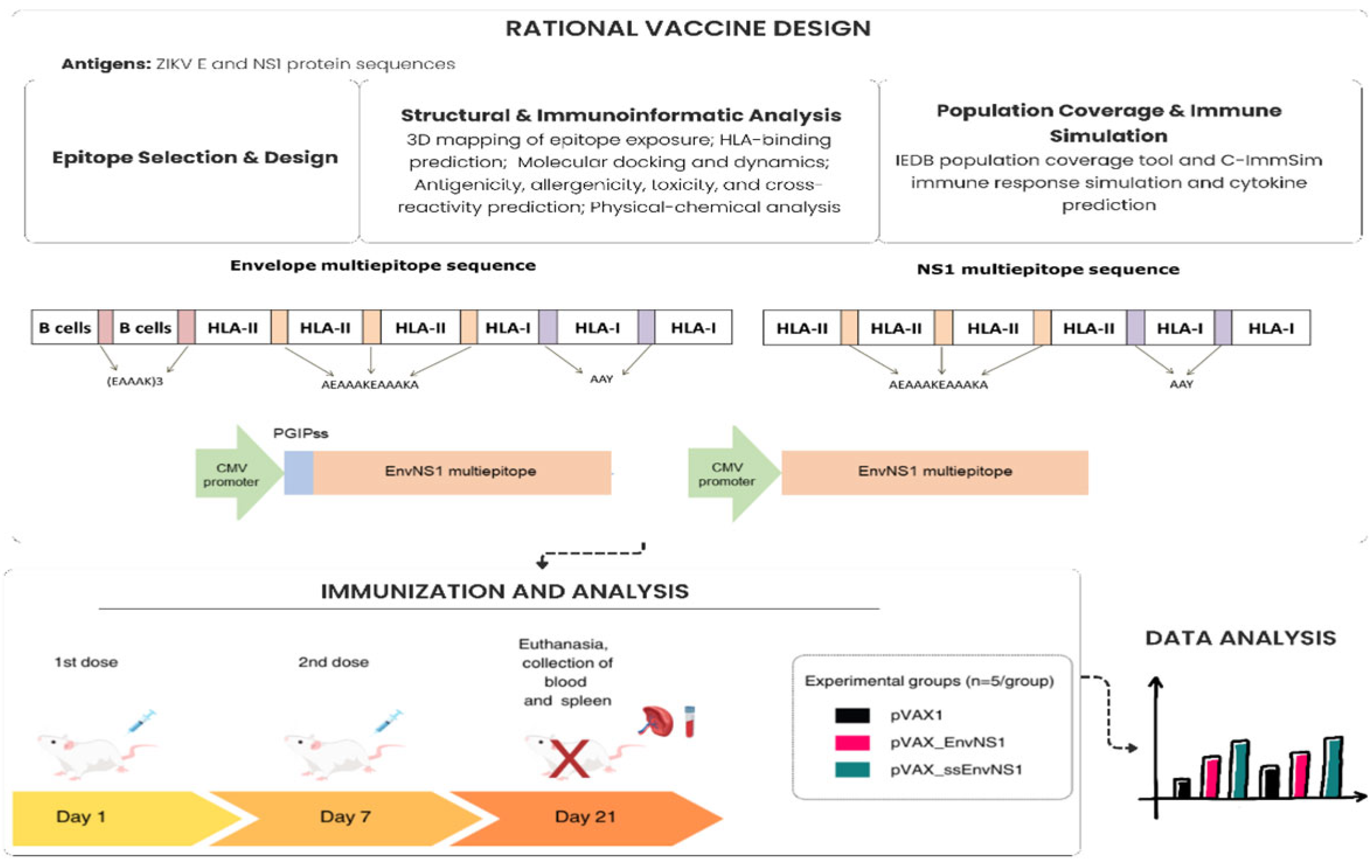
2.2. Study Design Overview
2.3. In Silico Rational Design and Analysis
2.3.1. Epitope Selection and Construct Design
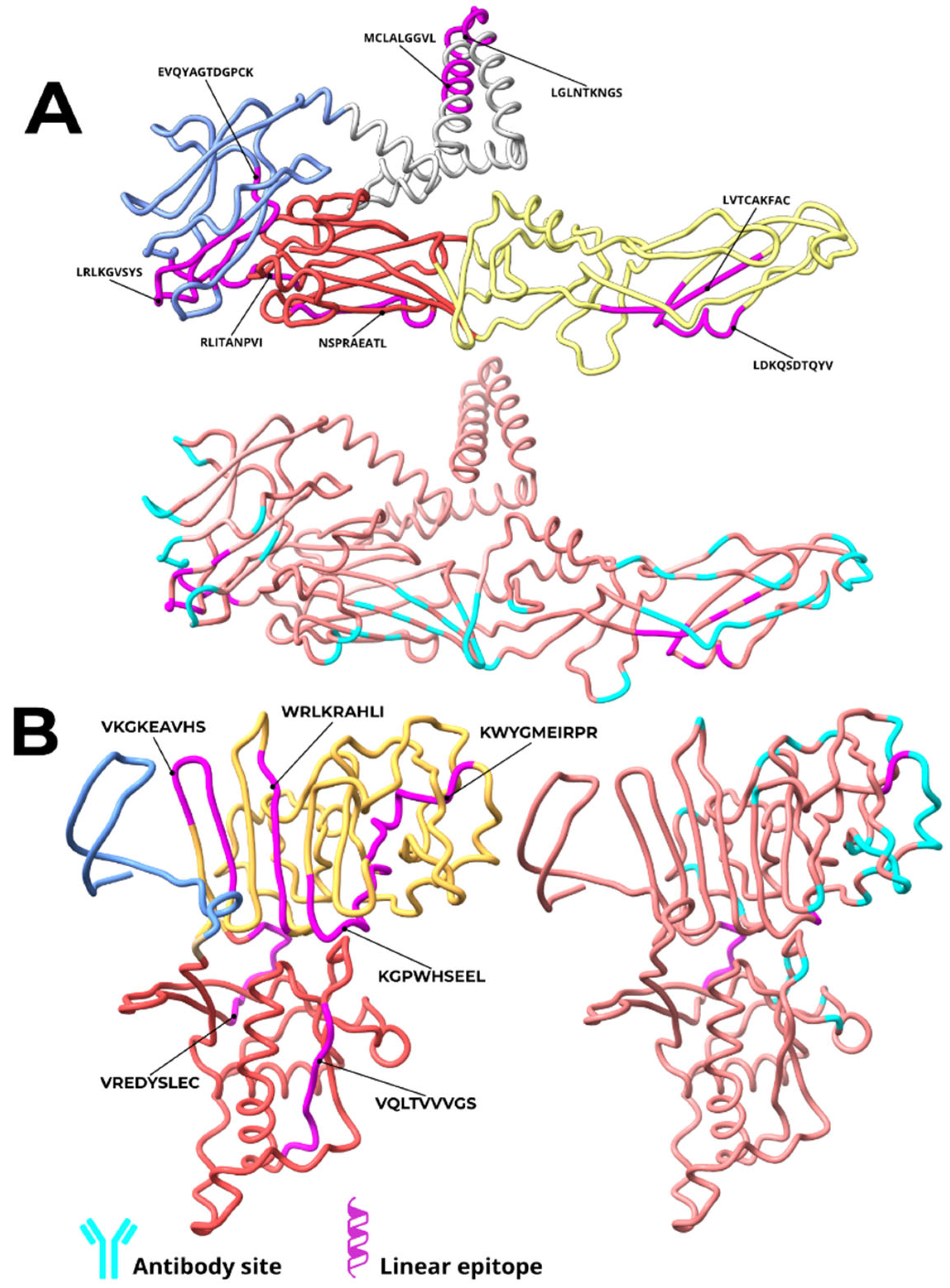
2.3.2. Structural Analysis and Epitope Exposure
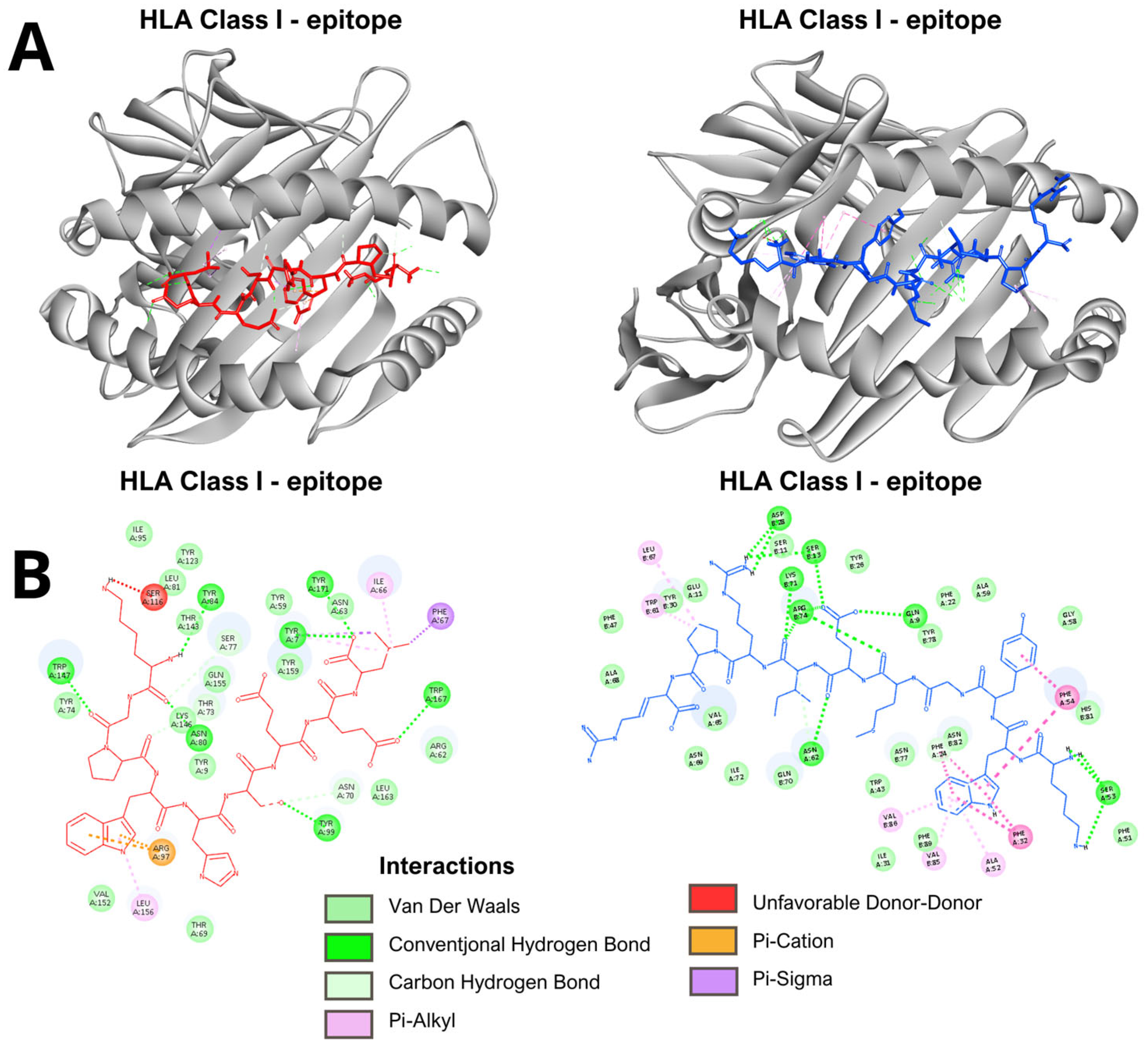
2.3.3. HLA Binding Prediction and Molecular Docking
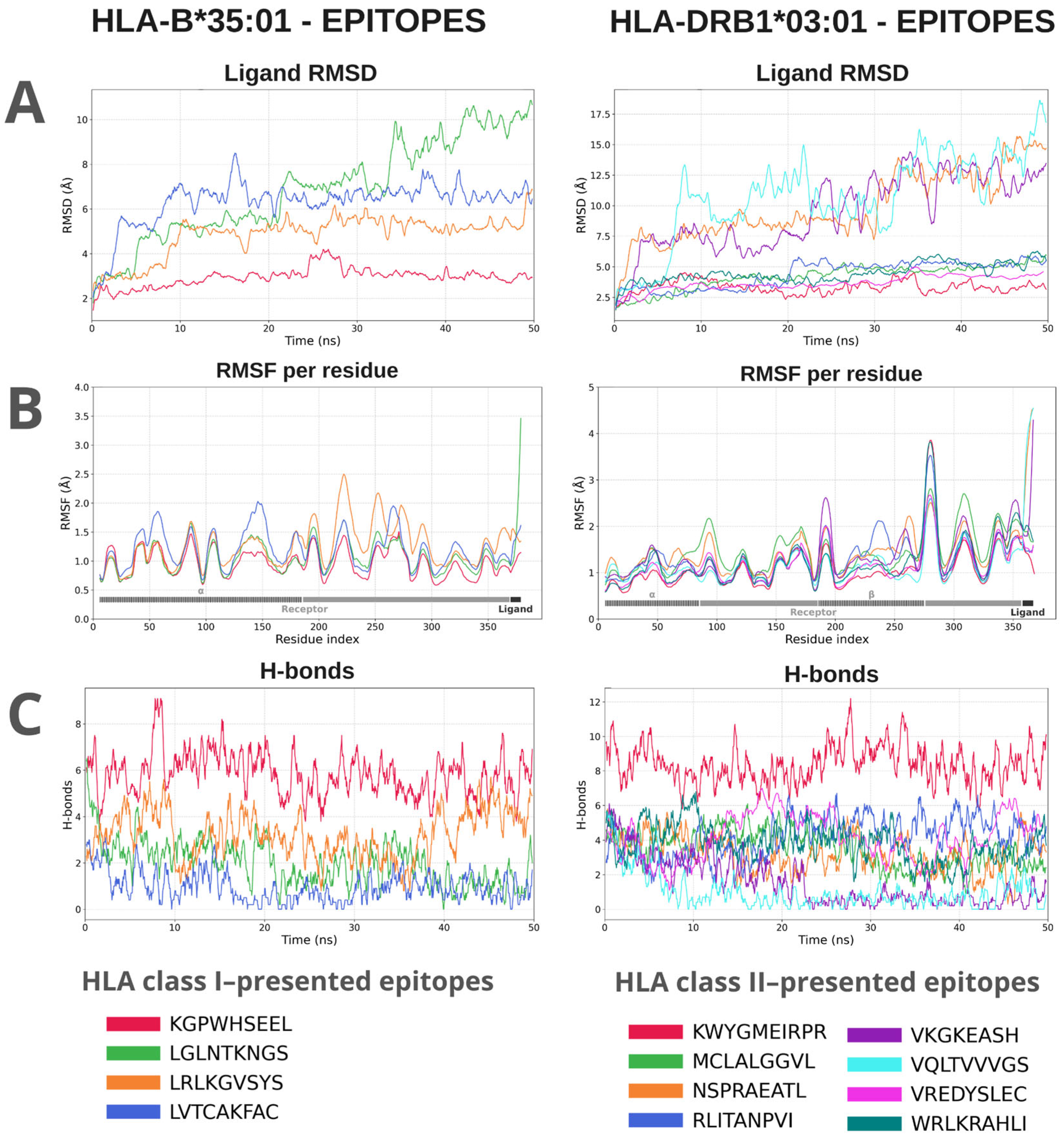
2.3.4. Molecular Dynamics (MD) Simulations
2.3.5. Physicochemical Characterization
2.3.6. Prediction of Immunological and Safety Properties
2.3.7. 3D Structure Modeling and Validation
2.3.8. Population Coverage and Immune Response Simulation
2.4. Experimental Validation In Vitro and In Vivo
2.4.1. Viruses, Cells, and Reagents
2.4.2. Vaccine Construction and Plasmid Production
2.4.3. Mammalian Cell Transfection and Immunofluorescence
2.4.4. Experimental Groups and Immunization Regimen
2.4.5. Immunogenicity Assessment
2.4.6. Hematological and Biochemical Analyses
2.4.7. Statistical Analysis
3. Results
3.1. Structural Localization and Neutralizing Antibody Overlap of Selected Epitopes
3.2. Molecular Docking Predicts Stable Epitope-HLA Binding
3.3. Binding Molecular Dynamics (MD) Simulations Reveal Epitope-HLA Complex Stability
3.4. In Silico Characterization of the Multiepitope Construct
3.4.1. Physicochemical Profile
3.4.2. Safety Profile and Immunogenicity
3.4.3. Population Coverage
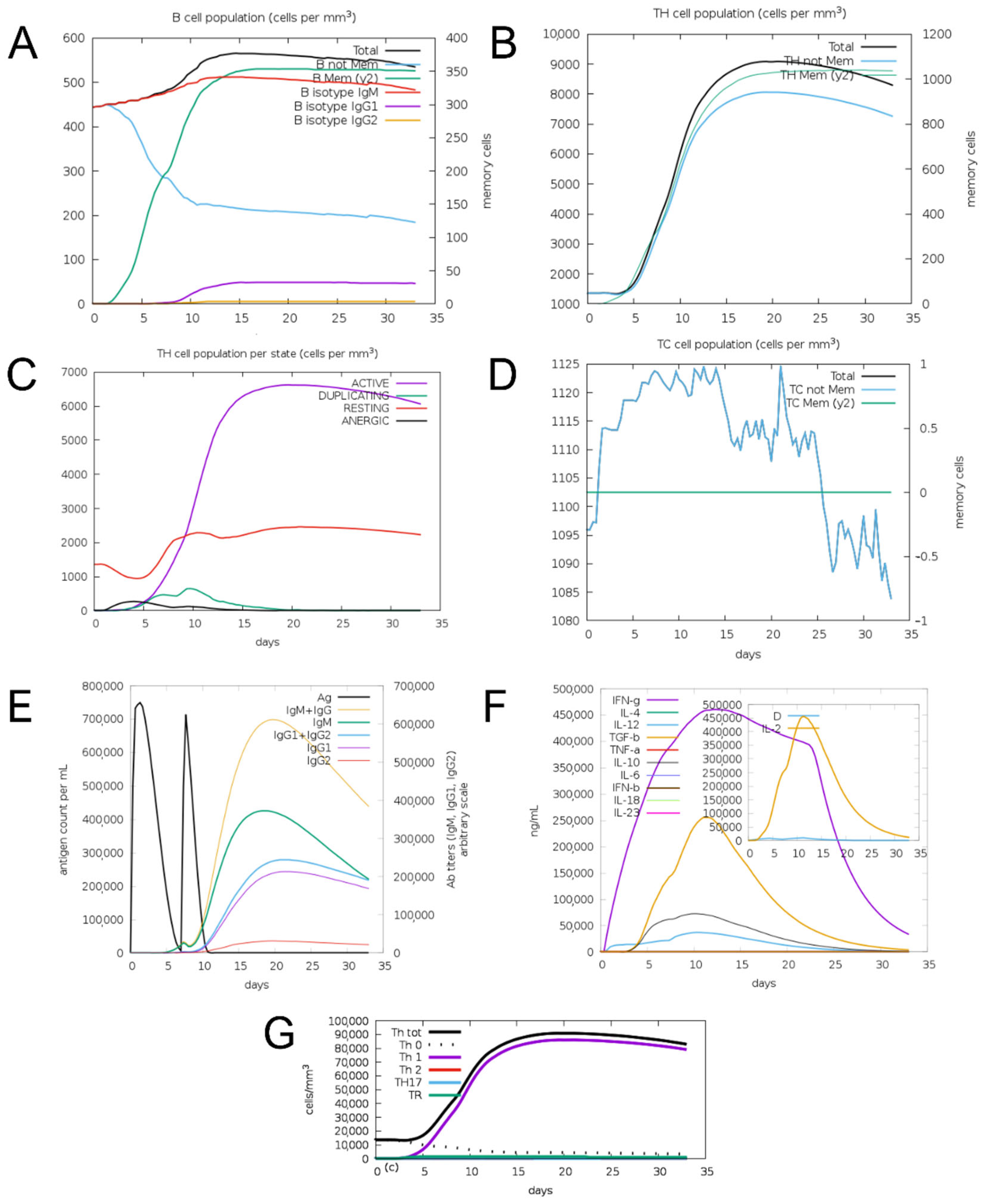
3.4.4. Immune Response Simulation
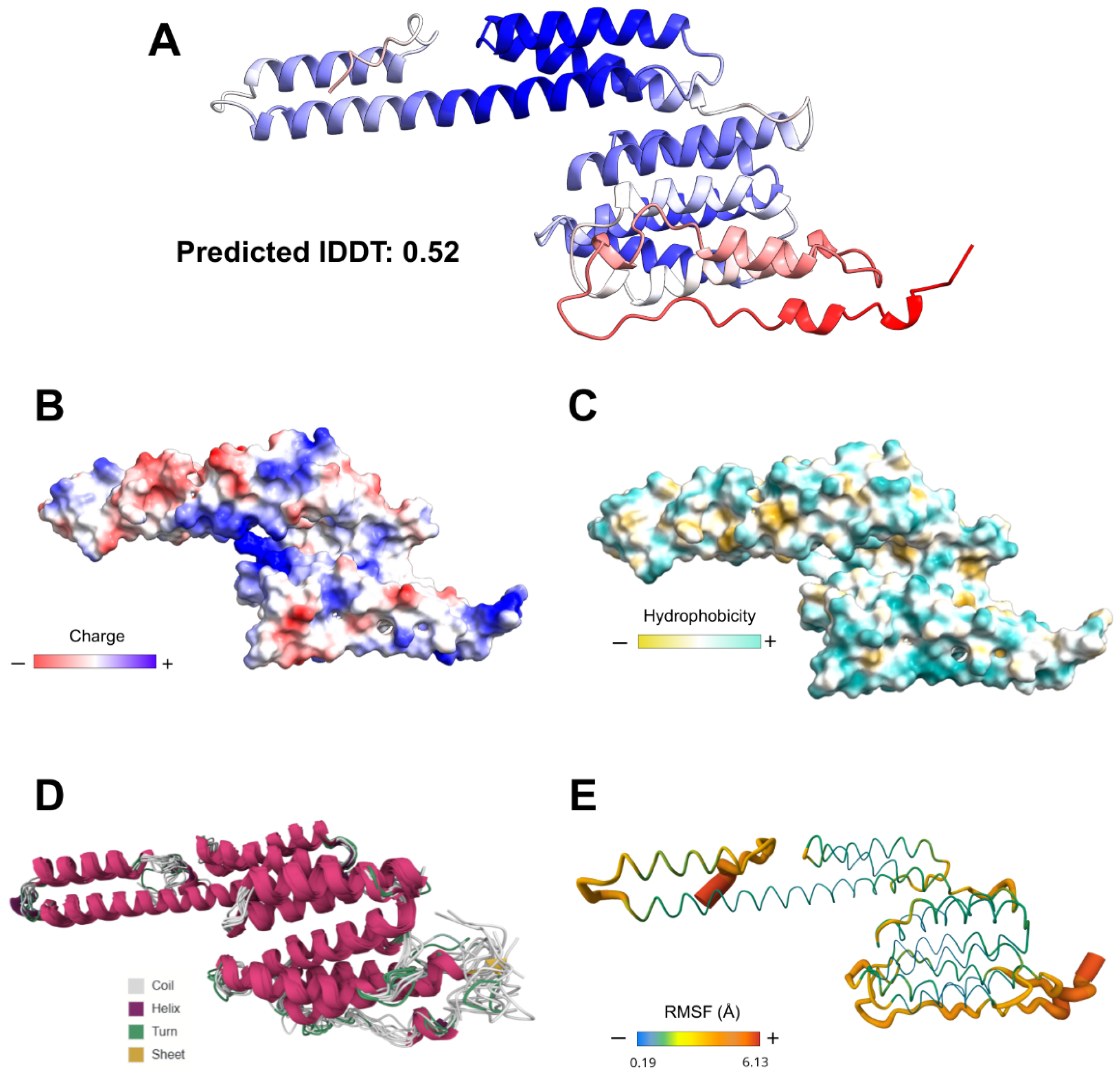
3.4.5. Structural Characterization
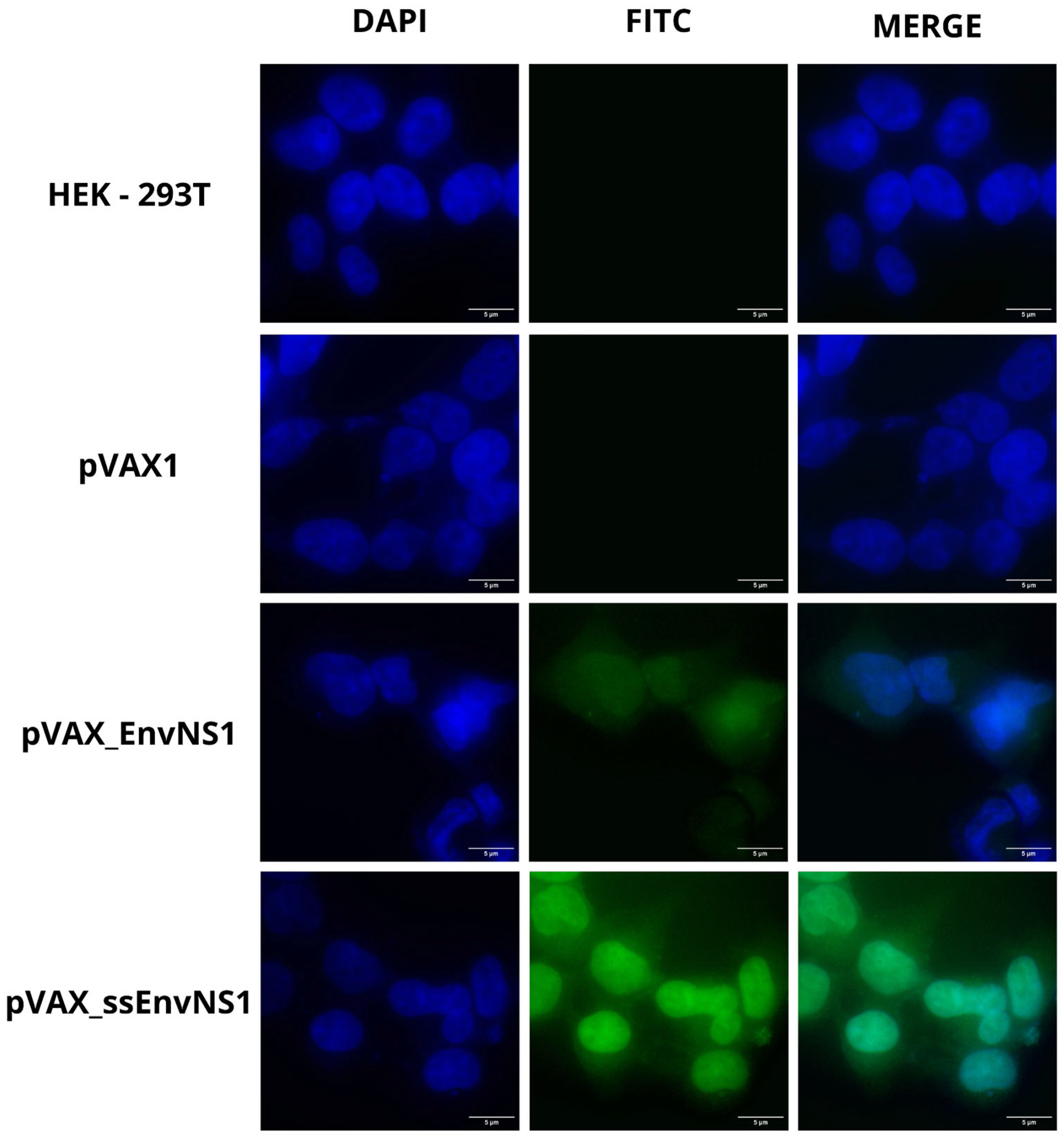
3.5. Construct Designs, Cloning in the pVAX1 Vector, and Immunofluorescence
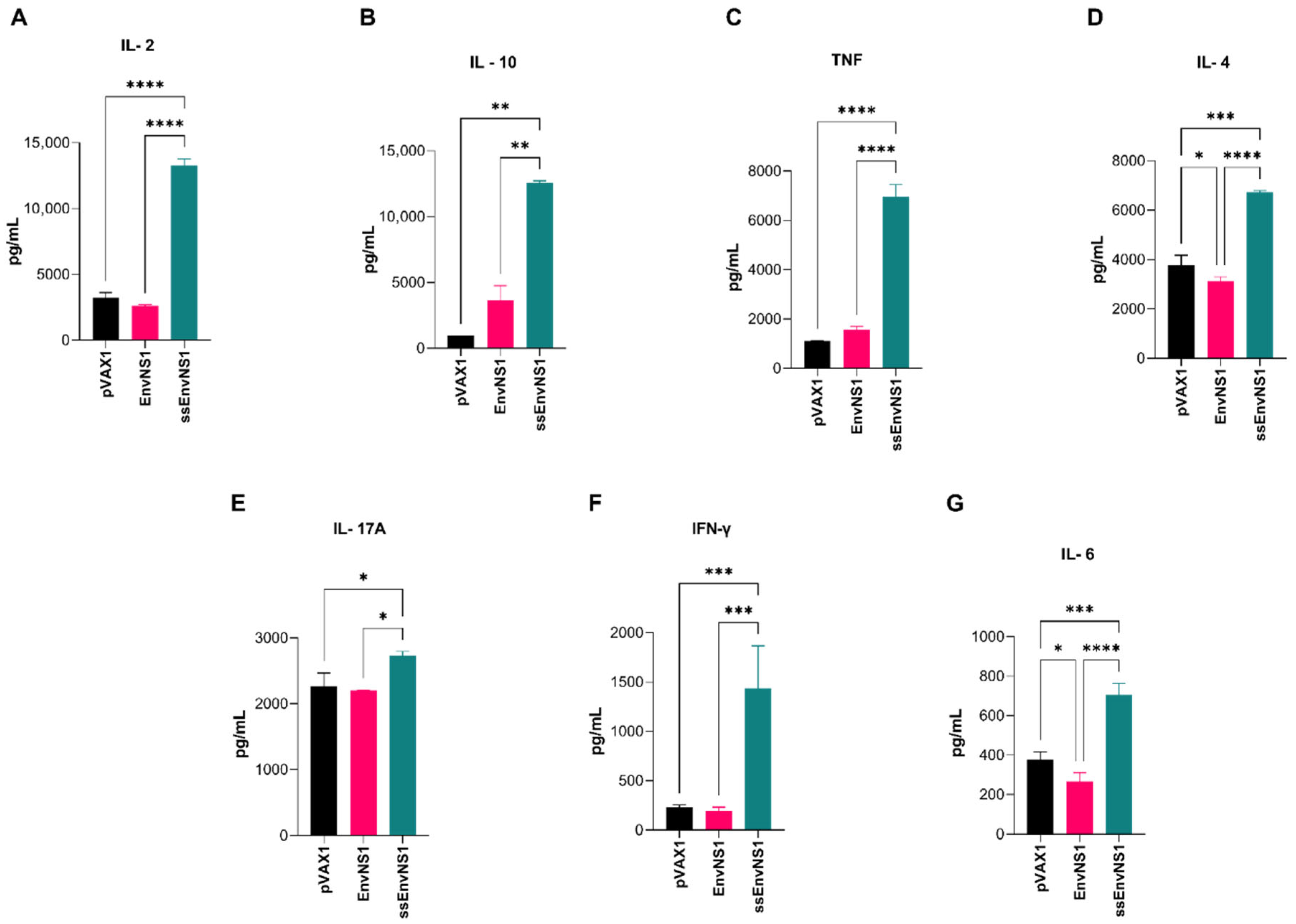
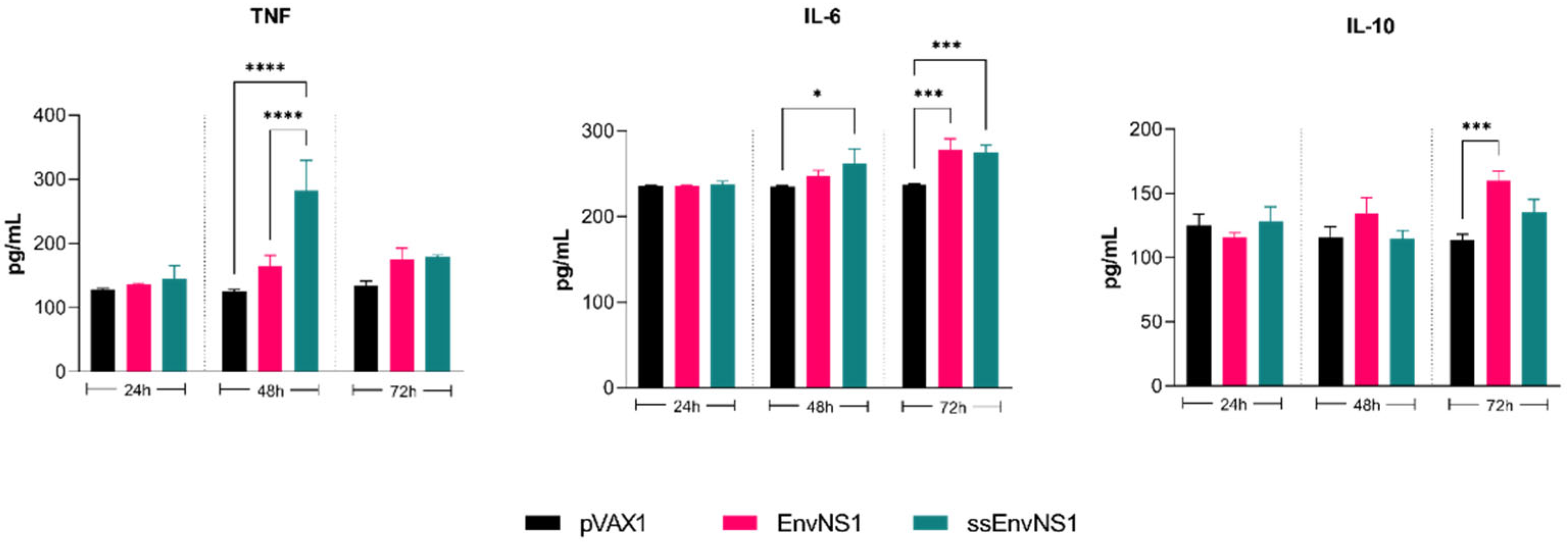
3.6. Analysis of Th1, Th2, and Th17 Cytokines Found in Blood and Produced by Virus-Stimulated Splenocytes
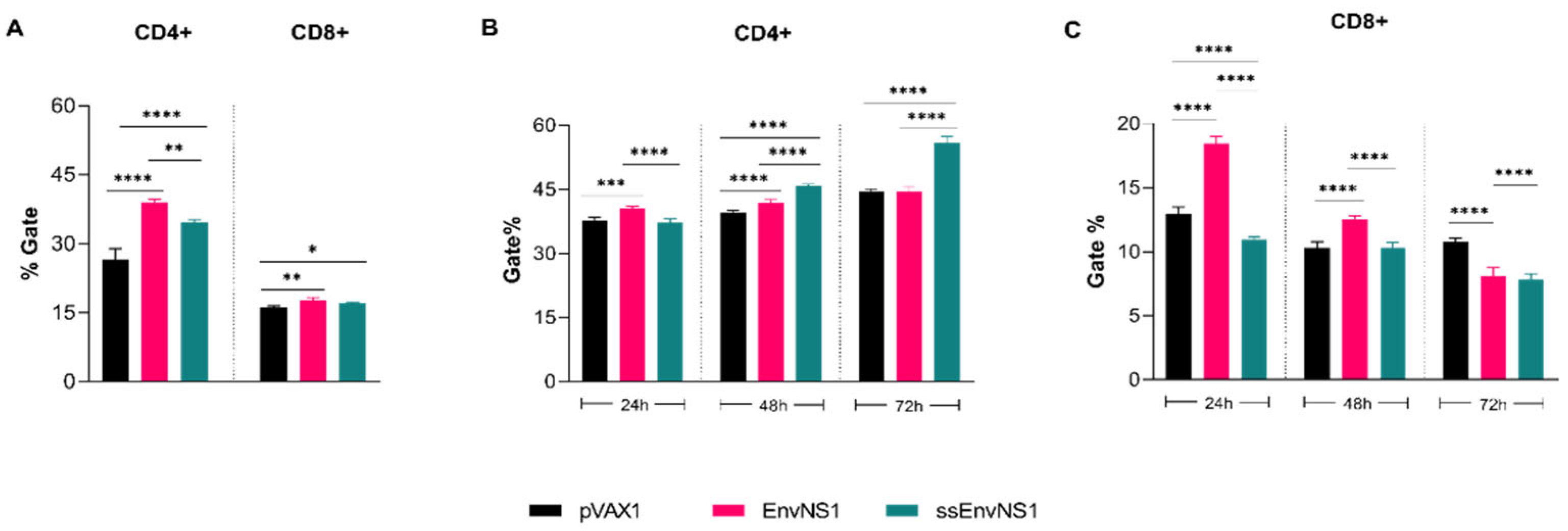
3.7. Detection of CD4+ and CD8+ T Cells After Two Vaccine Doses and Proliferation of Isolated Splenic Lymphocytes in Response to Viral Stimulation
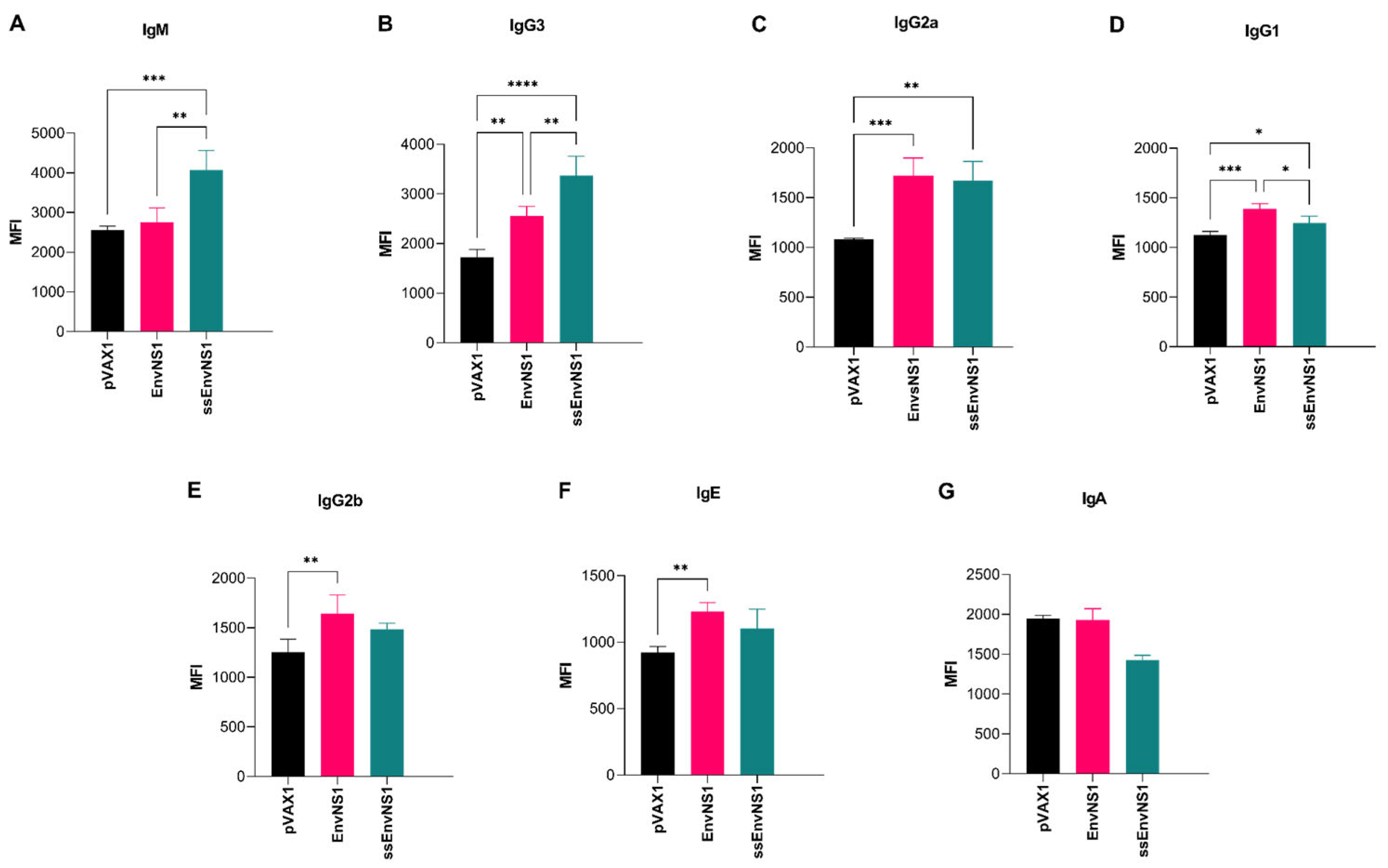
3.8. Detection of Antibodies in the Plasma of Immunized Mice
3.9. In Life Assessments, Hematological and Biochemical Analysis
4. Discussion
5. Conclusions
Supplementary Materials
Author Contributions
Funding
Institutional Review Board Statement
Informed Consent Statement
Data Availability Statement
Acknowledgments
Conflicts of Interest
Abbreviations
| Å | Angstrom |
| ADE | Antibody-Dependent Enhancement |
| BLASTp | Basic Local Alignment Search Tool (protein) |
| C | Capsid protein |
| CD4 | Cluster of Differentiation 4 |
| CD8 | Cluster of Differentiation 8 |
| CENAPAD-SP | Centro Nacional de Processamento de Alto Desempenho em São Paulo |
| CHARMM | Chemistry at Harvard Macromolecular Mechanics |
| CTL | Cytotoxic T Lymphocytes |
| CZS | Congenital Zika Syndrome |
| DENV | Dengue Virus |
| DI | Domain I (of the E protein) |
| DII | Domain II (of the E protein) |
| DIII | Domain III (of the E protein) |
| DMEM | Dulbecco’s Modified Eagle Medium |
| DNA | Deoxyribonucleic Acid |
| E | Envelope protein |
| E. coli | Escherichia coli |
| ER | Endoplasmic Reticulum |
| EnvNS1-Epi | Envelope and NS1 multi-epitope construct |
| FITC | Fluorescein Isothiocyanate |
| ΔG | Free binding energy |
| GDT | Global Distance Test |
| GRAVY | Grand Average of Hydropathy |
| HEK 293T | Human Embryonic Kidney 293T cells |
| HIS-tag | Histidine tag |
| HLA | Human Leukocyte Antigen |
| IFN-γ | Interferon gamma |
| Ig | Immunoglobulin |
| IgG | Immunoglobulin G |
| IgG1 | Immunoglobulin G subclass 1 |
| IgG2 | Immunoglobulin G subclass 2 |
| IgM | Immunoglobulin M |
| IEDB | Immune Epitope Database |
| IL | Interleukin |
| IL-2 | Interleukin-2 |
| IL-4 | Interleukin-4 |
| IL-10 | Interleukin-10 |
| IL-12 | Interleukin-12 |
| JEV | Japanese Encephalitis Virus |
| K | Kelvin |
| kcal/mol | kilocalories per mole |
| mAb | Monoclonal Antibody |
| mAbs | Monoclonal Antibodies |
| MD | Molecular Dynamics |
| MHC | Major Histocompatibility Complex |
| NAMD | Nanoscale Molecular Dynamics |
| ns | nanoseconds |
| NS1 | Nonstructural Protein 1 |
| PDB | Protein Data Bank |
| pH | Potential of Hydrogen |
| pI | Isoelectric Point |
| PROPRED | PROtein PREDiction tool |
| pTM | predicted Template Modeling |
| pVAX_EnvNS1 | pVAX1 plasmid containing the EnvNS1 gene |
| pVAX_ssEnvNS1 | pVAX1 plasmid containing the ssPGIP-EnvNS1 gene |
| PyRx | Python Prescription |
| RMSD | Root Mean Square Deviation |
| RMSF | Root Mean Square Fluctuation |
| ssPGIP | Signal peptide from the Polygalacturonase-Inhibiting Protein |
| Tfh | T follicular helper |
| TGF-β | Transforming Growth Factor beta |
| Th1 | T helper 1 |
| Th2 | T helper 2 |
| Th17 | T helper 17 |
| TNF | Tumor Necrosis Factor |
| VERO | Vero cell line (from African green monkey kidney) |
| VMD | Visual Molecular Dynamics |
| WNV | West Nile Virus |
| YFV | Yellow Fever Virus |
| ZIKV | Zika Virus |
References
- Song, B.-H.; Yun, S.-I.; Woolley, M.; Lee, Y.-M. Zika Virus: History, Epidemiology, Transmission, and Clinical Presentation. J. Neuroimmunol. 2017, 308, 50–64. [Google Scholar] [CrossRef] [PubMed]
- Pielnaa, P.; Al-Saadawe, M.; Saro, A.; Dama, M.F.; Zhou, M.; Huang, Y.; Huang, J.; Xia, Z. Zika Virus-Spread, Epidemiology, Genome, Transmission Cycle, Clinical Manifestation, Associated Challenges, Vaccine and Antiviral Drug Development. Virology 2020, 543, 34–42. [Google Scholar] [CrossRef]
- Capasso, A.; Ompad, D.C.; Vieira, D.L.; Wilder-Smith, A.; Tozan, Y. Incidence of Guillain-Barré Syndrome (GBS) in Latin America and the Caribbean before and during the 2015–2016 Zika Virus Epidemic: A Systematic Review and Meta-Analysis. PLoS Neglected Trop. Dis. 2019, 13, e0007622. [Google Scholar] [CrossRef] [PubMed]
- Wilder-Smith, A.; Osman, S. Public Health Emergencies of International Concern: A Historic Overview. J. Travel. Med. 2020, 27, taaa227. [Google Scholar] [CrossRef] [PubMed]
- Solomon, T.; Mallewa, M. Dengue and Other Emerging Flaviviruses. J. Infect. 2001, 42, 104–115. [Google Scholar] [CrossRef]
- Santana, L.M.B.; de Moura, I.A.; Mouzinho Ramos Tanaka, Y.; França, R.F.d.O. Zika Virus: A Review of Biology, Clinical Impacts, and Coinfections. Viruses 2025, 17, 637. [Google Scholar] [CrossRef]
- Vaziri, S.; Pour, S.H.; Akrami-Mohajeri, F. Zika Virus as an Emerging Arbovirus of International Public Health Concern. Osong Public Health Res. Perspect. 2022, 13, 341–351. [Google Scholar] [CrossRef]
- Han, H.-H.; Diaz, C.; Acosta, C.J.; Liu, M.; Borkowski, A. Safety and Immunogenicity of a Purified Inactivated Zika Virus Vaccine Candidate in Healthy Adults: An Observer-Blind, Randomised, Phase 1 Trial. Lancet Infect. Dis. 2021, 21, 1282–1292. [Google Scholar] [CrossRef]
- Tebas, P.; Roberts, C.C.; Muthumani, K.; Reuschel, E.L.; Kudchodkar, S.B.; Zaidi, F.I.; White, S.; Khan, A.S.; Racine, T.; Choi, H.; et al. Safety and Immunogenicity of an Anti-Zika Virus DNA Vaccine. N. Engl. J. Med. 2021, 385, e35. [Google Scholar] [CrossRef]
- Koren, M.A.; Lin, L.; Eckels, K.H.; Barrera, R.D.L.; Dussupt, V.; Donofrio, G.; Sondergaard, E.L.; Mills, K.T.; Robb, M.L.; Lee, C.; et al. Safety and Immunogenicity of a Purified Inactivated Zika Virus Vaccine Candidate in Adults Primed with a Japanese Encephalitis Virus or Yellow Fever Virus Vaccine in the USA: A Phase 1, Randomised, Double-Blind, Placebo-Controlled Clinical Trial. Lancet Infect. Dis. 2023, 23, 1175–1185. [Google Scholar] [CrossRef]
- Martinot, A.J.; Cox, F.; Abbink, P.; Hecht, J.L.; Bronson, R.; Borducchi, E.N.; Rinaldi, W.J.; Ferguson, M.J.; De La Barrera, R.A.; Zahn, R.; et al. Ad26.M.Env ZIKV Vaccine Protects Pregnant Rhesus Macaques and Fetuses against Zika Virus Infection. npj Vaccines 2024, 9, 157. [Google Scholar] [CrossRef] [PubMed]
- Roozitalab, A.; Zhang, J.; Zhang, C.; Tang, Q.; Zhao, R.Y. The Evolving Role of Zika Virus Envelope Protein in Viral Entry and Pathogenesis. Viruses 2025, 17, 817. [Google Scholar] [CrossRef] [PubMed]
- Pierson, T.C.; Diamond, M.S. Degrees of Maturity: The Complex Structure and Biology of Flaviviruses. Curr. Opin. Virol. 2012, 2, 168–175. [Google Scholar] [CrossRef] [PubMed]
- Newton, N.D.; Hardy, J.M.; Modhiran, N.; Hugo, L.E.; Amarilla, A.A.; Bibby, S.; Venugopal, H.; Harrison, J.J.; Traves, R.J.; Hall, R.A.; et al. The Structure of an Infectious Immature Flavivirus Redefines Viral Architecture and Maturation. Sci. Adv. 2021, 7, eabe4507. [Google Scholar] [CrossRef]
- Zhang, X.; Jia, R.; Shen, H.; Wang, M.; Yin, Z.; Cheng, A. Structures and Functions of the Envelope Glycoprotein in Flavivirus Infections. Viruses 2017, 9, 338. [Google Scholar] [CrossRef]
- Heinz, F.X.; Stiasny, K. The Antigenic Structure of Zika Virus and Its Relation to Other Flaviviruses: Implications for Infection and Immunoprophylaxis. Microbiol. Mol. Biol. Rev. 2017, 81, e00055-16. [Google Scholar] [CrossRef]
- Ngono, A.E.; Young, M.P.; Bunz, M.; Xu, Z.; Hattakam, S.; Vizcarra, E.; Regla-Nava, J.A.; Tang, W.W.; Yamabhai, M.; Wen, J.; et al. CD4+ T Cells Promote Humoral Immunity and Viral Control during Zika Virus Infection. PLoS Pathog 2019, 15, e1007474, Correction in PLoS Pathog. 2019, 15, e1007821. https://doi.org/10.1371/journal.ppat.1007821. [Google Scholar] [CrossRef]
- Zhang, X.; Zhang, Y.; Jia, R.; Wang, M.; Yin, Z.; Cheng, A. Structure and Function of Capsid Protein in Flavivirus Infection and Its Applications in the Development of Vaccines and Therapeutics. Vet. Res. 2021, 52, 98. [Google Scholar] [CrossRef]
- Sirohi, D.; Kuhn, R.J. Zika Virus Structure, Maturation, and Receptors. J. Infect. Dis. 2017, 216, S935–S944. [Google Scholar] [CrossRef]
- Dias, R.S.; Teixeira, M.D.; Xisto, M.F.; Prates, J.W.O.; Silva, J.D.D.; Mello, I.O.; Silva, C.C.D.; De Paula, S.O. DENV-3 Precursor Membrane (prM) Glycoprotein Enhances E Protein Immunogenicity and Confers Protection against DENV-2 Infections in a Murine Model. Hum. Vaccines Immunother. 2021, 17, 1271–1277. [Google Scholar] [CrossRef]
- Dowd, K.A.; Sirohi, D.; Speer, S.D.; VanBlargan, L.A.; Chen, R.E.; Mukherjee, S.; Whitener, B.M.; Govero, J.; Aleshnick, M.; Larman, B.; et al. prM-Reactive Antibodies Reveal a Role for Partially Mature Virions in Dengue Virus Pathogenesis. Proc. Natl. Acad. Sci. USA 2023, 120, e2218899120. [Google Scholar] [CrossRef] [PubMed]
- Brault, A.C.; Domi, A.; McDonald, E.M.; Talmi-Frank, D.; McCurley, N.; Basu, R.; Robinson, H.L.; Hellerstein, M.; Duggal, N.K.; Bowen, R.A.; et al. A Zika Vaccine Targeting NS1 Protein Protects Immunocompetent Adult Mice in a Lethal Challenge Model. Sci. Rep. 2017, 7, 14769. [Google Scholar] [CrossRef] [PubMed]
- Pattnaik, A.; Sahoo, B.R.; Pattnaik, A.K. Current Status of Zika Virus Vaccines: Successes and Challenges. Vaccines 2020, 8, 266. [Google Scholar] [CrossRef] [PubMed]
- Zhang, S.; He, Y.; Wu, Z.; Wang, M.; Jia, R.; Zhu, D.; Liu, M.; Zhao, X.; Yang, Q.; Wu, Y.; et al. Secretory Pathways and Multiple Functions of Nonstructural Protein 1 in Flavivirus Infection. Front. Immunol. 2023, 14, 1205002. [Google Scholar] [CrossRef]
- Li, L.; Petrovsky, N. Molecular Mechanisms for Enhanced DNA Vaccine Immunogenicity. Expert Rev. Vaccines 2016, 15, 313–329. [Google Scholar] [CrossRef]
- Suschak, J.J.; Williams, J.A.; Schmaljohn, C.S. Advancements in DNA Vaccine Vectors, Non-Mechanical Delivery Methods, and Molecular Adjuvants to Increase Immunogenicity. Hum. Vaccines Immunother. 2017, 13, 2837–2848. [Google Scholar] [CrossRef]
- Yurina, V.; Adianingsih, O.R. Predicting Epitopes for Vaccine Development Using Bioinformatics Tools. Ther. Adv. Vaccines Immunother. 2022, 10, 25151355221100218. [Google Scholar] [CrossRef]
- Vilela Rodrigues, T.C.; Jaiswal, A.K.; de Sarom, A.; de Castro Oliveira, L.; Freire Oliveira, C.J.; Ghosh, P.; Tiwari, S.; Miranda, F.M.; de Jesus Benevides, L.; Ariston de Carvalho Azevedo, V.; et al. Reverse Vaccinology and Subtractive Genomics Reveal New Therapeutic Targets against Mycoplasma Pneumoniae: A Causative Agent of Pneumonia. R. Soc. Open Sci. 2019, 6, 190907. [Google Scholar] [CrossRef]
- Kushwaha, V.; Prabha, A.; Sharma, V.; Devi, A.; Ramniwas, S.; Sharma, A.; Sharma, A.K.; Sheikh, I.; Panwar, A.; Kaur, D. Chapter 7 Immunoinformatics: Computational Keys to Immune System Secrets. In Bioinformatics: Drug Discovery; Sharma, A.K., Sharma, V., Eds.; De Gruyter: Berlin, Germany, 2024; pp. 123–140. [Google Scholar] [CrossRef]
- Massa, S.; Paolini, F.; Curzio, G.; Cordeiro, M.N.; Illiano, E.; Demurtas, O.C.; Franconi, R.; Venuti, A. A Plant Protein Signal Sequence Improved Humoral Immune Response to HPV Prophylactic and Therapeutic DNA Vaccines. Hum. Vaccines Immunother. 2017, 13, 271–282. [Google Scholar] [CrossRef]
- Silva, A.J.D.; Jesus, A.L.S.; Leal, L.R.S.; Silva, G.A.S.; Melo, C.M.L.; Freitas, A.C. Pichia Pastoris Displaying ZIKV Protein Epitopes from the Envelope and NS1 Induce in Vitro Immune Activation. Vaccine 2021, 39, 2545–2554. [Google Scholar] [CrossRef]
- Silva, A.J.D.; de Jesus, A.L.S.; Leal, L.R.S.; de Macêdo, L.S.; da Silva Barros, B.R.; de Sousa, G.F.; da Paz Leôncio Alves, S.; Pena, L.J.; de Melo, C.M.L.; de Freitas, A.C. Whole Yeast Vaccine Displaying ZIKV B and T Cell Epitopes Induces Cellular Immune Responses in the Murine Model. Pharmaceutics 2023, 15, 1898. [Google Scholar] [CrossRef] [PubMed]
- Huang, H.; Li, S.; Zhang, Y.; Han, X.; Jia, B.; Liu, H.; Liu, D.; Tan, S.; Wang, Q.; Bi, Y.; et al. CD8+ T Cell Immune Response in Immunocompetent Mice during Zika Virus Infection. J. Virol. 2017, 91, e00900-17. [Google Scholar] [CrossRef] [PubMed]
- Badolato-Corrêa, J.; Carvalho, F.R.; Paiva, I.A.; Familiar-Macedo, D.; Dias, H.G.; Pauvolid-Corrêa, A.; Fernandes-Santos, C.; Lima, M.d.R.Q.; Gandini, M.; Silva, A.A.; et al. Differential Longevity of Memory CD4 and CD8 T Cells in a Cohort of the Mothers with a History of ZIKV Infection and Their Children. Front. Immunol. 2021, 12, 610456. [Google Scholar] [CrossRef] [PubMed]
- Badawi, M.M.; Osman, M.M.; Alla, A.A.F.; Ahmedani, A.M.; Abdalla, M.h.; Gasemelseed, M.M.; Elsayed, A.A.; Salih, M.A. Highly Conserved Epitopes of ZIKA Envelope Glycoprotein May Act as a Novel Peptide Vaccine with High Coverage: Immunoinformatics Approach. Am. J. Biomed. Res. 2016, 4, 46–60. [Google Scholar]
- Dar, H.; Zaheer, T.; Rehman, M.T.; Ali, A.; Javed, A.; Khan, G.A.; Babar, M.M.; Waheed, Y. Prediction of Promiscuous T-Cell Epitopes in the Zika Virus Polyprotein: An In Silico Approach. Asian Pac. J. Trop. Med. 2016, 9, 844–850. [Google Scholar] [CrossRef]
- Dikhit, M.R.; Ansari, M.Y.; Vijaymahantesh; Kalyani; Mansuri, R.; Sahoo, B.R.; Dehury, B.; Amit, A.; Topno, R.K.; Sahoo, G.C.; et al. Computational Prediction and Analysis of Potential Antigenic CTL Epitopes in Zika Virus: A First Step towards Vaccine Development. Infect. Genet. Evol. 2016, 45, 187–197. [Google Scholar] [CrossRef]
- Chen, X.; Zaro, J.L.; Shen, W.-C. Fusion Protein Linkers: Property, Design and Functionality. Adv. Drug Deliv. Rev. 2013, 65, 1357–1369. [Google Scholar] [CrossRef]
- Jacob, E.; Unger, R. A Tale of Two Tails: Why Are Terminal Residues of Proteins Exposed? Bioinformatics 2007, 23, e225–e230. [Google Scholar] [CrossRef]
- Nielsen, M.; Lund, O.; Buus, S.; Lundegaard, C. MHC Class II Epitope Predictive Algorithms. Immunology 2010, 130, 319–328. [Google Scholar] [CrossRef]
- Ayyagari, V.S.; Venkateswarulu, T.C.; Peele, A.K.; Srirama, K. Design of a Multi-Epitope-Based Vaccine Targeting M-Protein of SARS-CoV2: An Immunoinformatics Approach. J. Biomol. Struct. Dyn. 2022, 40, 2963–2977. [Google Scholar] [CrossRef]
- Jumper, J.; Evans, R.; Pritzel, A.; Green, T.; Figurnov, M.; Ronneberger, O.; Tunyasuvunakool, K.; Bates, R.; Žídek, A.; Potapenko, A.; et al. Highly Accurate Protein Structure Prediction with AlphaFold. Nature 2021, 596, 583–589. [Google Scholar] [CrossRef]
- Meng, E.C.; Goddard, T.D.; Pettersen, E.F.; Couch, G.S.; Pearson, Z.J.; Morris, J.H.; Ferrin, T.E. UCSF ChimeraX: Tools for Structure Building and Analysis. Protein Sci. 2023, 32, e4792. [Google Scholar] [CrossRef] [PubMed]
- Niu, X.; Zhao, L.; Qu, L.; Yao, Z.; Zhang, F.; Yan, Q.; Zhang, S.; Liang, R.; Chen, P.; Luo, J.; et al. Convalescent Patient-Derived Monoclonal Antibodies Targeting Different Epitopes of E Protein Confer Protection against Zika Virus in a Neonatal Mouse Model. Emerg. Microbes Infect. 2019, 8, 749–759. [Google Scholar] [CrossRef] [PubMed]
- Zhao, H.; Fernandez, E.; Dowd, K.A.; Speer, S.D.; Platt, D.J.; Gorman, M.J.; Govero, J.; Nelson, C.A.; Pierson, T.C.; Diamond, M.S.; et al. Structural Basis of Zika Virus-Specific Antibody Protection. Cell 2016, 166, 1016–1027. [Google Scholar] [CrossRef] [PubMed]
- Dussupt, V.; Sankhala, R.S.; Gromowski, G.D.; Donofrio, G.; De La Barrera, R.A.; Larocca, R.A.; Zaky, W.; Mendez-Rivera, L.; Choe, M.; Davidson, E.; et al. Potent Zika and Dengue Cross-Neutralizing Antibodies Induced by Zika Vaccination in a Dengue-Experienced Donor. Nat. Med. 2020, 26, 228–235. [Google Scholar] [CrossRef]
- Robbiani, D.F.; Bozzacco, L.; Keeffe, J.R.; Khouri, R.; Olsen, P.C.; Gazumyan, A.; Schaefer-Babajew, D.; Avila-Rios, S.; Nogueira, L.; Patel, R.; et al. Recurrent Potent Human Neutralizing Antibodies to Zika Virus in Brazil and Mexico. Cell 2017, 169, 597–609.e11. [Google Scholar] [CrossRef]
- Wang, Q.; Yan, J.; Gao, G.F. Monoclonal Antibodies against Zika Virus: Therapeutics and Their Implications for Vaccine Design. J. Virol. 2017, 91, e01049-17. [Google Scholar] [CrossRef]
- Barba-Spaeth, G.; Dejnirattisai, W.; Rouvinski, A.; Vaney, M.-C.; Medits, I.; Sharma, A.; Simon-Lorière, E.; Sakuntabhai, A.; Cao-Lormeau, V.-M.; Haouz, A.; et al. Structural Basis of Potent Zika–Dengue Virus Antibody Cross-Neutralization. Nature 2016, 536, 48–53. [Google Scholar] [CrossRef]
- Zhang, S.; Kostyuchenko, V.A.; Ng, T.-S.; Lim, X.-N.; Ooi, J.S.G.; Lambert, S.; Tan, T.Y.; Widman, D.G.; Shi, J.; Baric, R.S.; et al. Neutralization Mechanism of a Highly Potent Antibody against Zika Virus. Nat. Commun. 2016, 7, 13679. [Google Scholar] [CrossRef]
- Sapparapu, G.; Fernandez, E.; Kose, N.; Cao, B.; Fox, J.M.; Bombardi, R.G.; Zhao, H.; Nelson, C.A.; Bryan, A.L.; Barnes, T.; et al. Neutralizing Human Antibodies Prevent Zika Virus Replication and Fetal Disease in Mice. Nature 2016, 540, 443–447. [Google Scholar] [CrossRef]
- Wang, L.; Wang, R.; Wang, L.; Ben, H.; Yu, L.; Gao, F.; Shi, X.; Yin, C.; Zhang, F.; Xiang, Y.; et al. Structural Basis for Neutralization and Protection by a Zika Virus-Specific Human Antibody. Cell Rep. 2019, 26, 3360–3368.e5. [Google Scholar] [CrossRef]
- Wang, Q.; Yang, H.; Liu, X.; Dai, L.; Ma, T.; Qi, J.; Wong, G.; Peng, R.; Liu, S.; Li, J.; et al. Molecular Determinants of Human Neutralizing Antibodies Isolated from a Patient Infected with Zika Virus. Sci. Transl. Med. 2016, 8, 369ra179. [Google Scholar] [CrossRef] [PubMed]
- Pan, Q.; Xing, X.; Yu, J.; Chen, Q.; Jiao, H.; Zhang, W.; Wen, Y.; Gao, M.; Zhao, W.; Yu, L.; et al. Structural Insights into the Distinct Protective Mechanisms of Human Antibodies Targeting ZIKV NS1. hLife 2024, 2, 527–541. [Google Scholar] [CrossRef]
- Reynisson, B.; Alvarez, B.; Paul, S.; Peters, B.; Nielsen, M. NetMHCpan-4.1 and NetMHCIIpan-4.0: Improved Predictions of MHC Antigen Presentation by Concurrent Motif Deconvolution and Integration of MS MHC Eluted Ligand Data. Nucleic Acids Res. 2020, 48, W449–W454. [Google Scholar] [CrossRef] [PubMed]
- Berman, H.M.; Westbrook, J.; Feng, Z.; Gilliland, G.; Bhat, T.N.; Weissig, H.; Shindyalov, I.N.; Bourne, P.E. The Protein Data Bank. Nucleic Acids Res. 2000, 28, 235–242. [Google Scholar] [CrossRef]
- Tufféry, P.; Derreumaux, P. A Refined pH-Dependent Coarse-Grained Model for Peptide Structure Prediction in Aqueous Solution. Front. Bioinform. 2023, 3, 1113928. [Google Scholar] [CrossRef]
- Trott, O.; Olson, A.J. AutoDock Vina: Improving the Speed and Accuracy of Docking with a New Scoring Function, Efficient Optimization, and Multithreading. J. Comput. Chem. 2010, 31, 455–461. [Google Scholar] [CrossRef]
- Dallakyan, S.; Olson, A.J. Small-Molecule Library Screening by Docking with PyRx. Methods Mol. Biol. 2015, 1263, 243–250. [Google Scholar] [CrossRef]
- BIOVIA Discovery Studio Visualizer—Dassault Systèmes. Available online: https://discover.3ds.com/discovery-studio-visualizer-download (accessed on 2 December 2025).
- Phillips, J.C.; Hardy, D.J.; Maia, J.D.C.; Stone, J.E.; Ribeiro, J.V.; Bernardi, R.C.; Buch, R.; Fiorin, G.; Hénin, J.; Jiang, W.; et al. Scalable Molecular Dynamics on CPU and GPU Architectures with NAMD. J. Chem. Phys. 2020, 153, 044130. [Google Scholar] [CrossRef]
- Lee, J.; Cheng, X.; Swails, J.M.; Yeom, M.S.; Eastman, P.K.; Lemkul, J.A.; Wei, S.; Buckner, J.; Jeong, J.C.; Qi, Y.; et al. CHARMM-GUI Input Generator for NAMD, GROMACS, AMBER, OpenMM, and CHARMM/OpenMM Simulations Using the CHARMM36 Additive Force Field. J. Chem. Theory Comput. 2016, 12, 405–413. [Google Scholar] [CrossRef]
- Humphrey, W.; Dalke, A.; Schulten, K. VMD: Visual Molecular Dynamics. J. Mol. Graph. 1996, 14, 33–38. [Google Scholar] [CrossRef]
- Harris, C.R.; Millman, K.J.; van der Walt, S.J.; Gommers, R.; Virtanen, P.; Cournapeau, D.; Wieser, E.; Taylor, J.; Berg, S.; Smith, N.J.; et al. Array Programming with NumPy. Nature 2020, 585, 357–362. [Google Scholar] [CrossRef]
- McKinney, W. Data Structures for Statistical Computing in Python. In Proceedings of the 9th Python in Science Conference, Austin, TX, USA, 28 June–3 July 2010. [Google Scholar] [CrossRef]
- Hunter, J.D. Matplotlib: A 2D Graphics Environment. Comput. Sci. Eng. 2007, 9, 90–95. [Google Scholar] [CrossRef]
- Waskom, M.L. Seaborn: Statistical Data Visualization. J. Open Source Softw. 2021, 6, 3021. [Google Scholar] [CrossRef]
- Gasteiger, E.; Hoogland, C.; Gattiker, A.; Duvaud, S.; Wilkins, M.R.; Appel, R.D.; Bairoch, A. Protein Identification and Analysis Tools on the ExPASy Server. In The Proteomics Protocols Handbook; Walker, J.M., Ed.; Humana Press: Totowa, NJ, USA, 2005; pp. 571–607. [Google Scholar] [CrossRef]
- Hebditch, M.; Carballo-Amador, M.A.; Charonis, S.; Curtis, R.; Warwicker, J. Protein–Sol: A Web Tool for Predicting Protein Solubility from Sequence. Bioinformatics 2017, 33, 3098–3100. [Google Scholar] [CrossRef] [PubMed]
- Gupta, S.; Kapoor, P.; Chaudhary, K.; Gautam, A.; Kumar, R.; Consortium, O.S.D.D.; Raghava, G.P.S. In Silico Approach for Predicting Toxicity of Peptides and Proteins. PLoS ONE 2013, 8, e73957. [Google Scholar] [CrossRef]
- Dimitrov, I.; Bangov, I.; Flower, D.R.; Doytchinova, I. AllerTOP v.2—A Server for in Silico Prediction of Allergens. J. Mol. Model. 2014, 20, 2278. [Google Scholar] [CrossRef]
- Doytchinova, I.A.; Flower, D.R. Identifying Candidate Subunit Vaccines Using an Alignment-Independent Method Based on Principal Amino Acid Properties. Vaccine 2007, 25, 856–866. [Google Scholar] [CrossRef]
- Dhanda, S.K.; Vir, P.; Raghava, G.P. Designing of Interferon-Gamma Inducing MHC Class-II Binders. Biol. Direct 2013, 8, 30. [Google Scholar] [CrossRef]
- Dhanda, S.K.; Gupta, S.; Vir, P.; Raghava, G.P.S. Prediction of IL4 Inducing Peptides. J. Immunol. Res. 2013, 2013, 263952. [Google Scholar] [CrossRef]
- Nagpal, G.; Usmani, S.S.; Dhanda, S.K.; Kaur, H.; Singh, S.; Sharma, M.; Raghava, G.P.S. Computer-Aided Designing of Immunosuppressive Peptides Based on IL-10 Inducing Potential. Sci. Rep. 2017, 7, 42851. [Google Scholar] [CrossRef] [PubMed]
- Baek, M.; DiMaio, F.; Anishchenko, I.; Dauparas, J.; Ovchinnikov, S.; Lee, G.R.; Wang, J.; Cong, Q.; Kinch, L.N.; Schaeffer, R.D.; et al. Accurate Prediction of Protein Structures and Interactions Using a Three-Track Neural Network. Science 2021, 373, 871–876. [Google Scholar] [CrossRef] [PubMed]
- Williams, C.J.; Headd, J.J.; Moriarty, N.W.; Prisant, M.G.; Videau, L.L.; Deis, L.N.; Verma, V.; Keedy, D.A.; Hintze, B.J.; Chen, V.B.; et al. MolProbity: More and Better Reference Data for Improved All-atom Structure Validation. Protein Sci. 2018, 27, 293–315. [Google Scholar] [CrossRef] [PubMed]
- Wróblewski, K.; Zalewski, M.; Kuriata, A.; Kmiecik, S. CABS-Flex 3.0: An Online Tool for Simulating Protein Structural Flexibility and Peptide Modeling. Nucleic Acids Res. 2025, 53, W95–W101. [Google Scholar] [CrossRef]
- Bui, H.-H.; Sidney, J.; Dinh, K.; Southwood, S.; Newman, M.J.; Sette, A. Predicting Population Coverage of T-Cell Epitope-Based Diagnostics and Vaccines. BMC Bioinform. 2006, 7, 153. [Google Scholar] [CrossRef]
- Ragone, C.; Manolio, C.; Cavalluzzo, B.; Mauriello, A.; Tornesello, M.L.; Buonaguro, F.M.; Castiglione, F.; Vitagliano, L.; Iaccarino, E.; Ruvo, M.; et al. Identification and Validation of Viral Antigens Sharing Sequence and Structural Homology with Tumor-Associated Antigens (TAAs). J. Immunother. Cancer 2021, 9, e002694. [Google Scholar] [CrossRef]
- Baz, M. Zika Virus Isolation, Purification, and Titration. Methods Mol. Biol. 2020, 2142, 9–22. [Google Scholar] [CrossRef]
- Eroglu, E.; Singh, A.; Bawage, S.; Tiwari, P.M.; Vig, K.; Pillai, S.R.; Dennis, V.A.; Singh, S.R. Immunogenicity of RSV F DNA Vaccine in BALB/c Mice. Adv. Virol. 2016, 2016, 7971847. [Google Scholar] [CrossRef]
- Dey, A.; Chozhavel Rajanathan, T.M.; Chandra, H.; Pericherla, H.P.R.; Kumar, S.; Choonia, H.S.; Bajpai, M.; Singh, A.K.; Sinha, A.; Saini, G.; et al. Immunogenic Potential of DNA Vaccine Candidate, ZyCoV-D against SARS-CoV-2 in Animal Models. Vaccine 2021, 39, 4108–4116. [Google Scholar] [CrossRef]
- Momin, T.; Kansagra, K.; Patel, H.; Sharma, S.; Sharma, B.; Patel, J.; Mittal, R.; Sanmukhani, J.; Maithal, K.; Dey, A.; et al. Safety and Immunogenicity of a DNA SARS-CoV-2 Vaccine (ZyCoV-D): Results of an Open-Label, Non-Randomized Phase I Part of Phase I/II Clinical Study by Intradermal Route in Healthy Subjects in India. EClinicalMedicine 2021, 38, 101020. [Google Scholar] [CrossRef]
- Zhang, S.; He, Z.; Wang, H.; Zhai, J. Signal Peptides: From Molecular Mechanisms to Applications in Protein and Vaccine Engineering. Biomolecules 2025, 15, 897. [Google Scholar] [CrossRef] [PubMed]
- Hemmerich, J.; Rohe, P.; Kleine, B.; Jurischka, S.; Wiechert, W.; Freudl, R.; Oldiges, M. Use of a Sec Signal Peptide Library from Bacillus subtilis for the Optimization of Cutinase Secretion in Corynebacterium glutamicum. Microb. Cell Factories 2016, 15, 208. [Google Scholar] [CrossRef] [PubMed]
- Kober, L.; Zehe, C.; Bode, J. Optimized Signal Peptides for the Development of High Expressing CHO Cell Lines. Biotechnol. Bioeng. 2013, 110, 1164–1173. [Google Scholar] [CrossRef] [PubMed]
- Ohmuro-Matsuyama, Y.; Yamaji, H. Modifications of a Signal Sequence for Antibody Secretion from Insect Cells. Cytotechnology 2018, 70, 891–898. [Google Scholar] [CrossRef]
- Franconi, R.; Massa, S.; Illiano, E.; Mullar, A.; Cirilli, A.; Accardi, L.; Di Bonito, P.; Giorgi, C.; Venuti, A. Exploiting the Plant Secretory Pathway to Improve the Anticancer Activity of a Plant-Derived HPV16 E7 Vaccine. Int. J. Immunopathol. Pharmacol. 2006, 19, 187–197. [Google Scholar] [CrossRef]
- Scheiblhofer, S.; Laimer, J.; Machado, Y.; Weiss, R.; Thalhamer, J. Influence of Protein Fold Stability on Immunogenicity and Its Implications for Vaccine Design. Expert Rev. Vaccines 2017, 16, 479–489. [Google Scholar] [CrossRef]
- Sootichote, R.; Puangmanee, W.; Benjathummarak, S.; Kowaboot, S.; Yamanaka, A.; Boonnak, K.; Ampawong, S.; Chatchen, S.; Ramasoota, P.; Pitaksajjakul, P. Potential Protective Effect of Dengue NS1 Human Monoclonal Antibodies against Dengue and Zika Virus Infections. Biomedicines 2023, 11, 227. [Google Scholar] [CrossRef]
- Lai, Y.-C.; Chuang, Y.-C.; Liu, C.-C.; Ho, T.-S.; Lin, Y.-S.; Anderson, R.; Yeh, T.-M. Antibodies Against Modified NS1 Wing Domain Peptide Protect Against Dengue Virus Infection. Sci. Rep. 2017, 7, 6975. [Google Scholar] [CrossRef]
- Lin, C.-F.; Wan, S.-W.; Chen, M.-C.; Lin, S.-C.; Cheng, C.-C.; Chiu, S.-C.; Hsiao, Y.-L.; Lei, H.-Y.; Liu, H.-S.; Yeh, T.-M.; et al. Liver Injury Caused by Antibodies against Dengue Virus Nonstructural Protein 1 in a Murine Model. Lab. Investig. 2008, 88, 1079–1089. [Google Scholar] [CrossRef]
- Cavazzoni, C.B.; Bozza, V.B.T.; Lucas, T.C.V.; Conde, L.; Maia, B.; Mesin, L.; Schiepers, A.; Ersching, J.; Neris, R.L.S.; Conde, J.N.; et al. The Immunodominant Antibody Response to Zika Virus NS1 Protein Is Characterized by Cross-Reactivity to Self. J. Exp. Med. 2021, 218, e20210580. [Google Scholar] [CrossRef]
- Watanabe, S.; Tan, N.W.W.; Chan, K.W.K.; Vasudevan, S.G. Dengue Virus and Zika Virus Serological Cross-Reactivity and Their Impact on Pathogenesis in Mice. J. Infect. Dis. 2019, 219, 223–233. [Google Scholar] [CrossRef] [PubMed]
- Prasasty, V.D.; Grazzolie, K.; Rosmalena, R.; Yazid, F.; Ivan, F.X.; Sinaga, E. Peptide-Based Subunit Vaccine Design of T- and B-Cells Multi-Epitopes against Zika Virus Using Immunoinformatics Approaches. Microorganisms 2019, 7, 226. [Google Scholar] [CrossRef] [PubMed]
- da Costa, A.S.; Fernandes, T.V.A.; Bello, M.L.; de Souza, T.L.F. Evaluation of Potential MHC-I Allele-Specific Epitopes in Zika Virus Proteins and the Effects of Mutations on Peptide-MHC-I Interaction Studied Using In Silico Approaches. Comput. Biol. Chem. 2021, 92, 107459. [Google Scholar] [CrossRef] [PubMed]
- Gerlier, D.; Calin-Laurens, V.; Bertolino, P.; Rabourdin-Combe, C. Molecular Biology of Antigen Presentation. In Immune System Accessory Cells; Fornusek, L., Vetvicka, V., Eds.; CRC Press: Boca Raton, FL, USA, 1992; pp. 287–323. ISBN 978-1-0402-9019-4. [Google Scholar] [CrossRef]
- Coban, C.; Kobiyama, K.; Aoshi, T.; Takeshita, F.; Horii, T.; Akira, S.; Ishii, K.J. Novel Strategies to Improve DNA Vaccine Immunogenicity. Curr. Gene Ther. 2011, 11, 479–484. [Google Scholar] [CrossRef]
- Luo, M.; Tao, P.; Li, J.; Zhou, S.; Guo, D.; Pan, Z. Immunization with Plasmid DNA Encoding Influenza A Virus Nucleoprotein Fused to a Tissue Plasminogen Activator Signal Sequence Elicits Strong Immune Responses and Protection against H5N1 Challenge in Mice. J. Virol. Methods 2008, 154, 121–127. [Google Scholar] [CrossRef]
- Hobernik, D.; Bros, M. DNA Vaccines—How Far from Clinical Use? Int. J. Mol. Sci. 2018, 19, 3605. [Google Scholar] [CrossRef]
- Stern, B.; Olsen, L.; Trösse, C.; Ravneberg, H.; Pryme, I. Improving Mammalian Cell Factories: The Selection of Signal Peptide Has a Major Impact on Recombinant Protein Synthesis and Secretion in Mammalian Cells. Trends Cell Biol. 2007, 2, 1–17. [Google Scholar]
- Tappe, D.; Pérez-Girón, J.V.; Zammarchi, L.; Rissland, J.; Ferreira, D.F.; Jaenisch, T.; Gómez-Medina, S.; Günther, S.; Bartoloni, A.; Muñoz-Fontela, C.; et al. Cytokine Kinetics of Zika Virus-Infected Patients from Acute to Reconvalescent Phase. Med. Microbiol. Immunol. 2016, 205, 269–273. [Google Scholar] [CrossRef]
- Kam, Y.-W.; Leite, J.A.; Lum, F.-M.; Tan, J.J.L.; Lee, B.; Judice, C.C.; Teixeira, D.A.d.T.; Andreata-Santos, R.; Vinolo, M.A.; Angerami, R.; et al. Specific Biomarkers Associated with Neurological Complications and Congenital Central Nervous System Abnormalities from Zika Virus-Infected Patients in Brazil. J. Infect. Dis. 2017, 216, 172–181. [Google Scholar] [CrossRef]
- Barros, J.B.d.S.; da Silva, P.A.N.; Koga, R.d.C.R.; Gonzalez-Dias, P.; Carmo Filho, J.R.; Nagib, P.R.A.; Coelho, V.; Nakaya, H.I.; Fonseca, S.G.; Pfrimer, I.A.H. Acute Zika Virus Infection in an Endemic Area Shows Modest Proinflammatory Systemic Immunoactivation and Cytokine-Symptom Associations. Front. Immunol. 2018, 9, 821. [Google Scholar] [CrossRef]
- Pardy, R.D.; Rajah, M.M.; Condotta, S.A.; Taylor, N.G.; Sagan, S.M.; Richer, M.J. Analysis of the T Cell Response to Zika Virus and Identification of a Novel CD8+ T Cell Epitope in Immunocompetent Mice. PLoS Pathog. 2017, 13, e1006184. [Google Scholar] [CrossRef] [PubMed]
- Nazerai, L.; Schøller, A.S.; Bassi, M.R.; Buus, S.; Stryhn, A.; Christensen, J.P.; Thomsen, A.R. Effector CD8 T Cell-Dependent Zika Virus Control in the CNS: A Matter of Time and Numbers. Front. Immunol. 2020, 11, 1977. [Google Scholar] [CrossRef] [PubMed]
- Wen, J.; Wang, Y.-T.; Valentine, K.M.; Dos Santos Alves, R.P.; Xu, Z.; Regla-Nava, J.A.; Ngono, A.E.; Young, M.P.; Ferreira, L.C.S.; Shresta, S. CD4+ T Cells Cross-Reactive with Dengue and Zika Viruses Protect against Zika Virus Infection. Cell Rep. 2020, 31, 107566. [Google Scholar] [CrossRef]
- Apostolico, J.d.S.; Lunardelli, V.A.S.; Boscardin, S.B.; Botosso, V.F.; Astray, R.M.; Kalil, J.; de Almeida, R.P.; Cunha-Neto, E.; Rosa, D.S. Durable Cellular Immune Response against Inactivated ZIKV and Envelope Proteins in ZIKV-Infected Women during Pregnancy. Front. Trop. Dis. 2024, 5, 1369608. [Google Scholar] [CrossRef]
- Wijeratne, D.T.; Fernando, S.; Gomes, L.; Jeewandara, C.; Ginneliya, A.; Samarasekara, S.; Wijewickrama, A.; Hardman, C.S.; Ogg, G.S.; Malavige, G.N. Quantification of Dengue Virus Specific T Cell Responses and Correlation with Viral Load and Clinical Disease Severity in Acute Dengue Infection. PLoS Neglected Trop. Dis. 2018, 12, e0006540. [Google Scholar] [CrossRef]
- Valentine, K.M.; Croft, M.; Shresta, S. Protection against Dengue Virus Requires a Sustained Balance of Antibody and T Cell Responses. Curr. Opin. Virol. 2020, 43, 22–27. [Google Scholar] [CrossRef]
- Rivino, L.; Lim, M.Q. CD4+ and CD8+ T-Cell Immunity to Dengue—Lessons for the Study of Zika Virus. Immunology 2017, 150, 146–154. [Google Scholar] [CrossRef]
- Mapalagamage, M.; Weiskopf, D.; Sette, A.; De Silva, A.D. Current Understanding of the Role of T Cells in Chikungunya, Dengue and Zika Infections. Viruses 2022, 14, 242. [Google Scholar] [CrossRef]
- Sant, A.J.; McMichael, A. Revealing the Role of CD4(+) T Cells in Viral Immunity. J. Exp. Med. 2012, 209, 1391–1395. [Google Scholar] [CrossRef]
- Ahrends, T.; Busselaar, J.; Severson, T.M.; Bąbała, N.; de Vries, E.; Bovens, A.; Wessels, L.; van Leeuwen, F.; Borst, J. CD4+ T Cell Help Creates Memory CD8+ T Cells with Innate and Help-Independent Recall Capacities. Nat. Commun. 2019, 10, 5531. [Google Scholar] [CrossRef]
- Liang, H.; Tang, J.; Liu, Z.; Liu, Y.; Huang, Y.; Xu, Y.; Hao, P.; Yin, Z.; Zhong, J.; Ye, L.; et al. ZIKV Infection Induces Robust Th1-like Tfh Cell and Long-Term Protective Antibody Responses in Immunocompetent Mice. Nat. Commun. 2019, 10, 3859. [Google Scholar] [CrossRef] [PubMed]
- Hassert, M.; Wolf, K.J.; Schwetye, K.E.; DiPaolo, R.J.; Brien, J.D.; Pinto, A.K. CD4+T Cells Mediate Protection against Zika Associated Severe Disease in a Mouse Model of Infection. PLoS Pathog. 2018, 14, e1007237. [Google Scholar] [CrossRef] [PubMed]
- Tonnerre, P.; Melgaço, J.G.; Torres-Cornejo, A.; Pinto, M.A.; Yue, C.; Blümel, J.; de Sousa, P.S.F.; de Mello, V.d.M.; Moran, J.; de Filippis, A.M.B.; et al. Evolution of the Innate and Adaptive Immune Response in Women with Acute Zika Virus Infection. Nat. Microbiol. 2020, 5, 76–83. [Google Scholar] [CrossRef] [PubMed]
- Sun, J.; Zheng, Z.; Li, M.; Liu, Z.; Su, X.; Jin, X. Development of a Novel ZIKV Vaccine Comprised of Immunodominant CD4+ and CD8+ T Cell Epitopes Identified through Comprehensive Epitope Mapping in Zika Virus Infected Mice. Vaccine 2021, 39, 5173–5186. [Google Scholar] [CrossRef]
- Griffin, I.; Martin, S.W.; Fischer, M.; Chambers, T.V.; Kosoy, O.; Falise, A.; Ponomareva, O.; Gillis, L.D.; Blackmore, C.; Jean, R. Zika Virus IgM Detection and Neutralizing Antibody Profiles 12–19 Months after Illness Onset. Emerg. Infect. Dis. 2019, 25, 299–303. [Google Scholar] [CrossRef]
- Calvert, A.E.; Horiuchi, K.; Boroughs, K.L.; Ong, Y.T.; Anderson, K.M.; Biggerstaff, B.J.; Stone, M.; Simmons, G.; Busch, M.P.; Huang, C.Y.-H. The Specificity of the Persistent IgM Neutralizing Antibody Response in Zika Virus Infections among Individuals with Prior Dengue Virus Exposure. J. Clin. Microbiol. 2021, 59, e0040021. [Google Scholar] [CrossRef]
- Seo, S.H.; Choi, J.-A.; Yang, E.; Park, H.; Jung, D.-I.; Kim, J.-O.; Yang, J.S.; Song, M. Mouse Strain-Dependent Neutralizing Antibody Responses to Zika Virus Vaccines. J. Microbiol. 2025, 63, e2504005. [Google Scholar] [CrossRef]



| LRLKGVSYS | EVQYAGTDGPCK | LVTCAKFAC | LDKQSDTQYV | DOMAIN | |
|---|---|---|---|---|---|
| MZ4 [46] | LRLKGVSYS | DI/DIII linker | |||
| Z006 [47] | LRLKGVSYS | DIII | |||
| Z004 [48] | LRLKGVSYS | EVQYAGTDGPCK | DI/DIII linker | ||
| ZIKV-116 [51] | LRLKGVSYS | EVQYAGTDGPCK | DIII | ||
| 7B3 [44] | EVQYAGTDGPCK | DIII | |||
| ZK2B10 [52] | EVQYAGTDGPCK | DIII | |||
| ZK-67 [45] | EVQYAGTDGPCK | DIII | |||
| C8 [49] | LVTCAKFAC | LDKQSDTQYV | DII Dimer | ||
| Z20 [53] | LVTCAKFAC | LDKQSDTQYV | DII Dimer | ||
| ZIKV-117 [51] | LVTCAKFAC | LDKQSDTQYV | DII Dimer | ||
| A11 [49] | LVTCAKFAC | DII Dimer | |||
| 1C11 [44] | DIII | ||||
| Z3L1 [53] | DI, DI-DII junction | ||||
| C10 [50] | DIII/DII Dimer |
| VREDYSLEC | KGPWHSEEL | CWYGMEIRPR | DOMAIN | |
|---|---|---|---|---|
| 3G2 | VREDYSLEC | Wing domain | ||
| z4B8 | VREDYSLEC | Wing domain | ||
| 4F10 | KGPWHSEEL | β-ladder domain | ||
| 2E11 | CWYGMEIRPR | β-ladder domain | ||
| 14G5 | CWYGMEIRPR | β-ladder domain |
| HLA CLASS I (kcal/mol) | HLA-B35:01 | HLA-B44:03 | HLA-B51:01 | HLA-B08:01 | HLA-B40:01 | HLA-A68:01 | HLA-A11:01 | HLA-B53:01 | HLA-B07:02 | HLA-A03:01 | HLA-A02:01 |
|---|---|---|---|---|---|---|---|---|---|---|---|
| LGLNTKNGS | −8.7 | −8.3 | −9.0 | −8.0 | −7.2 | −7.8 | −8.2 | −9.0 | −9.3 | −7.5 | −8.2 |
| LRLKGVSYS | −8.5 | −7.4 | −8.3 | −7.7 | −7.4 | −7.1 | −7.9 | −8.7 | −9.2 | −7.2 | −7.3 |
| LVTCAKFAC | −8.2 | −8.4 | −9.3 | −9.2 | −7.0 | −8.9 | −8.9 | −9.8 | −9.3 | −7.8 | −6.6 |
| KGPWHSEEL | −8.7 | −9.1 | −9.1 | −8.2 | −8.2 | −8.6 | −7.3 | −8.9 | −8.7 | −8.4 | −7.8 |
| HLA CLASS II (kcal/mol) | HLA DRB1 03:01 | HLA DRB1 07:01 | HLA DRB1 15:01 | HLA DRB5 01:01 |
|---|---|---|---|---|
| MCLALGGVL | −8.0 | −7.5 | −6.5 | −7.8 |
| NSPRAEATL | −7.5 | −7.1 | −8.9 | −8.4 |
| RLITANPVI | −9.3 | −8.5 | −8.0 | −8.1 |
| KWYGMEIRPR | −8.4 | −8.4 | −7.8 | −8.7 |
| VKGKEAVHS | −7.9 | −7.2 | −7.7 | −7.6 |
| VQLTVVVGS | −6.9 | −8.5 | −8.2 | −8.1 |
| VREDYSLEC | −7.0 | −7.3 | −9.1 | −8.2 |
| WRLKRAHLI | −8.1 | −7.8 | −8.3 | −8.6 |
| Multi-Epitope Analyses | EnvNS1 |
|---|---|
| Estimated Half-life: Mammary reticulocytes (in vitro): 30 h Yeast (in vivo): 20 h Escherichia coli (in vivo): 10 h | 30 h 20 h 10 h |
| Solubility (>0.45) | 0.566 (Soluble) |
| Theoretical pI (>7 basic) | 8.74 (Basic) |
| Instability Index (<40) | 30.39 (Stable) |
| Average Hydropathy Score (>0.0 hydrophilic) | −0.235 (Hydrophilic) |
| Aliphatic Index (>70) | 76.91 (Thermostable) |
| Antigenicity (>0.4) | 0.4486 (Probable antigen) |
| Toxicity (>0.0) | 0.3 (Non-toxic) |
| Allergenicity | Likely non-allergen |
| Organism (TaxID) | Description | Max Score | Query Cover | E-Value | Percent Identity (%) | Acc. Len |
|---|---|---|---|---|---|---|
| Dengue virus (12637) | NS1 protein [dengue virus type 4] | 28.1 | 4% | 0.018 | 81.82 | NP_740318.1 |
| West Nile virus (11082) | polyprotein [West Nile virus] | 37.0 | 14% | 3 × 10⁻⁵ | 40.54 | YP_001527877.1 |
| Japanese encephalitis virus (11072) | envelope protein | 33.5 | 25% | 1 × 10⁻⁴ | 29.89 | NP_775666.1 |
| Yellow fever virus (11089) | No significant similarity found | - | - | - | - | - |
| Homo sapiens (9606) | No significant similarity found | - | - | - | - | - |
| Epitope | World | South America | Brazil |
|---|---|---|---|
| LGLNTKNGS | 61.74 | 40.86 | 58.69 |
| LVTCALKFAC | 37.38 | 24.71 | 34.40 |
| NSPRAEATL | 34.78 | 14.26 | 13.93 |
| RLITANPVI | 34.44 | 13.72 | 14.49 |
| WRLKRAHLI | 34.44 | 13.72 | 14.49 |
| KGPWHSEEL | 28.80 | 13.80 | 23.20 |
| LRLKGVSYS | 20.79 | 8.38 | 16.96 |
| KWYGMEIRPR | 17.84 | 8.76 | 11.24 |
| MCLALGGLVL | 17.84 | 8.76 | 11.24 |
| VREDYSLEC | 17.84 | 8.76 | 11.24 |
| Epitope set | 87.28 | 60.59 | 75.83 |
| IgG1/IgG2a | IgG2b/IgG2a | ||||
|---|---|---|---|---|---|
| pVAX1 | EnvNS1 | ssEnvNS1 | pVAX1 | EnvNS1 | ssEnvNS1 |
| 1.0405 | 0.8083 | 0.7482 | 1.1572 | 0.9558 | 0.8879 |
Disclaimer/Publisher’s Note: The statements, opinions and data contained in all publications are solely those of the individual author(s) and contributor(s) and not of MDPI and/or the editor(s). MDPI and/or the editor(s) disclaim responsibility for any injury to people or property resulting from any ideas, methods, instructions or products referred to in the content. |
© 2025 by the authors. Licensee MDPI, Basel, Switzerland. This article is an open access article distributed under the terms and conditions of the Creative Commons Attribution (CC BY) license.
Share and Cite
Leal, L.R.S.; de Sena, M.G.A.M.; Invenção, M.d.C.V.; de Moura, I.A.; Jesus, A.L.S.d.; de Sousa, G.F.; Barros, B.R.d.S.; Melo, C.M.L.d.; Pena, L.J.; Paolini, F.; et al. Development and Immunogenicity Assessment of a Multi-Epitope Antigen Against Zika Virus: An In Silico and In Vivo Approach. Vaccines 2026, 14, 31. https://doi.org/10.3390/vaccines14010031
Leal LRS, de Sena MGAM, Invenção MdCV, de Moura IA, Jesus ALSd, de Sousa GF, Barros BRdS, Melo CMLd, Pena LJ, Paolini F, et al. Development and Immunogenicity Assessment of a Multi-Epitope Antigen Against Zika Virus: An In Silico and In Vivo Approach. Vaccines. 2026; 14(1):31. https://doi.org/10.3390/vaccines14010031
Chicago/Turabian StyleLeal, Lígia Rosa Sales, Matheus Gardini Amâncio Marques de Sena, Maria da Conceição Viana Invenção, Ingrid Andrêssa de Moura, André Luiz Santos de Jesus, Georon Ferreira de Sousa, Bárbara Rafaela da Silva Barros, Cristiane Moutinho Lagos de Melo, Lindomar José Pena, Francesca Paolini, and et al. 2026. "Development and Immunogenicity Assessment of a Multi-Epitope Antigen Against Zika Virus: An In Silico and In Vivo Approach" Vaccines 14, no. 1: 31. https://doi.org/10.3390/vaccines14010031
APA StyleLeal, L. R. S., de Sena, M. G. A. M., Invenção, M. d. C. V., de Moura, I. A., Jesus, A. L. S. d., de Sousa, G. F., Barros, B. R. d. S., Melo, C. M. L. d., Pena, L. J., Paolini, F., Venuti, A., Silva, A. J. D., & de Freitas, A. C. (2026). Development and Immunogenicity Assessment of a Multi-Epitope Antigen Against Zika Virus: An In Silico and In Vivo Approach. Vaccines, 14(1), 31. https://doi.org/10.3390/vaccines14010031