Review

Progress in L2-Based Prophylactic Vaccine Development for Protection against Diverse Human Papillomavirus Genotypes and Associated Diseases

by
Pola Olczak
1 and
Richard B.S. Roden
1,2,3,*
1
Department of Pathology, The Johns Hopkins School of Medicine, Baltimore, MD 21287, USA
2
Department of Oncology, The Johns Hopkins School of Medicine, Baltimore, MD 21287, USA
3
Department of Gynecology and Obstetrics, The Johns Hopkins School of Medicine, Baltimore, MD 21287, USA
*
Author to whom correspondence should be addressed.
Vaccines 2020, 8(4), 568; https://doi.org/10.3390/vaccines8040568

Submission received: 2 September 2020 / Revised: 17 September 2020 / Accepted: 21 September 2020 / Published: 1 October 2020
(This article belongs to the Special Issue Development of Cross-Protective Vaccines)

Abstract

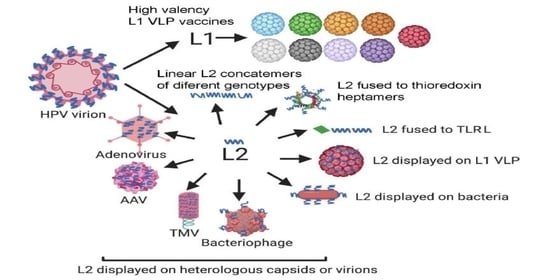
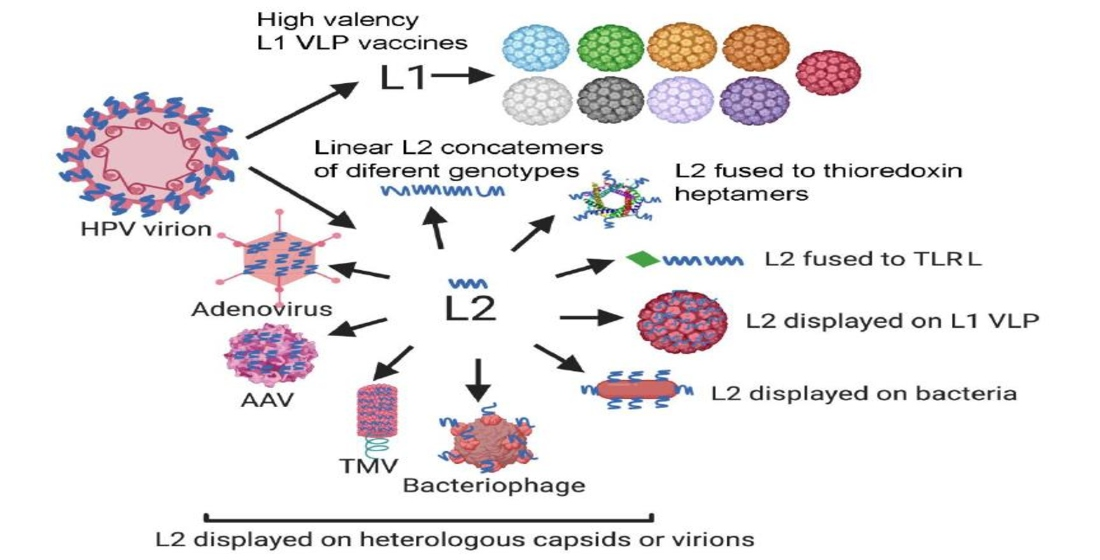
The human papillomaviruses (HPVs) are a family of small DNA tumor viruses including over 200 genotypes classified by phylogeny into several genera. Different genera of HPVs cause ano-genital and oropharyngeal cancers, skin cancers, as well as benign diseases including skin and genital warts. Licensed vaccines composed of L1 virus-like particles (VLPs) confer protection generally restricted to the ≤9 HPV types targeted. Here, we examine approaches aimed at broadening the protection against diverse HPV types by targeting conserved epitopes of the minor capsid protein, L2. Compared to L1 VLP, L2 is less immunogenic. However, with appropriate presentation to the immune system, L2 can elicit durable, broadly cross-neutralizing antibody responses and protection against skin and genital challenge with diverse HPV types. Such approaches to enhance the strength and breadth of the humoral response include the display of L2 peptides on VLPs or viral capsids, bacteria, thioredoxin and other platforms for multimerization. Neither L2 nor L1 vaccinations elicit a therapeutic response. However, fusion of L2 with early viral antigens has the potential to elicit both prophylactic and therapeutic immunity. This review of cross-protective HPV vaccines based on L2 is timely as several candidates have recently entered early-phase clinical trials.
Keywords: HPV; Human papillomavirus; vaccine; cross-protection; neutralization; papillomavirus; minor capsid protein; L2; cervical cancer; cervical intraepithelial neoplasia (CIN); anogenital cancers; skin cancer; warts HPV; Human papillomavirus; vaccine; cross-protection; neutralization; papillomavirus; minor capsid protein; L2; cervical cancer; cervical intraepithelial neoplasia (CIN); anogenital cancers; skin cancer; warts
Graphical Abstract