
Article

Preventive Strategies and Determinants of Vaccination Compliance Among Older Adults in Rural Amazonian Communities


by
Luciana T. Pasquel-Muñoz
1,2,
Ana Lucía Ramírez-Béjar
1,2,
Joaquín Eduardo Chávez Cano
1,2,
Kiara Camacho-Caballero
3,4,
José F. Parodi
5 and
Fernando M. Runzer-Colmenares
3,*
1
Carrera de Medicina Humana, Universidad Científica del Sur, Lima 15842, Peru
2
Sociedad Científica de Estudiantes de Medicina de la Universidad Científica del Sur, Lima 15842, Peru
3
CHANGE Research Working Group, Carrera de Medicina Humana, Universidad Científica del Sur, Lima 15842, Peru
4
Internal Medicine, Naples Comprehensive Health (NCH) Healthcare System, Naples, FL 34102, USA
5
Centro de Investigación del Envejecimiento, Facultad de Medicina Humana, Universidad de San Martín de Porres, Lima 15024, Peru
*
Author to whom correspondence should be addressed.
Vaccines 2026, 14(7), 643; https://doi.org/10.3390/vaccines14070643
Submission received: 1 July 2026 / Revised: 21 July 2026 / Accepted: 21 July 2026 / Published: 22 July 2026
(This article belongs to the Special Issue Vaccination and Public Health in the 21st Century, 2nd Edition)

Abstract

Background/Objectives: Respiratory infections are a major cause of morbidity and mortality among older adults. However, vaccination coverage against respiratory pathogens remains suboptimal, particularly in rural and vulnerable populations. This study aimed to identify factors associated with respiratory vaccination uptake among older adults living in rural Amazonian communities in Peru. Methods: We conducted an observational, analytical, cross-sectional study using secondary data from the Amazon Frail Project. A total of 429 adults aged ≥60 years from rural and suburban communities in San Martín, Loreto, and Ucayali were included. Vaccination coverage for influenza, pneumococcal disease, pertussis, and COVID-19, as well as vaccine combinations, was assessed. Multiple linear and Poisson regression models with robust variance were used to identify associated factors. Results: Complete vaccination coverage was 42.89% for influenza, 23.08% for pneumococcal disease, 4.43% for pertussis, and 70.16% for COVID-19. Only 3.50% of participants had received all four respiratory vaccines. Higher educational attainment, multimorbidity, social frailty, greater muscle mass, better physical performance, and healthcare center attendance were associated with higher vaccination uptake. Depressive symptoms, cognitive impairment, functional dependency, physical frailty, dynapenia, and higher body mass index were associated with lower vaccination uptake. Conclusions: Respiratory vaccination coverage was suboptimal among older adults living in rural Amazonian communities. Educational, functional, physical, social, and healthcare access factors significantly influenced vaccine uptake, highlighting the need for targeted immunization strategies in vulnerable rural populations.

1. Introduction

During the aging process, the immune system response declines, making older adults (OA), people aged 60 years or older, more vulnerable to infections and complications that are often preventable through vaccination [1,2]. As the OA population continues to grow, projected to increase from 12.5% to 22–25% by 2050, low vaccination rates among this population represent an important public health concern [3]. Considerable worldwide disparities have been reported in vaccination coverage among older adults, with some countries exhibiting coverage rates below 25% for influenza and pneumococcal vaccines [4].
In Peru, where older adults account for 14.6% of the population, vaccination against respiratory diseases in this age group is implemented through the current National Vaccination Schedule, in accordance with the guidelines established by the Peruvian Ministry of Health [5]. This schedule applies nationwide, including in rural Amazonian communities. Compliance with this regulatory framework is mandatory for public healthcare facilities that provide immunization services; however, vaccination against infectious respiratory diseases among older adults is established as a prioritized national recommendation. Furthermore, vaccines are administered free of charge through immunization activities conducted at public healthcare facilities and during vaccination campaigns. These vaccines may also be obtained from private healthcare providers; nevertheless, the public immunization system remains the primary means of access [6].
Regarding the vaccines evaluated in this study, national recommendations include annual influenza vaccination, at least one dose of a pneumococcal vaccine, and COVID-19 vaccination in accordance with current regulations. Protection against pertussis was assessed through combined booster vaccines containing a pertussis component, such as Tdap [6]. The influenza vaccine is an inactivated seasonal influenza vaccine, whereas the pneumococcal vaccine is a conjugate polysaccharide vaccine. The COVID-19 vaccine is based on messenger RNA technology, while the combined pertussis vaccine (Tdap) contains tetanus and diphtheria toxoids together with acellular pertussis antigens [6,7].
Vaccination coverage among older adults in Peru has been estimated to vary considerably. Regarding pneumococcal vaccination, the Ministry of Health reported that 66.67% of older adults had been vaccinated in 2025, whereas a community-based study conducted in selected Peruvian cities found that only 27% of older adults had received influenza vaccination during the previous year [8,9]. During the COVID-19 pandemic in Peru, older adults accounted for 68.8% of confirmed deaths, of which 96.4% were attributed to COVID-19-related pneumonia. In rural Amazonian communities, such as Condorcanqui in the Amazonas region, a cumulative incidence of 63.84 cases per 1000 inhabitants was reported; of these, 308 cases occurred among individuals aged 60 years or older, representing 9.4% of all cases [10,11]. Regarding pneumonia, one report indicated that older adults accounted for 75.6% of deaths due to pneumonia of unspecified etiology, suggesting potential limitations in etiological diagnosis [12].
The high prevalence of preventable respiratory diseases and vaccines in specific regions, such as the northern Peruvian Amazon, may reflect existing disparities in annual vaccination efforts geared specially towards this high risk population by the Ministry of Health, reflecting substantial disparities in health status, access to healthcare services, and vaccination coverage compared with other vulnerable populations in Peru, including urban communities living in poverty and other geographically isolated populations, largely driven by limited healthcare infrastructure, shortages of healthcare personnel, and sociocultural barriers to healthcare access [13].
Several factors have been associated with non-vaccination among OA, including poor mental health, depressive symptoms, and dementia [14,15]. Multimorbidity has also been associated with higher vaccination rates because these individuals are often prioritized during public health campaigns [16]. Lower education levels and socioeconomic status have also been associated with lower vaccination uptake [17,18]. In contrast, the relationship between frailty and vaccination remains inconsistent. Although some studies suggest that frailty is associated with higher vaccination rates, others have reported opposite findings [19]. Furthermore, evidence on these associations in rural settings remains limited.
Given these gaps, this study aimed to evaluate the factors associated with respiratory vaccination adherence among OA living in rural Amazonian communities in northern Peru.

2. Methods

This was an observational, analytical, cross-sectional study based on a secondary analysis of data from the Amazon Frail Project. The original study was conducted between 2024 and 2025 in rural and suburban communities of the Peruvian Amazon, located in the regions of San Martín, Loreto, and Ucayali. These communities are characterized by land and/or river access, poverty or extreme poverty, and limited access to basic services and healthcare [20].
The original study included adults aged 60 years or older residing in the selected communities. Participants were excluded if they had eight or more errors on the Pfeiffer Short Portable Mental Status Questionnaire [21], visual impairment that prevented completion of physical performance tests, hearing impairment that limited participation in the interview, refusal to participate, or limitations in understanding or communicating in Spanish. A non-probability census sampling method was used. The primary objective of the original study was to identify characteristics associated with physical, mental, and social frailty among OA.
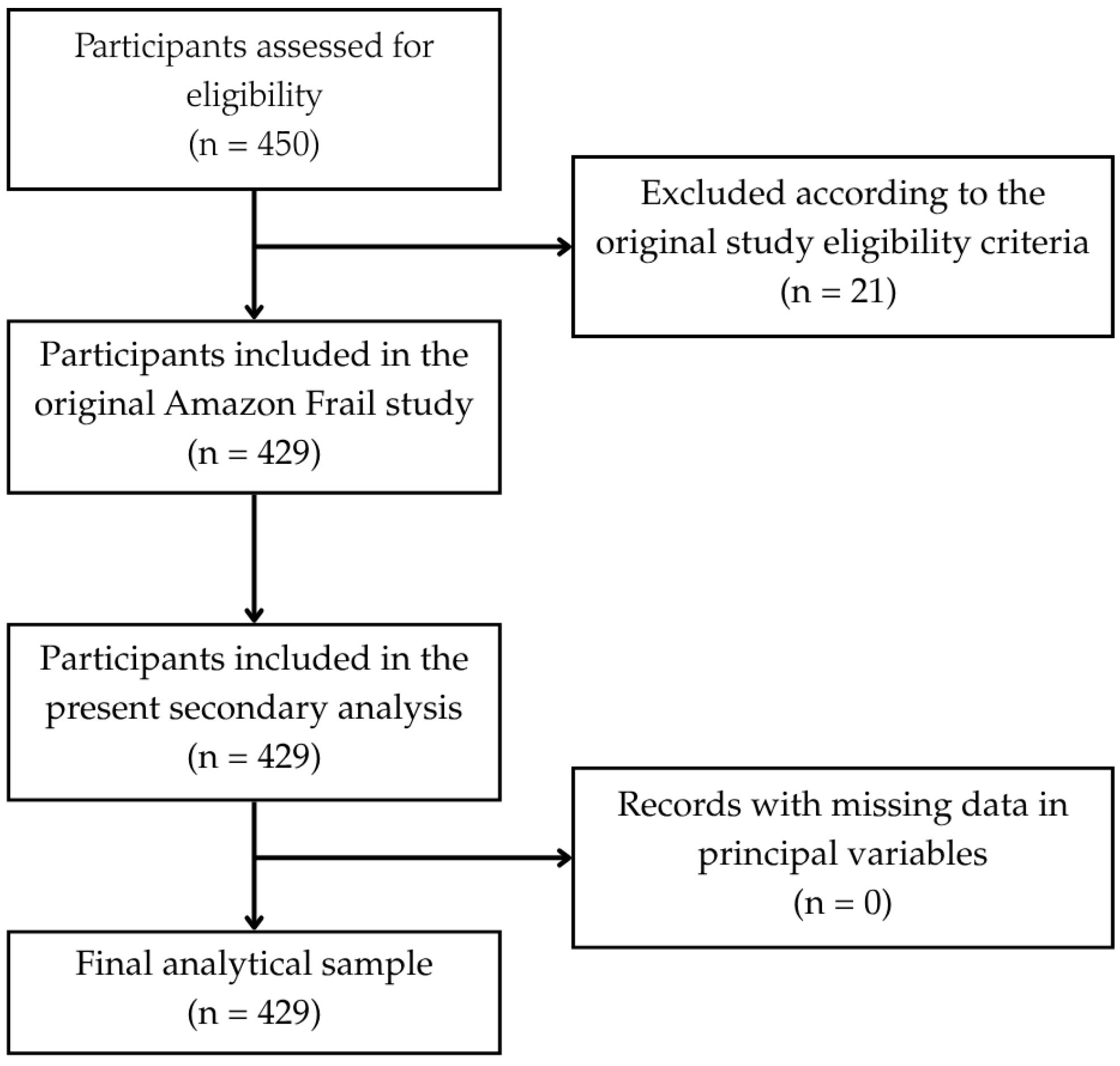
For this secondary analysis, all participants in the primary study were considered eligible. Records with missing data in the variables of interest were defined as an exclusion criterion; however, no incomplete records were identified for any principal variables. The final sample included 429 participants (Figure 1).

2.1. Variables

The outcome of interest was adherence to the vaccination schedule, assessed using a questionnaire item that involved direct verification of the participant’s vaccination card [2]. The vaccines evaluated were influenza, pneumococcal, COVID-19, and pertussis vaccines. For the statistical analysis, the number of respiratory vaccines received by each participant was analyzed as a numerical variable. In addition, exploratory variables were created based on combinations of the available respiratory vaccines (influenza plus pneumococcal; Influenza plus pertussis; influenza + COVID-19; pneumococcal + COVID-19; pneumococcal + pertussis; COVID-19 + pertussis) [2].
Covariates were grouped as sociodemographic, including age (60–79 and ≥80 years), sex (male and female), marital status (single, married/cohabiting, and divorced/separated), and educational level (illiterate/incomplete primary education; complete primary and secondary education; and higher technical education).
Clinical characteristics included multimorbidity, functional dependence, frailty, malnutrition and depressive symptoms. Multimorbidity was defined as the presence of two or more medical conditions, including hepatitis B, asthma, myocardial infarction, malaria, hypertension, chronic kidney disease, dengue, congestive heart failure, COVID-19, stroke, leishmaniasis, type 2 diabetes mellitus, chronic obstructive pulmonary disease, among others [22]. Functional dependence in basic activities of daily living was assessed using the Barthel index, with scores below 100 indicating dependence [23]. Functional dependence in instrumental activities of daily living was evaluated using the Lawton Index, with cutoff points of ≤7 for women and ≤4 for men [24]. Frailty was assessed using the FRAIL scale, which assesses fatigue, resistance, ambulation, illnesses, and weight loss, and was subsequently classified into three categories: non-frail (0 points), pre-frail (1 point), and frail (≥2 points) [25]. Malnutrition was assessed using the Mini Nutritional Assessment-Elderly, with a cutoff score of 23.5 or lower considered positive according to the Integrated Care for Older People (ICOPE) manual proposed by the Pan American Health Organization (PAHO) [26]. Depressive symptoms were evaluated using the 5-item Yesavage Geriatric Depression Scale, with a score of two or more points considered positive [27]. Social frailty was assessed using the Social Frailty Index (SFI), which consists of 10 items including social interaction, community participation, perception of the environment, and economic situation. The SFI score was obtained by calculating the log-odds (lp) of the scores for each of the 10 items using the following formula: lp = −9.210517 + 0.112097 × age − 0.553411 × gender + 0.497577 × meetup_child + 0.107782 × activity1 + 0.48419 × activity2 − 0.255202 × isolate + 0.351463 × area − 0.438733 × finance − 0.291638 × treat − 0.553316 × work. Subsequently, the lp scores were transformed into a probability using the logistic function: pr = e lp 1 + e lp/(1 + e lp) × 100. Finally, the total score was transformed into tertiles: tertile 1 (lower risk of frailty), tertile 2 (intermediate frailty) and tertile 3 (higher frailty) [20].
Finally, a third category of covariates included anthropometric and body composition variables. Body Mass Index (BMI) was calculated as weight (kg)/height (m)2, with values ≤ 18.4 kg/m2 classified as underweight, 18.5–24.9 kg/m2 as normal weight, 25.0–29.9 kg/m2 as overweight, and ≥30 kg/m2 as obesity [28]. The Skeletal Muscle Mass Index, measured through bioelectrical impedance analysis (SMI = appendicular muscle mass/height2), was used to assess muscle mass, with low muscle mass defined as ≤7.0 kg/m2 in men and ≤5.7 kg/m2 in women [29]. The waist-hip ratio (WHR) was calculated as waist circumference/hip circumference, with values > 1.0 in men and >0.85 in women considered indicative of increased health risk [30].

2.2. Statistical Analysis

Statistical analysis was performed using STATA version 18. Categorical variables were summarized as frequencies and percentages. Numerical variables were summarized as frequencies and percentages or means and standard deviations, since their distributions were considered approximately normal on histogram inspection.
Multiple linear regression models were conducted to estimate β coefficients, robust standard errors, p-values, and 95% confidence intervals (95% CIs). In these models, the number of respiratory vaccines received was treated as a continuous dependent variable. Age and sex were not included as covariates because they are confounders of the definition of other variables, such as muscle mass and muscle strength, in order to avoid model over-adjustment.
In the present study, a linear regression model was used to estimate the beta coefficients associated with the number of vaccines received (a discrete count variable ranging from 0 to 4), treating it as an ordinal quantitative variable because its empirical distribution and behavior allowed it to be reasonably approximated as a continuous scale while preserving the clinical interpretability of the marginal effects. In this context, the beta coefficients are interpreted as the mean change in the number of vaccines associated with a one-unit increase in each covariate, under the assumptions of linearity, homoscedasticity, and approximate normality of the residuals, all of which were verified. The use of linear regression, rather than count-specific models, is further justified by the bounded range and low dispersion of the outcome, which support stable parameter estimates and facilitate a more transparent and clinically interpretable presentation of the findings, consistent with the recommendations of contemporary biostatistical literature applied to clinical and epidemiological research.
Before performing the linear regression, the statistical assumptions were assessed using the Shapiro–Wilk test for normality, White’s test to evaluate heteroscedasticity, and a Q–Q plot to examine the normality of the residuals.
In addition, multiple Poisson regression models with robust variance were constructed to estimate prevalence ratios (PRs) and their corresponding 95% confidence intervals. Six models were developed, each considering a different combination of respiratory vaccines as the dependent variable. For both linear and Poisson regression models, statistical assumptions were evaluated, including independence, linearity, and Poisson distribution assumptions. Multicollinearity post hoc evaluations were also performed through the calculation of variance inflation factors (VIFs). No variables were excluded on the basis of multicollinearity, as all VIF values were below 2. It should be noted that, for Models 5 and 6, the body mass index (BMI) variable was excluded due to insufficient sample size.
Regarding statistical power, calculations were performed using OpenEpi 3.0 software, assuming a 95% confidence level and a sample size of 429 participants. Statistical power was estimated under four scenarios based on functional status, multimorbidity, marital status, and educational level. Complete vaccination frequencies reported in previous studies were used for each comparison group. In all four scenarios, the estimated statistical power exceeded 80%, indicating that the sample size was adequate for the analysis of the groups of interest.

2.3. Ethical Considerations

The research project was approved by the Institutional Research Ethics Committee of Universidad Científica del Sur. All participants were recruited after providing their written informed consent. In cases where cognitive impairment was identified, informed consent was obtained from the legally authorized representative or accompanying caregiver of the participant.
The database used for this analysis was fully anonymized and contained no information that could identify individual participants. The original project was funded by the Vice-Rectorate for Research of Universidad Científica del Sur through the Semilla 2023 Research Grant Program. Additional funding was provided by the Institute of Human Medicine of Universidad San Martín de Porres.

3. Results

Table 1 presents the main characteristics of the study population. Most participants were between 60 and 79 years old, and 64.02% (n = 274) were female. Regarding individual vaccines, 42.89% (n = 184) had received influenza vaccination, 23.08% (n = 99) pneumococcal vaccination, 4.43% (n = 19) pertussis vaccination, and 70.16% (n = 301) COVID-19 vaccination.
For combined vaccine schedules, 22.14% (n = 95) had completed the influenza—pneumococcal schedule, 4.43% (n = 19) had completed the influenza-pertussis schedule, 32.87% (n = 141) had completed the influenza -COVID-19 schedule, and 18.41% (n = 79) had completed the pneumococcal-COVID-19 schedule. Furthermore, combinations of pneumococcal-pertussis and COVID-19-pertussis vaccines were observed in 3.50% of participants for each schedule (n = 15 in both cases). Finally, regarding the number of respiratory vaccines received per participant, only 13.99% (n = 60) had received at least three of the four recommended respiratory vaccines, while 3.50% (n = 15) had completed the full four-vaccine schedule. Further details are presented in Table 1.
Table 2 shows the descriptive analysis of the numerical variables included in the study. The mean age of the participants was 70.46 years (standard deviation [SD]: 7.60). In addition, participants received a mean of 1.41 respiratory vaccines (SD: 1.06). More details are presented in Table 2.
Table 3 shows the multiple linear regression analysis evaluating the association between covariates and the number of respiratory vaccines received per participant (n = 429). Participants with school education had a higher mean number of respiratory vaccines received compared with illiterate participants (β = 0.30; 95% CI: 0.08–0.52). However, higher scores on the Yesavage Geriatric Depression Scale were associated with fewer respiratory vaccines received (β = −0.14; 95% CI: −0.20 to −0.07).
Higher Barthel Index scores, representing greater independence in basic activities of daily living, were associated with a lower mean number of respiratory vaccines received (β = −0.01; 95% CI: −0.02 to −0.01). Social frailty was associated with an increased mean number of respiratory vaccines received. Compared with participants with low social frailty, those with moderate social frailty received a significantly higher mean number of vaccines (β = 0.58; 95% CI: 0.35–0.81), and this association was even stronger among participants with high social frailty (β = 0.67; 95% CI: 0.38–0.96). In relation to muscle mass, greater muscle mass, measured by bioelectrical impedance analysis, was associated with a higher mean number of respiratory vaccines received (β = 0.16; 95% CI: 0.07–0.26). Similarly, participants with higher Short Physical Performance Battery (SPPB) scores received a greater mean number of respiratory vaccines (β = 0.05; 95% CI: 0.01–0.09). Participants with multimorbidity also received a significantly higher mean number of respiratory vaccines than those without multimorbidity (β = 0.36; 95% CI: 0.12–0.59). Finally, higher body mass index (BMI) was associated with a lower mean number of respiratory vaccines received (β = −0.03; 95% CI: −0.06 to −0.01). Further details are presented in Table 3.
Table 4 presents the adjusted Poisson regression analysis performed to quantify the association between covariates and respiratory vaccine combinations in the study population (n = 429). Six models were constructed based on the following vaccine combinations: influenza plus pneumococcal (Model 1), influenza plus pertussis (Model 2), influenza plus COVID-19 (Model 3), pneumococcal plus COVID-19 (Model 4), pneumococcal plus pertussis (Model 5), and COVID-19 plus pertussis (Model 6).
Overall, higher educational level was associated with a greater likelihood of receiving the influenza plus pertussis, influenza plus COVID-19, pneumococcal plus pertussis and COVID-19 plus pertussis vaccine combinations. Conversely, cognitive impairment and depressive symptoms were associated with a lower likelihood of receiving the influenza plus pneumococcal vaccine combination. Functional dependency was negatively associated with the influenza plus pertussis and pneumococcal plus COVID-19 combinations, while physical frailty and dynapenia were associated with a lower likelihood of receiving the pneumococcal plus pertussis and COVID-19 plus pertussis combinations. Participants with moderate or high social frailty were more likely to receive the influenza plus pneumococcal vaccine combination, whereas high social frailty was additionally associated with greater uptake of the influenza plus pertussis, influenza plus COVID-19 and pneumococcal plus COVID-19 combinations. Low muscle mass was associated with a lower likelihood of receiving the influenza plus pneumococcal and influenza plus COVID-19 combinations. Finally, participants who attended health centers had a greater likelihood of receiving the influenza plus pneumococcal, influenza plus COVID-19 and pneumococcal plus COVID-19 vaccine combinations. More details are presented in Table 4.

4. Discussion

Our study evaluated the factors and determinants associated with adherence to the respiratory immunization schedule among older adults living in rural Amazonian communities. Overall, our findings indicate that vaccination coverage in this group was suboptimal and was associated with factors from different categories, including sociodemographic factors, certain geriatric syndromes, and use of health services. Overall, these findings suggest that adherence to the immunization schedule in this group should be interpreted from an integral geriatric perspective, considering individual characteristics of older adults that may limit or facilitate access to vaccination and should be identified in a timely manner during contact with health services.
Educational level was significantly associated with the probability of receiving respiratory vaccines among older adults. In particular, older adults who were illiterate received a lower number of respiratory vaccines, whereas those with a higher educational level were more likely to receive them. This association may suggest that a higher educational level is related to a better understanding of health-related instructions, as well as deeper knowledge about vaccination and its benefits [31]. This is consistent with the literature, where low educational level has been associated with lower health literacy, understood as a reduced ability to understand, interpret, and use health information for decision-making [32]. This may limit the understanding of medical instructions, the identification of which vaccines correspond to each individual, especially when multiple immunization schedules are involved, and the appropriate follow-up of indicated doses [15]. Thus, these findings highlight the need to adapt vaccination communication strategies for older adults with low educational level, using clear and concise messages.
On the other hand, individuals with mental health problems, such as depressive symptoms or memory loss, were found to have a lower probability of receiving the influenza and pneumococcal vaccine combination. Several studies have shown that the presence of concomitant mental health problems in the older adult population is associated with reduced access to healthcare interventions such as vaccination [33,34]. This occurs because these mental health problems can significantly hinder understanding of medical instructions, as well as the ability to remember them over time and maintain the motivation to seek medical care proactively [35]. Similarly, among individuals with memory loss, intrapersonal barriers, such as cognitive impairment; interpersonal barriers related to the role of caregivers and the burden they may experience; and extrapersonal barriers, such as social isolation, have been described [15]. In this sense, these findings highlight the importance of reorienting the current approach to vaccination campaigns for older adults. Therefore, these findings suggest that depressive symptoms and cognitive impairment should also be considered when assessing vaccination in older adults.
Regarding functional status, multimorbidity, and body mass index (BMI), the associations differed according to the vaccine outcome evaluated. Functional dependency was associated with lower uptake of vaccine combinations, likely because reduced mobility, transportation barriers, and dependence on caregivers limit access to vaccination services [36,37]. In contrast, multimorbidity was associated with a higher probability of receiving respiratory vaccines, which is consistent with immunization strategies that prioritize individuals with chronic diseases and with previous evidence showing that greater disease burden increases opportunities for healthcare providers to recommend and administer vaccines during routine medical visits [38]. Regarding BMI, we found an inverse association with the number of respiratory vaccines received, where higher BMI was associated with lower vaccine uptake. This association should be interpreted with caution, since this finding differs from previous studies that reported higher vaccination rates among individuals with obesity, possibly due to more frequent healthcare utilization and recognition of obesity as a metabolic risk factor [39].
Social frailty was associated with a higher probability of receiving respiratory vaccines, indicating that sociofamilial protective factors and social networks are relevant and are adequately recognized as such by the Peruvian health system as part of vaccination campaign strategies and the identification of older adults who are vulnerable in this regard. Similarly, perceived social support and support have been described as factors that facilitate timely access to respiratory vaccines [40]. In contrast, with regard to physical and muscular frailty, a lower uptake of some combinations of respiratory vaccines was observed, suggesting a gap in muscle health screening, specifically for sarcopenia, particularly in these rural settings [41]. However, people with adequate physical performance had a higher probability of being vaccinated, especially with the influenza–pneumococcal combination, suggesting that adequate muscle health can promote independence and mobility to attend health centers.
In the use of health services, people who attended primary healthcare centers when medical care was needed were found to have greater coverage of respiratory vaccination. This finding emphasizes the importance of primary healthcare centers in identifying older adults and increasing vaccination opportunities, regardless of the initial reason for consultation [42]. These results are consistent with the literature, which describes that the use of health services and affiliation with a health network increase the likelihood of vaccination by facilitating counseling and access to information [43].
Our findings provide strong empirical evidence for more explicitly integrating vaccination into person-centered care models, such as the WHO’s ICOPE and the development of age-friendly services, at the micro, meso, and macro levels [44]. At the individual (micro) level, each older adult should be assessed according to their clinical, functional, and social circumstances. To this end, primary care protocols should include, from the beginning of each consultation and regardless of the reason for attendance, a review of the vaccination card, documentation of administered and pending doses, and application of the ICOPE screening tool by appropriately trained healthcare personnel. These measures would help bring overdue vaccinations up to date, reduce missed opportunities for vaccination in this age group, and facilitate the identification of vulnerable older adults. In this context, the coexistence of multimorbidity, impaired intrinsic capacity, physical and social frailty, and very low respiratory vaccination coverage among older adults already in contact with primary care highlights the need to incorporate routine assessment of vaccination status into ICOPE screening and individualized care plans, recognizing vaccination as a core component of preserving intrinsic capacity, rather than optional add-ons [44].
At the service level (meso), the significant gap between frequent use of health centers and missed vaccination opportunities suggests that services aligned with the 5Ms framework and age-friendly services should redesign operational workflows, protocols, and team roles so that each encounter with a frail older person triggers proactive and personalized vaccination offers, along with medication review, mobility support, and mental status assessment. The approach should not be limited to older adults with chronic conditions, such as cardiovascular or metabolic diseases, but should also include those with geriatric syndromes and barriers to healthcare access. Healthcare personnel should also assume an active role in providing clear, understandable, and age-friendly vaccination guidance. This role could be strengthened through periodic training in communication strategies tailored to each older adult’s sociocultural context and cognitive status. Furthermore, to reach the target population, healthcare centers should support the deployment of mobile land- and river-based vaccination teams to hard-to-reach communities, as well as regular home visits for older adults identified as having geriatric syndromes. These interventions should also seek to strengthen support networks, including caregivers, family members, and community health workers, by communicating vaccination dates and facilitating follow-up [45,46].
At the policy level (macro), documenting this combination of high vulnerability and low vaccination coverage in a real-world primary care setting supports the inclusion of adult vaccination indicators in national ICOPE-oriented strategies. The number of completed vaccination schedules should be recorded periodically and disaggregated by region, vulnerability status, and healthcare facility. This incentivizes health systems to prioritize and fund preventive interventions for those with the greatest needs and to align funding and performance metrics with the 5Ms objective of providing what matters most to older people.

5. Limitations

This study had some limitations. First, the selection of communities and participants was based on a nonprobability sampling method, which may limit the generalizability of the findings. Additionally, due to the cross-sectional design, the associations observed between the factors studied and the outcome do not allow causal inferences to be established.
Furthermore, information on the number of specific cases of influenza, pneumococcal disease, pertussis, and COVID-19 was not available. Likewise, it would have been valuable to include serological measurements to assess immune status and confirm the level of protection among participants. The inclusion of these variables could have provided a more comprehensive answer to the research question.
In the study communities, COVID-19 vaccination may have been promoted through Pensión 65, a non-contributory social pension program for older adults living in extreme poverty. Although this information was not systematically recorded, it may partially explain the relatively high COVID-19 vaccination coverage observed in our population and should be considered a potential unmeasured confounding factor.
Additionally, the exclusion of older adults with advanced dementia may have resulted in an overestimation of vaccination uptake in our cohort, as it excluded a subgroup that likely experiences a greater burden of cognitive, functional and logistical barriers to accessing healthcare services, attending scheduled appointments or maintaining vaccination records. However, in some rural settings, home-based vaccination strategies are available and may partially mitigate these limitations; therefore, the magnitude and direction of the potential bias introduced by our eligibility criteria cannot be determined with certainty. In this regard, it is important to emphasize that vaccination among individuals with major neurocognitive disorders requires specific and tailored methodologies, including systematic home-based vaccination strategies, close coordination with caregivers and simplified record-keeping systems. These considerations were beyond the scope of the present study but should be addressed in future research and considered when interpreting our findings.
Despite these limitations, the study provides relevant and novel evidence from a population rarely studied. Furthermore, data were collected by trained healthcare professionals using validated instruments, which improves the quality and reliability of the information obtained. In this sense, the findings contribute to a better understanding of the factors associated with adherence to the vaccination schedule among older adults living in rural Amazonian communities.

6. Conclusions

This study identified multiple factors associated with the coverage of respiratory vaccination among older adults living in rural Amazonian communities, in a context characterized by suboptimal uptake of vaccines. The findings suggest that vaccination strategies in rural Amazonian settings should move beyond disease-based prioritization and incorporate the active identification of geriatric syndromes, functional limitations and barriers to healthcare access. In addition to this, to reduce the coverage gaps identified among geriatric populations in Amazonian settings, it is necessary to strengthen support networks for vulnerable older adults and increase opportunities for vaccination and counseling during contact with primary healthcare centers and community spaces.

Author Contributions

Conceptualization, L.T.P.-M., A.L.R.-B., J.E.C.C. and F.M.R.-C.; Methodology, F.M.R.-C., K.C.-C. and J.F.P.; Formal Analysis, L.T.P.-M., A.L.R.-B., J.E.C.C. and F.M.R.-C.; Investigation, L.T.P.-M., A.L.R.-B. and J.E.C.C.; Data Curation, F.M.R.-C.; Writing—Original Draft Preparation, L.T.P.-M., A.L.R.-B. and J.E.C.C.; Writing—Review & Editing, F.M.R.-C., K.C.-C. and J.F.P.; Visualization, L.T.P.-M., A.L.R.-B. and J.E.C.C.; Supervision, F.M.R.-C., K.C.-C. and J.F.P.; Project Administration, F.M.R.-C.; Funding Acquisition, F.M.R.-C. All authors have read and agreed to the published version of the manuscript.

Funding

This project was funded by “Fondo Semilla 2023, Universidad Científica del Sur”.

Institutional Review Board Statement

This study is a secondary analysis of an anonymized database derived from the Amazon Frail Project. The original study was conducted in accordance with the Declaration of Helsinki and approved by the Institutional Review Board of Universidad Científica del Sur. Because the present study involved secondary analysis of fully de-identified data, additional ethical approval was not required.

Informed Consent Statement

Informed consent was obtained from all subjects involved in the study.

Data Availability Statement

The data supporting the findings of this study are available from the corresponding author upon reasonable request. The data are not publicly available because they contain information that could compromise participant privacy.

Acknowledgments

During the preparation of this manuscript, the authors used ChatGPT (GPT-5.5) to assist with language editing and translation of sections of the manuscript. The authors critically reviewed and edited all generated content and take full responsibility for the final version of the manuscript.

Conflicts of Interest

The authors declare no conflicts of interest.

References

  1. Hou, Y.; Chen, M.; Bian, Y.; Hu, Y.; Chuan, J.; Zhong, L.; Zhu, Y.; Tong, R. Insights into vaccines for elderly individuals: From the impacts of immunosenescence to delivery strategies. npj Vaccines 2024, 9, 77. [Google Scholar] [CrossRef] [Scilit] [PubMed]
  2. Sosa Liprandi, M.I.; Sosa Liprandi, Á.; Fernández, A.; Stecher, D.; Bonvehí, P.; Verón, M.T. Inmunización para influenza y neumococo en prevención cardiovascular. Medicina 2014, 74, 245–253. [Google Scholar] [PubMed]
  3. de Gomensoro, E.; Del Giudice, G.; Doherty, T.M. Challenges in adult vaccination. Ann. Med. 2018, 50, 181–192. [Google Scholar] [CrossRef] [Scilit] [PubMed]
  4. Giezeman-Smits, K.M.; Palache, B.; van Essen, G.A.; Jeseňák, M.; Castro-Sánchez, E.; Steinberg, A.E.; van Vugt, J. Disparities in Seasonal Influenza Vaccination in Europe. Immun. Inflamm. Dis. 2025, 13, e70186. [Google Scholar] [CrossRef] [Scilit] [PubMed] [PubMed Central]
  5. Ruiz, R.; Yong, J.; Palomares, R.; Huamán, C.; Martinez, L. Situación de la Población Adulta Mayor: Enero-Febrero-Marzo 2025. Available online: https://www.gob.pe/institucion/inei/informes-publicaciones/6915012-situacion-de-la-poblacion-adulta-mayor-enero-febrero-marzo-2025 (accessed on 29 June 2026).
  6. Ministerio de Salud del Perú. Norma Técnica de Salud N.° 208-MINSA/DIGIESP-2023: Norma Técnica de Salud que Establece la Vacunación Contra la COVID-19; Ministerio de Salud: Lima, Peru, 2023; Aprobada Mediante Resolución Ministerial N.° 863-2023-MINSA.
  7. Nakashima, K.; Fukushima, W. Strategies for pneumococcal vaccination in older adults in the coming era. Hum. Vaccines Immunother. 2024, 20, 2328963. [Google Scholar] [CrossRef] [Scilit] [PubMed] [PubMed Central]
  8. Ministerio de Salud del Perú. Cerca del 70% de Adultos Mayores de 60 Años ya Han Sido Vacunados Contra la Neumonía; MINSA: Lima, Peru, 2025. Available online: https://www.gob.pe/institucion/minsa/noticias/1210001-cerca-del-70-de-adultos-mayores-de-60-anos-ya-han-sido-vacunados-contra-la-neumonia (accessed on 17 July 2026).
  9. Reinders, S.; Romero, C.; Carcamo, C.; Tinoco, Y.; Valderrama, M.; La Rosa, S.; Mallma, P.; Neyra, J.; Soto, G.; Azziz-Baumgartner, E.; et al. A community-based survey on influenza and vaccination knowledge, perceptions and practices in Peru. Vaccine 2020, 38, 1194–1201. [Google Scholar] [CrossRef] [Scilit] [PubMed]
  10. Mas-Ubillus, G.; Ortiz, P.J.; HuaringaMarcelo, J.; Sarzo-Miranda, P.; Muñoz-Aguirre, P.; Diaz-Ramos, A.; Arribasplata-Purizaca, K.; Mendoza, D.; Rojas-Poma, J.; Marcelo-Ruiz, C.; et al. High mortality among hospitalized adult patients with COVID-19 pneumonia in Peru: A single centre retrospective cohort study. PLoS ONE 2022, 17, e0265089. [Google Scholar] [CrossRef] [Scilit] [PubMed]
  11. Pajuelo-Reyes, C.; Valencia, H.J.; Montenegro, C.C.; Quezada, E.; Gonzales, L.; Cruz, N.; Canelo, C.; Ordinola, C.; Quintana, J.L.M.; Tejedo, J.R.; et al. Epidemiological analysis of COVID-19 cases in native Amazonian communities from Peru. Epidemiologia 2021, 2, 490–501. [Google Scholar] [CrossRef] [Scilit] [PubMed]
  12. Sánchez, C.; Dávila, C.; Laura, W.; Maguiña, C. Análisis de serie de tiempo de patrones estacionales en defunciones por neumonía en el Perú, periodo 2003–2017. An. Fac. Med. 2022, 83, 271–279. [Google Scholar] [CrossRef] [Scilit]
  13. Carga de Enfermedad—Centro Nacional de Epidemiología Prevención y Control de Enfermedades. Available online: https://www.dge.gob.pe/portalnuevo/inteligencia-sanitaria/investigacion-monitoreo-y-evaluacion/carga-de-enfermedad/ (accessed on 29 June 2026).
  14. Suffel, A.M.; Ojo-Aromokudu, O.; Carreira, H.; Mounier-Jack, S.; Osborn, D.; Warren-Gash, C.; McDonald, H.I. Exploring the impact of mental health conditions on vaccine uptake in high-income countries: A systematic review. BMC Psychiatry 2023, 23, 15. [Google Scholar] [CrossRef] [Scilit] [PubMed] [PubMed Central]
  15. Ashtarieh, B.; Grabkowski, M.; Bartfay, E.; Sun, W. Examining the barriers of influenza vaccine hesitancy in persons with dementia: A literature review. Aging Clin. Exp. Res. 2022, 34, 309–324. [Google Scholar] [CrossRef] [Scilit] [PubMed] [PubMed Central]
  16. Chang, Y.C.; Huang, N.; Chen, L.S.; Hsu, S.W.; Chou, Y.J. Factors affecting repeated influenza vaccination among older people in Taiwan. Vaccine 2013, 31, 410–416. [Google Scholar] [CrossRef] [Scilit] [PubMed]
  17. Sacre, A.; Bambra, C.; Wildman, J.M.; Thomson, K.; Bennett, N.; Sowden, S.; Todd, A. Socioeconomic inequalities in vaccine uptake: A global umbrella review. PLoS ONE 2023, 18, e0294688. [Google Scholar] [CrossRef] [Scilit] [PubMed] [PubMed Central]
  18. Guclu, O.A.; Demirci, H.; Ocakoglu, G.; Guclu, Y.; Uzaslan, E.; Karadag, M. Relationship of pneumococcal and influenza vaccination frequency with health literacy in the rural population in Turkey. Vaccine 2019, 37, 6617–6623. [Google Scholar] [CrossRef] [Scilit] [PubMed]
  19. Takahashi, P.; Wi, C.I.; Ryu, E.; King, K.; Hickman, J.; Pignolo, R.; Juhn, Y. Influenza infection is not associated with phenotypical frailty in older patients, a prospective cohort study. Health Sci. Rep. 2022, 5, e750. [Google Scholar] [CrossRef] [Scilit] [PubMed] [PubMed Central]
  20. Runzer-Colmenares, F.M.; Mendoza, W.; Cahuapaza-Gutierrez, N.L.; Camacho-Caballero, K.; Parodi, J.F. Mapping Social and Physical Frailty in the Peruvian Amazon: Associated Factors Among Older Adults. Healthcare 2026, 14, 1684. [Google Scholar] [CrossRef] [Scilit] [PubMed]
  21. Ñaña-Cordova, A.M.; Macavilca-Toribio, M.A.; Reyna-Ruiz, V.L.; Oria-Morales, M.; Gonzales-Espinoza, A.J.; Parodi, J.F.; Camacho-Caballero, K.; Runzer-Colmenares, F.M. Factores asociados con el tamizaje de enfermedades cardiometabólicas en personas mayores de la Amazonía peruana. Rev. Panam. Salud Pública 2026, 49, e118. [Google Scholar] [CrossRef] [Scilit] [PubMed]
  22. Alexandrino, A.; De Oliveira, C.B.S.; Gomes, S.M.; Nogueira, M.F.; De Oliveira Mendes, T.C.; De Lima, K.C. Prevalence of multimorbidity and associated factors among older people in rural Northeast Brazil. Rev. Bras. Geriatr. Gerontol. 2023, 26, e230105. [Google Scholar] [CrossRef] [Scilit]
  23. Murillo-Llorente, M.T.; Lafuente-Sarabia, B.; De La Paz, J.S.; Flores-Púa, M.; Tejeda-Adell, M.; Legidos-García, M.E.; Perez-Bermejo, M. Assessing Nutritional Status and Frailty among Poor Elderly Individuals in Requena del Tapiche, Peru. Nutrients 2023, 15, 3840. [Google Scholar] [CrossRef] [Scilit] [PubMed]
  24. Almeida, L.A.; Dantas, B.A.D.S.; De Macêdo Rocha, K.P.; Araújo, M.P.D.; Andrade, N.d.L.; Batista, F.d.A.M.; Silva, R.L.d.S.; Silvino, M.L.M.; Barbosa, L.B.d.S.F.; de Oliveira, M.M.; et al. Nutritional, Cognitive, and Functional Deficits, Frailty, and Quality of Life Associated With Fall Risk in Community-Dwelling Older Adults: A Cross-Sectional Study Conducted in Brazil. J. Prim. Care Community Health 2025, 16, 1–12. [Google Scholar] [CrossRef] [Scilit] [PubMed]
  25. Aprahamian, I.; de Castro Cezar, N.O.; Izbicki, R.; Lin, S.M.; Paulo, D.L.V.; Fattori, A.; Biella, M.M.; Filho, W.J.; Yassuda, M.S. Screening for Frailty With the FRAIL Scale: A Comparison With the Phenotype Criteria. J. Am. Med. Dir. Assoc. 2017, 18, 592–596. [Google Scholar] [CrossRef] [Scilit] [PubMed]
  26. Zhou, Y.; Li, Y.; Zhu, X.; Ma, L. Medical and Old-age Care Integration Model and Implementation of the Integrated Care of Older People (ICOPE) in China: Opportunities and Challenges. J. Nutr. Health Aging. 2021, 25, 720–723. [Google Scholar] [CrossRef] [Scilit] [PubMed] [PubMed Central]
  27. Cabañero-Martínez, M.J.; Cabrero-García, J.; Richart-Martínez, M. Revisión estructurada de las escalas de depresión en personas mayores. Int. J. Clin. Health Psychol. 2006, 7, 823–846. [Google Scholar]
  28. Jayanama, K.; Theou, O.; Godin, J.; Mayo, A.; Cahill, L.; Rockwood, K. Relationship of body mass index with frailty and all-cause mortality among middle-aged and older adults. BMC Med. 2022, 20, 404. [Google Scholar] [CrossRef] [Scilit] [PubMed]
  29. Chen, L.K.; Liu, L.K.; Woo, J.; Assantachai, P.; Auyeung, T.W.; Bahyah, K.S.; Chou, M.-Y.; Chen, L.-Y.; Hsu, P.-S.; Krairit, O.; et al. Sarcopenia in Asia: Consensus report of the Asian Working Group for Sarcopenia. J. Am. Med. Dir. Assoc. 2014, 15, 95–101. [Google Scholar] [CrossRef] [Scilit] [PubMed]
  30. Carvalho, V.; Moreira, L.; Luft, V.; Fuchs, S. Waist-to-Height Ratio: A Sensitive Tool for Assessing the Need for Nutritional Risk Management in Elderly Populations from Brazil. Healthcare 2023, 11, 2406. [Google Scholar] [CrossRef] [Scilit] [PubMed]
  31. Fan, J.; Cong, S.; Wang, N.; Bao, H.; Wang, B.; Feng, Y.; Lv, X.; Zhang, Y.; Zha, Z.; Yu, L.; et al. Influenza vaccination rate and its association with chronic diseases in China: Results of a national cross-sectional study. Vaccine 2020, 38, 2503–2511. [Google Scholar] [CrossRef] [Scilit] [PubMed]
  32. Bostock, S.; Steptoe, A. Association between Low Functional Health Literacy and Mortality in Older Adults: Longitudinal Cohort Study. BMJ Br. Med. J. 2012, 344, e1602. [Google Scholar] [CrossRef] [Scilit]
  33. Appel, A.M.; Janbek, J.; Laursen, T.M.; Gasse, C.; Waldemar, G.; Jensen-Dahm, C. Dementia and influenza vaccination: Time trends and predictors of vaccine uptake among older adults. Vaccine 2025, 51, 126864. [Google Scholar] [CrossRef] [Scilit] [PubMed]
  34. Nicholls, L.A.B.; Gallant, A.J.; Cogan, N.; Rasmussen, S.; Young, D.; Williams, L. Older adults’ vaccine hesitancy: Psychosocial factors associated with influenza, pneumococcal, and shingles vaccine uptake. Vaccine 2021, 39, 3520–3527. [Google Scholar] [CrossRef] [Scilit] [PubMed]
  35. Veronese, N.; Ragusa, F.S.; Titone, P.R.; Vernuccio, L.; Catanese, G.; Randazzo, M.A.; Palermo, M.; Di Bella, G.; Mansueto, P.; Dominguez, L.J.; et al. Management of the vaccination campaign in a population of frail older outpatients affected by cognitive or endocrinological conditions: A pilot study in Italy. Aging Clin. Exp. Res. 2024, 36, 179. [Google Scholar] [CrossRef] [Scilit] [PubMed] [PubMed Central]
  36. Nguyen, K.H.; Nguyen, K.; Allen, J.D. COVID-19 vaccination receipt and intention to vaccinate among adults with disabilities and functional limitations, United States. Ann. Med. 2024, 56, 2399318. [Google Scholar] [CrossRef] [Scilit] [PubMed] [PubMed Central]
  37. Lucana, F.J.V.; Lucana, D.S.V. Dependencia funcional y accesibilidad a los servicios de salud en adultos mayores. Rev. Méd. Panacea 2026, 15, 5–12. [Google Scholar] [CrossRef] [Scilit]
  38. Papazoglou, D.D.; Baretella, O.; Feller, M.; Del Giovane, C.; Moutzouri, E.; Aujesky, D.; Schwenkglenks, M.; O’mAhony, D.; Knol, W.; Dalleur, O.; et al. Cross-sectional study on the prevalence of influenza and pneumococcal vaccination and its association with health conditions and risk factors among hospitalized multimorbid older patients. PLoS ONE 2021, 16, e0260112. [Google Scholar] [CrossRef] [Scilit] [PubMed] [PubMed Central]
  39. Tozduman, B.; Gülle, B.T. Influenza vaccination coverage and determinants of vaccination among older adults in Turkey. Epidemiol. Infect. 2026, 154, e59. [Google Scholar] [CrossRef] [Scilit] [PubMed] [PubMed Central]
  40. Datta, B.K.; Jaremski, J.E.; Ansa, B.E.; Odhiambo, L.A.; Islam, K.M.M.; Johnson, J.A. Role of Perceived Social Support in COVID-19 Vaccine Uptake Among U.S. Adults. AJPM Focus 2023, 2, 100104. [Google Scholar] [CrossRef] [Scilit] [PubMed] [PubMed Central]
  41. Batista, P.P.; Perracini, M.R.; do Carmo Correia de Lima, M.; de Amorim, J.S.C.; Pereira, D.S.; Pereira, L.S.M. Risk of sarcopenia and mobility of older adults during the COVID-19 pandemic: The longitudinal data from the REMOBILIZE study. Aging Clin. Exp. Res. 2024, 36, 80. [Google Scholar] [CrossRef] [Scilit] [PubMed] [PubMed Central]
  42. García-Hernández, H.; Zárate-Ramírez, J.; Kammar-García, A.; García-Peña, C. Estimation of vaccination coverage and associated factors in older Mexican adults. Epidemiol. Infect. 2023, 151, e134. [Google Scholar] [CrossRef] [Scilit] [PubMed] [PubMed Central]
  43. Zhang, E.; Shang, S.; Xing, Y.; Cui, J.; Pan, C.; Seale, H.; Fang, Q. Mapping Behavioral and Social Drivers of Influenza Vaccine Uptake in Older Adults: A Scoping Review. Vaccines 2025, 13, 624. [Google Scholar] [CrossRef] [Scilit] [PubMed]
  44. Atención Integrada Para Personas Mayores (ICOPE) Marco de Aplicación. Available online: https://www.who.int/es/publications/b/47283 (accessed on 30 June 2026).
  45. Jindal, S.K.; Paniszyn, L.; Lee, T.; Kumar, A.; Holliday, A.M.; Orkaby, A.R.; Schwartz, A.W. Bringing age-friendly care to the wards: A feasibility study implementing a 4Ms Bundle. J. Am. Geriatr. Soc. 2023, 71, 3943–3947. [Google Scholar] [CrossRef] [Scilit] [PubMed]
  46. Miller, R.K.; Young, M.; Chippendale, R.; Jantea, R.; Goroncy, A.; Murdock, C.; Schwartz, A.W.; Sehgal, M. Using the Geriatric 5Ms to teach structural and social determinants of health. J. Am. Geriatr. Soc. 2023, 71, 3967–3972. [Google Scholar] [CrossRef] [Scilit] [PubMed]
Figure 1. Flowchart of participant selection for secondary data analysis.
Vaccines 14 00643 g001
Table 1. Descriptive analysis of the main variables of the study (n = 429).
Characteristicsn%
Age in years
60–7936885.78
80 and over6114.22
Sex
Female27464.02
Male15435.98
Level of education
Illiterate11426.70
Incomplete primary/Complete primary/Incomplete secondary29368.62
Complete secondary/Higher technical education204.68
Pfeiffer Questionnaire score
No34279.72
Yes8720.28
5-item Yesavage Questionnaire score
No26862.62
Yes16037.38
Barthel Index score
No28667.14
Yes14032.86
Social frailty
Low14433.57
Medium14333.33
High14233.10
Number of frailty criteria according to Fried phenotype
Robust31673.66
Fragile11326.34
Muscle mass according to bioimpedance (kg)
Normal26361.45
Low16538.55
Handgrip strength (kg)
Normal20848.48
Weak22151.52
Short Physical Performance Battery score
Normal29167.83
Abnormal13832.17
Multimorbidity
No11627.04
Yes31372.96
Body Mass Index (kg/m2)
Underweight225.13
Normal14834.50
Overweight15235.43
Obese10724.94
Where to seek medical attention
Self-medication, pharmacy, traditional medicine, and other16538.46
Health center26461.54
Influenza vaccination
Incomplete24557.11
Complete18442.89
Pneumococcal vaccination
Incomplete33076.92
Complete9923.08
Pertussis vaccination
Incomplete41095.57
Complete194.43
COVID-19 vaccination
Incomplete12829.84
Complete30170.16
Combined Influenza + Pneumococcal vaccination schedule
Incomplete33477.86
Complete9522.14
Combined Influenza + Pertussis vaccination schedule
Incomplete41095.57
Complete194.43
Combined Influenza + COVID-19 vaccination schedule
Incomplete28867.13
Complete14132.87
Combined Pneumococcal + COVID-19 vaccination schedule
Incomplete35081.59
Complete7918.41
Combined Pneumococcal + Pertussis vaccination schedule
Incomplete41496.50
Complete153.50
Combined COVID-19 + Pertussis
Incomplete41496.50
Complete153.50
Number of respiratory vaccines per participant
None8519.81
117540.79
29421.91
36013.99
Complete schedule153.50
For the descriptive analysis, some variables might not add up to the final sample size, but in no case did the missing data exceed 10%.
Table 2. Descriptive analysis of the numerical variables (n = 429).
VariablesAverageStandard Deviation
Age in years70.467.60
Pfeiffer Questionnaire score1.741.90
5-item Yessavage Questionnaire score1.411.63
Barthel Index score90.1512.57
Number of frailty criteria according to Fried phenotype2.001.00
Muscle mass according to bioimpedance (kg)5.561.43
Handgrip strength (kg)19.276.31
Short Physical Performance Battery score9.312.93
Body mass index (kg/m2)26.574.84
Number of respiratory vaccines per participant1.411.06
Table 3. Multiple linear regression analysis to quantify factors associated with the number of respiratory vaccines per participant (n = 429).
VariablesBeta CoefficientRobust Standard Errorp-Value(95% Confidence Interval)
Level of education
IlliterateReferenceReferenceReferenceReference
Incomplete primary/Complete primary/Incomplete secondary0.300.110.007(0.08 to 0.52)
Complete secondary/Higher technical education0.310.260.226(−0.19 to 0.81)
Pfeiffer Questionnaire score−0.030.030.334(−0.09 to 0.03)
5-item Yesavage Questionnaire score−0.140.030.001(−0.20 to −0.07)
Barthel Index score−0.010.010.008(−0.02 to −0.01)
Social frailty
LowReferenceReferenceReferenceReference
Medium0.580.120.001(0.35 to 0.81)
High0.670.150.001(0.38 to 0.96)
Number of frailty criteria according to Fried phenotype0.030.060.647(−0.09 to 0.14)
Muscle mass according to bioimpedance (kg)0.160.050.001(0.07 to 0.26)
Handgrip strength (kg)0.010.010.254(−0.01 to 0.03)
Short Physical Performance Battery score0.050.020.040(0.01 to 0.09)
Multimorbidity
NoReferenceReferenceReferenceReference
Yes0.360.120.003(0.12 to 0.59)
Body mass index (kg/m2)−0.030.010.030(−0.06 to −0.01)
Where to seek medical attention
Self-medication, pharmacy, traditional medicine, and othersReferenceReferenceReferenceReference
Health center0.200.100.060(−0.01 to 0.40)
Pseudo R2 = 0.017
Table 4. Adjusted Poisson Regression Analysis to determine factors associated with combination of respiratory vaccines (n = 429).
VariablesModel 1: Influenza + PneumococcalModel 2: Influenza + PertussisModel 3: Influenza + COVID-19Model 4: Pneumococcal + COVID-19Model 5: Pneumococcal + PertussisModel 6: COVID-19 + Pertussis
RP (95% Confidence Interval)RP (95% Confidence Interval)RP (95% Confidence Interval)RP (95% Confidence Interval)RP (95% Confidence Interval)RP (95% Confidence Interval)
Level of education
IlliterateReferenceReferenceReferenceReferenceReferenceReference
Incomplete primary/Complete primary/Incomplete secondary1.13 (0.69–1.86)3.31 (0.78–14.12)1.67 (1.12–2.49)1.79 (0.93–3.43)1.47 (1.09–1.78)1.14 (1.02–1.78)
Completed secondary/Higher technical education1.72 (0.81–3.63)1.03 (1.02–1.08)1.92 (1.04–3.56)2.24 (0.98–5.09)1.99 (1.62–2.06)1.92 (1.35–2.61)
Pfeiffer Questionnaire score
NoReferenceReferenceReferenceReferenceReferenceReference
Yes0.46 (0.24–0.86)0.32 (0.06–1.64)0.72 (0.46–1.12)0.47 (0.22–1.02)0.64 (0.12–3.31)0.64 (0.12–3.31)
5-item Yesavage Questionnaire score
NoReferenceReferenceReferenceReferenceReferenceReference
Yes0.56 (0.37–0.87)0.69 (0.32–1.49)0.80 (0.59–1.08)0.79 (0.52–1.22)0.50 (0.14–1.80)0.50 (0.14–1.80)
Barthel Index score
NoReferenceReferenceReferenceReferenceReferenceReference
Yes0.77 (0.50–1.18)0.41 (0.19–0.85)1.12 (0.81–1.55)0.59 (0.37–0.95)0.47 (0.13–1.63)0.47 (0.13–1.63)
Social frailty
LowReferenceReferenceReferenceReferenceReferenceReference
Medium1.90 (1.21–3.00)1.07 (0.24–4.85)1.31 (0.91–1.88)1.52 (0.94–2.47)0.35 (0.09–1.32)0.35 (0.09–1.32)
High2.97 (1.95–4.51)2.84 (1.16–6.93)1.64 (1.14–2.35)2.83 (1.82–4.39)2.13 (0.75–5.99)2.13 (0.75–5.99)
Number of frailty criteria according to Fried phenotype
RobustReferenceReferenceReferenceReferenceReferenceReference
Fragile0.86 (0.50–1.45)1.12 (0.93–1.57)0.84 (0.57–1.24)1.08 (0.55–2.09)0.85 (0.76–0.98)0.35 (0.26–0.78)
Muscle mass according to bioimpedance (kg)
NormalReferenceReferenceReferenceReferenceReferenceReference
Low0.56 (0.36–0.88)0.61 (0.24–1.51)0.66 (0.48–0.92)0.60 (0.36–1.01)0.60 (0.21–1.67)0.60 (0.21–1.67)
Handgrip strength (kg)
NormalReferenceReferenceReferenceReferenceReferenceReference
Weak0.73 (0.48–1.12)0.56 (0.17–1.81)1.06 (0.76–1.48)0.59 (0.34–1.03)0.21 (0.06–0.72)0.21 (0.06–0.72)
Short Physical Performance Battery score
NormalReferenceReferenceReferenceReferenceReferenceReference
Abnormal1.66 (1.10–2.51)1.16 (0.24–5.64)0.95 (0.67–1.35)0.97 (0.60–1.57)0.35 (0.11–1.09)0.35 (0.11–1.09)
Multimorbidity
NoReferenceReferenceReferenceReferenceReferenceReference
Yes1.44 (0.86–2.42)3.15 (0.74–13.45)1.45 (0.95–2.22)1.83 (0.98–3.42)0.97 (0.95–0.99)0.96 (0.59–1.59)
Body mass index (kg/m2)
Low WeightReferenceReferenceReferenceReferenceReferenceReference
Normal1.24 (0.69–2.21)0.52 (0.12–2.35)0.95 (0.60–1.49)0.99 (0.53–1.85)--
Overweight0.84 (0.47–1.50)0.72 (0.17–3.09)0.72 (0.46–1.13)0.71 (0.40–1.26)--
Obese0.74 (0.38–1.45)0.86 (0.27–0.93)0.79 (0.49–1.26)0.28 (0.13–0.64)--
Where to go for medical care
Self-medication, pharmacy, traditional medicine, and otherReferenceReferenceReferenceReferenceReferenceReference
Health center1.56 (1.05–2.33)0.70 (0.34–1.44)1.35 (1.01–1.80)2.42 (1.43–4.09)0.77 (0.32–1.90)0.77 (0.32–1.90)
Disclaimer/Publisher’s Note: The statements, opinions and data contained in all publications are solely those of the individual author(s) and contributor(s) and not of MDPI and/or the editor(s). MDPI and/or the editor(s) disclaim responsibility for any injury to people or property resulting from any ideas, methods, instructions or products referred to in the content.