Influenza and Pertussis Vaccination During Pregnancy: A Systematic Review of Vaccination Rates and Vaccination Determinants


 ,
,
Abstract
1. Introduction
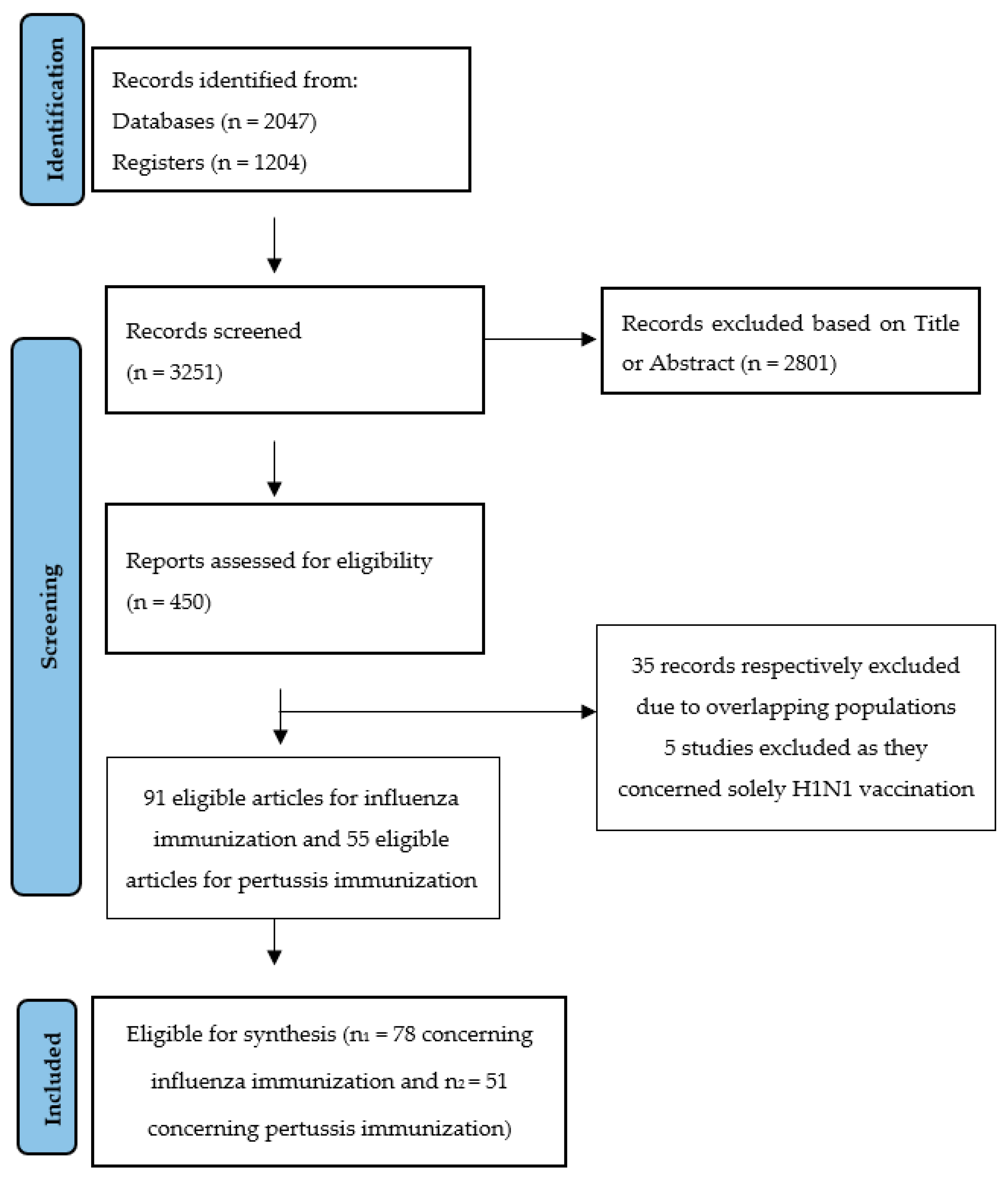
2. Materials and Methods
Data Analysis
3. Results
3.1. Influenza Vaccination During Pregnancy
Determinants Affecting Influenza Vaccination
3.2. Pertussis Vaccination During Pregnancy
Determinants Affecting Pertussis Vaccination
4. Discussion
5. Conclusions
Supplementary Materials
Author Contributions
Funding
Data Availability Statement
Acknowledgments
Conflicts of Interest
Abbreviations
| ACIP | Advisory Committee on Immunization Practices |
| RSV | Respiratory Syncytial Virus |
| HCP | Healthcare provider/practitioner |
| WHO | World Health Organization |
| SD | Standard Deviation |
| UK | United Kingdom |
| USA | United States of America |
| GP | General Practitioners |
| OR | Odds Ratio |
| RR | Relative Risk |
| PR | Prevalence Ratio |
| 95% CI | 95% Confidence Intervals |
| aOR | Adjusted Odds Ratio |
References
- Marshall, H.; McMillan, M.; Andrews, R.M.; Macartney, K.; Edwards, K. Vaccines in pregnancy: The dual benefit for pregnant women and infants. Hum. Vaccines Immunother. 2016, 12, 848–856. [Google Scholar] [CrossRef] [PubMed]
- Fouda, G.G.; Martinez, D.R.; Swamy, G.K.; Permar, S.R. The impact of IgG transplacental transfer on early life immunity. Immunohorizons 2018, 2, 14–25. [Google Scholar] [CrossRef]
- Centers for Disease Control and Prevention. Advisory Committee on Immunization Practices (ACIP) Recommendations. 2020. Available online: https://www.cdc.gov/acip/vaccine-recommendations/index.html (accessed on 6 March 2025).
- European Centre for Disease Prevention and Control. Vaccine Schedules in All Countries of the European Union. 2020. Available online: https://vaccine-schedule.ecdc.europa.eu/ (accessed on 24 April 2020).
- World Health Organisation. WHO position paper: Vaccines against influenza, May 2022. Wkly. Epidemiol. Rec. 2022, 97, 231–248. [Google Scholar]
- World Health Organization. Pertussis vaccines: WHO position paper—August 2015. Wkly. Epidemiol. Rec. 2015, 90, 433–460. [Google Scholar]
- World Health Organization. Vaccines against influenza WHO position paper—November 2012. Wkly. Epidemiol. Rec. 2012, 87, 461–476. [Google Scholar]
- Ding, H.; Black, C.L.; Ball, S.; Donahue, S.; Fink, R.V.; Williams, W.W.; Kennedy, E.D.; Bridges, C.B.; Lu, P.J.; Kahn, K.E.; et al. Influenza Vaccination Coverage Among Pregnant Women--United States, 2014–2015 Influenza Season. MMWR Morb. Mortal. Wkly. Rep. 2015, 64, 1000–1005. [Google Scholar] [CrossRef] [PubMed]
- Proto, A.; Agliardi, S.; Pani, A.; Renica, S.; Gazzaniga, G.; Giossi, R. COVID-vaccines in pregnancy: Maternal and neonatal response over the first 9 months after delivery. Biomolecules 2024, 14, 435. [Google Scholar] [CrossRef]
- Papazisis, G.; Topalidou, X. Maternal vaccination for the prevention of infantile RSV disease: An overview of the authorized, in progress, and rejected vaccine candidates. Vaccines 2024, 12, 980. [Google Scholar] [CrossRef]
- McDonald, H.I.; Tessier, E.; White, J.M.; Woodruff, M.; Knowles, C.; Bates, C.; Parry, J.; Walker, J.L.; Scott, J.A.; Smeeth, L.; et al. Early impact of the coronavirus disease (COVID-19) pandemic and physical distancing measures on routine childhood vaccinations in England, January to April 2020. Eurosurveillance 2020, 25, 2000848. [Google Scholar] [CrossRef] [PubMed]
- Azami, M.; Nasirkandy, M.P.; Esmaeili Gouvarchin Ghaleh, H.; Ranjbar, R. COVID-19 vaccine acceptance among pregnant women worldwide: A systematic review and meta-analysis. PLoS ONE 2022, 17, e0272273. [Google Scholar] [CrossRef] [PubMed]
- Agrinier, N.; Le Marechal, M.; Fressard, L.; Verger, P.; Pulcini, C. Discrepancies between general practitioners’ vaccination recommendations for their patients and vaccination practices for their children. Clin. Microbiol. Infect. 2017, 23, 311–317. [Google Scholar] [CrossRef] [PubMed]
- Wiley, K.; Regan, A.; McIntyre, P. Immunisation and pregnancy—Who, what, when and why? Aust. Prescr. 2017, 40, 122–124. [Google Scholar] [CrossRef]
- Napolitano, F.; Napolitano, P.; Angelillo, I.F. Seasonal influenza vaccination in pregnant women: Knowledge, attitudes, and behaviors in Italy. BMC Infect. Dis. 2017, 17, 48. [Google Scholar] [CrossRef]
- Bartolo, S.; Deliege, E.; Mancel, O.; Dufour, P.; Vanderstichele, S.; Roumilhac, M. Determinants of influenza vaccination uptake in pregnancy: A large single centre cohort study. BMC Pregnancy Childbirth 2019, 19, 510. [Google Scholar] [CrossRef]
- Mayet, A.Y.; Al Shaikh, G.K.; Al Mandeel, H.M.; Alsaleh, N.A.; Hamad, A.F. Knowledge, attitudes, beliefs, and barriers associated with the uptake of influenza vaccine among pregnant women. Saudi Pharm. J. 2017, 25, 76–82. [Google Scholar] [CrossRef]
- Wilcox, C.R.; Bottrell, K.; Paterson, P.; Schulz, W.S.; Vandrevala, T.; Larson, H.J. Influenza and pertussis vaccination in pregnancy: Portrayal in online media articles and perceptions of pregnant women and healthcare professionals. Vaccine 2018, 36, 7625–7631. [Google Scholar] [CrossRef]
- Page, M.J.; McKenzie, J.E.; Bossuyt, P.M.; Boutron, I.; Hoffmann, T.C.; Mulrow, C.D.; Shamseer, L.; Tetzlaff, J.M.; Akl, E.A.; Brennan, S.E.; et al. The PRISMA 2020 statement: An updated guideline for reporting systematic reviews. BMJ 2021, 372, n71. [Google Scholar] [CrossRef]
- Baïssas, T.; Boisnard, F.; Cuesta Esteve, I.; Garcia Sánchez, M.; Jones, C.E.; Rigoine de Fougerolles, T.; Tan, L.; Vitoux, O.; Klein, C. Vaccination in pregnancy against pertussis and seasonal influenza: Key learnings and components from high-performing vaccine programmes in three countries: The United Kingdom, the United States and Spain. BMC Public Health 2021, 21, 2182. [Google Scholar] [CrossRef] [PubMed]
- Specker, B.; Wey, B.; Fuller, J.; Sandoval, M.N.; Durkin, M.; Dole, N. 2009 H1N1 and seasonal influenza immunization among pregnant women: A comparison of different sources of immunization information. Matern. Child Health J. 2014, 18, 681–687. [Google Scholar] [CrossRef] [PubMed][Green Version]
- Kay, M.K.; Koelemay, K.G. 2009 pandemic influenza A vaccination of pregnant women: King County, Washington. Am. J. Prev. Med. 2012, 42, S172–S179. [Google Scholar] [CrossRef] [PubMed]
- Bettinger, J.A.; Greyson, D.; Money, D. Attitudes and beliefs of pregnant women and new mothers regarding influenza vaccination in British Columbia. J. Obstet. Gynaecol. Can. 2016, 38, 1045–1052. [Google Scholar] [CrossRef]
- Descamps, A.; Launay, O.; Bonnet, C.; Blondel, B. Seasonal influenza vaccine uptake and vaccine refusal among pregnant women in France: Results from a national survey. Hum. Vaccines Immunother. 2020, 16, 1093–1100. [Google Scholar] [CrossRef]
- Schlaudecker, E.P.; Conrey, S.; Gelvin, B.J.; Cline, A.R.; DeFranco, E.A.; Campbell, A.P. Influenza and Tdap vaccination coverage among pregnant women in the PREVAIL cohort. Open Forum Infect. Dis. 2019, 6, S919–S920. [Google Scholar] [CrossRef]
- Taksdal, S.E.; Mak, D.B.; Joyce, S.; Tomlin, S.; Carcione, D.; Armstrong, P.K. Predictors of uptake of influenza vaccination—A survey of pregnant women in Western Australia. Aust. Fam. Physician 2013, 42, 582–586. [Google Scholar]
- Wiley, K.E.; Massey, P.D.; Cooper, S.C.; Wood, N.J.; Ho, J.; Quinn, H.E.; Leask, J. Uptake of influenza vaccine by pregnant women: A cross-sectional survey. Med. J. Aust. 2013, 198, 373–375. [Google Scholar] [CrossRef] [PubMed]
- Maher, L.; Hope, K.; Torvaldsen, S. Influenza vaccination during pregnancy: Coverage rates and influencing factors in two urban districts in Sydney. Vaccine 2013, 31, 5557–5564. [Google Scholar] [CrossRef]
- Collins, J.; Alona, I.; Tooher, R.; Marshall, H. Increased awareness and health care provider endorsement is required to encourage pregnant women to be vaccinated. Hum. Vaccines Immunother. 2014, 10, 2922–2929. [Google Scholar] [CrossRef]
- Hayles, E.H.; Cooper, S.C.; Wood, N. What predicts postpartum pertussis booster vaccination? A controlled intervention trial. Vaccine 2015, 33, 228–236. [Google Scholar] [CrossRef] [PubMed]
- Mak, D.B.; Regan, A.K.; Joyce, S. Antenatal care provider’s advice is the key determinant of influenza vaccination uptake in pregnant women. Aust. N. Z. J. Obstet. Gynaecol. 2015, 55, 131–137. [Google Scholar] [CrossRef] [PubMed]
- McCarthy, E.A.; Pollock, W.E.; Tapper, L.; Sommerville, M.; McDonald, S. Increasing uptake of influenza vaccine by pregnant women post H1N1 pandemic: A longitudinal study in Melbourne, Australia, 2010 to 2014. BMC Pregnancy Childbirth 2015, 15, 53. [Google Scholar] [CrossRef] [PubMed][Green Version]
- O’Grady, K.A.F.; Dunbar, M.; Medlin, L.G.; Hall, K.K.; Toombs, M.; Meiklejohn, J.; McHugh, L.; Massey, P.D.; Creighton, A.; Andrews, R.M. Uptake of influenza vaccination in pregnancy amongst Australian Aboriginal and Torres Strait Islander women: A mixed-methods pilot study. BMC Res. Notes 2015, 8, 169. [Google Scholar] [CrossRef] [PubMed]
- Regan, A.K.; Mak, D.B.; Hauck, Y.L.; Gibbs, R.; Tracey, L.; Effler, P.V. Trends in seasonal influenza vaccine uptake during pregnancy in Western Australia: Implications for midwives. Women Birth 2016, 29, 423–429. [Google Scholar] [CrossRef] [PubMed]
- McRae, J.E.; Dey, A.; Carlson, S.; Sinn, J.; McIntyre, P.; Beard, F. Influenza vaccination among pregnant women in two hospitals in Sydney, NSW: What we can learn from women who decline vaccination. Public Health Res. Pract. 2022, 32, 31232111. [Google Scholar] [CrossRef] [PubMed]
- Lotter, K.; Regan, A.K.; Thomas, T.; Effler, P.V.; Mak, D.B. Antenatal influenza and pertussis vaccine uptake among Aboriginal mothers in Western Australia. Aust. N. Z. J. Obstet. Gynaecol. 2018, 58, 417–424. [Google Scholar] [CrossRef]
- Mak, D.B.; Regan, A.K.; Vo, D.T. Antenatal influenza and pertussis vaccination in Western Australia: A cross sectional survey of vaccine uptake and influencing factors. BMC Pregnancy Childbirth 2018, 18, 416–423. [Google Scholar] [CrossRef]
- Mohammed, H.; Clarke, M.; Koehler, A.; Watson, M.; Marshall, H. Factors associated with uptake of influenza and pertussis vaccines among pregnant women in South Australia. PLoS ONE 2018, 13, e0197867–75. [Google Scholar] [CrossRef]
- McHugh, L.; Marshall, H.S.; Perrett, K.P. The safety of influenza and pertussis vaccination in pregnancy in a cohort of Australian mother–infant pairs, 2012–2015: The FluMum study. Clin. Infect. Dis. 2019, 68, 402–410. [Google Scholar] [CrossRef]
- Laenen, J.; Roelants, M.; Devlieger, R.; Vandermeulen, C. Influenza and pertussis vaccination coverage in pregnant women. Vaccine 2015, 33, 2125–2131. [Google Scholar] [CrossRef] [PubMed]
- Mendoza Sassi, R.A.; Linhares, A.O.; Schroeder, F.M.M. Vaccination against influenza among pregnant women in southern Brazil and associated factors. Ciência Saúde Coletiva 2019, 24, 4655–4664. [Google Scholar] [CrossRef]
- Tong, A.; Biringer, A.; Ofner Agostini, M.; Upshur, R.; McGeer, A. A cross sectional study of maternity care providers’ and women’s knowledge, attitudes, and behaviours towards influenza vaccination during pregnancy. J. Obstet. Gynaecol. Can. 2008, 30, 404–410. [Google Scholar] [CrossRef]
- Yudin, M.H.; Salaripour, M.; Sgro, M.D. Pregnant women’s knowledge of influenza and the use and safety of the influenza vaccine during pregnancy. J. Obstet. Gynaecol. Can. 2009, 31, 120–125. [Google Scholar] [CrossRef]
- Gracie, S.; Metcalfe, A.; Dolan, S.M.; Kehler, H.; Siever, J.; Tough, S. Utilization of the 2009 H1N1 vaccine by pregnant women in a pandemic year. J. Obstet. Gynaecol. Can. 2011, 33, 127–133. [Google Scholar] [CrossRef] [PubMed]
- Lau, J.T.; Cai, Y.; Tsui, H.Y.; Choi, K.C. Prevalence of influenza vaccination and associated factors among pregnant women in Hong Kong. Vaccine 2010, 28, 5389–5397. [Google Scholar] [CrossRef]
- Tarrant, M.; Wu, K.M.; Yuen, C.Y.; Cheung, K.L.; Chan, V.H. Determinants of 2009 A/H1N1 influenza vaccination among pregnant women in Hong Kong. Matern. Child. Health J. 2013, 17, 23–32. [Google Scholar] [CrossRef]
- Song, Y.; Zhang, T.; Chen, L.; Yi, B.; Hao, X.; Zhou, S. Increasing seasonal influenza vaccination among high-risk groups in China: Do community healthcare workers have a role to play? Vaccine 2017, 35, 4060–4066. [Google Scholar] [CrossRef]
- Li, R.; Xie, R.; Yang, C.; Rainey, J.; Song, Y.; Greene, C. Identifying ways to increase seasonal influenza vaccine uptake among pregnant women in China: A qualitative investigation of pregnant women and their obstetricians. Vaccine 2018, 36, 3315–3322. [Google Scholar] [CrossRef] [PubMed]
- Kynčl, J.; Liptáková, M.; Košťálová, J.; Malý, M.; Křížová, M.; Heřman, H. Vaccination against influenza in pregnant women in a maternity hospital in the Czech Republic in the season 2020–2021. BMC Public Health 2023, 23, 1029. [Google Scholar] [CrossRef] [PubMed]
- Erazo, C.E.; Erazo, C.V.; Grijalva, M.J.; Moncayo, A.L. Knowledge, attitudes and practices on influenza vaccination during pregnancy in Quito, Ecuador. BMC Public. Health 2021, 21, 72. [Google Scholar] [CrossRef]
- Loubet, P.; Guerrisi, C.; Turbelin, C.; Blondel, B.; Launay, O.; Bardou, M. Influenza during pregnancy: Incidence, vaccination coverage and attitudes toward vaccination in the French web based cohort G GrippeNet. Vaccine 2016, 34, 2390–2396. [Google Scholar] [CrossRef] [PubMed]
- Gaudelus, J.; Martinot, A.; Denis, F.; Stahl, J.P.; Chevaillier, O.; Lery, T. Vaccination of pregnant women in France. Med. Mal. Infect. 2016, 46, 424–428. [Google Scholar] [CrossRef]
- Bödeker, B.; Walter, D.; Reiter, S.; Wichmann, O. Cross-sectional study on factors associated with influenza vaccine uptake and pertussis vaccination status among pregnant women in Germany. Vaccine 2014, 32, 4131–4139. [Google Scholar] [CrossRef] [PubMed]
- Psarris, A.; Sindos, M.; Theodora, M.; Antsaklis, P.; Pergialiotis, V.; Loutradis, D.; Daskalakis, G. Routine immunizations during pregnancy, doctors’ compliance and patient hesitancy: A two stage study on vaccination uptake. Eur. J. Obstet. Gynecol. Reprod. Biol. 2019, 243, 36–40. [Google Scholar] [CrossRef] [PubMed]
- Koul, P.A.; Bali, N.K.; Ali, S.; Ahmad, S.J.; Bhat, M.A.; Mir, H.; Akram, S.; Khan, U.H. Poor uptake of influenza vaccination in pregnancy in northern India. Int. J. Gynecol. Obstet. 2014, 127, 234–237. [Google Scholar] [CrossRef]
- Honarvar, B.; Odoomi, N.; Mahmoodi, M.; Kashkoli, G.S.; Khavandegaran, F.; Bagheri Lankarani, K.; Moghadami, M. Acceptance and rejection of influenza vaccination by pregnant women in southern Iran: Physicians’ role and barriers. Hum. Vaccines Immunother. 2012, 8, 1860–1866. [Google Scholar] [CrossRef] [PubMed]
- Abasi, E.A.; Tahmasebi, H.T.; Tofighi, M.T.; Zafari, M.Z. Knowledge and practice about influenza vaccination and compliance with influenza immunization among pregnant women in Sari. J. Nurs. Midwifery Sci. 2013, 2, e141290. [Google Scholar] [CrossRef]
- Barrett, T.; McEntee, E.; Drew, R.; O’Reilly, F.; O’Carroll, A.; O’Shea, A.; Cleary, B. Influenza vaccination in pregnancy: Vaccine uptake, maternal and healthcare providers’ knowledge and attitudes. A quantitative study. BJGP Open 2018, 2, bjgpopen18X101599. [Google Scholar] [CrossRef] [PubMed]
- Hallissey, R.; O’Connell, A.; Warren, M. Factors that Influence Uptake of Vaccination in Pregnancy. Ir. Med. J. 2018, 111, 713. [Google Scholar] [PubMed]
- O’Shea, A.; Cleary, B.; McEntee, E.; Barrett, T.; O’Carroll, A.; Drew, R.; O’Reilly, F. To vaccinate or not to vaccinate? Women’s perception of vaccination in pregnancy: A qualitative study. BJGP Open 2018, 2, bjgpopen18X101457. [Google Scholar] [CrossRef] [PubMed]
- Ugezu, C.; Essajee, M. Exploring patients’ awareness and healthcare professionals’ knowledge and attitude to pertussis and influenza vaccination during the antenatal periods in Cavan Monaghan general hospital. Hum. Vaccines Immunother. 2018, 14, 978–983. [Google Scholar] [CrossRef] [PubMed]
- Drezner, D.; Youngster, M.; Klainer, H.; Youngster, I. Maternal vaccinations coverage and reasons for non-compliance—A cross-sectional observational study. BMC Pregnancy Childbirth 2020, 20, 541. [Google Scholar] [CrossRef] [PubMed]
- Maurici, M.; Dugo, V.; Zaratti, L.; Paulon, L.; Pellegrini, M.G.; Baiocco, E.; Rizzo, G.; Franco, E. Knowledge and attitude of pregnant women toward flu vaccination: A cross-sectional survey. J. Matern.-Fetal Neonatal Med. 2016, 29, 3147–3150. [Google Scholar] [CrossRef] [PubMed]
- D’Alessandro, A.; Napolitano, F.; D’Ambrosio, A.; Angelillo, I.F. Vaccination knowledge and acceptability among pregnant women in Italy. Hum. Vaccines Immunother. 2018, 14, 1573–1579. [Google Scholar] [CrossRef] [PubMed]
- Scatigna, M.; Appetiti, A.; Pasanisi, M.; D’Eugenio, S.; Fabiani, L.; Giuliani, A.R. Experience and attitudes on vaccinations recommended during pregnancy: Survey on an Italian sample of women and consultant gynecologists. Hum. Vaccines Immunother. 2022, 18, 1–8. [Google Scholar] [CrossRef] [PubMed]
- Vilca, L.M.; Sarno, L.; Cesari, E.; Vidiri, A.; Antonazzo, P.; Ravennati, F.; Cavaliere, A.F.; Guida, M.; Cetin, I. Differences between influenza and pertussis vaccination uptake in pregnancy: A multi-center survey study in Italy. Eur. J. Public Health 2021, 31, 1150–1157. [Google Scholar] [CrossRef] [PubMed]
- Ferrari, A.; Moretti, G.; Corazza, I.; Mannella, P.; Simoncini, T.; Bonciani, M. Pregnancy vaccination predictive factors and uptake profiles among Italian women: A cross-sectional survey study on a large population. Int. J. Gynaecol. Obstet. 2023, 162, 105–115. [Google Scholar] [CrossRef] [PubMed]
- Yamada, T.; Abe, K.; Baba, Y.; Inubashiri, E.; Kawabata, K.; Kubo, T.; Maegawa, Y.; Fuchi, N.; Nomizo, M.; Shimada, M.; et al. Vaccination during the 2013-2014 influenza season in pregnant Japanese women. Eur. J. Clin. Microbiol. Infect. Dis. 2015, 34, 543–548. [Google Scholar] [CrossRef] [PubMed][Green Version]
- Kang, B.S.; Lee, S.H.; Kim, W.J.; Wie, J.H.; Park, I.Y.; Ko, H.S. Influenza vaccination during pregnancy and influencing factors in Korea: A multicenter questionnaire study of pregnant women and obstetrics and gynecology doctors. BMC Pregnancy Childbirth 2021, 21, 511. [Google Scholar] [CrossRef] [PubMed]
- Varan, A.K.; Esteves-Jaramillo, A.; Richardson, V.; Esparza-Aguilar, M.; Cervantes-Powell, P.; Omer, S.B. Intention to accept Bordetella pertussis booster vaccine during pregnancy in Mexico City. Vaccine 2014, 32, 785–792. [Google Scholar] [CrossRef] [PubMed]
- Yuet Sheung Yuen, C.; Yee Tak Fong, D.; Lai Yin Lee, I.; Chu, S.; Sau-mei Siu, E.; Tarrant, M. Prevalence and predictors of maternal seasonal influenza vaccination in Hong Kong. Vaccine 2013, 31, 5281–5288. [Google Scholar] [CrossRef] [PubMed]
- Arriola, C.S.; Vasconez, N.; Bresee, J.; Ministry of Civic Power for Health of Nicaragua; Ropero, A.M. Knowledge, attitudes and practices about influenza vaccination among pregnant women and healthcare providers serving pregnant women in Managua, Nicaragua. Vaccine 2018, 36, 3686–3693. [Google Scholar] [CrossRef] [PubMed]
- Arriola, C.S.; Vasconez, N.; Thompson, M.; Mirza, S.; Moen, A.C.; Bresee, J.; Talavera, I.; Ropero, A.M. Factors associated with a successful expansion of influenza vaccination among pregnant women in Nicaragua. Vaccine 2016, 34, 1086–1090. [Google Scholar] [CrossRef] [PubMed]
- Offeddu, V.; Tam, C.C.; Yong, T.T.; Tan, L.K.; Thoon, K.C.; Lee, N.; Tan, T.C.; Yeo, G.S.H.; Yung, C.F. Coverage and determinants of influenza vaccine among pregnant women: A cross-sectional study. BMC Public Health 2019, 19, 890. [Google Scholar] [CrossRef] [PubMed]
- Kim, C.; Pae, J.; Kim, W.J.; Jang, Y.; Wie, J.H.; Park, I.Y.; Ko, H.S. Current status of pertussis vaccination during pregnancy and influencing factors in Korea. Taiwan. J. Obstet. Gynecol. 2021, 60, 273–280. [Google Scholar] [CrossRef] [PubMed]
- Castro-Sánchez, E.; Vila-Candel, R.; Soriano-Vidal, F.J.; Navarro-Illana, E.; Díez-Domingo, J. Influence of health literacy on acceptance of influenza and pertussis vaccinations: A cross-sectional study among Spanish pregnant women. BMJ Open 2018, 8, e022132. [Google Scholar] [CrossRef] [PubMed]
- Tuells, J.; Rodríguez-Blanco, N.; Duro Torrijos, J.L.; Vila-Candel, R.; Nolasco Bonmati, A.V. Vaccination of pregnant women in the Valencian Community during the 2014–15 influenza season: A multicentre study. Rev. Española De Quimioter. 2018, 31, 344–352. [Google Scholar]
- Rodríguez Blanco, N.; Tuells, J.; Vila Candel, R.; Nolasco, A. Adherence and concordance of influenza and pertussis vaccination coverage in pregnant women in Spain. Int. J. Environ. Res. Public Health 2019, 16, 543. [Google Scholar] [CrossRef]
- Blanchard Rohner, G.; Meier, S.; Ryser, J.; Schaller, D.; Combescure, C.; Yudin, M.H. Acceptability of maternal immunization against influenza: The critical role of obstetricians. J. Matern. Fetal Neonatal Med. 2012, 25, 1800–1809. [Google Scholar] [CrossRef]
- Schindler, M.; Blanchard-Rohner, G.; Meier, S.; de Tejada, B.M.; Siegrist, C.-A.; Burton-Jeangros, C. Vaccination against seasonal flu in Switzerland: The indecision of pregnant women encouraged by healthcare professionals. Rev. Epidemiol. Sante Publique 2012, 60, 447–453. [Google Scholar] [CrossRef]
- Lumbreras Areta, M.; Valiton, A.; Diana, A.; Morales, M.; Wiederrecht Gasser, J.; Jacob, S. Flu and pertussis vaccination during pregnancy in Geneva during the COVID-19 pandemic: A multicentric, prospective, survey-based study. Vaccine 2022, 40, 3455–3460. [Google Scholar] [CrossRef] [PubMed]
- Celikel, A.; Ustunsoz, A.; Guvenc, G. Determination of vaccination status of pregnant women during pregnancy and the affecting factors. J. Clin. Nurs. 2014, 23, 2142–2150. [Google Scholar] [CrossRef]
- Yakut, N.; Soysal, S.; Soysal, A.; Bakir, M. Knowledge and acceptance of influenza and pertussis vaccinations among pregnant women of low socioeconomic status in Turkey. Hum. Vaccines Immunother. 2020, 16, 1101–1108. [Google Scholar] [CrossRef]
- Walker, J.L.; Rentsch, C.T.; McDonald, H.I.; Bak, J.; Minassian, C.; Amirthalingam, G. Social determinants of pertussis and influenza vaccine uptake in pregnancy: A national cohort study in England using electronic health records. BMJ Open 2021, 11, e045025. [Google Scholar] [CrossRef]
- Berendes, S.; Mounier-Jack, S.; Ojo-Aromokudu, O.; Ivory, A.; Tucker, J.D.; Larson, H.J.; Free, C. “Figuring stuff out myself”—A qualitative study on maternal vaccination in socially and ethnically diverse areas in England. BMC Public Health 2023, 23, 1408. [Google Scholar] [CrossRef]
- Silverman, N.S.; Greif, A. Influenza vaccination during pregnancy. J. Reprod. Med. 2001, 46, 989–994. [Google Scholar]
- Ahluwalia, I.B.; Jamieson, D.J.; Rasmussen, S.A.; D’Angelo, D.; Goodman, D.; Kim, H. Correlates of seasonal influenza vaccine coverage among pregnant women in Georgia and Rhode Island. Obstet. Gynecol. 2010, 116, 949–955. [Google Scholar] [CrossRef]
- Ding, H.; Santibanez, T.A.; Jamieson, D.J.; Weinbaum, C.M.; Euler, G.L.; Grohskopf, L.A. Influenza vaccination coverage among pregnant women—National 2009 H1N1 Flu Survey (NHFS). Am. J. Obstet. Gynecol. 2011, 204, S96–S106. [Google Scholar] [CrossRef] [PubMed]
- Fisher, B.M.; Scott, J.; Hart, J.; Winn, V.D.; Gibbs, R.S.; Lynch, A.M. Behaviors and perceptions regarding seasonal and H1N1 influenza vaccination during pregnancy. Am. J. Obstet. Gynecol. 2011, 204, S107–S111. [Google Scholar] [CrossRef]
- Goldfarb, I.; Panda, B.; Wylie, B.; Riley, L. Uptake of influenza vaccine in pregnant women during the 2009 H1N1 influenza pandemic. Am. J. Obstet. Gynecol. 2011, 204, S112–S115. [Google Scholar] [CrossRef] [PubMed]
- Drees, M.; Johnson, O.; Wong, E.; Stewart, A.; Ferisin, S.; Silverman, P.R. Acceptance of 2009 H1N1 influenza vaccine among pregnant women in Delaware. Am. J. Perinatol. 2012, 29, 289–294. [Google Scholar] [CrossRef] [PubMed]
- Gorman, J.R.; Brewer, N.T.; Wang, J.B.; Chambers, C.D. Theory-based predictors of influenza vaccination among pregnant women. Vaccine 2012, 31, 213–218. [Google Scholar] [CrossRef]
- Eppes, C.; Wu, A.; You, W.; Cameron, K.A.; Garcia, P.; Grobman, W. Barriers to influenza vaccination among pregnant women. Vaccine 2013, 31, 2874–2878. [Google Scholar] [CrossRef]
- Meharry, P.M.; Cusson, R.M.; Stiller, R.; Vázquez, M. Maternal influenza vaccination: Evaluation of a patient-centered pamphlet designed to increase uptake in pregnancy. Matern. Child Health J. 2014, 18, 1205–1214. [Google Scholar] [CrossRef] [PubMed]
- Henninger, M.L.; Irving, S.A.; Thompson, M.; Avalos, L.A.; Ball, S.W.; Shifflett, P. Factors associated with seasonal influenza vaccination in pregnant women. J. Women’s Health 2015, 24, 394–402. [Google Scholar] [CrossRef] [PubMed]
- Stark, L.M.; Power, M.L.; Turrentine, M.; Samelson, R.; Siddiqui, M.M.; Paglia, M.J. Influenza vaccination among pregnant women: Patient beliefs and medical provider practices. Infect. Dis. Obstet. Gynecol. 2016, 2016, 3281975. [Google Scholar] [CrossRef]
- Strassberg, E.R.; Power, M.; Schulkin, J.; Stark, L.M.; Mackeen, A.D.; Murtough, K.L. Patient attitudes toward influenza and tetanus, diphtheria and acellular pertussis vaccination in pregnancy. Vaccine 2018, 36, 4548–4554. [Google Scholar] [CrossRef]
- World Bank. How Does the World Bank Classify Countries? World Bank: Washington, DC, USA, 2026; Available online: https://datahelpdesk.worldbank.org/knowledgebase/articles/378834 (accessed on 29 March 2026).
- European Centre for Disease Prevention and Control. Review of the 2009 Pandemic Influenza Vaccination Programme in Europe; European Centre for Disease Prevention and Control: Stockholm, Sweden, 2010. [Google Scholar]
- Bernstein, H.H.; Tong Miller, S.; Cleary, S.S.; Sherin, M.; Spino, C. Factors influencing maternal antepartum Tdap vaccination. Matern. Child Health J. 2022, 26, 2385–2395. [Google Scholar] [CrossRef]
- Kharbanda, E.O.; Vazquez Benitez, G.; Lipkind, H.; Naleway, A.L.; Klein, N.P.; Cheetham, T.C. Receipt of pertussis vaccine during pregnancy across 7 Vaccine Safety Datalink sites. Prev. Med. 2014, 67, 316–319. [Google Scholar] [CrossRef]
- Butler, A.M.; Layton, J.B.; Li, D.; Hudgens, M.G.; Boggess, K.A.; McGrath, L.J. Predictors of low uptake of prenatal Tetanus Toxoid, Reduced Diphtheria Toxoid, and Acellular Pertussis immunization in privately insured women in the United States. Obstet. Gynecol. 2017, 129, 629–637. [Google Scholar] [CrossRef]
- Moir, D.; Gunter, K.; Lynch, L.A.; Vogrin, S.; Said, J. Antenatal vaccine uptake: A cross-sectional study investigating factors influencing women’s choices in pregnancy. Aust. N. Z. J. Obstet. Gynaecol. 2020, 60, 729–737. [Google Scholar] [CrossRef]
- Maertens, K.; Braeckman, T.; Top, G.; Van Damme, P.; Leuridan, E. Maternal pertussis and influenza immunization coverage and attitude of health care workers towards these recommendations in Flanders, Belgium. Vaccine 2016, 34, 5785–5791. [Google Scholar] [CrossRef] [PubMed]
- Li, Y.; Brousseau, N.; Guay, M.; Dubé, È.; Laghdir, Z.; Boucoiran, I.; Tapiéro, B.; Quach, C. Coverage for pertussis vaccination during pregnancy with 4 models of vaccine delivery: A quasiexperimental, multicentre observational study. CMAJ Open 2022, 10, E56–E63. [Google Scholar] [CrossRef] [PubMed]
- Gilbert, N.L.; Guay, M.; Kokaua, J.; Lévesque, I.; Castillo, E.; Poliquin, V. Pertussis Vaccination in Canadian Pregnant Women, 2018–2019. J. Obstet. Gynaecol. Can. 2022, 44, 762–768. [Google Scholar] [CrossRef] [PubMed]
- Wright, J.; Science, M.; Osman, S.; Arnold, C.; Sumaida, M.; Crowcroft, N.; Deeks, S.L.; Brown, K.; Halperin, S.; Hatchette, T.; et al. Uptake of pertussis immunization in pregnancy and determinants of vaccination in Toronto, Canada. Vaccine 2023, 41, 6895–6898. [Google Scholar] [CrossRef] [PubMed]
- Ben Natan, M.; El Kravchenko, B.; Sakashidlo, K.; Mor, S. What drives pregnant women’s decisions to accept the pertussis vaccine? Appl. Nurs. Res. 2017, 38, 60–63. [Google Scholar] [CrossRef] [PubMed]
- Zambri, F.; Perilli, I.; Quattrini, A.; Marchetti, F.; Colaceci, S.; Giusti, A. Health Belief Model efficacy in explaining and predicting intention or uptake pertussis vaccination during pregnancy. Ann. Ist. Super. Sanita 2021, 57, 167–173. [Google Scholar] [CrossRef] [PubMed]
- Gauld, N.J.; Braganza, C.S.; Babalola, O.O.; Huynh, T.T.; Hook, S.M. Reasons for use and non-use of the pertussis vaccine during pregnancy: An interview study. J. Prim. Health Care 2016, 8, 344–350. [Google Scholar] [CrossRef] [PubMed]
- Hill, L.; Burrell, B.; Walls, T. Factors influencing women’s decisions about having the pertussis-containing vaccine during pregnancy. J. Prim. Health Care 2018, 10, 62–67. [Google Scholar] [CrossRef] [PubMed]
- Deverall, E.J.; Gilmore, B.; Illing, S.; Peiris-John, R. Pertussis vaccination uptake in pregnancy: Lessons to be learned from an integrated healthcare approach. N. Z. Med. J. 2018, 131, 42–47. [Google Scholar] [PubMed]
- Donaldson, B.; Jain, P.; Holder, B.S.; Lindsey, B.; Regan, L.; Kampmann, B. What determines uptake of pertussis vaccine in pregnancy? A cross sectional survey in an ethnically diverse population of pregnant women in London. Vaccine 2015, 33, 5822–5828. [Google Scholar] [CrossRef] [PubMed]
- Goldfarb, I.T.; Little, S.; Brown, J.; Riley, L.E. Use of the combined tetanus-diphtheria and pertussis vaccine during pregnancy. Am. J. Obstet. Gynecol. 2014, 211, 299.e1–299.e5. [Google Scholar] [CrossRef] [PubMed]
- Housey, M.; Zhang, F.; Miller, C.; Lyon-Callo, S.; McFadden, J.; Garcia, E.; Potter, R. Vaccination with tetanus, diphtheria, and acellular pertussis vaccine of pregnant women enrolled in Medicaid--Michigan, 2011–2013. Morb. Mortal. Wkly. Rep. 2014, 63, 839–842. [Google Scholar] [PubMed]
- Healy, C.M.; Rench, M.A.; Montesinos, D.P.; Ng, N.; Swaim, L.S. Knowledge and attitudes of pregnant women and their providers towards recommendations for immunization during pregnancy. Vaccine 2015, 33, 5445–5451. [Google Scholar] [CrossRef] [PubMed]
- Dempsey, A.F.; Brewer, S.E.; Sevick, C.; Pyrzanowski, J.; Mazzoni, S.; O’Leary, S.T. Tdap vaccine attitudes and utilization among pregnant women from a high risk population. Hum. Vaccines Immunother. 2016, 12, 872–878. [Google Scholar] [CrossRef]
- O’Halloran, A.C.; Lu, P.J.; Williams, W.W.; Ding, H.; Meyer, S.A. Tetanus, diphtheria, and acellular pertussis vaccination among women of childbearing age—United States, 2013. Am. J. Infect. Control 2016, 44, 786–793. [Google Scholar] [CrossRef]
- Koerner, J.; Forinash, A.B.; Yancey, A.M.; Brinkmeyer, J.; Dingman, S.; Miller, C. Administration rates of the Tdap vaccine in obstetric patients. Ann. Pharmacother. 2018, 52, 655–661. [Google Scholar] [CrossRef]
- New, S.; Winter, K.; Boyte, R.; Harriman, K.; Gutman, A.; Christiansen, A. Barriers to receipt of prenatal Tetanus Toxoid, Reduced Diphtheria Toxoid, and Acellular Pertussis vaccine among mothers of infants aged <4 months with pertussis—California, 2016. Morb. Mortal. Wkly. Rep. 2018, 67, 1068–1071. [Google Scholar] [CrossRef]
- Khan, A.A.; Varan, A.K.; Esteves Jaramillo, A.; Siddiqui, M.; Sultana, S.; Ali, A.S. Influenza vaccine acceptance among pregnant women in urban slum areas, Karachi, Pakistan. Vaccine 2015, 33, 5103–5109. [Google Scholar] [CrossRef]
- Kriss, J.L.; Albert, A.P.; Carter, V.M.; Jiles, A.J.; Liang, J.L.; Mullen, J. Disparities in Tdap vaccination and vaccine information needs among pregnant women in the United States. Matern. Child. Health J. 2019, 23, 201–211. [Google Scholar] [CrossRef] [PubMed]
- Wales, D.P.; Khan, S.; Suresh, D. Factors associated with Tdap vaccination receipt during pregnancy: A cross sectional study. Public Health 2020, 179, 38–44. [Google Scholar] [CrossRef] [PubMed]
- Badreldin, N.; Drexler, K.; Weiss, R.; Yee, L.M. Vaccination adherence in pregnancy. Am. J. Obstet. Gynecol. 2020, 222, S413–S414. [Google Scholar] [CrossRef]
- Murthy, N.C.; Black, C.; Kahn, K.E.; Ding, H.; Ball, S.; Fink, R.V. Tetanus, diphtheria, and acellular pertussis and influenza vaccinations among women with a live birth, Internet panel survey, 2017–2018. Infect. Dis. 2020, 13, 1178633720904099. [Google Scholar] [CrossRef]
- Larson Williams, A.; McCloskey, L.; Mwale, M. Assessing the acceptability of a maternal Tdap vaccine based on mothers’ knowledge, attitudes, and beliefs in Lusaka, Zambia. Vaccine 2018, 36, 3048–3055. [Google Scholar] [CrossRef]
- Kilich, E.; Dada, S.; Francis, M.R.; Tazare, J.; Chico, R.M.; Paterson, P. Factors that influence vaccination decision-making among pregnant women: A systematic review and meta-analysis. PLoS ONE 2020, 15, e0234827. [Google Scholar] [CrossRef]
- Centers for Disease Control & Prevention. Influenza vaccination coverage among pregnant women—United States. Morb. Mortal. Wkly. Rep. 2013, 62, 787–792. [Google Scholar]
- Centers for Disease Control & Prevention. Influenza vaccination coverageamong pregnant women: 2011–12 influenza season, United States. Morb. Mortal. Wkly. Rep. 2012, 61, 758–763. [Google Scholar]
- Centers for Disease Control & Prevention. Seasonal influenza 2009 H1N1influenza vaccination coverage among pregnant women—10 States. Morb. Mortal. Wkly. Rep. 2010, 59, 1541–1545. [Google Scholar]
- Centers for Disease Control & Prevention. Influenza vaccination coverage among pregnant women—29 States New York City. Morb. Mortal. Wkly. Rep. 2012, 61, 113–118. [Google Scholar]
- Centers for Disease Control & Prevention. Receipt of influenza vaccine during pregnancy among women with live births—Georgia Rhode Island. Morb. Mortal. Wkly. Rep. 2009, 58, 972–975. [Google Scholar]
- Shaikh, H.; Koli, P.; Undale, V.; Pardeshi, A.; Asalkar, M.; Sahastrabuddhe, S. Safety and protective effects of influenza vaccination in pregnant women on pregnancy and birth outcomes in Pune, India: A cross sectional study. Vaccines 2023, 11, 1034. [Google Scholar] [CrossRef]
- Amour, S.; Djhehiche, K.; Zamora, A.; Bergeret, A.; Vanhems, P. Perception of the A/H1N1 influenza pandemic and acceptance of influenza vaccination by Université Claude Bernard Lyon 1 staff: A descriptive study. Hum. Vaccines Immunother. 2015, 11, 727–731. [Google Scholar] [CrossRef] [PubMed]
- Centers of Disease Control and Prevention. Pregnancy and Vaccination. Available online: https://www.cdc.gov/vaccines-pregnancy/hcp/vaccination-guidelines/index.html (accessed on 15 October 2025).
- Feng, L.Z.; Jiang, H.Y.; Yi, J.; Qian, L.L.; Xu, J.D.; Zheng, L.B. Introduction and implications of WHO position paper: Vaccines against influenza, May 2022. Zhonghua Yi Xue Za Zhi 2022, 102, 2315–2318. [Google Scholar] [PubMed]
- Beard, F.H. Pertussis immunisation in pregnancy: A summary of funded Australian state and territory programs. Commun. Dis. Intell. 2015, 39, E329–E336. [Google Scholar] [CrossRef] [PubMed]
- Wang, Q.; Leung, K.; Jit, M.; Wu, J.T.; Lin, L. Global socioeconomic inequalities in vaccination coverage, supply, and confidence. npj Vaccines 2025, 10, 91. [Google Scholar] [CrossRef]
- Johns, N.E.; Blumenberg, C.; Kirkby, K.; Allorant, A.; Costa, F.D.S.; Danovaro-Holliday, M.C.; Lyons, C.; Yusuf, N.; Barros, A.J.D.; Hosseinpoor, A.R. Comparison of Wealth-Related Inequality in Tetanus Vaccination Coverage before and during Pregnancy: A Cross-Sectional Analysis of 72 Low- and Middle-Income Countries. Vaccines 2024, 12, 431. [Google Scholar] [CrossRef] [PubMed]
- Ayouni, I.; Mbangiwa, T.; Amponsah-Dacosta, E.; Noll, S.; Kagina, B.M.; Muloiwa, R. Acceptance and uptake of vaccines against tetanus, influenza, pertussis, and COVID-19 among pregnant and postpartum women in low- and middle-income countries: A systematic review and meta-analysis protocol. Syst. Rev. 2024, 13, 227. [Google Scholar] [CrossRef]
- Yuen, C.Y.; Tarrant, M. Determinants of uptake of influenza vaccination among pregnant women—A systematic review. Vaccine 2014, 32, 4602–4609. [Google Scholar] [CrossRef]
- World Health Organization. Global Guidance on Maternal Immunization: Strategies for Improving Vaccination Coverage; WHO: Geneva, Switzerland, 2019. [Google Scholar]
- Gkentzi, D.; Zorba, M.; Marangos, M.; Vervenioti, A.; Karatza, A.; Dimitriou, G. Antenatal vaccination for influenza and pertussis: A call to action. J. Obstet. Gynaecol. 2021, 41, 750–754. [Google Scholar] [CrossRef]


| Country | Publication Year | First Author | Study Period | Study Design | Responders | Age (Years) § | Vaccination Rate | Country’s Recommendation |
|---|---|---|---|---|---|---|---|---|
| Australia | 2013 | Taksdal [26] | November 2012 | Cross-Sectional | 416 | NA | 25% | 2010 |
| Australia | 2013 | Wiley [27] | July to November 2011 | Cross-Sectional | 815 | NA | 27% | 2010 |
| Australia | 2013 | Maher [28] | November 2011 to December 2012 | Cross-Sectional | 462 | NA | 25% | 2010 |
| Australia | 2014 | Collins [29] | 2011–2012 | Cross-Sectional | 17 | NA | 11.8% | 2010 |
| Australia | 2015 | Hayles [30] | November 2010 to June 2013 | Cross-Sectional | 2483 | NA | 39.1% | 2010 |
| Australia | 2015 | Mak [31] | 2012–2013 | Cross-Sectional | 831 | NA | 36.5%Seasonal | 2010 |
| Australia | 2015 | McCarthy [32] | Each July, 2010 to 2014 | Cross-Sectional | 1086 | NA | 42.3% General (29.6% in 2010 to 51.3% In 2014) | 2010 |
| Australia | 2015 | O’ Grady [33] | January To April 2014 | Mixed Methods (Cross-Sectional Survey and Yarning Circles (Focus Groups)) | 53 | 25 (Range: 17–39) | 17% | 2010 |
| Australia | 2016 | Regan [34] | 2012–2014 (Every November) | Cross-Sectional | 2018 | NA | 35.3% | 2010 |
| Australia | 2022 | McRae [35] | July to September 2017 | Cross-Sectional | 642 | NA | 57.5% | 2010 |
| Australia | 2018 | Lotter [36] | 2015 | Cross-Sectional | 100 | 26.3 (Range: 18–43) | 62% | 2010 |
| Australia | 2018 | Mak [37] | April and October 2015 | Cross-Sectional | 424 | NA | 60.6% | 2010 |
| Australia | 2018 | Mohammed [38] | November 2014 And June-2016 | Cross-Sectional | 180 | 31.1 (Range: 21–43) | 76% | 2010 |
| Australia | 2021 | McHugh [39] | 2012–2015 | Cross-Sectional | 8827 | 31.8 (Range: 28.5–35.2) | 37% | 2010 |
| Belgium | 2015 | Laenen [40] | 2015–2018 | Cross-Sectional | 36,032 | 14.61% | 2010–2011 | |
| Brazil | 2019 | Mendoza-Sassi [41] | January 1 and December 31, 2016 | Cross-sectional | 2670 | NA | 53.9% | 2010 |
| Canada | 2008 | Tong [42] | December 2003 to March 2004 | Cross-Sectional | 185 | 32.2 (Range: 16–44) | 14% | ~2007–2009 |
| Canada | 2009 | Yudin [43] | October to December 2006 | Cross-Sectional | 58 | NA | 19% | ~2007–2009 |
| Canada | 2011 | Gracie [44] | November 2009 to March 2010 | Prospective Cohort Study | 402 | 31 (19–47) | 29.4% Seasonal and H1N1/1.7% Seasonal | ~2007–2009 |
| China | 2010 | Lau [45] | November 2005 To January 2006 | Cross-Sectional | 568 | NA | 3.9% | NA |
| China | 2013 | Tarrant [46] | February to June 2010 | Cross-Sectional | 549 | NA | 4.9% Seasonal/ 2.2% Seasonal and H1N1 | NA |
| China | 2017 | Song [47] | 2012–2014 | Cross-Sectional | 1673 | NA | 0% | NA |
| China | 2018 | Li [48] | May 2015 to February 2016 | Cross-Sectional | 108 | NA | 0% | NA |
| Czech Republic | 2023 | Kynčl [49] | September 2020 to August 2021 | Cross-Sectional | 4617 | 33 (Range: 18–51) | Less than 2% | ~2018–2020 |
| Equador | 2021 | Erazo [50] | from September 2016 to January 2017 | Cross-Sectional | 842 | NA | 36.6% | ~2010–2013 |
| France | 2016 | Loubet [51] | 2014–2015 | Cross-Sectional and Surveillance System integrated to the European Project Influenzanet | 153 | 34 ± 4.3 | 26% | ~2012 |
| France | 2016 | Gaudelus [52] | September to December 2014 | Cross-Sectional | 300 | NA | 7% | ~2012 |
| France | 2019 | Bartolo [16] | November 2014 to June 2015 | Cross-Sectional and Data from Medical Files | 2045 | NA | 35.50% | ~2012 |
| France | 2020 | Descamps [24] | March 2016 | Cross-Sectional And Medical Records | 11,712 | NA | 7.4% | ~2012 |
| Germany | 2014 | Boedeker [53] | 2013 | Cross-Sectional | 838 | NA | 10.90% | 2010 |
| Greece | 2019 | Psarris [54] | April to June 2018 | Cross-Sectional | 197 | NA | 16.2% | ~2010 |
| India | 2014 | Koul [55] | October 2012 to April 2013 | Cross-Sectional | 1000 | 37 (Range: 18–41) | 0% | limited/risk-based |
| Iran | 2012 | Honarvar [56] | 2010–2011 | Cross-Sectional | 416 | 27.06 ± 5.27 | 6% | ΝA |
| Iran | 2015 | Abasi [57] | 2013 | Cross-sectional | 384 | NA | 1.80% | ΝA |
| Ireland | 2018 | Barrett [58] | 2016 | Cross-Sectional | 198 | NA | 55.1% | 2010 |
| Ireland | 2018 | Hallissey [59] | November 2015 to March 2016 | Cross-Sectional | 88 | 31 (Range 18–42) | 40% | 2010 |
| Ireland | 2018 | O’Shea [60] | January and June 2016 | Cross-Sectional | 17 | 33 (Range: 23–44) | 76.40% | 2010 |
| Ireland | 2018 | Ugezu [61] | 2018 | Cross-Sectional | 113 | NA | 42.50% | 2010 |
| Israel | 2020 | Drezner [62] | December 2017 to July 2018 | Cross-Sectional | 290 | 30.5 (19–44) | 34.5% | ~2009 |
| Italy | 2016 | Maurici [63] | October to December 2013 | Cross-Sectional | 309 | 33.9 ± 4.8 | 0% | ~2012 |
| Italy | 2017 | Napolitano [15] | December 2015 And February 2016 | Cross-Sectional | 372 | NA | 9.7% | ~2012 |
| Italy | 2018 | D’ Alessandro [64] | 2017–2018 | Cross-Sectional | 358 | 31 ± 5.7 (18–44) | 1.4% | ~2012 |
| Italy | 2022 | Scatigna [65] | June to September 2019 | Cross-Sectional | 251 | NA | 5.7% | ~2012 |
| Italy | 2021 | Vilca [66] | 2018–2019 | Cross-Sectional | 483 | NA | 14.9% | ~2012 |
| Italy | 2023 | Ferrari [67] | 2019–2022 | Cross-Sectional | 25,160 | NA | 18.9% | ~2012 |
| Japan | 2015 | Yamada [68] | March to July 2014 | Cross-Sectional | 1713 | NA | 51% | Before 2010 |
| Korea | 2021 | Kang [69] | October to December 2019 | Cross-Sectional | 522 | NA | 63.2% | ~2010 |
| Mexico | 2014 | Varan [70] | 2012 | Cross-Sectional | 387 | 24 (Range: 15–43) | 45% | 2011–2012 |
| Nicaragua | 2013 | Yuet [71] | April to June 2011 | Cross-Sectional | 2822 | NA | 1.70% | ~2013 |
| Nicaragua | 2018 | Arriola [72] | June to August 2016 | Cross-Sectional | 1303 | 23 y (Range: 13–44) | 42% | ~2013 |
| Nicaragua | 2016 | Arriola [73] | October to December 2013 | Cross-Sectional | 1807 | NA | 71% | ~2013 |
| Saudi Arabia | 2017 | Mayet [17] | July To August 2013 | Cross-Sectional | 998 | 28.4 ± 6.1 | 18.% | 2010–2012 |
| Singapore | 2019 | Offeddu [74] | September to November 2017 | Cross-Sectional | 500 | NA | 9.8% | ~2017 |
| South Korea | 2014 | Kim [75] | 2013 | Cross-Sectional | 218 | NA | 48.60% | 2009–2010 |
| Spain | 2018 | Castro-Sanchez [76] | November 2015 to May 2016 | Cross-sectional | 119 | 32.3 ± 5.5 | 52% | 2005 |
| Spain | 2018 | Tuells [77] | 2014–2015 | Cross-Sectional | 934 | NA | 27.9% | 2005 |
| Spain | 2019 | Rodríguez-Blanco [78] | October 2015 to January 2016 | Cross-Sectional | 683 | 30.4 ± 5.6 | 61.6% | 2005 |
| Switzerland | 2012 | Blanchard-Rohner [79] | March 2011 | Cross-Sectional | 261 | NA | 18% | ~2009–2010 |
| Switzerland | 2012 | Schindler [80] | March 2011 | Cross-Sectional | 29 | 34 (Range: 19–40) | 17.2% | ~2009–2010 |
| Switzerland | 2022 | Lumbreras Areta [81] | November 2020 and March to April 2021 | Cross-Sectional | 950 | 49.8% | ~2009–2010 | |
| Turkey | 2014 | Celikel [82] | 2010 | Cross-Sectional | 198 | NA | 3% Seasonal | ~2010 |
| Turkey | 2020 | Yakut [83] | November 2015 to May 2016 | Cross-Sectional | 465 | 27.8 (Range: 17–42) | 19.80% | ~2010 |
| UΚ | 2018 | Wilcox [18] | July 2017 to January 2018 | Cross-Sectional | 314 | NA | 38% | 2010 |
| UK | 2021 | Walker [84] | 2010/2011–2015/2016 | Cross-Sectional | 152,132 | NA | 39.1% | 2010 |
| UK | 2023 | Berendes [85] | April to September 2022 | Cross-Sectional | 38 | NA | 50% | 2010 |
| USA | 2001 | Silverman & Greif [86] | January to March 2000 | Cross-Sectional | 242 | NA | 8% | 2004 |
| USA | 2010 | Ahluwalia [87] | 2006 and 2007 | Cross-Sectional | 5424 | NA | Georgia:18.4% Rhode Island: 31.9% | 2004 |
| USA | 2011 | Ding [88] | April to June 2010 | Cross-Sectional | 244 | NA | 32.1%Seasonal | 2004 |
| USA | 2011 | Fisher [89] | November 2009 to May 2010 | Cross-Sectional | 813 | NA | 64% Seasonal | 2004 |
| USA | 2011 | Goldfarb [90] | January to March 2010 | Cross-Sectional | 370 | 29.8 (15–46) | 81% Seasonal and H1N1/7.4% Seasonal | 2004 |
| USA | 2012 | Drees [91] | February to April 2010 | Cross-Sectional | 307 | NA | 60% Seasonal | 2004 |
| USA/Canada | 2012 | Gorman [92] | Oct2010 to June2011 | Cross-Sectional | 199 | NA | 81% | 2004/ ~2007–2009 |
| USA | 2013 | Eppes [93] | October 2009 to June 2010 | Cross-Sectional | 88 | NA | 69% Seasonal | 2004 |
| USA | 2013 | Meharry [94] | May to June 2010 | Cross-Sectional | 60 | 33 (Range: 19–40) | 51.60% | 2004 |
| USA | 2015 | Henninger [95] | 2010–2011 | Cross-Sectional | 1105 | NA | 63% | 2004 |
| USA | 2016 | Stark [96] | September 2013 to April 2014 and September 2014 to April 2015 | Cross-Sectional | 984 | NA | 71.9% | 2004 |
| USA | 2018 | Strassberg [97] | December 2014 to April 2015 | Cross-Sectional | 338 | NA | 70.7% | 2004 |
| USA | 2019 | Schlaudecker [25] | 2017 | Cross-Sectional and medical files | 265 | NA | 64.9% | 2004 |
| First Author, Year | Doctor’s Recommendation | Attitude | Parity | Previous Influenza Vaccination |
|---|---|---|---|---|
| Ahluwalia, 2010 [87] | ✓ | ✓ | ✓ | |
| Arriola, 2018 [72] | ✓ | ✓ | ✓ | |
| Arriola, 2016 [73] | ✓ | |||
| Bartolo, 2019 [16] | ✓ | ✓ | ✓ | |
| Blanchard-Rohner, 2012 [79] | ✓ | |||
| Celikel, 2014 [82] | ✓ | |||
| D’ Alessandro, 2018 [64] | ✓ | ✓ | ||
| Descamps, 2020 [24] | ✓ | |||
| Drees, 2012 [91] | ✓ | ✓ | ||
| Eppes, 2013 [93] | ✓ | ✓ | ||
| Erazo, 2021 [50] | ✓ | ✓ | ||
| Ferrari, 2023 [67] | ✓ | |||
| Gaudelus, 2016 [52] | ✓ | |||
| Goldfarb, 2011 [90] | ✓ | ✓ | ||
| Kang, 2021 [69] | ✓ | |||
| Lau, 2010 [45] | ✓ | ✓ | ||
| Lotter, 2018 [36] | ✓ | |||
| Loubet, 2016 [51] | ✓ | |||
| Maher, 2013 [28] | ✓ | |||
| Mak, 2015 [31] | ✓ | |||
| Mak, 2018 [37] | ✓ | |||
| Mayet, 2017 [17] | ✓ | ✓ | ||
| McCarthy, 2015 [32] | ✓ | ✓ | ||
| McRae, 2022 [35] | ✓ | ✓ | ✓ | ✓ |
| Mohammed, 2018 [38] | ✓ | ✓ | ✓ | |
| Napolitano, 2017 [15] | ✓ | |||
| Offeddu, 2019 [74] | ✓ | ✓ | ✓ | |
| Scatigna, 2022 [65] | ✓ | ✓ | ||
| Schlaudecker, 2019 [25] | ✓ | |||
| Stark, 2016 [96] | ✓ | ✓ | ||
| Taksdal, 2013 [26] | ✓ | |||
| Tarrant, 2013 [46] | ✓ | |||
| Tong, 2008 [42] | ✓ | ✓ | ||
| Varan, 2014 [70] | ✓ | |||
| Vilca, 2021 [66] | ✓ | ✓ | ||
| Wiley, 2013 [27] | ✓ | ✓ | ||
| Yamada, 2015 [68] | ✓ | ✓ | ||
| Yuet, 2013 [71] | ✓ | ✓ | ✓ |
| First Author | Year | OR (95% CI) | p-Value | RR (95% CI) | PR (95% CI) |
|---|---|---|---|---|---|
| Ahluwalia [87] | 2010 | 56.62 (37.43–85.63) | NA | NA | NA |
| Arriola [72] | 2018 | 74.11 (36.63–149.94) | NA | NA | NA |
| Arriola [73] | 2016 | 14.22 (10.45–18.40) | NA | NA | NA |
| Bartolo [16] | 2019 | 18.8 (10.0–35.8) | NA | NA | NA |
| Blanchard-Rohner [79] | 2012 | 107 | NA | NA | NA |
| Celikel [82] | 2014 | NA | p < 0.001 | NA | NA |
| Drees [91] | 2012 | NA | NA | 3.9 (2.1–7.4) | NA |
| Eppes [93] | 2013 | NA | p = 0.04 | NA | NA |
| Erazo [50] | 2021 | NA | NA | NA | Receiving recommendation/not offer → 3.17 (1.57–6.40)/Receiving both recommendation and offer → 15.84 (9.62–26.10) [compared to women who did not receive a recommendation/offer] |
| Goldfarb [90] | 2011 | 3.06 (1.27–7.38) | NA | NA | NA |
| Henninger [95] | 2015 | 3.14 (1.99–4.96) | NA | NA | NA |
| Kang [69] | 2021 | 11.44 (5.46–24.00) | NA | NA | NA |
| Lau [45] | 2010 | 15.91 | p < 0.01 | NA | NA |
| Lotter [36] | 2018 | 15.6 (4.9–49.5) | NA | NA | NA |
| Loubet [51] | 2016 | 41.9 (20.7–84.9) | NA | NA | NA |
| Maher [28] | 2013 | 41.89 (20.68–84.86) | p < 0.001 | NA | NA |
| Mak [31] | 2015 | 11.1 (7.9–15.5) | NA | NA | NA |
| Mak [37] | 2018 | influenza recommendation: 4.47 (1.89–10.59) both influenza and pertussis recommendation: 33.3 (15.15–73.38) | p < 0.001 | NA | NA |
| McCarthy [32] | 2015 | NA | p < 0.001 | NA | NA |
| McRae [35] | 2022 | 6.06 (3.50, 10.50) | p < 0.001 | NA | NA |
| Mohammed [38] | 2018 | 8.0 (3.06–20.9) | p < 0.001 | NA | NA |
| Offeddu [74] | 2019 | NA | NA | NA | PR = 7.11; 95% CI = 3.92–12.90 |
| Scatigna [65] | 2022 | NA | p < 0.001 | NA | NA |
| Taksdal [26] | 2013 | 15.58 (6.055–40.094) | p < 0.001 | NA | NA |
| Tong [42] | 2008 | 32.3 (10.4–100) | p < 0.0001 | NA | NA |
| Varan [70] | 2014 | 1.95 (1.21–3.15) | NA | NA | NA |
| Vilca [66] | 2021 | 29.8 (13.1–78.4) | NA | NA | NA |
| Wiley [27] | 2013 | 20.0 (10.9–36.9) | p < 0.01 | NA | NA |
| Yuet [71] | 2013 | 6.30 (3.19–12.46) | NA | NA | NA |
| First Author | Year | OR (95% CI) | p-Value | PR (95% CI) |
|---|---|---|---|---|
| Eppes [93] | 2013 | NA | p < 0.01 | NA |
| Erazo [50] | 2021 | NA | NA | 1.53 (1.03–2.37) |
| Goldfarb [90] | 2011 | OR = 3.92; 95% CI =1.48–10.43 | NA | NA |
| Henninger [95] | 2015 | participants’ positive views: 2.18 (1.72–2.78)/negative views: 0.36 (0.28–0.460) | NA | NA |
| Lau [45] | 2010 | 4.97 | p < 0.01 | NA |
| Napolitano [15] | 2017 | 1.35 (1.14–1.59) | NA | NA |
| Offeddu [74] | 2019 | NA | NA | PR = 1.62; 95% CI = 1.30–2.01 |
| Scatigna [65] | 2022 | NA | p < 0.001 | NA |
| Schlaudecker [25] | 2019 | effective in preventing influenza in themselves (OR 9.0) or their babies (OR 8.1) | NA | NA |
| Stark [96] | 2016 | 1.708 | p < 0.01 | NA |
| Tarrant [46] | 2013 | 3.52 (1.37–9.07) | NA | NA |
| Tong [42] | 2008 | medium attitude vs. low: 1.62 (1.25–2.1) (p = 0.0002)/high attitude vs. low: 4.69 (1.63–13.5) (p < 0.0001) | NA | NA |
| Vilca [66] | 2021 | 2.5 (1.2–6.2) | NA | NA |
| Wiley [27] | 2013 | 7.6 | p < 0.01 | NA |
| Yuet [71] | 2013 | 9.98 (3.79–26.24) | NA | NA |
| First Author | Year | OR (95% CI) | p-Value | RR (95% CI) | PR (95% CI) |
|---|---|---|---|---|---|
| Ahluwalia [87] | 2010 | 0.60 (0.40–0.89) | NA | NA | NA |
| Bartolo [16] | 2019 | 2.5 for nulliparity | NA | NA | NA |
| D’Alessandro [64] | 2018 | 1.87 for multiparity (1.02–3.41) | NA | NA | NA |
| Descamps [24] | 2020 | NA | NA | NA | PR = 2.1 for nulliparity 95% CI = 1.4–3.2 |
| Mayet [17] | 2017 | NA | p < 0.001 | NA | NA |
| Mohammed [38] | 2018 | 0.43 for multiparity; (0.19–0.99) | p = 0.048 | NA | NA |
| Yamada [68] | 2015 | NA | p < 0.05 | NA | NA |
| First Author | Year | OR (95% CI) | p-Value | RR (95% CI) | PR (95% CI) |
|---|---|---|---|---|---|
| Bartolo [16] | 2019 | 4.1 (3.1–5.5) | NA | NA | NA |
| Drees [91] | 2012 | NA | NA | Prior influenza vaccination [1.6(1.3–2.0)]/receipt of seasonal influenza vaccination [2.2(1.7–2.9)] | NA |
| Offeddu [74] | 2019 | NA | NA | NA | 2.51 (1.54–4.11) |
| Stark [96] | 2016 | NA | p < 0.01 | NA | NA |
| Yuet [71] | 2013 | 2.47 (1.25–4.91) | NA | NA | NA |
| Country | Publication Year | First Author | Study Period | Study Design | Responders | Age (Years) § | Vaccination Rate | Country’s Recommendation |
|---|---|---|---|---|---|---|---|---|
| Australia | 2014 | Collins [29] | 2011–2012 | Cross-Sectional | 17 | NA | 11.8% | 2015 |
| Australia | 2015 | Mak [31] | 2012–2013 | Cross-Sectional | 800 | NA | 71% | 2015 |
| Australia | 2018 | Lotter [36] | 2015 | Cross-Sectional | 100 | 26.3 (Range: 18–43) | 63% | 2015 |
| Australia | 2018 | Mohammed [38] | November 2014 and June 2016 | Cross-Sectional | 180 | 31.1 (Range 21–43) | 81% | 2015 |
| Australia | 2020 | Moir [103] | January 2017 to January 2018 | Cross-Sectional | 1305 | NA | 82.9% | 2015 |
| Belgium | 2015 | Laenen [40] | December 2013 to February 2014 | Cross-Sectional | 250 | NA | 39.2% | 2013–2014 |
| Belgium | 2016 | Maertens [104] | October 2014 and May 2015 | Cross-Sectional | 823 | 29.8 ± 4.8 | 64% | 2013–2014 |
| Canada | 2022 | Li [105] | April to October 2019 | Cross-Sectional | 946 | 31 (Range: 28–35) | 73.6% | 2012–2013 |
| Canada | 2022 | Gilbert [106] | September 2018 to March 2019 | Cross-Sectional | 4607 | NA | 43% | 2012–2013 |
| Canada | 2023 | Wright [107] | 2018–2020 | Cross-Sectional | 243 | NA | 31.3% | 2012–2013 |
| France | 2016 | Gaudelus [52] | September to December 2014. | Cross-Sectional | 300 | 30.8 | 7% | 2014–2015 |
| Ireland | 2018 | Hallissey [59] | 2015–2016 | Cross-Sectional | 88 | 31 (Range: 18–42) | 67% | 2016 |
| Ireland | 2018 | O’Shea [60] | 2016 | Cross-Sectional | 17 | 33 (Range: 23–43) | 52.90% | 2016 |
| Ireland | 2018 | Ugezu [61] | 2018 | Cross-Sectional | 113 | NA | 31% | 2016 |
| Israel | 2017 | Ben Natan [108] | January to March 2016. | Cross-Sectional | 200 | 28.7 ± 4.4. (Range:21–42) | 52% of Native-born women compared to 31% of women born in the former Soviet Union | 2016 |
| Israel | 2020 | Drezner [62] | December 2017 to July 2018 | Cross-Sectional | 290 | 30.5 ± 5.2 (Range:19–44) | 76% | 2016 |
| Italy | 2018 | D’ Alessandro [64] | 2017–2018 | Cross-Sectional | 358 | 31 ± 5.7 (Range: 18–44) | 0% | 2019 |
| Italy | 2022 | Scatigna [65] | June to September 2019 | Cross-Sectional | 251 | NA | 16.3% | 2019 |
| Italy | 2021 | Vilca [66] | 2018–2019 | Cross-Sectional | 483 | NA | 60.9% | 2019 |
| Italy | 2021 | Zambri [109] | October 2019 to January 2021 | Cross-Sectional | 300 | 33.3 (Range: 27.3–39.3) | 48.3% | 2019 |
| Italy | 2023 | Ferrari [67] | 2019–2022 | Cross-Sectional | 25,160 | NA | 56.5% | 2019 |
| Greece | 2019 | Psarris [54] | April to June 2018 | Cross-Sectional | 197 | NA | 0% | 2018 |
| Korea | 2021 | Kim [75] | October to December 2019 | Cross-Sectional | 466 | NA | 67% | 2019 |
| Mexico | 2014 | Varan [70] | 2012 | Cross-dectional | 387 | NA | 74% | 2012 |
| New Zealand | 2016 | Gauld [110] | 2014 | Cross-Sectional | 37 | Range: 18–43 | 46% | 2013 |
| New Zealand | 2018 | Hill [111] | 2013 | Cross-Sectional | 596 | ΝA | 74% | 2013 |
| New Zealand | 2018 | Deverall [112] | 2017 | Clinical audit | 111 | NA | 44% | 2013 |
| Spain | 2018 | Castro-Sanchez [76] | 2015–2016 | Cross-Sectional | 119 | 32.3 ± 5.5 | 94% | 2015 |
| Switzerland | 2022 | Lumbreras Areta [81] | November 2020 and March to April 2021 | Cross-Sectional | 950 | NA | 86.2% | 2020 |
| Turkey | 2014 | Celikel [82] | March to May 2010 | Cross-Sectional | 198 | NA | 47% | 2015 |
| Turkey | 2020 | Yakut [83] | November 2015 to May 2016 | Cross-Sectional | 465 | 27.8 (Range: 17–42) | 11.20% | 2015 |
| UK | 2015 | Donaldson [113] | 2013–2014 | Cross-Sectional | 200 | 31(Range: 18–34) | 26% vaccinated/ 47.5% willingness | 2012 |
| UK | 2018 | Wilcox [18] | 2017–2018 | Cross-Sectional | 314 | NA | 56.% | 2012 |
| UK | 2021 | Walker [84] | 2012–2015 | Cross-Sectional | 68,090 | NA | 67.3% | 2012 |
| UK | 2023 | Berendes [85] | Between April and September 2022 | semi-structured interviews and focus group discussion | 38 | NA | 71% | 2012 |
| USA | 2014 | Goldfarb [114] | February to June 2013 | Cohort retrospective | 1467 | NA | 81.6% | 2011 |
| USA | 2014 | Housey [115] | November 2011 and February 2013 | Cross-Sectional | 15,181 | 21 | 14.3% | 2011 |
| USA | 2015 | Healy [116] | May 2013 to February 2014 | Cross-Sectional | 825 | 30.2 (Range:18–45) | 51.6% | 2011 |
| USA | 2016 | Dempsey [117] | 2014 | Cross-sectional | 316 | NA | 82% | 2011 |
| USA | 2016 | O’Halloran [118] | 2013 | Cross-Sectional | 2958 | NA | 41.8% | 2011 |
| USA | 2018 | Koerner [119] | October 2013 to September 2014 | Cross-Sectional | 237 | NA | 65.8% | 2011 |
| USA | 2018 | Strassberg [97] | 2014–2015 | Cross-Sectional | 338 | NA | 35.8% | 2011 |
| USA | 2018 | New [120] | 2016 | Cross-Sectional | 66 | NA | 39% | 2011 |
| USA | 2018 | Khan [121] | March to April 2018 | Cross-Sectional | 700 | NA | 54.4% | 2011 |
| USA | 2019 | Kriss [122] | June to July 2014 | Cross-Sectional | 486 | NA | 41% | 2011 |
| USA | 2020 | Wales [123] | January to April 2016 | Cross-Sectional | 400 | 29.6 | 65.8% | 2011 |
| USA | 2019 | Shlaudecker [25] | 2017 | Cross-Sectional | 265 | NA | 89.8% | 2011 |
| USA | 2020 | Badreldin [124] | November 2011–2012, December 2012 and December 2015 | Cross-Sectional | 2460 | NA | 44.9% (preguidelines) | 2011 |
| USA | 2020 | Murthy [125] | March to April 2018 | Cross-Sectional | 700 | NA | 54.4% | 2011 |
| USA | 2022 | Bernstein [100] | March to August 2017 | Cross-Sectional/electronic medical record | 1571 | NA | 43.8%. | 2011 |
| Zambia | 2018 | Larson Williams [126] | 2016 | Cross-Sectional | 50 | Median: 27 | 100% | 2016 |
| First Author, Year | Doctor’s Recommendation | Adverse Events | Benefits | Parity |
|---|---|---|---|---|
| Badreldin, 2020 [124] | ✓ | |||
| Ben Natan, 2017 [108] | ✓ | |||
| Bernstein, 2022 [100] | ✓ | ✓ | ||
| Castro-Sanchez, 2018 [76] | ✓ | |||
| Celikel, 2014 [82] | ✓ | |||
| Collins, 2014 [29] | ✓ | |||
| D’ Alessandro, 2018 [64] | ✓ | |||
| Dempsey, 2016 [117] | ✓ | |||
| Donaldson, 2015 [113] | ✓ | |||
| Ferrari, 2023 [67] | ✓ | ✓ | ||
| Gauld, 2016 [110] | ✓ | ✓ | ||
| Goldfarb, 2014 [114] | ✓ | |||
| Healy, 2015 [116] | ✓ | |||
| Kim, 2021 [75] | ✓ | |||
| Kriss, 2019 [122] | ✓ | ✓ | ||
| Lotter, 2018 [36] | ✓ | |||
| Maertens, 2016 [104] | ✓ | |||
| Mak, 2015 [31] | ✓ | |||
| Mohammed, 2018 [38] | ✓ | ✓ | ||
| Moir, 2020 [103] | ✓ | ✓ | ||
| Murthy, 2020 [125] | ✓ | |||
| O’ Halloran, 2016 [118] | ✓ | |||
| Scatigna, 2022 [65] | ✓ | ✓ | ||
| Schlaudecker, 2019 [25] | ✓ | |||
| Strassberg, 2018 [97] | ✓ | |||
| Varan, 2014 [70] | ✓ | ✓ | ||
| Vilca, 2021 [66] | ✓ | ✓ | ✓ | |
| Wales, 2020 [123] | ✓ | |||
| Zambri. 2021 [109] | ✓ |
| First Author | Year | OR (95% CI) | p-Value |
|---|---|---|---|
| Bernstein [100] | 2022 | No HCP’s recommendation: 0.39 (0.23–0.65) | p = 0.0003 |
| Celikel [82] | 2014 | NA | p < 0.001 |
| Kim [75] | 2021 | 4.426 (2.114–9.267) | p < 0.001 |
| Lotter [36] | 2018 | 13.3 (4.6–38.0) | NA |
| Mak [31] | 2015 | 33.3 (15.15–73.38) | p < 0.001 |
| Mohammed [38] | 2018 | 7.8 (3.3–18.3) | p < 0.001 |
| Moir [103] | 2020 | 41.78 (20.03–87.17) | NA |
| Scatigna [65] | 2022 | NA | p < 0.001 |
| Schlaudecker [25] | 2019 | 5.4 | NA |
| Strassberg [97] | 2018 | 10.231 (3.246–32.247) | NA |
| Varan [70] | 2014 | 1.95 (1.21–3.15) | NA |
| Vilca [66] | 2021 | 55.8 (27–127.6) | NA |
| Wales [123] | 2019 | NA | p = 0.001 |
| Zambri [109] | 2021 | 2.8 (1.4–5.7) | p = 0.01 |
| First Author | Year | OR (95% CI) | p-Value |
|---|---|---|---|
| Bernstein [100] | 2022 | 1.59 (1.12–3.24) | p = 0.009 |
| Varan [70] | 2014 | 1.75 (1.16–2.63) | p = 0.008 |
| Vilca [66] | 2021 | 2.5 (1.1–6) | NA |
| First Author | Year | OR (95% CI) | p-Value |
|---|---|---|---|
| Ben Natan [108] | 2017 | NA | <0.001 |
| Dempsey [117] | 2016 | NA | 0.008 |
| Scatigna [65] | 2022 | NA | p < 0.001 |
| Vilca [60] | 2021 | 3.5 (1.5–8.7) | NA |
| First Author | Year | OR (95% CI) | p-Value | RR (95% CI) | PR (95% CI) |
|---|---|---|---|---|---|
| Badreldin [124] | 2020 | 1.43 (1.05–1.94) | p = 0.002 | N/A | NA |
| D’Alessandro [64] | 2018 | 1.87 (1.02–3.41) | p < 0.05 | NA | NA |
| Goldfard [114] | 2014 | 0.72 (0.55–0.94) | 0.01 | NA | NA |
| Maerteus [104] | 2016 | NA | p = 0.005 | NA | NA |
| Moir [103] | 2020 | 0.38 (0.24–0.6) (second child); 0.18 (0.11–0.31) (subsequent child) | p < 0.001 | NA | NA |
| O’Halloran [118] | 2016 | NA | p < 0.05 | NA | NA |
Disclaimer/Publisher’s Note: The statements, opinions and data contained in all publications are solely those of the individual author(s) and contributor(s) and not of MDPI and/or the editor(s). MDPI and/or the editor(s) disclaim responsibility for any injury to people or property resulting from any ideas, methods, instructions or products referred to in the content. |
© 2026 by the authors. Licensee MDPI, Basel, Switzerland. This article is an open access article distributed under the terms and conditions of the Creative Commons Attribution (CC BY) license.
Share and Cite
Maltezou, P.G.; Papakonstantinou, M.E.; Kourkouni, E.; Kousi, D.; Hadjichristodoulou, C.; Briana, D.; Papaevangelou, V. Influenza and Pertussis Vaccination During Pregnancy: A Systematic Review of Vaccination Rates and Vaccination Determinants. Vaccines 2026, 14, 325. https://doi.org/10.3390/vaccines14040325
Maltezou PG, Papakonstantinou ME, Kourkouni E, Kousi D, Hadjichristodoulou C, Briana D, Papaevangelou V. Influenza and Pertussis Vaccination During Pregnancy: A Systematic Review of Vaccination Rates and Vaccination Determinants. Vaccines. 2026; 14(4):325. https://doi.org/10.3390/vaccines14040325
Chicago/Turabian StyleMaltezou, Panagiota Georgia, Maria Eleni Papakonstantinou, Eleni Kourkouni, Dimitra Kousi, Christos Hadjichristodoulou, Despoina Briana, and Vasiliki Papaevangelou. 2026. "Influenza and Pertussis Vaccination During Pregnancy: A Systematic Review of Vaccination Rates and Vaccination Determinants" Vaccines 14, no. 4: 325. https://doi.org/10.3390/vaccines14040325
APA StyleMaltezou, P. G., Papakonstantinou, M. E., Kourkouni, E., Kousi, D., Hadjichristodoulou, C., Briana, D., & Papaevangelou, V. (2026). Influenza and Pertussis Vaccination During Pregnancy: A Systematic Review of Vaccination Rates and Vaccination Determinants. Vaccines, 14(4), 325. https://doi.org/10.3390/vaccines14040325