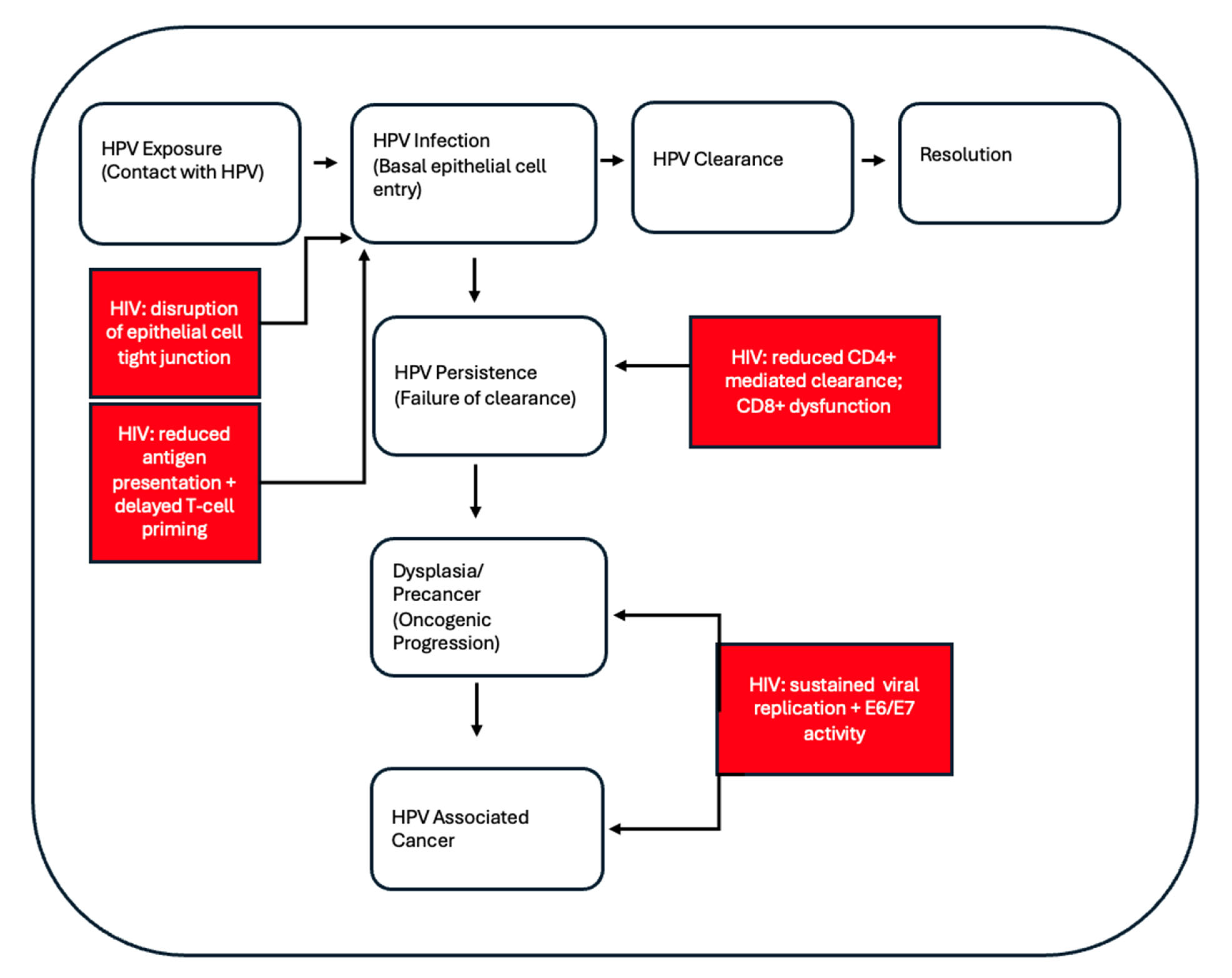

Advances in HPV Vaccination in People Living with HIV: A Review

Abstract
1. Introduction
2. HPV and HIV Co-Infection
3. HPV Vaccination
4. HPV Vaccination Coverage
5. HPV Vaccination Coverage in PLWH
6. Safety and Efficacy of HPV Vaccination in PLWH
7. Update on Current Research
8. Conclusions
Author Contributions
Funding
Data Availability Statement
Conflicts of Interest
Abbreviations
| HPV | Human Papillomavirus |
| HIV | Human immunodeficiency virus |
| PLWH | People living with HIV |
| VLP | Virus-like particle |
| WHO | World Health Organization |
| CDC | Center for Disease Control and Prevention |
| GAVI | Global Alliance for Vaccines and Immunization |
| cART | Combined anti-retroviral therapy |
References
- Hathaway, J.K. HPV: Diagnosis, Prevention, and Treatment. Clin. Obstet. Gynecol. 2012, 55, 671–680. [Google Scholar] [CrossRef]
- Burd, E.M. Human Papillomavirus and Cervical Cancer. Clin. Microbiol. Rev. 2003, 16, 1–17. [Google Scholar] [CrossRef] [PubMed]
- Arroyo Mühr, L.S.; Lagheden, C.; Hassan, S.S.; Eklund, C.; Dillner, J. The International Human Papillomavirus Reference Center: Standardization, collaboration, and quality assurance in HPV research and diagnostics. J. Med. Virol. 2023, 95, e29332. [Google Scholar] [CrossRef]
- Jensen, J.E.; Becker, G.L.; Jackson, J.B.; Rysavy, M.B. Human Papillomavirus and Associated Cancers: A Review. Viruses 2024, 16, 680. [Google Scholar] [CrossRef]
- de Sanjosé, S.; Diaz, M.; Castellsagué, X.; Clifford, G.; Bruni, L.; Muñoz, N.; Bosch, X. Worldwide prevalence and genotype distribution of cervical human papillomavirus DNA in women with normal cytology: A meta-analysis. Lancet Infect. Dis. 2007, 7, 453–459. [Google Scholar] [CrossRef]
- Bruni, L.; Diaz, M.; Castellsagué, M.; Ferrer, E.; Bosch, F.X.; de Sanjosé, S. Cervical Human Papillomavirus Prevalence in 5 Continents: Meta-Analysis of 1 Million Women with Normal Cytological Findings. J. Infect. Dis. 2010, 202, 1789–1799. [Google Scholar] [CrossRef]
- Bruni, L.; Albero, G.; Rowley, J.; Alemany, L.; Arbyn, M.; Giuliano, A.R.; Marowitz, L.E.; Broutet, N.; Taylor, M. Global and regional estimates of genital human papillomavirus prevalence among men: A systematic review and meta-analysis. Lancet Glob. Health 2023, 11, e1345–e1362. [Google Scholar] [CrossRef] [PubMed]
- de Sanjosé, S.; Brotons, M.; Pavón, M.A. The natural history of human papillomavirus infection. Best Pract. Res. Clin. Obstet. Gynaecol. 2018, 47, 2–13. [Google Scholar] [CrossRef]
- Markowitz, L.E.; Unger, E.R. Human Papillomavirus Vaccination. N. Engl. J. Med. 2023, 388, 1790–1798. [Google Scholar] [CrossRef] [PubMed]
- Szymonowicz, K.A.; Chen, J. Biological and clinical aspects of HPV-related cancers. Cancer Biol. Med. 2020, 17, 864–878. [Google Scholar] [CrossRef]
- Uusküla, A.; Tisler, A.; DeHovitz, J.; Murenzi, G.; Castle, P.E.; Clifford, G. Prevention and control of HPV-related cancers in people living with HIV. Lancet HIV 2025, 12, e293–e302. [Google Scholar] [CrossRef]
- UNAIDS Miles to Go: Closing Gaps, Breaking Barriers, Righting Injustices. Geneva: Joint United Nations Programme on HIV/AIDS (UNAIDS). Available online: https://www.unaids.org/sites/default/files/media_asset/miles-to-go_en.pdf (accessed on 22 December 2025).
- Karim, S.S.A.; Baxter, C. HIV incidence rates in adolescent girls and young women in sub-Saharan Africa. Lancet Glob. Health 2019, 7, e1470–e1471. [Google Scholar] [CrossRef]
- Bray, F.; Parkin, D.M.; Gnangnon, F.; Tshisimogo, G.; Peko, J.F.; Adoubi, I.; Assefa, M.; Bojang, L.; Awuah, B.; Koulibaly, M.; et al. Cancer in sub-Saharan Africa in 2020: A review of current estimates of the national burden, data gaps, and future needs. Lancet Oncol. 2022, 23, 719–728. [Google Scholar] [CrossRef] [PubMed]
- Bray, F.; Laversanne, M.; Sung, H.; Ferlay, J.; Siegel, R.L.; Soerjomataram, I.; Jemal, A. Global cancer statistics 2022: GLOBOCAN estimates of incidence and mortality worldwide for 36 cancers in 185 countries. CA Cancer J. Clin. 2024, 74, 229–263. [Google Scholar] [CrossRef]
- Bogale, A.L.; Belay, N.B.; Medhin, G.; Ali, J.H. Molecular epidemiology of human papillomavirus among HIV infected women in developing countries: Systematic review and meta-analysis. Virol. J. 2020, 17, 179. [Google Scholar] [CrossRef]
- Tartaglia, E.; Falasca, K.; Vecchiet, J.; Sabusco, G.P.; Picciano, G.; Di Marco, R.; Ucciferri, C. Prevalence of HPV infection among HIV-positive and HIV-negative women in Central/Eastern Italy: Strategies of prevention. Oncol. Lett. 2017, 14, 7629–7635. [Google Scholar] [CrossRef]
- Remis, R.S.; Liu, J.; Loutfy, M.; Tharao, W.; Rebbapragada, A.; Perusini, S.J.; Chieza, L.; Saunders, M.; Green-Walker, L.; Kaul, R. The epidemiology of sexually transmitted co-infections in HIV-positive and HIV-negative African-Caribbean women in Toronto. BMC Infect. Dis. 2013, 13, 550. [Google Scholar] [CrossRef] [PubMed]
- Liu, G.; Sharma, M.; Tan, N.; Barnabas, R.V. HIV-positive women have higher risk of human papilloma virus infection, precancerous lesions, and cervical cancer. AIDS 2018, 32, 795–808. [Google Scholar] [CrossRef]
- Caicedo-Martínez, M.; Fernández-Deaza, G.; Ordóñez-Reyes, C.; Olejua, P.; Nuche-Berenguer, B.; Mello, M.B.; Murilllo, R. High-risk human papillomavirus infection among women living with HIV in Latin America and the Caribbean: A systematic review and meta-analysis. Int. J. STD AIDS 2021, 32, 1278–1289. [Google Scholar] [CrossRef]
- Agyare Gyane, F.; Modey, E.; Maya, E.; Bonney, E.Y.; Abaidoo-Myles, A.; Paintsil, E.; Torpey, K. Prevalence and risk factors associated with high-risk human papillomavirus infection among women living with HIV (WLWH) at a tertiary health facility in Accra, Ghana. PLoS ONE 2024, 19, e0303535. [Google Scholar] [CrossRef] [PubMed]
- Castle, P.E.; Varallo, J.E.; Bertram, M.M.; Ratshaa, B.; Kitheka, M.; Rammipi, K. High-risk human papillomavirus prevalence in self-collected cervicovaginal specimens from human immunodeficiency virus (HIV)-negative women and women living with HIV living in Botswana. PLoS ONE 2020, 15, e0229086. [Google Scholar] [CrossRef]
- Abel, S.; Najioullah, F.; Voluménie, J.L.; Accrombessi, L.; Carles, G.; Catherine, D.; Chiappetta, D.; Clavel, C.; Codjo-Sodokin, A.; Guedj, M.E.; et al. High prevalence of human papillomavirus infection in HIV-infected women living in French Antilles and French Guiana. PLoS ONE 2019, 14, e0221334. [Google Scholar] [CrossRef] [PubMed]
- Konopnicki, D.; De Wit, S.; Clumeck, N. Medscape. 2013. HPV and HIV Coinfection—Page 3. Available online: https://www.medscape.com/viewarticle/810932 (accessed on 9 December 2025).
- Stanley, M. Immunology of HPV Infection. Curr. Obstet. Gynecol. Rep. 2015, 4, 195–200. [Google Scholar] [CrossRef]
- Tugizov, S.M.; Herrera, R.; Chin-Hong, P.; Veluppillai, P.; Greenspan, D.; Berry, J.M.; Pilcher, C.D.; Shiboski, C.H.; Jay, N.; Rubin, M.; et al. HIV-associated disruption of mucosal epithelium facilitates paracellular penetration by human papillomavirus. Virology 2013, 446, 378–388. [Google Scholar] [CrossRef] [PubMed]
- Zizza, A.; Banchelli, F.; Guido, M.; Marotta, C.; Di Gennaro, F.; Mazzucco, W.; Pistotti, V.; D’Amico, R. Efficacy and safety of human papillomavirus vaccination in HIV-infected patients: A systematic review and meta-analysis. Sci. Rep. 2021, 11, 4954. [Google Scholar] [CrossRef]
- Denslow, S.A.; Rositch, A.F.; Firnhaber, C.; Ting, J.; Smith, J.S. Incidence and progression of cervical lesions in women with HIV: A systematic global review. Int. J. STD AIDS 2014, 25, 163–177. [Google Scholar] [CrossRef]
- Tadese, B.K.; You, X.; Ndao, T.; Tota, J.E.; Chen, Y.T.; Chowdhary, A.; Pan, J.; Costa, A.C.; Mugo, N. The burden of HPV infections and HPV-related diseases among people with HIV: A systematic literature review. J. Med. Virol. 2025, 97, e70274. [Google Scholar] [CrossRef]
- Rositch, A.F.; Levinson, K.; Suneja, G.; Monterosso, A.; Schymura, M.J.; McNeel, T.S.; Horner, M.J.; Engels, E.; Shiels, M.S. Epidemiology of Cervical Adenocarcinoma and Squamous Cell Carcinoma Among Women Living With Human Immunodeficiency Virus Compared With the General Population in the United States. Clin. Infect. Dis. 2021, 74, 814–820. [Google Scholar] [CrossRef]
- Michaud, J.M.; Zhang, T.; Shireman, T.I.; Lee, Y.; Wilson, I.B. Hazard of Cervical, Oropharyngeal, and Anal Cancers in HIV-Infected and HIV-Uninfected Medicaid Beneficiaries. Cancer Epidemiol. Biomark. Prev. 2020, 29, 1447–1457. [Google Scholar] [CrossRef]
- Zhao, J.; Dong, Y.; Clark, E.; Garcia, J.M.; White, D.L.; Kramer, J.R.; Mazul, A.L.; Hartman, C.; Chiao, E.Y. Risk and predictors of penile cancer in US Veterans with HIV. AIDS 2024, 38, 1395–1401. [Google Scholar] [CrossRef]
- Illah, O.; Olaitan, A. Updates on HPV Vaccination. Diagnostics 2023, 13, 243. [Google Scholar] [CrossRef] [PubMed]
- Han, J.; Zhang, L.; Chen, Y.; Zhang, Y.; Wang, L.; Cai, R.; Li, M.; Dai, Y.; Dang, L.; Chen, H.; et al. Global HPV vaccination programs and coverage rates: A systematic review. eClinicalMedicine 2025, 84, 103290. [Google Scholar] [CrossRef]
- Centers for Disease Control and Prevention (CDC). HPV Vaccination. Human Papillomavirus (HPV). 2024. Available online: https://www.cdc.gov/hpv/vaccines/index.html (accessed on 24 November 2025).
- Miazga, W.; Tatara, T.; Gujski, M.; Pinkas, J.; Ostrowski, J.; Religioni, U. Global Guidelines and Trends in HPV Vaccination for Cervical Cancer Prevention. Med. Sci. Monit. 2025, 31, e947173. [Google Scholar] [CrossRef]
- Schiller, J.T.; Lowy, D.R. Understanding and learning from the success of prophylactic human papillomavirus vaccines. Nat. Rev. Microbiol. 2012, 10, 681–692. [Google Scholar] [CrossRef]
- World Health Organization. Human papillomavirus vaccines: WHO position paper, December 2022. Wkly. Epidemiol. Rec. 2022, 97, 645–672. Available online: https://www.who.int/publications/i/item/who-wer9750-645-672 (accessed on 24 November 2025).
- US Department of Health and Human Services. CDC Acts on Presidential Memorandum to Update Childhood Immunization Schedule. 2026. Available online: https://www.hhs.gov/press-room/cdc-acts-presidential-memorandum-update-childhood-immunization-schedule.html (accessed on 22 January 2026).
- World Health Organization. WHO Updates Recommendations on HPV Vaccination Schedule. 20 December 2022. Available online: https://www.who.int/news/item/20-12-2022-WHO-updates-recommendations-on-HPV-vaccination-schedule (accessed on 11 December 2025).
- Centers for Disease Control and Prevention (CDC). Human Papillomavirus Vaccination: Recommendations of the Advisory Committee on Immunization Practices (ACIP); CDC: Atlanta, GA, USA, 2014. Available online: https://www.cdc.gov/mmwr/preview/mmwrhtml/rr6305a1.htm#tab6 (accessed on 4 February 2026).
- Villa, A.; Patton, L.L.; Giuliano, A.R.; Estrich, C.G.; Pahlke, S.C.; O’Brien, K.K.; Lipman, R.D.; Araujo, M.W.B. Summary of the evidence on the safety, efficacy, and effectiveness of human papillomavirus vaccines: Umbrella review of systematic reviews. J. Am. Dent. Assoc. 2020, 151, 245–254.e24. [Google Scholar] [CrossRef]
- Garland, S.M.; Kjaer, S.K.; Muñoz, N.; Block, S.L.; Brown, D.R.; DiNubile, M.J.; Lindsay, B.R.; Kuter, B.J.; Perez, G.; Dominiak-Felden, G.; et al. Impact and Effectiveness of the Quadrivalent Human Papillomavirus Vaccine: A Systematic Review of 10 Years of Real-world Experience. Clin. Infect. Dis. 2016, 63, 519–527. [Google Scholar] [CrossRef]
- Kamolratanakul, S.; Pitisuttithum, P. Human Papillomavirus Vaccine Efficacy and Effectiveness against Cancer. Vaccines 2021, 9, 1413. [Google Scholar] [CrossRef]
- Naud, P.S.; Roteli-Martins, C.M.; De Carvalho, N.S.; Teixeira, J.C.; de Borba, P.C.; Sanchez, N.; Zahaf, T.; Catteau, G.; Geeraerts, B.; Descamps, D. Sustained efficacy, immunogenicity, and safety of the HPV-16/18 AS04-adjuvanted vaccine: Final analysis of a long-term follow-up study up to 9.4 years post-vaccination. Hum. Vaccines Immunother. 2014, 10, 2147–2162. [Google Scholar] [CrossRef] [PubMed]
- Harper, D.M.; DeMars, L.R. HPV vaccines—A review of the first decade. Gynecol. Oncol. 2017, 146, 196–204. [Google Scholar] [CrossRef] [PubMed]
- FUTURE II Study Group. Quadrivalent vaccine against human papillomavirus to prevent high-grade cervical lesions. N. Engl. J. Med. 2007, 356, 1915–1927. [Google Scholar] [CrossRef]
- Cheng, L.; Wang, Y.; Du, J. Human Papillomavirus Vaccines: An Updated Review. Vaccines 2020, 8, 391. [Google Scholar] [CrossRef]
- Giuliano, A.R.; Palefsky, J.M.; Goldstone, S.; Moreira, E.D.; Penny, M.E.; Aranda, C.; Vardas, E.; Moi, H.; Jessen, H.; Hillman, R.; et al. Efficacy of Quadrivalent HPV Vaccine against HPV Infection and Disease in Males. N. Engl. J. Med. 2011, 364, 401–411. [Google Scholar] [CrossRef]
- Kjaer, S.K.; Nygård, M.; Sundström, K.; Dillner, J.; Tryggvadottir, L.; Munk, C.; Berger, S.; Enerly, E.; Hortlund, M.; Agustsson, A.I.; et al. Final analysis of a 14-year long-term follow-up study of the effectiveness and immunogenicity of the quadrivalent human papillomavirus vaccine in women from four nordic countries. eClinicalMedicine 2020, 23, 100401. [Google Scholar] [CrossRef]
- Villa, L.L.; Costa, R.L.R.; Petta, C.A.; Andrade, R.P.; Paavonen, J.; Iversen, O.E.; Olsson, S.E.; Hoye, J.; Steinwall, M.; Riis-Johannessen, G.; et al. High sustained efficacy of a prophylactic quadrivalent human papillomavirus types 6/11/16/18 L1 virus-like particle vaccine through 5 years of follow-up. Br. J. Cancer 2006, 95, 1459–1466. [Google Scholar] [CrossRef]
- Herrero, R.; González, P.; Markowitz, L.E. Present status of human papillomavirus vaccine development and implementation. Lancet Oncol. 2015, 16, e206–e216. [Google Scholar] [CrossRef]
- Faksová, K.; Laksafoss, A.D.; Hviid, A. Human papillomavirus nonavalent (HPV9) vaccination and risk of immune mediated diseases, myocarditis, pericarditis, and thromboembolic outcomes in Denmark: Self-controlled case series study. BMJ Med. 2024, 3, e000854. [Google Scholar] [CrossRef]
- Gee, J.; Naleway, A.; Shui, I.; Baggs, J.; Yin, R.; Li, R.; Kulldorff, M.; Lewis, E.; Fireman, B.; Daley, M.F.; et al. Monitoring the safety of quadrivalent human papillomavirus vaccine: Findings from the Vaccine Safety Datalink. Vaccine 2011, 29, 8279–8284. [Google Scholar] [CrossRef] [PubMed]
- Slade, B.A.; Leidel, L.; Vellozzi, C.; Woo, E.J.; Hua, W.; Sutherland, A.; Izurieta, H.S.; Ball, R.; Miller, N.; Braun, M.; et al. Postlicensure Safety Surveillance for Quadrivalent Human Papillomavirus Recombinant Vaccine. JAMA 2009, 302, 750–757. [Google Scholar] [CrossRef] [PubMed]
- Shimabukuro, T.T.; Su, J.R.; Marquez, P.L.; Mba-Jonas, A.; Arana, J.E.; Cano, M.V. Safety of the 9-Valent Human Papillomavirus Vaccine. Pediatrics 2019, 144, e20191791. [Google Scholar] [CrossRef] [PubMed]
- Phillips, A.; Patel, C.; Pillsbury, A.; Brotherton, J.; Macartney, K. Safety of Human Papillomavirus Vaccines: An Updated Review. Drug Saf. 2018, 41, 329–346. [Google Scholar] [CrossRef]
- Moreira, E.D., Jr.; Block, S.L.; Ferris, D.; Giuliano, A.R.; Iversen, O.E.; Joura, E.A.; Kosalaraksa, P.; Schilling, A.; Van Damme, P.; Bornstein, J.; et al. Safety Profile of the 9-Valent HPV Vaccine: A Combined Analysis of 7 Phase III Clinical Trials. Pediatrics 2016, 138, e20154387. [Google Scholar] [CrossRef]
- World Health Organization. Safety of Human Papillomavirus Vaccines: Extract from Report of the Global Advisory Committee on Vaccine Safety (GACVS) Meeting of 7–8 June 2017. Available online: https://www.who.int/groups/global-advisory-committee-on-vaccine-safety/topics/human-papillomavirus-vaccines/safety (accessed on 12 January 2026).
- Crum-Cianflone, N.F.; Wallace, M.R. Vaccination in HIV-Infected Adults. AIDS Patient Care STDs 2014, 28, 397–410. [Google Scholar] [CrossRef] [PubMed]
- Staadegaard, L.; Rönn, M.M.; Soni, N.; Bellerose, M.E.; Bloem, P.; Brisson, M.; Maheu-Giroux, M.; Barnabas, R.V.; Drolet, M.; Mayaud, P.; et al. Immunogenicity, safety, and efficacy of the HPV vaccines among people living with HIV: A systematic review and meta-analysis. eClinicalMedicine 2022, 52, 101585. Available online: https://www.thelancet.com/journals/eclinm/article/PIIS2589-5370(22)00315-7/fulltext (accessed on 11 December 2025). [CrossRef]
- World Health Organization. Global Strategy to Accelerate the Elimination of Cervical Cancer as a Public Health Problem; WHO: Geneva, Switzerland, 2020; Available online: https://www.who.int/publications/i/item/9789240014107 (accessed on 11 December 2025).
- WHO Immunization Data Portal—Detail Page. Available online: https://immunizationdata.who.int/global/wiise-detail-page (accessed on 11 December 2025).
- Ebrahimi, N.; Yousefi, Z.; Khosravi, G.; Malayeri, F.E.; Golabi, M.; Askarzadeh, M.; Shams, M.H.; Ghezelbash, B.; Eskandari, N. Human papillomavirus vaccination in low- and middle-income countries: Progression, barriers, and future prospective. Front. Immunol. 2023, 14, 1150238. Available online: https://www.frontiersin.org/journals/immunology/articles/10.3389/fimmu.2023.1150238/full (accessed on 12 December 2025). [CrossRef]
- Chidebe, R.C.W.; Osayi, A.; Torode, J.S. The Global Fund, Cervical Cancer, and HPV infections: What can low- and middle-income countries do to accelerate progress by 2030? eClinicalMedicine 2025, 81, 103127. Available online: https://www.thelancet.com/journals/eclinm/article/PIIS2589-5370(25)00059-8/fulltext?rss=yes (accessed on 12 December 2025). [CrossRef] [PubMed]
- Gavi, the Vaccine Alliance. Human Papillomavirus. Available online: https://www.gavi.org/types-support/vaccine-support/human-papillomavirus (accessed on 24 December 2025).
- Gallagher, K.E.; Howard, N.; Kabakama, S.; Mounier-Jack, S.; Burchett, H.E.D.; LaMontagne, D.S.; Watson-Jones, D. Human papillomavirus (HPV) vaccine coverage achievements in low and middle-income countries 2007–2016. Papillomavirus Res. 2017, 4, 72–78. [Google Scholar] [CrossRef]
- Dorji, T.; Nopsopon, T.; Tamang, S.T.; Pongpirul, K. Human papillomavirus vaccination uptake in low-and middle-income countries: A meta-analysis. eClinicalMedicine 2021, 34, 100836. [Google Scholar] [CrossRef]
- Zhu, J.; Cole, C.B.; Fihman, J.; Adjagba, A.; Dasic, M.; Cernuschi, T. Opportunities to accelerate immunization progress in middle-income countries. Vaccine 2024, 42, S98–S106. [Google Scholar] [CrossRef]
- Zhang, X.; Chen, S.; Tang, S. Closing the immunization gap: Overcoming barriers for new vaccine introduction in Southeast and South Asia. Vaccine 2026, 72, 128119. [Google Scholar] [CrossRef] [PubMed]
- Baisley, K.; Kemp, T.J.; Mugo, N.R.; Whitworth, H.; Onono, M.A.; Njoroge, B.; Indangasi, J.; Bukusi, E.A.; Prabhu, P.R.; Mutani, P.; et al. Comparing one dose of HPV vaccine in girls aged 9–14 years in Tanzania (DoRIS) with one dose in young women aged 15–20 years in Kenya (KEN SHE): An immunobridging analysis of randomised controlled trials. Lancet Glob. Health 2024, 12, e491–e499. [Google Scholar] [CrossRef] [PubMed]
- Kreimer, A.R.; Porras, C.; Liu, D.; Hildesheim, A.; Carvajal, L.J.; Ocampo, R.; Romero, B.; Gail, M.H.; Cortes, B.; Sierra, M.S.; et al. Noninferiority of One HPV Vaccine Dose to Two Doses. N. Engl. J. Med. 2025, 393, 2421–2433. [Google Scholar] [CrossRef] [PubMed]
- Bénard, É.; Drolet, M.; Laprise, J.F.; Gingras, G.; Jit, M.; Boily, M.C.; Bloem, M.; Brisson, M. Potential population-level effectiveness of one-dose HPV vaccination in low-income and middle-income countries: A mathematical modelling analysis. Lancet Public. Health 2023, 8, e788–e799. [Google Scholar] [CrossRef]
- Pleuhs, B.; Walsh, J.L.; Quinn, K.G.; Petroll, A.E.; Nyitray, A.; John, S.A. Uptake of Human Papillomavirus Vaccination by HIVStatus HIVPre-exposure Prophylaxis (PrEP) Care Engagement Among Young Sexual Minority Men 17–24 Years Old in the USA. Sex. Res. Soc. Policy 2022, 19, 1944–1953. [Google Scholar] [CrossRef]
- McClung, N.; Burnett, J.; Wejnert, C.; Markowitz, L.E.; Meites, E. Human papillomavirus vaccination coverage among men who have sex with men—National HIV Behavioral Surveillance, United States, 2017. Vaccine 2020, 38, 7417–7421. [Google Scholar] [CrossRef]
- Chambers, C.; Gillis, J.; Lindsay, J.; Benoit, A.C.; Kendall, C.E.; Kroch, A.; Grewal, R.; Loutfy, M.; Mah, A.; O’Brien, K.; et al. Low human papillomavirus vaccine uptake among women engaged in HIV care in Ontario, Canada. Prev. Med. 2022, 164, 107246. [Google Scholar] [CrossRef]
- Kojic, E.M.; Rana, A.I.; Cu-Uvin, S. Human Papillomavirus Vaccination in HIV-infected Women: Need for Increased Coverage. Expert. Rev. Vaccines 2016, 15, 105–117. [Google Scholar] [CrossRef] [PubMed]
- Galindo, T.; Edwards, J.; Song, G.; Soyer, S.; Todd, S.; Boyce, G.; Ashing, K.T.; Edwards, R.J. Implementing HPV Vaccination Services in People Living with HIV in Trinidad and Tobago: A Brief Report. Cancer Epidemiol. Biomark. Prev. 2025, 34, 1089–1092. [Google Scholar] [CrossRef]
- Nakibuuka, V.; Muddu, M.; Kraehenbuhl, J.P.; Birungi, C.; Semitala, F.C.; Tusubira, A.K. Uptake of human papilloma virus vaccination among adolescent girls living with HIV in Uganda: A mixed methods study. PLoS ONE 2024, 19, e0300155. [Google Scholar] [CrossRef]
- Jensen, J.E.; Kanywa, J.B.; Ntege, P.N.; Becker, G.L.; Wendt, L.H.; Jackson, J.B.; Rysavy, M.B. Human Papillomavirus Vaccination Among Adolescent Girls in a Ugandan HIV Clinic: A Cross-Sectional Survey. Reprod. Female Child Health 2025, 4, e70023. [Google Scholar] [CrossRef]
- Grewal, R.; Grennan, T.; Gillis, J.L.; Ogilvie, G.; Gaspar, M.; Grace, D.; Raboud, J.M.; MacPherson, P.A.; Rosenes, R.; Salit, I.E.; et al. Low human papillomavirus (HPV) vaccine uptake among men living with human immunodeficiency virus (HIV): Cross-sectional findings from a clinical cohort. Prev. Med. 2021, 143, 106329. [Google Scholar] [CrossRef]
- Masamba Makanani, C.; Nyondo-Mipando, A.L.; Jumbe, V. Barriers and strategies to enhance HPV vaccine uptake in adolescents living with HIV and their guardians in Lilongwe, Malawi. Sci. Rep. 2025, 15, 32230. [Google Scholar] [CrossRef] [PubMed]
- Kutz, J.M.; Rausche, P.; Gheit, T.; Puradiredja, D.I.; Fusco, D. Barriers and facilitators of HPV vaccination in sub-saharan Africa: A systematic review. BMC Public Health 2023, 23, 974. [Google Scholar] [CrossRef]
- Kassa, H.N.; Bilchut, A.H.; Mekuria, A.D.; Lewetie, E.M. Practice and Associated Factors of Human Papillomavirus Vaccination Among Primary School Students in Minjar-Shenkora District, North Shoa Zone, Amhara Regional State, Ethiopia, 2020. Cancer Manag. Res. 2021, 13, 6999–7008. [Google Scholar] [CrossRef]
- Nakayita, R.M.; Benyumiza, D.; Nekesa, C.; Misuk, I.; Kyeswa, J.; Nalubuuka, A.; Murungi, T.; Udho, S.; Kumakech, E. Factors associated with uptake of human papilloma virus vaccine among school girls aged 9–14 years in Lira City northern Uganda: A cross-sectional study. BMC Women’s Health 2023, 23, 362. [Google Scholar] [CrossRef]
- Mavundza, E.J.; Wiyeh, A.B.; Mahasha, P.W.; Halle-Ekane, G.; Wiysonge, C.S. A systematic review of immunogenicity, clinical efficacy and safety of human papillomavirus vaccines in people living with the human immunodeficiency virus. Hum. Vaccines Immunother. 2020, 16, 426–435. [Google Scholar] [CrossRef]
- Boey, L.; Curinckx, A.; Roelants, M.; Derdelinckx, I.; Van Wijngaerden, E.; De Munter, P.; Vos, R.; Kuypers, D.; Van Cleemput, J.; Vandermeulen, C. Immunogenicity and Safety of the 9-Valent Human Papillomavirus Vaccine in Solid Organ Transplant Recipients and Adults Infected With Human Immunodeficiency Virus (HIV). Clin. Infect. Dis. 2021, 73, e661–e671. [Google Scholar] [CrossRef]
- Levin, M.J.; Moscicki, A.B.; Song, L.Y.; Fenton, T.; Meyer, W.A.; Read, J.S.; Handelsman, E.L.; Nowak, B.; Sattler, C.A.; Saah, A.; et al. Safety and immunogenicity of a quadrivalent human papillomavirus (types 6, 11, 16, and 18) vaccine in HIV-infected children 7 to 12 years old. J. Acquir. Immune Defic. Syndr. 2010, 55, 197–204. [Google Scholar] [CrossRef]
- World Health Organization. HPV Vaccine Rates Information Sheet; WHO: Geneva, Switzerland, 2017; Available online: https://cdn.who.int/media/docs/default-source/pvg/global-vaccine-safety/hpv-vaccine-rates-information-sheet.pdf?sfvrsn=d2f2750_3 (accessed on 12 January 2026).
- Giacomet, V.; Penagini, F.; Trabattoni, D.; Viganò, A.; Rainone, V.; Bernazzani, G.; Bonaredi, C.M.; Clerici, M.; Bedogni, G.; Zuccotti, G.V. Safety and immunogenicity of a quadrivalent human papillomavirus vaccine in HIV-infected and HIV-negative adolescents and young adults. Vaccine 2014, 32, 5657–5661. [Google Scholar] [CrossRef] [PubMed]
- Lacey, C.J.N. HPV vaccination in HIV infection. Papillomavirus Res. 2019, 8, 100174. [Google Scholar] [CrossRef] [PubMed]
- Weinberg, A.; Huang, S.; Moscicki, A.B.; Saah, A.; Levin, M.J.; IMPAACT P1085 Protocol Team. Persistence of memory B-cell and T-cell responses to the quadrivalent HPV vaccine in HIV-infected children. AIDS 2018, 32, 851–860. [Google Scholar] [CrossRef]
- Kojic, E.M.; Kang, M.; Cespedes, M.S.; Umbleja, T.; Godfrey, C.; Allen, R.T.; Firnhaber, C.; Grinstztejn, B.; Palefsy, J.M.; Webster-Cyriaque, J.; et al. Immunogenicity and Safety of the Quadrivalent Human Papillomavirus Vaccine in HIV-1–Infected Women. Clin. Infect. Dis. 2014, 59, 127–135. [Google Scholar] [CrossRef]
- McClymont, E.; Lee, M.; Raboud, J.; Coutlée, F.; Walmsley, S.; Lipsky, N.; Loutfy, M.; Trottier, S.; Smaill, F.; Klein, M.B.; et al. The Efficacy of the Quadrivalent Human Papillomavirus Vaccine in Girls and Women Living with Human Immunodeficiency Virus. Clin. Infect. Dis. 2019, 68, 788–794. [Google Scholar] [CrossRef]
- Kahn, J.A.; Xu, J.; Kapogiannis, B.G.; Sleasman, J.W. Brief Report: Antibody Responses to Quadrivalent HPV Vaccination in HIV-Infected Young Women as Measured by Total IgG and Competitive Luminex Immunoassay. JAIDS J. Acquir. Immune Defic. Syndr. 2017, 75, 241–245. [Google Scholar] [CrossRef]
- Kahn, J.A.; Xu, J.; Kapogiannis, B.G.; Rudy, B.; Gonin, R.; Liu, N.; Wilson, C.M.; Worrell, C.; Squires, K.E. Immunogenicity and Safety of the Human Papillomavirus 6, 11, 16, 18 Vaccine in HIV-Infected Young Women. Clin. Infect. Dis. 2013, 57, 735–744. [Google Scholar] [CrossRef] [PubMed][Green Version]
- Wilkin, T.J.; Chen, H.; Cespedes, M.S.; Leon-Cruz, J.T.; Godfrey, C.; Chiao, E.Y.; Bastow, B.; Webster-Cyriaque, J.; Feng, Q.; Dragavon, J.; et al. A Randomized, Placebo-Controlled Trial of the Quadrivalent Human Papillomavirus Vaccine in Human Immunodeficiency Virus-Infected Adults Aged 27 Years or Older: AIDS Clinical Trials Group Protocol A5298. Clin. Infect. Dis. 2018, 67, 1339–1346. [Google Scholar] [CrossRef] [PubMed]
- Palefsky, J.M.; Lensing, S.Y.; Belzer, M.; Lee, J.; Gaur, A.H.; Mayer, K.; Futterman, D.; Stier, E.A.; Paul, M.E.; Chiao, E.Y.; et al. High Prevalence of Anal High-Grade Squamous Intraepithelial Lesions, and Prevention Through Human Papillomavirus Vaccination, in Young Men Who Have Sex With Men Living With Human Immunodeficiency Virus. Clin. Infect. Dis. 2021, 73, 1388–1396. [Google Scholar] [CrossRef]
- Levin, M.J.; Huang, S.; Moscicki, A.B.; Song, L.Y.; Read, J.S.; Meyer, W.A.; Saah, A.J.; Richardson, K.; Weinberg, A. Four-year persistence of type-specific immunity after quadrivalent human papillomavirus vaccination in HIV-infected children: Effect of a fourth dose of vaccine. Vaccine 2017, 35, 1712–1720. [Google Scholar] [CrossRef]
- Barnabas, R. Efficacy of Human Papillomavirus (HPV) Vaccination to Prevent Infection Among Women Living With HIV: A Prospective, Individual, Double-Blind, Randomized Controlled Study; Report No. NCT06436274; National Library of Medicine: Bethesda, MD, USA, 2025. Available online: https://clinicaltrials.gov/study/NCT06436274 (accessed on 12 December 2025).
- Money, D. A Study of Reduced Dosing of the Nonavalent HPV Vaccine in Women Living With HIV; Report No. NCT05495906; National Library of Medicine: Bethesda, MD, USA, 2025. Available online: https://clinicaltrials.gov/study/NCT05495906 (accessed on 12 December 2025).
- Ron, R.; Díaz-García, C.; Sendagorta, E.; Cabello-Úbeda, A.; Moreno, E.; Crespillo-Andújar, C.; Feltes-Ochoa, R.; Carrillo-Acosta, I.; Navarro-Soler, R.; Esteban, H.; et al. A Phase IV, Open-label, Single-Arm, Multicentric Clinical Trial for Evaluation of Human Papillomavirus 9vHPV Vaccine Immunogenicity in Men Who Have Sex With Men Living With HIV: GeSIDA Study 10 017. Clin. Infect. Dis. 2025, ciaf435. [Google Scholar] [CrossRef] [PubMed]


| Category | WHO Guidelines | CDC Guidelines |
|---|---|---|
| Target Age | Girls aged 9–14 years | All adolescents aged 11–12 years (can start at age 9) |
| Catch-Up Vaccination | Girls up to the age of 20 | Up to 26 years of age |
| Adults > 26 years old | Not routinely recommended | Shared clinical decision making for age 27–45 years |
| Dose Schedule (Immunocompetent) | 1–2 doses | 1–2 doses |
| Dose Schedule (Immunocompromised) | 3 doses recommended | 3 doses recommended |
| Vaccine Type | Bivalent, quadrivalent, or nonavalent depending on availability | Nonavalent |
| Patient Level Barriers Strategies for Improvement | |
| Limited awareness of the HPV vaccine | Targeted HPV education on the HPV and the vaccine for PLWH |
| Misperception of personal risk for HPV infection | Risk-focused counseling and education |
| Lack of knowledge about dosing requirements for PLWH | Clear communication of vaccine schedule |
| Difficulty completing the 3-dose schedule | Mobile clinics and outreach programs |
| System Level Barriers Strategies for Improvement | |
| Vaccine cost and supply limitations | Subsidized vaccine programs |
| Fragmented care delivery and limited follow up for extended vaccine schedules | Integration with HIV treatment services and community outreach programs |
| PLWH | HIV-Negative Individuals | |
|---|---|---|
| Seroconversion Rates | 91–95% * | >99% |
| Antibody Titers following Vaccination | Lower | Higher |
| Durability of Antibody Titers | At least five years | At least 10–12 years |
| Clinical Efficacy | Not well studied | 90–100% |
| Adverse Effects | Few; injection site reaction is the most common | Few; injection site reaction is the most common |
Disclaimer/Publisher’s Note: The statements, opinions and data contained in all publications are solely those of the individual author(s) and contributor(s) and not of MDPI and/or the editor(s). MDPI and/or the editor(s) disclaim responsibility for any injury to people or property resulting from any ideas, methods, instructions or products referred to in the content. |
© 2026 by the authors. Licensee MDPI, Basel, Switzerland. This article is an open access article distributed under the terms and conditions of the Creative Commons Attribution (CC BY) license.
Share and Cite
Mooberry, M.; Jackson, J.B.; Rysavy, M.B. Advances in HPV Vaccination in People Living with HIV: A Review. Vaccines 2026, 14, 194. https://doi.org/10.3390/vaccines14020194
Mooberry M, Jackson JB, Rysavy MB. Advances in HPV Vaccination in People Living with HIV: A Review. Vaccines. 2026; 14(2):194. https://doi.org/10.3390/vaccines14020194
Chicago/Turabian StyleMooberry, Megan, J. Brooks Jackson, and Mary B. Rysavy. 2026. "Advances in HPV Vaccination in People Living with HIV: A Review" Vaccines 14, no. 2: 194. https://doi.org/10.3390/vaccines14020194
APA StyleMooberry, M., Jackson, J. B., & Rysavy, M. B. (2026). Advances in HPV Vaccination in People Living with HIV: A Review. Vaccines, 14(2), 194. https://doi.org/10.3390/vaccines14020194