Advances in Spatial Transcriptomics for Infectious Disease Research: Insight for Vaccine Development


Abstract
1. Introduction
2. Current Platforms and Features
- •
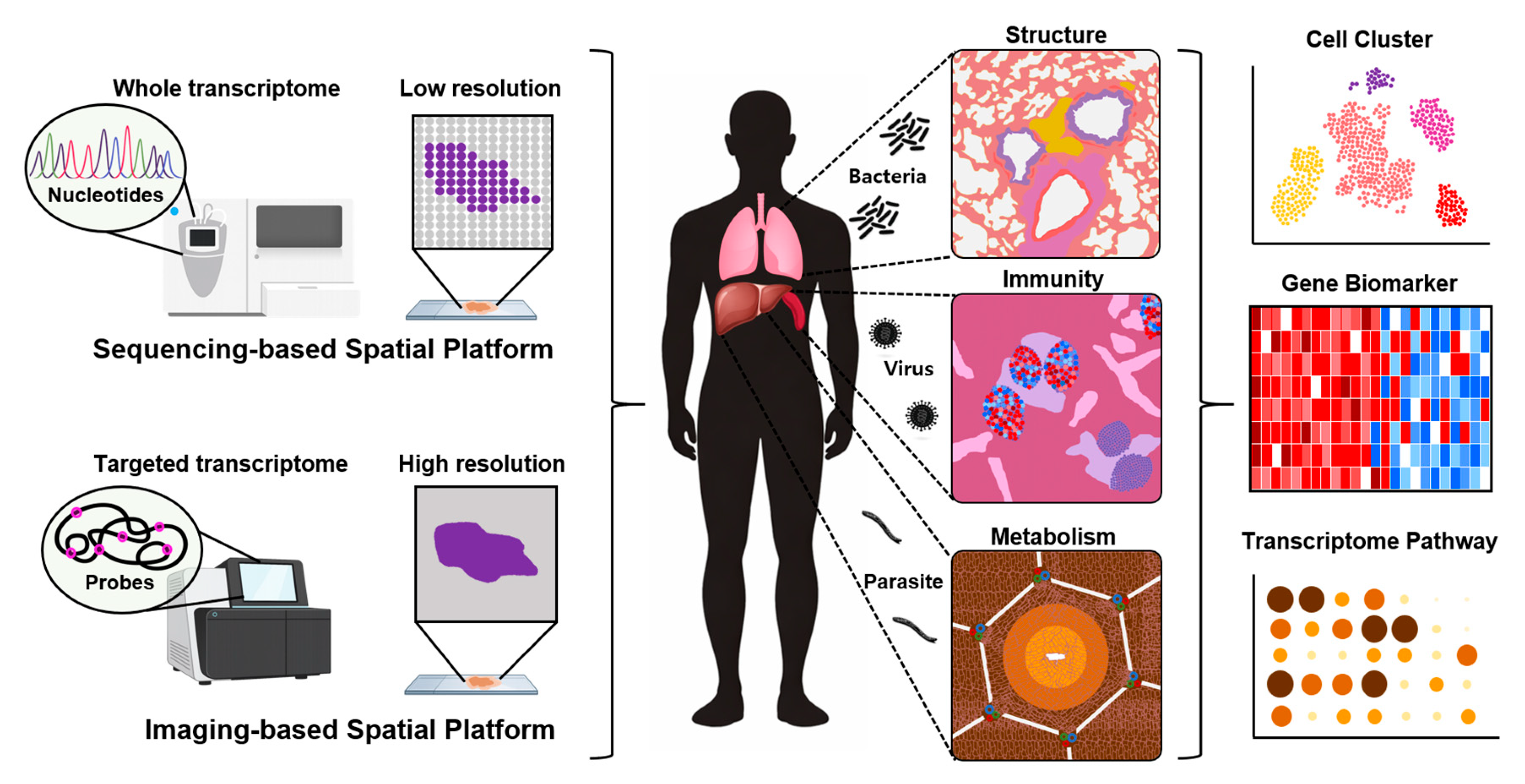
- BGI Stereo-seq (Shenzhen, China)—A DNA-nanoball (DNB)-based spatial transcriptomics platform that achieves ultra-high spatial resolution using patterned arrays. Tissue sections are placed onto chips densely coated with millions of DNA nanoballs carrying unique spatial barcodes. mRNAs hybridize in situ and are reverse-transcribed, and cDNA molecules are amplified and sequenced. Because DNB barcodes are spaced at submicron scale (≈500 nm), Stereo-seq provides true near-single-cell to subcellular resolution over very large tissue areas (centimeter-scale), enabling whole-organ or whole-embryo maps. The method is high-sensitivity and supports genome-wide profiling, but requires highly specialized chips and BGI’s proprietary sequencing workflow, limiting accessibility compared with more widely adopted platforms.
- •
- 10x Genomics Visium (Pleasanton, CA, USA)—A sequencing-based “slide” method. Fresh-frozen and formalin-fixed, paraffin-embedded (FFPE) tissue sections are placed on glass slides printed with an array of spots bearing barcoded oligo (dT) capture probes. mRNAs bind in situ and are reverse-transcribed with spatial barcodes, then pooled and sequenced. The commercial Visium platform (launched in 2018) uses 55 μm spots (improved from the original 100 μm) and can assay ~5000 transcripts per spot. A new Visium HD array (2024) further reduces spot size to ~2 μm, enabling nearly gapless, near-single-cell coverage. Visium is high-throughput and genome-wide, but each spot contains multiple cells (limiting exact single-cell resolution) and requires specialized equipment.
- •
- NanoString GeoMx (Seattle, WA, USA)—Not a whole-transcriptome method, but a targeted approach using oligo-tagged probes and UV photocleavable barcodes. It profiles more than thousands of transcripts in regions of interest (user-defined ROIs) on either frozen or FFPE sections. GeoMx allows flexible region selection and has been used to study infection in archived clinical samples but requires specialized equipment and is limited to pre-defined targets.
- •
- Vizgen/MERSCOPE (Cambridge, MA, USA)—An imaging-based approach using combinatorial fluorescent probes. First reported in 2015, MERFISH labels hundreds to thousands of transcripts in situ by sequential hybridization with error-correcting barcodes. It achieves single-molecule sensitivity and cellular resolution, enabling thousands of genes to be profiled in the same section. Its tradeoff is that it requires sophisticated microscopy and image processing and typically targets a pre-selected panel of genes.
- •
- 10x Genomics Xenium (Pleasanton, CA, USA)—A fluorescence-based in situ transcriptional profiling platform that detects RNA molecules directly inside intact tissue sections using targeted probe panels. Xenium employs rolling-circle amplification to generate fluorescent “amplicon dots” at each transcript’s location, followed by iterative imaging cycles to decode gene identities. Current panels cover hundreds to thousands of genes, with subcellular (~200–300 nm) localization precision and single-cell resolution across relatively large tissue areas. Xenium preserves tissue morphology for multimodal analysis (e.g., H&E, IF co-staining). Because it is targeted rather than whole-transcriptome, gene coverage is limited by probe design, and the instrument requires a dedicated imaging and chemistry system.
- •
- NanoString CosMx SMI (Spatial Molecular Imager, Seattle, WA, USA)—A multiplexed in situ RNA imaging platform that uses oligo-labeled probes and cyclic fluorescent readout to detect transcripts directly within preserved tissue at single-molecule resolution. CosMx decodes targets via sequential hybridization and imaging cycles, enabling detection of up to ~6000 RNA targets (and 100+ proteins) with subcellular precision, capturing transcript locations within cell bodies and processes. It delivers true single-cell and subcellular maps across moderately large fields of view and supports FFPE as well as fresh-frozen samples. As a targeted method, its gene panel breadth is limited by probe design, and the workflow requires specialized instrumentation and long imaging cycles, but it provides very high spatial resolution and rich multimodal data.
3. Applications on Pathogen Types
3.1. Virus
3.2. Bacteria
3.3. Parasites
4. Limitations and Challenges
5. Conclusions
Funding
Data Availability Statement
Conflicts of Interest
Abbreviations
| ST | Spatial transcriptomics |
| scRNA-seq | Single-cell RNA sequencing |
| LCM | Laser capture microdissection |
| FFPE | Formalin-fixed paraffin-embedded |
| FISH | Fluorescence in situ hybridization |
| NGS | Next-generation sequencing |
| DGE | Differential gene expression |
| GSEA | Gene set enrichment analysis |
| UMAP | uniform manifold approximation and projection |
| ROI | Region(s) of interest |
| DNB | DNA nanoball |
| DSP | Digital spatial profiling |
| IF | Immunofluorescence |
| H&E | Hematoxylin and eosin |
| COVID | Coronavirus disease 2019 |
| HBV | Hepatitis B virus |
| HIV | Human immunodeficiency virus |
| AIDS | Acquired immunodeficiency syndrome |
| ARDS | Acute respiratory distress syndrome |
| TB | Tuberculosis |
| Mtb | Mycobacterium tuberculosis |
| SARS-CoV-2 | Severe Acute respiratory syndrome coronavirus 2 |
| BALT | Bronchus-associated lymphoid tissue |
| Th1 | T helper 1 cells |
| Tfh | T follicular helper cells |
References
- Ståhl, P.L.; Salmén, F.; Vickovic, S.; Lundmark, A.; Navarro, J.F.; Magnusson, J.; Giacomello, S.; Asp, M.; Westholm, J.O.; Huss, M.; et al. Visualization and analysis of gene expression in tissue sections by spatial transcriptomics. Science 2016, 353, 78–82. [Google Scholar] [CrossRef]
- Strell, C.; Hilscher, M.M.; Laxman, N.; Svedlund, J.; Wu, C.; Yokota, C.; Nilsson, M. Placing RNA in context and space—Methods for spatially resolved transcriptomics. FEBS J. 2019, 286, 1468–1481. [Google Scholar] [CrossRef]
- Marx, V. Method of the Year: Spatially resolved transcriptomics. Nat. Methods 2021, 18, 9–14. [Google Scholar] [CrossRef]
- Wang, W.-J.; Chu, L.-X.; He, L.-Y.; Zhang, M.-J.; Dang, K.-T.; Gao, C.; Ge, Q.-Y.; Wang, Z.-G.; Zhao, X.-W. Spatial transcriptomics: Recent developments and insights in respiratory research. Mil. Med. Res. 2023, 10, 38. [Google Scholar] [CrossRef]
- Li, X.; Wang, C.Y. From bulk, single-cell to spatial RNA sequencing. Int. J. Oral. Sci. 2021, 13, 36. [Google Scholar] [CrossRef]
- Tang, F.; Barbacioru, C.; Wang, Y.; Nordman, E.; Lee, C.; Xu, N.; Wang, X.; Bodeau, J.; Tuch, B.B.; Siddiqui, A.; et al. mRNA-Seq whole-transcriptome analysis of a single cell. Nat. Methods 2009, 6, 377–382. [Google Scholar] [CrossRef]
- Wang, Y.; Wang, J.Y.; Schnieke, A.; Fischer, K. Advances in single-cell sequencing: Insights from organ transplantation. Mil. Med. Res. 2021, 8, 45. [Google Scholar] [CrossRef]
- Cross, A.R.; de Andrea, C.E.; Villalba-Esparza, M.; Landecho, M.F.; Cerundolo, L.; Weeratunga, P.; Etherington, R.E.; Denney, L.; Ogg, G.; Ho, L.-P.; et al. Spatial transcriptomic characterization of COVID-19 pneumonitis identifies immune circuits related to tissue injury. JCI Insight 2023, 8, e157837. [Google Scholar] [CrossRef]
- Desai, N.; Neyaz, A.; Szabolcs, A.; Shih, A.R.; Chen, J.H.; Thapar, V.; Nieman, L.T.; Solovyov, A.; Mehta, A.; Lieb, D.J.; et al. Temporal and spatial heterogeneity of host response to SARS-CoV-2 pulmonary infection. Nat. Commun. 2020, 11, 6319. [Google Scholar] [CrossRef]
- Sinha, A.; Weichhart, T. Spatial immunometabolic zonation in tuberculosis granulomas. Nat. Rev. Immunol. 2025, 25, 635. [Google Scholar] [CrossRef]
- Dries, R.; Chen, J.; Del Rossi, N.; Khan, M.M.; Sistig, A.; Yuan, G.C. Advances in spatial transcriptomic data analysis. Genome Res. 2021, 31, 1706–1718. [Google Scholar] [CrossRef]
- Du, J.; Yang, Y.-C.; An, Z.-J.; Zhang, M.-H.; Fu, X.-H.; Huang, Z.-F.; Yuan, Y.; Hou, J. Advances in spatial transcriptomics and related data analysis strategies. J. Transl. Med. 2023, 21, 330. [Google Scholar] [CrossRef]
- Delorey, T.M.; Ziegler, C.G.K.; Heimberg, G.; Normand, R.; Yang, Y.; Segerstolpe, Å.; Abbondanza, D.; Fleming, S.J.; Subramanian, A.; Montoro, D.T.; et al. COVID-19 tissue atlases reveal SARS-CoV-2 pathology and cellular targets. Nature 2021, 595, 107–113. [Google Scholar] [CrossRef]
- Dinnon, K.H., 3rd; Leist, S.R.; Okuda, K.; Dang, H.; Fritch, E.J.; Gully, K.L.; De la Cruz, G.; Evangelista, M.D.; Asakura, T.; Gilmore, R.C.; et al. SARS-CoV-2 infection produces chronic pulmonary epithelial and immune cell dysfunction with fibrosis in mice. Sci. Transl. Med. 2022, 14, eabo5070. [Google Scholar] [CrossRef]
- Oh, T.; Kim, G.; Baek, S.H.; Woo, Y.; Koo, B.-S.; Hwang, E.-H.; Shim, K.; An, Y.J.; Kim, Y.; Won, J.; et al. Spatial transcriptome atlas reveals pulmonary microstructure-specific COVID-19 gene signatures in cynomolgus macaques. Commun. Biol. 2023, 6, 879. [Google Scholar] [CrossRef]
- Oh, T.; Kim, G.; Baek, S.H.; Woo, Y.; Koo, B.; Hwang, E.; Shim, K.; An, Y.J.; Kim, Y.; Park, J.; et al. Comparative spatial transcriptomic profiling of severe acute respiratory syndrome coronavirus 2 Delta and Omicron variants infections in the lungs of cynomolgus macaques. J. Med. Virol. 2023, 95, e28847. [Google Scholar] [CrossRef]
- Oh, T.; Woo, Y.; Kim, G.; Koo, B.-S.; Baek, S.H.; Hwang, E.-H.; An, Y.J.; Kim, Y.; Kim, D.-Y.; Hong, J.J. Spatiotemporal Cellular Dynamics of Germinal Center Reaction in Coronavirus Disease 2019 Lung-Draining Lymph Node Based on Imaging-Based Spatial Transcriptomics. Lab. Investig. 2025, 105, 102180. [Google Scholar] [CrossRef]
- Oh, T.; Woo, Y.; Kim, G.; Koo, B.-S.; Baek, S.H.; Hwang, E.-H.; An, Y.J.; Kim, Y.; Kim, D.-Y.; Hong, J.J. Structural and functional characteristics of local immune memory formation in SARS-CoV-2-infected cynomolgus macaques. Clin. Immunol. 2025, 281, 110589. [Google Scholar]
- Beppu, A.K.; Zhao, J.; Yao, C.; Carraro, G.; Israely, E.; Coelho, A.L.; Drake, K.; Hogaboam, C.M.; Parks, W.C.; Kolls, J.K.; et al. Epithelial plasticity and innate immune activation promote lung tissue remodeling following respiratory viral infection. Nat. Commun. 2023, 14, 5814. [Google Scholar] [CrossRef]
- Margaroli, C.; Benson, P.; Sharma, N.S.; Madison, M.C.; Robison, S.W.; Arora, N.; Ton, K.; Liang, Y.; Zhang, L.; Patel, R.P.; et al. Spatial mapping of sars-cov-2 and h1n1 lung injury identifies differential transcriptional signatures. Cell Rep. Med. 2021, 2, 100242. [Google Scholar] [CrossRef]
- Kasmani, M.Y.; Topchyan, P.; Brown, A.K.; Brown, R.J.; Wu, X.; Chen, Y.; Khatun, A.; Alson, D.; Wu, Y.; Burns, R.; et al. A spatial sequencing atlas of age-induced changes in the lung during influenza infection. Nat. Commun. 2023, 14, 6597. [Google Scholar] [CrossRef]
- Yu, X.; Gong, Q.; Yu, D.; Chen, Y.; Jing, Y.; Zoulim, F.; Zhang, X. Spatial transcriptomics reveals a low extent of transcriptionally active hepatitis B virus integration in patients with HBsAg loss. Gut 2024, 73, 797–809. [Google Scholar] [CrossRef]
- Cross, A.; Harris, J.M.; Arbe-Barnes, E.; Nixon, C.; Dhairyawan, R.; Hall, A.; Quaglia, A.; Issa, F.; Kennedy, P.T.F.; A McKeating, J.; et al. Characterisation of HBV and co-infection with HDV and HIV through spatial transcriptomics. EGastroenterology 2024, 2, e100067. [Google Scholar] [CrossRef]
- Zaman, F.; Smith, M.L.; Balagopal, A.; Durand, C.M.; Redd, A.D.; Tobian, A.A. Spatial technologies to evaluate the HIV-1 reservoir and its microenvironment in the lymph node. Mbio 2024, 15, e01909-24. [Google Scholar] [CrossRef]
- Boger, M.F.; Kaldhusdal, V.; Pascual-Reguant, A.; Kroh, S.; Uecker, R.; Burgener, A.D.; Lajoie, J.; Omollo, K.; Kimani, J.; Fowke, K.R.; et al. Spatial transcriptomics and in situ immune cell profiling of the host ectocervical landscape of HIV infected Kenyan sex working women. Front. Immunol. 2024, 15, 1483346. [Google Scholar] [CrossRef]
- McCaffrey, E.F.; Delmastro, A.C.; Fitzhugh, I.; Ranek, J.S.; Douglas, S.; Peters, J.M.; Fullaway, C.C.; Bosse, M.; Liu, C.C.; Gillen, C.; et al. The immunometabolic topography of tuberculosis granulomas governs cellular organization and bacterial control. bioRxiv 2025. [Google Scholar] [CrossRef]
- Pyle, C.J.; Wang, L.; Beerman, R.W.; Jain, V.; Ohman, H.K.E.; Thompson, B.A.; Abramson, K.R.; Ko, D.C.; Gregory, S.G.; Smith, C.M.; et al. Paired single-cell and spatial transcriptional profiling reveals a central osteopontin macrophage response mediating tuberculous granuloma formation. mBio 2025, 16, e01559-25. [Google Scholar] [CrossRef]
- Adduri, S.; Bohorquez, J.A.; Adejare, O.; Rincon, D.; Tucker, T.; Konduru, N.V.; Yi, G. Spatial transcriptomic analysis of HIV and tuberculosis coinfection in a humanized mouse model reveals specific transcription patterns, immune responses and early morphological alteration signaling. bioRxiv 2025. [Google Scholar] [CrossRef]
- Lu, T.; Kramer, S.T.; York, M.A.; Zahan, M.N.; Howlader, D.R.; Dietz, Z.K.; Whittier, S.K.; Bivens, N.J.; Jurkevich, A.; Coghill, L.M.; et al. Spatial visualization provides insight into immune modulation by an L-DBF vaccine formulation against Shigella. Front. Immunol. 2025, 16, 1577040. [Google Scholar] [CrossRef]
- Hildebrandt, F.; Iturritza, M.U.; Zwicker, C.; Vanneste, B.; Van Hul, N.; Semle, E.; Quin, J.; Pascini, T.; Saarenpää, S.; He, M.; et al. Host-pathogen interactions in the Plasmodium-infected mouse liver at spatial and single-cell resolution. Nat. Commun. 2024, 15, 7105. [Google Scholar] [CrossRef]
- Williams, C.G.; Moreira, M.L.; Asatsuma, T.; Lee, H.J.; Li, S.; Barrera, I.; Murray, E.; Soon, M.S.F.; Engel, J.A.; Khoury, D.S.; et al. Plasmodium infection induces phenotypic, clonal, and spatial diversity among differentiating CD4+ T cells. Cell Rep. 2024, 43, 114317. [Google Scholar] [CrossRef]
- Saiselet, M.; Rodrigues-Vitória, J.; Tourneur, A.; Craciun, L.; Spinette, A.; Larsimont, D.; Andry, G.; Lundeberg, J.; Maenhaut, C.; Detours, V. Transcriptional output, cell-type densities, and normalization in spatial transcriptomics. J. Mol. Cell Biol. 2020, 12, 906–908. [Google Scholar] [CrossRef]
- Yagi, Y.; Aly, R.G.; Tabata, K.; Barlas, A.; Rekhtman, N.; Eguchi, T.; Montecalvo, J.; Hameed, M.; Manova-Todorova, K.; Adusumilli, P.S.; et al. Three-dimensional histologic, immunohistochemical, and multiplex immunofluorescence analyses of dynamic vessel co-option of spread through air spaces in lung adenocarcinoma. J. Thorac. Oncol. 2020, 15, 589–600. [Google Scholar] [CrossRef]
- Liao, J.; Lu, X.; Shao, X.; Zhu, L.; Fan, X. Uncovering an organ’s molecular architecture at single-cell resolution by spatially resolved transcriptomics. Trends Biotechnol. 2021, 39, 43–58. [Google Scholar] [CrossRef]
- Rotrosen, E.; Kupper, T.S. Assessing the generation of tissue resident memory T cells by vaccines. Nat. Rev. Immunol. 2023, 23, 655–665. [Google Scholar] [CrossRef]
- Ward, R.A.; Aghaeepour, N.; Bhattacharyya, R.P.; Clish, C.B.; Gaudillière, B.; Hacohen, N.; Mansour, M.K.; A Mudd, P.; Pasupneti, S.; Presti, R.M.; et al. Harnessing the potential of multiomics studies for precision medicine in infectious disease. In Open Forum Infectious Diseases; Oxford University Press: Mumbai, MA, USA, 2021; Volume 8, p. ofab483. [Google Scholar]
- Khan, M.M.; Ernst, O.; Manes, N.P.; Oyler, B.L.; Fraser, I.D.; Goodlett, D.R.; Nita-Lazar, A. Multi-omics strategies uncover host–pathogen interactions. ACS Infect. Dis. 2019, 5, 493–505. [Google Scholar] [CrossRef]
- Aswini, R.; Saranya, B.; Gayathri, K.; Karthikeyan, E. Revolutionizing infectious disease surveillance: Multi-omics technologies and AI-driven integration. Decod. Infect. Transm. 2025, 3, 100061. [Google Scholar] [CrossRef]
- Elrashedy, A.; Mousa, W.; Nayel, M.; Salama, A.; Zaghawa, A.; Elsify, A.; Hasan, M.E. Advances in bioinformatics and multi-omics integration: Transforming viral infectious disease research in veterinary medicine. Virol. J. 2025, 22, 22. [Google Scholar] [CrossRef]


| Company/Platform | Transcript Coverage | Resolution | Scan Area (mm2) | |
|---|---|---|---|---|
| NGS-based (In situ capture) | BGI/Stereo-seq | Whole transcripts | 500 nm spot | 10 × 10 |
| 10X/Visium | Whole transcripts | 2000 nm spot | 6.5 × 6.5 | |
| Nanostring/GeoMx | ~18,000 transcripts | User-defined ROI | 35.3 × 14.1 | |
| FISH-based (Imaging) | Vizgen/MERSCOPE | ~1000 transcripts | 100 nm (subcellular) | 18 × 22 |
| 10X/Xenium | ~5000 transcripts | 50 nm (subcellular) | 12 × 24 | |
| Nanostring/CosMx | ~6000 transcripts | 50 nm (subcellular) | 20 × 15 |
| Disease | Tissue | Application Context | Platform | |
|---|---|---|---|---|
| Virus | COVID-19 | Lung Lymph nodes | Inflammatory microenvironment Germinal center reaction | GeoMx Xenium |
| Influenza | Lung | Stromal cell dynamics | Visium | |
| Hepatitis | Liver | Host genome and function alteration | Visium, GeoMx | |
| AIDS | Lymph nodes Ectocervix | Reservoir tissue immune evasion Persistent immune activation | Visium Visium | |
| Bacteria | Tuberculosis | Lung | Granuloma structure organization | Visium |
| Shigellosis | Lung | Vaccine-induced local response | Visium | |
| Parasite | Malaria | Liver | Cell metabolism and differentiation | Visium, Stereo-seq |
Disclaimer/Publisher’s Note: The statements, opinions and data contained in all publications are solely those of the individual author(s) and contributor(s) and not of MDPI and/or the editor(s). MDPI and/or the editor(s) disclaim responsibility for any injury to people or property resulting from any ideas, methods, instructions or products referred to in the content. |
© 2026 by the author. Licensee MDPI, Basel, Switzerland. This article is an open access article distributed under the terms and conditions of the Creative Commons Attribution (CC BY) license.
Share and Cite
Oh, T. Advances in Spatial Transcriptomics for Infectious Disease Research: Insight for Vaccine Development. Vaccines 2026, 14, 158. https://doi.org/10.3390/vaccines14020158
Oh T. Advances in Spatial Transcriptomics for Infectious Disease Research: Insight for Vaccine Development. Vaccines. 2026; 14(2):158. https://doi.org/10.3390/vaccines14020158
Chicago/Turabian StyleOh, Taehwan. 2026. "Advances in Spatial Transcriptomics for Infectious Disease Research: Insight for Vaccine Development" Vaccines 14, no. 2: 158. https://doi.org/10.3390/vaccines14020158
APA StyleOh, T. (2026). Advances in Spatial Transcriptomics for Infectious Disease Research: Insight for Vaccine Development. Vaccines, 14(2), 158. https://doi.org/10.3390/vaccines14020158